I haven’t blogged much lately. Most of what I’ve written in the past five months has filled the first half of my journal and the margins of the books I have read. This post is a digest of those books.
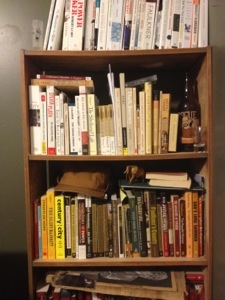 In 2012, I discovered that reading is more enjoyable as a hobby than as a job (big surprise). As a student for 16 years, I learned to resent the books that were assigned to me for book reports, essays and those dreaded Accelerated Reader (AR) tests. I watched as my hobby became points on a chart, grades and boxes to check. Most books I read during high school and college were left unfinished or skimmed at the last minute to meet deadlines and find quotes. Of the photo to the left, I probably finished a few.
Since finishing books wasn’t much of a priority, I did a little happy dance for each of the first three books I finished last year: another milestone. The authors of these books have since inspired me to read more authors in new fields. Following their suggestions has made for a delightful rabbit hole full of entertaining stories and thoughtful prose. These books have also reminded me that my childhood was full of days spent lost in the joy of books. I am thankful, once again, to be a reader.
This is the list of books I read in 2012. It’s nothing spectacular, but it’s a first for me and hopefully a sign of good things to come. Enjoy:
I still have a hard time spelling the word, Isaiah. Every time I write it, I have to sound it out and double-check. After spending almost a year reading this book of Old Testament prophecy, that just about sums up my knowledge of the book as well. While I didn’t always know the context of the prophecy, I appreciated the content of each chapter and verse. Often, Isaiah caught me off guard with romanticized highs and lows. What was once beautiful is destroyed, the place we loved has been defiled, and great skill has been corrupted by great delusion. I could say more, but it’s probably best to read it yourself. Along the way, this book inspired me to write two blog posts: “Delusions” and “Haunted Houses.”
The Spirit of the Disciplines, Dallas Willard
I’m almost ashamed to admit that I read this book last year. It’s not that I’m ashamed of the book, it’s more that I’m ashamed at my lifestyle. While I read and appreciated this book (strong recommendation), I’m just barely beginning to apply the spiritual disciplines to my life. As Willard writes, “If we refuse to practice, it is not God’s grace that fails when a crisis comes, but our own nature. When crisis comes, we ask God to help us, but He cannot if we have not made our nature our ally.” This book inspired me to write a blog post about silence: “Our Haunted Selves.”
Integrity: The Courage to Meet the Demands of Reality, Dr. Henry Cloud
My grandfather, Orville Rogers, gave me this book when I graduated from college. When I started it in May of 2011, I realized it was nothing like the books that I had read all my life. It was not “heady” or theoretical, it was practical and wise. While it took me a year and three months to finish, it sparked something in myself I never (ever) expected: an interest in business management books. Also, reading this book gave me more of an appreciation for Dr. Henry Cloud and I highly recommend his work. While reading this book, I wrote a blog post on decisions, “Gamble and Risk.”
Fierce Conversations: Achieving Success at Work and in Life One Conversation at a Time, Susan Scott
This book is out of control. When I finished my yearlong internship at Church Hill Activities and Tutoring (CHAT), I mentioned to one of the board members that I wished I’d had more difficult conversations. “Oh,” he said picking up a book beside him, “you might be interested in this book my daughter’s team at Capitol One has been reading.” A year ago, I would have said forget it, but Cloud had already softened me on business books and two weeks later Susan Scott changed my life. This book is a hard-hitting, unpredictable look into your relationships and the conversations you have each day. If you’re avoiding it, Susan Scott will be sure to let you know and tell you how to have the conversation in a productive way.
The Social Animal: The Hidden Sources of Love, Character, and Achievement, David Brooks
This book says so much about who we are and how we develop from toddlers to adults. In typical David Brooks fashion, this book highlights the incredible connections that scientists are making between the brain and human behavior without being boring. Brooks trades science jargon with fiction and tells the story of cognitive science through the story of one couple from infancy to death. That’s not a spoiler, it’s all about the journey.
Necessary Endings: The Employees, Businesses, and Relationships That All of Us Have to Give Up in Order to Move Forward, Dr. Henry Cloud
Not every ending is necessary, but determining when something needs to end is a hard process for all of us. This book taught me that if we don’t end things in life well (from jobs to friendships) we can’t move on in a healthy way. Cloud calls this process “metabolizing” endings and I think it’s the best description I’ve ever read.
The Defining Decade: Why Your Twenties Matter–And How to Make the Most of Them Now, Dr. Meg Jay
Forget everything you’ve read in the tabloids: the twenties are an important decade of life. That’s pretty much the message of Meg Jay’s new book that’s been taking over my social networks since it was published. For me, it all started when my brother Steven sent Will and I a link to an interview with the author titled, “Thirty Is Not The New Twenty: Why Your Twenties Matter.” Since then, Eunice read it, Will read it, I read it, Nina read it, Stacy and Stephen read it, Elizabeth read it … it’s out of control. Read the book — It’s not always necessarily right, but it’s good and helpful.
The Five Love Languages Men’s Edition: The Secret to Love that Lasts, Gary Chapman
I am selfish. That’s pretty much the biggest takeaway from reading Gary Chapman’s often referenced (and suggested) book about the ways we give and receive love. One thing that was fun about reading this book is that tons of people talk about the 5 love languages, but most people I know haven’t actually read it. It’s practical, thoughtful, and entertaining. Especially talking to all the fellas right now, you will not regret reading this book.
BUMBLE-ARDY, Maurice Sendak
From the author of Where the Wild Things Are comes a book about a pig who wants to party and a domineering aunt that doesn’t see the point. Bumble-Ardy follows in line with other works from Sendak as creative and childish with a depth of human understanding. As in the case of Wild Things, when you read about Bumble-Ardy you simultaneously become the child and the adult: reckless and responsible. I love this book for it’s cadence and rhyme scheme and a reminder not to let control prevent me from enjoying a party. In an interview with an aging Sendak, Terry Gross noted a section in particular where Bumble-Ardy is punished for his party and makes a profound commitment to get back in line:
“Okay smarty you’ve had your party! But never again!”
Bumble-Ardy replies, I promise! I swear! I won’t ever turn ten!”
Here’s to another year.
P.S. I’ve been collecting books in my Amazon Wish List (a service I highly recommend) that I may or may not ever read.
 One of the more surprising aspects of my research into Richmond newspapers was the sort of stuff I found in the Afro-American (Now the Richmond Free Press). My primary research interest, the story of a highway being build through Black neighborhoods, was hardly covered. In addition, I didn’t find the “Black is beautiful” perspective of Marcus Garvey and his contemporaries. Instead, I was devastated to find ads such as this one to the right promising lighter, softer skin. I share it because, like me, you may not have known that this ad existed in 1950s Richmond. I share it so that we all can have a tiny connection to the past.



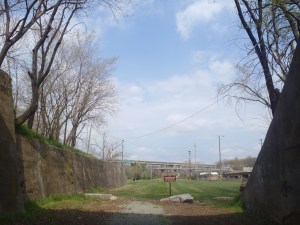 I recently visited the Negro Burial Ground just east of downtown Richmond in Shockoe Valley. My approach to this site was across a VCU parking lot and through a tunnel under Broad St. As you walk through the tunnel, you emerge onto a huge empty field of beautiful grass that was once yet another parking lot in downtown Richmond. In recent years, the asphalt was removed and this area was designated “A Place of Contemplation and Reflection.” I appreciate this area mostly because it’s a complicated place. There aren’t physical buildings that most people would consider “historic,” but what happened on this one piece of ground (the public execution and careless burial of enslaved and free people) is considered enough to make the place significant today. Once a place of fear and violence, it has been restored to the people of Richmond as a place of silence and careful thought.
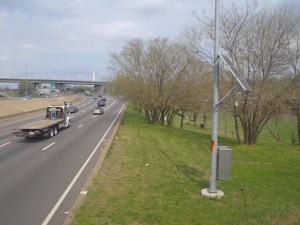 While I think the site itself is certainly worth visiting, what I really care about is a place located just above the actual burial grounds. From this vantage, you can see that less than 50 yards away from this place of contemplation is Interstate 95 in all of its glory. The cars and tractor trailers fly by on this crazy asphalt slingshot that shoots cars straight through the heart of my city. Like all highways, it’s a totally anonymous no man’s land where you don’t walk, you don’t slow down, and you don’t typically notice the historic burial grounds nearby. When you’re on a highway like this, you don’t care much for where you are because you’re more focussed on where you’re going. That’s essentially the nature of movement.
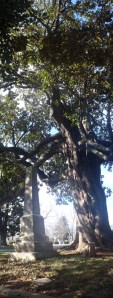 There is something so basic and yet remarkable about the time and care that was taken in the planning and development of Hollywood Cemetery. It’s no wonder Richmond’s aristocracy used to picnic on the hills of Hollywood overlooking the James River. They escaped the smoke of the city, tidied up their family plot, and caught a cool breeze on warm summer days. Since the cemetery was first planned, it has been maintained, improved, and today remains a destination in this old American city. A brick walkway was added to create “President’s Circle” where two former US presidents are buried. The cemetery stands, in part, as a testament to the longevity of power and tradition in American society.
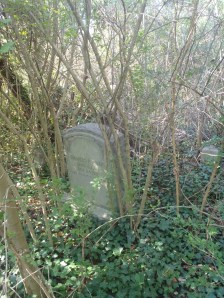 Another remarkable cemetery in Richmond, one that is not highlighted in Thadani’s epic, is Evergreen Cemetery. I visited Evergreen four days before I visited Hollywood and, as anyone would tell you, the difference is stark. Where one has improved, the other has declined. Where one is prominently placed on the hills overlooking the James, the other is beside a highway in Church Hill. Where one is a testament to power, the Other is a testament to the longevity of systemic stigmatization and shame.