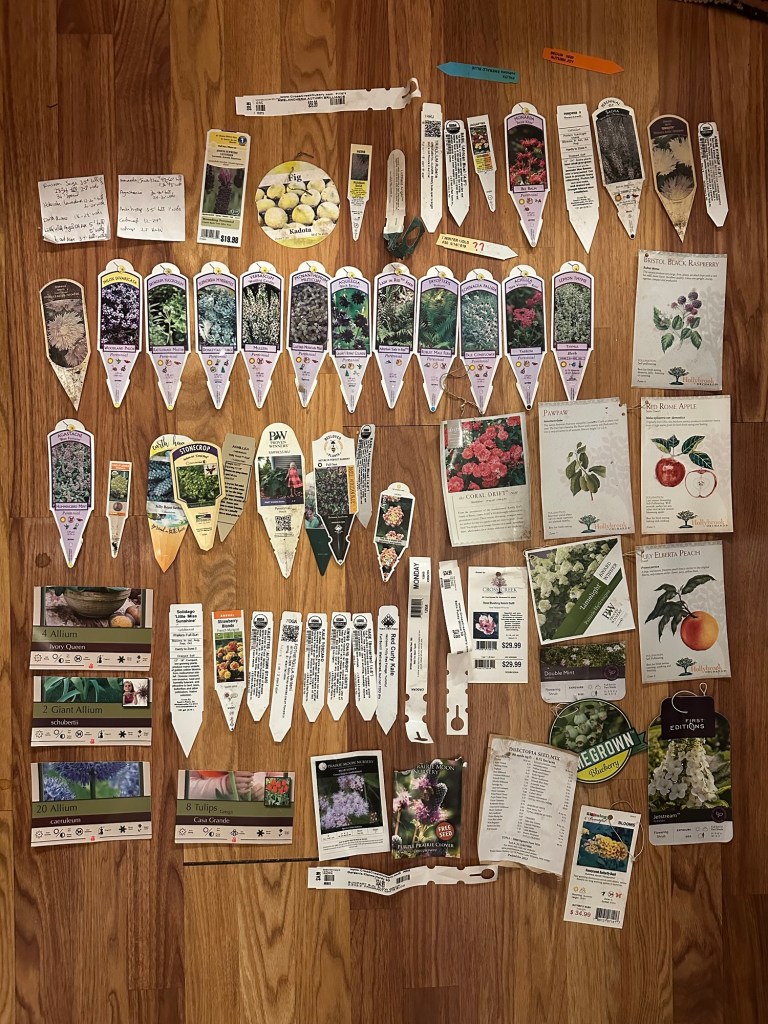
I was getting ready for a party recently when I decided it would be a good idea to clean out a random cabinet in the kitchen. I found these old plant tags from the early years of gardening our current house and couldn’t throw them away without snapping a picture. Some of these plants are still thriving, some have spread themselves around the garden, and many have died.
The COVID years of my gardening hobby feel a bit manic to me at the moment. I remember going to plant nurseries when we first moved in like I NEEDED to fill a garden while I was still overwhelmed with the idea of mowing the yard. It is also sweet to remember purchasing and planting each of these. It’s all part of the process – planting, growing, harvest, renewal. I’m still in the phase of winter (and parenthood) where the thought of plants and gardens is exhausting to me, but this little memory moment is giving me a glimmer of hope for bluer skies, buzzing bees, and the delightful surprises of a garden brought back to life.
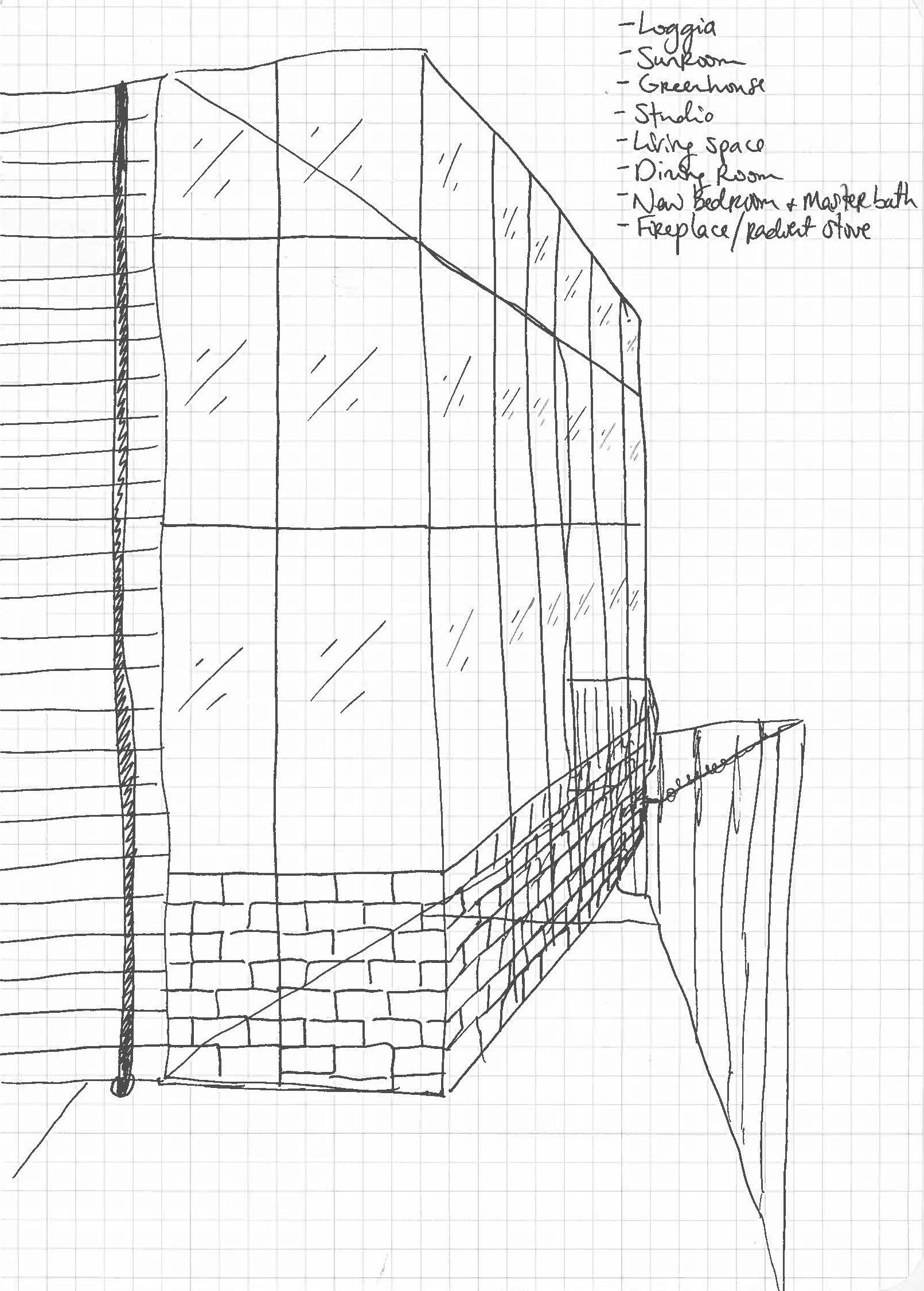
I was going through some old planners this morning (trying to clear out as much clutter as possible these days) and I found this drawing for a house we used to live in. The house is pretty small so I wanted to add on a space the length of the back of the building to serve as a flex lounge/dining area with a wood stove.
The house has an unloved gravel area in the back that would definitely not be missed. The design would have been terrible for insulation with all that glass (on a north-facing side no less), but I still like the drawing and thought it would be fun to save and share.
Over the past little while I have been processing the loss of a very significant relationship. When I look online for guidance, a lot of people say that exercise is the best way through. Exercise helps people regain confidence and independence as they grieve. The end result is their “revenge body.”
The revenge body says two things at the same time: Look at how well I’m doing/what you’re missing out on and also look at how much I miss you. It’s a positive outlet for the emotions and also a confirmation that those feelings are being felt.
I’ve never been a gym rat (except for one year in high school), and I already feel pretty good about my body thanks to being vegan and active. So instead of working out, I realized pretty quickly that writing was going to be my outlet. It always has been, but I’ve noticed myself leaning into it much more regularly, almost constantly, these days.
At some point I started to think of it as my revenge body of work.
Writing basically serves the same purpose as exercise to me. I enjoy it, it’s a distraction from life, it gives me space to process, and I can take a step back and look at all that I’ve written with a sense of pride. It’s also a reminder of that person: the way they encouraged, read, and even reviewed specific posts in advance. The reminders are everywhere.
I have more time on my own these days, more brain space, and to some extent more clarity, all of which have been fueling my creative habit. I’ve wanted to write more regularly since I started this blog, but at some point early in my career I decided it was trivial. Then, I felt like I didn’t have anything I really wanted to share.
Coming out of the closet has given me so MUCH to say (110 drafts and counting) and it’s time to start getting more of it out there. And just like with revenge bodies, I’ve started to let go of the idea that it needs to be perfect. The value is in the action, the regularity, and the simultaneous memory and movement of letting go.
For the last week or so I’ve been thinking about the Celtic holiday of Samhain. I don’t know much about the Celtic holidays, but I read a book once about a home called Bealtine Cottage and at the very least the idea of Bealtine planted a seed in my mind.
After some deep dives, I’ve learned that Samhain is essentially the “pagan” holiday that Catholics co-opted when they created All Hallows Eve (and All Souls, etc.). In a further twist of colonialism, it is also basically the origin of Dia de los Muertos – a holiday some see as a Catholic invention/amalgamation of existing rituals and beliefs.
Anyways, a witch on Instagram made a video saying that tonight is actually the best time to set resolutions and to plan for the work ahead. This night marks the end of the Celtic year and the beginning of the “dark half” of the year. This is a time when we are inside more, when gardens and farms have begun to rest. We often use this time to focus inward and draw close to friends, family, and partners.
With all this energy in the air, I decided it was time to take some small steps of preparation. With the help of our kids, we cleaned out several bags of toys and started to organize their play area. That felt like a nice small win. I am thinking about the fact that I’ll be inside more soon and feeling a desire to organize and repair more in general – there are so many projects that weigh me down more than I even realize.
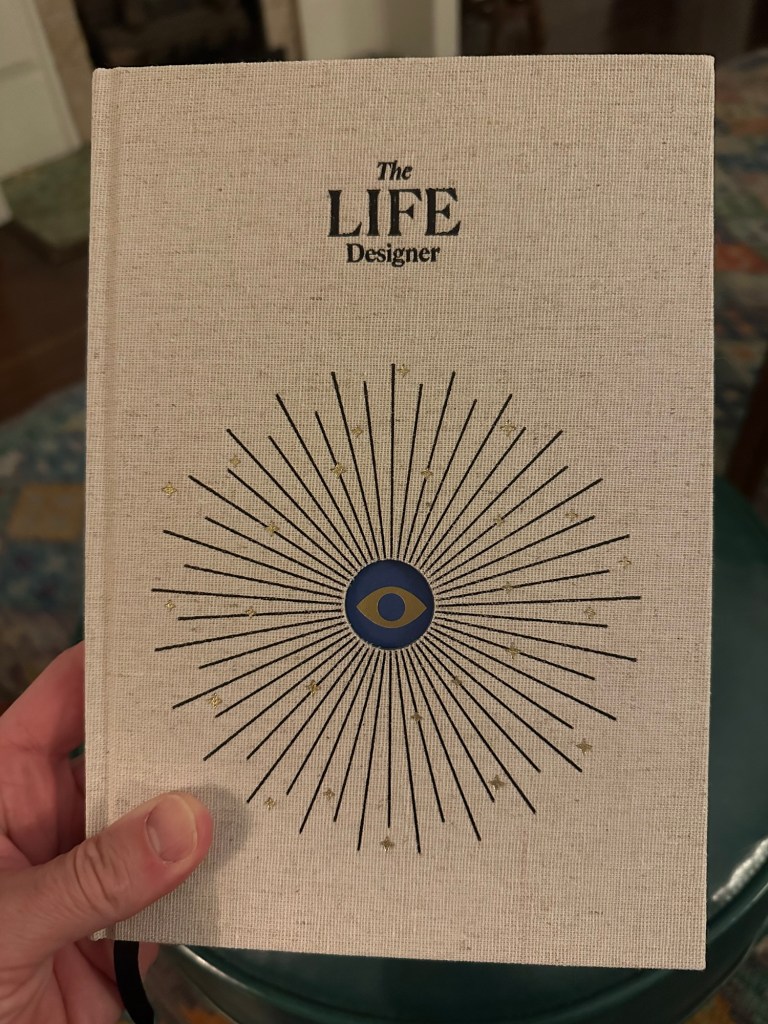
I also decided to start the new Life Designer workbook from Intelligent Change. I bought it before the Samhain connection, but soon realized that it would be perfect for this (new) new year.
At it’s core, it’s a workbook to plan the next ten years of my life. On October 31, 2035, I’ll be 47 years old. I actually started crying just typing that sentence.
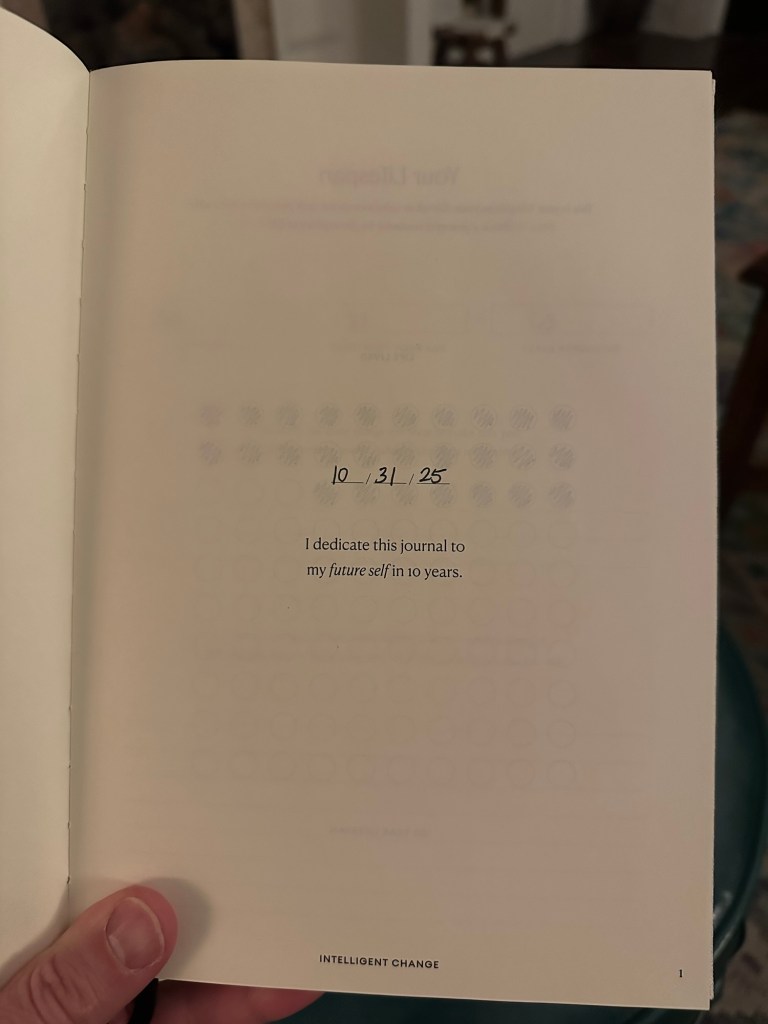
Oh, I also cried when I filled in this dedication page:
I really do not want to get older – I don’t know how else to say it. On the other hand, there have been so many days in my adult life that I’ve just wanted to be over so that I can sleep again.
I know that I have to fix my days before I can fix my years. And since I can’t avoid age, I can’t avoid work, I can’t avoid relationships, hopes, disappointments, responsibilities, etc., I know that it’s time to start thinking about what I want to build on the years I’ve lived so far. Because “the next ten years” are already here.
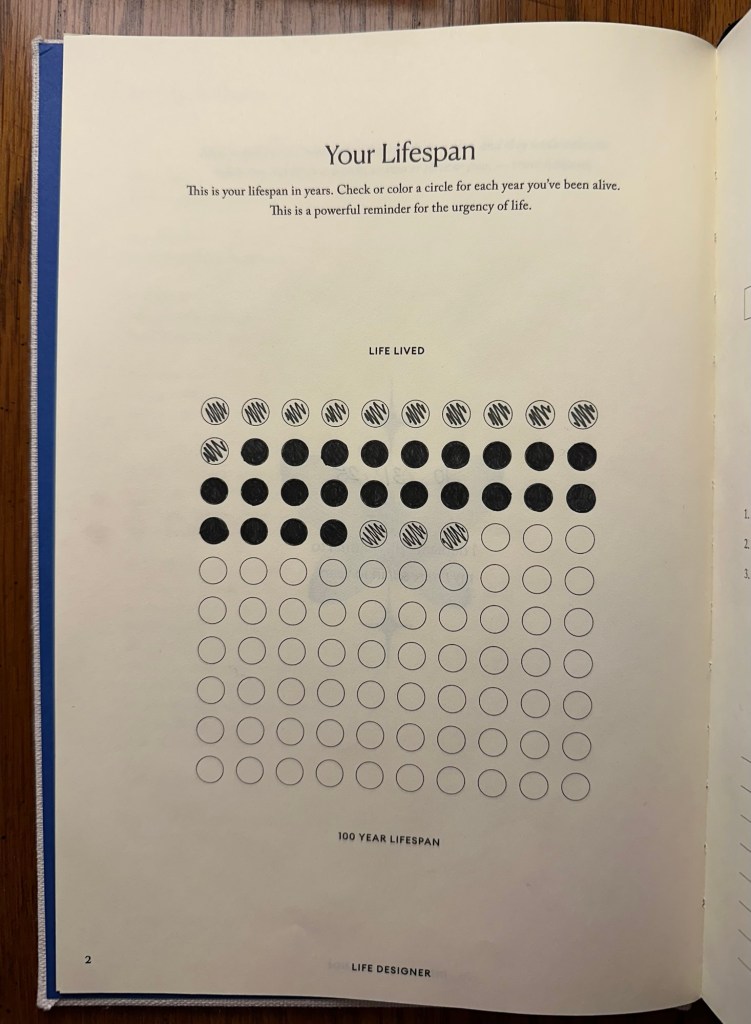
With my fear of getting older, it was encouraging to fill out this chart of the years that I’ve lived so far and see how many I presumably have left.
Even if I live to be 70 or 80 I still have a lot of life ahead of me. The first time I posted this page I did it wrong so this is a new photo. Also, I decided to black out the years that I was in the closet. I cried for a moment when it sunk in that I’ve only lived around 15 years of life not in the closet. Hiding took such a toll on me that I need to label those years differently. Also, being in the closet delays adolescence (like what a 15 year-old would be experiencing) so the past three years have looked very different than they would for someone who is not going through that.
I’ve only just started this workbook, and, based on the witch’s advice, I would like to finish it between now and the Winter Solstice. (update – I’m still working through it as of 1/20/26, but I’ll finish it when the time is right)
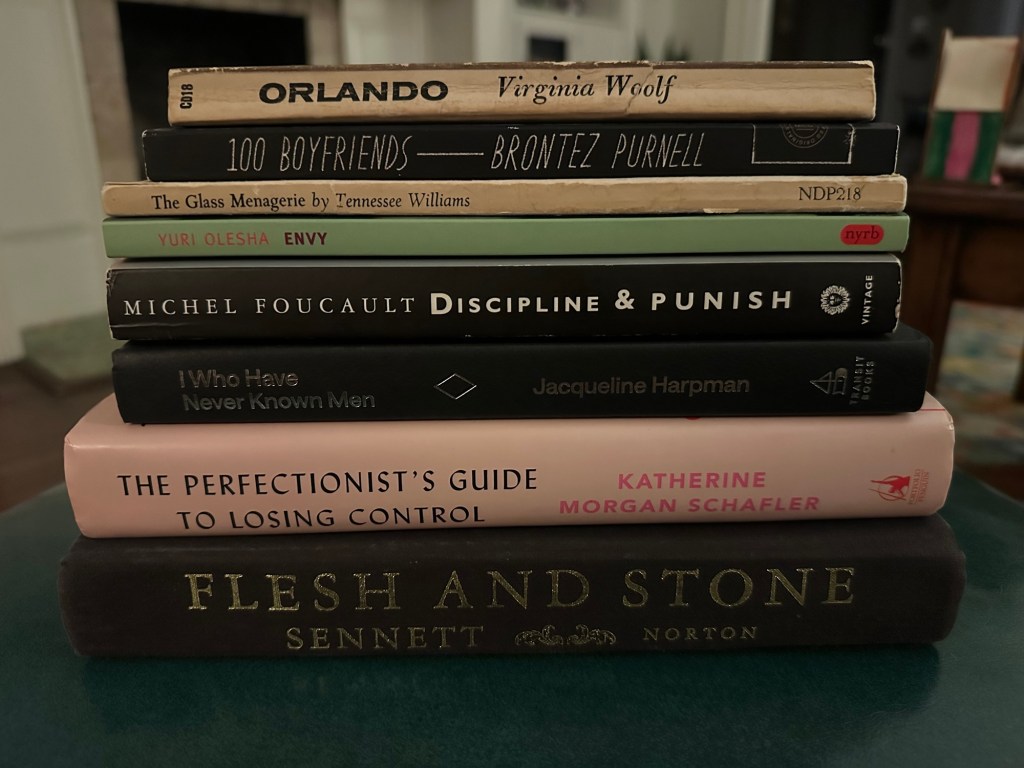
With the seasonal shift toward intentions, I also thought about books I might like to read over the next 12 months. I’ve pulled together a stack that I’m pretty excited about and replaced the one under my side table that has been sitting there for months (years?), mostly unappreciated. This new stack was chosen more carefully and I’d love to actually see the stack tick down as I read each one and the shelf empty by the next Samhain, 2026.
I started the Foucault and Sennett books around 2008 and 2011, respectively. I’ve only read the first chapter or so of each, but they have both been so influential to how I think about things that I’ve decided I’d like to finally finish them. Along with those two books, Orlando,100 Boyfriends, and The Glass Menagerie continue to round out my gay literature cannon. I Who Have Never Known Men and Envy (a personal problem, unfortunately) are two foreign language books I’m looking forward to. Finally, The Perfectionist’s Guide to Losing Control, a book I started during a hard time last year and have decided to pick back up during a new season of loss.
So much of this post may seem like I am trying to control my life, but I really do want to lose control more than anything. I want to let go of legalism, perfectionism, and self-criticism, especially. I am not going to feel like a failure if I don’t read all these books or achieve the life I envision exactly. I just know that there are some things in my life that almost never feel like work (even when they are work). I desire/intend to do much more of the work, to spend time with the people, and to inhabit the places that give me that kind of energy over the next 40 seasons of change.
The other day I walked by this little island of English Ivy in the James River Parks System and dreamed about filling it with native plants.
Considering the size of the JRPS and the extent of the invasive species domain, these little slivers are exciting to me as a manageable place to start restoring the native undergrowth. I could easily dig up and replace this ivy in a weekend. It also feels strategic to start with these small protected areas deep in the forest – each established native plant will begin producing seeds and spores that will start to spread by the thousands.
These seeds and spores will build up in the forest seed bank so that any time the soil is disturbed (including when native plants are removed) the seeds will already be in the soil, ready for the chance to take over. It’s ultimately much cheaper than purchasing the seeds themselves and the sooner we get those plants in the ground the sooner they start to do that work.
I’ve already written some thoughts on this idea of rewilding the JRPS so I do have a grand vision for the area, but in general I am a piecemeal gardener. I usually prefer to work slowly, one section at at time, and whenever I see these little moments I can’t help but connect the dots and see the vision coming to life.
A little over three years ago, in the early days of fall, I noticed myself looking forward to the first frost. It had been a season of upheaval in my life and I was tired. Everything in the garden felt like too much: the tomato plants were enormous, mosquitoes continued to test my sanity, and even trees seemed tired from the growth.
I was excited for the cold-weather months. It can be a relief when everything outside looks like death and the work (for a time) is done. I looked forward to hikes and runs when you can see straight through the faded underbrush. What I did not know at that time, when the sunlight cuts across the landscape and flies and dust dance in the cool, dry air of harvest, is that in a couple of months I would lose one of my closest friends forever.
Unable to control the weather, I started to cut back in my own ways. I aggressively unsubscribed myself from email lists. My inbox had become overrun just like everything else. I also decided to stop drinking coffee. I noticed it was making me more anxious than focused, my mind a glutton for information, too busy with ideas and making connections to focus on tasks at work. With less caffeine I found myself breathing more deeply, crying more easily.
As time wound into winter, the landscape began to feel more manageable and muted. There were few weeds to pull, nothing to prune or harvest. During winter we find comfort knowing that nature is just resting, that everything is gone for a time, that there will be flowers and fruit again.
On the night of Christmas Eve, just past the darkest night of the year, I got a text from a friend asking me to call. I immediately felt that someone had died. When I finally reached her, she told me something unimaginable. After I got off the phone, I called another of my closest friends and shared what I couldn’t even fully believe myself.
Then all of the sudden, in my grief and loss, I wanted every bit of the chaos to come back. I wanted to get caught up in the weeds, the insects, the relentless advance of kudzu. The land, now bare and clear, felt more acute, more permanent, more extreme, life cleared out and put away. I wanted the change of seasons that felt familiar, the loss that turns back into life.
At the same time, I was grateful that I had been listening to my sadness over the previous months. I felt like my emotions were very accessible to me in the early days of grief and acceptance. Many times I wondered if leaving religion had also prepared me to grieve.
Sometimes I feel like religions treat death like it’s perennial or cyclical rather than permanent. They believe (and maybe I still believe on some level) that the person has been reborn instead of accepting that they are gone forever. This is just my personal experience, but it has always felt too soon, like a silver lining, to say that someone is in a better place before someone else has let them go.
I want to tie this up with some kind of “and yet” sentence where I channel my inner Margaret Renkl and talk about being grateful for the things that are going well, but it feels more appropriate to just accept and metabolize the loss.
Nature is full of metaphors of rebirth and renewal, but sometimes things do just die. Sometimes species go extinct. Climate change is looking very one-directional these days. So when spring came, and warmer temperatures brought ephemerals, buds, and other signs of life, he was still gone.
Summer followed and my friend was not here to enjoy the cool river on a hot, humid day, or whatever beach trip he had been planning with his family. Fall came around before too long and he wasn’t trick-or-treating or getting cozy on a couch. Then winter again and we all relived in our own way the experience of losing him that cold night. That is cyclical, I suppose. I am always grateful for the chance to remember him, see mutual friends, and let him go all over again.
Over the past couple of months I’ve rediscovered the loop walk around Belle Isle. I’ve been spending time in more secluded areas of the river lately and had forgotten how beautiful it is with sweeping views, changing topography, and people everywhere enjoying the water and trails.
One morning in September, I also noticed something else: I hadn’t seen a single bumblebee on the entire walk. I started to look more closely and in two months I’ve only seen bumblebees two times, a total of four, all on bluestem goldenrod. Otherwise, the forests and fields of the island seem sort of oddly quiet.
Not only have I not seen many bumblebees, but I also haven’t other bees, wasps, butterflies, bugs, or birds like goldfinches, hummingbirds, and cardinals.
I think the reason I’m noticing this absence now is that I’ve been gardening for a decade or so and I love to see plants as a part of the whole ecosystem. Over the past six years especially my current garden has come alive in a way that gives me a lot of joy. I see more bumblebees on a single anise hyssop at the same time than I have on Belle Isle recently. For the past week, panicled aster (Symphyotrichum lanceolatum) has been in full bloom around my house and there are more bees and bumblebees than I could ever count. I see goldfinches eating coneflower seeds, hummingbirds on the cardinal flower, and monarchs on the milkweed.
And my garden is definitely not the only one. Richmond is full of gardeners who are planting native or “nearly native” plants and attracting all kinds of birds and the bees. Which got me thinking: What if we could somehow organize everyone to invest their energy into the JRPS?
I’ve been toying with this idea for a little while now and I see it working something like this:
Starting with Belle Isle, a list of 30 or so first-round parcels are identified. These should be small, edges, islands, and otherwise manageable, well-defined parcels. These kinds of spaces would be really easy to manage and would have a lot of nice visibility:
These plots are designated as full sun, part sun, part shade, and full shade with a list of plants that are approved to be planted in the area. They could also be designated for tall, medium, and short-growing plants depending on the location.
A call is put out into the community for interested gardeners to join the program
Selected participants are placed in an orientation and trained on the process of invasive species removal, which plants that are pre-approved for planting, and the general overview of the program
Approved gardeners then “claim” plots on the map and the first thing they would do is string a simple string and stick barrier around their plot with a sign that explains the program and the project – they would take a photo of this and post it to a google doc or app as a record of their project for someone to verify compliance and serve as a “before” photo for the plot
The gardeners would work at their own pace to fully remove the invasives and replace them with the native plants appropriate for the amount of sunlight and location of that plot. A photo would be uploaded for every day of work on the plot and for all subsequent maintenance visits.
Gardeners would be expected to maintain their plot for as long as they are in the program including weeding invasives and tending to the plot for other needs.
If they have capacity (looking at you, retired gardeners!), they could select multiple plots depending on availability
Gardeners would also be asked to provide seeds and seedlings to a community crowdsourced greenhouse. Gardeners who don’t have time to garden their own plot could opt to only participate in this donation program for their seeds and volunteer seedlings to be used by other gardeners around the project site
Once the initial phase is complete, a detailed GIS map of the landscape is drawn to divide the entire island into small, garden-sized parcels, maybe 400 sqft each
The plots would then be organized in order of priority
Areas around all entrances/exits to the island
Areas along high-traffic pathways
Areas along low-traffic pathways
Areas in the interior of the woods and fields of the island
These plots would be assigned to more trained volunteers as the program continued to grow. If possible, a landscape team could be hired to plan the overall layout of the island and select a smaller number of plants for each location to provide a little more guidance on the final product
I know this is a little far-fetched and that there are already organizations doing a lot of this work. But this does feel on some level possible. The local knowledge, technology, and tools are all available.
I also think the sooner we start the better. Plants are basically seed factories. Once we start to establish a wider diversity of plants they will start to continue the work for us in spreading throughout the area.
In a very non-scientific search, there are 129 plants listed as native to Virginia on the Prairie Moon Nursery website which seems like a good place to start. With some professional consultation, we could finalize a list of plants, divide them up by their planting guides, and start some test gardens around the island. With so many deer living in the JRPS, it will be important to prioritize aromatic, deer-resistant plants like Purple giant hyssop (Agastache scrophulariifolia) and Yellow giant hyssop (Agastache nepetoides). These will have a better chance of becoming established over time. I have gardened with Anise hyssop (Agastache foeniculum) for years and love the way that it spreads, attracts bumblebees, and blooms successively throughout the summer, but it doesn’t appear to be native to this region. Another deer-resistant perennial that I would like to see is Rattlesnake master (Eryngium yuccifolium). It is very hardy, spreads generously, and attracts wasps, bees, beetles, and other small flying insects.
The middle of the island contains an open prairie that could be restored in the same way as the forests and trails. It seems to have full and partial sun exposure which would create an opportunity for many sun-loving perennials and grasses. More deep-rooted grasses would also provide an amazing opportunity for carbon sequestration. It seems like switchgrass and big bluestem are valuable in this way, but I’m sure there is an argument for most native grasses.
If there is a concern with the JRPS looking too manicured, I would support limiting the list of plants and also planning large colonies of a single flowering plant along with native ferns and grasses rather than a high diversity of plants in a single plot. It could look more natural for the species to be grouped like they have spread over time.
I think this project would work well on a stand-alone website with a front end that promoted the program and receives donations and a member login portal where members can manage their plots, post photos, and record donations.
The program could be funded in part through sales of excess seeds and plants grown in the shared greenhouse. It might even be possible to apply for carbon credits if the restoration were successful and extensive to warrant that. Of course, there are also grants and billionaires.
Once the program is functional, it could be expanded to include the entire JRPS. I can imagine there are many gardeners who would prefer to work in their neighborhood parks for convenience and sense of personal ownership. Every year there could be an outdoor awards ceremony on the island, etc. To scale this, we could sell licenses to other municipalities who could buy into the program and use the training materials, website design, etc. to manage their own crowdsourced rewilding programs. Training materials would be adapted to the native plants of that area, but otherwise could be fairly interchangeable.
I’ve really enjoyed imagining a Belle Isle that is buzzing with life, an oasis in the middle of a manicured/ruined landscape, and a pocket of life to inspire more and more people to garden with nature in mind. I don’t know exactly how, but I do believe it should happen. There is no way any of us would regret it.
From an early age, I considered sexuality to be primarily a spiritual issue. The Bible and the church were the only sources I could consult on the issue of sex and sexuality. I accepted it as an implicit truth that it was a sin to be anything other than straight (even for a moment), but beyond just a sin, it was a shame. A shame on yourself, your family, and all kinds of things could go wrong if the secret were to be revealed.
As I have come out of the closet, I have allowed aspects of myself to finally relax in ways that I wasn’t ever able to do. I have allowed myself to embrace my gay cultural interests. I have allowed myself to embrace my gay social, relational, and style interests. But for a long time I was still repressed in my intellectual life. Even as I started to read and watch and embrace gay culture, my brain wasn’t thinking critically about any of it in the way that I have loved to think about so many other things. Over time I have realized that I trained my brain to immediately set aside any thought that might have been deemed too gay to share. These thoughts were set aside long before they could form a sentence or an essay or even just come up in conversation. With some conscious effort I’ve started to catch myself just before setting an idea aside. With encouragement, I’ve started to write these ideas down as blog post drafts. I’ve started to accept that I have tons of opinions on gay culture, history, humor, and theory and these have always informed how I see the world even before I was aware of it.
Becoming aware of my own thoughts has been a process of liberation. When I lived in fear I was trained to contain myself within the boundaries of a homophobic culture and religion. Being liberated from that culture and religion meant truly believing that they had no control over my life, present or eternal. Once liberated, my mind still needed acceptance and exposure to gradually become confident enough to start to share. Friends, family, and significant others have been a safe haven for me to share as well as a source of inspiration, new directions, healthy disagreement, and perspectives.
Early on in my coming out journey, a friend (we love our straight allies) shared with me a beautiful speech by Stephen Fry on the significance of Oscar Wilde. I was so incredibly moved by aspects of the story of Oscar Wilde that I had never heard before. I was also moved by the confidence of this gay man who was able to inform his interests with his personal experience while still maintaining a level of intellectual rigor. I had been extremely aware of Wilde as a teenager, I knew he was gay or at least rumored to be gay, and I noticed whenever I saw his name or a picture of him. Despite my obvious interest, I consciously avoided Picture of Dorian Gray my senior year and even avoided talking to classmates that read it. Instead, I chose to read (most of ) the more socially acceptable Crime and Punishment. I was somewhat interested in Dostoyevsky and the book was interesting, but I really didn’t enjoy reading it and I wasn’t really excited to research the life of the author and the cultural themes of guilt, mental illness, etc. I was actively suppressing my desires – I didn’t even know what it felt like to do otherwise.
More recently, I finally did read Wilde’s famous novel and loved every page. Looking back I wonder if I would have been thrilled as an adolescent to find a book that was so personally engaging and to read about an individual with a story and a sexuality that I could relate to. If at that young age I had read Wilde instead, would that have changed what I studied in college and grad school? Would it have affected the direction of my career and other life choices? It’s cathartic to reimagine the past in a way that was more free, accepting, and intrinsically motivated. A past where I trusted myself, listened to my heart, and shared what was on my mind. I’m not regretting the choices I made, I’m wondering how I can change the way I make choices today and going forward. Along the way I have been grateful to receive book and movie recommendations that have given me so much joy, catharsis and perspective.
I’m early in this journey of allowing myself to be gay intellectually and at times it’s been a little embarrassing to feel so behind. I know I’m not quite ready to be a critic because I’ve loved nearly everything I’ve read and basically every gay story makes me cry. Even the acknowledgements section of some books has made me cry as I have considered the partners and community that support an author in their work. I have more emotions to release than I could have ever imagined. At the same time, while my heart is being nourished, my mind is being coaxed into the light, invited to make connections and observations, compare books and movies, consider timelines, politics, cultures, and geographies. With the desires and emotions of my heart, I also care personally about these issues and feel strongly about them in a way that I think will make the intellectual work come naturally – I don’t have to convince myself to be interested.
Over the past few years my brain has finally started to naturally make connections . I have wondered about the political usefulness of homophobia for blackmail, the lasting cultural affects of France and Italy being some of the earlier European countries to decriminalize gay sex, the connection between replacement theory and the religious demands of procreation. In general, these have been passing thoughts, but eventually I think they may start to become something I would write about and share. Before coming out, I didn’t even have a base of knowledge to draw from, a sense of what has already been explored, and references to help me understand. Now that I’m out and exploring I’m excited to write, and speak, and live more from the heart as well as from my mind. My primary goal right now is to enjoy myself and the journey. I have a lot of energy, previously spent on repression, that I am more than happy to put to a better use.
There is a scene in Yes, Daddy that I think about every once in a while. Jonah, the main character, is on the beach with a man who is holding him captive in his house compound nearby. While they walk, Jonah sees an old friend from work. The friend is with another guy who Jonah learns is his boyfriend. In that moment, Jonah is trapped in his life psychologically, physically, and financially, in contrast to his friend who is free, authentic, and enjoying what appears to be a mature, healthy, romantic relationship. They are on the same beach, but they are not the same. Jonah was trained to be controlled, through religion, he was trained to give up agency, he was trained to look for a savior. He had chosen to leave the city and ignore this friend – he had actively sought out the man that had taken his freedom away. Throughout the book, you realize that Jonah doesn’t get to do the normal “boyfriend thing,” he doesn’t get to just enjoy his life. Those things are a fantasy. They are like a movie he is watching. It is impossible to climb into the screen and join them. He can’t even be sure that he would be happy and satisfied there if he could.
I remember almost every interaction I ever had with a gay person (or someone I perceived to be gay) while I was in the closet. In high school I remember a student that I didn’t know looking at me in a way while I showered (in my bathing suit) after swim practice one night. I remember the younger brother of a classmate talking to me in the hallway near the auditorium and poking his finger into my chest in a way that made me feel uncomfortable. I remember a phone call with a guy who had moved to Tyler after Hurricane Katrina – he said, “you’re mine and will always be mine,” or something like that – while I talked to him on my cell phone under the taxidermied cougar outside the school gym one evening during a basketball game.
I remember two guys that I shopped near at a J Crew over ten years ago. I remember a guy in an a Capella group in college slapping my butt while we played beer pong, the stranger that dropped his number on my table at a coffee shop a week before my wedding. I remember inhabiting gay spaces, a gay sports bar in DC, a gay bar in Charlottesville. I saw gay wedding announcements, watched YouTube videos of guys dancing so freely that I cried. All of these moments were very unsettling – I wouldn’t say they were traumatic, but for each of them I remember exactly where I was standing, details about my surroundings, the time of day, who else was there, etc. I was “faking it” for a lot of my life and these moments called me out on my bs.
In all of these interactions, what was so unsettling was that I felt like I was being truly seen. I was being pulled into reality – like they were actually kind of waking me up from my disassociation. As I came out of the closet, the closet followed me. The fear, the self-criticism, the willingness to give it all away, the lack of faith that happiness is something truly accessible to me. As I entered relationships, entered new spaces, even physically connected, I felt like there was always this layer of cellophane between me and that world. It had a shimmer. I was sometimes very stressed out on the inside and I had a hard time recognizing all the feelings I was feeling much less actually acknowledge them in the moment. Even as I was being warmly welcomed I felt like I didn’t really belong, not just in their life, but in their reality.
I can’t say exactly why I felt these ways. I’ve given myself permission to not always know (or try to know) why some things are the way they are. I am certainly working through personality and attachment issues that exacerbated these feelings for me vs. potentially other people coming out of the closet. These feelings affected my relationships in ways that I very much want to resolve – through work and also by just living more life. It was overwhelming in those early days to be face-to-face with a life that I had denied myself, that was denied to me, that to an extent I didn’t even know existed.
One unfortunate aspect of repression is that I sometimes forgot other people were struggling as much as I was. Early on, gay life seemed so desirable and gave me so much energy that I couldn’t even imagine why someone out of the closet would be unhappy. Repression inflated the sense of freedom I assumed they were experiencing. It also prevented me from realizing how hard they had worked to have the life they lived and how much energy it required to maintain it.
On the other hand, it’s also true that they were even more free and uninhibited than I realized. Grief has come to me in waves over the last few years as I have realized how much I gave up by staying in the closet: the places, events, organizations, friendships, and experiences I denied myself. In some ways it was easier when I was in the closet and didn’t know how much I was missing out on. Although staying in the closet kept me safe and did preserve a small measure of inner peace, but it was extremely fragile. As much as I tried to avoid queer culture to preserve that inner peace, it was impossible to really maintain that distance. I regularly caught glimpses of articles, Instagram accounts, or people that reminded me of what I was missing out on. Over time, these moments all added up to a deep and secret sadness I carried for so long I nearly forgot about it. The more I have opened up my life the more I have grieved everything that I missed. Early on, I cried all the time as I let go of deep layers of pain, loneliness, and sadness. The grief has been a relief and a release. It has felt healing and life-giving. Grief comes with any loss and the greater the loss the greater the grief.
Coming out of the closet for me has been a little different from traditional grief because it is grieving something I never had in the first place – something I didn’t even fully comprehend. Seeing gay life is reckoning with its existence, it’s beauty, it’s sadness, it’s joy. Even though it seemed inaccessible, it was always just around the corner, it was even in the same room, at times. I could have taken one step, could have reached out to touch it, could have changed course with just a few simple words. But I didn’t. I had been taught to be afraid, taught to perform. So, instead, I froze, I cried in secret, laughed in secret, listened to music in secret, constructed a world just for me where I tried to feel safe and happy. My life in the closet was “real,” but I was not fully participating in it so it’s also true that it wasn’t really “mine.” The straight world was also an experience that didn’t fully belong to me. It’s crazy how something can be both boring and stressful at the same time. Many friendships were born during those years that gave me life, many memories gave me joy, but much of it also gives me sadness and all of it feels like a bit of a dream.
As I have come out and taken steps to live honestly I’ve had the funny realization that my life is now a fantasy to someone else. I’ve been to gay events and destinations, I’ve read books, watched movies, made friends across the country, found and lost love, found pleasure and joy. Although they feel fleeting to me still, these moments are becoming less the exception, and more secure, more predictable, more comfortable. I have found a measure of freedom that is outside the grasp of many people. There are some who aren’t even free within themselves. Others may feel like they have invested so much time and energy into their closeted life they would be giving up too much to let it all go. They might break under the weight of their grief if they opened that door – at least for a time it might feel impossible. But holding on to that life requires constant attention and effort that seems to never provide anything in return. And many of the things that seem impossible actually become the most natural thing we have ever done.
When I finally started to come out of the closet, one of the ways that I processed my story was by reading through old journal entries.
So much has changed over the years and looking back has helped me connect with my younger self as well as understand why and how I managed to stay in the closet for so long. One particular aspect that feels important is that I had a long-term relationship with a “Christian counselor.”
The person I saw is a licensed therapist, but we always called what he did “Christian counseling.” And it did feel different from the therapy that I’ve experienced more recently. This post is not to drag an individual, but I am definitely critical of the idea of Christian counseling overall.
My main critique is simply that much of the “Christian” aspect is not based on research or best practices. For instance, here are some ways that Christian counseling is different from therapy in my experience:
My counselor prayed for me at the end of every session and asked that God would support me in my struggles. Prayer is seen as an encouragement, but in my experience it was often a way for me to give up control of my life to God. This prayer at the end of the session may have had the effect of undoing some of the progress I had made to become more self-determined.
They very frequently related my problems to “the fall” which basically means that my problems were a result of my “sin nature.” The emphasis on sin and “the fall” may have reinforced the feeling that my problems in life were intractable. In other words, I was not empowered to solve them.
My Christian counselor seemed a little too comfortable with my suffering. They did not really seem to think of it as something that needed to be fixed. Some things could be changed, but in general, Christianity and Christian counseling taught me that suffering was good for me, that it is God’s way of testing our character, and, bizarrely, that it means we are doing the right thing because God is teaching us something through the suffering.
I don’t remember them affirming my sexuality in a meaningful way, preferring to make general statements that were not untrue, but also not very helpful like, “It’s always going to be a part of you.”
One phrase they repeated many times was that “every man feels like they aren’t enough and every woman feels like they’re too much.” This was mentioned in individual therapy as well as in couples therapy. The idea apparently comes from God’s curse of Adam and Eve in Genesis which I might try to unpack in another post. For now, I’ll just say that I don’t typically find generalizations around gender to be helpful and that these kinds of religions aphorisms often end what could have otherwise been a productive inquiry.
When I first decided to start seeing a Christian counselor (with much encouragement), I was so scared to talk about my personal life that it certainly came as a relief to find someone I could trust. I needed a lot of help and in many ways found the support that I was looking for. It was even somewhat affirming to hear things like the idea that my sexual attraction would always be a part of me. I was raised to think of sexuality as something that could change so in this sense, I didn’t technically receive conversion therapy. I feel like what I received was more similar to the hypnosis in “Get Out.”
If you haven’t seen it, the general premise of the movie is that old, wealthy white people pay to have their brains transplanted into younger, Black bodies so that they can be active and young again. Before the transplant can happen, however, the victim had to be hypnotized so that their consciousness is sunken to a deep part of the brain stem. With the completion of the brain transplant, the consciousness of the older person has essentially replaced that of the younger person – they think, talk, operate the body, etc. But the hypnotized consciousness is never fully removed. It stays in the brain stem unless it’s triggered by a flashing light like that of a camera and the trapped person escapes back into their body (very dramatically) until they are hypnotized again into the subconscious.
In discussing drafts of this blog post with friends (both gay and straight) I received encouragement that the metaphor was helpful for understanding their experience in Christianity. Many aspects of our lives can be suppressed and there are triggers/moments when we wake up to realize we aren’t really the ones living them. One time in grad school a classmate told me that when he first met me he thought that I was gay. I was shocked and I completely froze in the middle of our conversation – I have no idea what I even said in response. Years later my therapist (not a Christian counselor) asked me if I thought I had disassociated. After some thought I told him that it was actually the opposite – I had been disassociated and his question has brought me back into myself. I was just too afraid of the world to say anything.
I have thought about the sunken place and identified with the idea of it for many years. One thing I want to add is that when I was in Christianity there was a part of me that wanted to stay in the sunken place – out of fear, self-preservation, rewards in heaven, etc. In that sense, the Christian counselor is sort of a co-conspirator in the sunken place. They know that the liberation queer Christians seek in counseling is constrained by the rules of their shared faith so they help their clients find significance and meaning within the sunken place rather than providing them with the tools they need to get out. I do believe that this is why I felt safe with a Christian counselor, but also why I eventually grew out of the limited support they were able to provide.
Even though my counselor and I agreed my sexuality would always be with me, the agreement was that it shouldn’t need to “dictate” my decisions or be a significant part of my life. In our conversations, my sexuality was more of a “thorn in the flesh” kind of situation where it would be something that God would use to teach and humble me. My counselor encouraged me to talk about it, but not in the sense of coming out. It could just “be there,” under the surface, suffering silently, for my entire life. The Christian, I was told, is divorced from their sexuality.
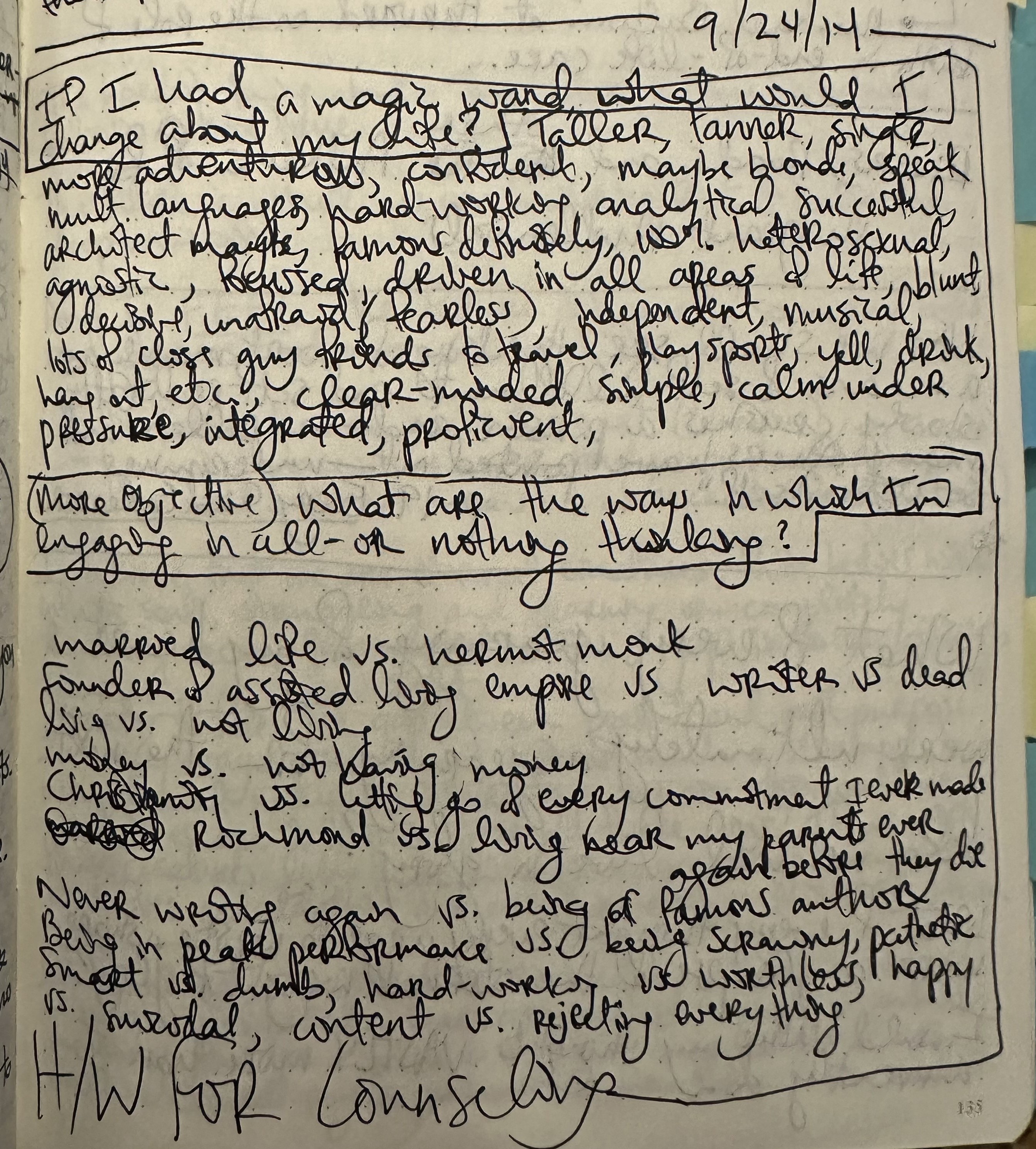
When I was 26 years old I wrote the reflection below as homework for counseling. (For a link to a transcript of this handwriting, click here.)
I was very clearly holding on to a lot of internalized homophobia, but I do not remember my Christian counselor seeing this as a problem or helping me to recognize and let go of it. “If I had a magic wand,” I wrote, I would have made myself “100% heterosexual.” I was struggling with body-image issues, self-criticism, and a general lack of confidence. I wrote that I wanted lots of close guy friends, but had to couch it in masculine terms like “play sports, yell, drink” rather than just say I wanted to be around men because I wanted to. I couldn’t say I wanted to dance with them, kiss them, laugh with them, go to the beach or Broadway, etc.
Looking back at this entry I am reminded that I talked and wrote about my own death a lot in those years. I felt trapped by my life. Rather than encourage me to come out of the closet and let go of my fears, I was encouraged to pray about my sadness, share my story with other Christians, and keep my life moving forward trusting that God would figure it out for me along the way.
Instead, I wish I had been encouraged to take risks and actually listen to my needs in a way that might have helped me find a supportive community, my voice, or a life that I desired. I am grateful for the safety of my counseling experience. I also can’t help but feel like during those years I was drowning and every time I came up for air my Christian counselor gently pushed me back under water.
I have at times considered my experience in religion as a kind of brainwashing, but as I’ve reflected more (and read some critiques of the idea of brainwashing) I’ve become more specific about the ways I was shaped by religion as I experienced it. I believe that my religious life resulted in a decreased self-esteem, inability to listen to my intrinsic desires, and a fear of the outside world that left me overly cautious in my decision-making, isolated from my community, and overwhelmed by the pressure of evangelism.
Maybe a more accurate and contemporary term would be that I was groomed. I was groomed to look for someone to take care of me, handle all my problems, and essentially to live my life on my behalf. I was groomed to give up agency, blame myself for my problems, and wallow in my sadness rather than solve my problems and move on.
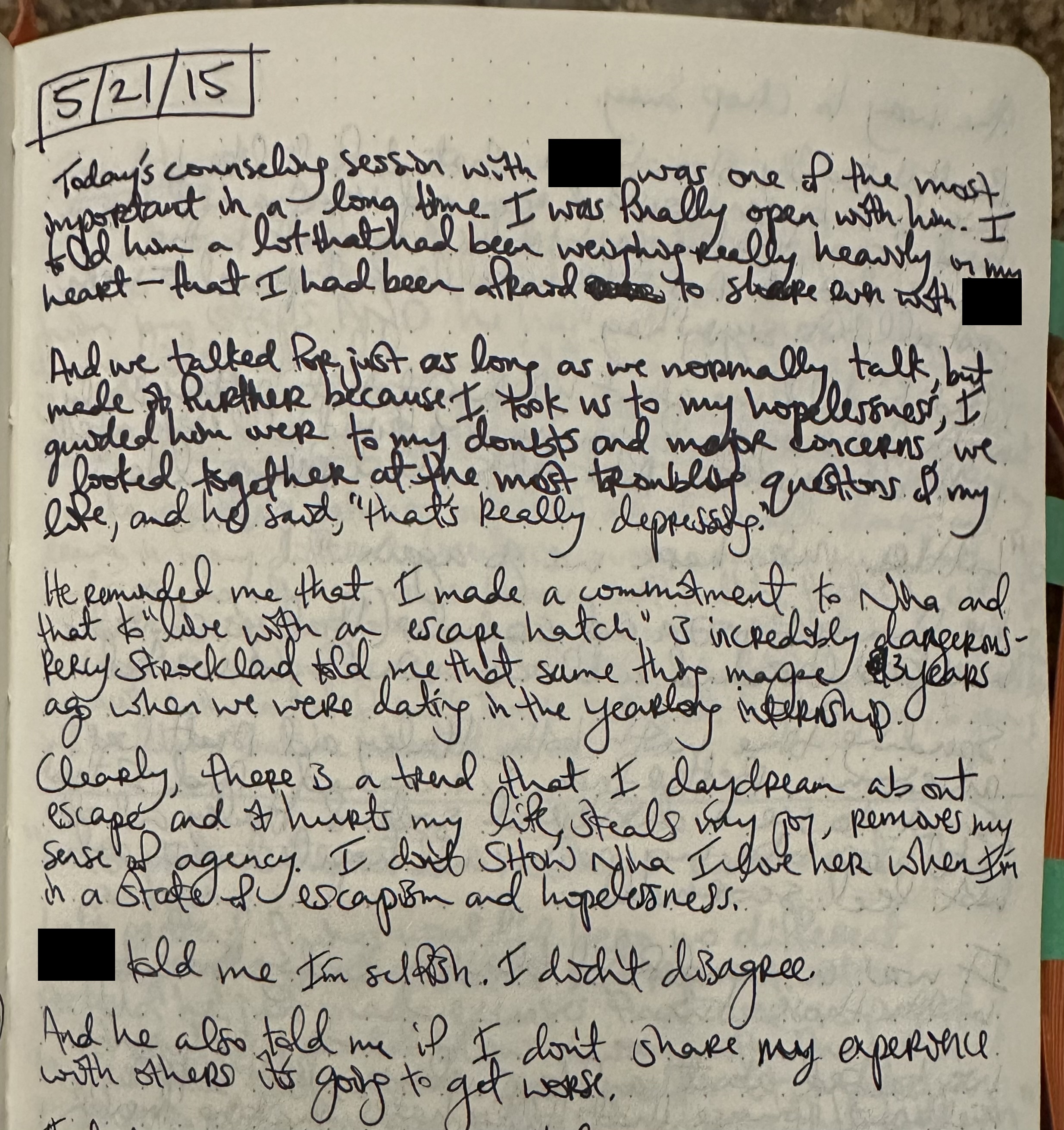
Below is a journal entry where I reflected on a time when I shared more with my counselor about my sexuality (with their name covered) and “felt a peace” about my life despite my reservations. (For a link to a transcript of this handwriting, click here.)
Looking back on this journal entry after coming out I wrote “WHAT THE FUCK” on a Post-it note and stuck it to the top of the page. It’s painful to remember how repressed I was and sad to see how much it affected my quality of life. These journal entries seem like moments when I almost made progress then, with encouragement from my counselor, recommitted to the status quo. I wanted to change my life, but I was too afraid to do it. Instead of help me push through the fear, I was told that I was selfish and reminded that promises are binding for life.
It’s weird to think that sadness, loneliness, and hopelessness could be interpreted as selfishness, but within the context of Christianity it does make sense. Your life exists for the glory of God and longing for anything other than the life you’ve been given is placing your own self-interest above God’s plans. This perspective fit into my worldview at the time and I didn’t question it.
I also think that I accepted what they told me out of self-interest and self-preservation. I was overwhelmed by the amount of change that might occur in my life if I actually came out. I thought the whole world would fall apart. I thought I would be an embarrassment to my family, and I was probably even afraid of losing my marriage. My spouse and I had become huge sources of support for each other over the years and our relationship felt too important to lose.
In reflecting on this journal entry, I wish the person counseling me had told me some of the lessons I have learned since we ended our time together. I wish they had told me that clear is kind, that love cannot exist without honesty, and that my partner and I were strong enough for the truth that I was holding in my heart. I wish he had told me that I needed to let go of the responsibilities and obligations I felt to everyone but myself.
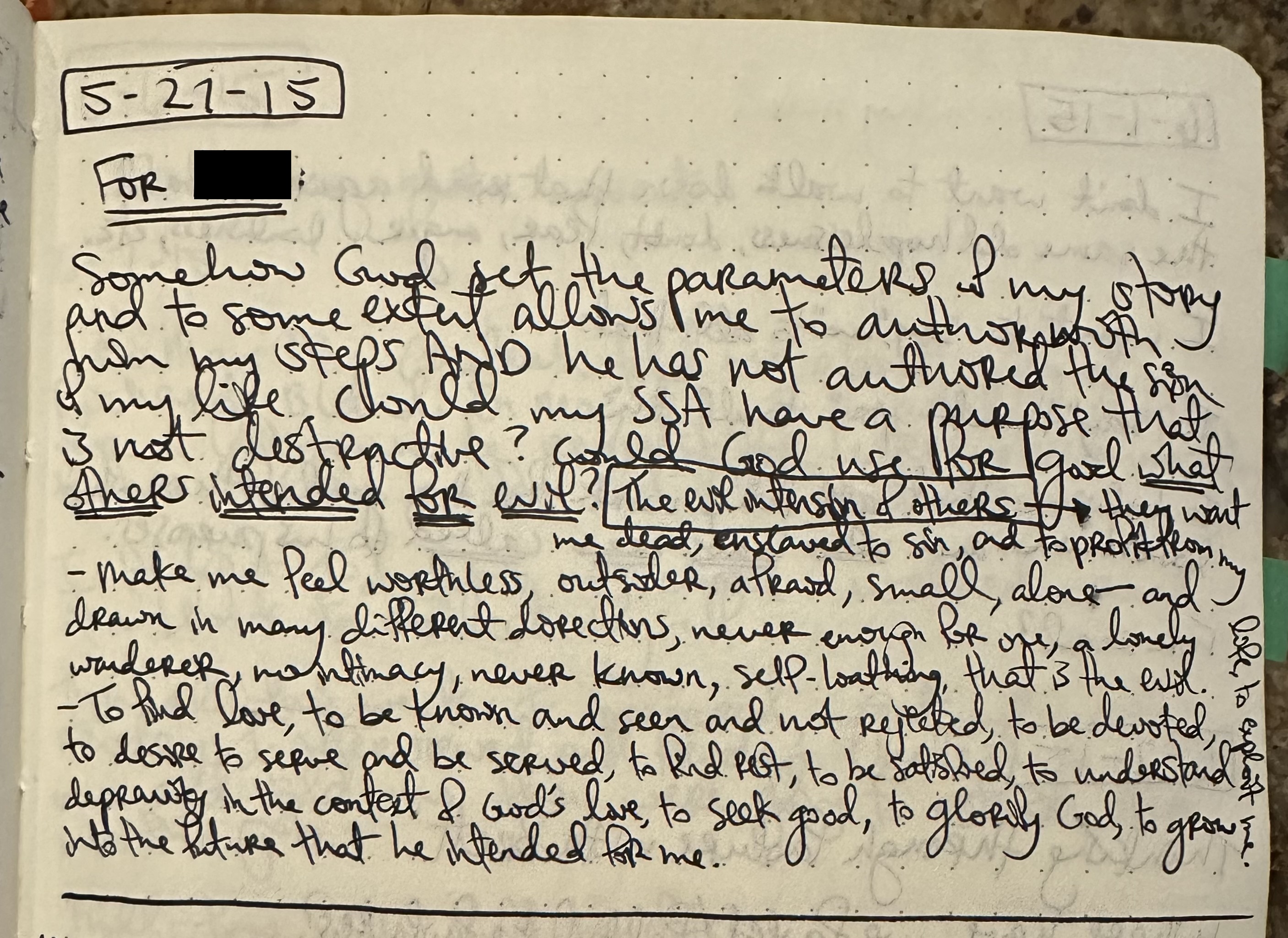
The next journal entry is a reflection I wrote in advance of counseling or as homework after a counseling session. (For a link to a transcript of this handwriting, click here.)
In this reflection find myself, once again, giving control of my life to God and hoping for the best. God “set the parameters of my life” and I was trying to accept that and believe that these parameters were placed in my best interest.
Part of what made God’s plan good, I thought, was that I was being protected from the LGBT community. I had been led to believe that the LGBT community was dangerous and essentially evil. I write, “they want me dead, enslaved to sin, and to profit from my life, to exploit me.” I had been taught to have so much irrational fear towards the very people who might have wanted the best for me. As I have come out of the closet I have not felt worthless, like an outsider, afraid, small, or alone. I have felt the exact opposite. I have felt understood, safe, and affirmed. All this fear of the outside world feels a little cultish actually. I was isolated from my community, too afraid to explore and find out whether happiness could exist outside the world that I had known.
One thing I’m still thinking about after reading this journal entry is how I believed that I could only feel “known and seen” within the context of Christianity while I was very fervently (consciously or unconsciously) holding back a huge part of my life. How could I believe that coming out of the closet and joining the LGBT community would make me feel “never known” and “self-loathing” when the opposite is so obviously the case?
It’s a bit of a mindfuck, but after some reflection, I think I have finally wrapped my head around it. I think Christianity successfully convinced me that my sexuality was not a part of me, and that actually much of “me” was not a part of me. Instead, my true self, the one that mattered, was the ideal self that God was theoretically transforming me into.
So I could truly believe that I wasn’t being dishonest or holding anything back from anyone while staying in the closet because I was sharing with the world what was true about me – what God had done in my life and the plans God had for my life. That was the version of me that I wanted to be “known and seen” and that was the only version of me that deserved to be known and seen. That was the version I could plan a future for. The rest of me was essentially disregarded as sin or evil. I was taught to repent of all of the bad parts of me and run away from them, to take those thoughts “captive,” and literally for those parts of me to die. In this way, much of me, not just my sexuality, was hypnotized into the sunken place.
If those parts of me including my sexuality had been killed/taken captive/left behind, then I wasn’t really hiding anything because it wasn’t there anymore. And if it “came up” every once in a while I just had to pray about it and ask that it would go away again so I could go back to living my true life as God intended – the only life that I wanted others to see and know. My dishonesty was completely justified, sanctioned, and encouraged by the Christian faith, at least in my personal experience of it.
It has been a painful, healing process for me to piece together these three artifacts from my past. For many years my journal was a safe space for me – one of the only safe spaces in the world. It feels very liberating to finally let these words out into the world as they always should have been.
When I was in high school we read a poem in class about an athlete dying young – I’m pretty sure it was this one. I remember thinking that if I died before I had the chance to be a failure I would be more likely to leave a good legacy. In retrospect, I think that the pressure of life, especially the pressure of achieving success while also being in the closet, was draining a lot of my joy and energy. I knew that at some point I would burn out.
In my high school years I actually thought God might have promised me I would die young. If I stayed in the closet for my faith it seemed like an early death was God holding up their end of the bargain. Twenty or so years on earth seemed doable, but much more than that was hard to imagine. Being a closeted gay adolescent in the church left me feeling committed to my path and hopeless that it could actually work out in my favor. Going to heaven was the primary reward I was presented with in these years so it makes sense that when life felt overwhelming that’s where my mind would wander.
I didn’t really plan much past my early 20s, basically college was as far as I got in my mind. I couldn’t imagine the future in any kind of hopeful way so I just took life one day, month, and year at a time. When my tragic early death never happened I felt pretty behind and unprepared. Since I thought it was something God had promised, it may have even caused my faith to wane when I was left to figure out the years I hadn’t planned for. (As I scrambled it didn’t feel like God had planned much for those years either.) It wasn’t always conscious, but it does seem pretty clear in retrospect.
The other day on the way to therapy I saw an activity bus from an assisted living facility and cried for most of the rest of the drive. I worked in assisted living so I have some personal experience with how sad and lonely those places can be. In these moments I think I’m already grieving the future I feel is coming for me. Many people close to me have tried to reassure me about the future and remind me how far I’ve come. I actually have a very long blog post draft called, “The Future is Home,” in which I have tried to convince myself for more than a decade that it’s going to be ok. Rationally I want to believe them (and myself), but emotionally I just can’t.
Adolescence is supposed to be a time of exploration. It’s supposed to be a time when you get to know yourself, try on different identities, express desire, start to experience autonomy and independence. My experience of adolescence was closer to one of commitment before exploration – what Marcia would call identity Foreclosure. Now I am finally (really) exploring and, even though I have felt late to the party at times, I am very grateful to be here.
I do think that I will get to a point where I am optimistic about the future. I am already “less hopeless” at least which feels like progress. Even writing this blog post has made me feel better about things in the moment, probably because writing is something that I enjoy and it is a relief to write out thoughts that have been on my mind. I have also given myself the freedom to explore without making promises the way I did the first time around. I gave away all my agency at a young age and I’m too prone to do it again. Instead, I’m just following the energy of my life as best I can. The more my life feels like home right now the more likely I’ll be able to imagine it for myself down the road.
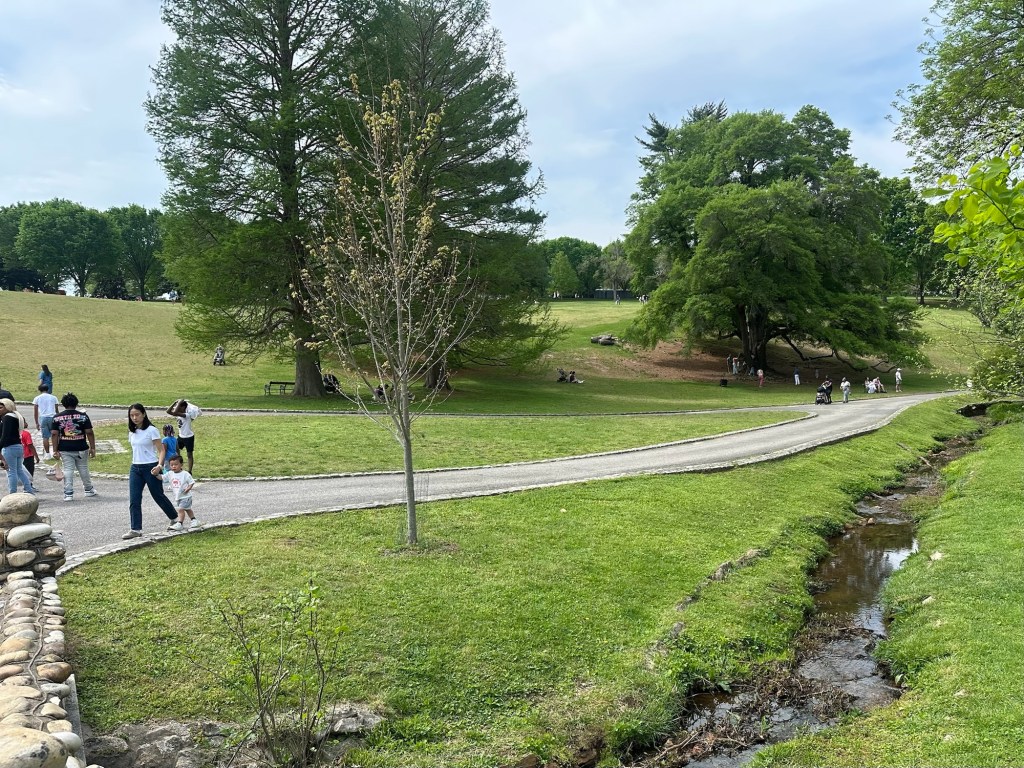
During a recent visit to Maymont I noticed a small island of grass that I can’t stop thinking about. It feels like the perfect opportunity for a small meadow of perennials at the intersection of the more formal Maymont Mansion and more “natural” Robins Nature Center and Maymont Farm sections of the property.
The long, tear-drop shaped island of grass is in the middle of the photo below, but of course I already have ideas for the area along the creek as well.
Compared to the yucca project, this feels somewhat realistic. I would need to borrow black tarps to kill the grass, enlist some volunteers to clear the area a month or so later, install plants collected from my garden, and spread leaf mulch in between. It would be nice to put a small stick and twine “fence” along the edge while it’s getting established as well as a “Prairie in Progress” sign and some educational materials about the benefits of these types of gardens.
The cost of this could be essentially free. Here is a list of plants I can think of off the top of my head that I would be able to contribute:
Anise hyssop
Echinacea / coneflower
Mountain mint
Showy goldenrod
Milkweed (1 or more varieties depending on how they spread)
Coreopsis
Panicled aster
Rudbeckia / black-eyed Susan
Rattlesnake master
Spiderwort
Wild garlic
Aromatic aster
Bee balm
Foxglove beardtongue
Groundcovers including violet and wild strawberry
While doable, it would still require a lot of work obviously. I would need them to commit to watering for the first couple of months after install and provide ongoing support like cutting it all down to about a foot off the ground in the fall, weeding, and continuing to add more plants. Still too much for me right now, but a really fun thought.
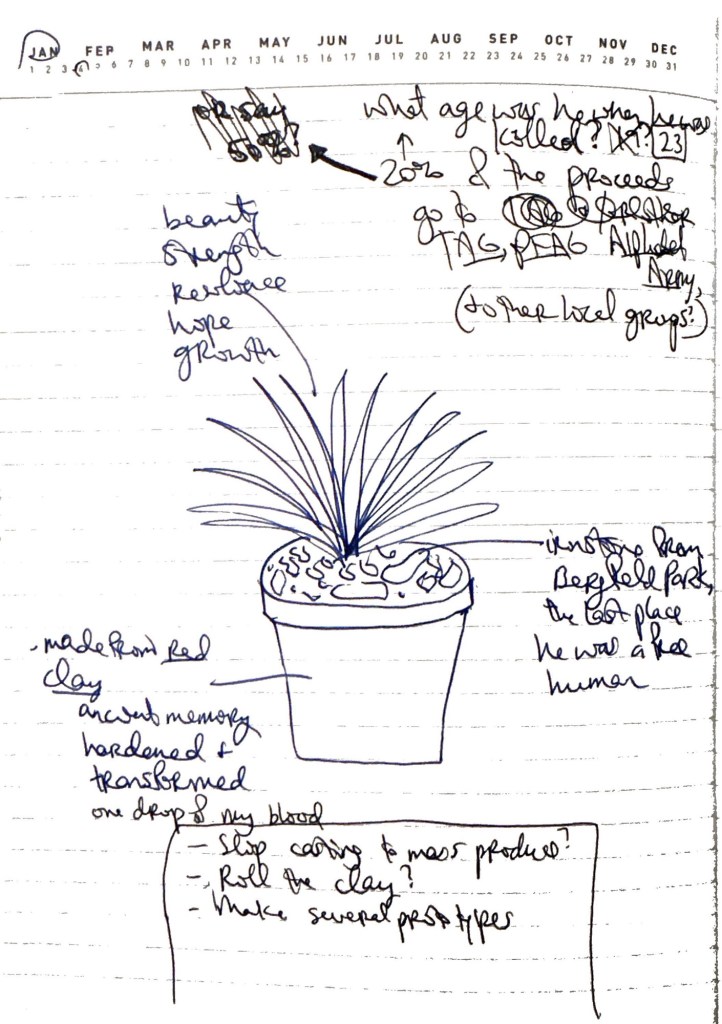
One Saturday in early January, in the middle of cleaning and entertaining my kids, I got an idea for an art project and sketched the notes below.
I’ve been really interested in the life and death of Nicholas West for a little over a year now and continue to feel a strong connection to his story.
The basic idea is…
A collection of pots thrown from red clay harvested in and around Noonday, TX where Nicholas was tortured and killed
The pots are different sizes with different biographical information about Nicholas like his birth and death years, text from obituaries, anything significant from his story
Each pot would have a drop or two of my own blood. I want to make people a little uncomfortable when they pick up the pot and read the description. I want to make his death more tangible and remind people that all soil has seen bloodshed of one kind or another. (On a more cosmic level, I also love the connection between the iron in our blood and the iron in the soil which was all stardust flung across the universe from dying supernovae.) I’ve noticed that men are pretty squeamish about the idea of the blood, and women I’ve told are much more supportive which makes me want to do it even more.
In the pot will be planted a Yucca filamentosa, native to the southeastern US (from Tyler to Richmond), very hardy, tropical, and structural. The yucca will grow to fit the size of the container that it is in, the yucca is resilient, and in the spring it has a bloom several feet above most other plants.
Yucca is also the first plant that I really noticed and developed a connection to. It is the first plant I remember finding and foraging and I’ve planted and potted at least five in the last two houses where we’ve lived. I was in a dark place in my life and my interest in plants, yucca specifically, was an encouragement that has continued to center me and excite me while also driving me a little crazy with more ideas than I’ll ever have time for.
While I still love the idea of Yucca, more recently I’ve considered Hesperaloe parviflora, also known as “red yucca” or “false yucca.” I noticed it in Texas at some point and planted it in my garden 3-4 years ago. I had a naturalist walk around with me and he commented that he liked seeing it growing in Richmond because he didn’t know that it could. I love the idea of a Texas transplant thriving in Richmond and the idea of it being a “false” yucca feels appropriate for the Southern culture of repression and how much of myself I held back from others for so long. Of course I love the red bloom, the color of blood and nectar for hummingbirds stopping for a moment on their impossible migration.
On the surface of the dirt in the pot I want to scatter bits of ironstone found at Bergfeld Park, the place where Nicholas was picked up, the last place he was free. On my most recent visit to Tyler I pocketed some pieces of the stone and brought them back to a potted yucca I have by our back porch. It has been special to me to have them there as a connection to home
I’d love to sell replicas of the different styles of pots and give a portion of the proceeds to local LGBT community organizations in the Tyler area.
It would take months or years to really do this as well as I would want to – I haven’t even fired a clay pot since high school. I’d need time to harvest the clay, prototype different styles, and learn how to make them consistently well, etc. So with all that considered in addition to the constraints of full-time employment/parenting life, I’ve accepted that I’m probably not going to attempt it, as much as I want to. It felt better to share the idea here and let it go rather than hold it too tightly.
4.22.25 – Since writing this post I’ve thought more about the possibility of partnering with an artist to make the pots that I could use to plant and we could market the project together. Even still I don’t think I have the time to do it well, but the partnership would be really rewarding and it’s much more realistic to lean on someone’s existing expertise rather than try and develop it myself. It also got me thinking outside the box even more. Maybe this idea should actually be an assignment for a class where everyone chooses an event that deserves more recognition and designs an installation to share the story. Maybe it should just be an online project that collects memories and details from his story. Or maybe this just needs to be a section of my own garden: a shrine to his life and a broader connection to my own story, my hometown, and the resilience, growth, and occasional moments of flourish.
4.24.25 – While reading about “The Burying Grounds Memorial” at the University of Richmond I learned that Yucca, “is often found in the cemeteries of enslaved people, serving as living grave markers.” I have only just gone a few steps down this rabbit hole, but I’ve already found some interesting articles and anecdotes that support using it for the project. It seems the plant has long served to mark the memory of people who might have otherwise been forgotten, to bind their restless spirits after life, and to provide permanent protection to their physical remains.
“Fieldstones. Yucca plants. Seashells. The last object a loved one touched. For centuries, these items, cultivated from lives and landscapes, marked many graves at burial places for Black people in America.” National Grographic
“Some of the plots were marked with pieces of quartz or with yucca plants, which were used by many Southern Black families who could not afford stones.” ProPublica
“The phrase “pushing up yucca” has been coined to describe these graveyards, and there was a Gullah belief that spiny plants restricted the movement of the spirits of the dead.” Society of Ethnobiology
“Spiky clumps of yucca dot Odd Fellows cemetery as further reminders that this patch of woods was once a curated (if not manicured) space. Though widely found in cemeteries across the country, in African-American tradition specifically, yucca binds restless spirits to their graves. Easily transplanted and nearly ever-lasting, yucca was sometimes planted near the head of a grave in lieu of an expensive stone marker.” Black Wide-Awake
“Yucca is another plant that marks many early graves even today. It can live hundreds of years and represents eternity. In many African American communities it was also traditionally thought that yucca kept restless spirits in the grave.” City of Birmingham
“Due to their association with cemeteries, the yucca plant has also taken on an association with the supernatural, as a way to ward off evil spirits.” Lumpkin County Historical Society
3.31.26 – It would be very interesting to also shoot the clay several times (perhaps even the number of times Nicholas was shot if that is published information) when it is still wet and let it harden in whatever shape it takes with the bullets. The violence of guns is something we are too numb to in the US and we need to be forced to think more clearly about how terrible they really are.
If I make multiple pots in a series, the one with bullet holes could be separate from the one with the printed information and others.
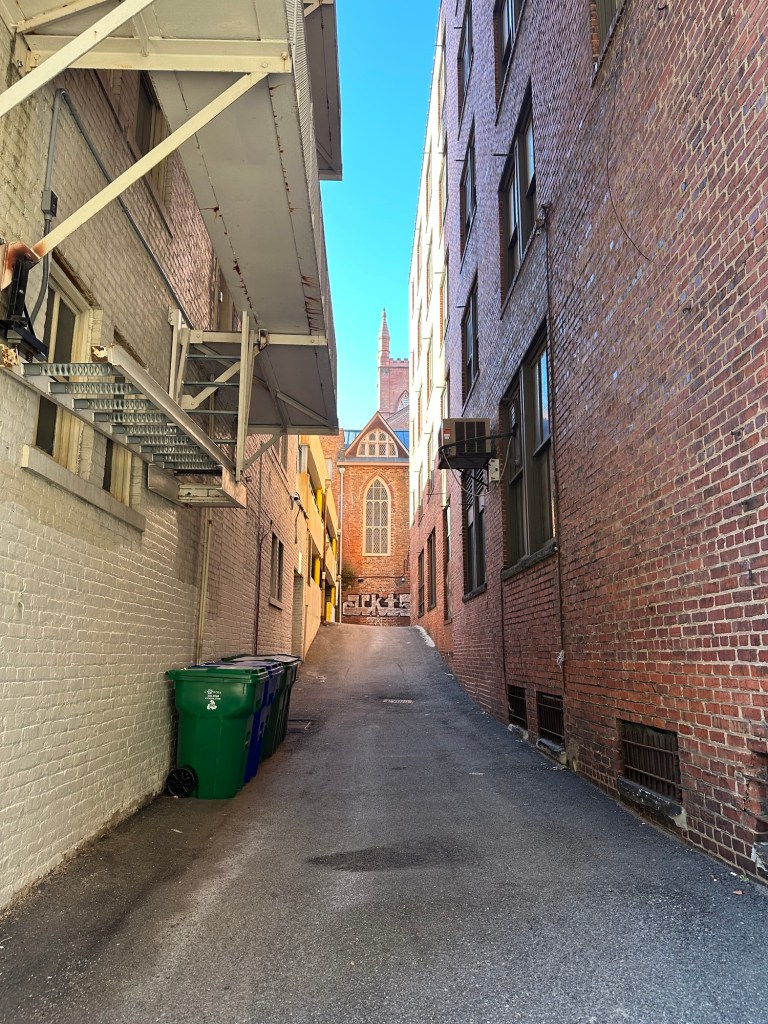
The other day while I was walking through downtown Richmond I stumbled on a small space with huge potential. It’s basically just a concrete slab, but what makes it special is that it’s located right in the middle of a city block. The concrete is connected to one building that forms an “L” around it. The area is accessible by three different alleys which all meet at the base of a somewhat beautiful, mature tree.
With some love, this could be a place to congregate just like the La Colombe near Logan Circle in D.C. The benefits of using these interior spaces is that they are quieter than the city streets and they are often cooler in the summer months because the buildings provide shade. They are cozy spaces, the diffused light is relaxing, and there is something charming about the irregular shapes. I love the surprise and delight of waking down an alley, turning a corner, and finding something you wouldn’t have expected,
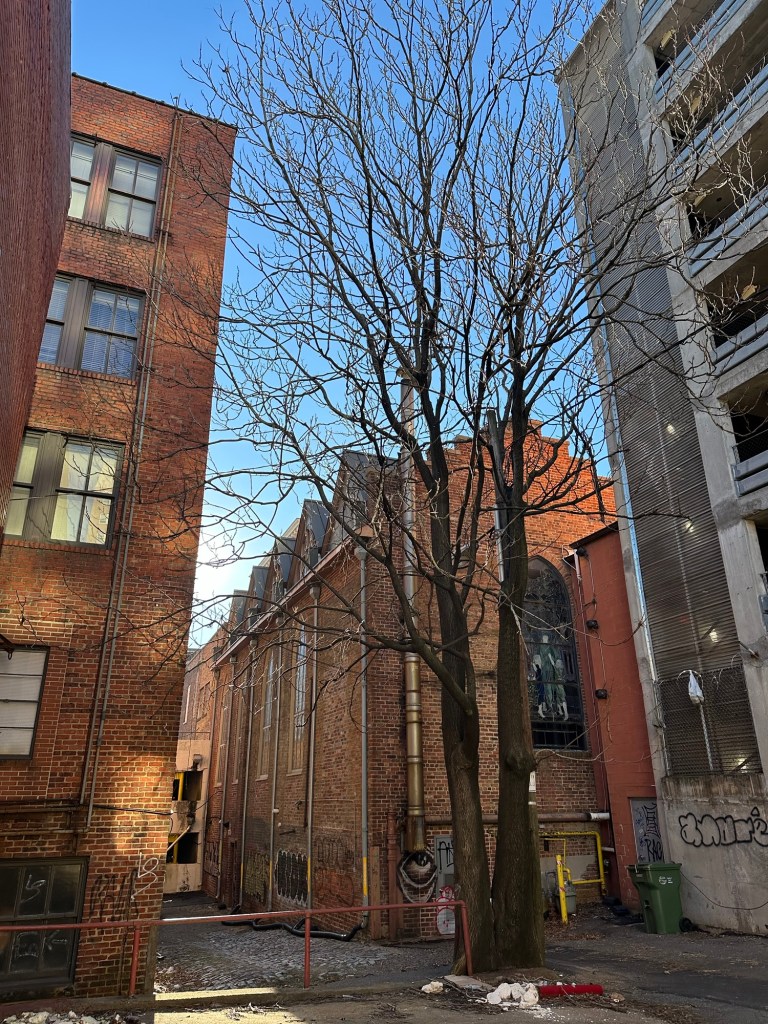
The approach that is most familiar to me (I actually worked and parked in the building to the left years ago) is below. I love the way the buildings frame the old window and steeple of Second Presbyterian.
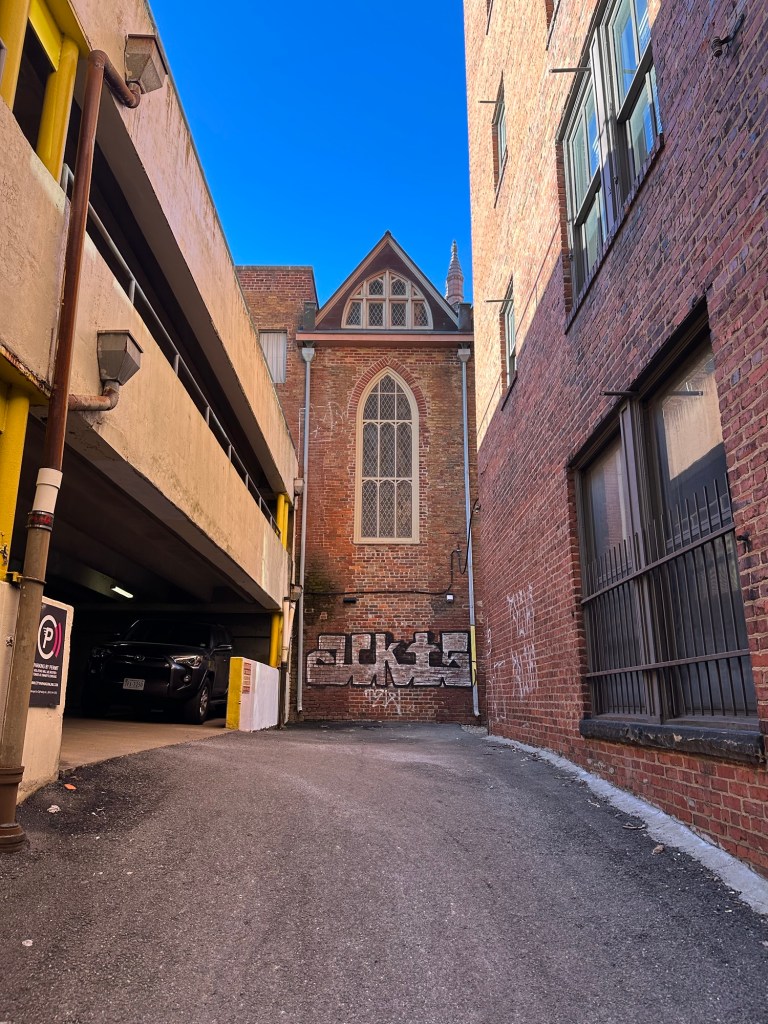
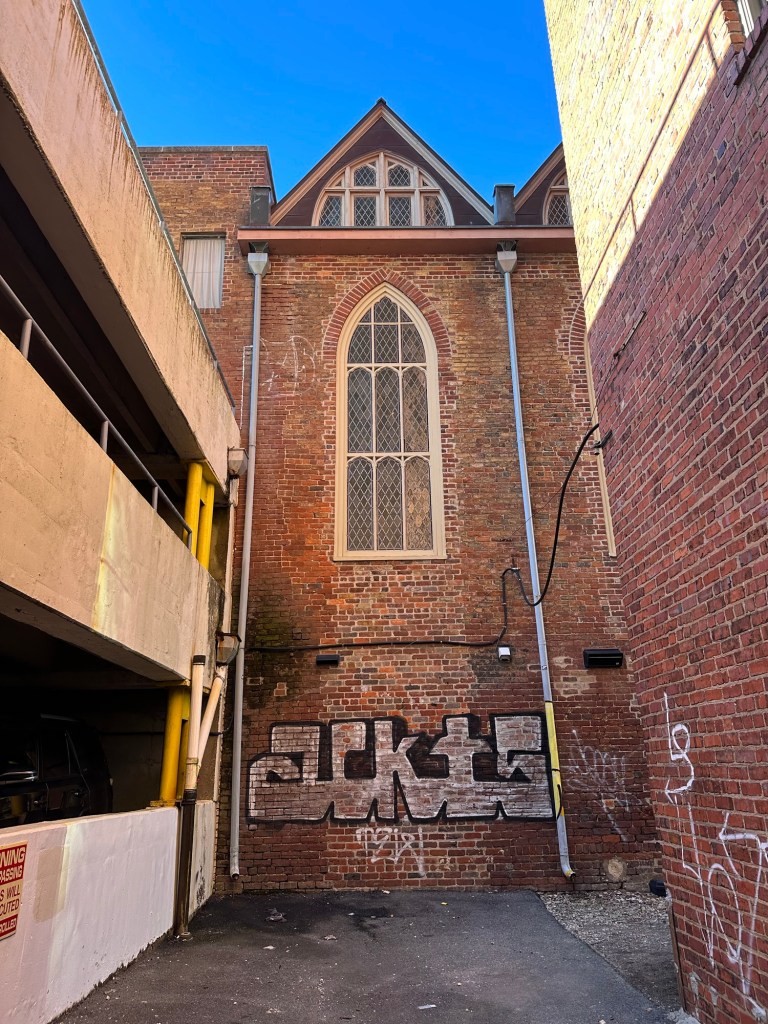
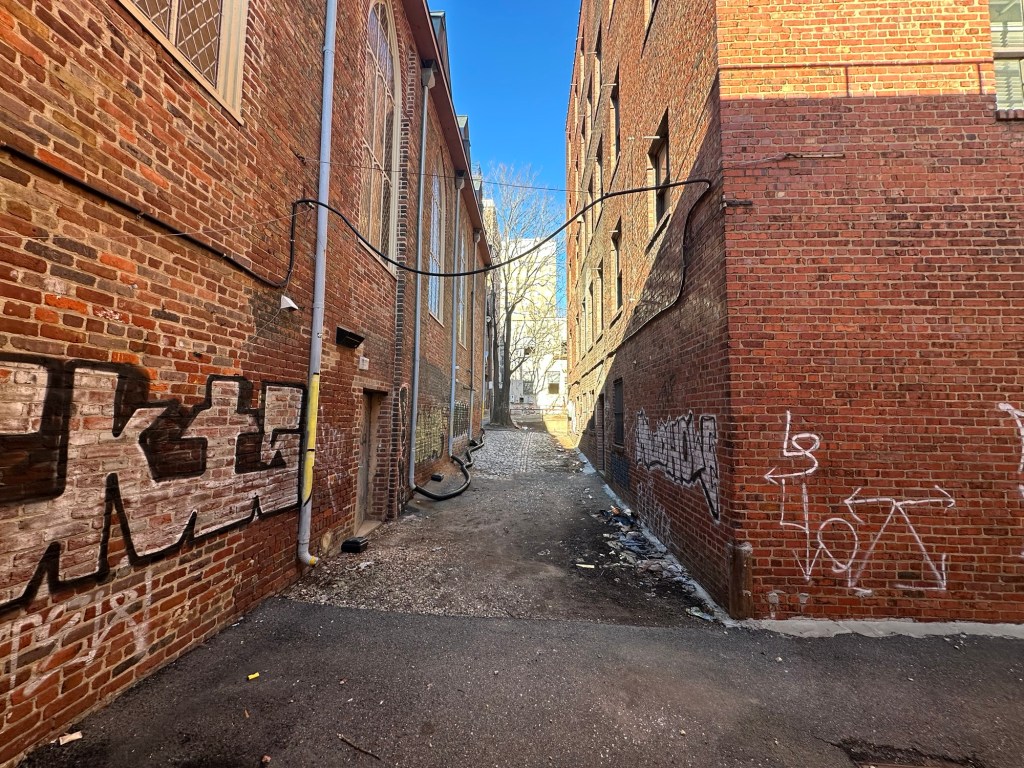
After you turn to the right, you start to get a glimpse of the destination. The area also starts to become more charming: the alley transitions to cobblestone, instead of a parking garage you have old brick and stained glass, and the tree is visible as well.
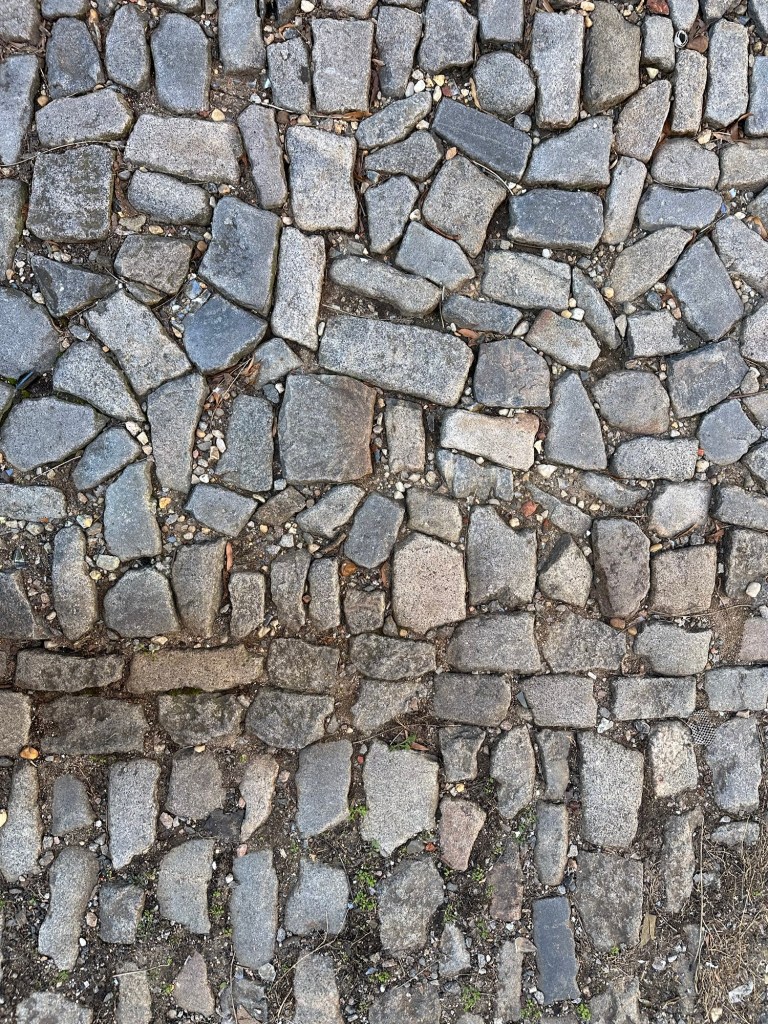
Despite being completely forgotten and unloved these granite stones are beautiful and the whole section would clean up very nicely.
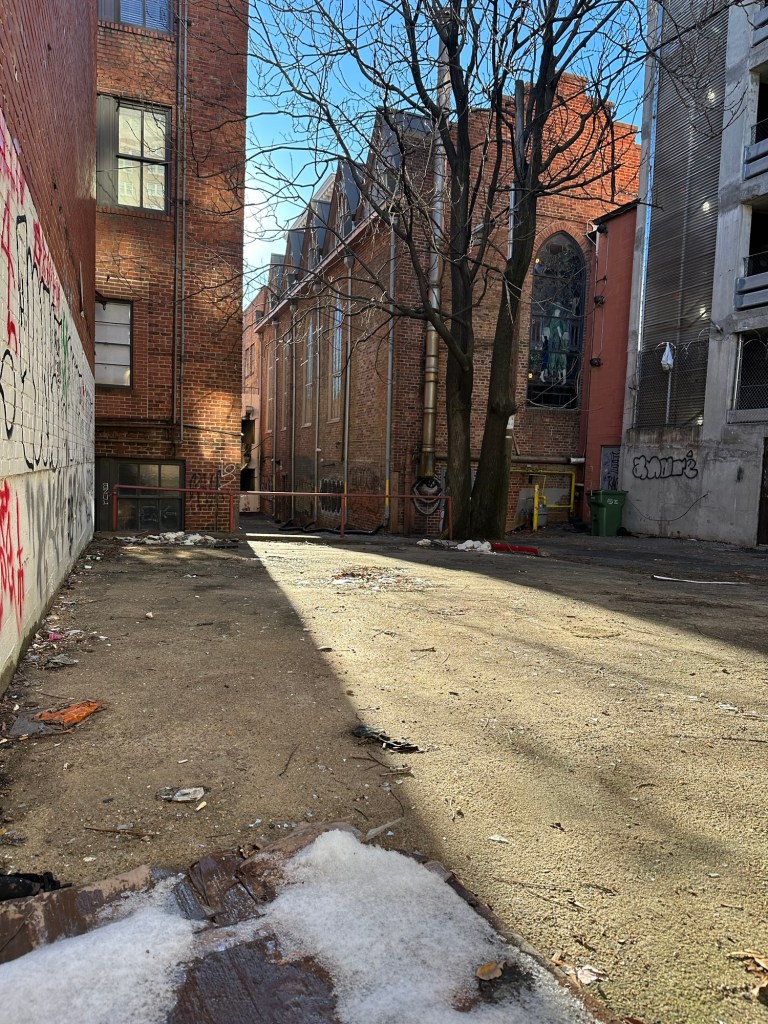
This is the view from the space that I’m interested in. I appreciate how much there is to look at even in this small space. It feels like the medieval section of a city: winding, ad hoc, dense, and built to the human scale. The tree would also provide shade in the summer and a beautiful accent.
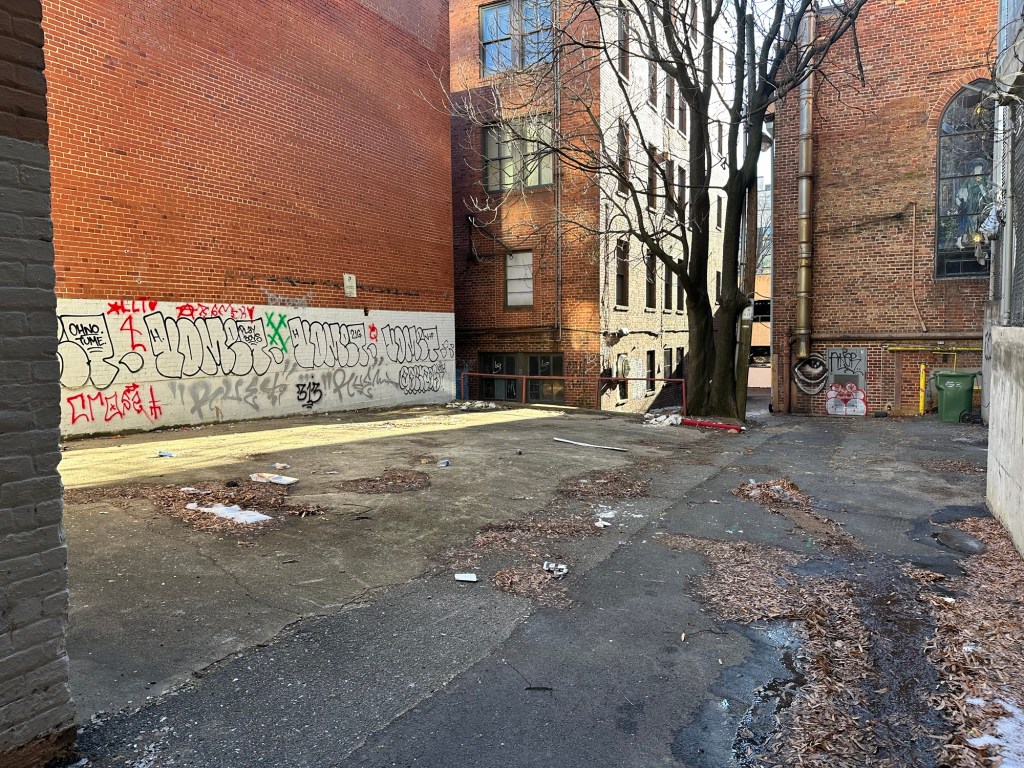
Here are two views of the actual space.
I am so in love with this idea. I had a similar vision for a space in Tyler many years ago and still believe in the potential of this sort of retrofit to bring new life and charm to cities. Whatever zoning process that’s required should be fast-tracked. Whatever the building around this space becomes (it’s currently being renovated), this should be a cafe or similar commercial space, with bistro lights, live music, and otherwise completely transformed into a beautiful and charming refuge in the middle of downtown Richmond.
A few weeks ago I woke up with a lot of climate anxiety. I could hear rain on the roof of our house – rain that 50 years ago might have been snow or sleet. We had just returned from a trip to New York City where it had also rained on an unseasonably warm December evening. I had global temperature charts and thoughts about crazy weather stressing me out before I even got out of bed.
When I came downstairs, the first thing my kids wanted to do was play with toys that we brought back from the city. As a parent I’m used to suspending whatever anxiety or “grown up things” are on my mind to enjoy my kids in the moment. On this particular day I found myself playing with, of all things, Magic Snow. It really is pretty cool. You add water to this very fine powder and it grows into a fluffy snow that we played with for an hour or more before school. On the inside I was wondering if at some point magic snow would be the only snow left. On the outside I was laughing and enjoying myself and the simple joy of parenthood
Since that day, my five-year-old asked several times if we were going to have a white Christmas and whether it was going to snow at all this winter. My niece also recently asked her mom if it was going to snow this winter and when she heard it might not immediately said, “We have to compost!!” Sometimes parenting feels a little bit like the movie “Room” where you are creating a reality within the safety and coziness of your house, neighborhood, etc. On the other hand, while I do want to keep my anxiety to myself, I don’t want to try and keep reality out more than I have to. I want to start to bring in age-appropriate books and conversations about climate change just like I want to do with other complex topics. This experience also pushed me to focus on solutions rather than abstract fears and sadness for a lost planet that we haven’t even entirely lost. So, yes, I’m going to continue to compost and I want to start buying carbon offsets again. I’m probably going to buy a children’s book like Bright New World or one of these. While I read about a hopeful future to my kids I hope to start to believe it for myself.
Welcome to the world, little seed. We’ve been waiting for you.
Every rain, every flower, every bee, every beautiful dappled moment of summer were for you. Every leaf now dry and cracked on the ground was an engine of energy for your growth.
And now you’re here, ready with the fuel and protection you need to start the next chapter.
May you fly to the place where you were meant to land. May you dig down deep and find it within yourself to transform in the way that you know you know how.
May the deep, ancient memory guide you in the months to come. While most of us rest, you will be cracking, freezing, opening up the most sensitive parts of yourself to the world.
You will put down roots, once you have exhausted the fuel you were given, you will start to draw nutrients from the world and find your own sources of strength and sustenance.
May you grow, may you bloom with radiance, may you be visited by insects – your connections to the world beyond.
And when you have finished your work, may you produce seeds of your own, a part of yourself that will live on through the dark nights ahead.
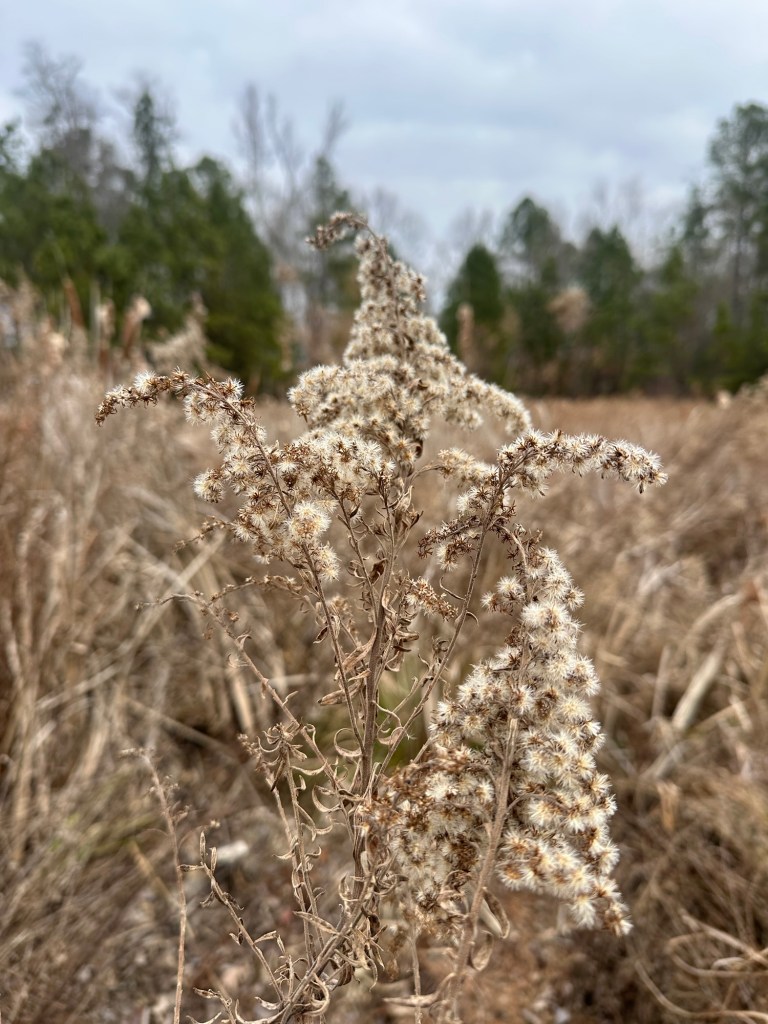
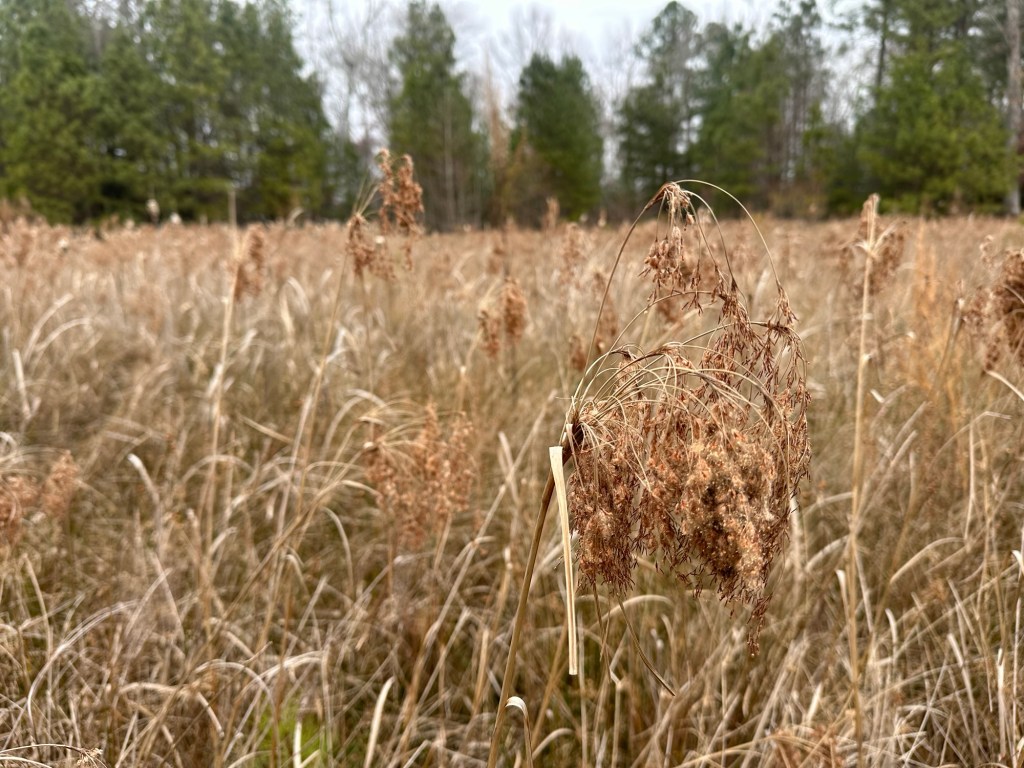
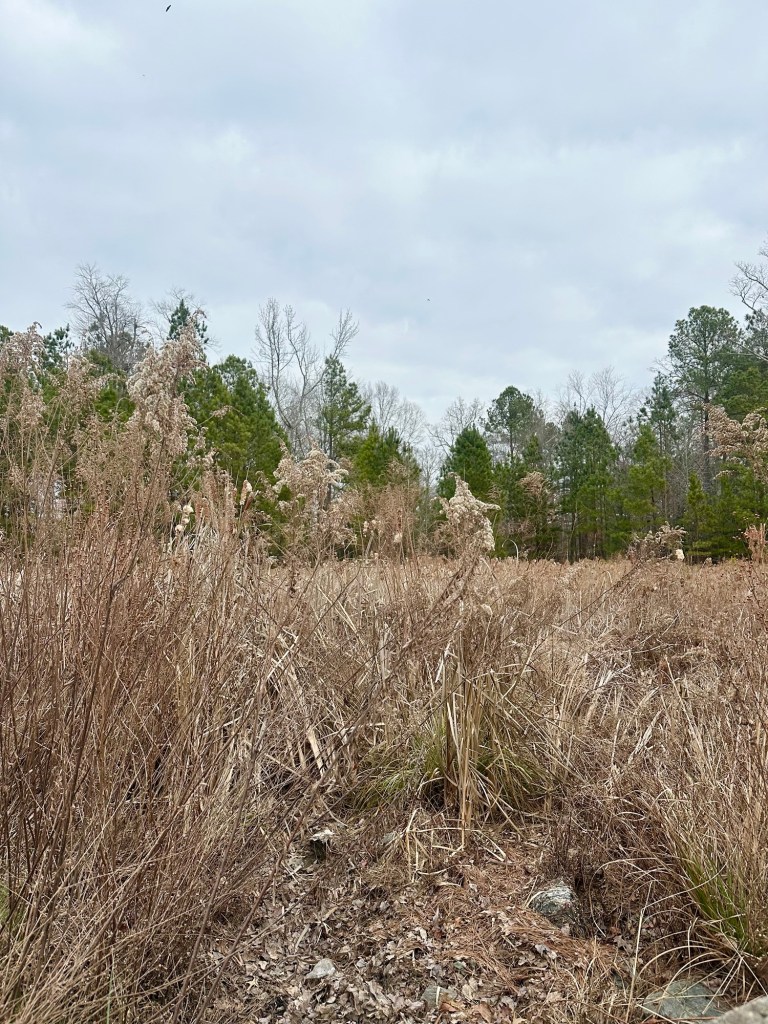
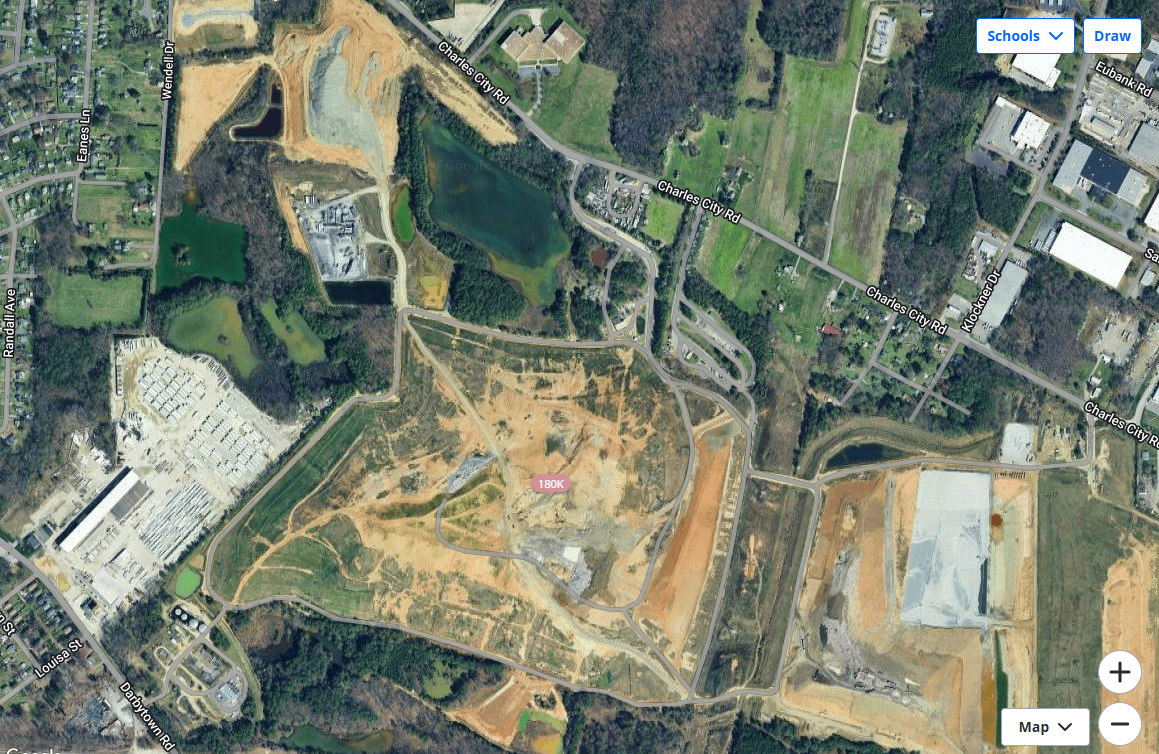
Yesterday morning I found myself dreaming about a plot of land for sale in East End Henrico County, just outside Richmond city limits. It’s 8.72 acres for $180K located very close to the center of the city and I think it would be an amazing chance to plant a pollinator meadow to restore the ecosystem and have it be managed as a park by Henrico County.
I’m imagining walking trails, giant woodland sculptures, and it might have some elevation that could be fun with a lookout tower at the top. The grounds at Glenstone would be a good inspiration. This plot of land looks like part of the East End Henrico landfill – I think the one that was shut down by Henrico County. I’m sure there are liabilities with owning a former landfill (environmental concerns, seepage, etc.), but I know it’s been done before and this could be a good chance to do it in the Richmond region.
I already emailed the Capital Region Land Conservancy, and I probably won’t go any further with the idea, but I wanted to at least post it here as a personal memory of the dream. At some point this is exactly the kind of restoration project I’d like to be a part of.
Update: I heard back from the Executive Director at CRLC and he told me that the information on Zillow was incorrect – there are actually only two acres for sale about seven miles west of the location – kind of bizarre. I still love the idea of course 🙂
I remember exactly where I was sitting when my older brother told me the story of Nicholas West. In 1993, when West was 23 years old, he was picked up just blocks from my childhood home, taken to a clearing in some woods outside the city, brutalized, and killed for being gay. His murder was deemed a hate crime, two of the perpetrators received the death penalty and one is still serving a life sentence in prison. Earlier this year, thirty years after a crime he committed at just 17 years old, he was denied parole.
I had always known intuitively that Tyler was a conservative place, but this story captivated me as someone who had recently come out of the closet and was still trying to understand my own childhood. In a sort of backwards way I feel affirmed by the knowledge of his story and my own self-preservation reasons for staying in the closet for so long. His murder likely sent a chilling effect through the community and I imagine kept many people from coming out of the closet and/or from supporting their children from doing the same.
His story also helped to explain a strange vision I had in the summer of last year, months before I learned about Nicholas. One weekend day, struggling to be a good parent, I decided to take my oldest to a flower farm outside of Richmond. They had hay rides, play forts, a huge dirt pile (his favorite), and all-you-can eat grilled corn (with Tajin of course). On the way to the farm, we happened to drive past a large pine forest. As I watched the parallax of tall, narrow trees shift to my right I had a very clear vision: I was running for my life through the forest, chased by counselors from the Christian camp I attended as a child. It was a mix between Sothern Gothic and the music video for the alt J song, “Hunger of the Pine.” If they caught me, they were going to drag me back and force me into the closeted life I felt I’d narrowly escaped.
The vision surprised me for how clear and intense it was. Although I was well aware of the culture of homophobia, I had managed to avoid the worst of it. Homophobia mostly came to me through casual phrases (it was the era of “that’s so gay”) or religions conversations like my high school teacher telling me that it was a worse sin because it was a sin “against the body.” The story of Nicholas, one of visceral hatred, was recent enough to be very much a part of the culture and collective memory of the place that raised me even though I didn’t know about it at the time.
Ever since I had that vision I’ve looked at pine forests differently. I grew up in the Piney Woods of East Texas and I have plenty of childhood memories in the tall, quiet, spaces carpeted with pine needles that choke out any understory so you can see straight through them. I think they are beautiful, but like everything in the South (and anywhere) they hold dark secrets, secrets of terror and violence. Terror has been used to control many communities and its effects last long beyond the actual event. Terror changes the way that affected people experience a place. Even when hatred becomes more benign, the memory of the violence serves as a threat that it could happen again.
I’ve picked up lots of articles on this story during my deep dives:
I also recently watched Lone Star Hate, a documentary about the story, embedded below:
I was only five years old, probably asleep under the glow-in-the-dark stars of my room, when Nicholas West was picked up at the park nearby. In some ways I wish I had known about his story at a younger age. I wish I had known about all of these stories, the gay community, the mentors I didn’t have, the history I wasn’t told. Part of moving forward is going back and making those connections when I get the chance.
I’ll be in Tyler in a few weeks and this story is going to be on my mind. I certainly hope to visit the memorial stone in the park where Nicholas was picked up. On a later visit to the area, I’d love to connect with anyone that knew him or was friends with him at the time. I feel really connected to his story and want to know more about his life before it was defined by someone else’s hatred. I’ve also considered scheduling a visit with David McMillan some day. At 47 years old, he still has a barbaric amount of time in prison ahead of him as he pays for his role in the murder. I want to know how he found himself participating in that crime and what he thinks about it today.
While I have a tendency to focus on the sad aspects of this story (and most stories), I have also been incredibly inspired. I have learned about organizations like TAG, Alphabet Army, and PFLAG of East Texas. As someone who chose to escape, I am so proud of folks who have managed to stay and have committed to changing the culture for the better – I would love to support and visit for one of their events some day. There are also seeds of hope in my own story. It was in a journal that I purchased from Pine Cove Christian Camps of all places that I first came out to myself in middle school. It would be many years before I felt safe enough to come out to my friends and family, but that journal entry, among the prayer requests and gossip, was always important to me and a sweet, salient connection to my younger self.
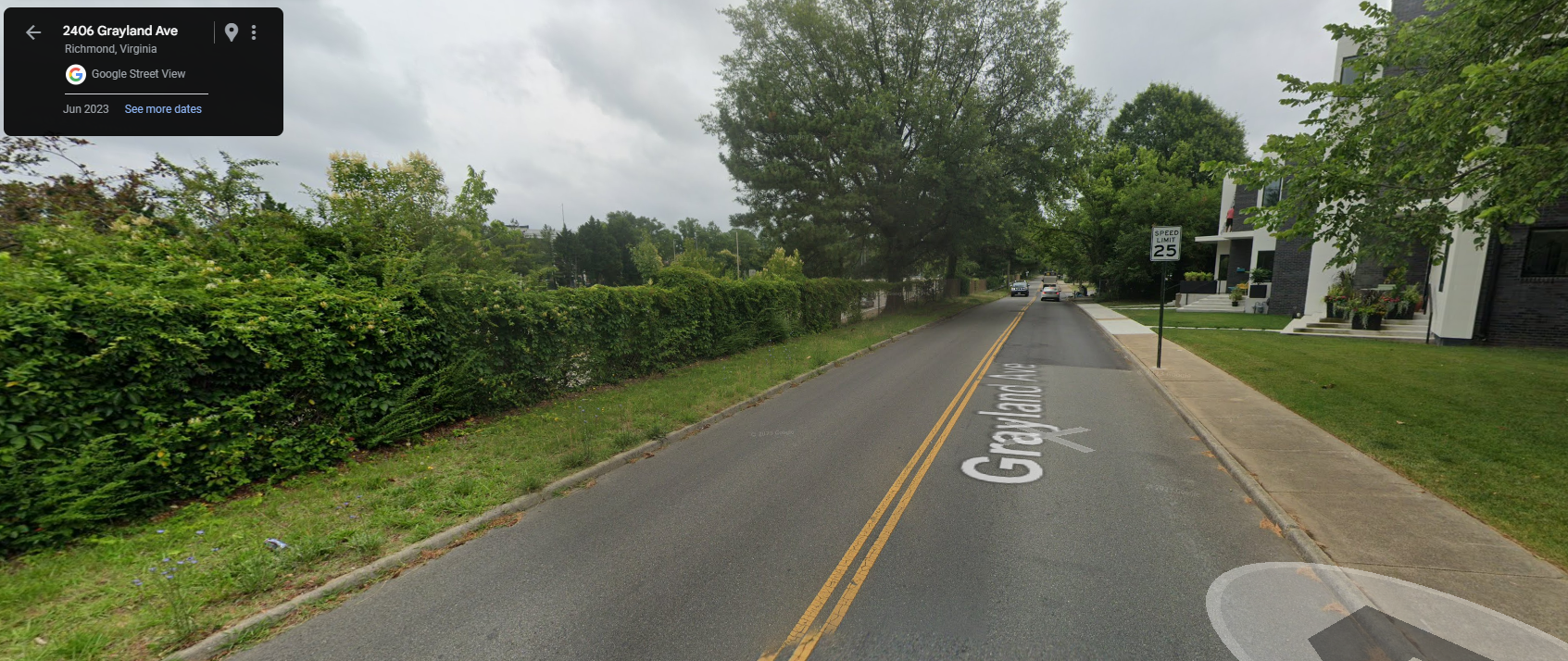
I was driving next to a stretch of I-195 in Richmond when I realized we are missing out on a huge opportunity: planting bamboo forests along our highways. Specifically I want to see bamboo in these little strips of grass in between the road and the fence or barrier to the highway, on the left side of Grayland Ave. shown below.
The first reason I would want to plan bamboo in these spaces is to create a natural barrier between the highway and the surrounding areas and the second would be to create an effective carbon sink on degraded and underutilized land.
Anyone who has ever walked through a bamboo forest knows intuitively that they are extremely quiet, but the noise-reduction has actually been studied and found to be effective comparable to solid noise barriers. Bamboo barriers create themselves and repair themselves so they are incredibly cost effective compared to concrete noise barrier solutions (the Berlin Wall of highway design). Bamboo forests are beautiful, certainly as beautiful as whatever invasive species there is growing in the space currently. Bamboo also grows tall enough to block the sight of highways from most passersby.
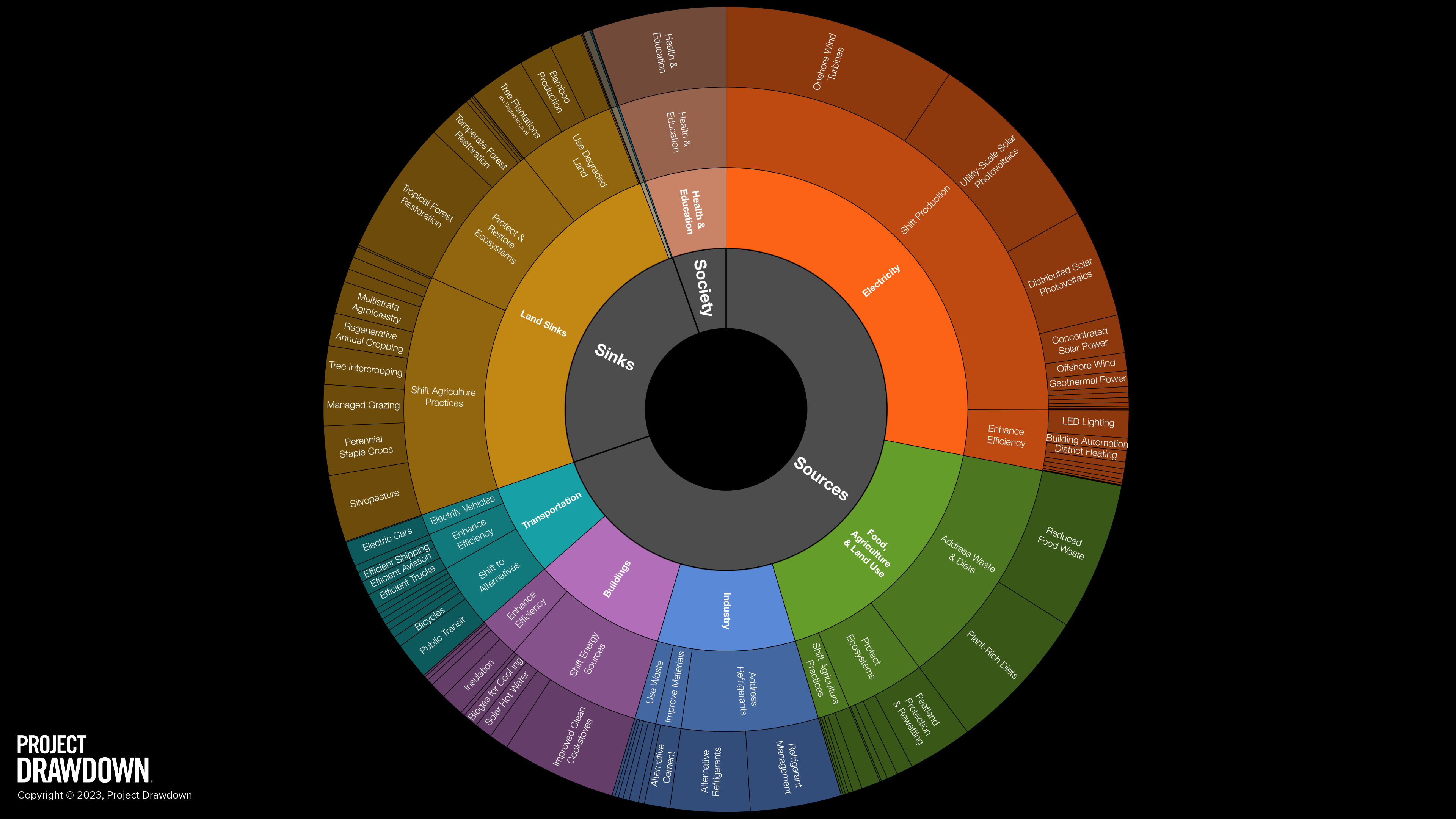
I’ve been thinking about bamboo as a carbon sink ever since I saw it specifically referenced on the Project Drawdown Roadmap where they calculated that the addition of bamboo forests could result in 7.70–19.60 gigatons of carbon dioxide sequestered by 2050. In the graphic below it is in the top left-hand quadrant on the use of degraded lands for carbon land sinks. I will not restate the entire Drawdown summary on “Bamboo Production,” but the summary for me is that it is extremely inexpensive and effective at long-term carbon sequestration.
Bamboo is often passed over because of how aggressively it spreads, but there are many ways to prevented unwanted growth. There are often strips of grass along highways that are already separated by concrete or asphalt that would prevent spread underground. If not, fairly low-cost barriers can be installed – the cost of these barriers may be less over a few years than the cost to companies contracted to mow these completely unloved areas of grass. According to Project Drawdown, there are also native North American bamboo varieties and varieties that do not run or flower which makes their spread unlikely and easy to manage. Years ago, while vising Echo in Southwest Florida I learned about clumping bamboo and have been interested in how we could encourage its use more widely. More information about Echo’s work with bamboo in this video: Bamboo’s Many Uses (filmed at ECHO in Ft. Myers). The fears around its spread are also not based in the reality of the current climate situation – are we really afraid of a fast-growing, zero cost, regenerative carbon sink?
Bamboo along highways is just the start. There are countless strips and triangles of land in cities that could be filled with beautiful, noise-reducing, sight-blocking, carbon sequestering bamboo. In particular I would like to cut sections along the perimeter of parking lots to be planted with bamboo. Combining bamboo with impermeable surface parking would have the added benefit of reducing water runoff into the combined storm-sewage system in cities like Richmond. Of course, bamboo is always the best or only solution. Often prairie grasses and native plantings can facilitate ground water recharge and sequester incredible amounts of carbon in their root systems underground. In terms of highway design, I do think bamboo is the best option for their combined benefits to the neighborhood and the climate.
I recently read an article about three colleges in Virginia that are showing signs of financial trouble. Apparently the “enrollment cliff” is set to begin next year and all institutions of higher education in the US will be affected by a shrinking domestic applicant pool. Some Virginia schools like Sweet Briar College have threatened closure and others, including HBCUs such as St. Paul’s College, have ceased operations.
The article reminded me of an idea I’ve been mulling over for at least a decade: that colleges and universities could somehow incorporate retirement communities into their campus life. While the enrollment cliff approaches, the Silver Wave (or Tsunami) is already over a decade in and will increase in the years to come. By 2030, there will be nearly a billion people over the age of 65 worldwide – by that same year, older Americans will make up 21 percent of the population.
This post is more of a brain dump, but I do hope to do more research, look into case studies, and hopefully plan some field trips to consider the different aspects of an intergenerational college campus. The following are some potential positive outcomes I’ve considered over the years.
There are obviously incredible financial benefits to building retirement communities. Baby Boomers will need places to live and they have the wealth and benefits to afford high-quality options.
Retirees will have the benefit of living in a vibrant place full of enrichment opportunities including
Cultural events
Continuing education
Sports
Dining options
Wellness facilities
Retirees could elect to be buried on campus in a cemetery or columbarium, a beautiful location where they could be remembered and visited
Retirees could serve in a number of capacities on campus
Formal and informal boards for oversight
Advisers for student organizations
Mentors for students
Serve in the career center based on their professional experiences
Volunteer in the community
Students from many different disciplines could benefit from having older neighbors
Psychology students would benefit from their research being more diverse in terms of age
History students could practice interviews and gathering personal narratives and incorporate first hand sources, artifacts, and perspectives into their research
Students in the medical and allied health professions would benefit from practical experience volunteering with community members that have health needs
Business students could do market research to understand the needs and desires of a growing consumer population
Philosophy students could consider the meaning of life with people who are near the end of it
Biology students could study their bodies after death to learn about degenerative diseases
Colleges and universities could bring a new and innovative option to the market
With a commitment to diversity and inclusion these communities could be safe spaces for individuals at the end of life
With their beautiful and walkable campuses, colleges would be the ideal setting for active, enriching retirement life
With their endowments, colleges could invest in all sorts of solutions to improve quality of life for residents in ways that aren’t available to existing retirement communities
There is enough demand for retirement communities and the associated labor that institutions could even transition into “work college” models like Berea, Warren Wilson, and others to reduce or remove the need for tuition
While writing this post I learned for the first time that there is a project underway to “reimagine” the empty campus of St. Paul’s College which seems exciting. A non-profit, SPC4LIFE, is organizing to purchase and reopen the college in some capacity and their mission, “creating an equitable, family-based academic environment,” seems to align beautifully with a multi-generational campus design.
Ever since St. Paul’s College closed I’ve been imagining it as the perfect location to try something like this. It’s only an hour outside Richmond and only a little farther from Durham which seems like a good location – inexpensive and accessible. One of my favorite aspects of the college campus is how integrated it is with the town of Lawrenceville, a historic and walkable area with amenities for residents to enjoy. A lot of the town appears to have been demolished, but there might still be enough of a historic core to inspire rezoning if needed and future dense, mixed-use developments.
I am definitely going to follow along with their progress and I am going to plan a visit some day to see the town, the campus, and imagine what it could all look like with some vision and a lot of work.