Over the past little while I have been processing the loss of a very significant relationship. When I look online for guidance, a lot of people say that exercise is the best way through. Exercise helps people regain confidence and independence as they grieve. The end result is their “revenge body.”
The revenge body says two things at the same time: Look at how well I’m doing/what you’re missing out on and also look at how much I miss you. It’s a positive outlet for the emotions and also a confirmation that those feelings are being felt.
I’ve never been a gym rat (except for one year in high school), and I already feel pretty good about my body thanks to being vegan and active. So instead of working out, I realized pretty quickly that writing was going to be my outlet. It always has been, but I’ve noticed myself leaning into it much more regularly, almost constantly, these days.
At some point I started to think of it as my revenge body of work.
Writing basically serves the same purpose as exercise to me. I enjoy it, it’s a distraction from life, it gives me space to process, and I can take a step back and look at all that I’ve written with a sense of pride. It’s also a reminder of that person: the way they encouraged, read, and even reviewed specific posts in advance. The reminders are everywhere.
I have more time on my own these days, more brain space, and to some extent more clarity, all of which have been fueling my creative habit. I’ve wanted to write more regularly since I started this blog, but at some point early in my career I decided it was trivial. Then, I felt like I didn’t have anything I really wanted to share.
Coming out of the closet has given me so MUCH to say (110 drafts and counting) and it’s time to start getting more of it out there. And just like with revenge bodies, I’ve started to let go of the idea that it needs to be perfect. The value is in the action, the regularity, and the simultaneous memory and movement of letting go.
For the last week or so I’ve been thinking about the Celtic holiday of Samhain. I don’t know much about the Celtic holidays, but I read a book once about a home called Bealtine Cottage and at the very least the idea of Bealtine planted a seed in my mind.
After some deep dives, I’ve learned that Samhain is essentially the “pagan” holiday that Catholics co-opted when they created All Hallows Eve (and All Souls, etc.). In a further twist of colonialism, it is also basically the origin of Dia de los Muertos – a holiday some see as a Catholic invention/amalgamation of existing rituals and beliefs.
Anyways, a witch on Instagram made a video saying that tonight is actually the best time to set resolutions and to plan for the work ahead. This night marks the end of the Celtic year and the beginning of the “dark half” of the year. This is a time when we are inside more, when gardens and farms have begun to rest. We often use this time to focus inward and draw close to friends, family, and partners.
With all this energy in the air, I decided it was time to take some small steps of preparation. With the help of our kids, we cleaned out several bags of toys and started to organize their play area. That felt like a nice small win. I am thinking about the fact that I’ll be inside more soon and feeling a desire to organize and repair more in general – there are so many projects that weigh me down more than I even realize.
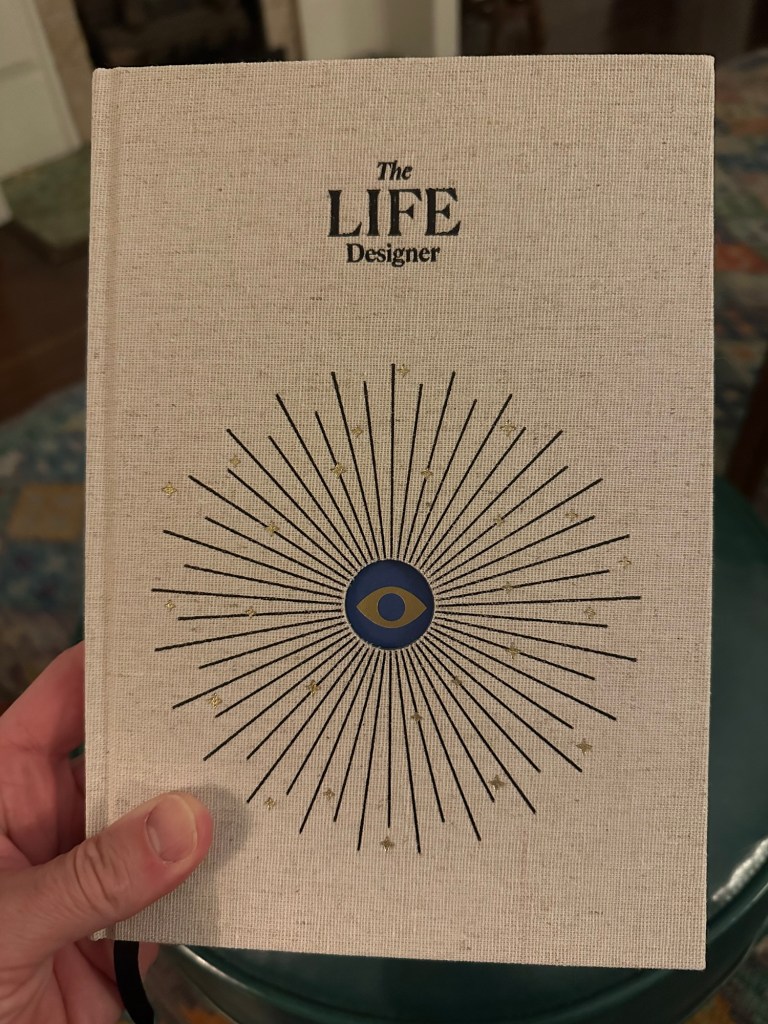
I also decided to start the new Life Designer workbook from Intelligent Change. I bought it before the Samhain connection, but soon realized that it would be perfect for this (new) new year.
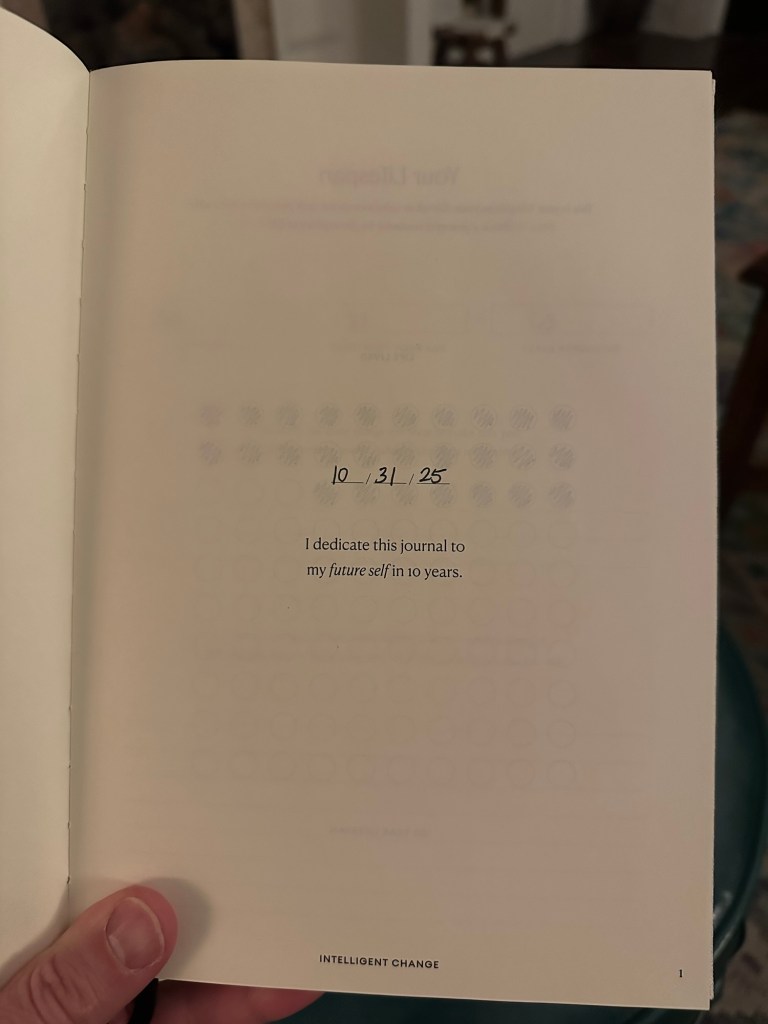
At it’s core, it’s a workbook to plan the next ten years of my life. On October 31, 2035, I’ll be 47 years old. I actually started crying just typing that sentence.
Oh, I also cried when I filled in this dedication page:
I really do not want to get older – I don’t know how else to say it. On the other hand, there have been so many days in my adult life that I’ve just wanted to be over so that I can sleep again.
I know that I have to fix my days before I can fix my years. And since I can’t avoid age, I can’t avoid work, I can’t avoid relationships, hopes, disappointments, responsibilities, etc., I know that it’s time to start thinking about what I want to build on the years I’ve lived so far. Because “the next ten years” are already here.
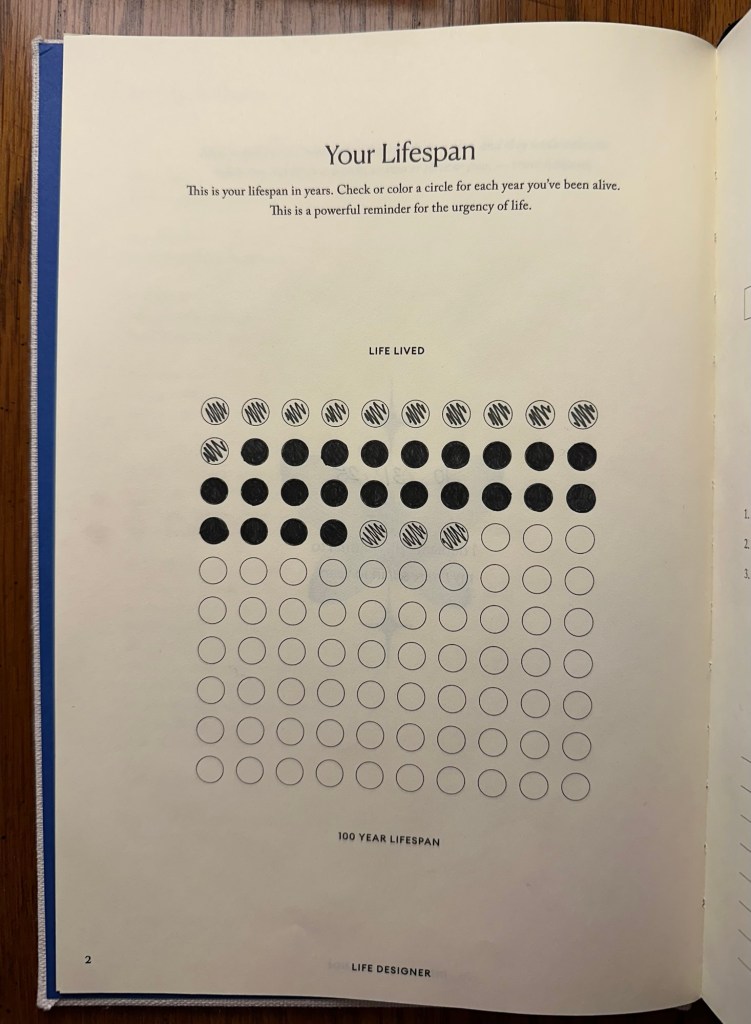
With my fear of getting older, it was encouraging to fill out this chart of the years that I’ve lived so far and see how many I presumably have left.
Even if I live to be 70 or 80 I still have a lot of life ahead of me. The first time I posted this page I did it wrong so this is a new photo. Also, I decided to black out the years that I was in the closet. I cried for a moment when it sunk in that I’ve only lived around 15 years of life not in the closet. Hiding took such a toll on me that I need to label those years differently. Also, being in the closet delays adolescence (like what a 15 year-old would be experiencing) so the past three years have looked very different than they would for someone who is not going through that.
I’ve only just started this workbook, and, based on the witch’s advice, I would like to finish it between now and the Winter Solstice. (update – I’m still working through it as of 1/20/26, but I’ll finish it when the time is right)
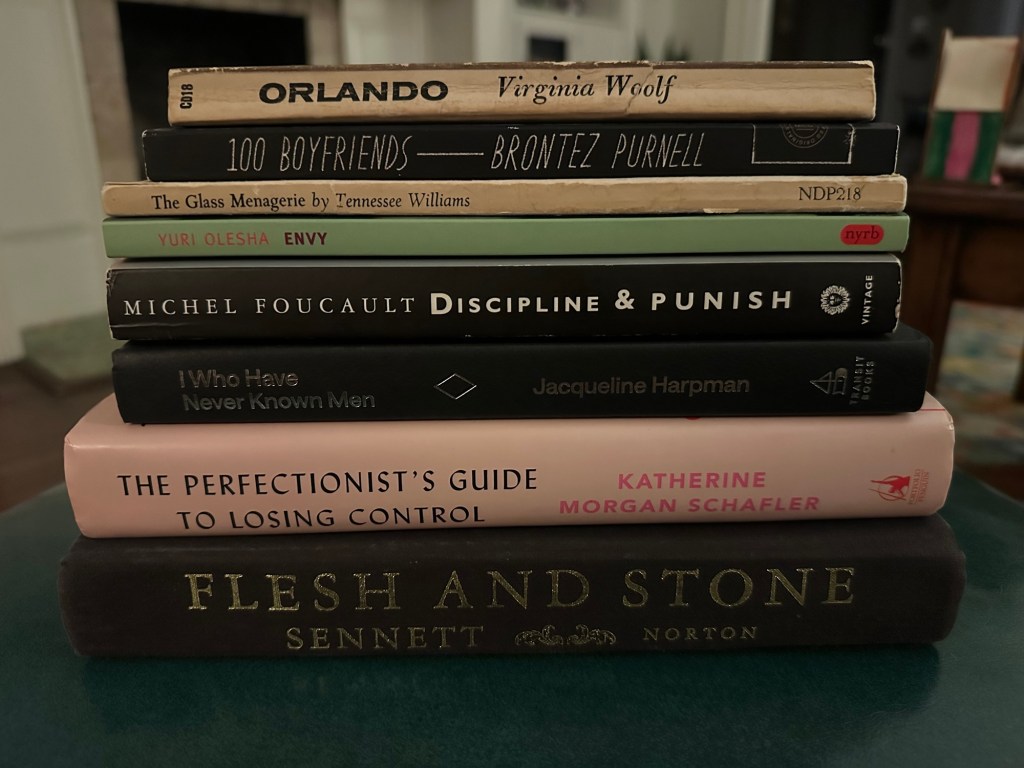
With the seasonal shift toward intentions, I also thought about books I might like to read over the next 12 months. I’ve pulled together a stack that I’m pretty excited about and replaced the one under my side table that has been sitting there for months (years?), mostly unappreciated. This new stack was chosen more carefully and I’d love to actually see the stack tick down as I read each one and the shelf empty by the next Samhain, 2026.
I started the Foucault and Sennett books around 2008 and 2011, respectively. I’ve only read the first chapter or so of each, but they have both been so influential to how I think about things that I’ve decided I’d like to finally finish them. Along with those two books, Orlando,100 Boyfriends, and The Glass Menagerie continue to round out my gay literature cannon. I Who Have Never Known Men and Envy (a personal problem, unfortunately) are two foreign language books I’m looking forward to. Finally, The Perfectionist’s Guide to Losing Control, a book I started during a hard time last year and have decided to pick back up during a new season of loss.
So much of this post may seem like I am trying to control my life, but I really do want to lose control more than anything. I want to let go of legalism, perfectionism, and self-criticism, especially. I am not going to feel like a failure if I don’t read all these books or achieve the life I envision exactly. I just know that there are some things in my life that almost never feel like work (even when they are work). I desire/intend to do much more of the work, to spend time with the people, and to inhabit the places that give me that kind of energy over the next 40 seasons of change.
Last fall I took two online classes through the local community college as prerequisites for a graduate program that I eventually decided not to pursue. Along the way, I discovered James Marcia.
Marcia contributes the idea that as someone enters each stage of identity development they tend to move into four alternative statuses: identity diffusion, identity foreclosure, identity moratorium, and identity achievement.
These four alternatives are connected by the presence or absence of two characteristics: crisis and commitment. The experience of crisis, to Marcia, involves an individual exploring options as their identity develops. Commitment is the moment the individual decides to invest in one option and integrate it into to their newly resolved identity.
There are four different combinations of crisis and commitment that a person may find themselves experiencing during their development. Identity diffusion is the state of a person who has not explored meaningful alternatives and also has not made an identity commitment. Perhaps, they have been made by others to feel powerless to true exploration and commitment or it may be they are simply content and comfortable. An individual who makes a commitment without exploring options is said to be in identity foreclosure. They’ve confidently ended their journey before they even started, often accepting their received culture and path. Identity moratorium is the state of an individual who has explored meaningful alternatives, but has not yet made a meaningful, lasting commitment.
At the end of a crisis, if the person is to have developed in a new way, they will examine all of the options they have explored during their crisis and commit to the one or few that most define their identity in this new context. This is called identity achievement.
It’s certainly not a passive process. Most current research suggests that major identity shifts occur during late adolescence and early adulthood when individuals are embracing their independence and exploring on their own. In early adulthood there is an emergence of identity that is more vetted and integrated. But the process is never finished.
The final truth that I learned from Marcia, for me, is the most encouraging. He believes that in order to achieve a positive identity, most individuals go through “MAMA” cycles: from moratorium (that is, exploring without a commitment) to achievement (choosing and recommitting to your identity) and then back again. “Marcia agues that the first identity is just that—it should not be viewed as the final product.”
With each relationship, job, community, major world event, or other change in life, we are given the chance to reconsider our beliefs and identity. The MAMA cycles are healthy. That was positive news to me—as a somewhat impulsive explorer—and an affirmation that searching is healthy. We can always decide to return to what we already knew to be true, but knowing that we have explored our options will provide necessary assurance along the way.
I’ve primarily learned about Marcia through the textbook Children by John Santrock (2013). All quotes and paraphrases here are from that work.
Sennett here is writing a history of the physical aspect of life in the cities I have been learning about all my life: Athens, Rome, Paris, London. He isn’t interested in an intellectual history: just a bunch of Western thoughts traveling along from one place to another. Instead, he writes, “I was prompted to write this history out of bafflement with a contemporary problem: the sensory deprivation which seems to curse most modern building: the dullness, the monotony, and the tactile sterility which afflicts the urban environment.” With the context of history, Sennett introduces us to the ways citizens have lived differently in the past and the role of the city in protecting and facilitating human interactions.
Additionally, Sennett conjures a common conflict within this history that sets Western cultures in opposition to the body. He writes, “Western civilization has had persistent trouble in honoring the dignity of the body and diversity of human bodies …” from the Greek ideal of male athletes to the multicultural communities of modern Greenwich Village (15).
Consistently returning to the current experience, Sennett writes that rather than interacting with other people while accomplishing daily tasks, even literally bumping into them, many of us live from one contained space to another: the home, the car, the office.
Today, more sensory experiences are now consumed with little required input. Pleasure and pain are most often experienced through television, movies, and video games and even the greatest cities are most often viewed through the windshield of a car. Distances that once involved hours and innumerable human interactions now require only 10-15 minutes of driving. “Both the highway engineer and the television director create what could be called ‘freedom from resistance.'” Sennett is writing from the vantage of this society we’ve created for ourselves in order to prevent unplanned, unwarranted encounter. “Thus the new geography reinforces the mass media. The traveller, like the television viewer, experiences the world in narcotic terms…” (18).
After looking through my books, multiple friends have commented that the large font of Flesh and Stone “stands out” on the shelf or that the title is “weird”. I think Sennett (or his publisher) chose the title partly in order to make people uncomfortable. The fact that it sounds sort of like an adult romance novel is definitely connected to Sennett’s thoughts on contemporary life and our discomfort with even the word “flesh.” Sennett is concerned for the experience of the body in the city in and most importantly the way that social behavior reinforces social connection far more than in merely romantic terms. He writes, “much as today in small southern Italian towns a person will reach out and grip you hand or forearm in order to talk seriously to you” (21).
When I read that particular example I was struck by the simple idea of it and how far it is from normal behavior among my friends and family. Sennett writes to teach us about ourselves and the lives that we live, sometimes prescribed by urban design and other times by cultural tradition we have forgot to even notice
Finally, Sennett concludes with a personal note about the origins of his research, particularly within the context of his friendship to the late Michel Foucault. When they began in the 1970s, he writes that Foucault envisioned human bodies as constrained by tradition, culture, and “choked by the knot of power.” But as he observed Foucault in his last days, Sennett noticed that the fixation on power and control began to relax. As a result, the book that he completed is not the research that Sennett began decades before.
Particularly, he pushed his research beyond simply the realm of human sexuality and, to honor his late friend, embrace the numerous aspects of life that provide meaning and value. He writes, “If liberating the body from Victorian sexual constraints was a great event in modern culture, this liberation also entailed the narrowing of physical sensibility to sexual desire” (26). This narrowing, to Sennett, is no longer necessary or helpful toward understanding human social interaction. As in the example from Italy (I think the Instagram account @notmynonni is a fitting connection here) there are a million meaningful moments in a life that deserve our attention.
Ever-committed also to his hope in the potential of the city, Sennett writes from the Judeo-Christian perspective that the body is connected to the spirit, valued and important. Although I don’t think Sennett is a Christian today (in more recent interviews it seems like he identifies as a secular humanist), at the time of writing this book he identified as a “believer” and acknowledged this perspective in his research. While conceding the Biblical idea of “the fall” and great separation between humans (loss of trust, for example) he also shares the way that his faith weaves into his research and his own stubborn optimism.
Somewhere between the chaos of the past and the isolation of modern life, Sennett ultimately writes, “to show how those who have been exiled from the Garden might find a home in the city.”
While my 16-year-old sister was at the beach last month, she stopped by the local bookstore and bought me a copy of The Image of the City by Kevin Lynch. Amazing. A lot has changed since it was published in 1960, but the main idea is just as important today: we should work to enhance the quality of the experience of each city. Is the city easy to navigate? Is it memorable? Is it hospitable?
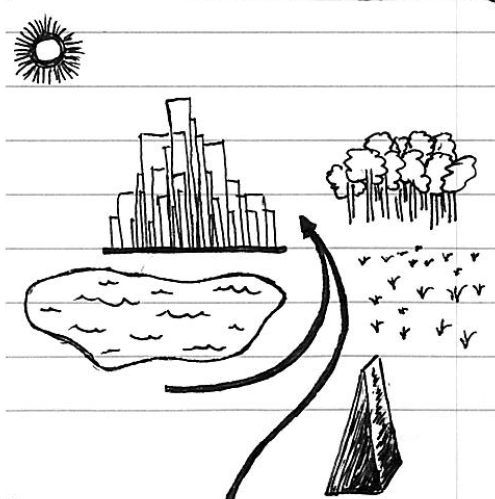
Throughout the book, Lynch uses small drawings to explain his theories. Now, instead of practice my signature when I’m bored, I’ve been doodling:
This is my idea of the best highway experience. The road travels toward the city, embraces the full broadside view of its beauty, then bends around. In Richmond, there is a reoccurring conversation about the view of Richmond from the highway (especially traveling south on I-95). Lynch’s research gives good context to this and similar, ongoing conversations.
To explain his desire to improve cities, Lynch uses the terms legible and imageable. Basically, does it make sense and is it memorable? If it doesn’t make sense to the viewer then it won’t be memorable. I have to add, you want your city to memorable for the right reasons: beautiful, consistent, dramatic, historic, dynamic, creative, vibrant, efficient.
To describe the “imageable city,” Lynch chooses five elements that he believes make up the urban experience. Each of these can either be completely forgettable or incredibly memorable. Here are some examples from Richmond:
Paths (Monument Ave., Grace St., the Boulevard)
Edges (the James River)
Districts (The Fan, Church Hill, and many others)
Nodes (downtown, Carytown, MacArthur Ave.)
Landmarks (The Sailors and Soldiers Monument, The Carillon)
Fortunately, Richmond has been blessed with examples that show off the potential beauty of each element. At the same time, there are many issues with the “Richmond image.” To many, it’s a confusing and disconnected city.
To move forward, we need to find simple ways to turn everyday elements into memorable, quality experiences. For decades, economic development in Richmond equated to wedging large-scale projects in or near the central business district. These projects aren’t going to improve the overall experience of the city. In contrast, improving the most basic elements—paths, edges, districts, nodes, and landmarks—will gradually create what Christopher Silver refers to as the “Good City.”
The real lesson of the book is that urban form is important from border to border. It’s a lesson for us as we work to create the best possible Richmond: a city that is coherent, beautiful, and vital.
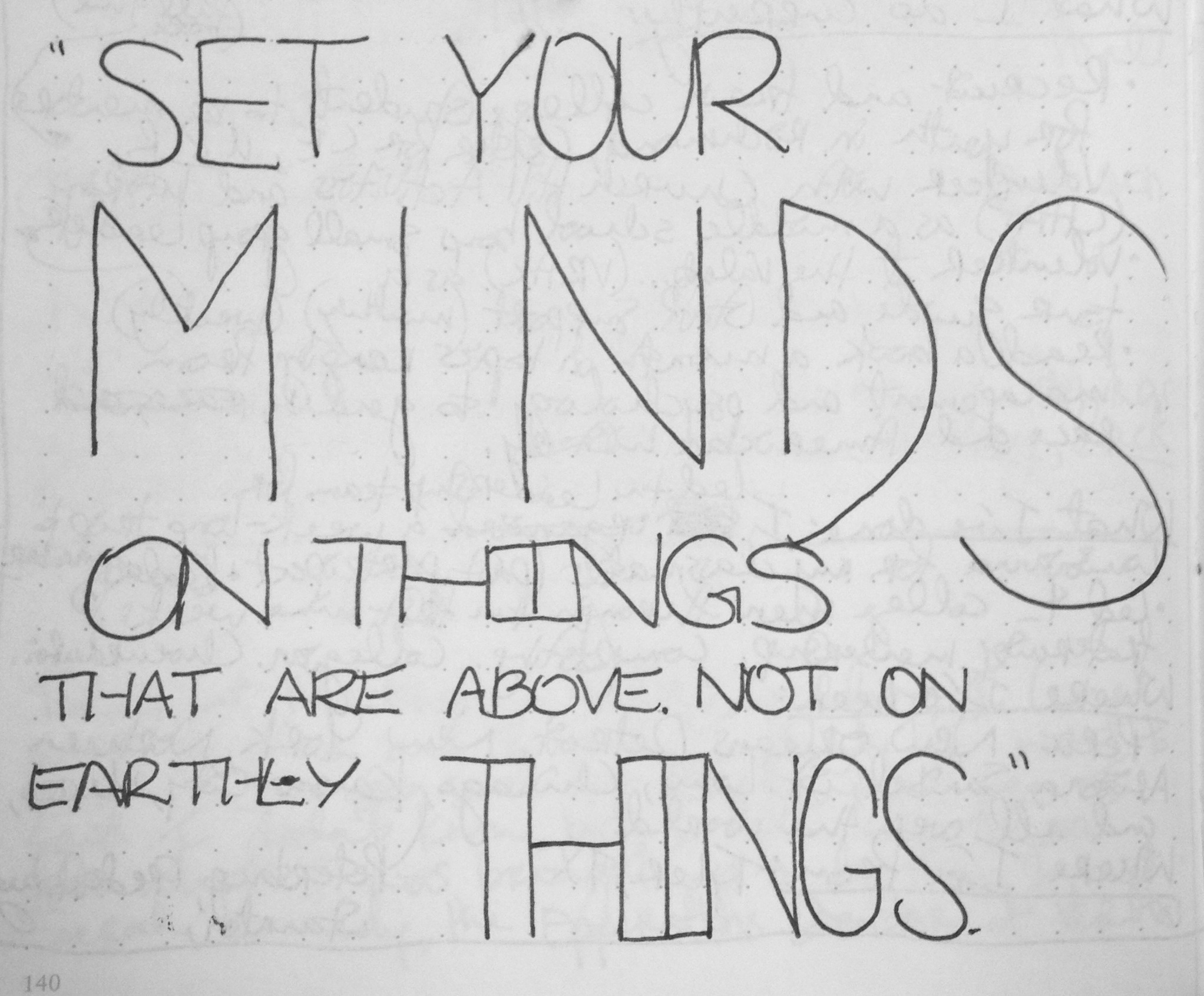
There are some verses in the Bible I could read every morning. This one struck me a week ago because I never really realized how much work there is implied between the lines. In a world where everything I experience with my senses is earthly, this verse is a challenge. I believe the word “set” is an active process. This is the work of faith.
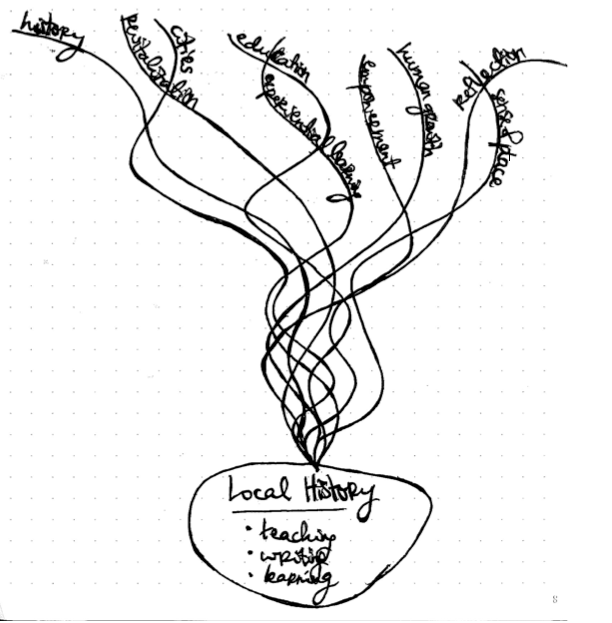
While flying back to Richmond a few weeks ago, I drew up a brainstorm for my future. All of the sudden, it became clear that local history is something that I could champion for a lifetime. It’s not really a brainstorm. It’s an observation of my past and a hope that, with a lot of work, all of my various interests might be resolved into one goal:
I recently moved out of the house I lived in for two years. That is the longest I’ve lived in any place in the city of Richmond.
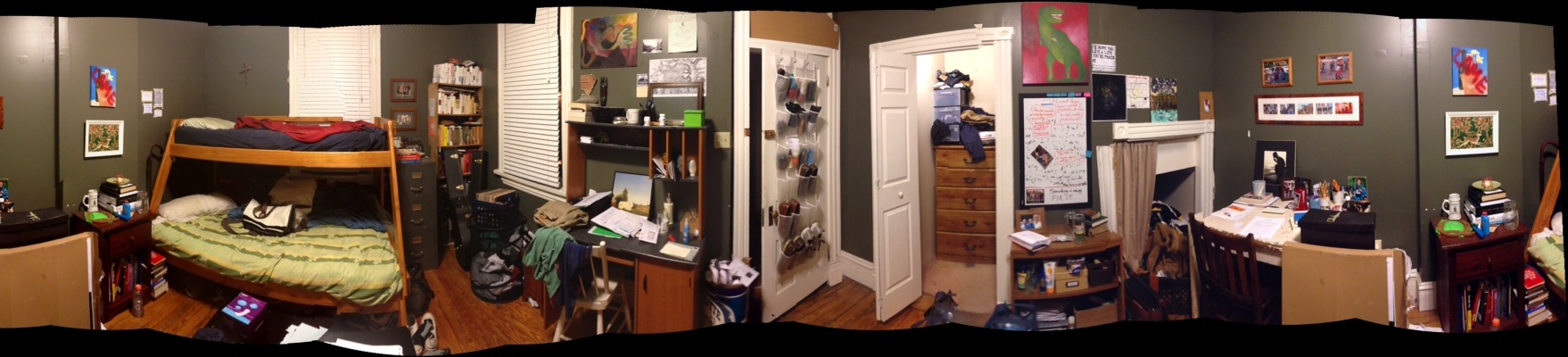
Before I left, I stood in the middle of the room to take this panorama of the space as it never again will be:
I spent two tumultuous and rewarding years in this room as I worked to resolve the dissonance of post-grad life. I printed photos, hung my art, displayed my books, and taped inspirational quotes and life lessons everywhere:
“Something is wrong. FIX it.”
“I went from, ‘How could I possibly do this’ to ‘ How could I possibly not?'”
“A man without self-control is like a city broken into and left without walls.”
The night before I moved out of this room, I posted a photo on Facebook and wrote a long, emotional homage to my room and house of two years. Two weeks later, I had almost forgotten about it entirely. I moved into a new house, created a new routine for myself with new habits and a new environment. I have new roommates and a new city block with new neighbors to meet.
Also, I’ve realized that over the past few years I developed the habit of leaving unfinished business laying around. In the photo above, it’s on my desk (which I rarely used as a desk), on the floor, on my bed, on my bookshelves. Moving was an incredibly healthy process for me as I was forced to sort through all the unfinished tasks and gradually resolve each one.
So I’m glad I took this photo. I’m incredibly thankful for the two years I spent in this room, the two people that I shared it with, and a total of 15 guys with whom I shared the house. It’s a powerful thing to share a space with someone.
Light illuminates dust played through the air as everyone goes everywhere. It’s golden hour in the Charlotte airport.
Staring into that playful dust takes me to my playful past. A son drapes his arm over his dad’s shoulder. A woman walks by talking on her cellphone. The world draws me away from my book then back into my mind.
Book. World. Mind. Journal.
I’m amazed by the depth of our diversity. Where are we from? Who do we love? Where are we going? The dust in the air turns day into dream. Conversations, beeping shuttles and rustling feet fade to the background as I, entranced by that light, sit and rest like a silent protagonist monologue or a string of thoughts tangled and blended together.
The sun is now shining on my entire body from the window across the room and I can feel it when I close my eyes. When the sun begins to set you wonder where you’re going to rest your head, and with whom.
I first wrote this as a journal entry in May, 2013.
“I will hurl you and the mother who bore you into another country, where you were not born, and there you shall die. But to the land to which they will long to return, there they shall not return.”
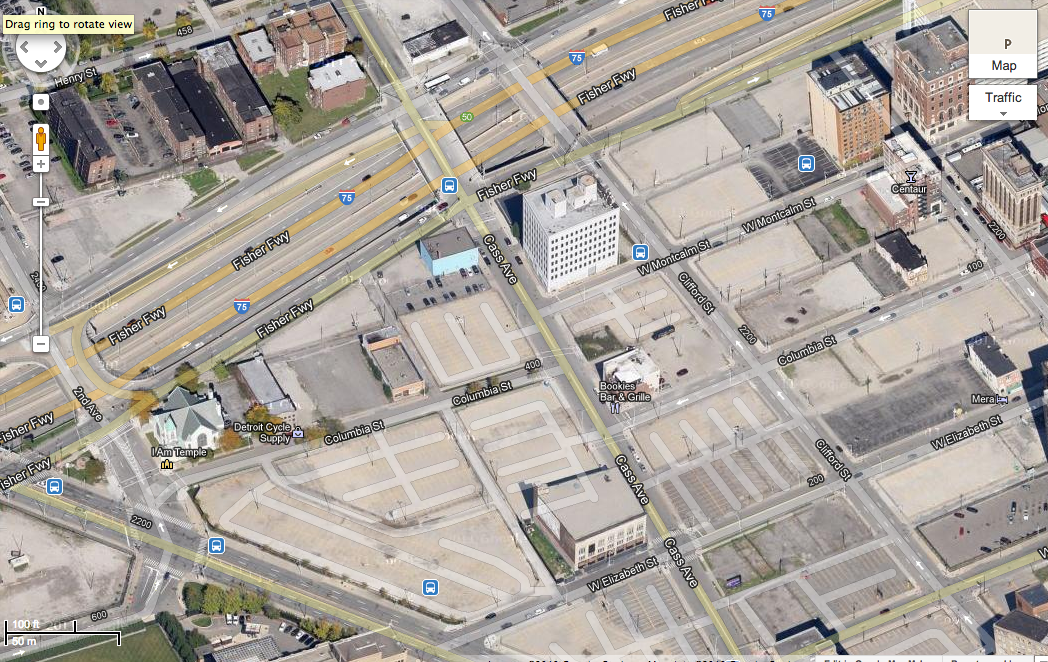
There is something that’s been bothering me since I left Detroit. It’s a lingering question: What would America be like today if auto workers throughout the Twentieth Century had rioted and protested against the American government rather than corporations for benefits and a fair wage?
What if the corporation was the wrong target all along?
Today, many people look to Detroit as a failure of unions demanding too much of corporations: health care, pensions, company cars. I disagree with this opinion, but I do see the point: residents on that frontier town were struggling too locally. This made Detroit a formidable industrial town for corporations looking to do business. But their struggle didn’t benefit or protect the rest of their nation with federal policy.
I think one reason workers demanded help from their employers was their perceived permanence. From the nineteen teens to the 1950s the auto industry in Detroit seemed as permanent as the nation itself. I think that it was also a matter of proximity for disgruntled employees: Workers in Detroit could march down the road to Ford’s River Rouge plant more easily (even with the fire hoses and armed guards) than they could drive 10 hours or so to D.C. Unlike Paris and London, our nation’s Capitol wasn’t the heart of industry and labor reform.
Ford was close and he was rich. The businesses in the city also had the most to lose and so it was here that employees felt they had the most leverage. With sit ins and riots they demanded their humanity and their health. And won. As their employers rose to global prominence the quality of life for middle class residents of the city continued to increase.
And then Martelle writes that two things happened: globalization and vertical integration. New factories were increasingly being built abroad and auto parts were increasingly being manufactured on site rather than purchased from suppliers. Neither of these is the fault of Detroiters. And then there was the flight to the suburbs and the Sun Belt, encouraged by federal policy and grants to decentralize defense industry and connect the nation with highways.
In sixty years, the city flipped in every way imaginable.
Today, the Big Three have taken their factories elsewhere and acquired or driven out many of their parts suppliers. With their departure went their jobs and salaries as well as their accompanying healthcare and other benefits. The classic quick-one-two jab of American unemployment.
We’ll never know what America would be like if we had demanded more security from our national government as we industrialized. Perhaps we’d be falling like France or maybe we’d be rising like Great Britain.
While we benefit from the labor struggle in Detroit, we continue to blame the city for demanding more. When really I think they should have demanded differently.
I’m going to Detroit. In preparation, I’m putting together a reading list, calling interesting people for advice, and working my network to put together a legendary survey of this monumental city. I will likely post about Detroit in advance of my trip, potentially during the trip, and certainly after the trip. For now, here’s my reading list:
When I was in college, I loved to plan trips like this so I’m beyond excited to get back into the fun. Can’t forget about fun 🙂 Maybe one day I’ll have a job that encourages me to plan trips to places that have a story to tell, lessons to learn, and a creative vision for the future. Until then, Detroit awaits.
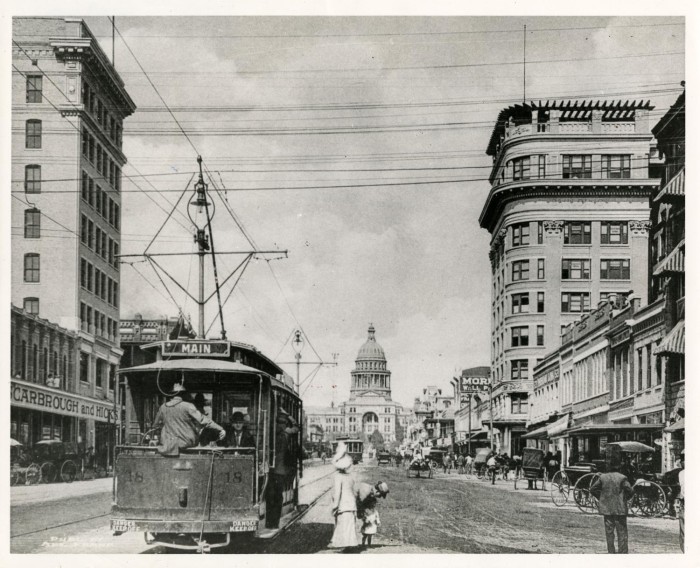
“Not Even Past,” a blog produced by the history department at the University of Texas at Austin, just posted a piece about streetcars in the city. It’s amazing how similar the story of one American city is to the next.
“Cities have become the career dressing rooms for young adults. They have become the place where people go in their twenties to try on different identities. Then, once they know who they are, they leave.”
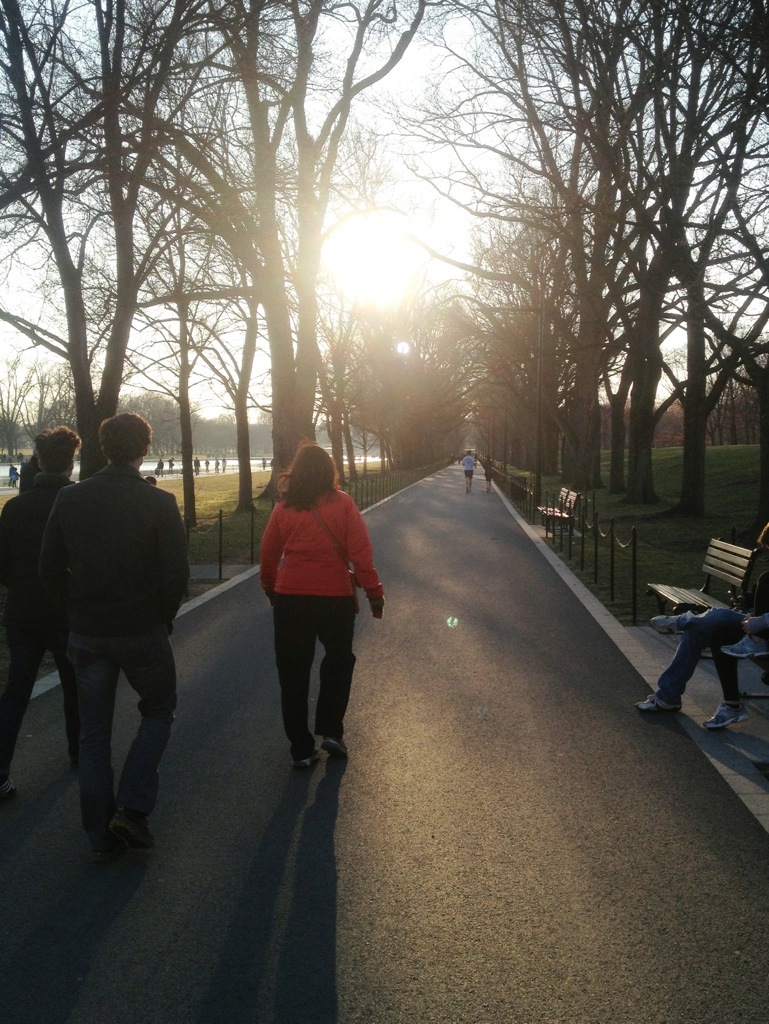
I believe that the beauty of D.C. is the simplicity of a good plan: symmetry, long vistas, and grand terminals. All of these qualities are found in the allée.
Here is a photo I took while walking the National Mall:
What I love about the allée is that it’s so simple. With a straight path and some lovely trees we could turn any formless green space into a memorable experience.
With the allée, a simple path becomes dramatic. A walk becomes an journey.
At the Lincoln Memorial, beneath the text of the Gettysburg Address, there is a room with an elevator and a door. In this room, while waiting for an elevator that never came, I noticed a sign for the US National Parks Service:
“That’s interesting,” I thought, “Native Americans and bison.” Two groups that my ancestors hunted to the brink of extinction. Yet, today they symbolize the preservation of our wild frontier.
Whoops.
After I made this connection, the looming text of the Gettysburg Address started to feel like a grand contradiction. This speech was given almost three decades before the Wounded Knee Massacre that finally ended the American Indian Wars. When he gave the speech, Lincoln made the bold claim that the phrase, “all men are created equal,” applied to enslaved people, but he made no mention of the other war out West.
Instead, he said that “our forefathers brought forth on this continent a new nation, conceived in liberty…” It was an incredible proposition (and it’s a remarkable nation), but our forefathers needed a clean slate for this new, great nation. So they drove away all signs that this wasn’t a new or completely pure endeavor.
Native Americans were quarantined to the remotest sections of this land-rich nation. Today, many residents of the reservations live in poverty, many desire cultural and traditional significance, and many long for the places of their forefathers.
This world wasn’t new when America was founded. Freedom wasn’t truly extended when the Civil War ended. Today, we are living the dreams of Europeans that took a chance.
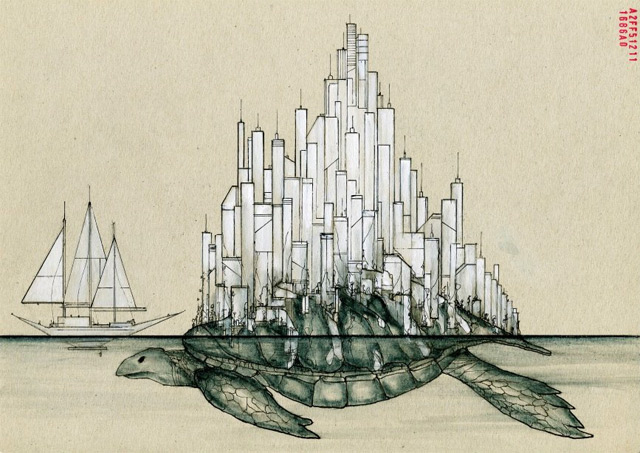
I found this image on one of my favorite blogs, Colossal. It seemed like a perfect example of the truth that cities are not a place where you have to get stuck. Investing in a city (and making it your home) doesn’t make you dependent. Cities are an adventure. There is some danger in this adventure, but without high risk there’s no chance for high reward. This photo also reminded me of one of my favorite Foucault quotes from an essay I first read five years ago: “Of Other Spaces.” He writes,
“In civilizations without boats, dreams dry up, espionage takes the place of adventure, and the police take the place of pirates.”
With twenty-first century communication and connections, the modern city has become a boat (er, turtle) and if you are willing to commit, it will eventually take you somewhere completely new:
You know that brief moment in “Tarzan” when he is flying through the air between vines? That’s basically been my life for the last five years.
Like many of you, I left my family and friends to start college in Richmond. My first night in town, I had dinner with a student named Dan and listened while he shared his story. He became my first friend and connection to this place.
The next day, he introduced me to a few of his friends and his favorite professor. We laughed, they made fun of each other, and I began to imagine that life on this campus might actually work. In some small way, I was closer to home.
I had no idea how fast time in college would move. I especially didn’t know how significant those first few friends would be in providing me with advice as I made my way through the maze of classes, programs and professors. Without their help, I might have never found that sneaky second vine.
Looking back, I wonder why I listened at all. I could have disregarded their advice and found my own way. But for some reason I appreciated their experience and trusted strangers in a strange place.
Lesson #1: When life gives you strangers, hear them out. At the very least, you’ll have a story to tell. At best, you’ll have a new guide to show you the way.
These new friends told me which classes to take (and which not to take), welcomed me into their community and drove me to the ER when I fell out of a tree and broke my arm. That’s right, this Tarzan metaphor just got real.
Not much has changed from those early days in Richmond. If I’m honest, the vines just feel farther apart and the fall much farther below. The only difference is that I now have faith that someone will introduce me to someone who can show me the way.
I’ve also matured a little since then. I certainly appreciate people more than I used to. While I usually took advice from others, I also regularly took it for granted.
Appreciating our mentors doesn’t mean we have to become our mentors, but it does mean that we have to give some effort. We have to be willing to say yes to something new and outside of our comfort zone.
Lesson #2: Receiving advice means humbling yourself long enough to actually listen.
I’ve also learned (many times over) that being mentored isn’t simply about receiving advice. Mentoring is not a product to consume or even a loan to repay. It’s also not supposed to make me feel good about myself or confirm what I already know. At its best, mentoring is a truth and a challenge. Mentoring first says, “I think you can do it,” and then, “Here’s what it’s going to take.”
Being mentored then becomes more about making choices than discussing ideas. When you receive wise counsel, it’s not a hypothetical in a book; it’s wisdom applied to your life. Receive it and say, “Thank you.”
Lesson #3: The more often you ignore someone else’s advice (for no good reason), the less likely they will be to share it.
When we commit to being mentored, we become a part of generations of mentors who have been acquiring and passing down wisdom for years. Open yourself up to wise counsel, prepare to be honest, and be willing to be wrong. Then, if you really want to be stretched, you can become a mentor yourself.
You may think that you’re not patient enough to mentor or that you don’t have enough time. But that is exactly why you should do it. If life gives you a chance to grow in a new (and uncomfortable) direction, shouldn’t you take it?
You can become more patient and eventually learn how to make time for the relationships that matter most. You can have the chance to pass on what was taught and the advice you have been given. And, for what it’s worth, I think you’d make a great mentor.
This article first appeared in print on January 30, 2013, in The Collegian.