Category Archives: Movement

We, the Mobile

As I rode home from work on Friday, I decided I needed to get out of Richmond. For me, a 70-mile drive to Charlottesville is far enough to feel like I got “away” from my routine life. That drive down I-64 was the beginning of an idea that has everything to do with highways and hallowed halls: the faster you can get somewhere the closer it feels.

I’ve been told that humans have always considered a reasonable commute to be about a half of an hour to an hour of travel. Walking, that would be about 3.5 miles. Driving, that could be a trip from Trenton to New York. Flying, that’s a D.C. to Chicago commute that no child dreams to have when they grow up. While the amount of time we travel to work has remained relatively the same, the increase in distance has been significant. The affects of this distance are profound.

In the early 1900s, before the Model T and good roads, many wealthy Americans owned second homes just outside the city. In Boston, for instance, this was the rural getaway known as Jamaca Plain. Near Richmond, it was the neighborhood of Bon Air. Originally a retreat ten miles outside the city, Bon Air was frequented by Richmonders who wanted to get “away” from the stifling life of an industrial city. Today, Bon Air is near the middle of a metropolitan region and considered just another inner suburb. Meanwhile, the wealthiest residents are more likely to have second homes in Sun Valley or Naples than rural Virgina. The idea of buying a second home 10 miles away seems absurd. The faster you can get somewhere, the closer it feels. But is it actually close?

Many American cities today are populated by the children of faraway parents that raised them and watched them leave. I am one of these children. I was given the chance to move over 1,000 miles from home to live somewhere new and exciting. I have been given the chance to go out on my own. But when did this become normal? We, the millennials, are the fifth generation of Americans with access to cheap gasoline and the third generation to grow up with interstate highways.

We grew up as the unsettled generation of an increasingly mobile nation. There have always been wealthy people, but there have not always been turbojets and 70 mph speed limits. This has changed the way we see distance and separation.

For instance, I live about three-and-a-half hours away from my hometown of Tyler, TX. By plane. So that’s about 22 hours away by car and 349 hours by foot. When I left Tyler for college I didn’t really think it was a big deal. Now, it feels significantly farther than I originally imagined. In my sixth year of life away from Texas I can say there is much I have learned while I’ve been away. I wouldn’t change my decision to leave if I had the chance. I love the city where I live and the university where I studied.

But there is this simple, lingering question I am asked every once in a while that I can never completely answer: “So, how’d you end up in Richmond?”

Like most, I tend to focus on the “pull” factors of migration. Oh, I came here for college and fell in love with the city. I usually also make a joke about how the University’s website was easy to navigate or that Richmond wasn’t as cold as Boston, another city I considered for school. But why, as a senior in high school, did I not consider a single school in Texas or even somewhere closer like New Orleans or St. Louis? Why the 1,000-mile trek? There are a few easy answers I can think of:

  1. My brothers did it
  2. My parents let us
  3. I knew I would only be “a flight away”

But that doesn’t really answer the question. While there was a draw to move away, there were also significant “push” factors that sent me away from my southern home. In the land of football and Rick Perry, I didn’t really think there was a place for a friendly writer trying to make a difference. I made lots of unfavorable generalizations to justify my move away, but at the same time I was more focussed on where I was headed. When I applied to college, I dreamed of a place where people liked to read and write, where Christians didn’t all look the same, and where it wasn’t weird to suck at basketball. I didn’t know if I would find that, but I figured it was worth a shot. Everywhere I went in Texas, I saw the same story and realized that, while I think it’s a great story, it would be a hard one to fit into.

So I got out. I became one of the many confused Texpatriots simultaneously displaying a Texas flag and critiquing that beautiful, mineral-rich place.

And here I am: living in an old mansion in Richmond, working at an amazing university that also happens to be my alma mater. My neighborhood is both dangerous and beautiful depending on who you ask. My house is used as a tutoring site for hundreds of kids each year. My city has representations of American architecture going back to the 1700s, fine art, public murals, excellent restaurants, and more. It’s not D.C., but it’s also not snooty and it suits me well.

And yet, if you notice, all the positives aren’t really adding up. There’s always the question, “But what?” Living in Richmond is awesome, but it involves this thing I call the golden triangle of growing up: the pull between a career, a significant other, and family/hometown.

This is how it plays out:

Whenever I think about moving home (or at least near family), my first thought is that I can’t go back until I get somewhere in my career. There’s not much of a market in Tyler for someone who made up their own major in college. Then, whenever I think about advancing my career (a word I routinely misspell) which might involve grad school somewhere far away, I immediately think about my girlfriend and wonder how the timing of both will work out. Thinking about our relationship then takes me back to thinking about moving home and I imagine a life of holiday swaps and long-distance in-laws. Again, when I think about home, I think about my career pulling me all across the nation and I wonder what my little sister will be up to as she finishes high school and enters young adulthood herself. I wonder if my parents will be sitting on our back patio enjoying those cool spring afternoons in Tyler while I’m who-knows-where doing who-knows-what. I think about my three older brothers who are all living in this golden triangle as well and I wonder if we will ever manage to live near each other again.

I wonder if I will ever get to move home and whether it will still be home when I get there.

When you’re in a relationship with someone that’s in a similar situation, you also realize that at some point one of you will have to bend for the other. That’s the compound reality of this golden triangle: both of you can never have all three at the same time. And since both people in relationships today have educations and aspirations, it takes a lot of energy to make it all line up. Often people choose to go their separate ways, some struggle through the long-distance life, and others manage to work it out in the same place. Even when it does work out, it can be a gauntlet of long-term planning and flexibility.

That brings me back to my trip to Charlottesville. I’m currently sitting at a coffee shop with four friends I’ve met since moving out to Virginia. Between the two couples and myself, we represent five home states: Tennessee, Ohio, Maine, Virginia and Texas. We are all living in the reality of the triangle:

I am from Tyler, TX and my girlfriend is from Medford, NJ and Sanibel, FL. We both currently live in Richmond, but our families are scattered from Florida to California. My friend, Max, who is originally from Portland, ME, currently works and lives in D.C. where he met his girlfriend, Shannon, a native Tennesseean (who also moved around growing up), in D.C. just before she moved to Charlottesville for law school at UVA. Max is currently applying to law schools around the mid-Atlantic region and hopes to end up somewhat close by. Margo, another friend from college, is currently living in her hometown of Cincinnati and hoping to start medical school in the fall. She got into the University of Cincinnati program but is trying her darndest to get into a med school in Virginia so she can live near her boyfriend, Joe. Joe, a native of Richmond (the only native Virginian in the group), is currently in the UVA post-bac program so that that he can apply for med schools this summer and start a year from now in the fall. If Margo starts the program in Cincinnati, he will likely move to Cincinnati to work while he does his best to get into the same program or, if he only gets into a program in Virginia, she may try and transfer after her first two years.

It’s no wonder some are calling us the most stressed-out generation.

Max made the comment last night that we are living in an era of “progressive instability” as young adults in Twenty-First-Century America.

“Dramatic instability,” he added.

Since the best opportunities are no longer nearby, we find ourselves settling into LDRs (long-distance relationships) while we find jobs or attend grad school. Even if you don’t want to go to grad school, you’ve most likely thought about it. Max made the comment that the economy expects us to have graduate educations, but doesn’t facilitate the experience. Also, with MBA programs like UVA’s Darden that charge $76,000 a year for in-state tuition, our generation is making history in the way of personal debt.

With the sluggish economy, vertical mobility is synonymous with geographic mobility and cross-country job searches are the norm. This was once the time of life when people began to build stability, moved home, and started a new chapter of life. Some of my friends have managed to work that out, but many of us genuinely didn’t know it was an option. We, the mobile, have followed the allure of big cities and fresh lives.

No longer a time for building community, the twenties have become a very dynamic stage of life. One misstep and you’ll be roadkill in this “Great Recession” that sees unemployment as a mark of personal failure: you can’t get a job if you don’t have experience and you can’t get experience if you don’t have a job. Of course, it can work out, but it’s a little terrifying at the same time. And we are all living in this reality from day to day. Every once in a while I think about all of this and I take a very deep breath. It’s just too much to consider it all at the same time.

In a decade, I hope I look back and laugh at the golden triangle of growing up. I hope we will have a chance to tell stories and swap war wounds on the other side. I hope we all keep our sanity in the process and I hope we remember what matters most. What makes people happy today is what made people happy thousands of years ago: close relationships, good work, and unconditional love.

In the world of the golden triangle, it’s simply a question of where.
The end of an era

Just about anyone who loves Richmond has heard a story about streetcars: Did you know Richmond invented streetcars? Did you know that Ginter Park was a streetcar suburb? Did you know they piled them up and burned them all in the 50s?

And so the stories go, a hint of nostalgia here and a tinge of sadness there.

If you don’t love cars and highways, odds are good that part of you longs for streetcars. You also might have loved Richmond in the early 1900s when the city was denser (16,000 residents per square mile), connected (more than 80 passenger trains arrived in Richmond daily) and dynamic (real estate values doubled on Grace St. in the 20s.) Yes, this was the time of crowded streets, industrial haze, and grand plans to make our cities beautiful. In many ways, streetcars have come to represent this era as a symbol of the public good and a physical commitment to the life of the city.

From 1888 to 1949, the streetcar reigned as the liberator of urban life. No more stench of horse manure! No more flies! No more walking for miles in the rain! Streetcars filled a need for transportation with incredible efficiency and in a matter of years became an integral part of this growing city. But just as streetcars have come to represent the dense, thriving city, their removal has become a symbol of mid-century American planning and desire for change. As streetcars were ascending to power, the wealthiest of Americans were already turning their attention to the unbounded freedom of the automobile. The military also took note during WWI and afterwards paraded trucks through cities across the entire nation. Compared to cars, streetcars were standing still. You know the rest of the story: highways, suburban sprawl, urban decay/destruction, new neighborhoods, new churches, new malls.

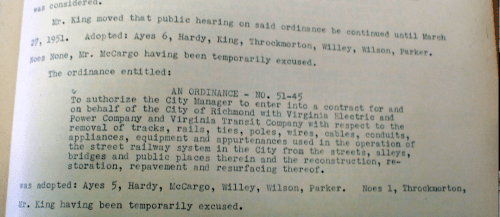
But that’s not really how I want this story to end. Rather than chase cars through the next 60 years of history, I want to remain in the moment that the streetcar era ended and the very memory of streetcars began to fade. The moment when the Richmond City Council passed ordinance No. 51-45 and decided to remove every last piece of streetcar infrastructure from Richmond’s “streets, alleys, bridges and public places therein.” When I found this page in the city council records, I was struck by the wording of the ordinance:

Everything removed

The process just seemed so easy and the change so vast. I pictured a huge eraser passing over the city, wiping away all of that clumsy streetcar infrastructure. The people of Richmond were changing, the city itself was changing, and transportation would never be the same. The streetcar, it seems, couldn’t leave fast enough.

For more artifacts from my research, check out my Archives page.

A year

This story starts, not in the year itself, but in those preceding that conspired its form: to understand the confluence you must also embrace the tributaries of life. Bind the tails, I have been telling myself, and see how other lives have stretched out to your own and brought you to this moment in this place with these people. Bind the tales, I tell myself, and see how one life is made up of many.

The foundation of this story is the past that has been mostly lost. There was an alcoholic man who left his family just before the Great Depression, a young girl who watched all of her family’s belongings sold on their front lawn, somewhere a boy found a love for planes and a young woman found her love for him. The foundation of my story is this love, these two sets of people, their commitment, and their families that became my own.

The story moves to Dallas, Texas, where the Quin family and the Rogers family grew, saved, and travelled on airlines that have since been bought, lost and replaced. There was a great war, America increased, there were riots and protests, Curtis Rogers was killed in the jungles of Vietnam, Mrs. Quin died of cancer in a hospital in Dallas, and, as their families felt the shock of loss, two high school students chose, at the last minute, to go to Baylor instead of UT. Jane Quin and Rick Rogers met during those years at Baylor, but it was later when they both moved to Dallas after college and even later still that they did finally fall in love. And, like their parents before them, committed their lives to each other and an unknown future in an unknown place.

This story finds its roots in Rochester, New York, in the early 1980s. A boy named Daniel Fisher loved the Allen family and he walked to their house to see his best friend, Johnathan, and Cindy, the mom who loved him as her own. After a few years, the Allens left Rochester, but they never forgot the city where they spent their first years together as a family. Time passed, Daniel and Johnathan grew, the Iron Curtain fell, Clinton served two terms, Cindy got a new teaching job in Tyler, TX, and down the road a boy named Michael was born to a doctor and a retired nurse who had recently moved to the neighborhood from Dallas.

The story begins to take shape in the kitchen of my house in Tyler where I prayed with my mom to accept the love and forgiveness of a God I had been told could hear my voice. My story moves to the woods behind my house where I imagined an empire in the trees and to the floor of my bedroom where I prayed for a new life and a better future. And so I grew, learned to read, swim, bike and run, travelled, fell in and out of love, lost and made friends, and, at some point between then and now, became a person.

Lives began to converge when my oldest brother Curtis finished elementary and moved to a private school on the other side of town. Following precedent, we all moved to this new school and as I moved through the next ten years, Cindy made a reputation for herself teaching American history and leading others. She also began to advise the high school student government to which I was later elected and devoted. Then, as I looked to finally move away, Cindy told me about a young man from Rochester named Dan who was about to graduate from a university in Richmond. If I was interested, I could meet him and hear his story.

I did apply to the university and, when accepted, flew up with my dad make a decision. Dan, then in his early twenties, met us for dinner at an Italian restaurant in Carytown and told us about life at school, a professor named Rick Mayes, and the neighborhood of Church Hill where he and others were planning to start a high school. The next day, Dan introduced me to Jason Barnes (who now lives with Caitlin on 26th), Benjamin Telsey (with whom I travelled to Peru to study with Dr. Mayes), Sarah Burd (who now lives on Chimborazo Blvd.), and Michael Kolbe (who moved in with Adam Hake with whom I lived during our first year of college across the hall from Rashad Lowry who now lives on 23rd and with whom I currently work). I did not understand at the time how significant this move to Richmond would become.

In my first semester, I rode with Alli Barton every Thursday morning to tutor (her future husband) Dan’s math students at Church Hill Academy (where I also taught for the past year) and spent the afternoon each week at Captain Buzzies Beanery, my first love in this beautiful, lonely city. Three years past, I did not transfer as I claimed I would, Gordon Meador (who lives on Oakwood and with whom I taught) told me about Shane Claiborne, I attended Urbana and the CCDA conference, and found myself hopelessly drawn to a Christian faith that challenged paradigms and transformed lives. A man named Adam Burgess decided to work at CHAT and later walked with me through Chimborazo Park as I decided to commit to the summer internship. Already connecting the dots, I told him that I had been headed in this direction even before I started school.

I spent that amazing summer working at CHAT, but when I returned for my fourth and final year at Richmond, I left that summer behind. I interviewed at the Deloitte offices in Arlington, fell in love with New Orleans (again), (re)started dating Nina, considered a year abroad, and began to feel trapped by this city that had given me so much. I watched as my friends left for China, DC, New York, and Atlanta; whether they were going home or abroad, they were going somewhere else and I felt, again, like I was stuck. But God, in his sovereignty, desired that I would continue my commitment to this one place and these people he had given me for this time. He was drawing me to Richmond years before I even knew where it was on the map and had not yet finished teaching me what I had come to learn.

Nina accepted her calling back to Church Hill far more readily than I did as I continued to resent all that I had come to love. Once Richmond started to feel like home, I wanted to get away. I eventually applied for the yearlong internship, but in this move toward that life there was also an emotional move away as I reconnected with family and friends in Texas. When I did commit, I had no reservation in my heart that I was making a decision to accept the life I had been given and God’s plan for my future.

With that behind me, a new year gradually began to take shape. Friends, family, and my home church in Tyler committed to fund my salary, Gina Maio and I discussed what classes I might teach, Chris Whiting told me about life in the Lighthouse, and I carried on exploring my hometown learning how to read and write. Before I started this year, I thought it would be much like the twenty-three preceding years I had already lived. I thought my life would be similar to the life I had come to love in Richmond, but with the addition of work at CHAT and the academy. I did not yet realize that, in ways both simple and profound, life gradually becomes work and work isn’t all that bad.

I drove to Virginia at the end of August, moved into the Lighthouse where I was joined by Daniel, Matt, Steven, and my own brother Will. Nina lived down the road and we drank coffee on our first morning together in Richmond with no idea what we were about to experience. We simply started the day as we would start hundreds more. The days were long and the weeks were fast. The heat of summer cooled, leaves turned brown, Jamel T. Cobb was killed and mourned, Khalil Clark was born and celebrated, Nina and I somehow became teachers and bus drivers and tutoring coordinators, mentors, and, eventually, neighbors in this home away from home.

Winter came, however reluctantly, ice on the bus windows had to be scraped, and on Wednesday, January 19, 2o12, I went home from work with a virus that emptied my stomach and stole my day. I slept for 36 hours, my coworkers covered my classes, and when I woke up on Thursday, I started to write. In a Google doc titled “personal reflection,” I wrote and wrote and wrote: 2,608 words I wrote about feeling like a failure, about wishing I were home with my family, and about the desire to finally learn how to do hard work. The next day, the reflection doubled as my teaching style transformed and my perspective grew. This reflection (now over 45,000 words and counting) signaled a bit of a mid-year awakening within me as I found perspective and began to value my thoughts enough to write them down until they gradually started to make sense.

The calendar progressed as Epiphany became Lent, coffee became hot tea, and work stretched into more work. February and March dragged on (as we were told they would) and we looked forward to spring break, to the weekend, to the end of each school day, the end of tutoring and the idea of something called rest. There were worksheets, of course, and videos and tests, quizzes, projects, NWEA, arguments, unuttered rage, tears, laughter, conversations about another life, and dreams of “para-para-paradise.” I wept as five students walked across the graduation stage and in my brokenness I began to find more love for their stories and their future selves.

Summer, like life, has not been what I expected. What I thought would be easy, has been hard, and what I thought would be hard, has been easy. There are new faces in the Mix, new events and partnerships, and a renewed commitment to the program. It has been a blessing to let God redeem this year, take on my burdens, and gradually continue to transform my life as well as theirs.

I do not know how it is that I find myself, two weeks until the end of a year, already boxing its contents and sharing its thoughts. It has been a good year and, as promised, life has been abundant. It will also become something new as my life moves on and others move as well. I have faith that, in ways I can’t predict, this year will become a foundation for the next and the rest to come as each begins and ends. The future will always be unknown, but I am happy because I can already see God’s faithfulness in the lives (many not mentioned) that he has connected to form this one single year. I am confident that he will continue to bring us together and apart as we move to the next.

A year, I have found, is a made up of all those preceding and those yet to come. Only time can move one into the next, reflection allows it to be perceived as it happens, and healing allows it to be processed and integrated when it is done. You’re not always ready for the next year (or even the next week), but still it comes and then it goes. And every once in a long while you are given a chance to grasp the magnitude of its significance. This is the genealogy of a year.

Note: for the past month I’ve been reading through an essay by Walter Benjamin that has motivated me to learn how to tell stories. “A Year” is my second attempt. Thanks to Bonnie Swift for writing about the essay and to Will Rogers for printing it and leaving it for me to read in the loo.

Somewhere between here and there

I drove pretty fast. Tie on the seat beside me on my suit jacket and portfolio of resumes. I calculated how late I would be for the job I didn’t want. Really, for the interview for the job I didn’t want. Maybe five minutes late? Sixty miles an hour is one mile a minute and I guess 70 miles/hour is a little more road in a little less time. Margeaux, the gatekeeper of this job, is now perhaps wondering where I am.

I tie my tie while sitting in my car. Too short. Four times a charm and I get it right as I put my jacket on and step out into the summer heat, walk to the building, to the elevator (check myself in the reflection), up to the third floor, and inside the room to my right.

I awkwardly move to a chair to sit down when, a voice and “May I help you?” redirect me to the woman at the desk on wall to my left.

“Oh, yes. I’m here to see Margeaux.” (Stupid, I don’t even remember her last name. I start to remember I hate this suit.)

“Are you here for an interview?”

Yes. “Have you already graduated from law school?” No. And I think to myself, “There are law school graduates sitting in leather chairs filling out forms on clipboards at temp agencies.” No, but that does sound worse.

“Here you go. The application is double-sided.” Great! Thanks. I walk to one of the chairs along the back wall. I’ve almost been here before, but I’m not exactly sure where.

Filling out the form, I notice that, while I have some qualifications, the questions are all in a different language. Supervisor? Firm? The woman’s question about law school is still bouncing around my head as I look at the two people sitting near me, the woman behind the front desk, men in suits walk by talking loudly.

Name: check. Employment history: sort of check. And then I read the contract: temporary work, weekly time sheets, legal this, jargon that. Money slowly collecting somewhere at the top and me filling out this form realizing that this half-hearted attempt to be employed was, perhaps, the most depressing moment of this exhausting week. “I need to get out of here,” I realized as I crossed my left leg over my right and then switched them back again. I started to rehearse some lines in my head as if they had been written somewhere else:

“Sorry, I think I’m gonna take myself out of this process. I just realized I don’t want this job and I don’t really want to waste any more of y’alls time.”

Nothing in the room feels the same as it had before. I realize that Margeaux, wherever she is, will not see me in this suit and tie. The older woman to my right, still filling out the forms, can have the job. And for some reason I feel like she deserves it. Or better.

So I walk back to the woman behind the front desk, mumble my semi-rehearsed explanation, and she replies with a little curiosity, “O.K.? I’ll tell Margeaux,” and I say thanks. I leave. I walk out of the room to the right and into the elevator hall where I see myself again in those shiny, gold doors. I walk through the lobby on the first floor of this building somewhere between here and there and once outside again feel hot summer sun.

At my car, I smile. And smile as I put my jacket back onto the seat to my right under the portfolio and resumes and the pen I accidentally stole in the process.

“That” I say out loud, “was the right thing to do.” And I smile some more as I back out of the space and drive toward the exit. I smile as I drive in the wrong direction, check my map, and get back on track.

For some bizarre reason, my primary goal at this point becomes finding a Starbucks. Perhaps, because I know that I’ll find one. Perhaps, because I know I have been there before. And where better to reflect on this experience?

As Gaskins nears I-64, I see the green logo to my right: I knew there would be one. I kind of hate and love that I was right, walk in, get the coffee that everyone claims they hate, and sit down to write this story. But as I write, I also take in my surroundings. I feel like I have seen this tile before, the gold bags of coffee, the photos of scooters on cobblestone streets, the music overhead, and the “Oh! I love that carwash!” But where is that scooter? Where is that cobblestone street? Somewhere between here and there, is a Starbucks and an empty leather chair. And a woman named Margeaux, the Gatekeeper.

And me: still smiling as this reflection now moves through the present and into the future. As I walk out the door, I drop the cup into the trashcan, and walk to the door of my car. I’m still smiling to myself because I’m not sure if I should really feel successful about my day, but I do. I took my skills with me when I left that room. I took my experience, my interests, my creativity. I literally took myself and, in a strange way, found myself.

And throughout the day I became increasingly sure: It was the right thing to do.

Movement and Moment

Over the course of the past year, I’ve been writing my way through a bunch of different thoughts and ideas and the result has basically become the entirety of this blog. At the same time, I’ve also been gradually trying to connect the dots with one underlying theme: that life is all about circulation and significance, the movement as well as the moment.

Since my words don’t always make a lot of sense, I’m constantly trying to find new ways to explain myself and share what I think is interesting about the world: examples of circulation and significance in our daily lives. Most of these places are either what I consider Highways (circulation) or Hallowed Halls (significance). Today, I get to write about a place that embodies both of these characteristics and the tension that exists between the two.

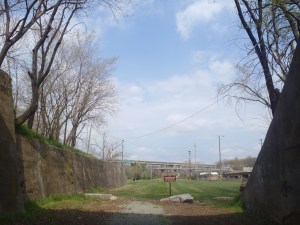
I recently visited the Negro Burial Ground just east of downtown Richmond in Shockoe Valley. My approach to this site was across a VCU parking lot and through a tunnel under Broad St. As you walk through the tunnel, you emerge onto a huge empty field of beautiful grass that was once yet another parking lot in downtown Richmond. In recent years, the asphalt was removed and this area was designated “A Place of Contemplation and Reflection.” I appreciate this area mostly because it’s a complicated place. There aren’t physical buildings that most people would consider “historic,” but what happened on this one piece of ground (the public execution and careless burial of enslaved and free people) is considered enough to make the place significant today. Once a place of fear and violence, it has been restored to the people of Richmond as a place of silence and careful thought.
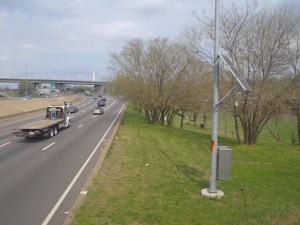
While I think the site itself is certainly worth visiting, what I really care about is a place located just above the actual burial grounds. From this vantage, you can see that less than 50 yards away from this place of contemplation is Interstate 95 in all of its glory. The cars and tractor trailers fly by on this crazy asphalt slingshot that shoots cars straight through the heart of my city. Like all highways, it’s a totally anonymous no man’s land where you don’t walk, you don’t slow down, and you don’t typically notice the historic burial grounds nearby. When you’re on a highway like this, you don’t care much for where you are because you’re more focussed on where you’re going. That’s essentially the nature of movement.
To get the photo above, I climbed up a little hill to the foot of the Broad St. bridge I had previously walked underneath. For a while, I just sat up on the hill and watched the disinterested movement of the highway next to the contemplative stillness of the old burial ground. I realized that we need both the movement and the moment, but I think sometimes we feel like we have to make a choice: You have to be either ambitious or thoughtful, motivated or lazy. When I experience a place like this, it reminds me that we should be aware of both aspects of life. It also makes me a little more hopeful that my writing is still relevant. What I have learned through writing this blog is still teaching me and making the world a more interesting place.

While I was looking out on the scene, I realized that photos and words are limited media for describing ideas such as movement and moment. So I filmed a brief and simple video (below) that might help to further explain this relationship. It’s much more about the idea than the video itself … and I recommend muting the video sound and listening to Lisbon, OH by Bon Iver while you watch it.

As always, more to come.

P.S.  to Gwarlingo for the movement/moment pairing … it used to be found in their explanation of the meaning of the word Guarlingo which is Welsh for the sound a grandfather clock makes before it strikes on the hour, “the movement before the moment.” Of course, my blog is about the movement and the moment, but I thought it was an interesting side note.

Whence, What, Whither

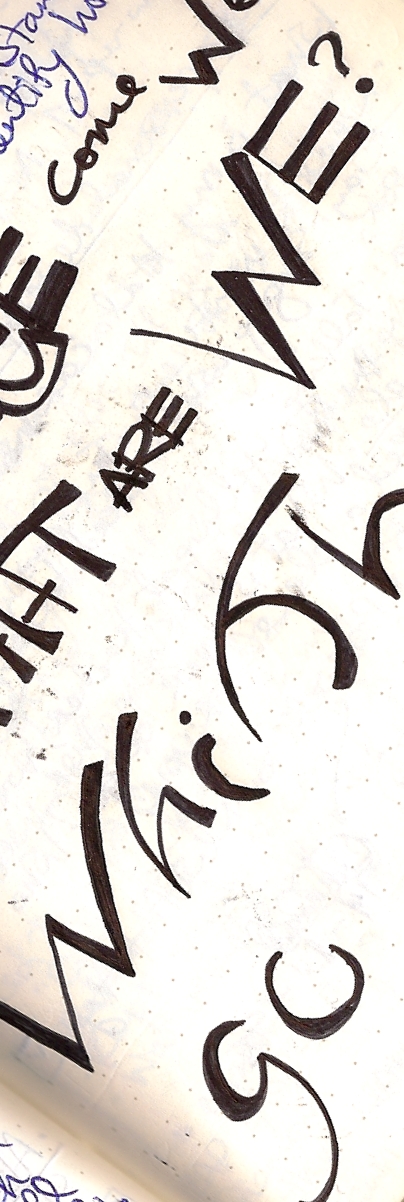
Last Saturday I was thinking about Paul Gauguin’s painting “Whence come we? What are we? Whither go we?” So as I thought about the questions, I wrote them out in some random fonts and scanned the page. I got one good scan, but I think I prefer the image below where the scanner randomly cropped it:

Plastic Cities

Considering the trauma of urban destruction abroad, it’s not altogether surprising if the American city lost its ethos in the decades following WWII. While our cities were physically spared, our citizens may have lost faith in places that could now be so easily destroyed. In a matter of minutes, cities that were once homes became memories and photographs. While foreign nations surveyed the damage and made plans to rebuild, our nation realized that social damage was more difficult to restore. In this environment, such an urban rebirth would not suffice.

In contrast to the the restoration abroad, Americans returned home to find their cities inadequate to satisfy the need for privacy and control that accompanied post-war life. In a state of collective PTSD, upwardly mobile Americans fell into consumerist mania searching to restore the peace that had been lost during those war years. The dense urban spaces — those which had been so easily uprooted abroad — could no longer be trusted at home. As the banner photograph of this blog implies, the American city would soon be destroyed as well. Not as a destruction, but as a progression toward the better life many believed they would find at the end of the highway.

Sixty-six years later, many of us find ourselves still hopelessly desiring stability, but unable to remember the traditions and pride that once connected us to our cities. We also seem to carry an unspoken longing for that time when cities could be trusted and investment sustained. Uprooted and displaced, we move as much as the walls of our plastic cities: completely worthless to human memory and love.

In this third or fourth generation removed, I seem to notice that we are finally beginning to settle back into each other’s lives and our oldest spaces. We may have a very hard time excavating what was lost in the post-war mania, but it will be worth it, vale la pena.

Restoring trust in a city, like everything else, takes time.

MADD Highways

If I were a historian, I might write a book about the relationship between the drinking age and car driving in America. I might wonder how much of our lives have been fragmented by these two devices. I might marvel at their intertwined stories and their combined affect on the way we live. I might mourn the loss of American tradition and culture.

I think I might be too emotionally invested to be a historian.

New Term: Grand Obsolescence

The term is usually “planned obsolescence,” but the word “planned” doesn’t exactly apply to what our cities look like today. So Grand Obsolescence is the term I guess I’ll to describe the spaces in our cities that have beed deemed worthless and discarded. Just like your iPhone 3 when the new one came out.

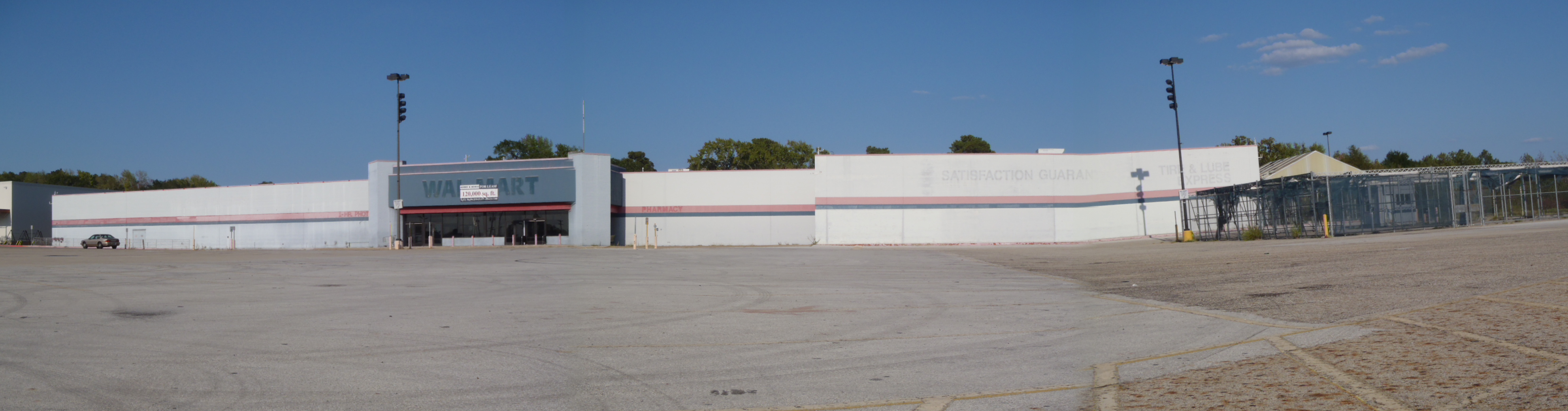
A Walmart was built on a highway in Tyler and surrounded by acres of asphalt. Then, Walmart built a supercenter right down the road and left this building to anyone that wants to spend the money to retrofit a warehouse. Thanks Walmart! The parking lot is now (obviously) underperforming asphalt and the building is vacant. The reality is: multi-nationals don’t have any concern for the long-term well-being of a city … they just need to make money. It’s up to the city to look out for itself and to prevent stymie process. The problem is usually a weak planning function and a city council that can only see $$$ with each new development. The result is cities that Kunstler says simply “aren’t worth caring about.” Of course, there is still plenty to care about, but the problem is that you have to drive farther to get to them. And even then … it’s still not usually impressive.

Maybe, we drive so fast we don’t notice these vacant buildings or maybe we just have low expectations. Maybe because our cities grow outward we don’t feel the need to look inward. All I know is, it ain’t pretty and we can do better.

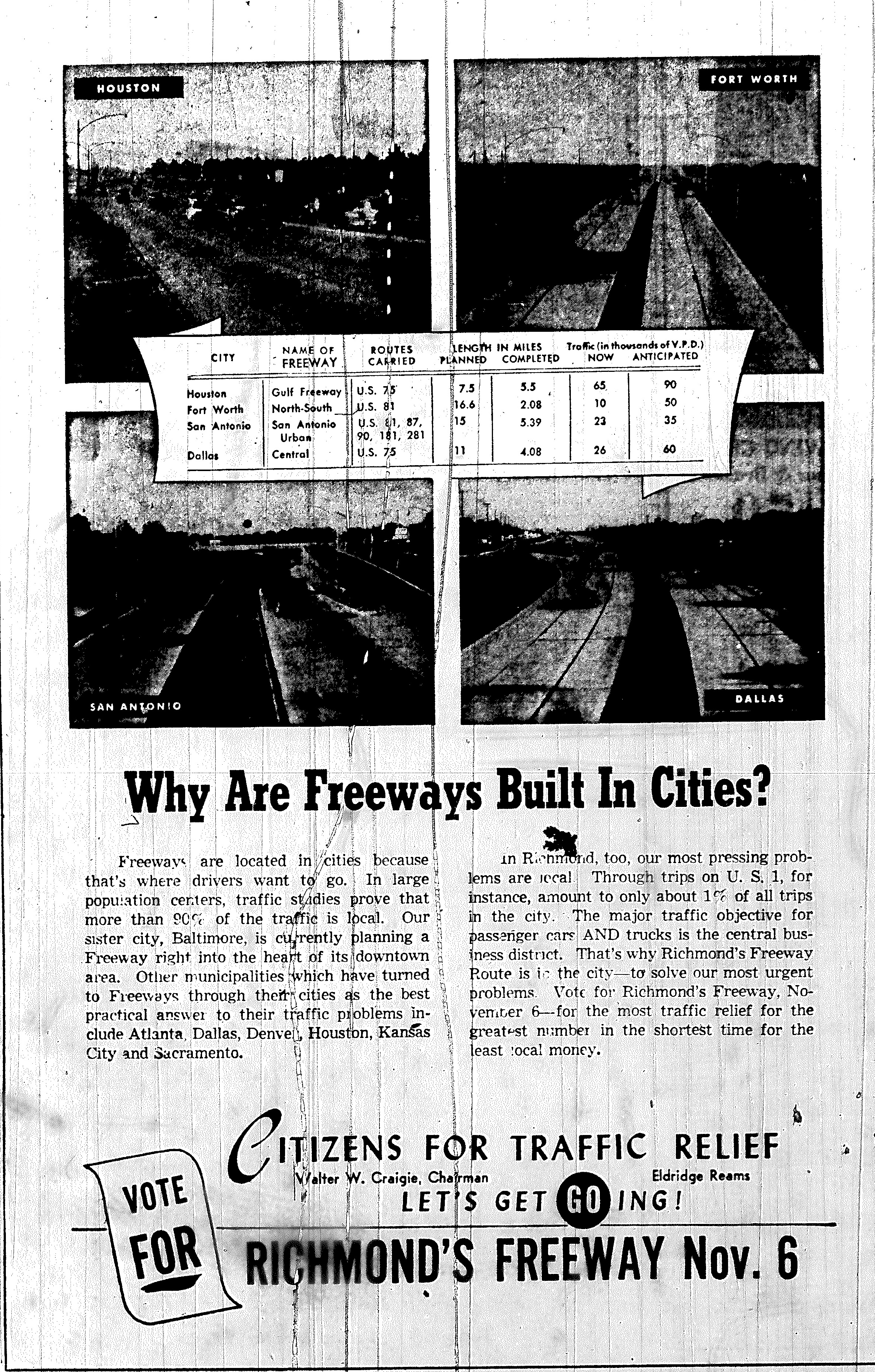
Weekend Graphic: Why are freeways built in cities? (1951)

On Nov. 2, 1951, Citizens for Traffic Relief ran a political ad in the Richmond Times-Dispatch titled “Why Are Freeways Built in Cities?” This ad was purchased in anticipation of the second public referendum related to the Richmond-Petersburg Turnpike (which failed). It reads,

This as was especially interesting to me as a child of Texas. Looking back 60 years it’s amazing that it seemed like a good idea to pattern Richmond’s regional development after a city like Houston.

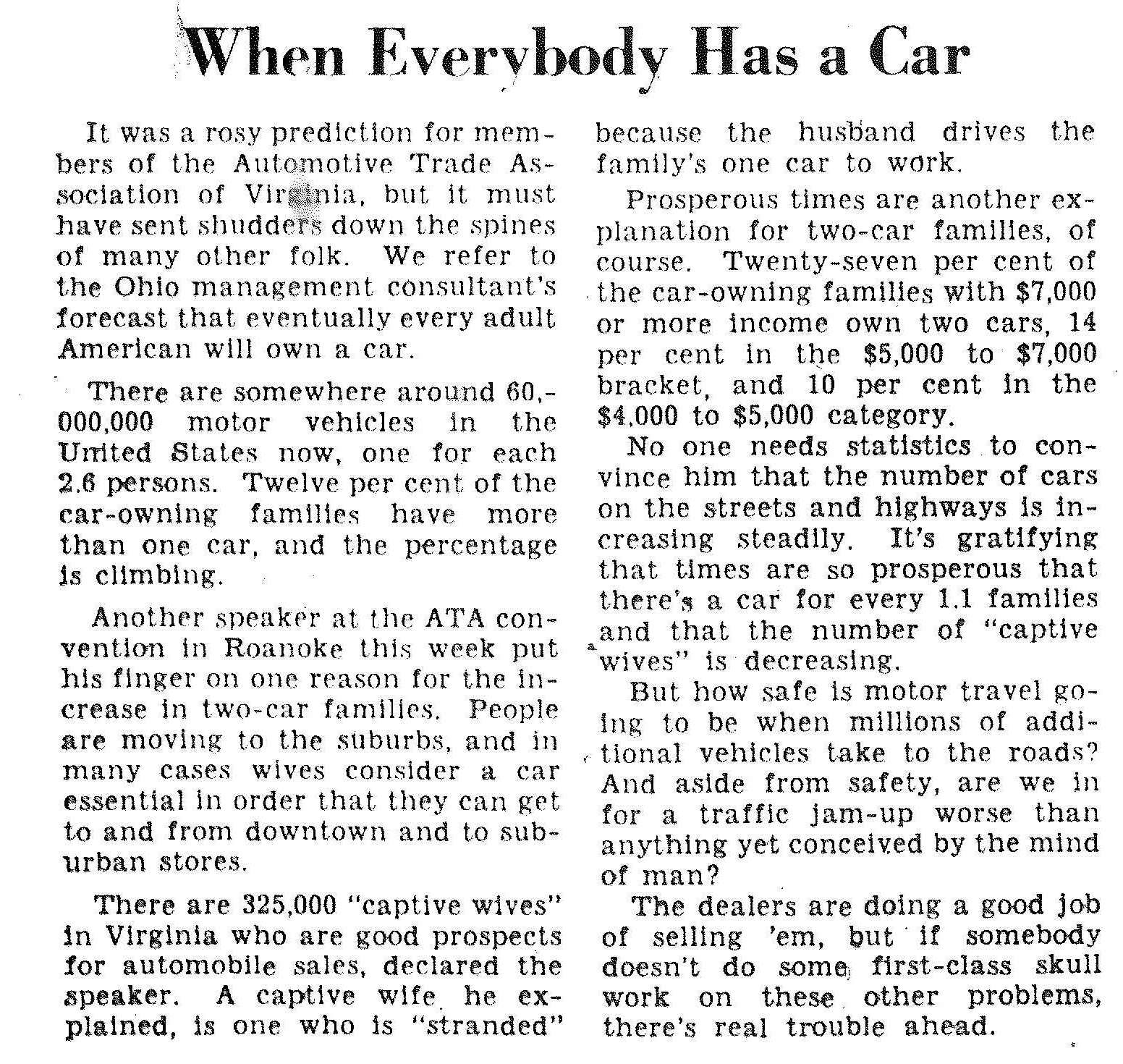
“When Everybody Has a Car”

On Monday Nov. 14 1965, the Richmond Times-Dispatch published an article in the opinion section. It reads,

In the 1950s and 60s, members of the automobile hegemony often made grand statements. I’m amazed that even in 1965 this one sounded like a bad idea.

C-T-D: The Complete Loop

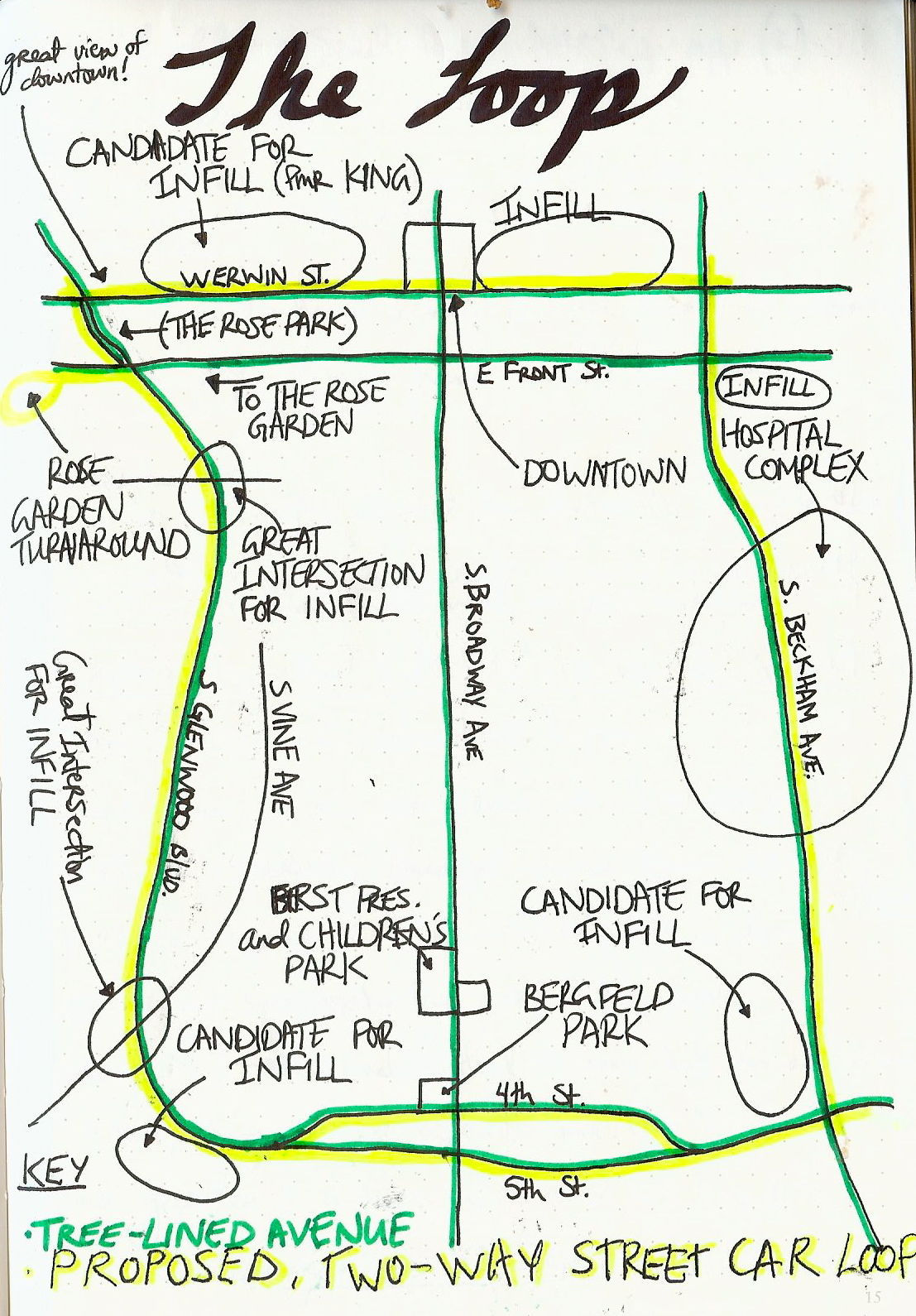
Ok, I’m changing my vision for reconnecting Tyler. In my post “Connecting the Dots: Intro,” I called for a loop of streets to be beautified with bike lanes, street trees as well as connected with street cars. My original vision saw the street car loop connecting down Broadway, but today I changed my mind. My imaginary Tyler now has a network of complete streets and a two-way street car loop. The map I have drawn (to the right) is the culmination of about a month of work on my Connecting the Dots project (C-T-D). It’s not a conclusion, but this is this skeleton that will be my foundation for future posts on infill development in Tyler. These developments are the dots themselves: The high-density nodes that should be developed throughout the older parts of Tyler. “The Loop” is the public investment that is necessary to make the entire concept a reality.

It begins with a paradigm shift from the current philosophy on street construction in Tyler. Currently, a street in Tyler (left) is where cars drive. While it seems like a basic statement, this is a relatively new phenomenon credited to 20th century engineers and planners who gave cars complete precedence in matters of urban travel. Before the advent of the automobile, streets were places to walk, gather, transport and protest. Bicyclists were the first promoters of “good streets” in America and streetcars (started in Richmond, VA) were the first modes of suburbanization. When the car became affordable, it trumped all of these previous developments and occluded their progression. In the past century, streets became very dangerous spaces as car-related deaths increased. The gathering spaces in America were lost. In his TED Talk, “The Tragedy of Suburbia“* (*F-Bomb warning) James Howard Kunstler argued,

“The public realm in America has two roles: It is the dwelling place of our civic life and it is the physical manifestation of the common good. And when you degrade the public realm you will automatically degrade the quality of your civic life and the character of all the enactments of your public life and communal life. The public realm comes mostly in the form of the street in America …”

In Tyler, we have certainly experienced this degradation of the quality of our civic life. There are few public gathering spaces. Just so we’re clear, Starbucks is not a public space, it is a private, money-making enterprise. There were once some incredible public spaces in the city, but many were destroyed or neglected … the downtown square is a sad example. Public space today is a scattered system of lovely public parks typically accesible by car. Our streets are often these large asphalt rivers running through the city with cars zooming by at deadly speeds. I drive one of these cars so I understand their utility, but I also understand the benefits of alternative transportation.

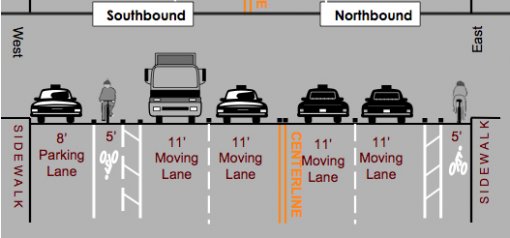
The National Complete Streets Coalition (NCSC) states that “Complete Streets are for everyone.” While there is no singular definition of a complete street, NCSC states that a city committed to transportation choices will ensure that “every transportation project will make the street network better and safer for drivers, transit users, pedestrians, and bicyclists – making your town a better place to live.” (NCSC also listed the “elements of an ideal Complete Streets policy” to help local citizens tailor the concept to their locality.) Thus, a complete street will have defined spaces designated to those citizens not driving in cars:

I really can’t expound on this concept any more except to say this: Complete Streets are a message to the citizens of a city. It says, “Come outside, experience our streets and enjoy your city.” Currently, the message is, “Drive here, this speed, when I say go.”

The next stage in revitalizing this section of the city is the addition of a two-way street car loop. This will be an incredible statement of commitment from the public sector and will stimulate private investment at every point along the route. In my map (above) I have designated some locations that are prime for infill development. These typically have a ton of underperforming asphalt and outdated strip centers. The street car loop will be a convenient novelty for tourists as well as a viable commuting opportunity for a number of large employers along the loop. In addition, the street car loop will finally connect the parts of Tyler that are culturally, financially and historically significant: The Rose Garden, downtown, the hospital district, and the Azalea District. I’ll admit, the primary shortcoming of this loop is that it currently ignores the area north of the square. I response, I think that Broadway should be “completed” all the way to Gentry (banner photo of this post) which should also be retrofitted with bike lanes and street trees all the way to the amazing Caldwell Zoo. If you haven’t driven on Gentry lately you might not know how big that street is … it is due for a full retrofit.

So this is my “Complete Loop.” Unlike the car loop (323), it’s beautiful and versatile and it invites everyone to come and enjoy.

Check out my other Tyler projects at my Tyler, TX page.

*I also had a policy thought: Developments and businesses along The Loop would be exempt from zoning laws that require on-site parking. Instead, public parking would be provided at points along The Loop to encourage a “park-and-ride” system.

The Rose Park

Look at the image below. What do you see?

I see a rose.

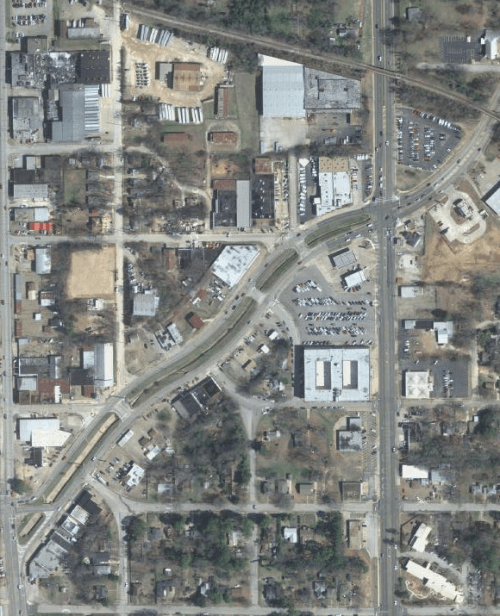
The stem of the rose (S. Glenwood Blvd.) extends as a greenway belt from the bottom left corner toward the upper right. It curves along the stream in between the grass of the greenbelt. At the end of the stem, there is a parking lot in a shape that resembles a flower bud. It seems like a perfect fit for the Rose Capitol … especially considering it’s in The Rose District, my fictitious plan for the area of land around the Rose Garden Complex. The Rose Park would be the perfect way to say, “Welcome to Tyler, we like roses a lot.” Since we pretty much control the commercial rose industry in the USA … I’d say roses like us too.

The Rose Park is the perfect way to welcome visitors into this city that has been celebrating the rose industry for decades. As you drive into Tyler on Glenwood, the road is suddenly transformed into a tree-lined parkway with a creek running down the middle of it. Brick sidewalks run along this parkway as it wanders past the junk shops and the Cotton Belt Building. The sidewalks of this parkway then ends with a crosswalk across the intersection that has been rebuilt to accommodate a larger number of walkers and bikers. The bike/ped crossing leads across the intersection into the parking lot that has been transformed into a park of flowers. From the sky, the stem and rose form a clear picture of the city’s identity. From the road, drivers get a glimpse of the park and begin to feel like they have formally entered Tyler.

The Rose Park should be a part of a bigger network of trails and parks in the Rose District. These would all make this an area of the city that is accessible, functional and proud. In it’s current form, this is just a road and a parking lot. But in a few years it could be a purposeful use of space and an excellent entry to this city.

Check out my other Tyler projects at my Tyler, TX page.

On Space and Place: Terms Defined

Over the course of this blog, I will often write about space and place. This post is my attempt to clarify these two terms because they are ultimately the two underlying concepts of each post. While I draw from theorists such as Foucault and Said, I have eventually developed my own way of thinking about life through these lenses.

The two words, in my opinion, are completely distinct from each other. Space is the void. Space is the physical, tangible built environment in which we live. Space is buildings, roads, houses, parks, landscapes. Space is the void. Place is the life. Place is the culture that is created within a space.  Place is what makes a house a home. Place is created when people congregate, communicate, experience each other. Place is a conversation in a coffee shop or a fight outside your house. Place is the life.

These concepts of space and place are often used in casual conversation. Consider the phrase, “I’m just not in the right place to make that sort of decision.” This common refusal is usually considered metaphorical as in an emotional state or a level of maturity. But, what if the person is thinking of actual places where they have experienced significant emotional attachment to other people and are not prepared to enter those places again. Or what if the person has a close tie to a person that lives in another space and they aren’t willing to leave? These are the memory places that are informing the person as they make the decision to move forward or remain.

We all know spaces such as these where we have invested time, emotion and energy to create place with another. We have struggled to be accepted into the group of people that make up these places or we have revelled in our influence over them. It is in these places of human interaction that we struggled through love, lust, pleasure, loss, enlightenment, rejection and friendship to eventually reach some sort of comfort. No matter how frightening these places are, what is more frightening is the thought of leaving them. In these places we become ourselves, we find our identities and we are unsure how that will change when we leave.

Pardon the long quote below … I think it helps me to understand what I am saying:

In his book Repairing the American Metropolis, Douglas Kelbaugh writes, “As others have pointed out, spatial boundaries demarcate the beginning of a place as much as the ending of a place and its power. Boundless architectural and urban space has less nearness, less presence. Limits are what differentiate place from raw space,  whether they separate sacred from profane space or one secular space from another.”

The “spatial boundaries” which demarcate place are the physical boundaries which affect the human interaction within that space. These are often used to enhance the experience of existing in a certain space, but they cannot alone create space. Without humans a space is meaningless. In the same way, it is humans that give space meaning regardless of the intent of the design of the place. All throughout history there have theories about cities which attempt to create the perfect society with the perfect spaces. Le Corbusier’s La Ville radieuse is a common example of this delusional habit. But we have learned time and time again that you can’t solve problems with new space: Housing projects and suburbs are two great examples. They were both dreams for a better life, but both inhabit miserable and satisfied people alike.

It is places that people crave. To me, it is not easy to create place with another. To be honest, many people don’t create place because they don’t linger in a space for long enough. Think about a highway. It is the space par excellence. There is only movement and stigma on the highway — no life, no place. It is one, uniform, vacuous space. And how many of us spend hours each day in these spaces? In contrast, a place can be anywhere. I remember four friends and I had an impromptu gathering in a chapel recently that created the most beautiful place of fellowship. I recently wrote that graduation was an instantly nostalgic place where people gathered from all over the world. It was not “The University of Richmond” that weekend, but instead it was transformed by the presence of a multitude of people that had gathered for the same purpose.

I don’t want to limit myself with these terms, but I sincerely believe they illuminate my perspective on the city and society. I will likely link back to this post many times in the future for reference … they’re my words, but the concepts belong to many people. I’m excited to see how far I can take them.

*Repairing the American Metropolis: Common Place Revisited.  Douglas S. Kelbaugh


Gallery

Movement and Waste

This gallery contains 1 photos.

Americans waste a lot: Food, toys, paper cups. If we’re not wasting something (e.g. a power tool) we’re usually storing it which is really just a prolonged and more passive form of waste. We know we waste. It’s something we hear … Continue reading

Gallery

Biopower, repentance and traffic court

“[T]he judicial institution is increasingly incorporated into a continuum of apparatuses (medical, administrative, and so on) whose functions are for the most part regulatory” (Foucault, The Will to Knowledge, 1976, 144, Found in “Sovereign Power and Biopower“). Today I went … Continue reading

On Plans and the Future

On November 3, 1951, Robert LeRoy Shepherd wrote an opinion article in the Richmond Times-Dispatch titled “Freedom, Independence, Taxes and the Freeway.” I found this article 60 years after it was written and was struck by the candor of his voice and the content of his message: Plans for the future must respond to reality.

At the time it was written, the city was in the midst of a highway battle over the plans for the Richmond-Petersburg Turnpike (what is now a section of I-95). As was common practice at the time, Richmond politicians contracted large firms to develop plans for this expressway without significant input from the residents of the city. As a result, the thought of destroying the city for a highway divided citizens and outraged residents. Many conceded that the city fathers had already decided what would be best for Richmond, but fought to make their voices heard during the second public referendum of the highway plan.

Uncertainty filled the minds of Richmonders who were unsure whether their city would be completely transformed by this idea proffered by huge national planning firms and local politicians. The highway plan would result in the destruction of large sections of the city and would forever change the way people move throughout the region. On a more philosophical level, the plans for the highway also seemed to fundamentally question the legitimacy of the physical structure city. After 210 years of individuals shaping the built environment, an outside idea was being presented as more legitimate. At this moment of crisis in the battle for Richmond’s future, Shepherd wrote a philosophical piece that questioned the idea of a highway in Richmond and made a simple, yet compelling argument for democracy in the midst of the American highway era.

At this point in time, the Richmond Times-Dispatch was not new to articles and ads related to the expressway.  Leading up to the referendum on November there were dozens of references to the highway including political ads, cartoons, editorials, news articles, and opinion submissions. Many of these references simply recycled the same ideas and arguments for or against the highway plan. In these arguments it was too expensive or it was the ultimate solution to traffic, either not the will of the people or a well-developed plan vetted by studies and experts.

Amidst the banal arguments, Shepherd’s article called Richmonders to think critically about the process of planning a highway in the 50s. He was not enamored by the professional firms that planned the highway or their ideas for the future of Richmond. Instead, he writes, “Inflexible plans result in a fixation of mind. Steering them becomes an obsession kindred to a driver’s headlong dash above or over a freeway.” To Shepherd, politicians in Richmond were  trying to make the plan fit an unwilling populace. To Shepherd, the future was not so easy to predict.

While many framed the highways as American progress, Shepherd framed the highway plan as megalomania. He compares the politics to Alexander the Great, Caesar, Hitler, Hirohito, and the British Empire. The one thing in common was the concept of invasion and empire, but more philosophically the empires were imposed and forced on unprepared societies. The empires constantly developed their ability to transform the life of citizens in order to complete the assimilation of diverse societies. The highway was no exception. Plans for the city of Richmond were meticulously developed before being presented to the people of Richmond and expected to impress and amaze. The highway was an idea from the outside that was forced upon cities in America and unwilling to change or shift to fit the will of the people.

To Shepherd, these plans did not make sense in context because they weren’t democratic. “Taxes and plans?” writes Shepherd, “Yes.” In some instances it is wise to plan for the future and prepare for potential changes and developments, “But [while] some lead to the freedom of men, others lead to a fixation of mind and bondage just a binding as chains.” Today we are living the legacy of these plans and I believe we finally beginning to understand the captivity of which Shepherd spoke. While the highway seemed like an opportunity for growth, it has become a fundamental aspect of American life. What was once vehemently opposed has now become part of routine commutes and shopping trips.

Many people look at cities without any sort of historic lens or context, but a deeper understanding of the politics of a place will give us a better understanding of the place itself. As we continually struggle to recover our buried past we will likely find similar instances where democracy failed and voices were silenced. Uncovering these voices will further illuminate our nation’s past and present and allow us to begin to right our future.