Moses to Zuckerberg: A Position of Power

Mark Zuckerberg is the Robert Moses of the twenty-first century. Never elected, powerful beyond imagination. Not from the right family, but more influential. Not a member of Phoenix, but extremely selective. Not in the game, but driven to rewrite its rules. Robert Moses experienced similar social exclusion at Yale. Similar to Zuckerberg, this exclusion drove him. On Moses, Caro writes,

“Alongside the massive cathedrals of Yale’s traditions, buttressed by prejudice and pride, Bob Moses had erected his own small but sturdy structure. ‘In our little world…,” Bacon was to say, “he made himself a position of power.’ 

In light of Moses’ later career, that was the key point” (Caro, 47).

From his Ivy League education, Zuckerberg didn’t look to New York for power, that traditional American icon. The internet and computers were dramatically reshaping global influence in Silicon Valley.

In grand New York, Moses planned and completed massive public works projects to connect the boroughs and the region while Zuckerberg, from a garage in the valley, constructed a virtual bridge to connect the entire world. Through their efforts, these two men shaped the world that we inhabit today.

Facebook’s Twitter description states, “Giving people the power to share and make the world more open and connected.” Essentially they want to democratize the world, to end exclusivity. Moses also worked to make the city more accessible for the average American (as long as they could afford a car) and used his power to force roads through old-money estates in Long Island and elsewhere.

Someone from a powerful, WASP background wouldn’t work to undermine regional power. But neither of these men had much to loose. Moses was a Jew, didn’t know how to drive a car and spent his life building roads, bridges and tunnels. Zuckerberg (also of Jewish descent) is a socially awkward computer hacker who made billions connecting “friends” around the world.

Zuckerberg and Moses both lived life on the margins of traditional power.  As a result, they both developed a deep understanding of power. And when they realized that power wouldn’t engage them as equals … they turned it on its head. Both knew they could not win at the old game, both knew that the game had a weakness, and both were smart and industrious enough to exploit it.

Both created new worlds and situated themselves comfortably in the center.

Duck on Decorated Shed?

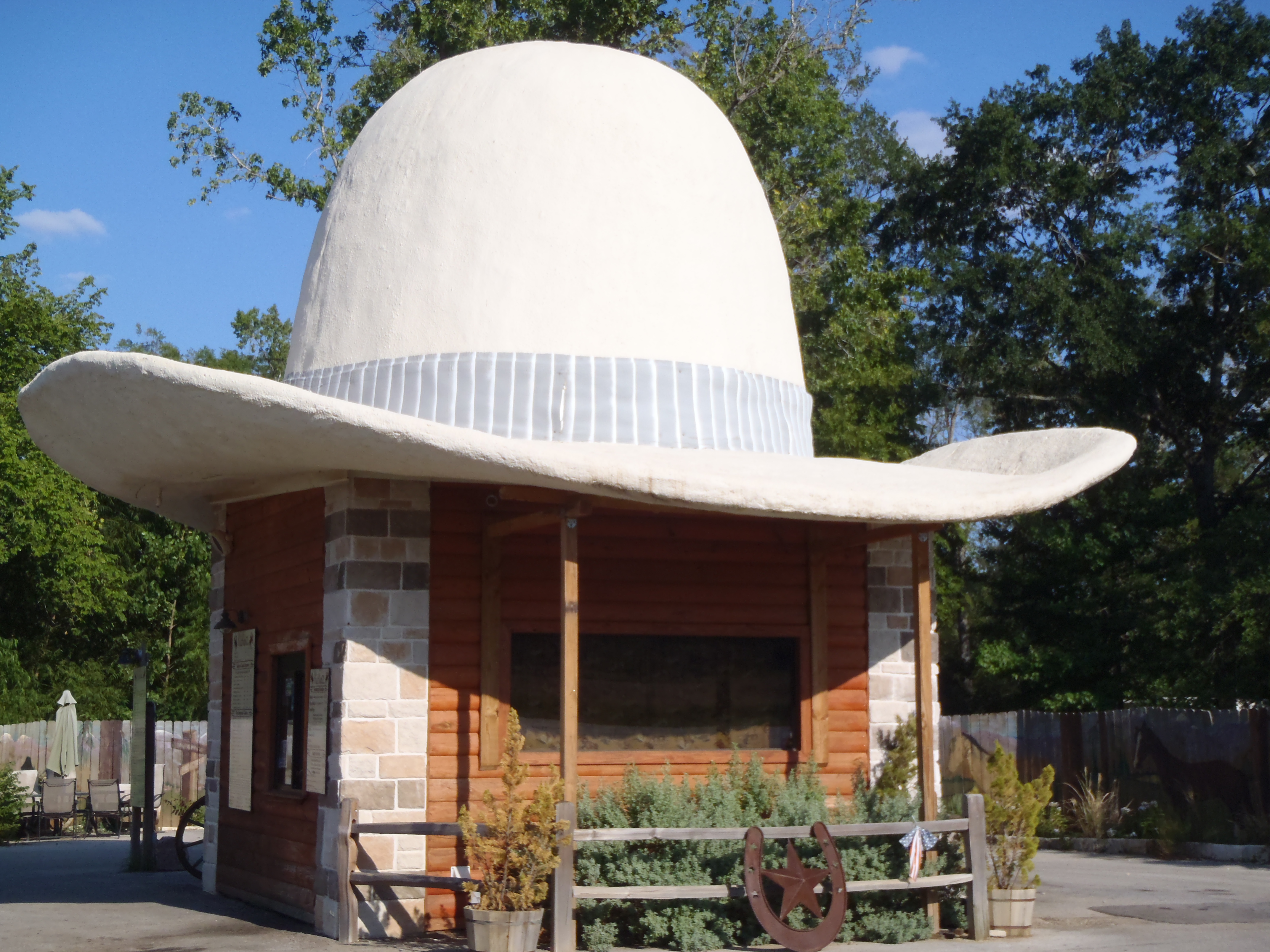
I don’t think Robert Venturi had any idea someone would ever take his duck and decorated shed concepts to this level. The (now patented) concept of building a huge, proportional hat onto a small square building was inspired by my hometown of Tyler, TX with the “Kicker’s” coffee franchise. The hat might even qualify as a duck? Be amazed:

Elks, Masons, and Odd Fellows: antiquated past or valuable tradition?

“I just worry,” my dad told me one day this summer, “that there won’t be enough Shriners in the future to maintain hospitals like Scottish Rite (Hospital, Dallas).” “Well,” I responded, “why don’t you become a Shriner?”

Growing up, I never would have thought about fraternal societies. To be honest, Barney Flintstone’s membership in the Loyal Order of Water Buffaloes was the closest I ever came to even knowing they existed. Then I went to college, joined a fraternity, and never looked back … until now. I graduated in May and in the last few months, fraternal societies for grown men have started to make a lot more sense. I think it was when people started doing this weird thing — calling me a man instead of a guy — that I started to wonder what I was getting myself into. Isn’t being a man all about being lonely and depressed? Work all day then come home and sit in your house? Robert Putnam’s book Bowling Alone makes a strong case that we’re living more of our lives without each other. As a result, it doesn’t feel like there’s any benefit to this whole “guy-to-man” switch … just more responsibility. There’s nothing cool waiting for me on the other side. But in the context of our nation’s history, that wasn’t always the case. There was an era of the American city when the fabric of society was dense with organizations and groups that carried and supported you through all the stages of life.

Douglass Rae summarized this era of ‘urbanism’ in this way:

“All or virtually all of the people who were assembled by these organizations — whether for religious or a fraternal lodge meeting or a sporting contest — were members of locally grounded communities. And the acts of assembly and association almost certainly deepened and enriched participants sense of loyalty to and identity with place.” Rae, City: Urbanism and its end (2003).

Rae’s research focussed on the city of New Haven, Connecticut and the 100-year deterioration of urbanism. In his research, he documents how each city block in New Haven was once a thriving microcosm of society. Middle-class men and women were usually a part of several societies in the city for different purposes including fraternities, sports teams, and social clubs. It’s wasn’t easy life in 1900, but it was lived together.

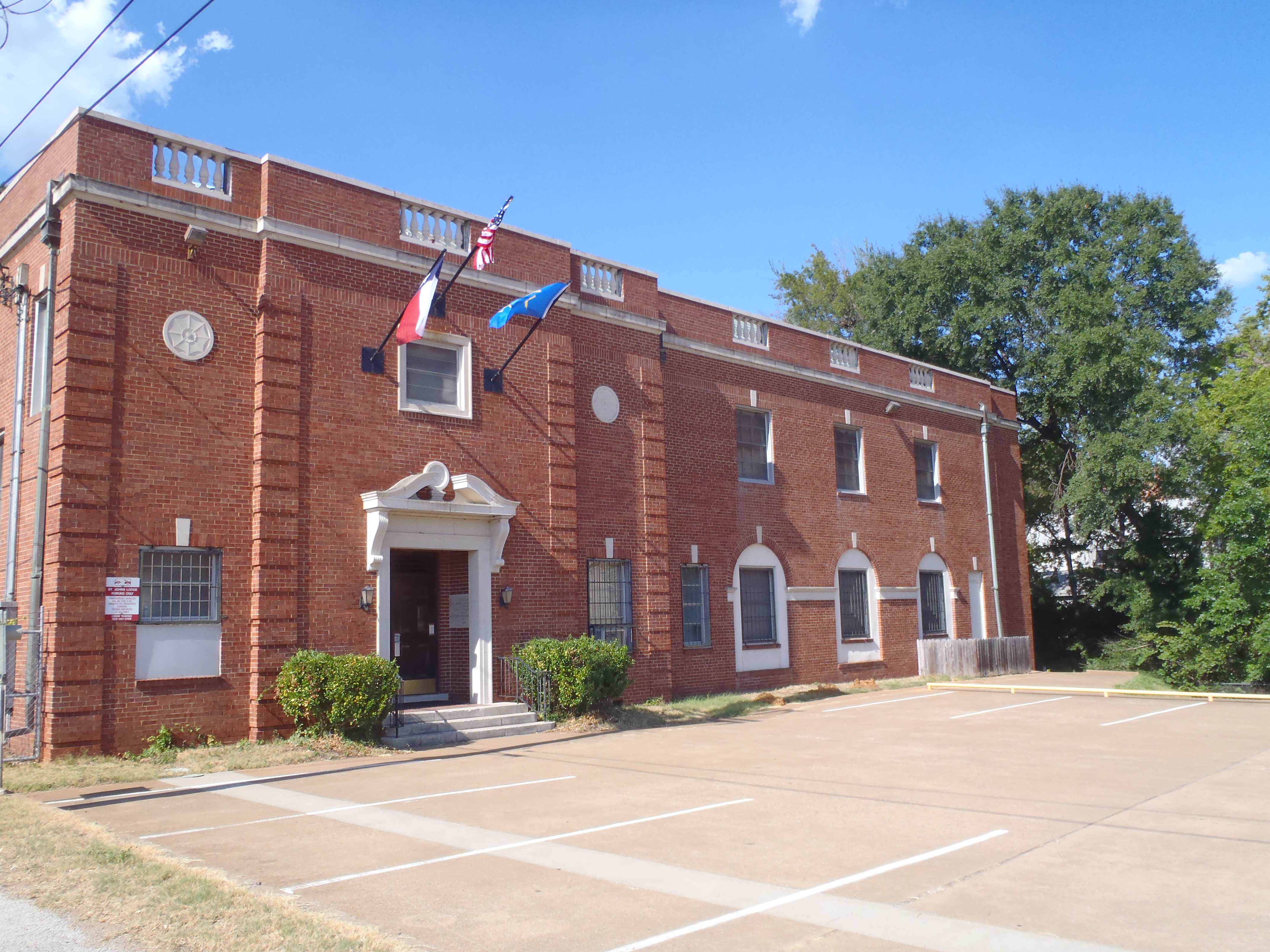
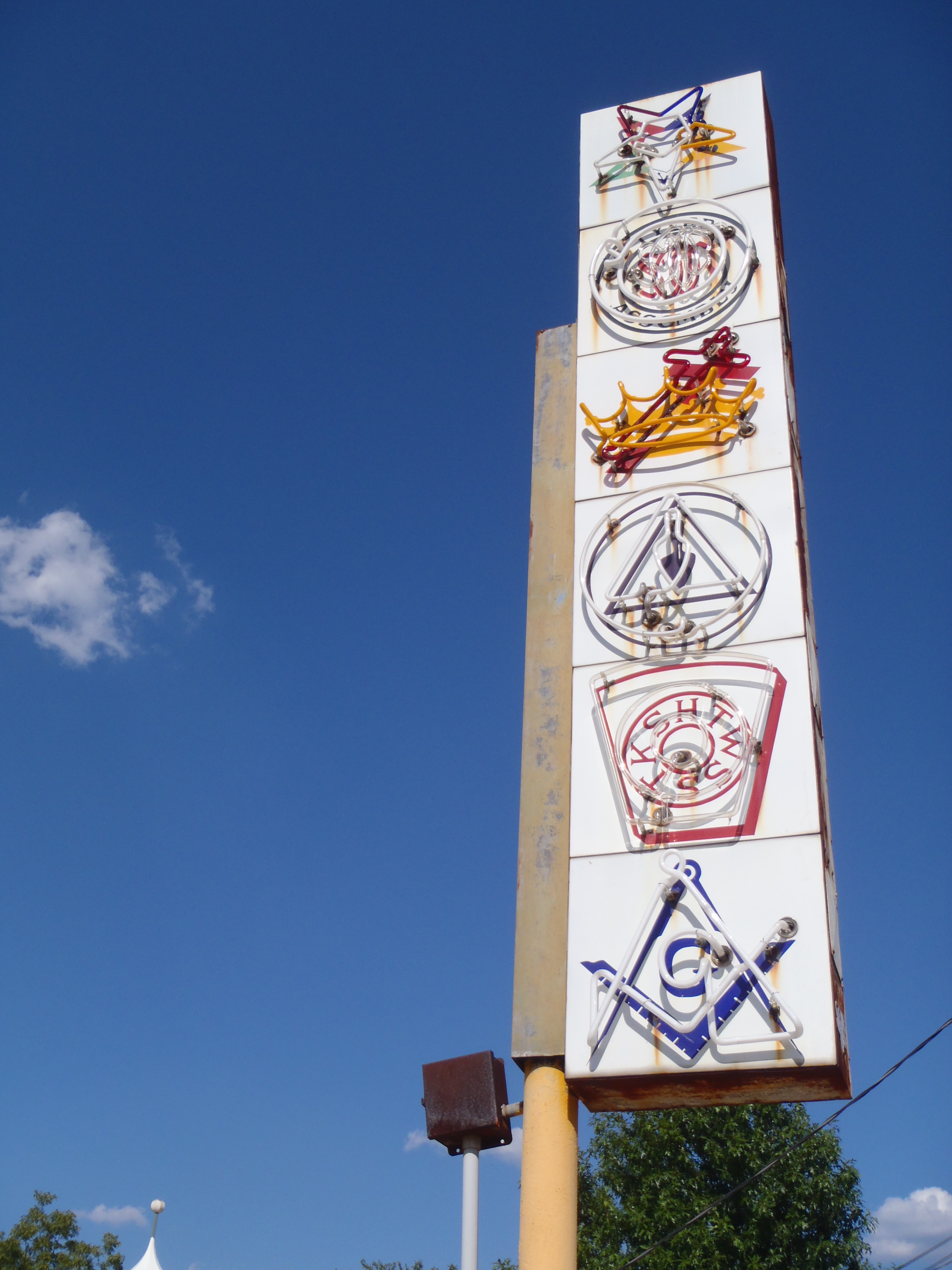
Today, things have changed. The America of 1900 no longer exists. But what I love about cities is that the buildings in our cities (the ones that survived) are the constructed monuments to our past. Tyler, TX is no exception. While they don’t hold the same place of prominence in the region, there are still buildings in Tyler that harken to an older era. The Masonic Lodge (pictured above), built in 1932 is the most striking downtown example that is still in use. I’ve driven by this building numerous times, but never thought it was special. Today, I almost felt like someone was going to come out and kidnap me for taking a photo of their building. The awesome neon sign (left) on the street is also worth noting … I don’t recognize some of the symbols, but I’m sure they all mean something to the men involved. The pentagram at the top looks slightly demonic, but I’d still think it was cool if my dad went to this building for a meeting once a week.

Other buildings in Tyler are no longer being used for their original purposes, but still bear the markings of early twentieth-century urbanism. The old Elk Lodge is one such building. I believe there is still a group of Elks in Tyler, but now they meet on the edge of the city in a newer lodge. It’s kind of a shame they moved, but I’m partially glad they did because the building is amazing and I got to walk through it today (without being properly initiated). It’s currently being renovated by Ron Mabry of Tyler for events in the city. I believe All Saints Episcopal is having a dance later on in the year. I hope that at least one high school student walking by notices the plaque on the building that states the founding purpose of the building: “Tyler Lodge No. 215, B. P. O. Elks, M. E. Danbom, Exalted Ruler.” The people on this plaque cared enough about each other to build a building where they could meet, talk about life, celebrate and mourn.

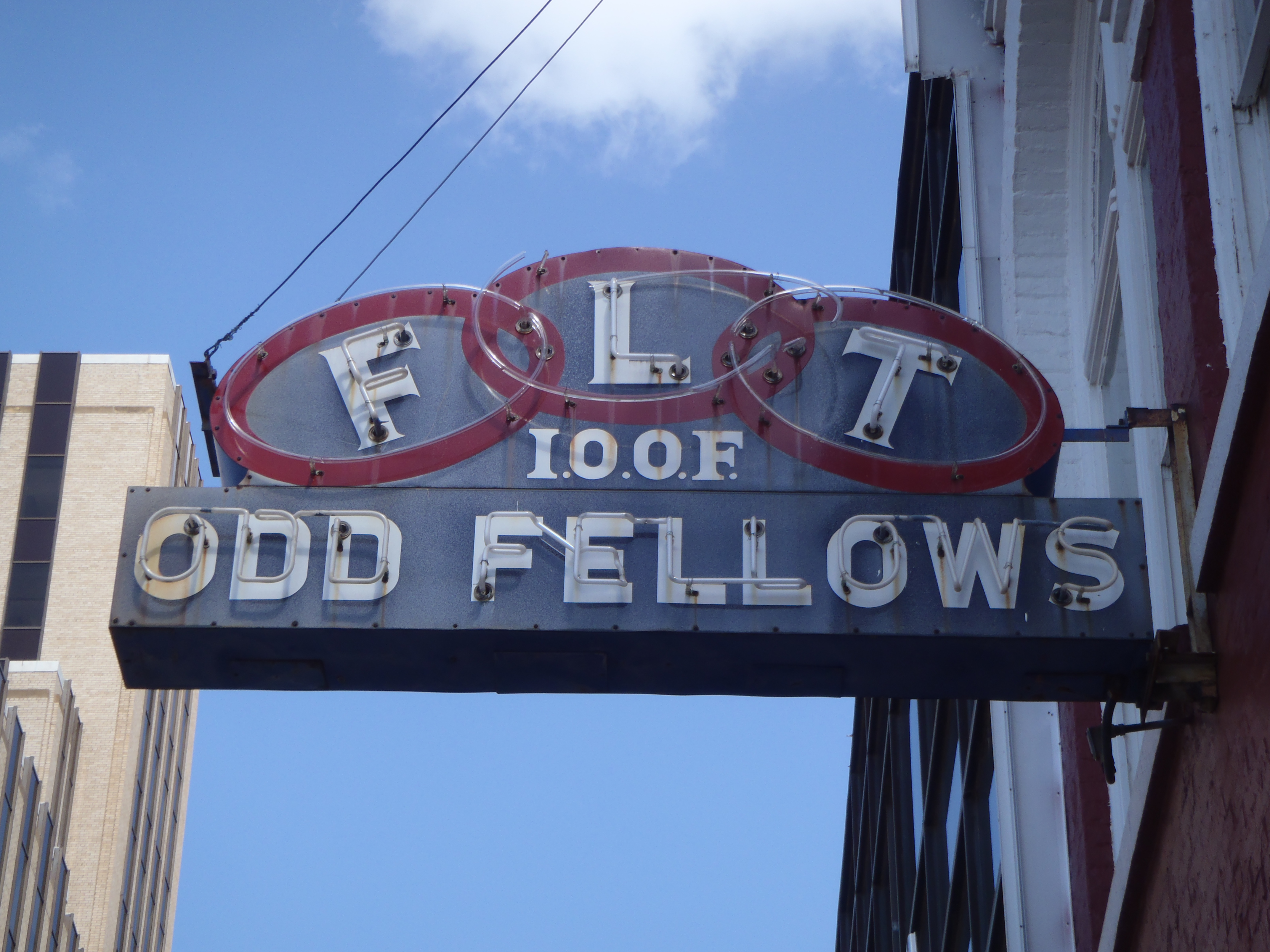
Only the oldest parts of our nation harbor these artifacts of the American past. It is always good to remember where we came from because it gives us a context for where we are. Plenty of people today are talking about why guys aren’t growing up, etc, but I don’t think they ever ask the question, “What’s waiting on the other side?” Yes, traditions are cumbersome and (quite necessarily) antiquated, but even in this postmodern society there is utility in having a structure to stand up under. There is a beauty in being told how to act. So don’t mock the Oddfellows, Lions, Masons, or Shriners. The men involved in these organizations are engaging in a tradition of American civil society that was once a grand element of this American life. Today, it is mostly just plaques on buildings … and a memory of how life could be.

Weekend Graphic: The Origins of “Dumb Growth” (1946)

Click the photo to maximize:

The summer after my sophomore year, I interned at Partnership for Smarter Growth, a non-profit in Richmond devoted to containing the sprawl and reinvesting in the core. During this summer, I discovered a vocabulary to help me define what it was about new cities that I didn’t like. “They’re just not cool,” I thought in high schoool, “and there just aren’t any people.” After the summer at PSG, concepts such as connectivity, the human scale, walkability, mixed-use, access, density and others began to shift my mind to what we called “smart growth.” I have always been an advocate of smart growth, I just never knew what to call it

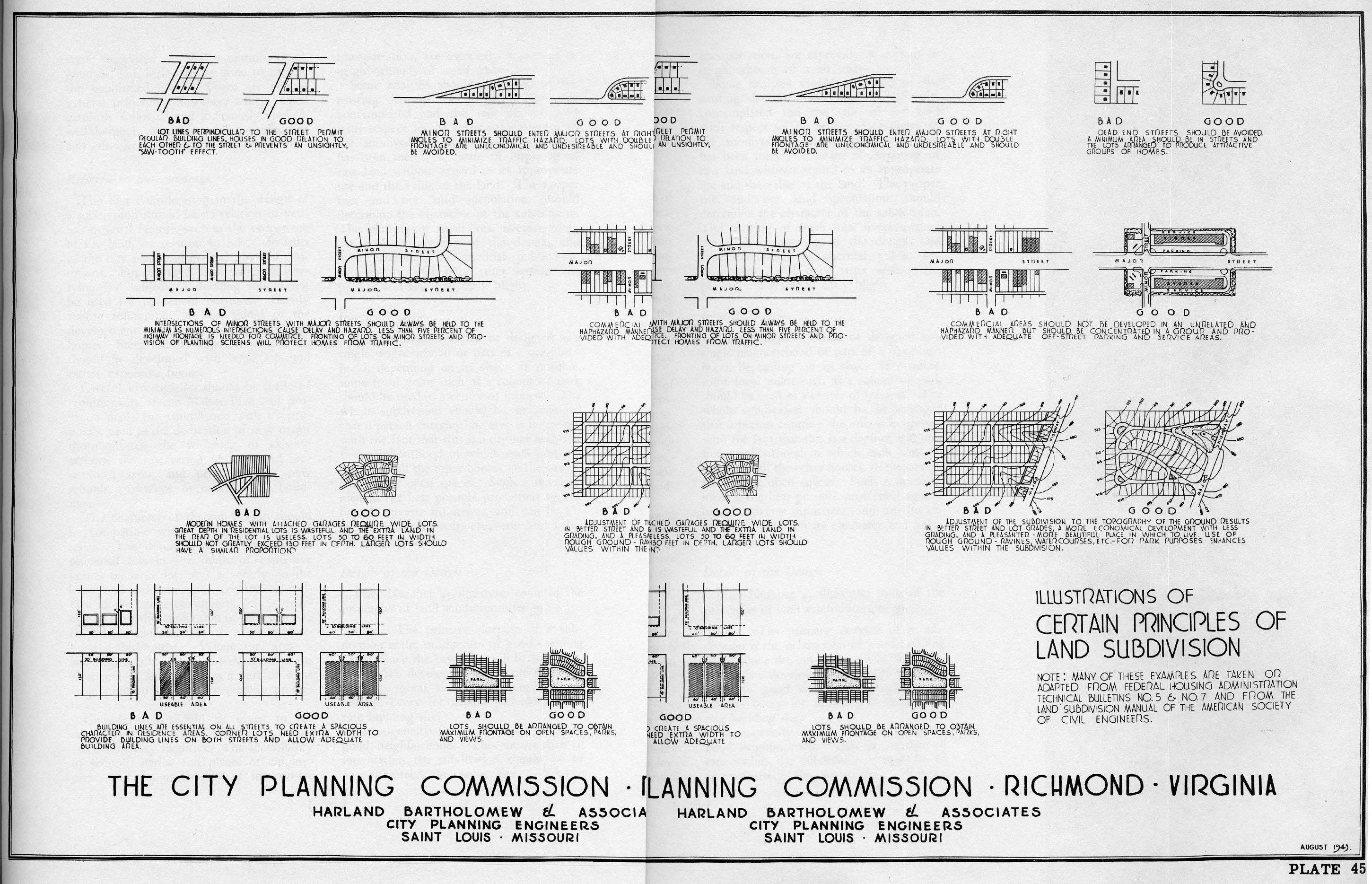
This perspective is why I found the graphic for this weekend particularly moving. I stared at these two pages in disbelief. I had found the origins of what I guess you could call “dumb growth” in Richmond. I don’t want to make it personal if you live on a cul-de-sac … it’s not about that it’s about how the city functions as a whole. During the 40s, Richmond embarked on a planning process to move the city into the twentieth century. As a part of this proces, the planning firm, Harland Bartholomew and Associates, developed this “bad/good” depiction of urban forms.  Over sixty years later, many people are still busy working to undo the spirit of this graphic and its affect on the American city: curvy roads, culs de sac, congested arteries, and a general disconnect between most segments of metropolitan society.

Race in Tyler: A Pie Graph of Color

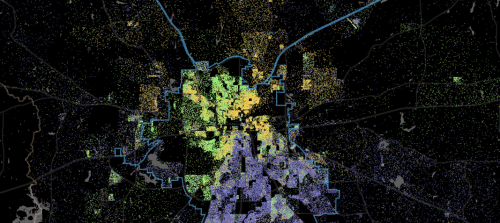
This is a response to a map of race in Tyler recently produced by Christopher Groskopf (@onyxfish) using the brand spankin’ new 2010 census data. He posted his analysis on the Web site hacktyler.com  titled “2010 Census: Racial diversity in Smith County.” Check it out:

In some ways, what I always knew makes much more sense after looking at this map. I now see that the original El Lugar is in the middle of the most Hispanic section of Tyler. Texas College and Martin Luther King Blvd are in the heart of Black Tyler. South Broadway, the site of most new development and big business in the city, is the backbone of White Tyler.

I think Groskopf’s work compliments thoughts that I and others have had on Tyler and gives me more of a context for the city over all.  Somehow with the language of the internet (which is beyond me)  he has illuminated my city in a way I have never before seen. Granted, some racial realities are not surprising, but the overall experience as a resident looking through this map is remarkable.

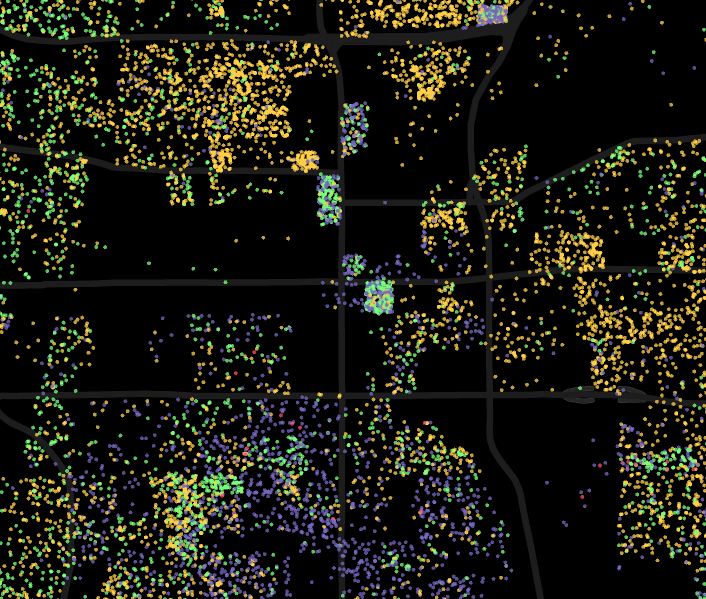
When I first looked a the map, my eyes immediately went downtown (pictured right). That black, vacuous space in the middle of my city. It may seem strange to be drawn to an empty space, but it’s because I have a different vision for downtown. In an earlier post, “C-T-D: Thoughts on Downtown,'” I tried to understand the idea of “downtown.” What is it supposed to be in relation to the city? If we understand the idea, then we have a standard of comparison for the reality. Here’s my standard: The first element of downtown is density, the second is urbanity, and the third is a creative economy. Looking at the black space of our downtown reminds me that it is still primarily a place to work and park your car. What would it look like if it was a place to live? Downtown could be the place where all three major pieces of the racial pie meet each other. It could be the center of city life and it could be a place where everyone feels welcome. I know there are dreams for the old King Chevrolet location and other vacant lots downtown … I hope we share these dreams with the rest of the city.

From downtown, my eyes zoom outward. I follow the three pieces of this pie from their smallest points to their largest and I’m amazed at the simplicity of the settlement patterns in our city. Groskopf mentioned the racial segregation in Chicago because in my experience that city is a patchwork of race. Tyler is more of a pie. The white population in Tyler is certainly the most homogenous, but there are some clear demarcations between the Black and Hispanic regions as well.

Here are specific observations:

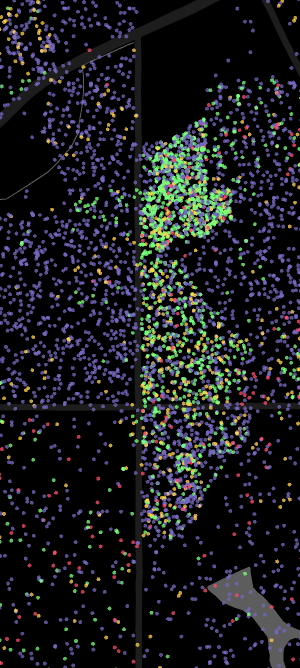
Physical structures divide urban communities. The clearest example of this for me was the section of Paluxy just south of the Loop (pictured right). This photo is special to me because the black community to the right is in the middle of the huge white piece of the pie. The community also looks clearly sectioned off by Paluxy to the west (left) and other, smaller roads to the N,E, and S. On Google maps, this section doesn’t look any different. I have to admit I haven’t driven around these streets on either side of the color line, but I have this urge to go there and learn more about why the communities have settled in this way.

Invisible lines divide rural communities. I was really unaware of the racial breakdown of rural Tyler before looking at this map. It’s partly because I haven’t spent as much time in rural Smith County and it’s partly because it’s just a bigger amount of space to understand. I think it’s so interesting that north of Tyler the two pie pieces of Black and hispanic communities stops at this invisible line (pictured left) and then White communities continue all the way to the county line. BUT, to the east, there is no imaginary line and the rural Black population is sustained to the edge. I wonder what historical legacy or communal understanding has created these invisible lines? While roads and buildings sustain separation in the city, segregation in the rural areas of Smith County is a little more difficult to comprehend.

There is so much more to learn from this map. I have already spent over an hour looking at the dots on this black field and I’m still amazed at what they have to teach me. I will certainly be referencing this map until the next census and I look forward to thoughts and responses from my fellow Tylerites.

Check out my other Tyler projects at my Tyler, TX page.

The Place of Learning

An ordinary room can become a place of learning, imagination, creativity, and new ideas. But it can also become a place of chaos, frustration, depression, stress, anxiety, fear, and resentment. When I was young, I didn’t really appreciate the work it takes to transform a room into an environment that encourages learning. In about a month, that will be my new responsibility.

As a teacher, I’m basically charged with the responsibility of a room and a group of high school students. My students and I will both enter that room with expectations and apprehensions. Will I succeed? Will I look dumb? Will others respect me? Doesn’t matter how old you are … these questions go through your head when you prepare to do something you’ve never done before. And I, the person charged with sharing new information in this room, do have these and other questions to ask myself. Rather than continue to focus on my responsibility, tantamount to my success will be the ability to convey the idea that we (the “teacher” and the “students”) are all charged with turning that anonymous, empty room into a place of learning.

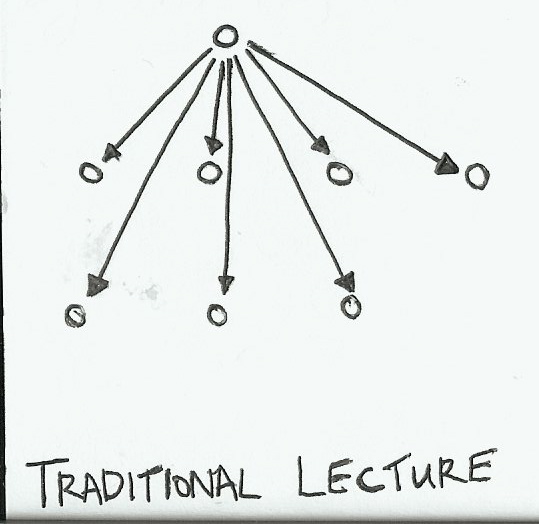
To me, a “place” is essentially an ongoing communal project within a given space. People talk about “creating place” and I think we may be talking too much about buildings and trees. The way I see it is that places are created and sustained by a group of people. The murals and cafes are the positive effects of an engaged group, but not the goal itself. Some people involved in creating a place of learning have more responsibility than others, but one person cannot create a place on their own. I’ve drawn a few power map doodles to discuss my ideas of education and teaching. Above, I’ve included a doodle of a “traditional lecture” model of teaching. This model is employed in many traditional hierarchical organizations such as the military, fraternities, churches, corporations, many low-income schools and some universities. In this model, the teacher (the circle at the top) is the dispenser of information to the students. Whether they understand the information is not readily apparent because they are not encouraged to react or “translate” the information into their own perspective. They are not given the chance to apply the information to what they already know.

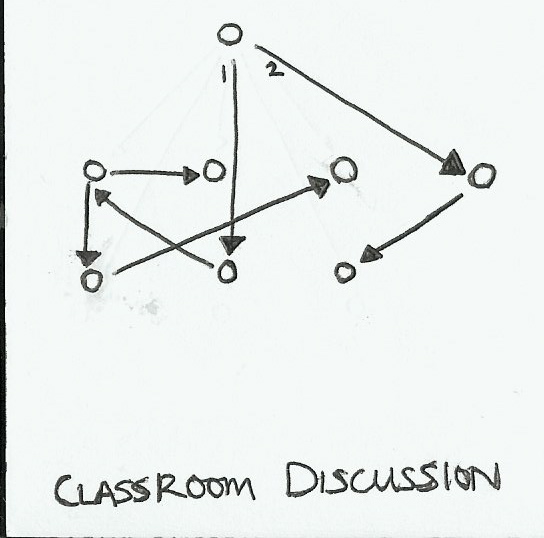
In my second doodle, “Classroom Discussion,” the teacher (again, the top circle) introduces an idea to the classroom (1) which then elicits a response from a student whose response then resonates with another student and so on. Then the teacher introduces a second idea (2) which engages a previously unengaged student whose response resonates with the last student in the classroom. This discussion encourages students to enter into the process of turning the classroom into a place of learning. It engages them and provides the opportunity for the students to inform the classroom with their own lived experience and perspective. As Surowiecki argues in The Wisdom of Crowds, a diversity of opinions in a room is far more worthwhile than the perspective of one person. Even if that person is a “teacher.”

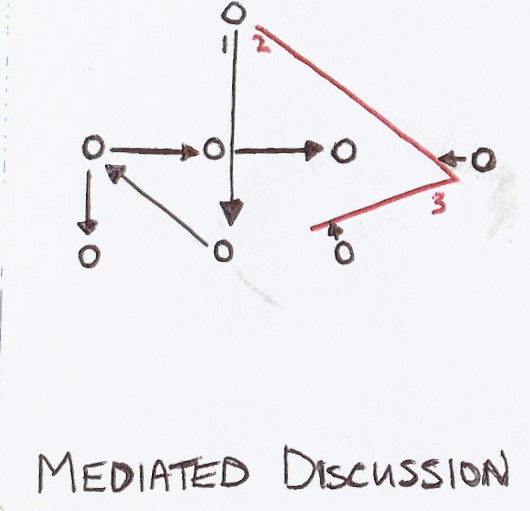
The third doodle, “Mediated Discussion,” is a more realistic version of the classroom discussion. Sometimes, students are not fully committed to transforming the room into a place of learning. Sometimes students aren’t willing to give up the goal that they had when they entered the room: Perhaps to make a name for themselves or create a little chaos. In the mediated discussion (right), the teacher introduces an idea (1), this idea resonates with a student whose response then continues the chain and encourages other students to share their thoughts. At the same time, the teacher extends vested power (2) and prevents two students from asserting their ideas on the rest of the class. I am fiercely democratic, but I also understand that strong leadership has a place in the classroom and elsewhere. Not everyone is always on board with the goal.

I recently watched the movie Buck and it was an inspiration. I never thought a horse movie could ever teach me so much about people and teaching. What Buck Brannaman discusses in relation to horses finds a direct parallel in the human experience. “Your horse is a mirror to your soul,” says Buck, “Sometimes you might not like what you see … sometimes you will.” I think the same could be said for your children and your students. In fact, everyone you affect with your wake tells you about yourself (Idea cite). I hope that in creating this place of learning I will be patient and understanding like Buck. He understands where horses are coming from — their fears, apprehensions, and previous experiences — and invites them to trust his correction and accept his leadership. I look forward to learning how to teach effectively, to drawing more doodles and to hearing more theories on how to improve. Here’s to trial and error.

New Term: Grand Obsolescence

The term is usually “planned obsolescence,” but the word “planned” doesn’t exactly apply to what our cities look like today. So Grand Obsolescence is the term I guess I’ll to describe the spaces in our cities that have beed deemed worthless and discarded. Just like your iPhone 3 when the new one came out.

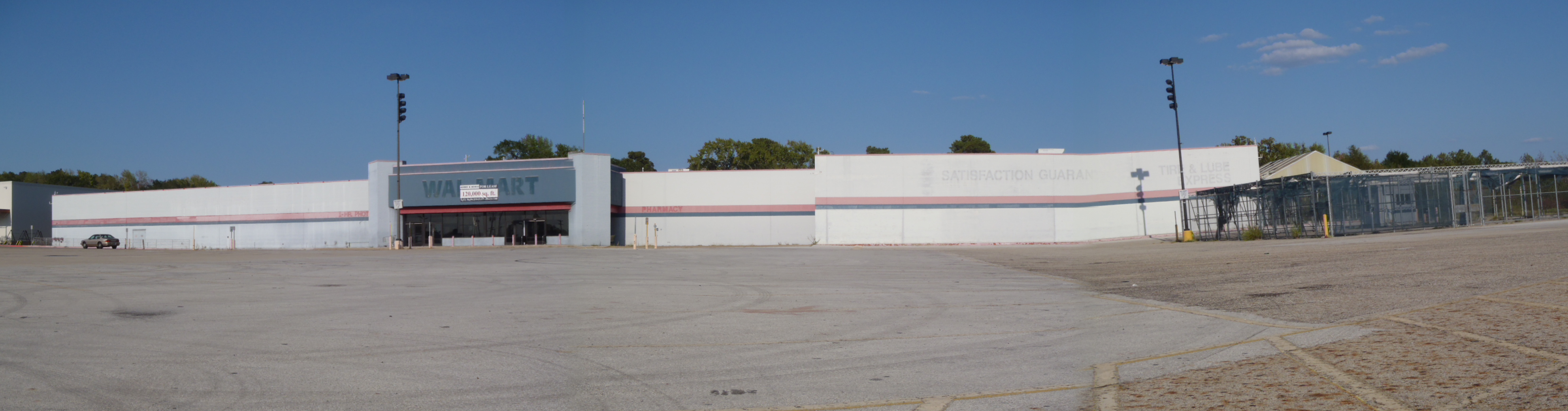
A Walmart was built on a highway in Tyler and surrounded by acres of asphalt. Then, Walmart built a supercenter right down the road and left this building to anyone that wants to spend the money to retrofit a warehouse. Thanks Walmart! The parking lot is now (obviously) underperforming asphalt and the building is vacant. The reality is: multi-nationals don’t have any concern for the long-term well-being of a city … they just need to make money. It’s up to the city to look out for itself and to prevent stymie process. The problem is usually a weak planning function and a city council that can only see $$$ with each new development. The result is cities that Kunstler says simply “aren’t worth caring about.” Of course, there is still plenty to care about, but the problem is that you have to drive farther to get to them. And even then … it’s still not usually impressive.

Maybe, we drive so fast we don’t notice these vacant buildings or maybe we just have low expectations. Maybe because our cities grow outward we don’t feel the need to look inward. All I know is, it ain’t pretty and we can do better.

Weekend Graphic: The Lady and the Car (1950)

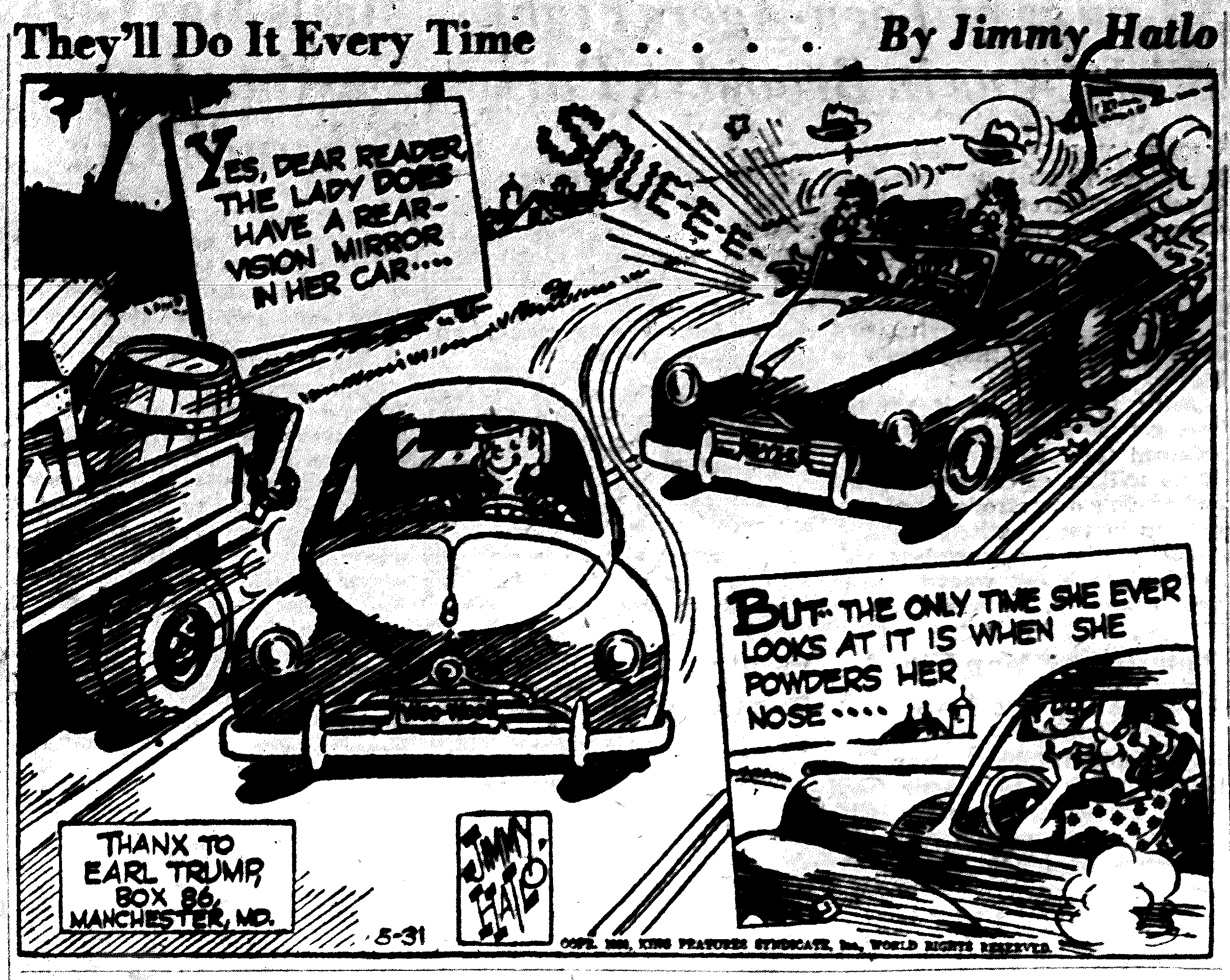
On May 31, 1950, the Richmond Times-Dispatch ran a cartoon titled “They’ll Do It Every Time.” I guess the “bad driver” trope was the 1950s alternative to the “captive wife.” It’s pretty self explanatory:

Friday Photo: Tyler City Hall

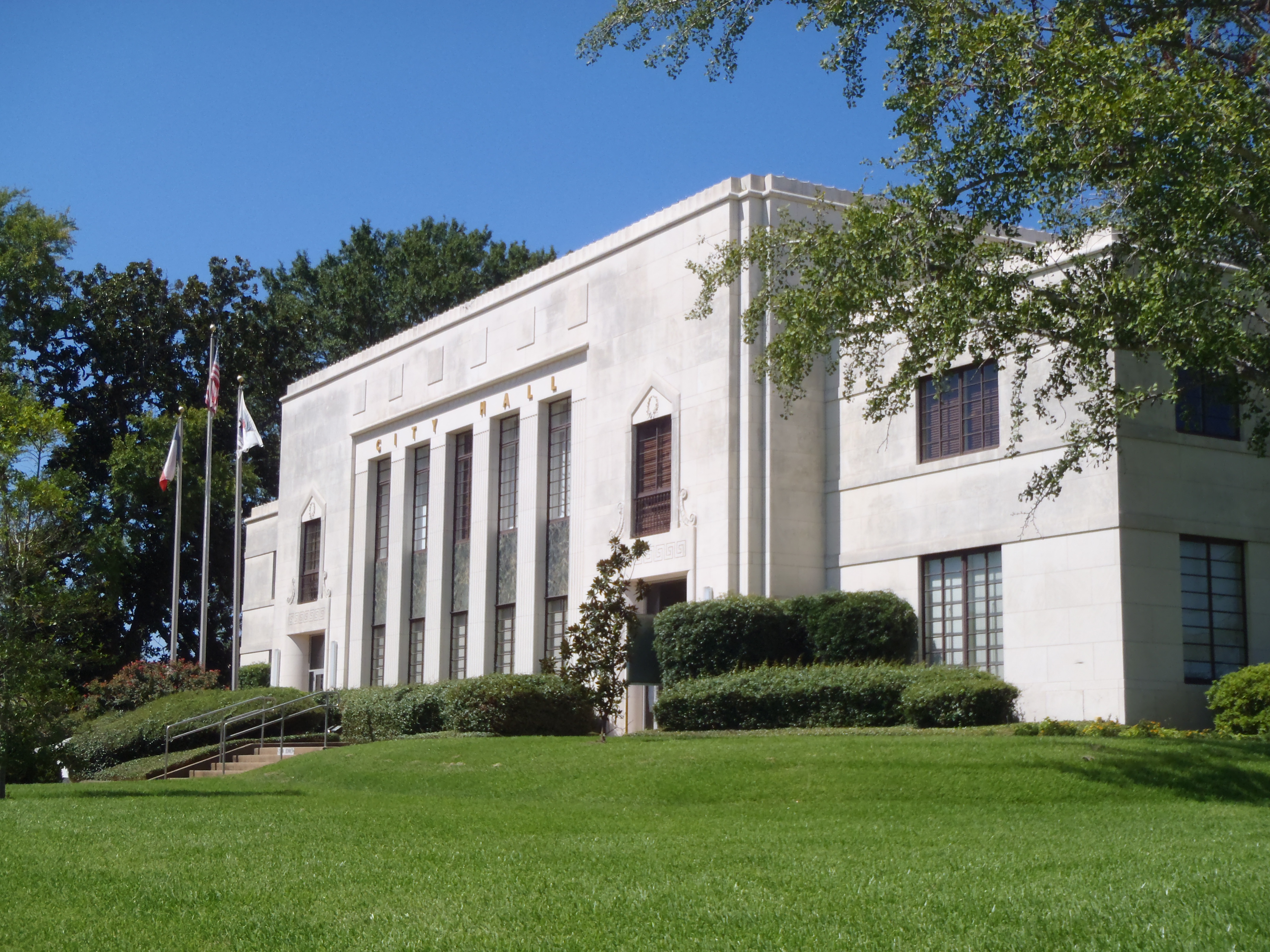
You might not know this (I didn’t until recently), but Tyler has a City Hall. The mayor and city manager work there along with other public officials and board members. It’s on Bonner Avenue just north of the wasteland formerly known as King Chevrolet. I like the building because it’s a decent Art Deco piece from the 30s when Tyler was awash in oil revenue and looking to the world for inspiration. It’s also surrounded by nice grounds, picnic tables, and benches. Take a look:

C-T-D: Conclusion to my time in this place called Tyler

I moved back to my hometown of Tyler in May to begin a brief, post-grad-limbo summer. Since I arrived, I have made it my hobby to explore the city, imagine its potential, and write a series of posts on my ideas. I called this, “Connecting-the-Dots,” because I believe that Tyler (like many cities) suffers from a lack of cohesion and identity. On the micro level, we lack special places (“dots”) fully enhanced with the cultures, traditions, and organizations that comprise our civil society. On the macro level, we lack the connections of transportation and urban design that unite the disparate pieces of what we consider to be a singular unit. I’ve been primarily guided by the question, “Where is Tyler?”

In my attempt to answer this question, I’ve spent my time looking for what I believe makes this city unique: what someone can find here that is not anywhere else in the same way. The places that I love the most are sometimes the places that are most unloved. In other words, the Rose Garden may not be as sexy as Chuy’s right now, but it is unique to Tyler unlike the Austin import. Business in North Tyler might not be as lucrative as its cousin on South Broadway, but it’s more creative, local and artisan. It’s the difference between Janie’s Cakes and the WallMart bakery, Stanley’s and Spring Creek, the Rose Garden and Faulkner Park, Balance and World Gym, La Favorita and Pasado’s.

Unfortunately, all of those places that I believe represent Tyler do not reside together in one awesome, dense, and diverse place. In my opinion, a visitor to this city needs a guide to properly experience what this city has to offer. But suppose there were such a singular place comprised of all the unique Tyler attractions. It would be remarkable. People would come from all over the region to be a part of it’s energy and excitement. Now, suppose there were two. Or three and a street car connecting them. Suppose you could go to one for dinner, the next for a concert and the third for coffee, dessert and drinks and never get into a car or leave your friends. Suppose everyone in East Texas heralded this as the “Tyler experience.” Suppose we leveraged what makes us unique in order to make us uniquely great.

Our city is positioned as a regional leader in oil & gas, the processing of roses, healthcare, higher education, retail, banking, legal and financial services. Suppose we were also known as a creative and innovative community that supports new ideas local aspirations. That is a dream many in this city have been fighting to realize. I believe it’s a dream worthy of this place called Tyler.

Lost Treasure: Stone Drainage Tunnel

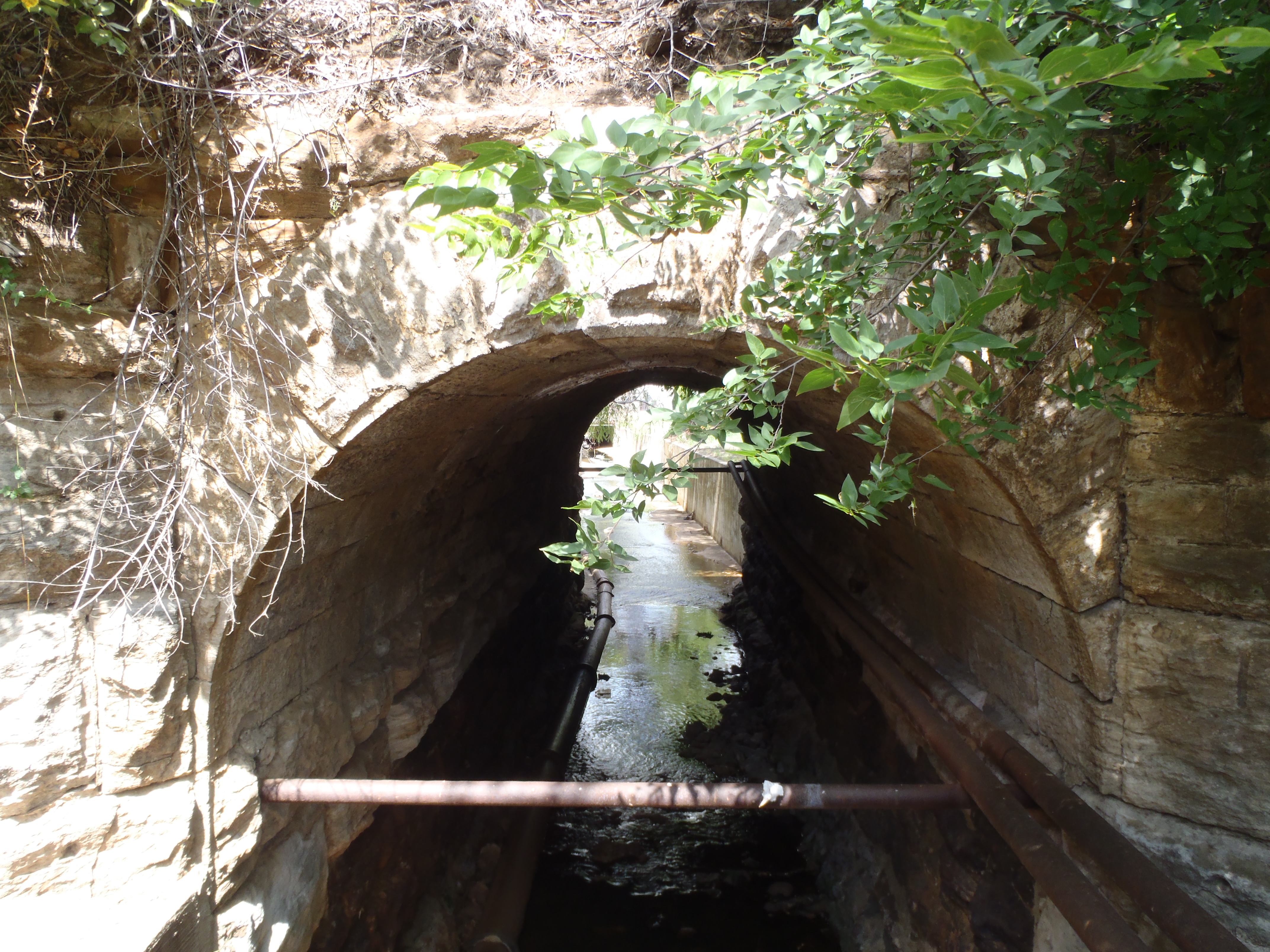
They don’t build ’em like they used to … so why don’t we take care of the old stuff? My “Lost Treasure” category is for structures and spaces that have been forgotten. The first entry is my favorite bit of public infrastructure in Tyler. The tunnel is a stone arch made of stone with a capstone that reads, “1880.” You might not have noticed it just east of the intersection of Elm St. and Fannin Ave. Here’s a link to the Google map aerial shot for reference. This is something worth restoring:

Buy this Brownfield: Tyler Ice House

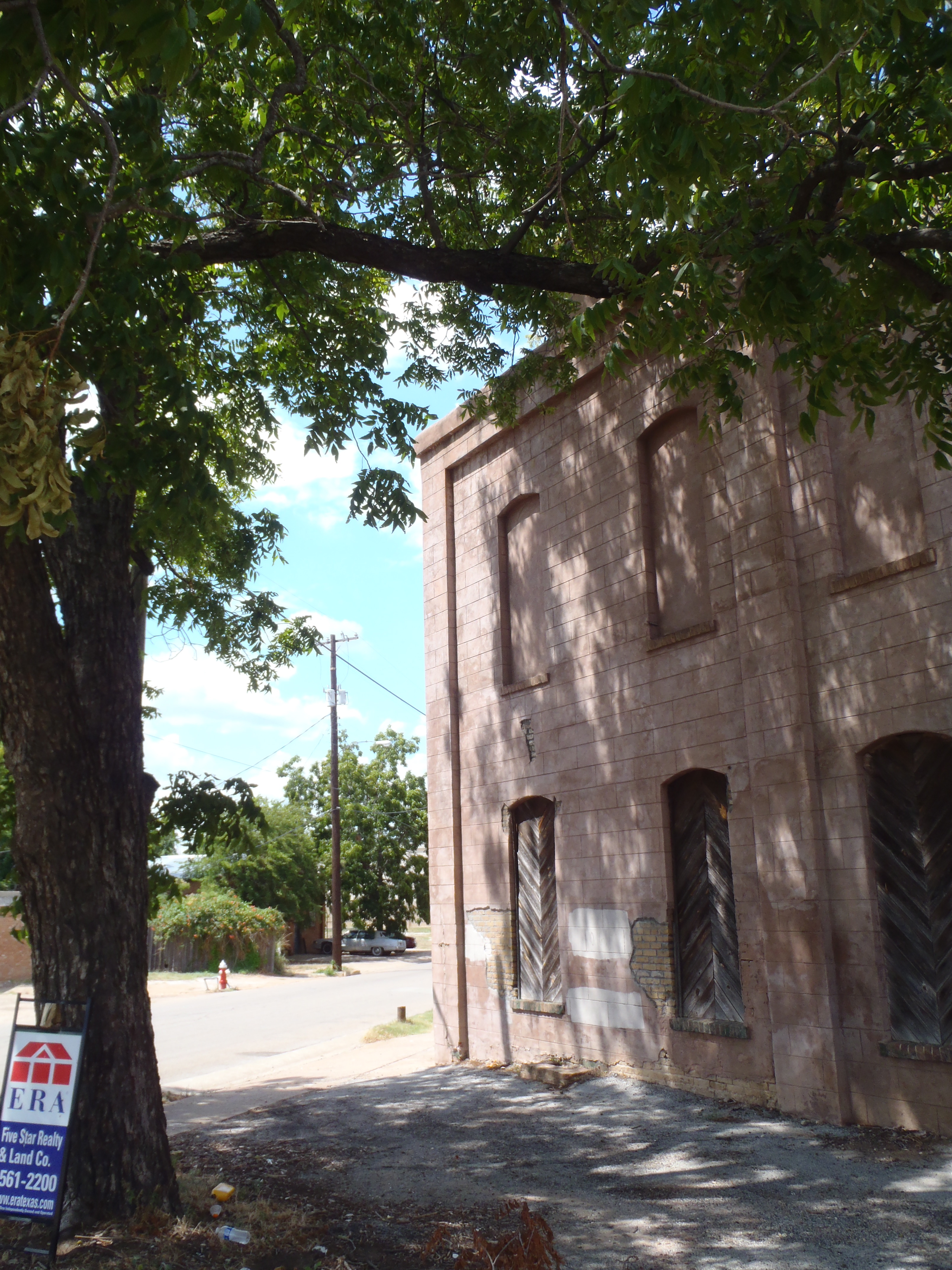
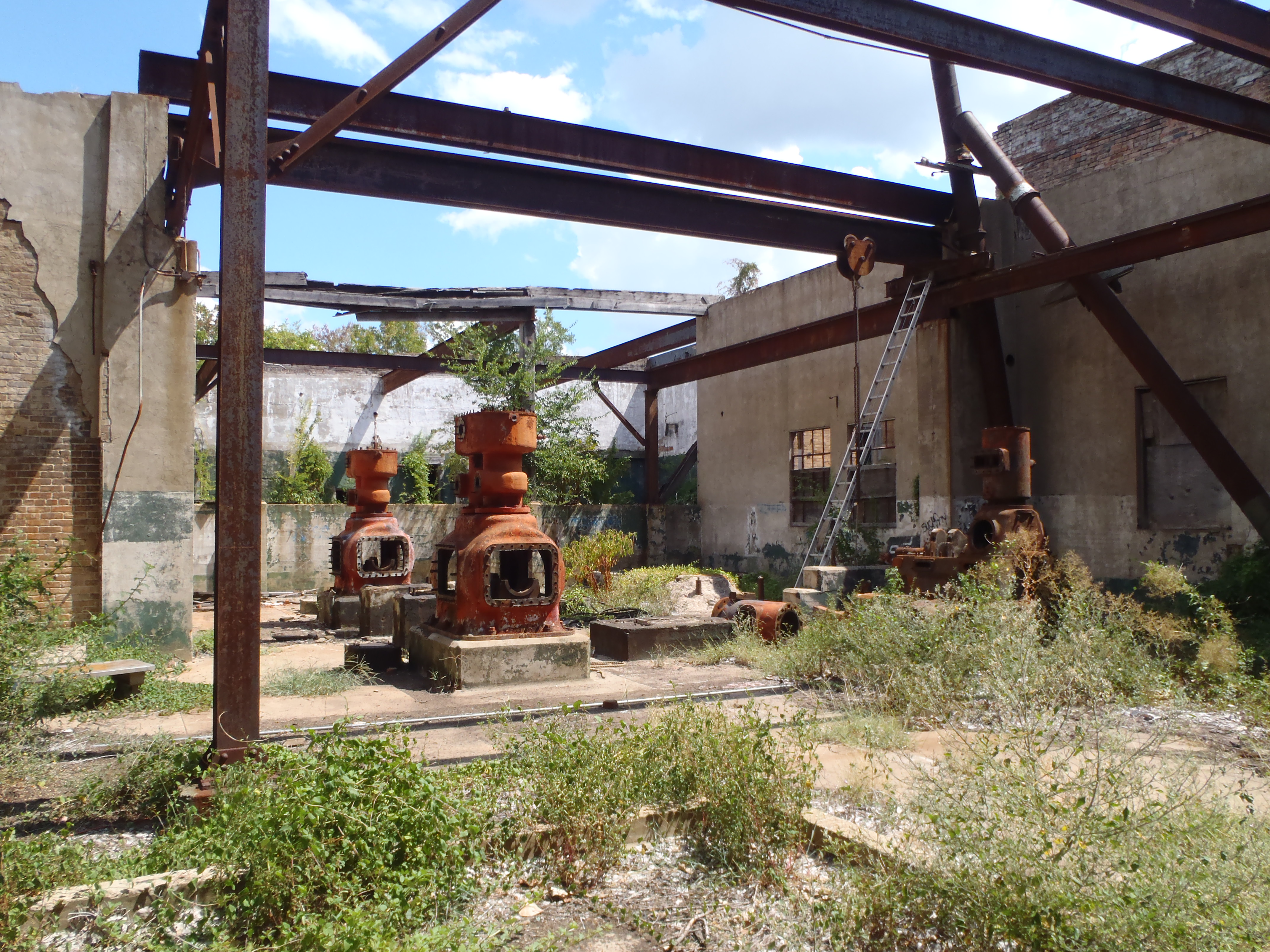
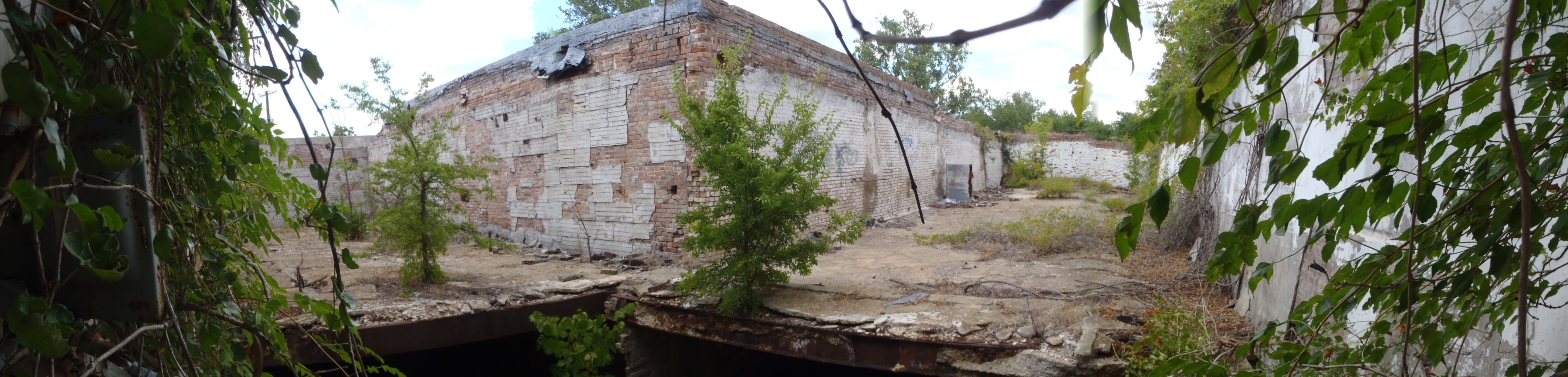
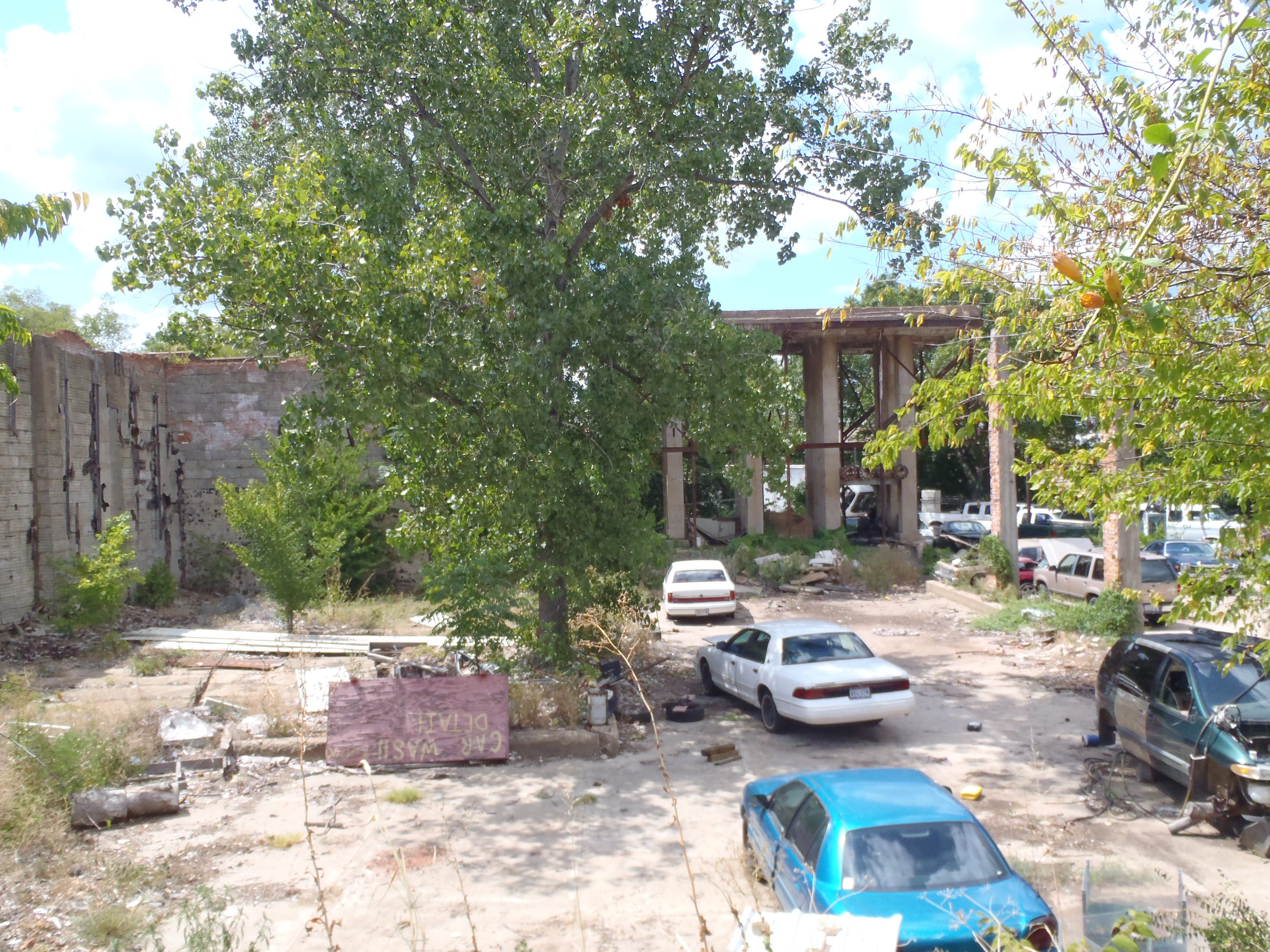
The coolest building in Tyler has trees growing in it. If you’re like me, you’ve seen it before. If you’ve lived in or visited the Salvation Army, you might have stumbled upon it. Otherwise the area is probably one big blank spot on your mental map of Tyler.

Check it out on  Google maps. I first found this building years ago while exploring North Tyler. When I found it, I couldn’t believe I was in the same city. It was one of those”WHAT IS THIS” moments that I have on occasion. From the road, the building is impossible to understand. The first think you notice is that it’s huge, old and derelict. The outside of the building is this weird cross between a Tex-Mex Restaurant stucco façade and a 1900s industrial frame. The primary door (right) is relatively ornate for an old ice house and a reminder that there was a time when people cared about details.  From what I can tell, besides the materials there is also nothing really uniform about the design. Which is perfect. Buy this brownfield. It could be literally be the coolest “whatever you want” in Tyler.

Because the space has the potential for such a wide variety of uses, I decided to choose my five favorite options. Four are long-term options and the fifth one is my “Hail Mary” option that would at least create some temporary attraction and breathe new life into the space.

Option #1: Concert Venue. You could do this tomorrow! All you would have to do is secure the area, hang a light canopy from the walls, spray some Roundup, and get an electricity hookup. The actual venue would be housed in the cavernous great room (left). It is reminiscent of an industrial cathedral with rusting machinery, an I-beam frame, and a large floor space. Recently, I walked into the space and got that sense of wonder I get when I see something that was once great. When you first walk into the space (beware of the three dogs that chased us out … seriously), you feel a sense of grandeur that can only come from an old factory brownfield. Instead of supporting the ceiling, the old steel beams rise into the air to the sky itself. There is some leftover from the industrial era, but otherwise most of this great room has been cleared away making it a perfect place to set up chairs and blankets for a life concert under the stars.

Option #2: Artist Collective and Gallery. This idea incorporates the mission of “creative placemaking” which seeks to attract creative people to improve a building or neighborhood. This plan would incorporate two parts: A retrofit of the great hall into a gallery and a renovation into the rest of the building into studios and apartments. For the great hall, imagine The Tate Modern on a significantly smaller scale. It would be industrial, expansive and equally stunning. With a glass dome spanning the distance between the walls and a canopy of lights it would be the coolest art space in Tyler. The great hall was made to showcase art. The two-story southern half of the building (pictured below) is large enough to fit 20 or so studios for local artists who desire an inspirational setting for their projects. I’ll admit this section needs a lot of work, but someone with a vision and some money could invite the right people to make it an incredible success.

Option #3: Urban Farm and Fresh Produce Market. This project could be a particularly good fit because the entire lot includes both a large amount of land and a large building on the street. The land surrounding the building could be an excellent urban farm and garden. There’s enough room to grow crops as well as concept gardens for visitors. This vacant land  is currently being used for auto repair, but I don’t think there much physical infrastructure associated with the shop. The owner of the business (and the dogs) would probably be able to find another vacant lot in N. Tyler … I can think of a few. If the land were converted into a farm and garden, the building itself would be converted into greenhouses, market space and apartments for the farming community. In contrast to the current farmer’s markets in Tyler, this would be a permanent space completely devoted to the growing, sharing, and selling of good food. In addition, the location of this farm would be strategic in connecting the surrounding neighborhoods with fresh vegetables and weekly workshops on nutrition, agriculture and entrepreneurship.

Option #4: Offices for an Urban Development Firm. Usually, it takes a very creative and ambitious firm with a lot of money and confidence to retrofit something like this building. As such, it would be the perfect flagship for a pioneering architectural firm in Tyler. Is there one? I’m not sure, but if there is one I would consider applying for their first entry-level job in this new space. As a flagship, it would highlight the firms ability to critically analyze the historical significance and current condition of a space and produce successful adaptive reuse solutions. There are already people doing this sort or work in Tyler, but I think they need to join forces, gather investors and convert this building. With representatives from real estate, landscape architecture, architecture, engineering and planning, this new firm could be a regional presence.

Hail Mary Option: Host a Regional Mural Conference! My last-ditch effort to start using this space is simply this: Invite artists from all over Tyler and East Texas to come for a weekend of live music, street food and live mural paintings on the property. What is now old and grey could find new life with creative people and for a moment everyone would catch a glimpse of the buildings full potential.

Check out my other Tyler projects at my Tyler, TX page!

p.s. I’ve heard the building is overpriced, but if you’re up for a challenge call Five-Star Reality at 903-561-2200. I’m sure they’d be happy to show you around.

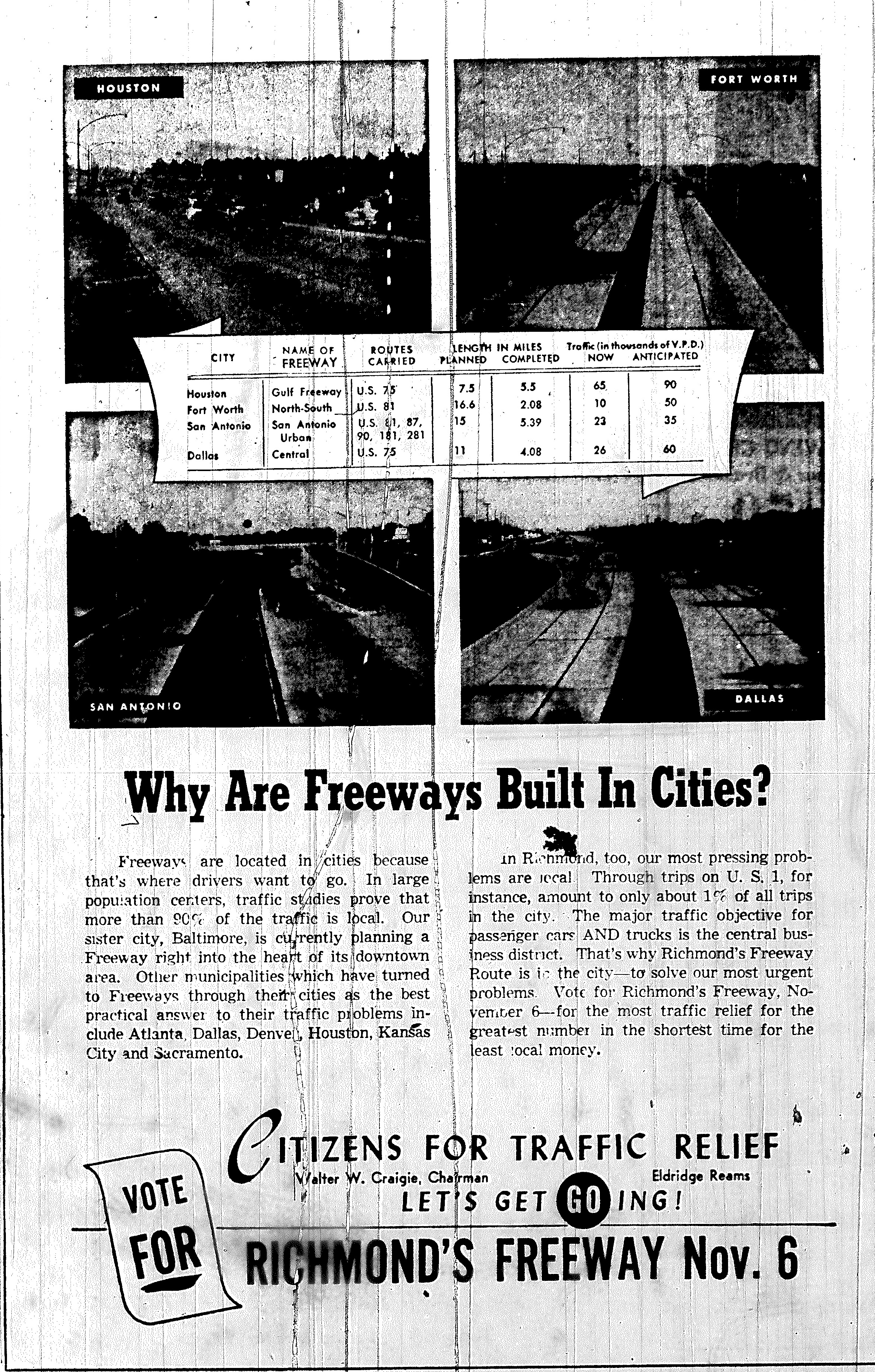
Weekend Graphic: Why are freeways built in cities? (1951)

On Nov. 2, 1951, Citizens for Traffic Relief ran a political ad in the Richmond Times-Dispatch titled “Why Are Freeways Built in Cities?” This ad was purchased in anticipation of the second public referendum related to the Richmond-Petersburg Turnpike (which failed). It reads,

This as was especially interesting to me as a child of Texas. Looking back 60 years it’s amazing that it seemed like a good idea to pattern Richmond’s regional development after a city like Houston.

Singing from Whiteness

*Warning, this post is about race … including white people.

The other day I was driving through Tyler listening to some country music on a local station tryna get in touch with my white roots. As I listened, Eric Church’s incredibly catchy song, “Homeboy,”  came on. If you haven’t heard it, the first verse of the song reads,

“You were too bad for a little square town
with your hip-hop hat and your pants on the ground
Heard you cussed out momma, pushed daddy around
You tore off in his car
Here you are runnin’ these dirty old streets
Tattoo on your neck, fake gold on your teeth
Got the hood here snow, but you cant fool me, we both know who you are”

“Hip-hop hat?” “Pants on the ground”? “Fake gold on your teeth?” As I tapped my thumbs on my steering wheel, I wondered to myself, “What is he even talking about?” And the the name of the song is “Homeboy”? Anyone who’s seen Antoine Dodson’s intruder speech (and the requisite autotuned followup) doesn’t have to check Urban Dictionary to know that “homeboy” isn’t really the most white thing you could call someone. So I started thinking about race and how people of different races refer to the other. In other words, how do white people say “stuff Black people do” without really having to say it for fear of sounding racist.

Since I usually write about actual spaces, in honor of Church’s song, I want to get a little more academic and talk about rhetorical spaces. The song constructs two spaces in particular: White (rural) spaces and Black (urban) spaces.

First, I want to talk about the rhetorical space of whiteness as the location from which Church is singing.  Basically, Whiteness is the space from which white people often (albeit unknowingly) speak and operate. Whiteness is often compared to a black hole in the sense that you can feel the power of its influence on society, but cannot often determine its characteristics. The blog, “Stuff White People Like” is important regardless of it’s limitations because of its noteworthy purpose: To essentialize Whiteness. When I first saw the blog four years ago it was the first of its kind. Honestly, I don’t think I had even heard the phrase, “White people _____,” in any context. Lots of white people object to the blog (i.e. “I’m not like that” or “That’s just hipsters, not white people!”), but I think that’s partially the point: There are no essential characteristics to a race. It’s also just plain funny.

The objections from white people are interesting because it seems the majority is uncomfortable being “pinned down.” Of course, this is minor in comparison to the experience of African Americans as essentialized minorities. In this world, there are a multitude of examples of Blackness: Stereotypes associated with the black race. These represent the rhetorical space of Blackness. In his song, Church is pretty blunt about his references to Blackness. The song is just full of references such as the ones listed above. As far as I can tell, the song is written about a white guy performing Blackness … basically some guy’s younger brother gets too good for the comfortable, white country lifestyle. Then he starts to cuss, become more physically violent, rebel, become more likely to be thrown in jail, feel entitled, and waste money.

But isn’t that a strange leap? What is it about a tattoo and gold on someone’s teeth that makes them more violent? The reason is this: Blackness, in contrast to Whiteness, is a very defined rhetorical construct.

As a the minority population, black people have often been associated with each other by members of the majority.  In other words, for centuries members of the Black Diaspora have been saying, “Hey, I’m not really like that” or “I’ve never seen a black person that actually actually acts like that.” But many white people don’t usually get the chance to feel “called out” for their Whiteness in the same way. If you are white and you’ve been called out for, say, drinking so much milk, you may feel angry thinking about the experience. I usually just laugh. Unlike Blackness, Whiteness is relatively undefined and uninterrogated AND it isn’t historically associated with political oppression. Blackness, in stark contrast, has been constructed over the years with clear political and economic motivations.

The best description I ever heard basically said that Whiteness is an elusive center. It’s relatively undefined and often subtly powerful. In operating from the elusive position of Whiteness, Eric Church seems to be making two statements at the same time. The explicit statement is that there is value in the country life and honoring your family. It’s true: We shouldn’t mock our families or disobey our parents. The implicit statement, however, is that city life is morally inferior and that urban culture or Blackness will lead you down a self-destructive path. There’s a few problems. The first is that rural life is not a white experience. The second is that the WSJ recently reported that city life is in many ways healthier.

As a fan of flat-brim hats, Mike Jordans and doing “The Jerk,” I happen to disagree with the notion that urban culture instills rage or disrespect. In fact, I’ve seen people do some pretty dumb things in Topsiders. Maybe I’ll write an autobiographical counter to Church’s song titled, “Frat boy.” That way, I could engage the ethos of the song which is “Family first” without falling into the pitfalls of race. At this point, I think it’s always important to ask yourself, “What are we trying to say?” As a member of the majority, I think a new kind of thoughtfulness (not merely political correctness) would be appreciated.

 
Works (loosely) cited:
McKerrow, Raymie E. “Critical Rhetoric: Theory and Praxis.”
Nakayama, Thomas K. and Robert L. Krizek. “Whiteness: A Strategic Rhetoric.”
Also, if you’re interested, here is a link the lyrics to the song I referenced

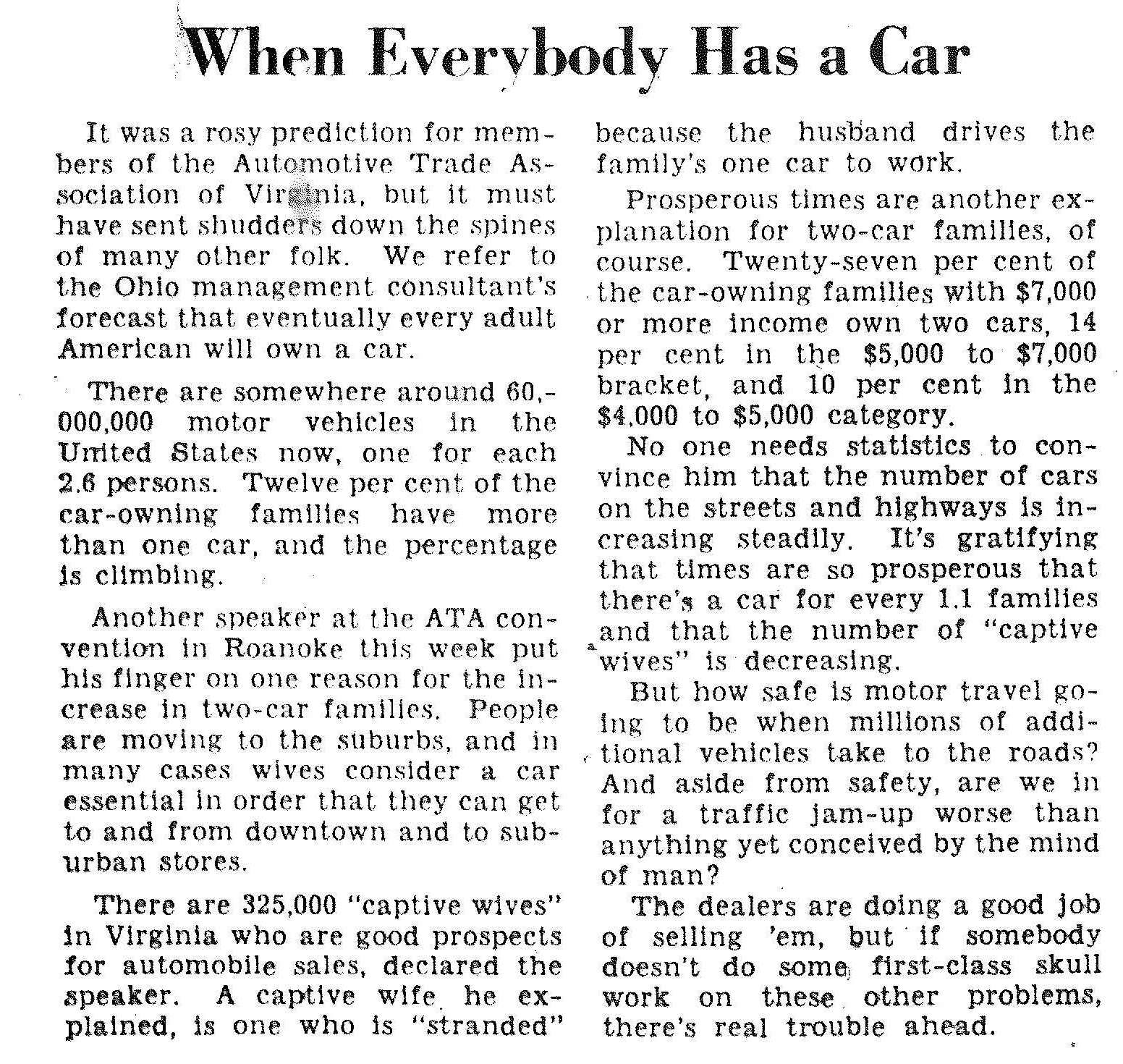
“When Everybody Has a Car”

On Monday Nov. 14 1965, the Richmond Times-Dispatch published an article in the opinion section. It reads,

In the 1950s and 60s, members of the automobile hegemony often made grand statements. I’m amazed that even in 1965 this one sounded like a bad idea.

C-T-D: Broadway Center

Here’s the deal: I want downtown to be cool, but I think we need more than one cool place. The historical buildings and “monuments” on the square are worth saving, but they shouldn’t have a monopoly on dense urban development in Tyler. I’m convinced that we can improve downtown and create more high-density developments at the same time. Most importantly, if we connect them to each other, their synergy will have far more positive social and economic impact than they could on their own.

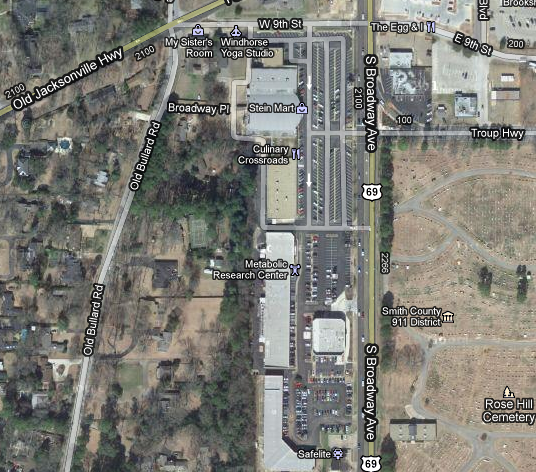
First stop: Broadway Center. Once we have finished building The Complete Loop, we should look to Broadway for the next great artery of development in Tyler. But, instead of the constant retail strip malls and big boxes that you see in South Tyler, this section of Broadway will augment the existing historic neighborhoods with new, high-density developments. Like two weights on the end of a barbell, Downtown and the redeveloped Bergfeld Center will anchor this region. See the difference? Instead of constant retail strip, we will concentrate businesses in two high-density places that will are in close proximity to valuable real estate. It’s better 🙂

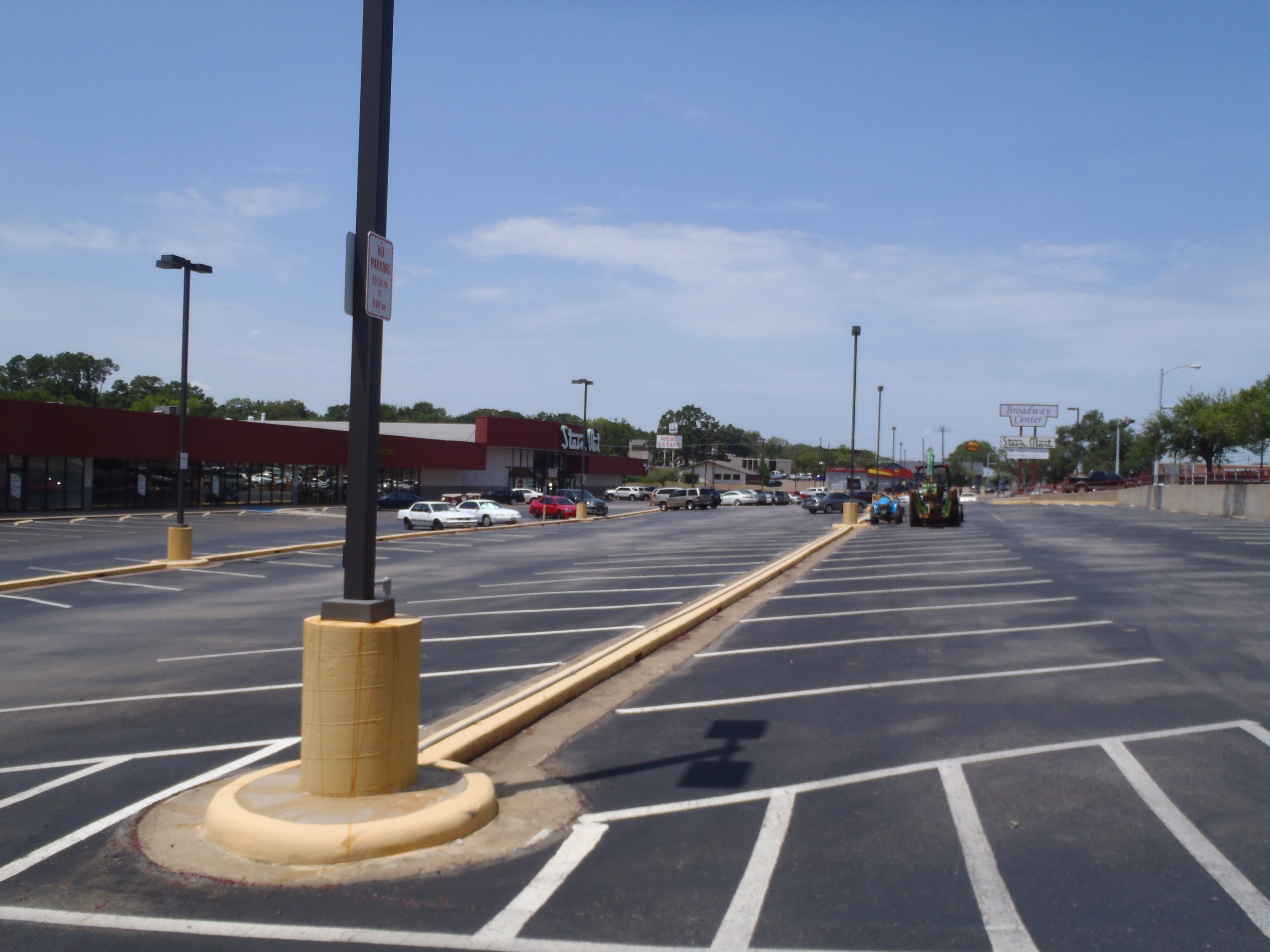
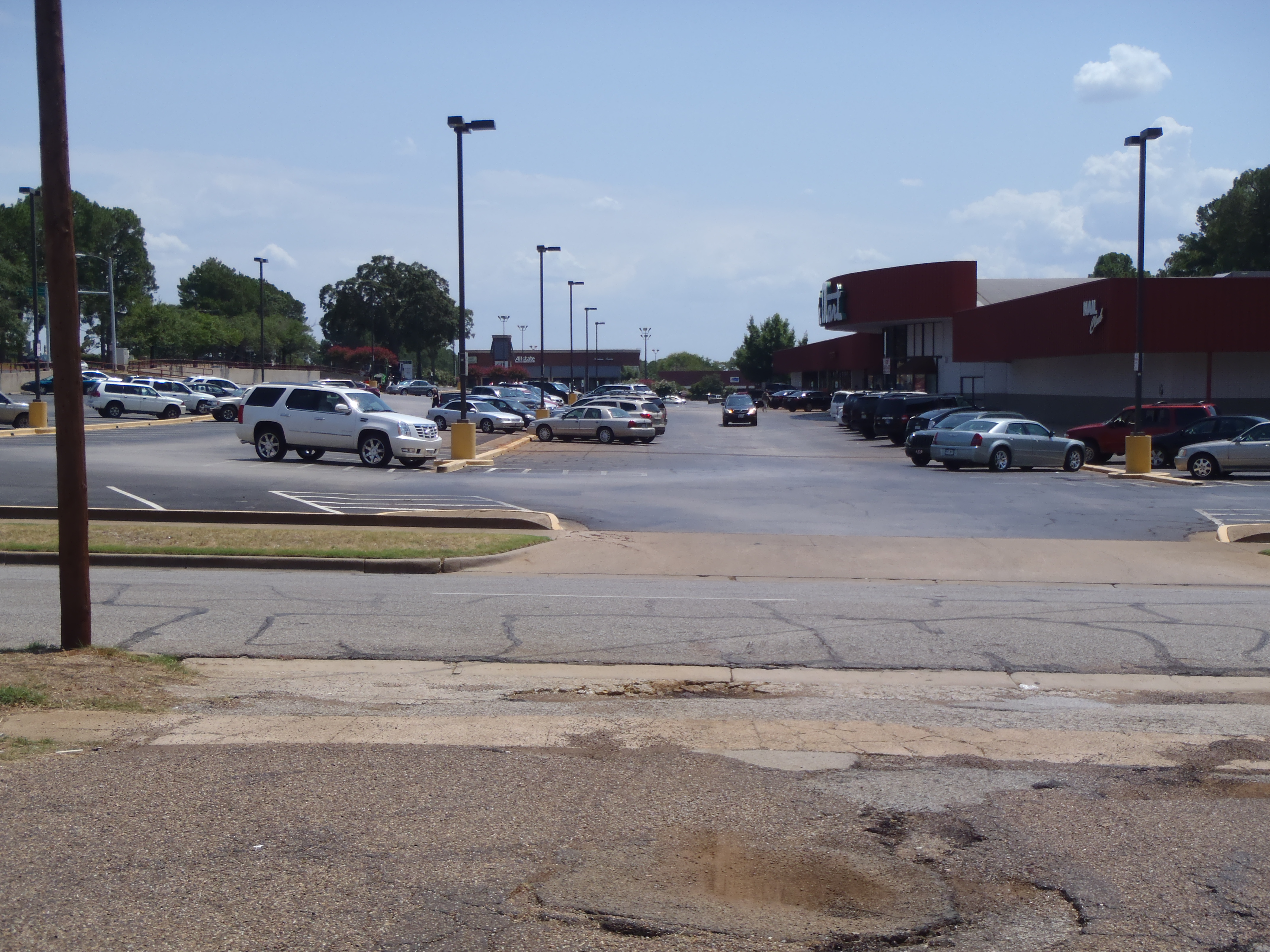
Rule #1: Every parking lot in this section has potential for development. It’s a pretty basic rule, but  necessary. Building on parking lots has the capacity to transform ugly/boring/typical spaces into unique and attractive spaces. We also don’t often don’t even realize how incredibly big these parking lots are. We just get used to them so we don’t “see” them any more. I know, people have to park somewhere, but we also deserve to have a beautiful city, right? Let’s find a way to do both.

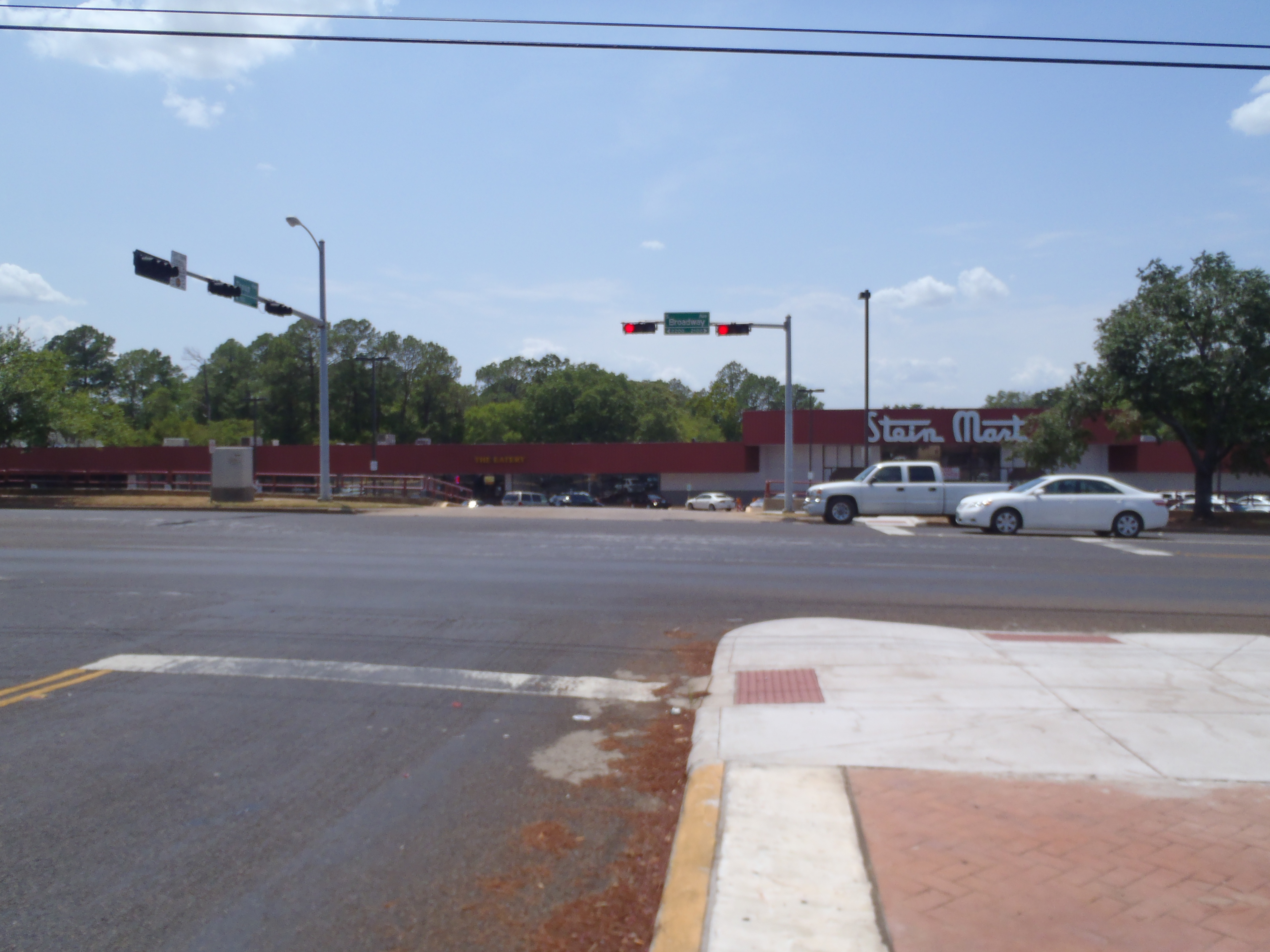
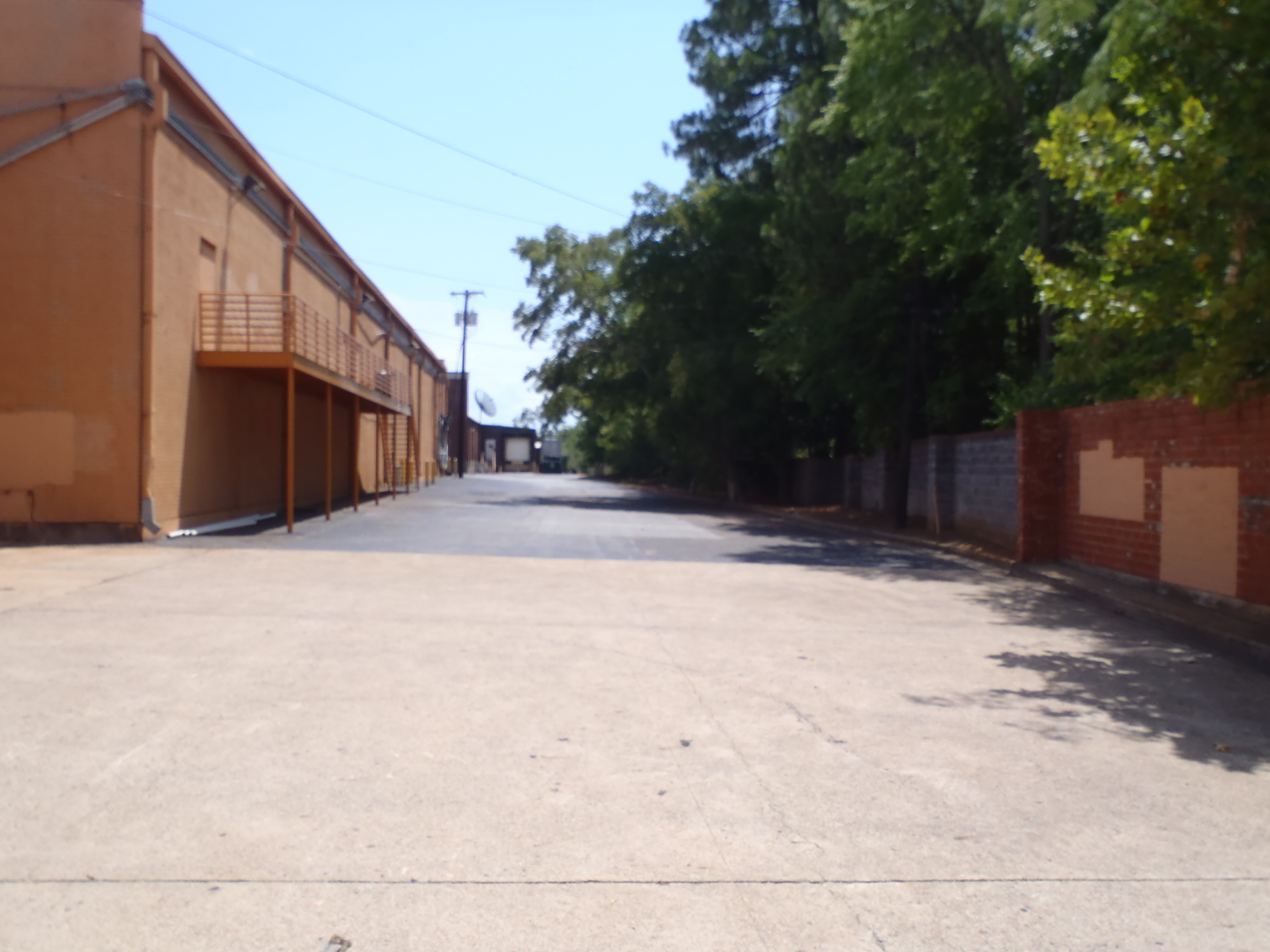
Rule #2: Reconnect the roads and the complete the grid. More roads means more access and more retail space. In regard to the issue of parking, it also means more on-street parking. If we connect Troup Highway (left) through what is now a parking lot and Stein Mart, it would meen a straight shot to Old Bullard and plenty of places to spend money. Additionally, the connectivity would invite residents of the nearby neighborhoods to visit the new shops, parks and restaurants on their morning walk. According to a recent traffic study, 30,000 cars per day drive by this spot on Broadway — Let’s give them more reason to stop. Also, in order to extend the grid, it would be great to build two new roads through this development in front of (to the right) and behind (left) what is now Stein Mart. This will complete the grid and create city blocks for more dense, protected urban development. Think less people would come? Think again. More people are likely to shop and spend their time in compact, beautiful spaces. These developments are essentially the free-market “one-stop-shop” developments that incorporate a multitude of uses into previously unloved space.

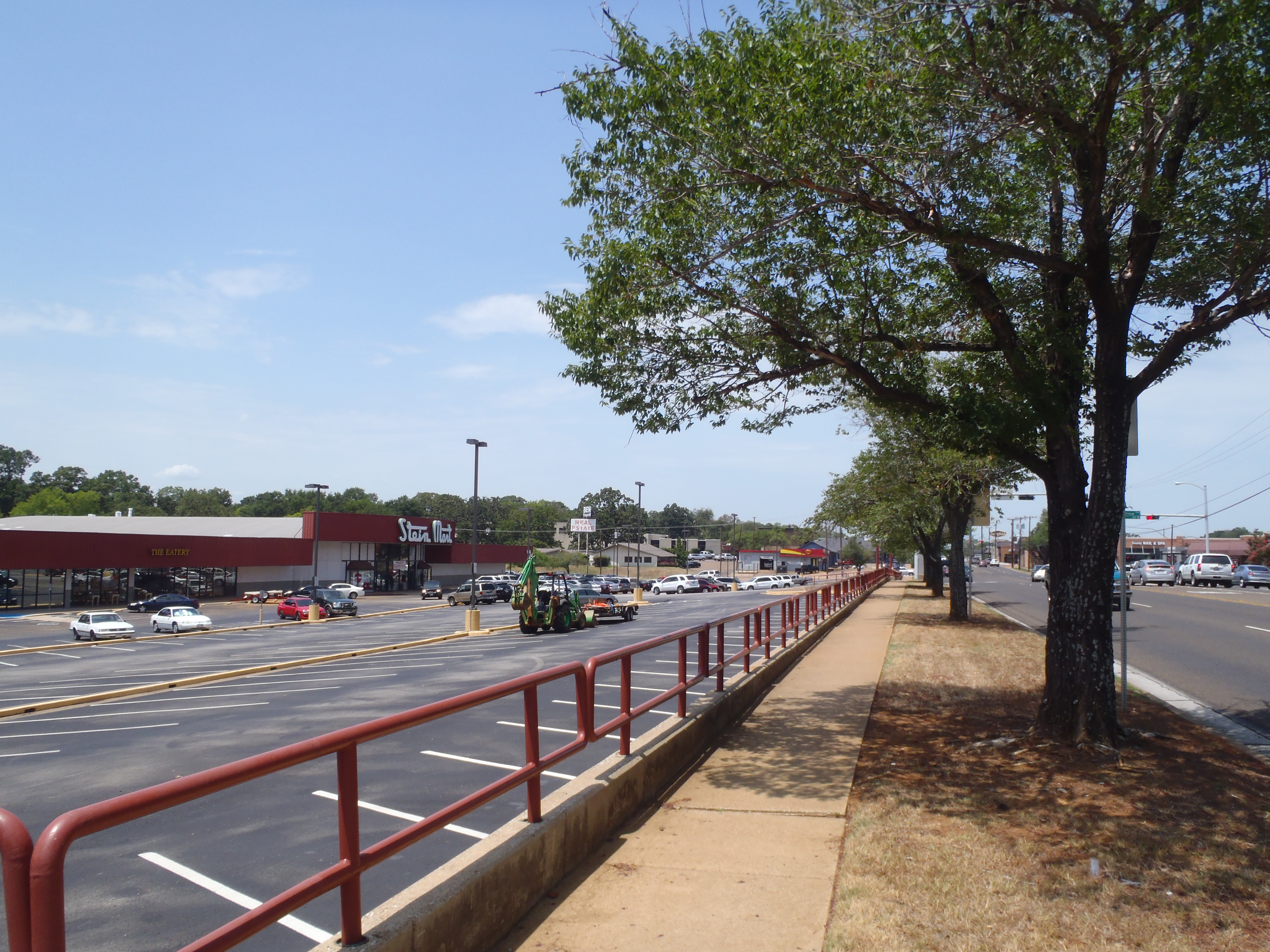
Rule #3: Build to the street on street level. This is important: Don’t pop it up with a “sporty” flight of stairs, don’t put parking in front, and do keep the street trees as a buffer. If there must be parking, put it on the inside of the development. The point is to make the development itself the advertisement for the development. Currently, with a football field of asphalt infront of the strip mall, you have to put a sign out front informing people exactly what it is. With the building built to the road, they will know what it is and they will appreciate the good urbanism.

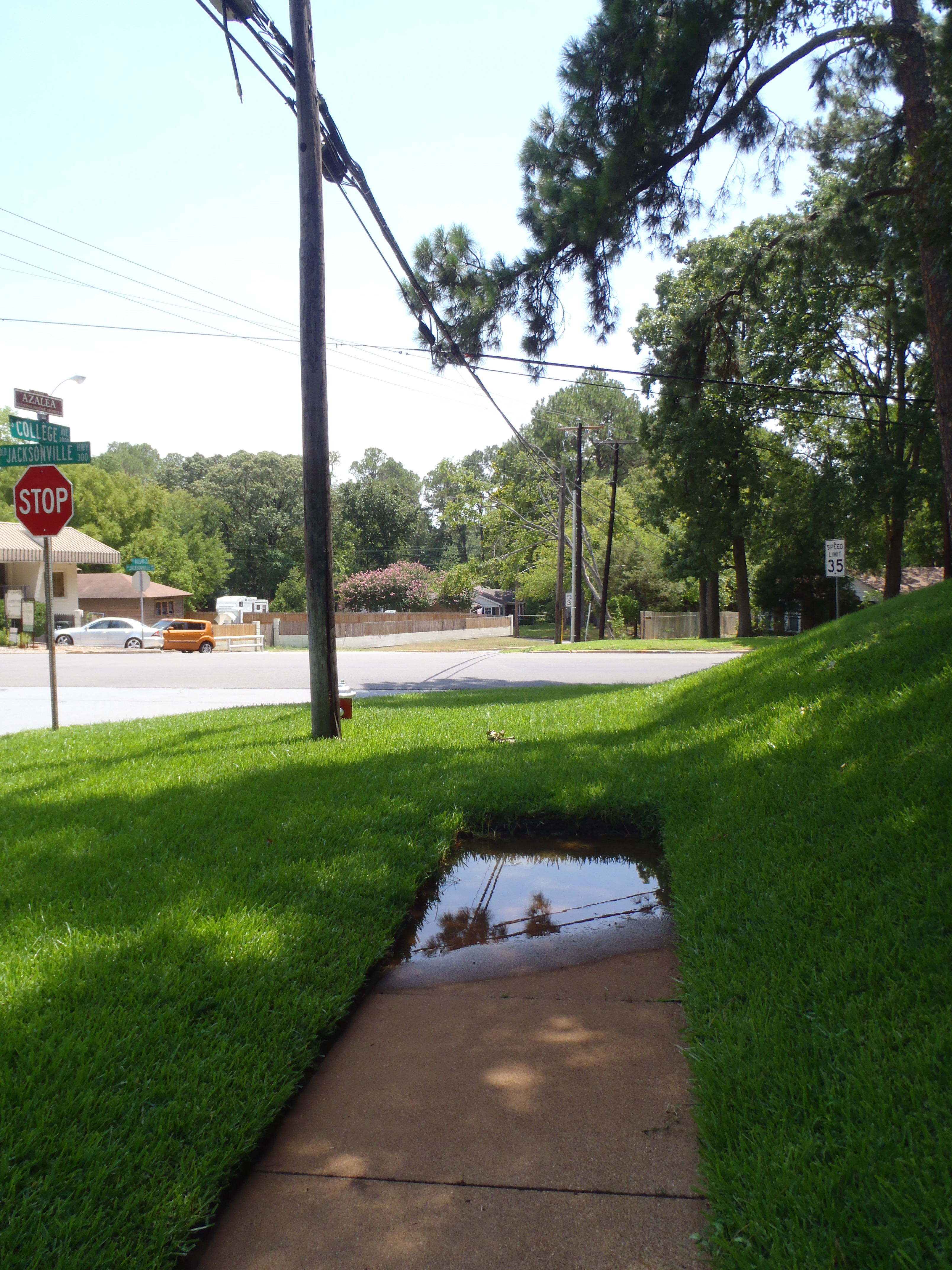
Rule #4: Finally, of course, make it walkable and bikeable. According to the recent Walk Score report, the most walkable cities in America are, as always, also the coolest cities in America. Tyler was not on the list. Many times when I walk in Tyler I have this feeling like I don’t belong. Today was no different … as I was walking down Old Bullard toward this development the sidewalk ended. There aren’t crosswalks across Old Jacksonville or Broadway and there isn’t a sidewalk along Ninth St. That’s just not acceptable … and more importantly not welcoming. With a little public investment, this could be a completely accessible and welcoming area for everyone.

So that’s the newest node! I’m gradually “Connecting the Dots” in Tyler and hoping one day someone will take my ideas and make lots of money with them.

Check out my other Tyler projects at my Tyler, TX page.

C-T-D: The Complete Loop

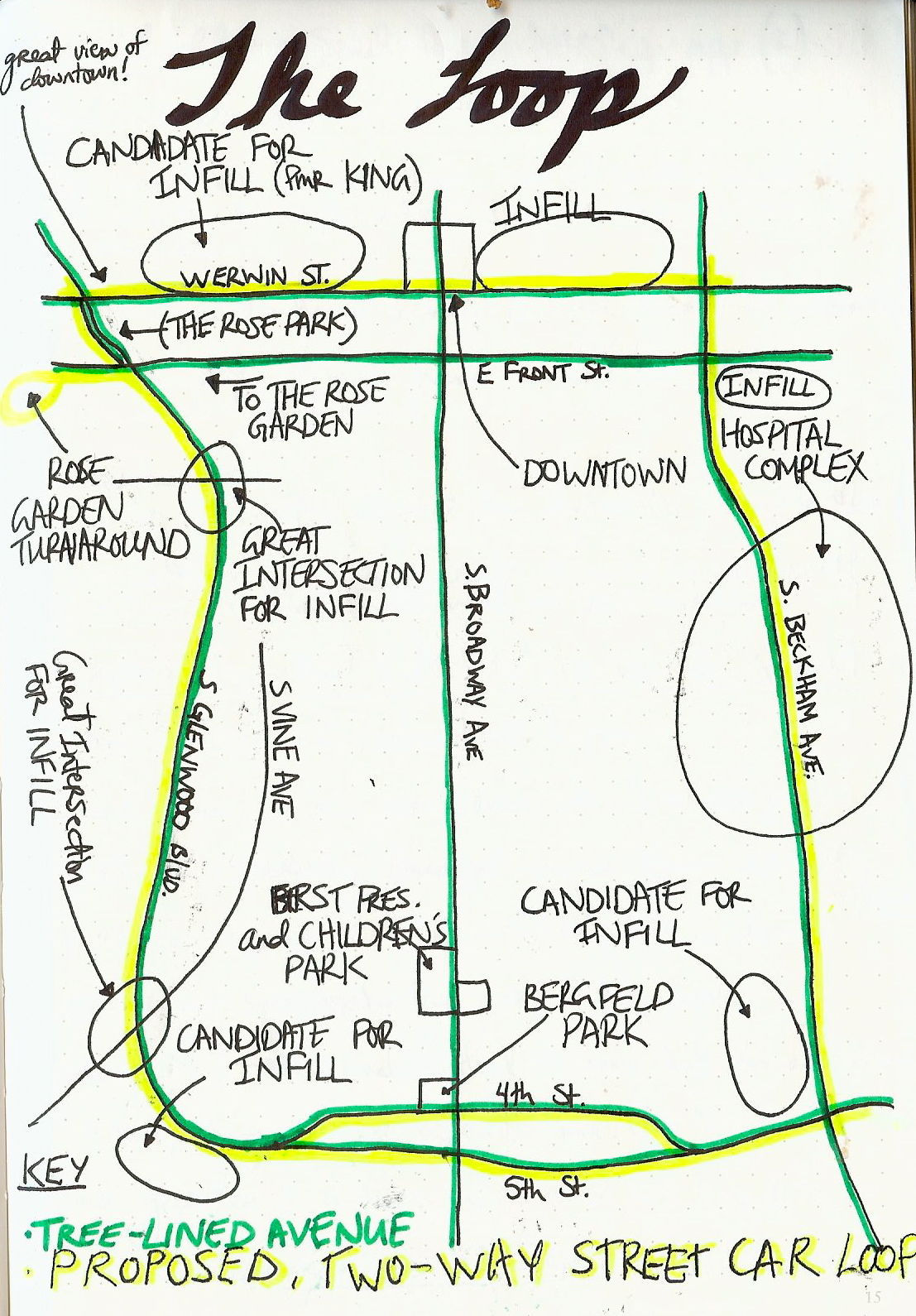
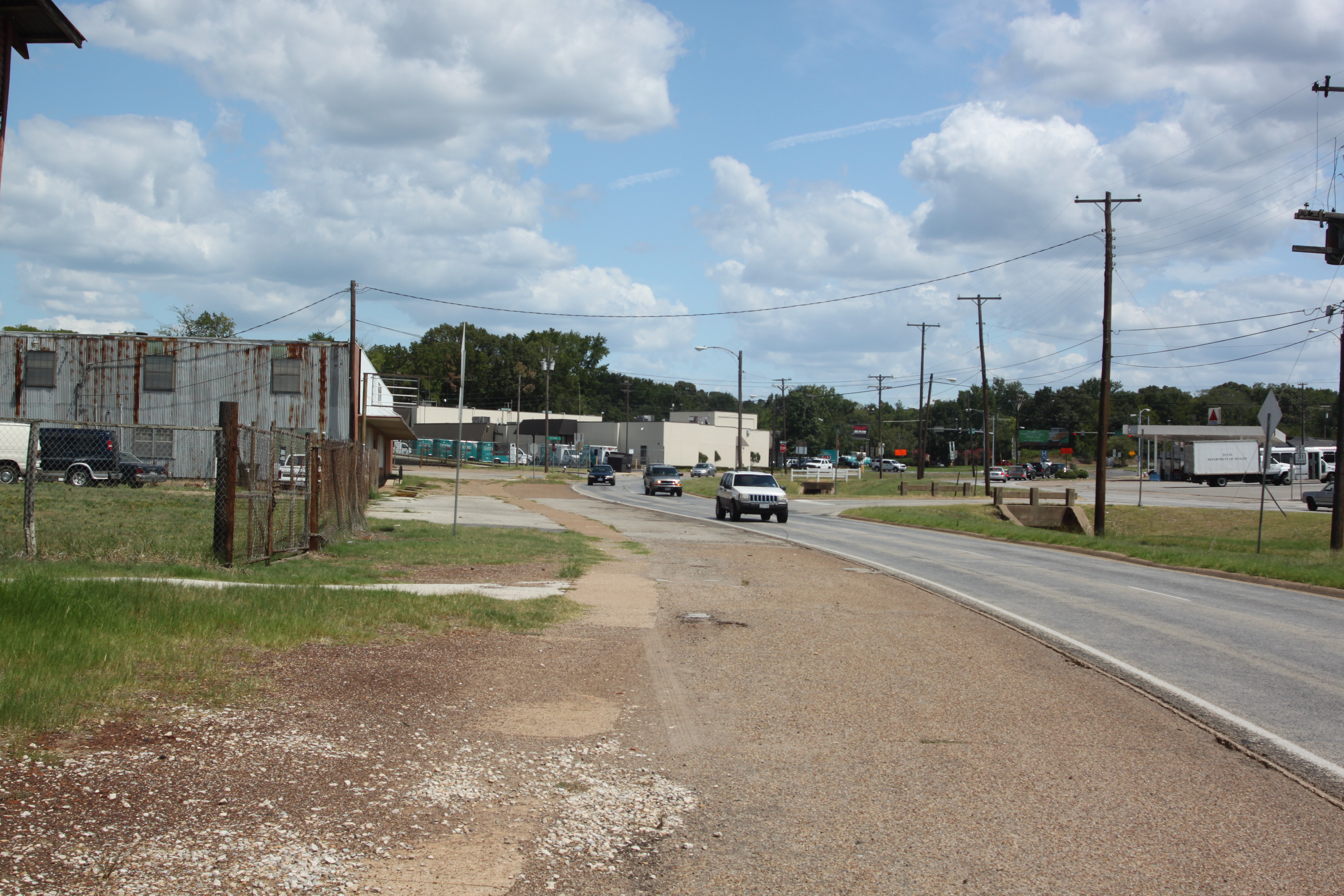
Ok, I’m changing my vision for reconnecting Tyler. In my post “Connecting the Dots: Intro,” I called for a loop of streets to be beautified with bike lanes, street trees as well as connected with street cars. My original vision saw the street car loop connecting down Broadway, but today I changed my mind. My imaginary Tyler now has a network of complete streets and a two-way street car loop. The map I have drawn (to the right) is the culmination of about a month of work on my Connecting the Dots project (C-T-D). It’s not a conclusion, but this is this skeleton that will be my foundation for future posts on infill development in Tyler. These developments are the dots themselves: The high-density nodes that should be developed throughout the older parts of Tyler. “The Loop” is the public investment that is necessary to make the entire concept a reality.

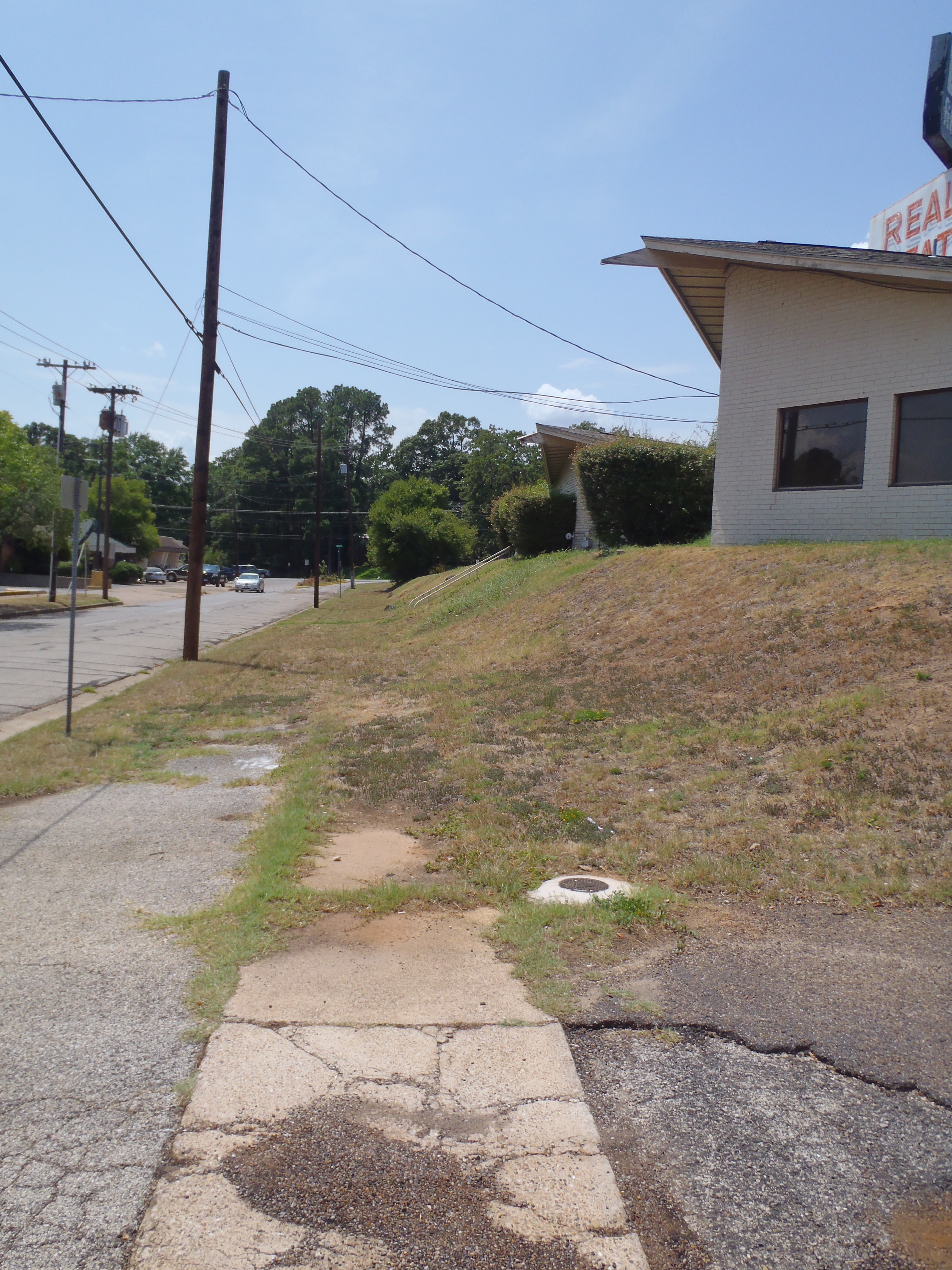
It begins with a paradigm shift from the current philosophy on street construction in Tyler. Currently, a street in Tyler (left) is where cars drive. While it seems like a basic statement, this is a relatively new phenomenon credited to 20th century engineers and planners who gave cars complete precedence in matters of urban travel. Before the advent of the automobile, streets were places to walk, gather, transport and protest. Bicyclists were the first promoters of “good streets” in America and streetcars (started in Richmond, VA) were the first modes of suburbanization. When the car became affordable, it trumped all of these previous developments and occluded their progression. In the past century, streets became very dangerous spaces as car-related deaths increased. The gathering spaces in America were lost. In his TED Talk, “The Tragedy of Suburbia“* (*F-Bomb warning) James Howard Kunstler argued,

“The public realm in America has two roles: It is the dwelling place of our civic life and it is the physical manifestation of the common good. And when you degrade the public realm you will automatically degrade the quality of your civic life and the character of all the enactments of your public life and communal life. The public realm comes mostly in the form of the street in America …”

In Tyler, we have certainly experienced this degradation of the quality of our civic life. There are few public gathering spaces. Just so we’re clear, Starbucks is not a public space, it is a private, money-making enterprise. There were once some incredible public spaces in the city, but many were destroyed or neglected … the downtown square is a sad example. Public space today is a scattered system of lovely public parks typically accesible by car. Our streets are often these large asphalt rivers running through the city with cars zooming by at deadly speeds. I drive one of these cars so I understand their utility, but I also understand the benefits of alternative transportation.
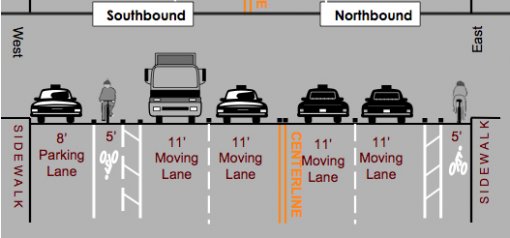
The National Complete Streets Coalition (NCSC) states that “Complete Streets are for everyone.” While there is no singular definition of a complete street, NCSC states that a city committed to transportation choices will ensure that “every transportation project will make the street network better and safer for drivers, transit users, pedestrians, and bicyclists – making your town a better place to live.” (NCSC also listed the “elements of an ideal Complete Streets policy” to help local citizens tailor the concept to their locality.) Thus, a complete street will have defined spaces designated to those citizens not driving in cars:

I really can’t expound on this concept any more except to say this: Complete Streets are a message to the citizens of a city. It says, “Come outside, experience our streets and enjoy your city.” Currently, the message is, “Drive here, this speed, when I say go.”

The next stage in revitalizing this section of the city is the addition of a two-way street car loop. This will be an incredible statement of commitment from the public sector and will stimulate private investment at every point along the route. In my map (above) I have designated some locations that are prime for infill development. These typically have a ton of underperforming asphalt and outdated strip centers. The street car loop will be a convenient novelty for tourists as well as a viable commuting opportunity for a number of large employers along the loop. In addition, the street car loop will finally connect the parts of Tyler that are culturally, financially and historically significant: The Rose Garden, downtown, the hospital district, and the Azalea District. I’ll admit, the primary shortcoming of this loop is that it currently ignores the area north of the square. I response, I think that Broadway should be “completed” all the way to Gentry (banner photo of this post) which should also be retrofitted with bike lanes and street trees all the way to the amazing Caldwell Zoo. If you haven’t driven on Gentry lately you might not know how big that street is … it is due for a full retrofit.

So this is my “Complete Loop.” Unlike the car loop (323), it’s beautiful and versatile and it invites everyone to come and enjoy.

Check out my other Tyler projects at my Tyler, TX page.

*I also had a policy thought: Developments and businesses along The Loop would be exempt from zoning laws that require on-site parking. Instead, public parking would be provided at points along The Loop to encourage a “park-and-ride” system.

Creative Placemaking in Big D

Right now, all I can think about is Creative Placemaking.

My friend Anne Tyler just told me about the term which she first encountered this summer during an internship in DC. She’s working at the National Endowment for the Arts (don’t throw stones) as a part of their newly created “Our Town” grant program.  On July 12, 2011, the NEA posted a Press Release announcing the first round of grants totalling $6.5M. Through this program, the NEA will fund 51 communities that have a desire to reinvision neglected spaces for the purpose of encouraging creative people and collaborative culture. According to the Web site,

“Through Our Town … the National Endowment for the Arts will provide a limited number of grants, ranging from $25,000 to $250,000, for creative placemaking projects that contribute toward the livability of communities and help transform them into lively, beautiful, and sustainable places with the arts at their core.”

The idea is basically this: If you are a city, you want to be “creating” rather than “consuming.” In other words, you want to be the place that people look to for the next big idea rather than simply using old ideas from elsewhere. In order to be a city that creates, you must have a creative culture and places that attract and encourage creative people. If you do not have these places in your city, you will find yourself buying rather than producing ideas. Creative people who do not feel engaged will move to another place where they feel welcome. The creativity brain drain.

So how do you keep and attract young, creative talent?

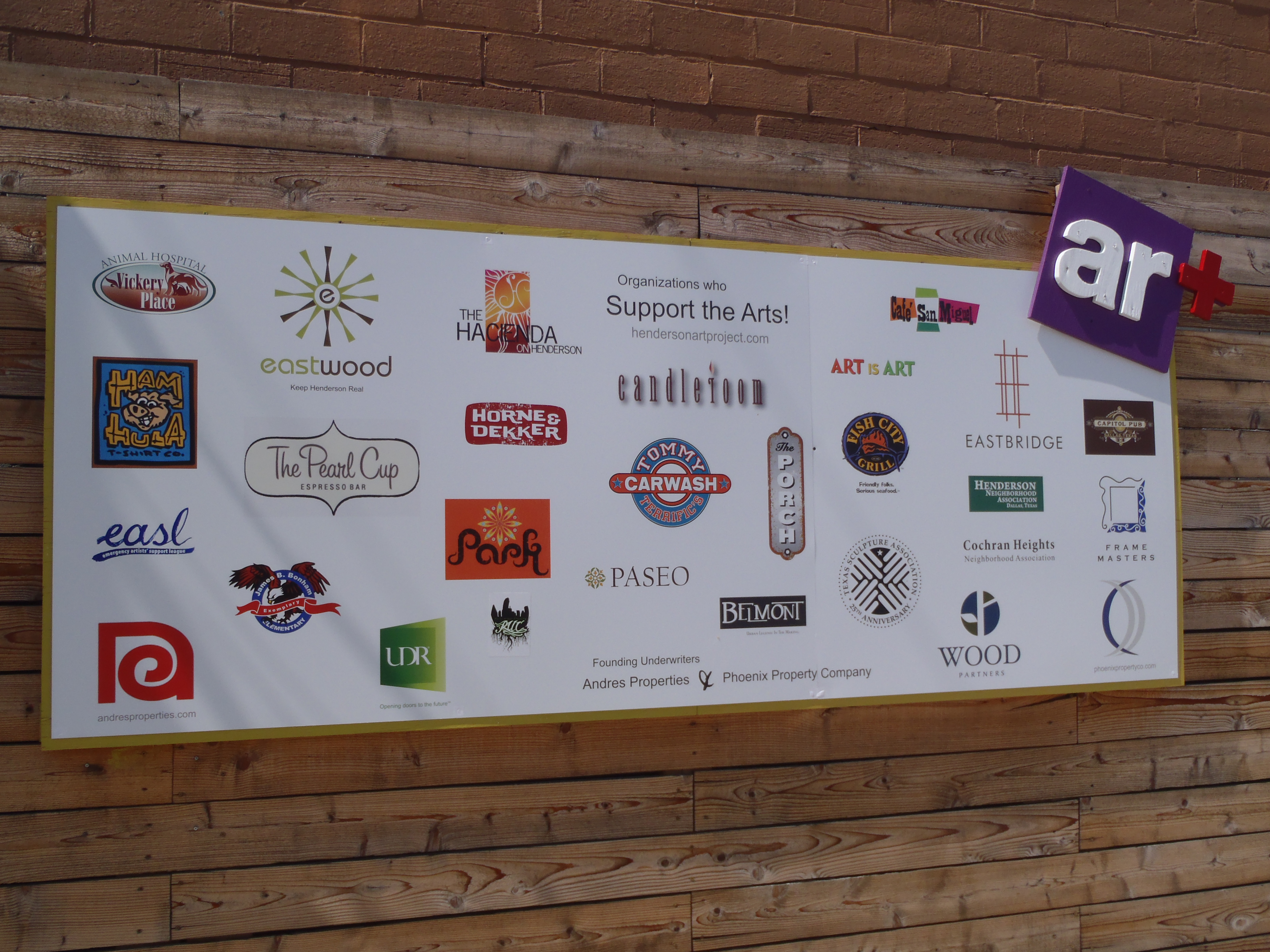
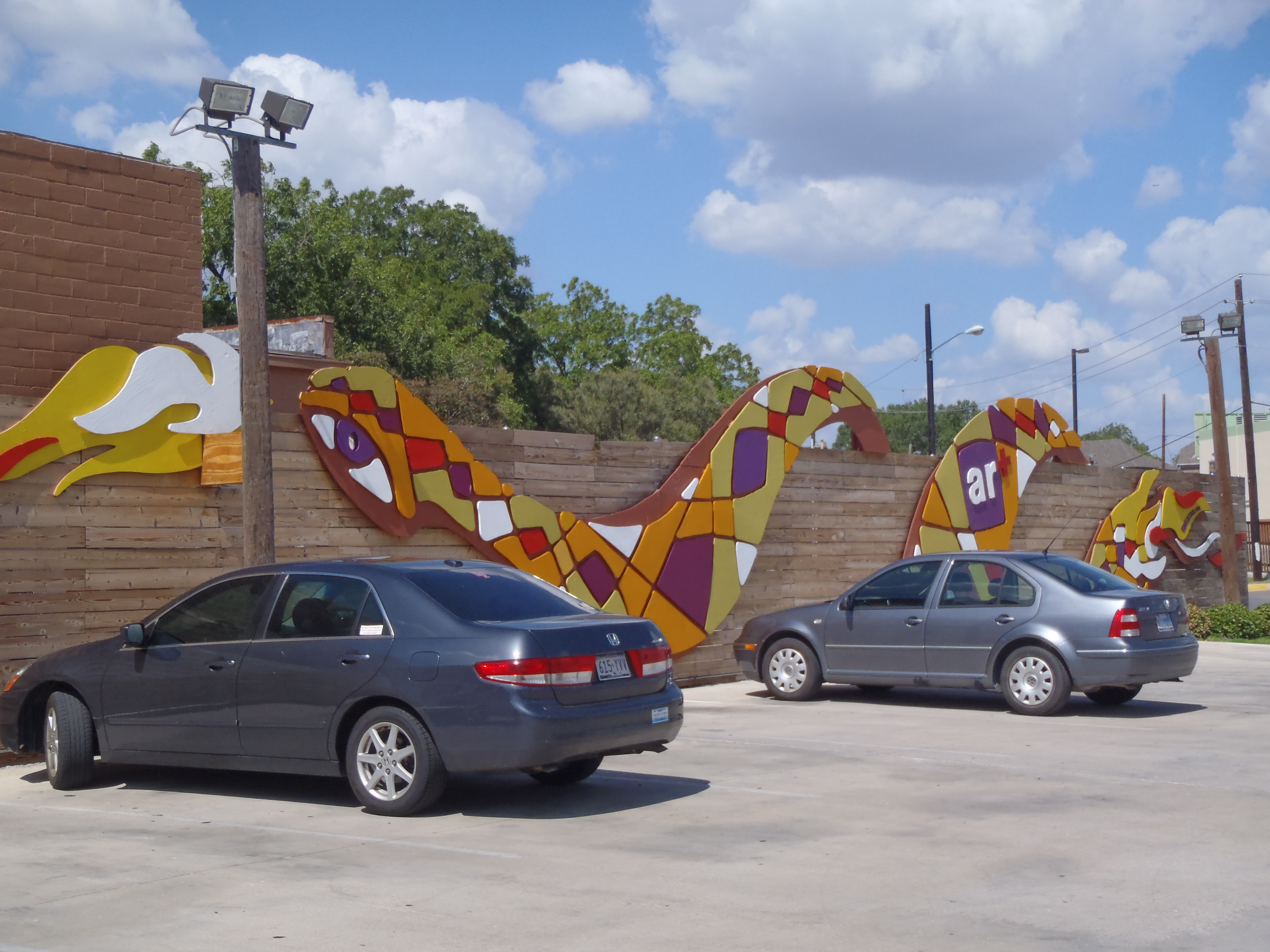
I drove to Dallas to find an example: The Knox-Henderson neighborhood. Many Texas would consider Knox-Henderson a gayborhood (rightly so), but as my friend Price always says, “Hey, they make nice things!” Indeed. The image to the right is of a sign on Henderson Ave. that lists the local businesses that support the arts in the neighborhood. When I saw this sign, I realized I had arrived. The Pearl Cup, my coffee destination, was one of the businesses listed that had contributed  to the Henderson Art Project, a collaboration between local businesses and a larger property company. On the same wall, there is a huge flame/dragon/snake installation (pictured left) that takes up about half of the entire length. You can’t miss it … it’s huge. This and several other examples of public art (Included in the Picasa album at the end) are an example of what can happen when businesses realize the economic and cultural value of Creative Placemaking. The public art is a message to creative people: You will thrive here.

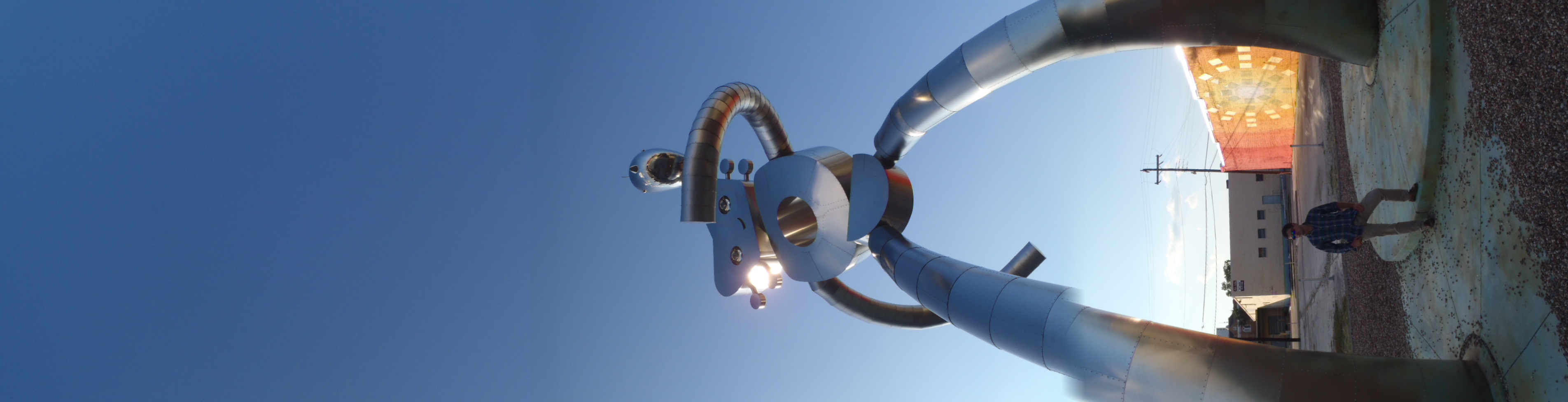
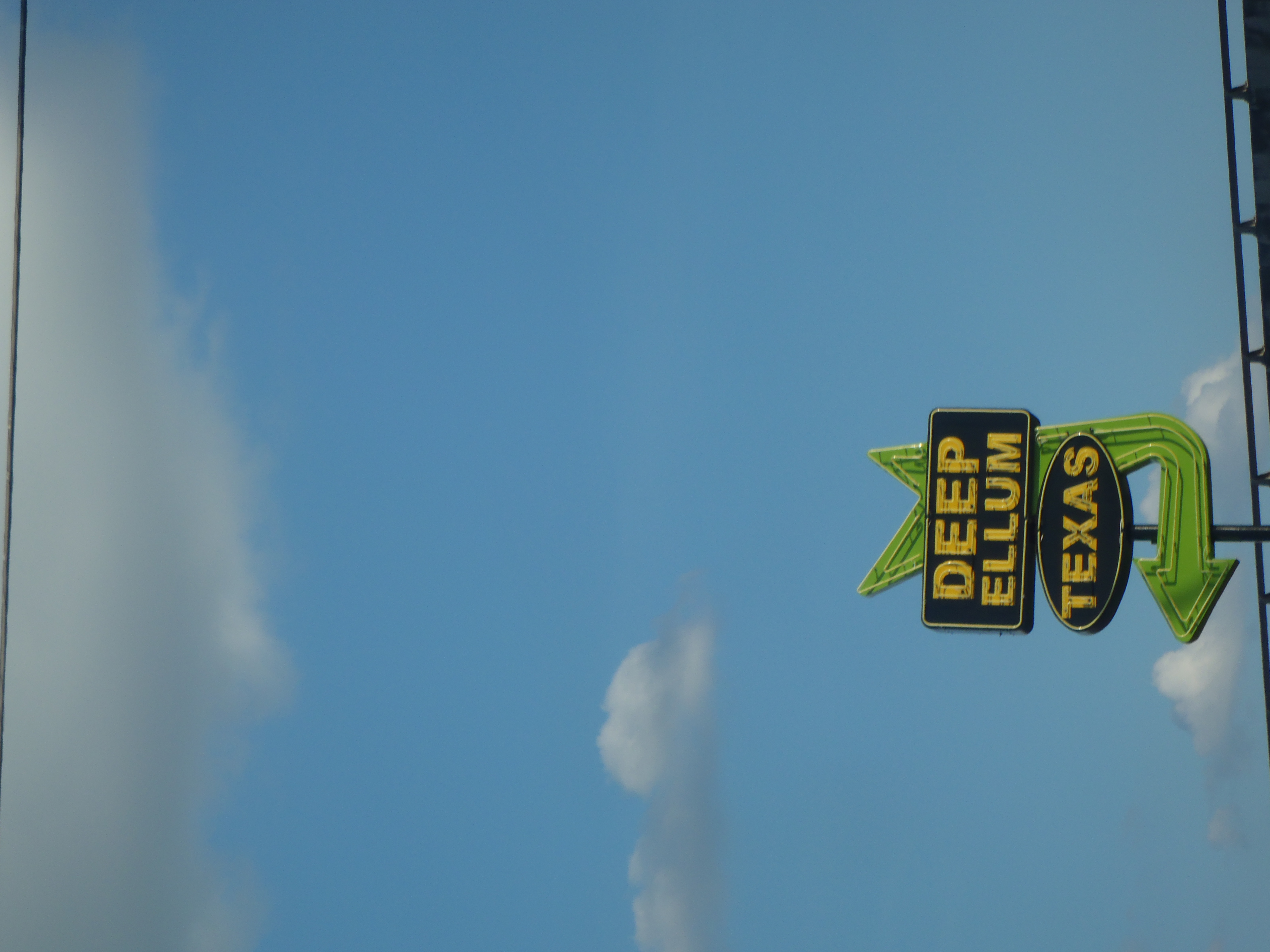
My second example of Creative Placemaking is slightly more dramatic and significantly more cool. I first visited Deep Ellum  for a concert when I was a junior in high school. It wasn’t until last week that I went back. Ladies and gentlemen, Deep Ellum is the coolest neighborhood around. It kicks Uptown in the butt and gives Victory Park the finger while doing a wheelie down Main St. The reason why I had to include it as an example in this post is for two reasons: The artisan culture in Deep Ellum feels significantly more organic than in Knox-Henderson and the art itself is displayed on a far grander scale. The murals are the length of entire city blocks (see banner photo), the sculptures are often ten times the size of human scale and the art in general is prolific.

You can’t walk anywhere without seeing something that someone has improved with their imagination. The place feels very engaged. One of the best examples of public art in this neighborhood are the robot sculptures (pictured right) scattered around. They are huge, shiny and very unassuming. There’s no sign that says, “Look at what we did! We’re creative people!” They’re just there … waiting for people to stroll beside them or for an urbanist to take photos and blog about them. Of course, like all cool places, there are people that say Deep Ellum is DANGEROUS. According to the Dallas interactive crime statistics, there are more crimes here then in some places, but not significantly more. Regardless, my conviction is that crime does not get better when upstanding citizens move out of these neighborhoods. Cool places need cool people. In turn, cities need these cool places to thrive and attract new ideas. Many cities would be lucky to have one.

Hopefully, through the Our Town program, many cities will have neighborhoods like these two examples in Dallas. With these grants, the NEA is going beyond simply promoting art. The NEA is promoting the very places that inspire and cultivate art. The Our Town grants can be used for many different reasons, but their primary function is to energize cities to find ways to invite and invest in creative people. I feel like suddenly I have a term that describes a process that I have wanted to promote for a long time.

Creative Placemaking

If you find the concept Creative Placemaking at all interesting, you must watch this video of three remarkable case studies: “Creative Placemaking in Shreveport, Milwaukee and Madison.”

The NEA also funded a journal research that resulted in the publication of a journal article titled Creative Placemaking. This article is a must-read for anyone that wants to add lasting value to their city or real estate development.

C-T-D: Downtown, no finer place … for sure

If Jane Jacobs is famous for describing “the sidewalk ballet” outside her window in Greenwich Village, I would like to be the first to say Tyler is in a “sidewalk intermission.” There was a time when our downtown was full of people “dancing” around each other to get to the stores and offices, but I believe we are now experiencing the intermission that happens before a renaissance. Rather than hold on with nostalgia to a proud past, we have to look to the future and imagine how downtown will once again be great in a completely new way.

But when did we begin to neglect our downtown? Petula Clark’s  famous ballad, “Downtown,” offers some insight into the process. “When you’re alone and life is making you lonely,” she sings, “you can always go downtown” … “everything’s waiting for you, downtown.” This song is such a incredible artifact of the 60s zeitgeist and a common reference point for urban historians. The paradigm shift is that in the twentieth century (many say after WWII), the dense urban spaces in America became places to visit rather than places to inhabit and as a result they became neither. The problem is that downtown will not always be “waiting for you” if there are not people living there and sustaining it while you’re gone. Like many cities with oil and money, Tyler followed the trend of outward growth and the commuter lifestyle. Fueled by our cheap, local oil we basically packed our cars and left downtown in the dust.

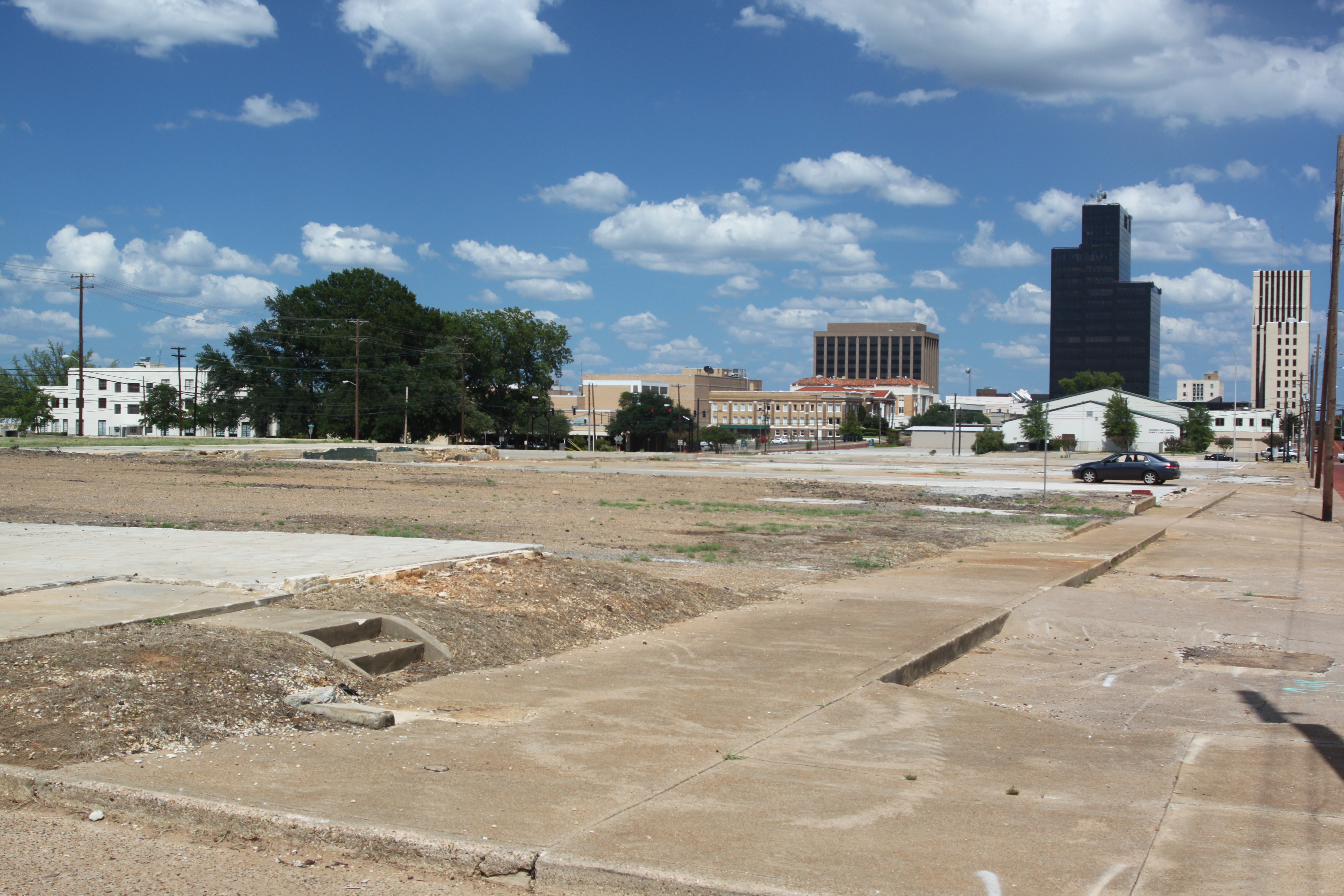
The result of this growth mentality is that we do not have the money to “care about what we already have.” For every new development in Tyler, the public sector is expected to provide roads, sewage, fire departments, police departments, schools, street lights, signs and other various forms of public services and infrastructure. This cost is significant and it is somewhat needless considering there are vast sums of land in the city where services already exist. As the city continues to cater to new developments, we do so rather than reinvesting the money into older, existing spaces elsewhere in the city. These images of Tyler’s downtown (below) are images of a city waiting to be reborn.

Downtown Tyler, TX

So here’s the basic dilemma: How does our local government incentivize businessmen to build on parking lots rather than horse ranches? I suppose it starts with a vision.

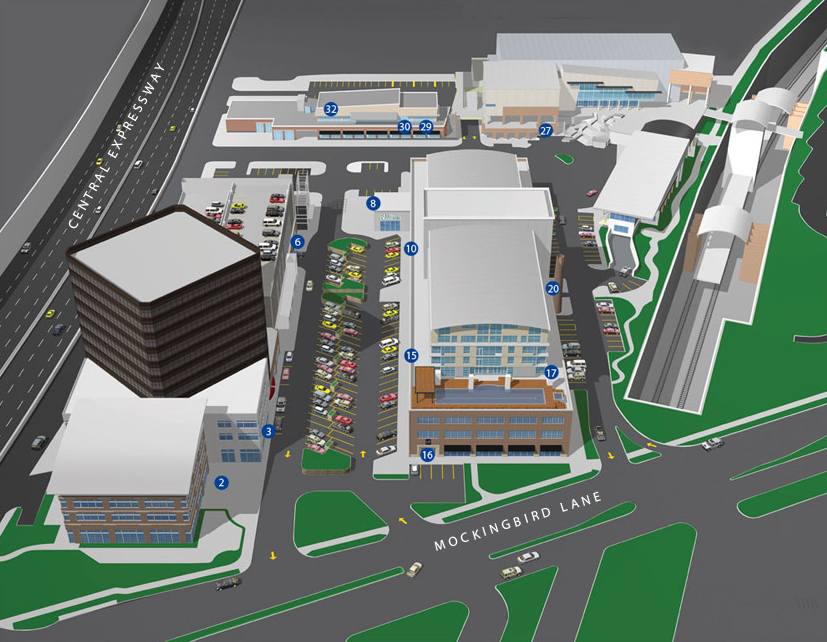
Empty lots, parking lots and vacant buildings are waiting for a renaissance. Young people, artisans, and creatives are looking for a place to find community. Some churches desire to feel more connected to the city. Our government deserves to reside in a place of prominence. This is my vision for downtown Tyler as a dense node of city life connected to the rest of the city by transportation and urban design. A great example of this sort of development is Mockingbird Station in Dallas. The place is an incredible example of the potential of a repurposed factory building that is now connected to the DART light rail. It’s attractive, interesting and it has created a significant draw for itself even in its relatively short lifetime. This is the vision I would like to cast for every empty lot in downtown Tyler. Could we do it?

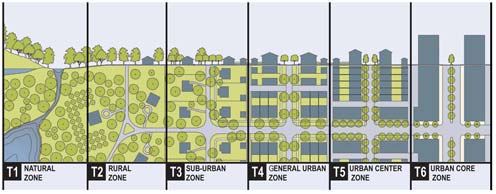
First, I suppose we need a zoning code that allows for a variety of living options such as row houses and lofts next door to hole-in-the wall cafes and shops. A place for people to live. One popular concept promoted by Duany Plater-Zyberk (pictured below) is called the Transect.

The transect is basically a zoning plan that allows for a wide variety of urban forms and gives the city a gradual progression from the urban core all the way out to nature. In addition to new zoning, I am (of course) confident that we need to “connect the dots” of high-density developments with a street car loop along beautiful avenues, bike lanes and sidewalks. All I want is one loop of public investment and long-term commitment to our existing city. The private-sector investments would be astounding. We have already begun to see developers look to the downtown with businesses such as Don Juan’s, Rick’s, Jake’s, the Downtown Coffee Lounge, Balance, and others. What these all need is to be more connected to the city and they will not simply exist as moments of brilliance. Instead, they will reside in an area inhabited by people that have pride in their business and share this pride throughout the city. These people also sustain the economy while visitors increasingly come enjoy the city life.

So there are economic arguments, community arguments, and even valid entertainment arguments for downtowns. To me, the argument for downtowns and urban spaces is more simple: Let’s turn this city (the whole city) into a source of pride. It’s not too late. I don’t want us to look back and wish we had taken our city a little more seriously. We need to allow for a little urban chaos, promote design oddities and find some way to discourage this endless leapfrog development to the next new loop. We need significant places and I believe we need to collectively begin to care about what we already have.

Check out my other Tyler projects at my Tyler, TX page.

Longing for a Heyday

So we all know that our downtowns aren’t what they used to be. They’re cleaner, taller and most importantly (in most places) they’re quieter. There’s just no people. But we Americans also all seem to carry this strange collective memory of a heyday when our cities and our downtowns were bustling, busy, smelly and successful.

In that era, downtown was a source of pride and a symbol of ambition and progress. In her book Downtown America, Alison Isenberg describes downtown as the cite of transformation, protest, destruction and renewal. Most importantly, she argues, the history of downtown America teaches us about ourselves as Americans and specifically what we value. She writes,

“It has been the people — their crusades, their financial stake, their ideals, and their changing priorities — that have given meaning, hopes, and limitations to the material condition of downtown and that ultimately have given Main Street its form. This interplay puts buildings up and takes them down (Insnberg, 316).

It was people who cast a vision for a space and called it downtown. They called it special — worth taking a risk and worth making bold statements. But today downtown America is mostly just a few lines on a historical marker, “This place was once great because ___.” There are very few people who live downtown, there is little diversity, and most of the buildings are relics of a once-proud past. We have lost downtown and the institutions that resided there. All we have now is a memory of a space and an incredible longing for the heyday of our cities.

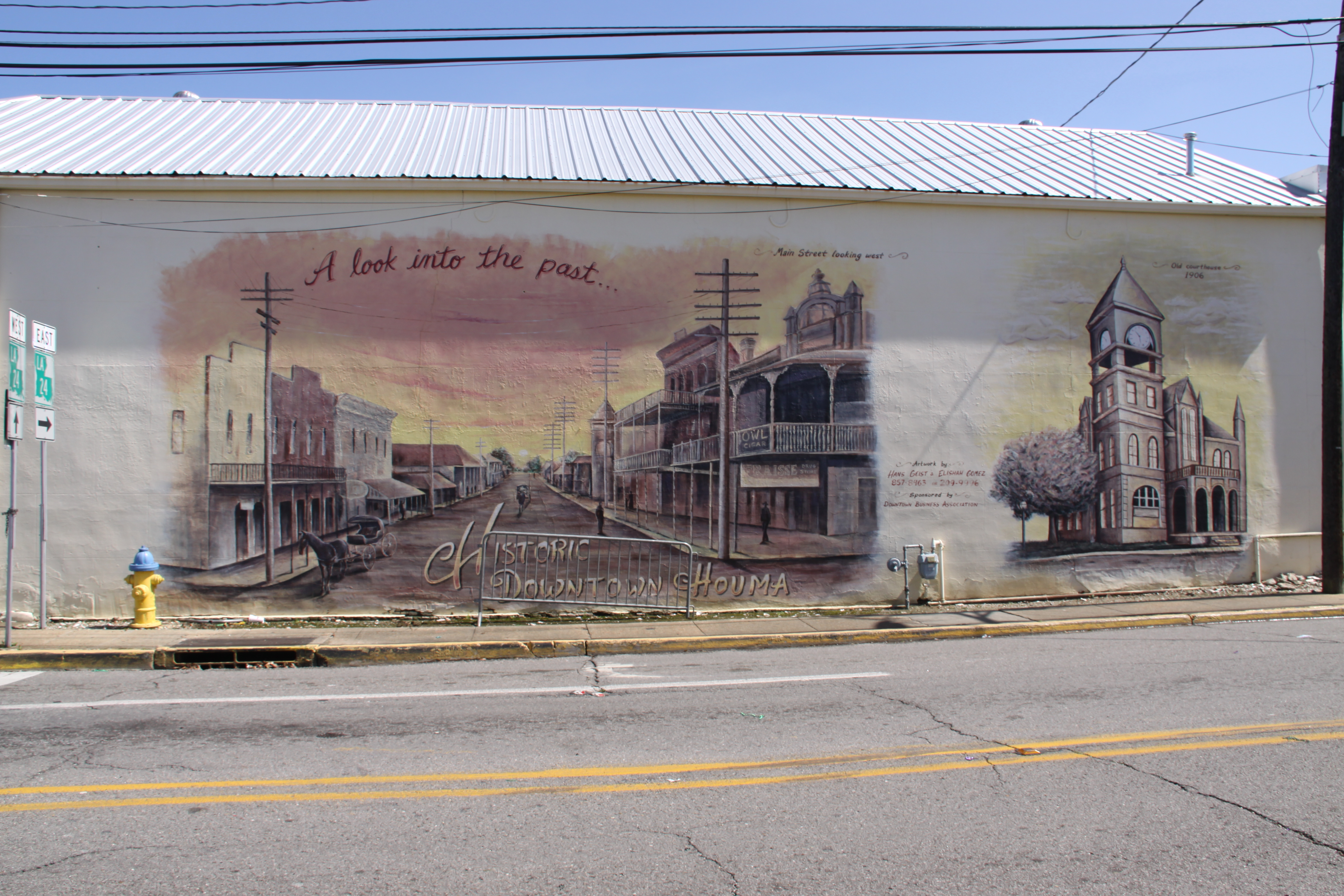
In the past few months I have visited two small towns that perfectly encapsulated this nostalgia. The first is Houma, Louisiana and the second is Ilwaco, Washington. In Houma, I experienced the mélange of Louisiana cultures: Country music bars, party busses blaring rap music (it was Mardi Gras weekend), old southern mansions, a beautiful old courthouse and food carts serving Mexican food. As I walked through the city I noticed a mural of an old “Main St.” scene (above). “A look in to the past …” the mural reads, “Historic Downtown Houma.” The larger image is of “Main Street looking west” and the smaller image to the right is of the old Houma Courthouse ca. 1906.  I suppose this mural, sponsored by the Downtown Business Association, was an attempt to remind people in the region of the proud history of Houma. Hopefully visitors will enjoy a stroll “into the past,” spend their money, and come again.
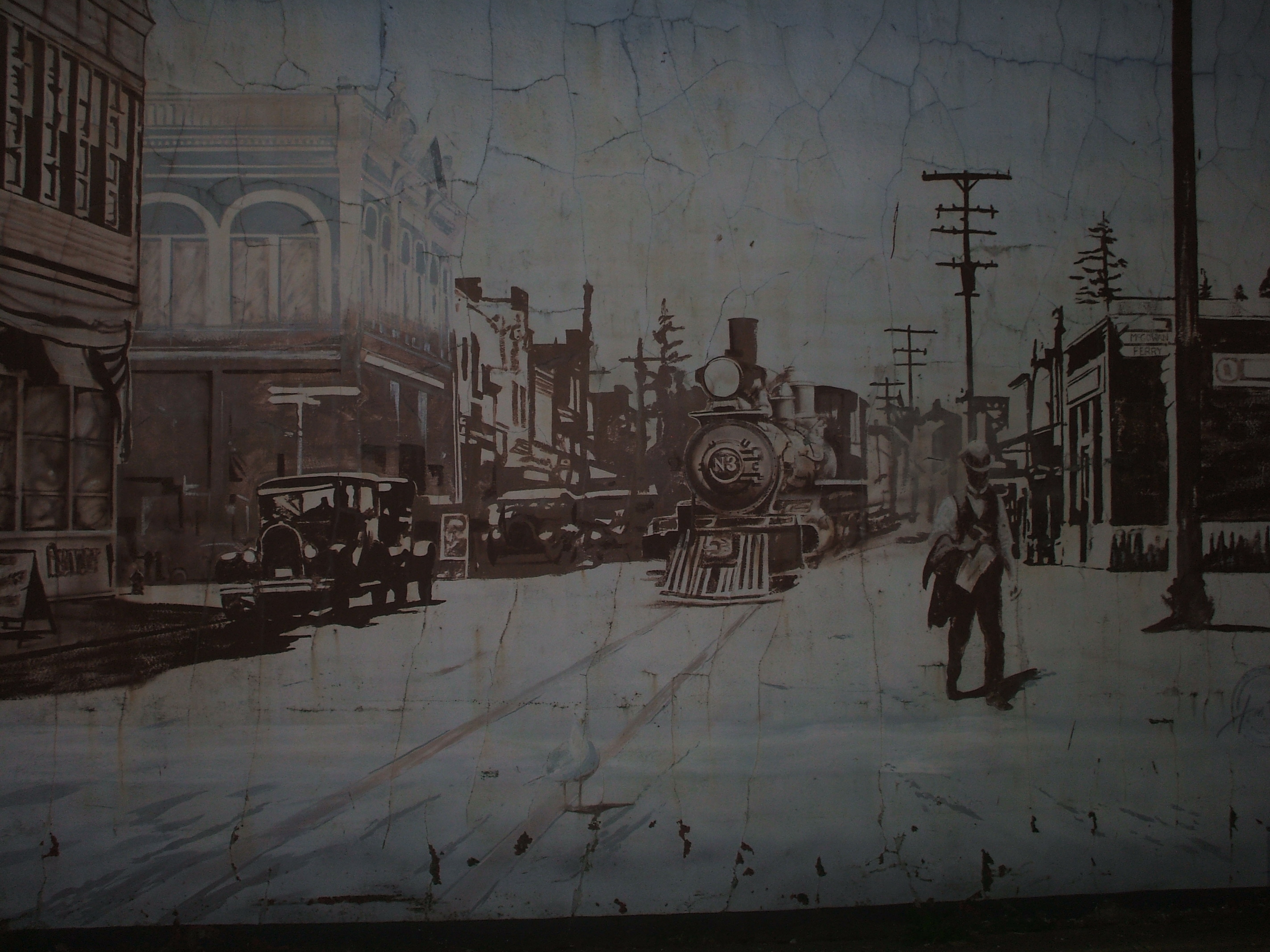
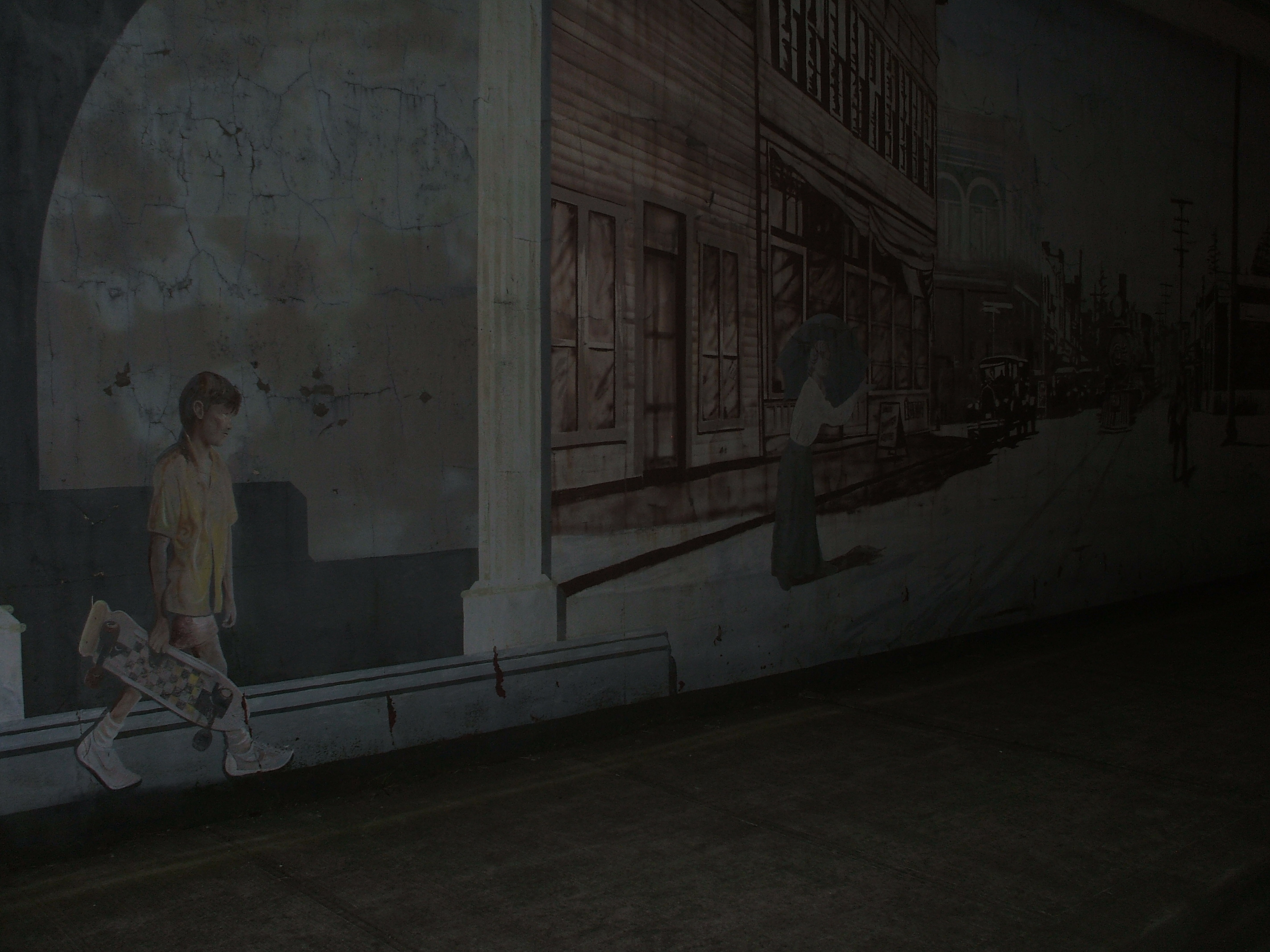
The second example of a nostalgic mural (left) is a little more complex. It is titled a “Main Street” mural in Ilwaco, WA located on, not Main St., but Spruce St. at the intersection of First Ave. This mural depicts the same nostalgia for a bustling past with cars! trains! A/C grid! and a man with a hat! walking through the street. This is clearly  a mural of past progress and innovation. When I looked closer, however, I realized that it’s actually a mural of a mural of progress. On the left side of the mural, there’s a boy walking with a skateboard toward the mural of the old Main St.  The boy seems to represent a newer sort of progress, but is placed in context of the historical legacy of the city.

So what are these murals trying to say?

Greg Dickenson writes extensively about the connection between memory and place and the significance of both on personal identity. He considers the new spaces that we inhabit (e.g. McDonalds and strip malls) which seem devoid of historical context. They are clean and new, but what do these spaces lack? Dickenson’s perspective states,

“In a post-traditional period, a time of deepening memory crisis, secured place becomes harder and harder to maintain, giving rise to nostalgia to cover the discomforts of the present.”

This nostalgia is often revealed in murals such as the two above as well as in old photographs, old marquees, historical markers and similar references to the past. It is sort of a cheap nostalgia because it really doesn’t help us to understand the complexities of the past. I think that a more complex history would defeat the purpose of increasing tourism because it wouldn’t make people feel “comfortable” in these nostalgic places. The problem with that simple message is that when downtown was bustling it was a complex place. As long as we continue to sanitize (“suburbanize”) our cities for the sake of visitors and tourism we fail to revitalize (“urbanize”) our downtowns.

Isenberg, Alison. Downtown America: A History of the Place and the People Who Made It. Chicago: University of Chicago, 2004.
Dickinson, G. (1997). “Memories For Sale: Nostalgia and the Construction of Identity in Old Pasadena,” Quarterly Journal of Speech 83, 1-26.