The Rose Park

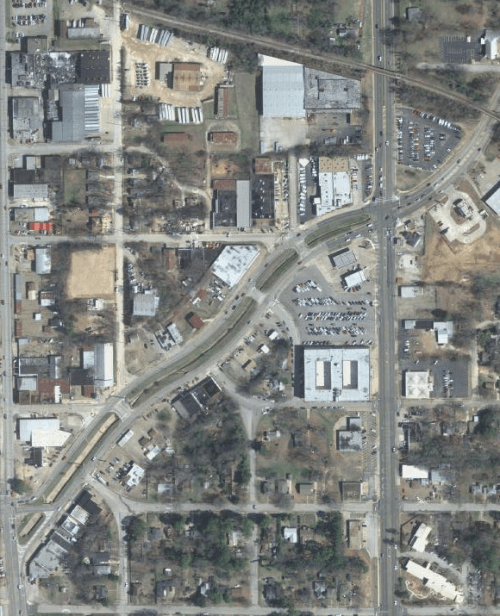
Look at the image below. What do you see?

I see a rose.

The stem of the rose (S. Glenwood Blvd.) extends as a greenway belt from the bottom left corner toward the upper right. It curves along the stream in between the grass of the greenbelt. At the end of the stem, there is a parking lot in a shape that resembles a flower bud. It seems like a perfect fit for the Rose Capitol … especially considering it’s in The Rose District, my fictitious plan for the area of land around the Rose Garden Complex. The Rose Park would be the perfect way to say, “Welcome to Tyler, we like roses a lot.” Since we pretty much control the commercial rose industry in the USA … I’d say roses like us too.

The Rose Park is the perfect way to welcome visitors into this city that has been celebrating the rose industry for decades. As you drive into Tyler on Glenwood, the road is suddenly transformed into a tree-lined parkway with a creek running down the middle of it. Brick sidewalks run along this parkway as it wanders past the junk shops and the Cotton Belt Building. The sidewalks of this parkway then ends with a crosswalk across the intersection that has been rebuilt to accommodate a larger number of walkers and bikers. The bike/ped crossing leads across the intersection into the parking lot that has been transformed into a park of flowers. From the sky, the stem and rose form a clear picture of the city’s identity. From the road, drivers get a glimpse of the park and begin to feel like they have formally entered Tyler.

The Rose Park should be a part of a bigger network of trails and parks in the Rose District. These would all make this an area of the city that is accessible, functional and proud. In it’s current form, this is just a road and a parking lot. But in a few years it could be a purposeful use of space and an excellent entry to this city.

Check out my other Tyler projects at my Tyler, TX page.

C-T-D: Thoughts on “Downtown”

I would love to start drawing a map for downtown Tyler. I’ve already written extensively about an imaginary place I call the Urban Valley, but right now I have this burning question in my mind, “Do we want a downtown in Tyler?” If yes, then for what purpose?

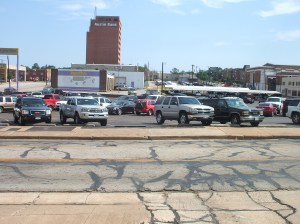
You see, there is this crime that occurs when people try to “bring the suburbs in to the city.” I’m worried we don’t quite realize that the two concepts are completely antithetical. Suburban settlements usually have large parking lots, small wooded areas and one-story detached buildings. These should have very little relevance in a downtown. Take a look at the photo of the parking lot. Does this photo look like a city? (Side note: The city of Tyler has looked into building a parking garage here, but most likely won’t put floorspace on the first floor) The real tragedy is that there were likely beautiful buildings here that served a whole variety of purposes. Now, this entire city block serves one purpose: The storage of cars (idea cite: Douglass Rae). Urban space should be considered so valuable that buildings are next to each other, green space is a planned park or garden and cars cannot be given ultimate precedence. In all sincerity, we have enough suburbs in Tyler … please, first and foremost, let downtown be urban.

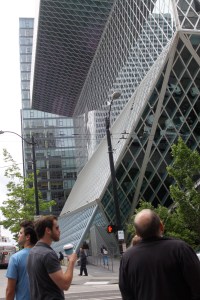
I believe that the potential of every space is limited by real and imagined barriers. If there are real, perhaps topographical, barriers to building a higher density downtown than I’ll be content to give up this dream. I just don’t think that’s the case. Most barriers I would consider “real” are primarily economic, but as long as people continue to build farther south I’ll contend that they might as well build downtown. To me, it’s the imagined barriers that I can’t stand. If it’s a zoning issue, some regulation, or a city of small dreams then I won’t be satisfied. Cities do not become great with small dreams. Cities become great when people do bold things that the mainstream calls crazy. Take, for instance, the Seattle Public Library (pictured). This building is a strikingly beautiful and completely functional structure that could theoretically be built anywhere on any square piece of land. In Seattle, they love it. Could we love this library? I should add, there are people in Tyler doing great work to revitalize our downtown, but I’m just not sure whether the public will appreciate it.

Another possible impediment to Tylerites embracing urban life is a lack of urbanity. It seems like Tylerites like to live in wooded neighborhoods rather than urban spaces. Most of Tyler is so spread out that we don’t always have to interact with people who are different from us on a regular basis. I fear we’re missing the beauty and diversity of urban life. But could it be that there is simply not a viable urban option? I say yes. I bet there are thousands of people in East Texas that are tired of mowing their lawns, driving everywhere and living far away from “the action.” I bet if we promote city life in Tyler and remove P&Z red tape then people will come from all over to create and inhabit a thriving downtown.

The other day, my friend Dustin asked me what my ideal downtown would look like if I could design it. I said that there really isn’t (or shouldn’t be) an ideal downtown. As long as there are people there at every hour of the day and night; as long as there are public spaces that welcome every citizen of the city; as long as people claim it rather than exploit it; as long as it’s traditional, deviant, creative and ultimately “Tyler,” then that will be perfect no matter what it looks like.

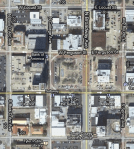
Look at the arial photo of Tyler to the left. These nine city blocks should not look like everywhere else in the city because if they do then they will be no longer be significant. Downtowns are places where you can live to not only experience the diversity of other people’s lives, but most importantly you can personally add to the diversity of self expression, culture, perspective, race, ethnicity, etc. When we begin to add to this multi-cultural society and invest in the community we become a part of organizations and we learn what it means to be citizens instead of consumers. I don’t want us to “consume” downtown as entertainment the same way we sometimes consume church, media and everything else. Rather, we must commit to downtown as an idea and be unified on our goal at the outset. This idea is that, in many ways, downtown is what we look to as the zenith of our city’s development. I believe there is an inherent value to dense urban downtowns as the site of culture creation, political debate and financial stability. Our downtown is a vital element of the future of our city as the capitol of East Texas. We need a viable downtown option, but we have to want it. And we have to know what it is.

Check out my other Tyler projects at my Tyler, TX page.

C-T-D: The Rose Garden Complex

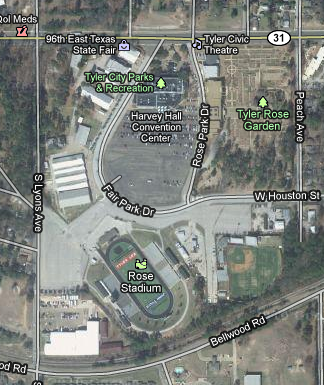
There are many proud  Tylerites who love the Tyler Rose Garden while also thinking that it needs some work. It’s heralded as the largest municipal rose garden in the nation (impressive), but for  some reason it just doesn’t do it for people. It doesn’t have pull. For the past few days I’ve been thinking about the garden and wondering what Tyler could change to make it a more desirable destination. When I drove there myself, I realized something: The Rose Garden can’t be significant on it’s own.

While there are several components of “The Rose Garden Complex,” they don’t form a cohesive destination. They’re essentially separated from each other by roads and parking lots. As it is, this expanse of asphalt ruins what could be a really cool Rose Garden Complex experience. I wonder if Depave would be willing to help us take it out because it’s got to go. It does not draw you towards anything or direct you to go anywhere. Most of the parking lots don’t even have lines marking individual spots … it is truly formless space.

If you look through the photo album at the end of this post, I think you’ll notice what I’m talking about. I was even impressed and I was expecting a lot of asphalt. I found myself thinking that we patterned our parking lot design after the ship harbor design. It might be because the huge Rose Festival floats need a place to sit and maneuver before starting the annual parade. While that may be the case, I think we can find some parking elsewhere in Tyler … their waiting area on one day of the year shouldn’t hold back the entire space.  Besides, wouldn’t it be more fun to parade through a beautiful space?

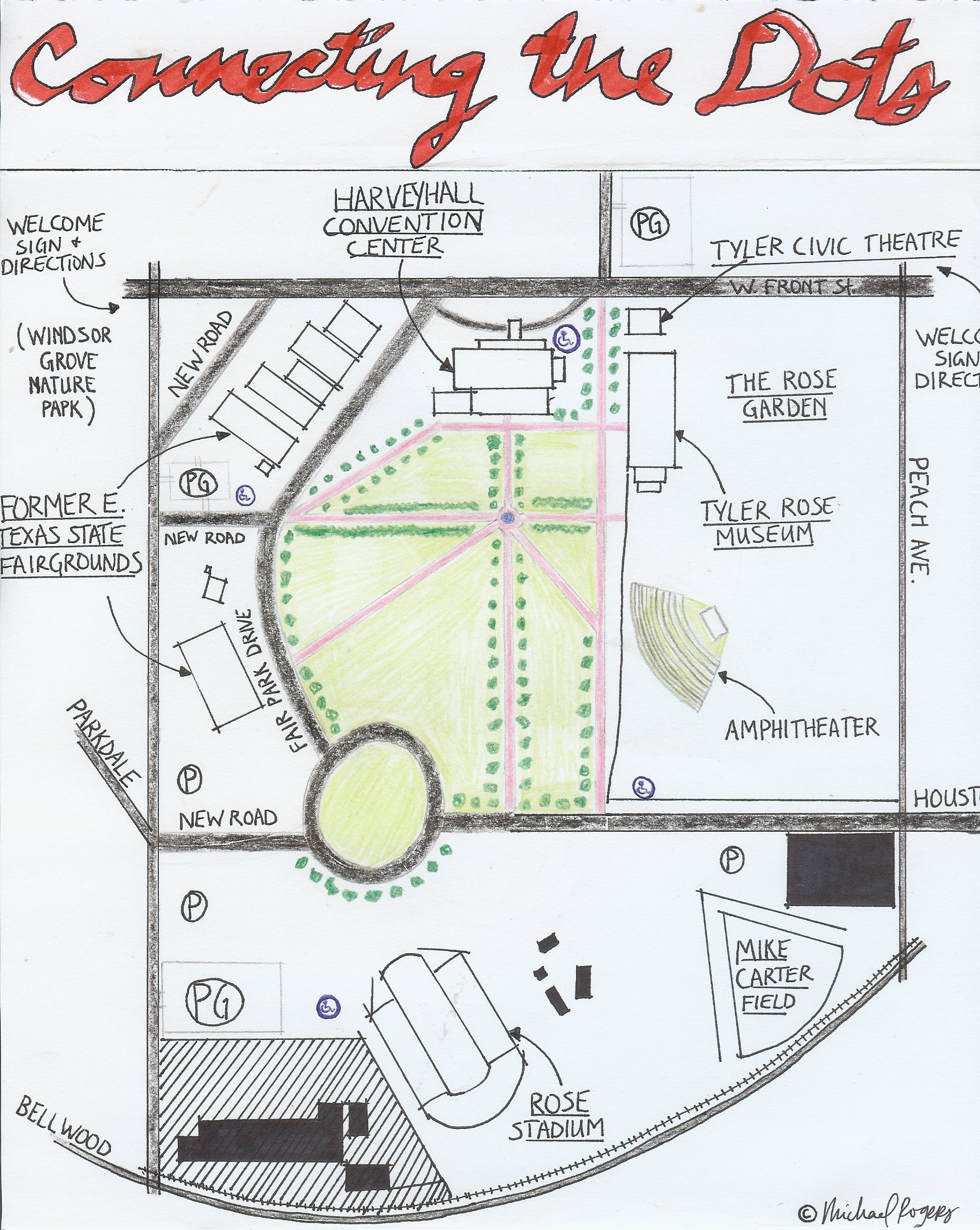
Fortunately for Tyler, a blank slate is a great place to start. My mind has wandered for hours these past few days and it finally arrived at the place pictured to the right. It looks like the Tyler Rose Garden Complex, but the center of the picture is grass (light green), trees (dark green dots), and rose bushes (dark green squiggly lines). And a water feature! (blue dot where the paths converge). In this place, the view from Harvey Hall is grand: Down a path bordered by trees, across a great lawn and toward the old fairgrounds and the Rose Garden. There is nothing but trees and grass between Harvy and the Rose Garden so that people can walk from one to another in the cool shade of trees. The Rose Garden itself hasn’t changed much except for the addition of an amphitheater (!) for live converts. (Big shout out to fellow visionary Tom Ramey and others for the idea of making the Rose Garden a music venue).

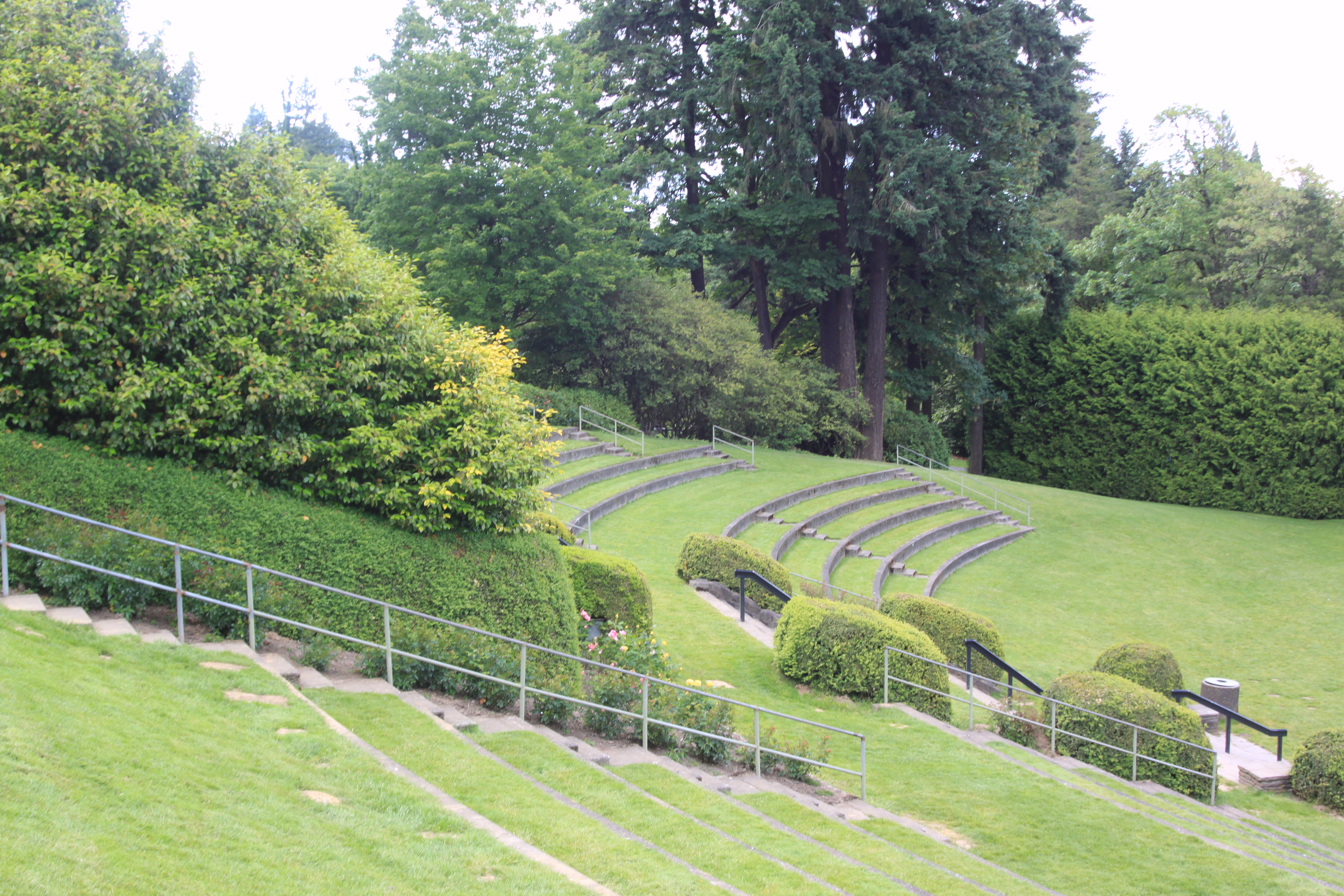
“Live at the Rose Garden” is the hottest tagline in East Texas because (you guessed it) the backdrop to the concert is the largest municipal rose garden in the nation and for once there is something to do while you’re looking at it. This amphitheater looks like the one from the Portland Rose Garden (to the right), but it’s better because it’s facing the flowers instead of big bushes. Every Friday night during the summer there’s a live concert here and people come from all over to fall in love with the place (and return again). When they arrive, they exit the street car at the stop just outside Harvey Hall on Front St. If they’re driving, they’re directed to park in one of the parking garages (PG) or lots (P) located on the perimeter of the complex. The roads within the complex also have on-street parking and handicapped spots closer to the center of the site. They all meet at the new roundabout in the middle.

Once they’ve parked, they walk down a number of brick paths (red) or bike in the bike lanes along each street (black) to get to the amphitheater. Every Friday night during football season people come early before the games to walk to the lawn that is lit up with lights from the trees. The Rose Garden is even open on these game nights with special events to keep people in the area. All this visiting is great business for the bars and restaurants that opened up in the former fairgrounds buildings! That whole area was rezoned to allow mixed-use infill development so there’s even a small community of people living in apartments with a view of the lawn and garden. They go on walks down the brick paths and do stair runs up the amphitheater in the mornings to stay in shape.

Whew! That place is so alive and engaging that people (even locals) don’t have to have a reason to visit. They just want to be there. Stay tuned for the next place my mind wanders to! I’m thinking it might visit a place that’s more urban … in the meantime, enjoy these photos from the Tyler Rose Complex! It’s ripe for redevelopment.

Check out my other Tyler projects at my Tyler, TX Page.

The Rose Complex

Connecting the Dots: Intro

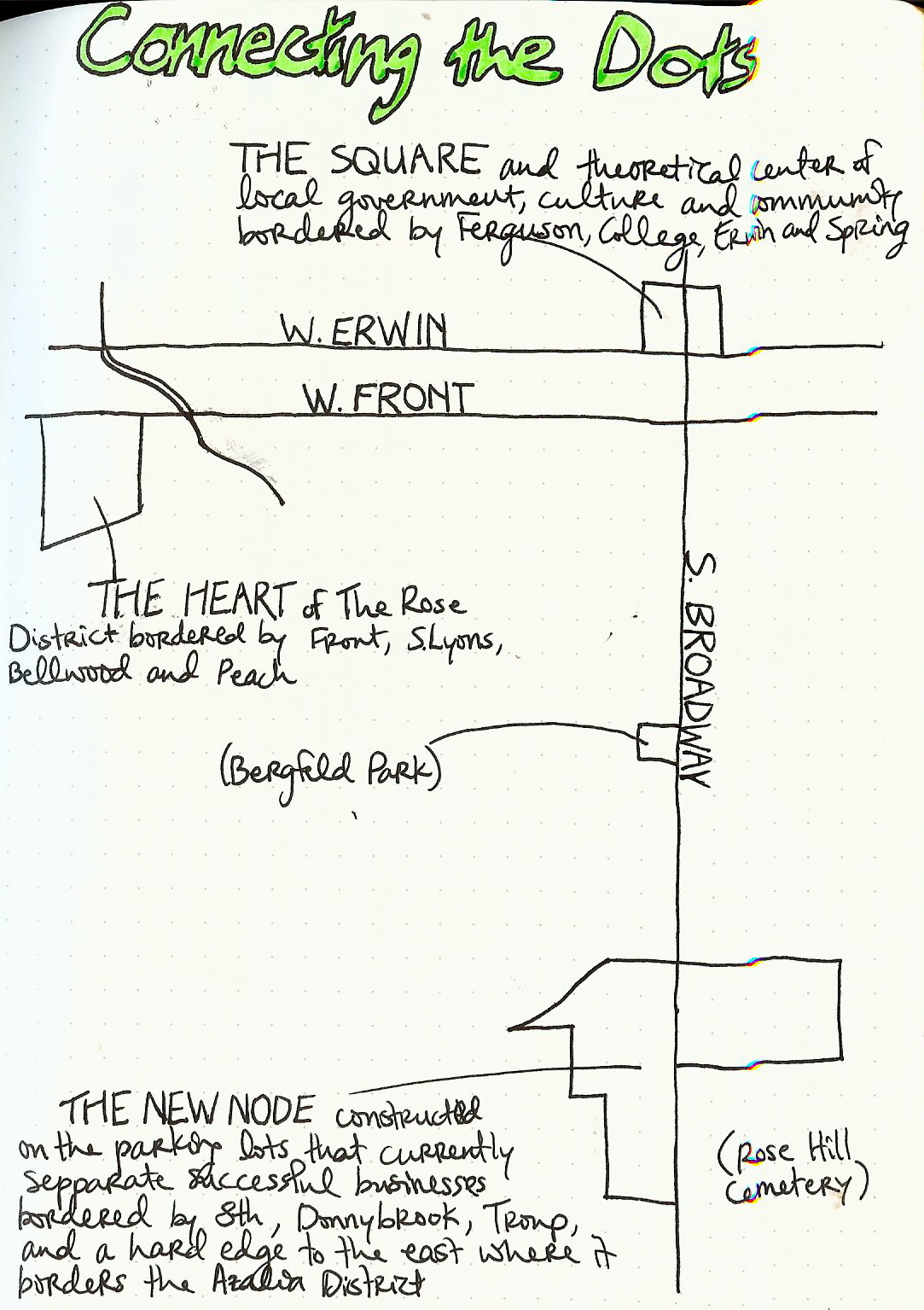
Imagine if Tyler decided to take a few areas, increase their eminence, and connect them to each other. My latest concept, Connecting the Dots (C-T-D), outlines a long-term process of public and private investment that I’ll complete in the next three followup posts.

The basic idea is often called Transit-oriented development. It’s the idea that we need to begin considering land use and transportation as one unified city function. You see, for the past century or so we have built our cities without considering how people will travel  because access to a car was generally assumed. And, I might add, those without cars were not usually considered valuable (i.e. profitable). Cities have grown rapidly and died gradually with this sort of development because 1. The roads cost too much, 2. New developments make older ones obsolete, and 3. New developments often have difficulty maintaining lasting significance past their prime. This paradigm is the Gander Mountain, it’s the church my family goes to, it’s the Hollywood Tyler Rose theater, and it’s the majority of this city.

But it wasn’t always this way. There was a brief time in history somewhere between horses and cars that we travelled on fixed tracks. During this time, (often) private corporations ran street cars through a partnership with municipalities in order to provide transportation for locals or visitors when they entered the train station, “Welcome to Richmond.” Now, it seems that the main city function is to facilitate transportation through the building of roads rather than to provide transportation for the general public. “But,” you say, “Tyler has a bus system already.” Yes it’s true, but in this post I want to argue that the bus system has not succeeded in unifying our city. Besides, we don’t have many significant areas to visit. What we have is a lot of stores, schools, restaurants and other businesses scattered over 49.3 square miles of asphalt, concrete and St. Augustine grass. Where, I wonder, is Tyler in all of this?

C-T-D seeks to revisit that earlier era of development for a 21st Century application. I have decided to start macro with this first piece (perhaps a look at Tyler 10 years down the road) then followup with more micro concepts for each individual node that I’ve proposed: The Rose District, The Square (with my Urban Valley), and a New Node that I haven’t named yet (ideas?). Each of these locations will be connected to each other with complete streets. This will also provide an alternative to cars and increase their viability as destinations. Completing streets will finally reconnect our asphalt to our buildings after decades of disconnected drives. Also, a recent report promoted by Smart Growth America shows that sidewalks and bike lanes increase the economic vitality of a region. That means more jobs! Eventually, we would add light rail trains (or BRT) to these streets in a circuit in order to properly move citizens from one location to the next.

I personally prefer light rail (yes, in Tyler) because it makes such a statement of  commitment to a given space. Light rail is also not as stigmatized as busses. Besides, it’s just plain cool. Check out the loop (below) I’ve devised for the light rail and complete streets:

Of course, in order to connect the dots … we first need dots to connect. This process involves developing three high-density, mixed use, cool (this is not a joke), and interesting nodes. These nodes are special, they have names and unique characteristics and an eminence that draws people to visit.

Check out my other Tyler projects at my Tyler, TX page.

P.S. I recently returned from a trip to Seattle and Portland and I brought back ideas, the book 101 Things I Learned in Architecture School,  and a Leuchtturm1917 journal with dots instead of lines. Let the games begin.

Gallery

C-T-D: Tyler’s Urban Valley

This gallery contains 6 photos.

**Interesting update: I met with my city councilman today and he told me that a very well-known real estate developer in Tyler bought the location of the “Urban Valley” and he wants to turn it in to an outdoor movie … Continue reading

On Space and Place: Terms Defined

Over the course of this blog, I will often write about space and place. This post is my attempt to clarify these two terms because they are ultimately the two underlying concepts of each post. While I draw from theorists such as Foucault and Said, I have eventually developed my own way of thinking about life through these lenses.

The two words, in my opinion, are completely distinct from each other. Space is the void. Space is the physical, tangible built environment in which we live. Space is buildings, roads, houses, parks, landscapes. Space is the void. Place is the life. Place is the culture that is created within a space.  Place is what makes a house a home. Place is created when people congregate, communicate, experience each other. Place is a conversation in a coffee shop or a fight outside your house. Place is the life.

These concepts of space and place are often used in casual conversation. Consider the phrase, “I’m just not in the right place to make that sort of decision.” This common refusal is usually considered metaphorical as in an emotional state or a level of maturity. But, what if the person is thinking of actual places where they have experienced significant emotional attachment to other people and are not prepared to enter those places again. Or what if the person has a close tie to a person that lives in another space and they aren’t willing to leave? These are the memory places that are informing the person as they make the decision to move forward or remain.

We all know spaces such as these where we have invested time, emotion and energy to create place with another. We have struggled to be accepted into the group of people that make up these places or we have revelled in our influence over them. It is in these places of human interaction that we struggled through love, lust, pleasure, loss, enlightenment, rejection and friendship to eventually reach some sort of comfort. No matter how frightening these places are, what is more frightening is the thought of leaving them. In these places we become ourselves, we find our identities and we are unsure how that will change when we leave.

Pardon the long quote below … I think it helps me to understand what I am saying:

In his book Repairing the American Metropolis, Douglas Kelbaugh writes, “As others have pointed out, spatial boundaries demarcate the beginning of a place as much as the ending of a place and its power. Boundless architectural and urban space has less nearness, less presence. Limits are what differentiate place from raw space,  whether they separate sacred from profane space or one secular space from another.”

The “spatial boundaries” which demarcate place are the physical boundaries which affect the human interaction within that space. These are often used to enhance the experience of existing in a certain space, but they cannot alone create space. Without humans a space is meaningless. In the same way, it is humans that give space meaning regardless of the intent of the design of the place. All throughout history there have theories about cities which attempt to create the perfect society with the perfect spaces. Le Corbusier’s La Ville radieuse is a common example of this delusional habit. But we have learned time and time again that you can’t solve problems with new space: Housing projects and suburbs are two great examples. They were both dreams for a better life, but both inhabit miserable and satisfied people alike.

It is places that people crave. To me, it is not easy to create place with another. To be honest, many people don’t create place because they don’t linger in a space for long enough. Think about a highway. It is the space par excellence. There is only movement and stigma on the highway — no life, no place. It is one, uniform, vacuous space. And how many of us spend hours each day in these spaces? In contrast, a place can be anywhere. I remember four friends and I had an impromptu gathering in a chapel recently that created the most beautiful place of fellowship. I recently wrote that graduation was an instantly nostalgic place where people gathered from all over the world. It was not “The University of Richmond” that weekend, but instead it was transformed by the presence of a multitude of people that had gathered for the same purpose.

I don’t want to limit myself with these terms, but I sincerely believe they illuminate my perspective on the city and society. I will likely link back to this post many times in the future for reference … they’re my words, but the concepts belong to many people. I’m excited to see how far I can take them.

*Repairing the American Metropolis: Common Place Revisited.  Douglas S. Kelbaugh

 

Supplice (sou-pleas) and the Body of Christ

One of my friends once visited a Christian mega-church where they were hosting a huge college A cappella conference. In describing the conference, she explained to me that the church was, “…one of those churches that had paintings with hands and nails in them and blood gushing out” … or something like that. As a product of the Christian subculture, I laughed at her candor and perspective on the representation of Christ’s body. To me, this sort of painting had become commonplace, but I gradually began to realize that there is nothing “normal” about the bleeding body of Christ.

Can you imagine what it would be like for one of the apostles to see one of these paintings so common in Christian spaces today? Then it would have been a powerful image, but Christians have referenced the body of Christ so many times over the past two thousand years that it seems it may have lost much of its significance. A simple Google images search for “Jesus hands nails blood” reveals an amazing set of images such as the one below. Of course, we know that this isn’t exactly what Jesus’s hands 

looked like, but it’s close enough that it serves it’s purpose. What is the purpose? I believe that the purpose of all of these images is to further a successful reappropriation of what was once considered a public and humiliating death.

To describe a death such as the Jesus’ death on the cross, Foucault uses the French word “supplice” which refers specifically to public torture and the spectacle of punishing the accused. This torture inflicted on the body of the accused was used by leaders to make a statement of their power and to reinstate order in the realm (Discipline and Punish, editor’s note, 16-18). This statement of power was more likely the original purpose of the cross. The body itself was seen as rebellious and was thus used by earthly kings to maintain control. Foucault writes that all sorts of rituals were used to make these statements of power, but most often these referenced the king directly such as public coronations and parades. In contrast, the public death of the condemned is a statement of the opposite end of the king’s power being used to destroy rather than to ennoble. He writes, “In the darkest region of the political field the condemned man represents the symmetrical, inverted figure of the king” (D & P, 29). The accused seems completely helpless as the power of the king binds the body and destroys the life within.

This death was designed to be dramatic: The public setting, the long walk to Golgotha, the location of a hill for all to see, the pain, the blood. It was a physical punishment very unlike the more common “mental” punishments we see in our incarcerated population today. Christ’s execution on the cross would have been humiliating to his honor and devastating to his followers. The power of the Caesar was proven more powerful than the magic tricks of a man from Nazareth. Order had been restored and the earth was once again Caesar’s realm. It seems that the image of Christ’s hand with a nail in it should be a symbol of triumph over religion or a statement of the former power of the Roman empire to suppress all who undermined the reach of Caesar’s influence.

But somehow this powerful statement was reappropriated by Christians over the past two thousand years … somehow it has become a statement that we seem proud to interpret and display in churches and make in to necklaces. Somehow the effect of the memory has also diminished over time. I believe that is because the death of Jesus was not the conclusion of the story. The Christian story continues to say that Jesus did not remain dead, but was resurrected. This proves to many that his death was not the will of a king, but the will of God.

This perspective completely inverts Foucault’s “king-accused” dichotomy as the king on the cross looks to the accused on the throne. The purpose of the supplice then becomes an invitation of self-sacrifice to all who watch. Rather than reinstate the power, tradition and civilization of man, the cross invites humans to relinquish their ties to the earth for a higher calling. The accused is invited to confess, but not under the weight of torture as in the earthly supplice. Rather, the sight of the king on a cross moves one to reconsider their own lives and their own ambition.

From the earthly, political perspective, leaders have to continually kill and suppress others in order to maintain power. The more public the death, the more widespread the influence (think of Osama Bin Laden and JFK) . Each death lends legitimacy to the source of power be it a president or rebel. From the Jewish perspective, the sacrifice for atonement had to be repeated regularly in order to continually state one’s repentance and submission to God. In both of these readings, Christ’s death is not enough to have any sort of lasting effect. It would still need to be repeated later with another man who had another claim on the throne or another animal to be a ransom for one’s transgressions. The Christian interpretation goes against both of these perspectives to say that the death was a conclusive sacrifice for the sins of humanity and also that the death was not an inconclusive statement of earthly power, but the definitive statement of selfless sacrifice.

I hope that as Christians we will begin to think more deeply about the meaning of the cross because from outside our faith it seems a little strange to wear an image of suffering and torture as a necklace. Perhaps as we seek a deeper understanding of the image of the body of Christ we will have a deeper understanding of the power of this moment in history. Perhaps the sacrifice won’t seem as trivial as any painting on the wall.

Notes:
“Nor was it to offer himself repeatedly, as the high priest enters the holy places every year … for then he would have had to suffer repeatedly since the foundation of the world” (Heb. 9:25-26, ESV).
Here’s a link to Foucault’s Discipline and Punish: http://www.scribd.com/doc/26150474/Foucault-M-Discipline-Punish-The-Birth-of-the-Prison-Tr-Sheridan-NY-Vintage-1977-1995.

Gallery

Movement and Waste

This gallery contains 1 photos.

Americans waste a lot: Food, toys, paper cups. If we’re not wasting something (e.g. a power tool) we’re usually storing it which is really just a prolonged and more passive form of waste. We know we waste. It’s something we hear … Continue reading

Gallery

C-T-D: The Rose District

This gallery contains 1 photos.

The other night I couldn’t sleep because I kept thinking about this one section of Tyler. The latest iteration of the city within my mind is a revision of a section of Tyler which can be accessed via Google maps … Continue reading

Gallery

The City in my Mind

In her preface to The Sheltered Life, Ellen Glasgow describes the development of a character named Little Willie. She writes, “Far back in my childhood, before I had learned the letters of the alphabet, a character named Little Willie wandered into the … Continue reading

The Place of Graduation and Instant Nostalgia

Well, it happened. My university invited students, families, professors and friends to unite and create a weekend of temporary places throughout campus and the city. These were places of reunion, reflection, celebration and, ultimately, the conferral of a degree for each student’s completed course of study. This invitation created an incredible pull which brought people (with means) from all over the world to join each other for a brief moment and to give legitimacy to the ceremony of graduation. It was excellent.

My family seven united in Richmond in order to celebrate my achievements as well as to enjoy each other’s company on this incredible weekend. As it was also Mother’s Day, the reunion of graduation assumed even more significance to my family and others. In some amazing way, the presence of my family on this day allowed me to love my college experience because it had been shared with those I love. The temporary place of Graduation, while nostalgic, is also intended to become even more powerful a memory than those considered on that day. Now, the place of Graduation in my memory has truly become the culmination of life that many hoped it would be.

Perhaps the most significant place during this process was a small patch of grass beside Ryland Hall. It was here that my thesis adviser met my family including my parents and my 93-year-old grandfather.  To me, this was a place of Healing because my grandfather and parents are the reasons why I was empowered to attend college, but they did not know what I would eventually learn. In four years, I wrote many papers and had many conversations that they would not agree with and developed passions that seem impractical. Often during this time, I viewed college as more of an implicit rebellion than a submission to my grandfather’s provision. Despite this attitude, I worked hard and developed relationships with people like Dr. Brandenberger who watched me grow. When Dr. Brandenberger met my grandfather, he made the comment that I got my money’s worth. He couldn’t have chosen a better person with which to share that news.

As I now (appropriately) reflect on the place of Graduation, I realize that it was a different place for each participant and now exists as many different memories in each person who attended. For some, it was perhaps another place of loneliness and for others I believe it was an inconsequential celebration that they felt they deserved. For me, it was a place of redemption and celebration, not of my achievements, but of the blessing it is to have a family that can create such a place of love anywhere in the world. The milestone served its purpose and I truly believe that I have completed more than I ever imagined I would in four years. Now that I am done, I stand on the past and look forward to the places I will create with other people in the future. I know not where or with whom but I know that I will be committed and active in the process of creating meaningful places.

It is exciting, indeed.

Gallery

Biopower, repentance and traffic court

“[T]he judicial institution is increasingly incorporated into a continuum of apparatuses (medical, administrative, and so on) whose functions are for the most part regulatory” (Foucault, The Will to Knowledge, 1976, 144, Found in “Sovereign Power and Biopower“). Today I went … Continue reading

That Which is Built

When I was young, people taught me history from a book. This history was often a history of nations and political places (e.g. Texas, Germany, the South) and we usually discussed history as a distant idea with little relevance to our lives. I believe this omission is common practice, but in many ways it prevented me from fully appreciating the legacy of history and what Faulkner famously stated is “never dead … not even past.” Additionally, I’ve come to realize that the political history I was taught was difficult to interact with because politics themselves are abstract. I began to realize that the national history seems irrelevant because it seems to only indirectly relates to one’s personal life. I believe that we should rediscover the value in local, applied history that engages the mind on many different levels. Furthermore, I have realized that in studying the physical structures of a society one can develop a deeper understanding of the politics and power of the past.

This is my manifesto for studying that which is built.

Consider the legacy of segregation in America. While there has not been a law mandating segregation for decades, the reality of segregation today is difficult to deny. This legacy lives on in both the tangible structures and the intangible social divisions that locked themselves into the urban landscape years ago.

In my hometown, Jim Crow told black residents to live north of the railroad tracks and white residents of course lived to the south. This one simple policy, coupled with latent racism, has transformed my city into an oblong egg shape as more and more businesses and people move farther south. While they may claim they are moving towards new regions, they are also moving farther away from the historically black and historically poor northern region of the city. Implicit within this movement to the south is the stigmatization of those neighborhoods to the north and their residents. This stigmatization is no longer written in law, but it lingers in the streets named after MLK, the local HBCU Texas College, the Salvation Army and other similar signifiers of race and class. The power of stigma prevents many developers and individuals from imagining a profitable future for the spaces to the north of downtown Tyler. It’s a mental block, but it is directly informed by the physical environment.

This is because the built environment makes statements about the relative significance of a place. On the surface, buildings teach the observer about an area and the people who live there. On a deeper level, buildings teach the scholar about the society that has shaped that place and transformed it’s potential. Greg Dickinson further describes the way buildings “speak” to us in his article “Memories For Sale: Nostalgia and the Construction of Identity in Old Pasadena.” Dickinson writes, “Places are often constructed to make claims about a society. As time passes, these places become rhetorical artifacts that can maintain rhetorical and memorial significance. (Dickinson, 4). This rhetorical significance is powerful and shapes the way we experience places whether or not we are aware. There are many structures that obviously make claims about a society (e.g. Confederate monuments in Richmond) and others that are more subtle such as bike lanes and sidewalks for those who cannot afford to drive. There are also “absences” in many cities where significant places have been destroyed and memories have been lost (I will discuss memory places more at a later time).

As a student, I was not made fully aware of the rhetorical and historical nature of places until an independent study on the rhetoric of highway battles with Dr. Kevin Kuswa. As a spatial thinker, this lesson illuminated my view of the American city and activated my brain to think of history and society in three-dimensions. I believe that it is necessary to teach our students about the built environment because we will begin to realize how significant history is to our individual cities and lives. It helps to answer questions such as, “Why does everyone in my neighborhood look the same?” and “Why aren’t the roads in our neighborhood paved?” The city becomes the classroom and the students become active participants in both learning about the general history and more significantly about themselves and their place in society on a local and national level.

On Plans and the Future

On November 3, 1951, Robert LeRoy Shepherd wrote an opinion article in the Richmond Times-Dispatch titled “Freedom, Independence, Taxes and the Freeway.” I found this article 60 years after it was written and was struck by the candor of his voice and the content of his message: Plans for the future must respond to reality.

At the time it was written, the city was in the midst of a highway battle over the plans for the Richmond-Petersburg Turnpike (what is now a section of I-95). As was common practice at the time, Richmond politicians contracted large firms to develop plans for this expressway without significant input from the residents of the city. As a result, the thought of destroying the city for a highway divided citizens and outraged residents. Many conceded that the city fathers had already decided what would be best for Richmond, but fought to make their voices heard during the second public referendum of the highway plan.

Uncertainty filled the minds of Richmonders who were unsure whether their city would be completely transformed by this idea proffered by huge national planning firms and local politicians. The highway plan would result in the destruction of large sections of the city and would forever change the way people move throughout the region. On a more philosophical level, the plans for the highway also seemed to fundamentally question the legitimacy of the physical structure city. After 210 years of individuals shaping the built environment, an outside idea was being presented as more legitimate. At this moment of crisis in the battle for Richmond’s future, Shepherd wrote a philosophical piece that questioned the idea of a highway in Richmond and made a simple, yet compelling argument for democracy in the midst of the American highway era.

At this point in time, the Richmond Times-Dispatch was not new to articles and ads related to the expressway.  Leading up to the referendum on November there were dozens of references to the highway including political ads, cartoons, editorials, news articles, and opinion submissions. Many of these references simply recycled the same ideas and arguments for or against the highway plan. In these arguments it was too expensive or it was the ultimate solution to traffic, either not the will of the people or a well-developed plan vetted by studies and experts.

Amidst the banal arguments, Shepherd’s article called Richmonders to think critically about the process of planning a highway in the 50s. He was not enamored by the professional firms that planned the highway or their ideas for the future of Richmond. Instead, he writes, “Inflexible plans result in a fixation of mind. Steering them becomes an obsession kindred to a driver’s headlong dash above or over a freeway.” To Shepherd, politicians in Richmond were  trying to make the plan fit an unwilling populace. To Shepherd, the future was not so easy to predict.

While many framed the highways as American progress, Shepherd framed the highway plan as megalomania. He compares the politics to Alexander the Great, Caesar, Hitler, Hirohito, and the British Empire. The one thing in common was the concept of invasion and empire, but more philosophically the empires were imposed and forced on unprepared societies. The empires constantly developed their ability to transform the life of citizens in order to complete the assimilation of diverse societies. The highway was no exception. Plans for the city of Richmond were meticulously developed before being presented to the people of Richmond and expected to impress and amaze. The highway was an idea from the outside that was forced upon cities in America and unwilling to change or shift to fit the will of the people.

To Shepherd, these plans did not make sense in context because they weren’t democratic. “Taxes and plans?” writes Shepherd, “Yes.” In some instances it is wise to plan for the future and prepare for potential changes and developments, “But [while] some lead to the freedom of men, others lead to a fixation of mind and bondage just a binding as chains.” Today we are living the legacy of these plans and I believe we finally beginning to understand the captivity of which Shepherd spoke. While the highway seemed like an opportunity for growth, it has become a fundamental aspect of American life. What was once vehemently opposed has now become part of routine commutes and shopping trips.

Many people look at cities without any sort of historic lens or context, but a deeper understanding of the politics of a place will give us a better understanding of the place itself. As we continually struggle to recover our buried past we will likely find similar instances where democracy failed and voices were silenced. Uncovering these voices will further illuminate our nation’s past and present and allow us to begin to right our future.

Dear friends and family

I have decided to start a blog in order to begin the process of thinking through the most influential ideas of the past four years of college. I hope you will enjoy my thoughts.

Cheers,

MR