Category Archives: Significance

2012: A year in books

I haven’t blogged much lately. Most of what I’ve written in the past five months has filled the first half of my journal and the margins of the books I have read. This post is a digest of those books.
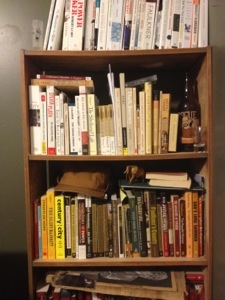
Books, some readIn 2012, I discovered that reading is more enjoyable as a hobby than as a job (big surprise). As a student for 16 years, I learned to resent the books that were assigned to me for book reports, essays and those dreaded Accelerated Reader (AR) tests. I watched as my hobby became points on a chart, grades and boxes to check. Most books I read during high school and college were left unfinished or skimmed at the last minute to meet deadlines and find quotes. Of the photo to the left, I probably finished a few.

Since finishing books wasn’t much of a priority, I did a little happy dance for each of the first three books I finished last year: another milestone. The authors of these books have since inspired me to read more authors in new fields. Following their suggestions has made for a delightful rabbit hole full of entertaining stories and thoughtful prose. These books have also reminded me that my childhood was full of days spent lost in the joy of books. I am thankful, once again, to be a reader.

This is the list of books I read in 2012. It’s nothing spectacular, but it’s a first for me and hopefully a sign of good things to come. Enjoy:

Isaiah

I still have a hard time spelling the word, Isaiah. Every time I write it, I have to sound it out and double-check. After spending almost a year reading this book of Old Testament prophecy, that just about sums up my knowledge of the book as well. While I didn’t always know the context of the prophecy, I appreciated the content of each chapter and verse. Often, Isaiah caught me off guard with romanticized highs and lows. What was once beautiful is destroyed, the place we loved has been defiled, and great skill has been corrupted by great delusion. I could say more, but it’s probably best to read it yourself. Along the way, this book inspired me to write two blog posts: “Delusions” and “Haunted Houses.”

The Spirit of the Disciplines, Dallas Willard

I’m almost ashamed to admit that I read this book last year. It’s not that I’m ashamed of the book, it’s more that I’m ashamed at my lifestyle. While I read and appreciated this book (strong recommendation), I’m just barely beginning to apply the spiritual disciplines to my life. As Willard writes, “If we refuse to practice, it is not God’s grace that fails when a crisis comes, but our own nature. When crisis comes, we ask God to help us, but He cannot if we have not made our nature our ally.” This book inspired me to write a blog post about silence: “Our Haunted Selves.”

Integrity: The Courage to Meet the Demands of Reality, Dr. Henry Cloud

My grandfather, Orville Rogers, gave me this book when I graduated from college. When I started it in May of 2011, I realized it was nothing like the books that I had read all my life. It was not “heady” or theoretical, it was practical and wise. While it took me a year and three months to finish, it sparked something in myself I never (ever) expected: an interest in business management books. Also, reading this book gave me more of an appreciation for Dr. Henry Cloud and I highly recommend his work. While reading this book, I wrote a blog post on decisions, “Gamble and Risk.”

Fierce Conversations: Achieving Success at Work and in Life One Conversation at a Time, Susan Scott

This book is out of control. When I finished my yearlong internship at Church Hill Activities and Tutoring (CHAT), I mentioned to one of the board members that I wished I’d had more difficult conversations. “Oh,” he said picking up a book beside him, “you might be interested in this book my daughter’s team at Capitol One has been reading.” A year ago, I would have said forget it, but Cloud had already softened me on business books and two weeks later Susan Scott changed my life. This book is a hard-hitting, unpredictable look into your relationships and the conversations you have each day. If you’re avoiding it, Susan Scott will be sure to let you know and tell you how to have the conversation in a productive way.

The Social Animal: The Hidden Sources of Love, Character, and Achievement, David Brooks

This book says so much about who we are and how we develop from toddlers to adults. In typical David Brooks fashion, this book highlights the incredible connections that scientists are making between the brain and human behavior without being boring. Brooks trades science jargon with fiction and tells the story of cognitive science through the story of one couple from infancy to death. That’s not a spoiler, it’s all about the journey.

Necessary Endings: The Employees, Businesses, and Relationships That All of Us Have to Give Up in Order to Move Forward, Dr. Henry Cloud

Not every ending is necessary, but determining when something needs to end is a hard process for all of us. This book taught me that if we don’t end things in life well (from jobs to friendships) we can’t move on in a healthy way. Cloud calls this process “metabolizing” endings and I think it’s the best description I’ve ever read.

The Defining Decade: Why Your Twenties Matter–And How to Make the Most of Them Now, Dr. Meg Jay

Forget everything you’ve read in the tabloids: the twenties are an important decade of life. That’s pretty much the message of Meg Jay’s new book that’s been taking over my social networks since it was published. For me, it all started when my brother Steven sent Will and I a link to an interview with the author titled, “Thirty Is Not The New Twenty: Why Your Twenties Matter.” Since then, Eunice read it, Will read it, I read it, Nina read it, Stacy and Stephen read it, Elizabeth read it … it’s out of control. Read the book — It’s not always necessarily right, but it’s good and helpful.

The Five Love Languages Men’s Edition: The Secret to Love that Lasts, Gary Chapman

I am selfish. That’s pretty much the biggest takeaway from reading Gary Chapman’s often referenced (and suggested) book about the ways we give and receive love. One thing that was fun about reading this book is that tons of people talk about the 5 love languages, but most people I know haven’t actually read it. It’s practical, thoughtful, and entertaining. Especially talking to all the fellas right now, you will not regret reading this book.

BUMBLE-ARDY, Maurice Sendak

From the author of Where the Wild Things Are comes a book about a pig who wants to party and a domineering aunt that doesn’t see the point. Bumble-Ardy follows in line with other works from Sendak as creative and childish with a depth of human understanding. As in the case of Wild Things, when you read about Bumble-Ardy you simultaneously become the child and the adult: reckless and responsible. I love this book for it’s cadence and rhyme scheme and a reminder not to let control prevent me from enjoying a party. In an interview with an  aging Sendak, Terry Gross noted a section in particular where Bumble-Ardy is punished for his party and makes a profound commitment to get back in line:

“Okay smarty you’ve had your party! But never again!”

Bumble-Ardy replies, I promise! I swear! I won’t ever turn ten!”

Here’s to another year.

P.S. I’ve been collecting books in my Amazon Wish List (a service I highly recommend) that I may or may not ever read.

Lighter Skin

One of the more surprising aspects of my research into Richmond newspapers was the sort of stuff I found in the Afro-American (Now the Richmond Free Press). My primary research interest, the story of a highway being build through Black neighborhoods, was hardly covered. In addition, I didn’t find the “Black is beautiful” perspective of Marcus Garvey and his contemporaries. Instead, I was devastated to find ads such as this one to the right promising lighter, softer skin. I share it because, like me, you may not have known that this ad existed in 1950s Richmond. I share it so that we all can have a tiny connection to the past.


Reflex Relearned

Over the course of the past year, I have written and thought about the effects of stress and trauma. I have wondered about how the major traumas and micro traumas might have affected how we inhabit our communities and the ways in which we react to the stress of life. Yesterday, I listened to the This American Life podcast, “Back to School.” It’s a very well-done take on early childhood development and what some believe teachers should be expected to “actually accomplish” in their work.

In it, there is an amazing conversation about the affects of stress biologically and the long term affects of stress psychologically. What does it do to the brain when each day there is a stressful event that triggers a flood of adrenaline? How do humans develop when they are always tensing up, afraid of the unwarranted (and unpredictable) verbal or physical lashing? What Ira Glass says, is that, “When the brain does something over and over and over again, it creates pathways that get more and more ingrained.” The fight or flight response thus becomes one of the primary responses in the affected brain and one of the primary responses in the child’s life. Fight or flight.

If you’ve ever been a teacher this is perhaps not news to you. You might have experienced one of these two responses as you placed a worksheet on a student’s desk or passed out a graded quiz. You may have seen a student place his or her head on the desk during class because the numbers on the page might as well be written in Chinese: their brain is not connecting. Glass shares that over time the adrenaline rush during these traumatic moments stunts the development of a section of the brain called the prefrontal cortex, “where a lot of these non-cognitive skills happen — self-control and impulse control, certain kinds of memory and reasoning. Skills they call executive functions.” Without these executive functions, students cannot sit still, engage information, and reason a thoughtful response.

There are even ways that I can see these pathways in my own brain and and how stress has affected my own experience. How I interact with some sorts of people, how I believe I am perceived when I walk into a room, when and where I feel confident. All of these have developed over years through a series of unstructured, unplanned, semi-traumatic events that have brought me to this point in time. Granted, these traumas are minor in scale in comparison to many. I have been blessed to grow up in a world where I felt safe to play outside and to spend vacation with my relatives.

Still, as I grow up (however reluctantly) I am finding that I have these reflexes within me that emerge under certain types of stress. Because the prefrontal cortex is where a lot of non-cognitive skills happen, I am not totally in control of these responses. I can only be aware of myself and the ways in which I affect others in order to preempt my more negative, learned reflexes. Also, I believe that leaning into these harmful reflexes and embracing activities that may conjure up these responses (in a safe space) will allow me to reteach my brain new responses and to integrate new positive experiences into my identity. I can effectively relearn a reflex. This is is most commonly called therapy or, more simply, personal growth.

Below is a transcript of the excerpted conversation on the effects of stress. I highly recommend listening to the whole piece, but also take some time to read through and contemplate the conversation below. For me, it is a profoundly important take-away because it has everything to do with my current work as well as my life of personal evaluation. Enjoy:

“Ira Glass

But in addition to all the bad things that are likely to happen to them as adults, there’s also the effect that long-term stress has on them when they’re still kids, especially on their brains and their ability to learn.

Nadine Burke Harris

If you look on the molecular level, you’re walking through the forest and you see a bear, right? So you can either fight the bear or run from the bear. That’s kind of your fight or flight system. Right?

Ira Glass

Right.

Nadine Burke Harris

And your body releases a ton of adrenalin, right? Which is your short-term stress hormone, and something else called cortisol, which tends to be more of a long-term stress hormone. And this dilates your pupils, gets your heart beating fast. Your skin gets cold and clammy. That’s because you’re shunting blood from anywhere that isn’t absolutely necessary to the muscles that you need to be able to run from that bear.

The other thing that it does– now, you can imagine that if you’re about to fight a bear, you need some gumption to fight that bear, right? So it kind of shuts off the thinking portion of your brain, right? That executive function cognitive part. And it turns on the real primal aggression and the things that you need to be able to think that you’re going to go into a fight with a bear and come out on the winning side.

Ira Glass

Yeah.

Nadine Burke Harris

And that’s really good if you’re in a forest and there’s a bear. The problem is when that bear comes home from the bar every night. Right? And for a lot of these kids, what happens is that this system, this fight or flight response, which is an emergency response in your body, it’s activated over and over and over again. And so that’s what we were seeing in the kids that I was caring for.

Ira Glass

When the brain does something over and over and over again, it creates pathways that get more and more ingrained. So this kind of repeated stress affects the development of these kids’ brains. And especially affected in this situation is a specific part of the brain that’s called the prefrontal cortex, which is where a lot of these non-cognitive skills happen– self-control and impulse control, certain kinds of memory and reasoning. Skills they call executive functions.

If you’re in a constant state of emergency, that part of your brain just doesn’t develop the same. Doctors can see the differences on brain scans. Dr. Burke Harris says that for these kids, the bear basically never goes away. They still feel its effects even when they’re just trying to sit there quietly in English class.

Nadine Burke Harris

And if right at that moment someone asks you, “Oh, could you please diagram this sentence? Or could you please divide two complex numbers?” You’d be like, what are you talking about? And so that’s what we were seeing in the kids that I was caring for, is that a lot of them had a terrible time paying attention. They have a hard time sitting still.

Ira Glass

And you hear about this in lots of schools. Head Start teachers in one survey said that over a fourth of their low income students had serious self-control and behavior problems. Nadine Burke Harris says that it’s true for her patients, the ones with adverse childhood experiences like neglect, domestic violence, a parent with mental illness or substance abuse.

Nadine Burke Harris

For our kids, if they had four or more adverse childhood experiences, their odds of having learning or behavior problems in school was 32 times as high as kids who had no adverse childhood experiences.”

A year

This story starts, not in the year itself, but in those preceding that conspired its form: to understand the confluence you must also embrace the tributaries of life. Bind the tails, I have been telling myself, and see how other lives have stretched out to your own and brought you to this moment in this place with these people. Bind the tales, I tell myself, and see how one life is made up of many.

The foundation of this story is the past that has been mostly lost. There was an alcoholic man who left his family just before the Great Depression, a young girl who watched all of her family’s belongings sold on their front lawn, somewhere a boy found a love for planes and a young woman found her love for him. The foundation of my story is this love, these two sets of people, their commitment, and their families that became my own.

The story moves to Dallas, Texas, where the Quin family and the Rogers family grew, saved, and travelled on airlines that have since been bought, lost and replaced. There was a great war, America increased, there were riots and protests, Curtis Rogers was killed in the jungles of Vietnam, Mrs. Quin died of cancer in a hospital in Dallas, and, as their families felt the shock of loss, two high school students chose, at the last minute, to go to Baylor instead of UT. Jane Quin and Rick Rogers met during those years at Baylor, but it was later when they both moved to Dallas after college and even later still that they did finally fall in love. And, like their parents before them, committed their lives to each other and an unknown future in an unknown place.

This story finds its roots in Rochester, New York, in the early 1980s. A boy named Daniel Fisher loved the Allen family and he walked to their house to see his best friend, Johnathan, and Cindy, the mom who loved him as her own. After a few years, the Allens left Rochester, but they never forgot the city where they spent their first years together as a family. Time passed, Daniel and Johnathan grew, the Iron Curtain fell, Clinton served two terms, Cindy got a new teaching job in Tyler, TX, and down the road a boy named Michael was born to a doctor and a retired nurse who had recently moved to the neighborhood from Dallas.

The story begins to take shape in the kitchen of my house in Tyler where I prayed with my mom to accept the love and forgiveness of a God I had been told could hear my voice. My story moves to the woods behind my house where I imagined an empire in the trees and to the floor of my bedroom where I prayed for a new life and a better future. And so I grew, learned to read, swim, bike and run, travelled, fell in and out of love, lost and made friends, and, at some point between then and now, became a person.

Lives began to converge when my oldest brother Curtis finished elementary and moved to a private school on the other side of town. Following precedent, we all moved to this new school and as I moved through the next ten years, Cindy made a reputation for herself teaching American history and leading others. She also began to advise the high school student government to which I was later elected and devoted. Then, as I looked to finally move away, Cindy told me about a young man from Rochester named Dan who was about to graduate from a university in Richmond. If I was interested, I could meet him and hear his story.

I did apply to the university and, when accepted, flew up with my dad make a decision. Dan, then in his early twenties, met us for dinner at an Italian restaurant in Carytown and told us about life at school, a professor named Rick Mayes, and the neighborhood of Church Hill where he and others were planning to start a high school. The next day, Dan introduced me to Jason Barnes (who now lives with Caitlin on 26th), Benjamin Telsey (with whom I travelled to Peru to study with Dr. Mayes), Sarah Burd (who now lives on Chimborazo Blvd.), and Michael Kolbe (who moved in with Adam Hake with whom I lived during our first year of college across the hall from Rashad Lowry who now lives on 23rd and with whom I currently work). I did not understand at the time how significant this move to Richmond would become.

In my first semester, I rode with Alli Barton every Thursday morning to tutor (her future husband) Dan’s math students at Church Hill Academy (where I also taught for the past year) and spent the afternoon each week at Captain Buzzies Beanery, my first love in this beautiful, lonely city. Three years past, I did not transfer as I claimed I would, Gordon Meador (who lives on Oakwood and with whom I taught) told me about Shane Claiborne, I attended Urbana and the CCDA conference, and found myself hopelessly drawn to a Christian faith that challenged paradigms and transformed lives. A man named Adam Burgess decided to work at CHAT and later walked with me through Chimborazo Park as I decided to commit to the summer internship. Already connecting the dots, I told him that I had been headed in this direction even before I started school.

I spent that amazing summer working at CHAT, but when I returned for my fourth and final year at Richmond, I left that summer behind. I interviewed at the Deloitte offices in Arlington, fell in love with New Orleans (again), (re)started dating Nina, considered a year abroad, and began to feel trapped by this city that had given me so much. I watched as my friends left for China, DC, New York, and Atlanta; whether they were going home or abroad, they were going somewhere else and I felt, again, like I was stuck. But God, in his sovereignty, desired that I would continue my commitment to this one place and these people he had given me for this time. He was drawing me to Richmond years before I even knew where it was on the map and had not yet finished teaching me what I had come to learn.

Nina accepted her calling back to Church Hill far more readily than I did as I continued to resent all that I had come to love. Once Richmond started to feel like home, I wanted to get away. I eventually applied for the yearlong internship, but in this move toward that life there was also an emotional move away as I reconnected with family and friends in Texas. When I did commit, I had no reservation in my heart that I was making a decision to accept the life I had been given and God’s plan for my future.

With that behind me, a new year gradually began to take shape. Friends, family, and my home church in Tyler committed to fund my salary, Gina Maio and I discussed what classes I might teach, Chris Whiting told me about life in the Lighthouse, and I carried on exploring my hometown learning how to read and write. Before I started this year, I thought it would be much like the twenty-three preceding years I had already lived. I thought my life would be similar to the life I had come to love in Richmond, but with the addition of work at CHAT and the academy. I did not yet realize that, in ways both simple and profound, life gradually becomes work and work isn’t all that bad.

I drove to Virginia at the end of August, moved into the Lighthouse where I was joined by Daniel, Matt, Steven, and my own brother Will. Nina lived down the road and we drank coffee on our first morning together in Richmond with no idea what we were about to experience. We simply started the day as we would start hundreds more. The days were long and the weeks were fast. The heat of summer cooled, leaves turned brown, Jamel T. Cobb was killed and mourned, Khalil Clark was born and celebrated, Nina and I somehow became teachers and bus drivers and tutoring coordinators, mentors, and, eventually, neighbors in this home away from home.

Winter came, however reluctantly, ice on the bus windows had to be scraped, and on Wednesday, January 19, 2o12, I went home from work with a virus that emptied my stomach and stole my day. I slept for 36 hours, my coworkers covered my classes, and when I woke up on Thursday, I started to write. In a Google doc titled “personal reflection,” I wrote and wrote and wrote: 2,608 words I wrote about feeling like a failure, about wishing I were home with my family, and about the desire to finally learn how to do hard work. The next day, the reflection doubled as my teaching style transformed and my perspective grew. This reflection (now over 45,000 words and counting) signaled a bit of a mid-year awakening within me as I found perspective and began to value my thoughts enough to write them down until they gradually started to make sense.

The calendar progressed as Epiphany became Lent, coffee became hot tea, and work stretched into more work. February and March dragged on (as we were told they would) and we looked forward to spring break, to the weekend, to the end of each school day, the end of tutoring and the idea of something called rest. There were worksheets, of course, and videos and tests, quizzes, projects, NWEA, arguments, unuttered rage, tears, laughter, conversations about another life, and dreams of “para-para-paradise.” I wept as five students walked across the graduation stage and in my brokenness I began to find more love for their stories and their future selves.

Summer, like life, has not been what I expected. What I thought would be easy, has been hard, and what I thought would be hard, has been easy. There are new faces in the Mix, new events and partnerships, and a renewed commitment to the program. It has been a blessing to let God redeem this year, take on my burdens, and gradually continue to transform my life as well as theirs.

I do not know how it is that I find myself, two weeks until the end of a year, already boxing its contents and sharing its thoughts. It has been a good year and, as promised, life has been abundant. It will also become something new as my life moves on and others move as well. I have faith that, in ways I can’t predict, this year will become a foundation for the next and the rest to come as each begins and ends. The future will always be unknown, but I am happy because I can already see God’s faithfulness in the lives (many not mentioned) that he has connected to form this one single year. I am confident that he will continue to bring us together and apart as we move to the next.

A year, I have found, is a made up of all those preceding and those yet to come. Only time can move one into the next, reflection allows it to be perceived as it happens, and healing allows it to be processed and integrated when it is done. You’re not always ready for the next year (or even the next week), but still it comes and then it goes. And every once in a long while you are given a chance to grasp the magnitude of its significance. This is the genealogy of a year.

Note: for the past month I’ve been reading through an essay by Walter Benjamin that has motivated me to learn how to tell stories. “A Year” is my second attempt. Thanks to Bonnie Swift for writing about the essay and to Will Rogers for printing it and leaving it for me to read in the loo.

Away for now

The book has been written but not yet been read and
the life of the love of the living and dead are searching
the highs and finding the blows
of the fight and the trauma of flight too great
for the one lonely death of the unknown life
untried and untrue,
but unlived and through you I have found that my blood courses too
and my muscles, my eyes, my skin can be used when aligned
to his will to his glory his story of me and my sad little life made anew
from on high to become little like that of his and his alone
on the mountain at dawn getting
away from the work and
away from the tears to laugh and
sing the praises of life made right made day
made green with buds on branches made dead
by years of living inside of my head and denying the water of his divine truth
killing myself and wanting to lose the only thing I was ever given:
my life and my all
to the garbage, I said and to hell with my future
I will make more as a moral for others in death,
and in dying make them finally find their loves and their lives
unloved as mine was over too early and as if the universe
now had a debt to be paid
with the zeal of the rest of those still living
in my memory and for my name, but how vain! and how selfish!
to think that my fall woud be so tragic that others would be moved
by my own sudden end
and Christ’s irony is that my life now is work and the cross is my death every day at sunrise,
new life,
new breath,
new radiant death
and a new vision for myself through his eyes and his mind
that I could not work to find or discern and
now realize it is merely the beginning of things unseen
and life undreamed, resung, reseemed — wrinkles and scars remain
and nothing can be taken away fully forgotten or totally boxed
even life itself is here in this moment and he is faithful to get me where I am going
as long as I am faithful to get away from wherever I am
and he will remove me if I am deemed unfit, unfight, unprepared for the work
and he will take me to this place of ‘away’
of a way that I have not bothered to embrace and have not truly tried.
 
I do not wish to read this book.
I don’t want to know how the story ends.
I still want to escape sometimes and go nowhere, but he pulls me back to himself,
his places, and his people for his will.
And all I can do is look with him to the new
where he lives. 
The rest is too much.
One day,
but for now,
I am away.
 

The moment of impact

Around 9:25 this morning, I was hit by a car while driving the bus.

As I entered an intersection, a car to my left ran a stop sign and I instantly knew we weren’t going to make it in time. That was the moment of realization.

The next moment, I screamed, “Oh my God!” and looked at the street in front of me and away from the car as it hit. That was the moment of reaction. I may have also sped up or slammed on the breaks, but I can’t remember at this point.

Then, the car slammed into my door and the front end of the bus I was driving. That was the moment of impact.

In the three hours after, I pulled the bus off the road, called 911, swapped information, started to feel sorry for the guy that hit me, got a friend to pick up the students, got a ride to the graduation, cried during the entire ceremony, ate food, and introduced my parents to all my friends. It was an amazing, but there was still part of me that hadn’t quite forgotten that I was hit by a car earlier in the morning. The phrase “shaken up” even started to make a little more sense.

There are so many moments in one day, but they don’t all create lasting memories. After today I realized that if there’s one thing that does seem to create memories, it’s impact. Even after this great day, I have images burned in my mind of the car to my left, as it entered the intersection, and the view out the windshield as I screamed and it knocked the bus sideways.

When miles of force are compressed into fractions of seconds, the memory of trauma can last a lifetime. After the wreck, I even realized I was carrying the tension with me in my neck and lower back.

My students who were on the bus during the wreck were already making jokes a few hours later. One came up to me and laughed and said, “Oh my God … BAM!” a few times. All I could do was laugh. It seemed like a good way to remember the experience. I could think that it was a terrible day. Of course, it was a hard morning, but it was also kind of hilarious.

To be honest, it was also kind of miraculous. No one dead, no one hurt, everyone got to the graduation on time, the other guy had insurance. It’s hard to think of a wreck as a miracle — that is, it’s hard to think of the moment of impact as a miraculous moment — because it seems so violent. But if I’m stuck with the memory forever I don’t want to simply hold onto the violence of the moment.

I want to retell the story in the way that my student told it: to entertain. I also want to tell it in the way that I’m currently thinking about it: to inspire. It happened. I figure I should go ahead and make something out of it.

That way, it won’t be waste. It will be a story worth telling.

7 – 3 – 1: My Journey Through the Enneagram

 “One of the great dangers of transformational work is that the ego attempts to sidestep deep psychological work by leaping into the transcendent too soon. This is because the ego always fancies itself much more ‘advanced’ than it actually is.”
 

The quote above has become one of the defining quotes of my year. To me, it means it’s not enough to talk about practices for healthy life, you have to be willing to submit yourself to a process. You actually have to do the work.

This idea comes from a book about a system of personality types that has, in some ways, become my current practice of self-knowledge and discovery. For those of you who may be worried, it’s more psychological work than spiritual practice. The Enneagram has in no way usurped my Christian faith, but, to the contrary, has led me to a deeper understanding of my personal brand of depravity (in other words, how I personally manifest brokenness) and given me a vocabulary for understanding myself and my behavior. Also, when I talk about the Enneagram, it is through the lens of one book, The Wisdom of the Enneagram. To my knowledge, it’s the most thorough one of its kind.

I almost can’t imagine my life before the Enneagram, the book, and the quote.

For those of you who haven’t heard of the Enneagram, it is a vastly complex system for understanding different personalities. Unlike the Myers-Briggs and others, it does not prescribe static labels or obscure beaver-otter-retriever metaphors. It contains nine personality types that have somewhat recently been placed on the ancient nine-point symbol of the Enneagram.

Beyond the nine main types, each type has “wing” personality types of the immediate numbers (e.g. “9 with a 1 or 8 wing”) which does not define their dominant motivators, but is still highly influential in their way of life. Furthermore, each personality type assumes the negative or positive qualities of another personality type when the person is unhealthy or healthy respectively. Thus, a domineering eight becomes more helpful like a two when healthy and more controlling and secretive like a five when unhealthy. So there are nine types, 18 sub-types, and the ability to “catch” you at any stage of development along the way to maturity.

Now, take a deep breath.

When I first learned about the Enneagram I was surrounded by two good friends who also happen to identify as sevens. That’s me! I thought, as one friend read the description of the “busy, fun-loving” personality type I so longed to embody. This seemed to explain why I was always distracting myself by looking for cool articles about my passions, stop motion videos and infographics on the internet and sharing them with my friends. I’m just a scattered seven, afraid of my past and searching for newer, more exciting experiences to assuage my pain.

But then people were like, hold up. I sort of act like my friends that are sevens in social settings, but there are some aspects of my life that don’t match up: My car is organized and vacuumed, I have a LinkedIn, and I talk about adventures way more than I actually go on them. And then it all made sense, you’re a three! With a two wing! You’re “the charmer,” always looking for another way to help someone and improve your image. And at the time this seemed to really fit.

As I started to look at my life, I became painfully aware of the fact that I have spent countless hours crafting an image for myself whether on social network sites, through this blog and in my personal relationships with others. I hated myself because I began to perceive all my pursuits (my hobbies and jobs) as mere image maintenance for my troubled ego. I started beating myself up for caring so much about what other people thought about me and this made me care even more about what other people thought than I had before. All about image and success? I wondered to myself if all my work were just to create a name and a desirable image as the three is prone to do.

Then all the sudden I had this realization: Work? Beating myself up? Passions? None of these tendencies fit either of the two personalities that I had previously considered for myself. Sevens are way too carefree to think that what they’re doing is work (“life’s an adventure!”) and threes are too busy fitting in and receiving awards (of the traditional sort) to really beat themselves up for failing to meet personal standards. Besides, if my desire were to have a good image, I wouldn’t type blog posts longer than 1400 words!

At long last, after about eight months of wrestling with this whole Enneagram idea, I found a personality type that describes me so well it hurts: I am a one.

My girlfriend (also, almost definitely a one) and I laughed our way through the entire section on this type, its tendencies, and our own stories from the past. We would read the first sentence of a paragraph, have an entire conversation, then realize that our conversation was almost identical to the rest of the paragraph we were on. The one is the personality that is essentially trying to prove its worth, its reason for existing. One’s are also impatient, think they know the right way things should be done, and, when healthy, champion reform throughout society.

Who would have guessed it? Probably all of my friends, family, and acquaintances. It’s so obvious now looking back on my time in college. If I wasn’t ranting about the administration I was organizing to get sidewalks built or developing plans for the student composting system. Always. Always. Always looking at what could be fixed/changed rather than what was going well. I also realized that I was sometimes so perfectionistic in my work that if I couldn’t do it perfectly, I would give up and do it poorly last minute. Then, I would beat myself up for not living up to my expectations of myself and fall into an emotional tailspin (ones move to fours under stress) and feel like I had lost myself entirely.

Conversely, some of the most difficult moments of growth in my life continue to be the times when I realize I am impatient with someone else’s way of doing things. I also realize now that my personality is to feel self-righteous and to orient myself away from other people in an attempt to feel personally just and good. That is, after all, what my personality is striving to be: good. But since no human can reach their personal standards of perfection, as I gradually mature I find more value in other people’s standards and processes while also transitioning from judgement to discernment. Rather than rely on a good-bad dichotomy to deceive my guilty ego, I develop more internal self-confidence and open myself up to more external disorder. I learn to embrace the grey of life.

Why have I put myself through this process? Because the Enneagram has forced me to examine my behaviors, thoughts and instincts in way that I would have never done otherwise. Furthermore, what I have learned has also been supported by other books I’m reading, most specifically Integrity by Henry Cloud and The Spirit of the Disciplines by Dallas Willard. One of Cloud’s quotes in particular seemed to encapsulate this realization:

“This process is called assimilation and accommodation. Which means someone has graduated past childhood levels of information processing and can adapt to reality and make external reality their own. I will repeat that for emphasis: it is the ability to make external reality one’s own reality.”
 

This sort of maturity does not come easily. We all have delusions, but it is knowing our delusions that will allow us to operate in the complex world effectively and honestly. Also, it is only “deep psychological work” that will force us to remember the parts of our lives that we desire to forget (our weakness and shortcoming) and integrate these into our more realistic and honest identity.

Thanks for making it to the end! You deserve a prize. And that prize should be a copy of the Enneagram book … and friends to share the journey.

As always, and most definitely, more to come.

Opening quote: Don Riso and Russ Hudson. The Wisdom of the Enneagram, 10.
Second quote: Dallas Willard. Integrity, 135.
 

Therapy and Trauma

I have recently come to the conclusion that life is a combination of therapy and trauma. There are moments in between, of course, but these are often forgotten.

I’m not really thinking of therapy in the strictly medical sense. I think of therapy more as an overcoming of the past. Two months ago I wrote a similar post from a slightly different perspective. At the time, I saw our selves as haunted houses full of fear and stigma. The ghosts, I thought, were the memories of trauma. And the therapy for trauma I described in this way:

“We need to painfully return to embrace ourselves: chaos and all.
We need to walk the halls of this haunted house, to run our hands over dusty railings, to notice what has been broken, and perhaps to even find that our fears were unfounded.”

At the time, I don’t think I really respected the difficulty of therapy. That is, I don’t think I understood how difficult it can be to work through and overcome the past. I also had a shallow understanding of the memories of trauma I carry within myself. Now, I see that embracing ourselves “chaos and all” is a much more difficult and long road, but no less worthwhile.

My next thought is also related to how we form memory and how events in retrospect can become therapeutic while others later seem traumatic. The former are the stories we tell ourselves from the past that help us to understand the kind of person that we are and want to be. The other stories, the stories of trauma, are the stories that we usually ignore or try and laugh about and forget. These are the stories that remind us of who we don’t want to be.

These are the stories we ignore … as well as the people and places with which they are associated.

But they are as intimately “us” as are the stories we enjoy hearing about ourselves. They shape the way we approach every situation. These stories affect the way we interact with other people, perceive authority figures, the opposite sex, peers, coworkers. And since each of us carries different traumatic experiences, each of us will see vastly different activities as therapeutic. For me, baseball was a sport that I was never good at. Struck out in T-ball, put away the bat, gave the pants to a friend’s little brother, and never looked back. So when I threw a baseball with one of my friends the other day, for the first time in about a decade, it was actually a strange sort of therapy.

For someone else, public speaking might be a therapy. For another, going back home is either therapy or trauma depending on how productive we think that it is vs. how much we revert to the person we are trying to forget. We all fear different things in order to protect ourselves, but these fears are usually more internal than we realize: hanging out with the old traumatic stories we love to hate.

As we interact with the past we don’t get rid of it, but, rather we grow to understand it and appreciate it. We also learn more about our negative cycles and can catch ourselves before they set in. Unfortunately, this process never ends, but I imagine it develops over time. I suppose that’s really the goal of these sorts of processes anyways: longevity. The more we’re willing to submit ourselves to life, to therapy, the more we’ll develop and mature. So here’s to long, healthy lives. Here’s to the good and the bad and the perfectly normal in between.

 @Spozbo and the semi-controversial David Deida for leading me to consider the benefits of therapy not as something to fear, but as something integral to healthy human development: life as therapy.
 

Photos from the Capital

I loved D.C. even before I knew that I loved cities in general. There was something about the power, the tradition, and the variety of architectural styles placed within the order of the L’Enfant Plan. So when I visited recently, began to remember why I loved the city then and found a few more reasons to love it now: A red castle, a circle of art, and a statue in a garden. Enjoy:

The Smithsonian Castle


The Hirshhorn Museum

Holy Moley Murals

The Richmond art scene has been blowing up for years. Now, in epic proportion, artists here have begun to reveal this transformation in the public realm.

Rather than start with the newest, most epic murals (skip to the end if you want!), I want to put this Richmond mural passion in some context. Like all great American stories, it starts with Coca-Cola. This advertisement is located on the side of Globehopper at Main and 21st. I believe paintings like this became common starting in the mid-1800s along with the rise of the modern brand:

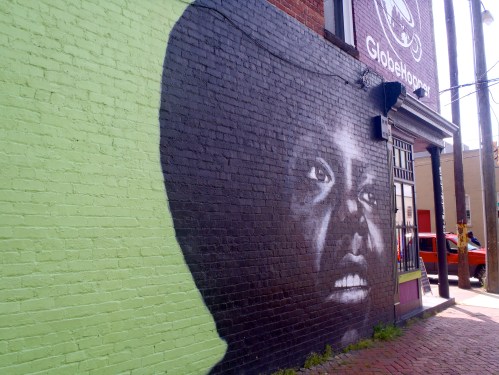
On the same wall, the Globehopper mural stands in vivid contrast:

I think this mural is Trask at his best and, in all honesty, I think I could end the story here. But alas that would not do justice to what is happening. These newest murals (the next two and the last one on this post) are apparently a part of the G40 Art Summit, a sort of obscure event that has come to energize the Richmond art scene for the month of April.

Writes Art Whino, “By inviting 13 of the top mural artists from around the globe to unleash their creativity to 20 large scale walls in a 10 block radius, it will surely become amazing artistic destination point for years to come.” As I drove west on Main St. I was soon greeted by one of these murals: the most epic (and hopeful) turtle I have ever seen. It’s being painted on the back wall of famed nightclub Have a Nice Day which means I’m surprised and impressed. And you may be amazed:

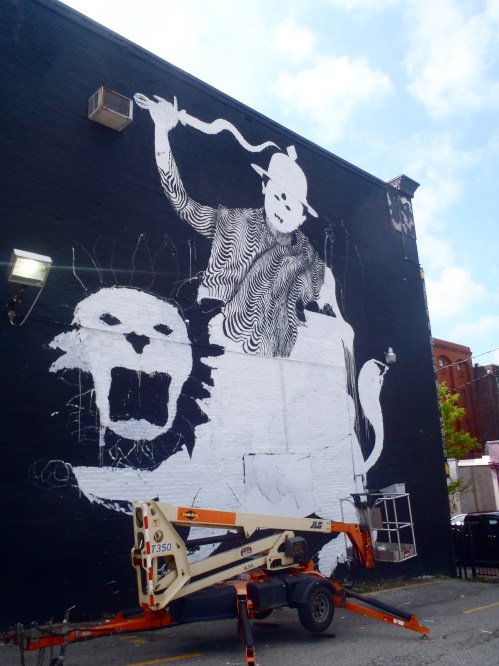
Somewhat more fittingly, Have a Nice Day is also adding a somewhat demonic-looking mural of a man whipping a lion (?) to their exterior wall facing Main. I can’t pass final judgement at this point because it’s not finished, but I do know this: There are epic murals in Richmond:

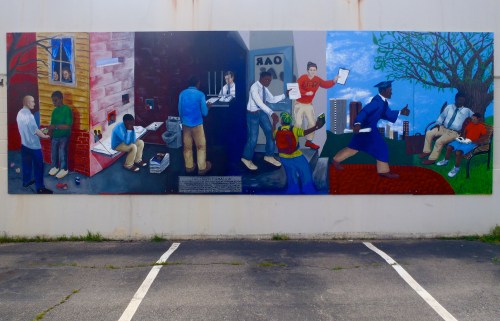
A little farther down Main, there is a mural that seems to have been commissioned by Offender Aid and Restoration of Richmond. While not the most epic, it is the most clear narrative portrayed in the murals I’ve seen lately and I appreciate OAR’s embracing the mural format in their latest outreach:

I also couldn’t help but include a snapshot of the graffiti located just a few blocks away from the mural above. While I’m not sure where “graffiti” becomes “mural,” I am sure it’s probably for a dumb reason so here’s my sample:

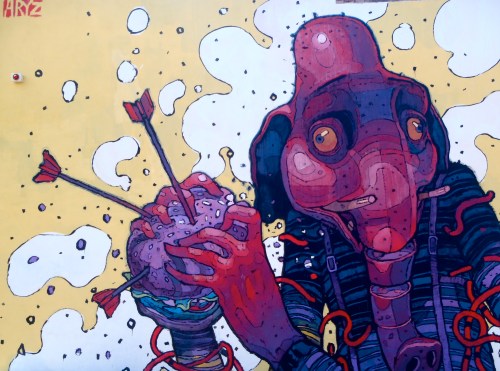
Finally, this mural is the last one I catalogued on my drive down Main St. and in some ways this one is the reason why I’m writing this post because it is the first I saw of the newest crop. It is, I believe, an elephant holding a hamburger that’s been shot with a few arrows … feast your eyes:

Here’s another view:

The only thing I can say at the end of a post like this is “holy. moley. murals.” What I love most about murals is that they take an everyday walk down a street and turn it into a free stroll through an art gallery. If you don’t like art, you might not like these murals, but you have to at least admit they are better than a blank wall. Creativity like this gives a city, and individual buildings, significance and character.

And the crazy thing is these are just the beginning … for examples of more epic murals check out this article by RVA News of other murals being painted around town this week. While I selected one street, they selected the entire arts district from Manchester to Broad St. I couldn’t be more pleased that my favorite city just got that much cooler.

And a little more bizarre.