The other day while I was walking through downtown Richmond I stumbled on a small space with huge potential. It’s basically just a concrete slab, but what makes it special is that it’s located right in the middle of a city block. The concrete is connected to one building that forms an “L” around it. The area is accessible by three different alleys which all meet at the base of a somewhat beautiful, mature tree.
With some love, this could be a place to congregate just like the La Colombe near Logan Circle in D.C. The benefits of using these interior spaces is that they are quieter than the city streets and they are often cooler in the summer months because the buildings provide shade. They are cozy spaces, the diffused light is relaxing, and there is something charming about the irregular shapes. I love the surprise and delight of waking down an alley, turning a corner, and finding something you wouldn’t have expected,
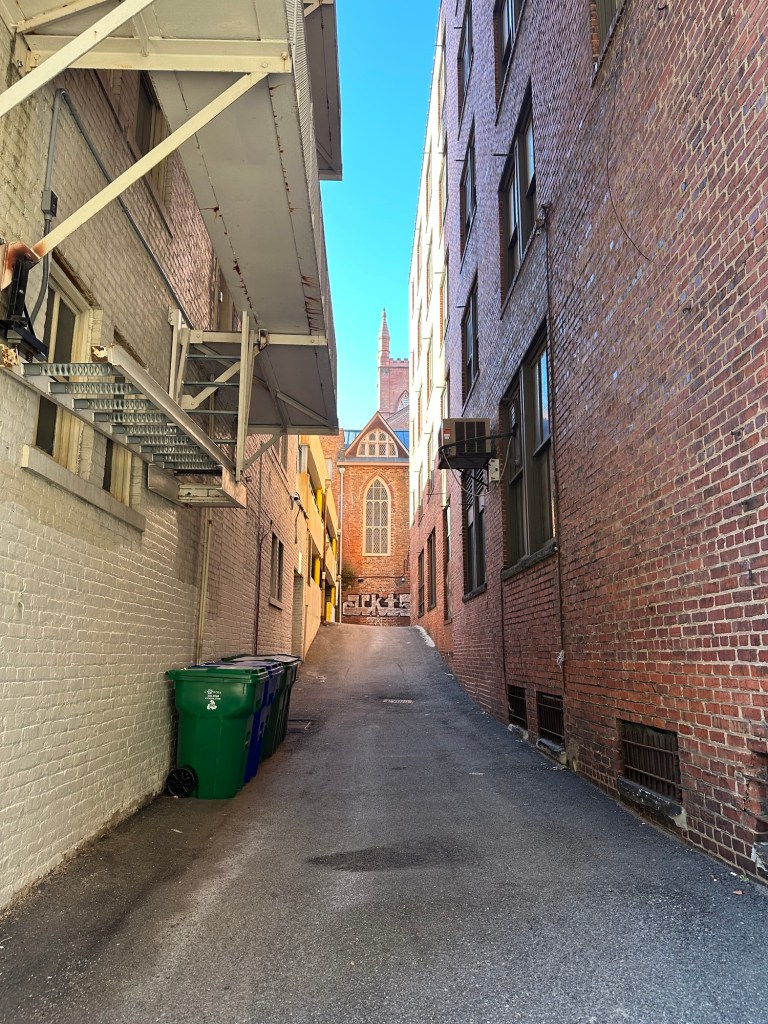
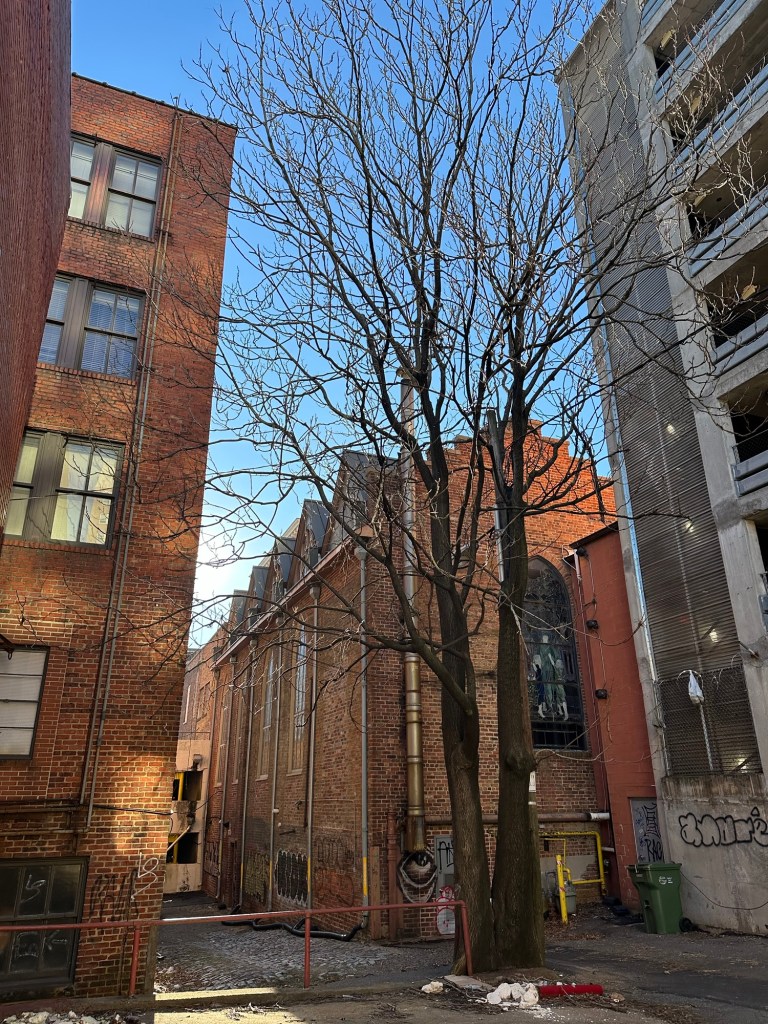
The approach that is most familiar to me (I actually worked and parked in the building to the left years ago) is below. I love the way the buildings frame the old window and steeple of Second Presbyterian.
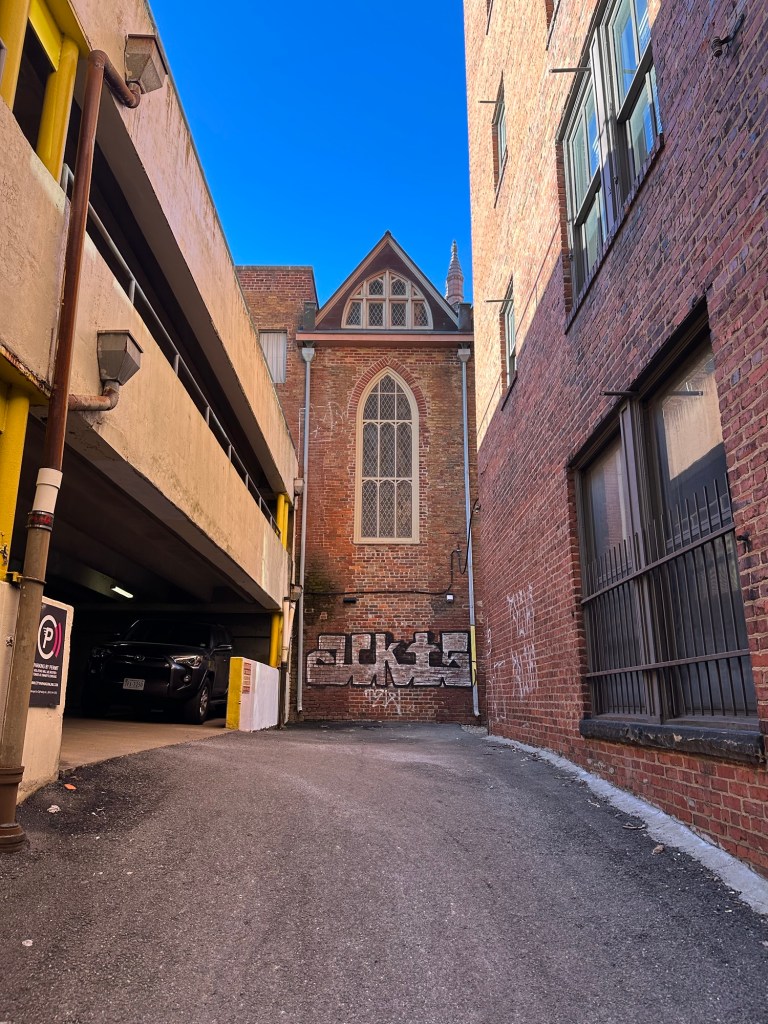
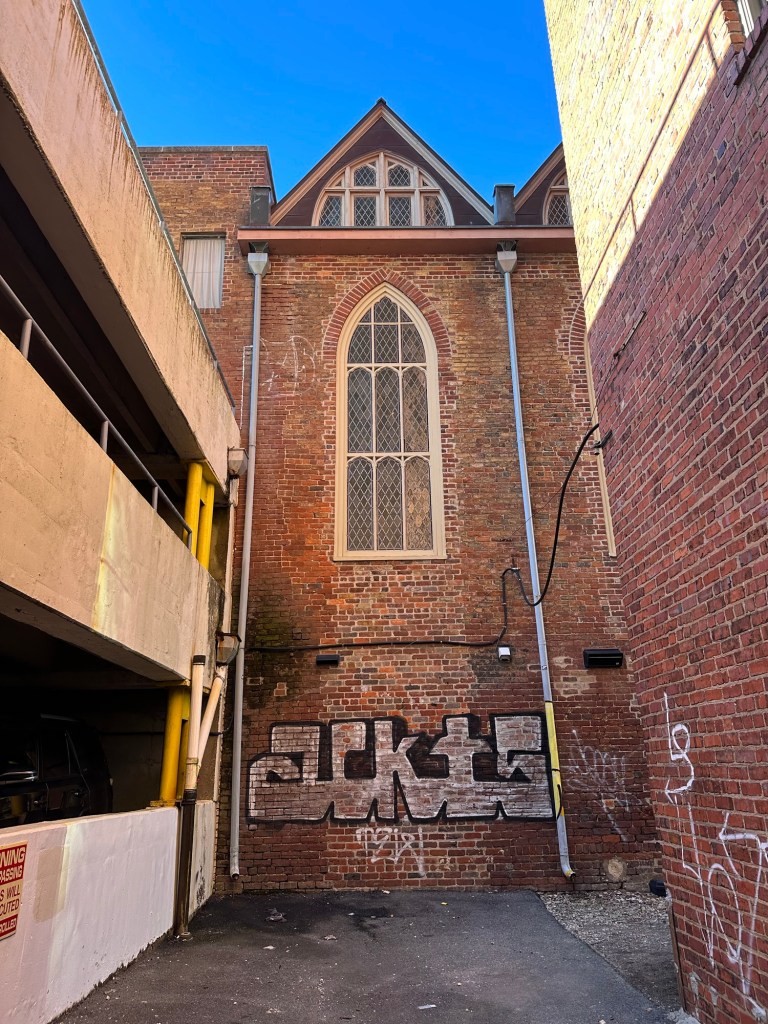
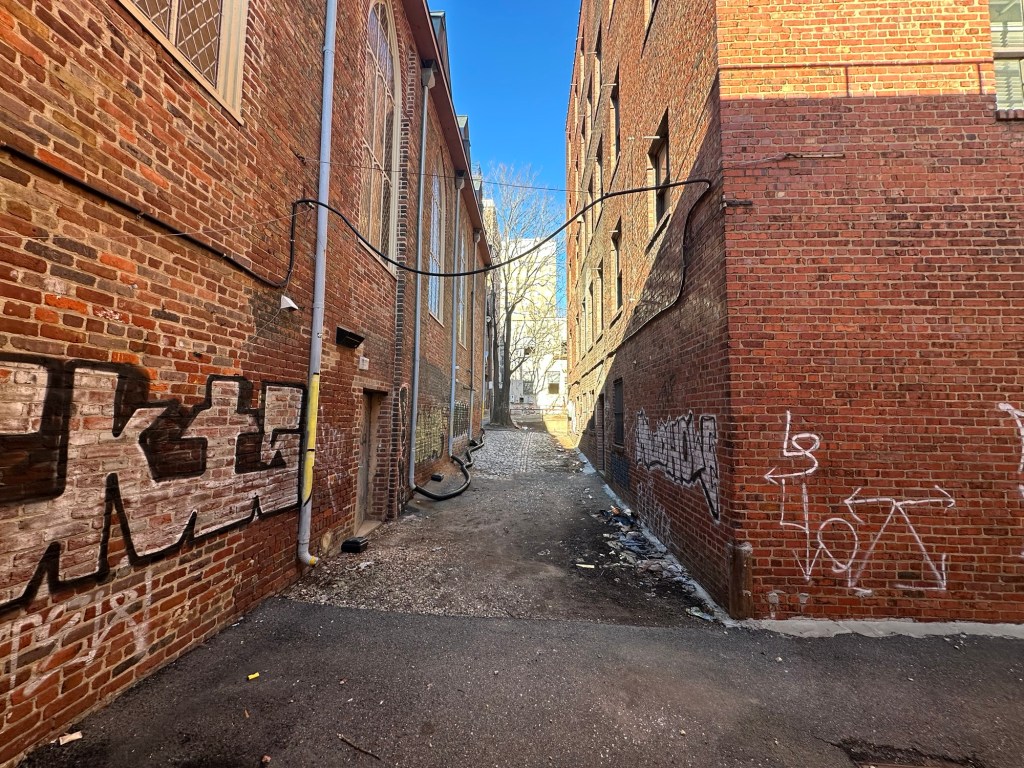
After you turn to the right, you start to get a glimpse of the destination. The area also starts to become more charming: the alley transitions to cobblestone, instead of a parking garage you have old brick and stained glass, and the tree is visible as well.
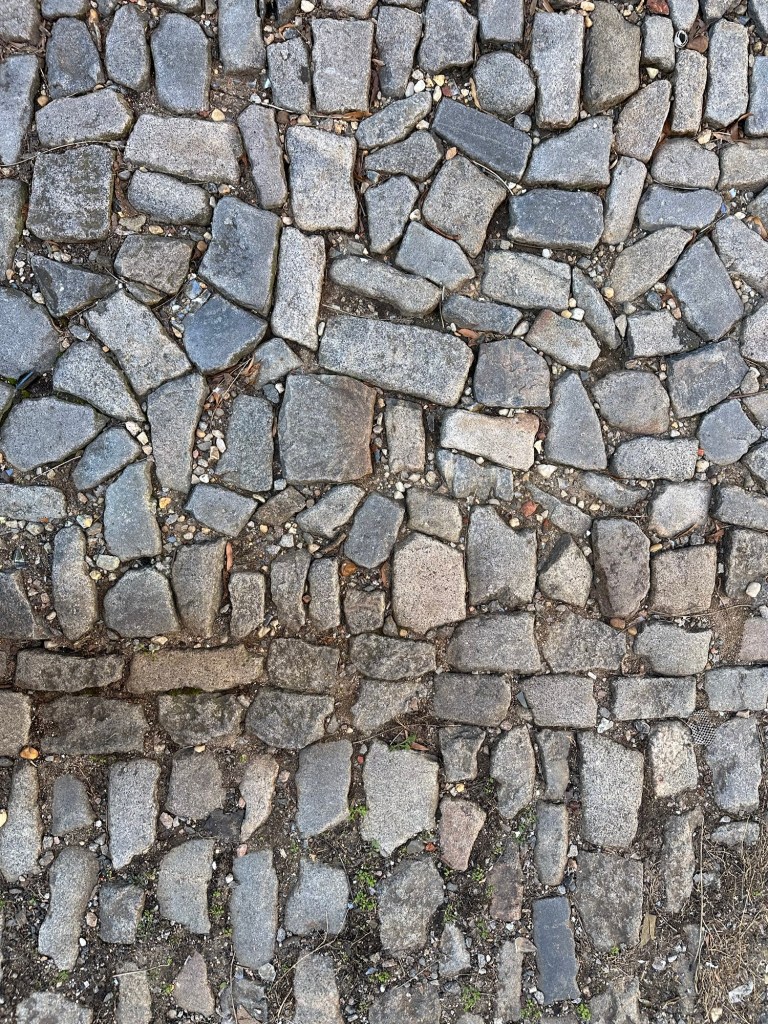
Despite being completely forgotten and unloved these granite stones are beautiful and the whole section would clean up very nicely.
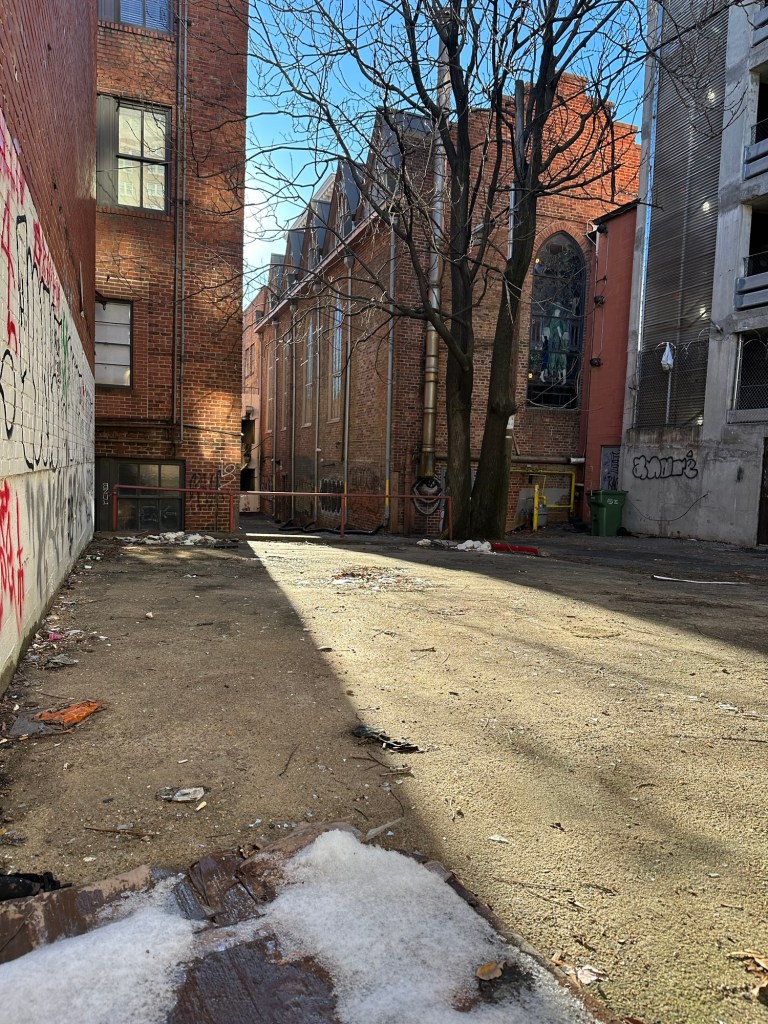
This is the view from the space that I’m interested in. I appreciate how much there is to look at even in this small space. It feels like the medieval section of a city: winding, ad hoc, dense, and built to the human scale. The tree would also provide shade in the summer and a beautiful accent.
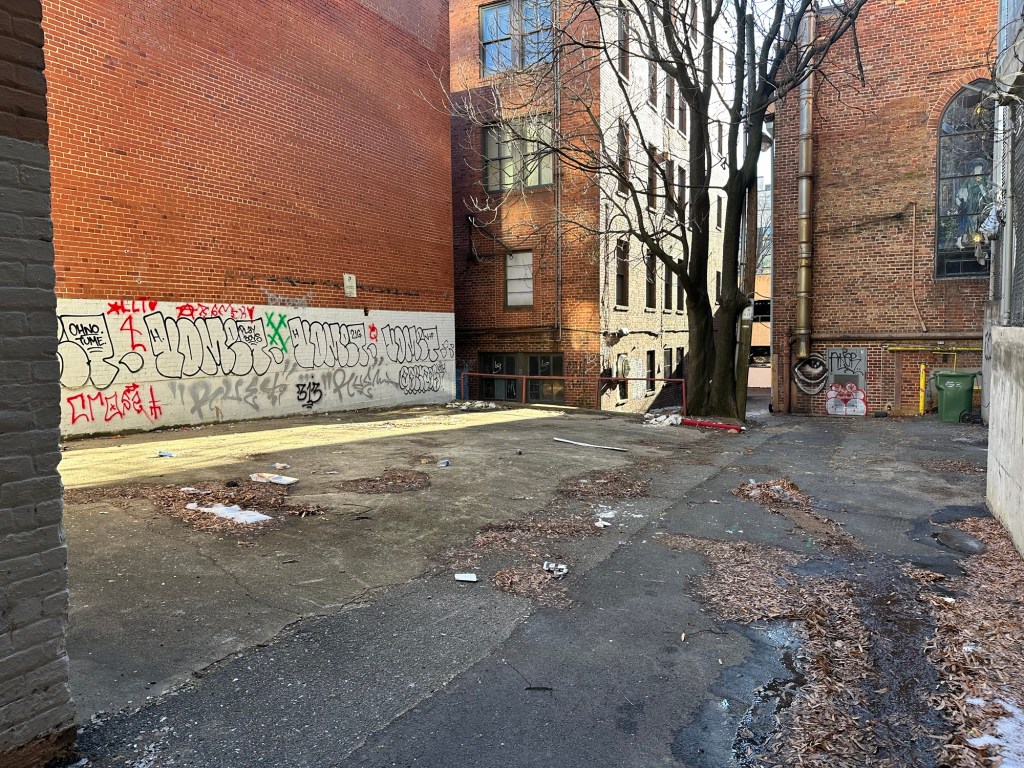
Here are two views of the actual space.
I am so in love with this idea. I had a similar vision for a space in Tyler many years ago and still believe in the potential of this sort of retrofit to bring new life and charm to cities. Whatever zoning process that’s required should be fast-tracked. Whatever the building around this space becomes (it’s currently being renovated), this should be a cafe or similar commercial space, with bistro lights, live music, and otherwise completely transformed into a beautiful and charming refuge in the middle of downtown Richmond.
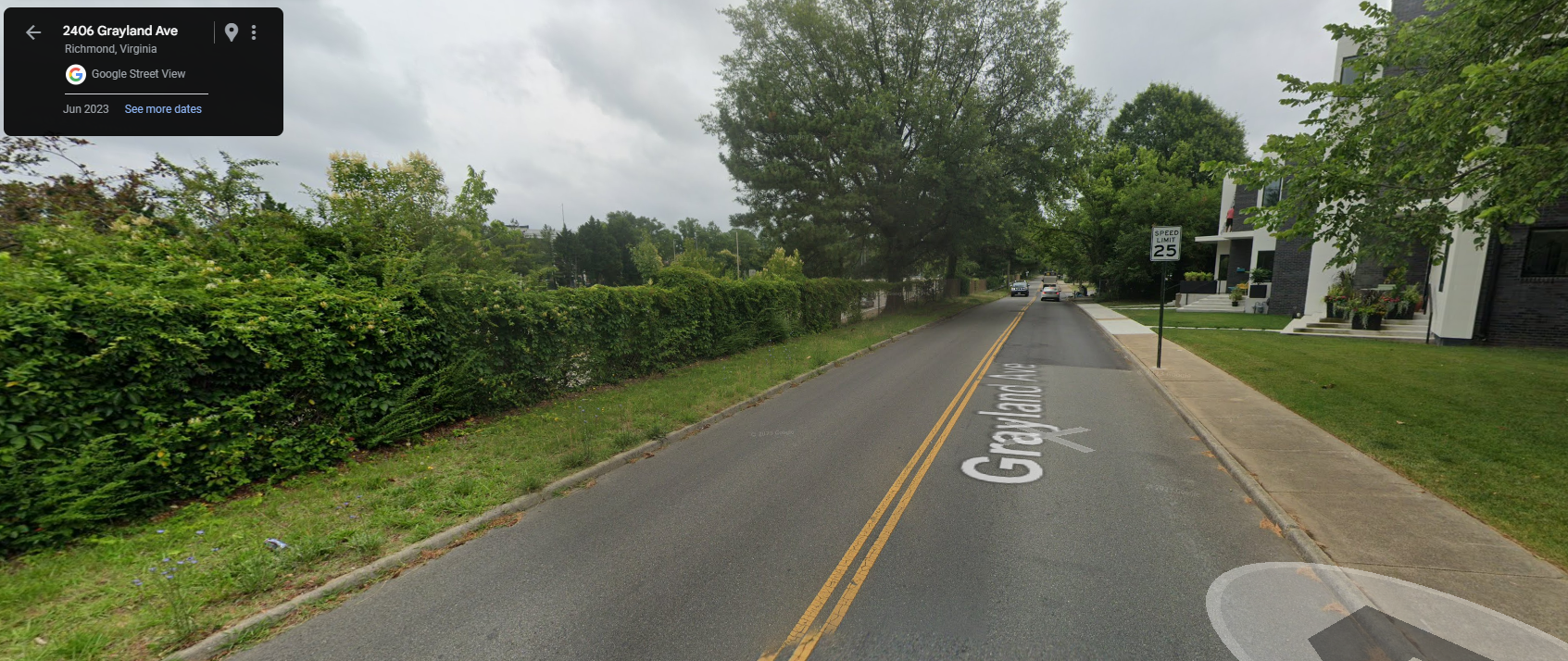
I was driving next to a stretch of I-195 in Richmond when I realized we are missing out on a huge opportunity: planting bamboo forests along our highways. Specifically I want to see bamboo in these little strips of grass in between the road and the fence or barrier to the highway, on the left side of Grayland Ave. shown below.
The first reason I would want to plan bamboo in these spaces is to create a natural barrier between the highway and the surrounding areas and the second would be to create an effective carbon sink on degraded and underutilized land.
Anyone who has ever walked through a bamboo forest knows intuitively that they are extremely quiet, but the noise-reduction has actually been studied and found to be effective comparable to solid noise barriers. Bamboo barriers create themselves and repair themselves so they are incredibly cost effective compared to concrete noise barrier solutions (the Berlin Wall of highway design). Bamboo forests are beautiful, certainly as beautiful as whatever invasive species there is growing in the space currently. Bamboo also grows tall enough to block the sight of highways from most passersby.
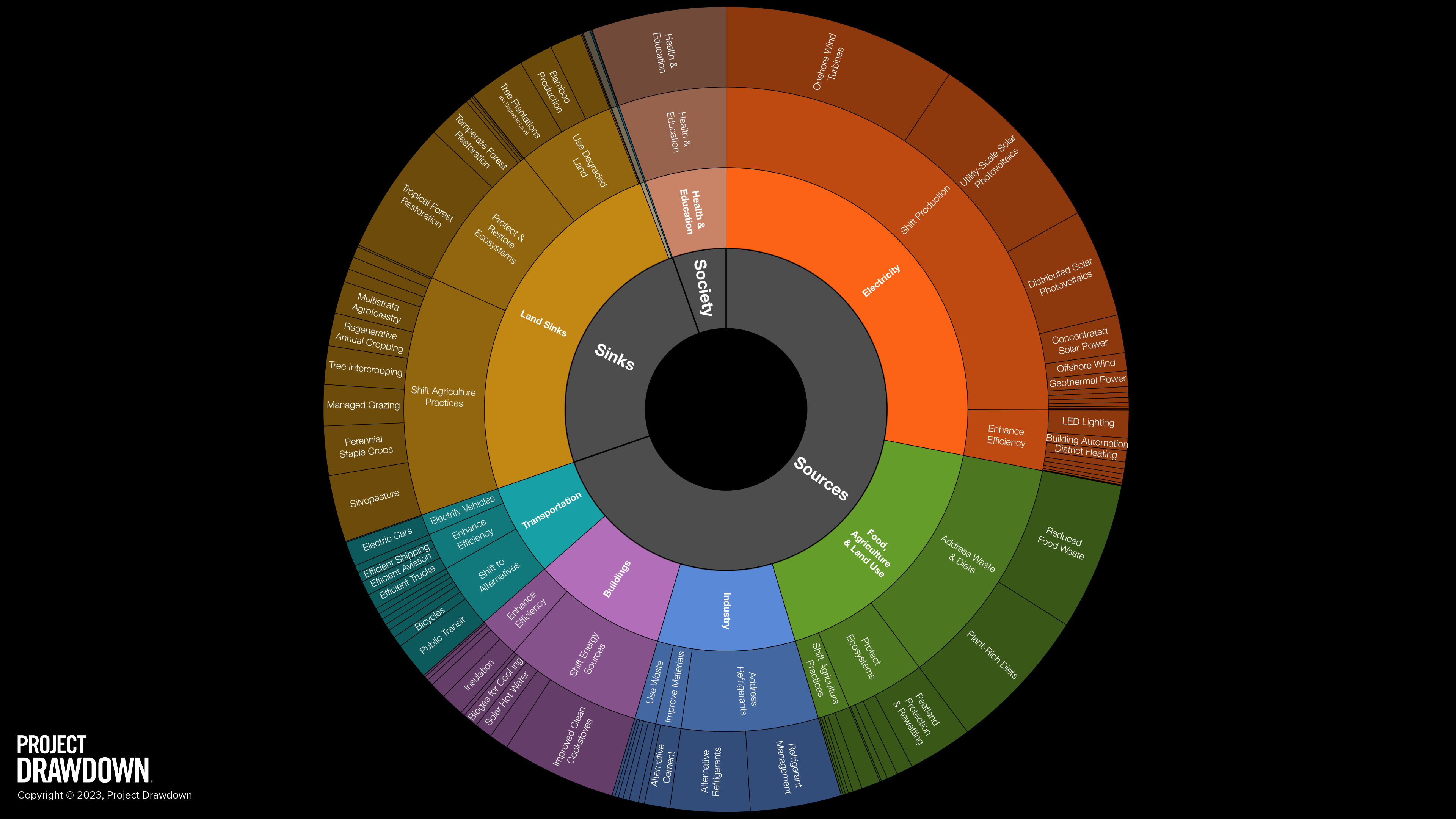
I’ve been thinking about bamboo as a carbon sink ever since I saw it specifically referenced on the Project Drawdown Roadmap where they calculated that the addition of bamboo forests could result in 7.70–19.60 gigatons of carbon dioxide sequestered by 2050. In the graphic below it is in the top left-hand quadrant on the use of degraded lands for carbon land sinks. I will not restate the entire Drawdown summary on “Bamboo Production,” but the summary for me is that it is extremely inexpensive and effective at long-term carbon sequestration.
Bamboo is often passed over because of how aggressively it spreads, but there are many ways to prevented unwanted growth. There are often strips of grass along highways that are already separated by concrete or asphalt that would prevent spread underground. If not, fairly low-cost barriers can be installed – the cost of these barriers may be less over a few years than the cost to companies contracted to mow these completely unloved areas of grass. According to Project Drawdown, there are also native North American bamboo varieties and varieties that do not run or flower which makes their spread unlikely and easy to manage. Years ago, while vising Echo in Southwest Florida I learned about clumping bamboo and have been interested in how we could encourage its use more widely. More information about Echo’s work with bamboo in this video: Bamboo’s Many Uses (filmed at ECHO in Ft. Myers). The fears around its spread are also not based in the reality of the current climate situation – are we really afraid of a fast-growing, zero cost, regenerative carbon sink?
Bamboo along highways is just the start. There are countless strips and triangles of land in cities that could be filled with beautiful, noise-reducing, sight-blocking, carbon sequestering bamboo. In particular I would like to cut sections along the perimeter of parking lots to be planted with bamboo. Combining bamboo with impermeable surface parking would have the added benefit of reducing water runoff into the combined storm-sewage system in cities like Richmond. Of course, bamboo is always the best or only solution. Often prairie grasses and native plantings can facilitate ground water recharge and sequester incredible amounts of carbon in their root systems underground. In terms of highway design, I do think bamboo is the best option for their combined benefits to the neighborhood and the climate.
Margaret Renkl is a regular contributer to the NYT opinion section who has made me sigh more than once. Her observations in the garden connect with me on so many levels, from the plants and insects that we share to the sense that things are not what they once were. As someone who has lived in both extreme corners of the South (Eastern Texas and Virginia) I always appreciate her references and storytelling. She writes in a Southern lament style as she finds beauty in nature as well as the death and decay below the surface. In a more practical way, the essay by Margaret Roach shares wisdom from the 85-acre Brooklyn Bridge Park. While Renkl mourns the loss of butterflies, Roach reminds me that while rural and suburban America are a toxic wasteland of pesticides, a new wave of natural meadow-style landscaping is turning cities into oases of natural beauty. Here are just some quotes and photos I enjoyed from each piece.
From Renkl, there is always beauty and death. She and I are living parallel lives and I’m so grateful that she writes because she helps me organize my own thoughts, she connects the ecosystem and helps me appreciate each part.
“How ragged we are now, dragging summer behind us like an old blanket we can’t set down. The homicidal heat of August has given way to the merely cruel heat of mid-September, but we are done with it even so. Everyone is cross, and not just the people.”
“And yet.
The mornings are a gift. Cool and damp, they feel like part of an entirely different ecosystem. If I’m poking around the garden early enough, I can spy all the darling bumblebee butts deep in the bells of balsam flowers where the bees have tucked themselves in for sleep.”
“The spent zinnias and coneflowers and black-eyed Susans provide plenty of seeds, and the beautyberries, arrowwood berries and pokeweed berries are ripe now, too.”
“Already the fall wildflowers are beginning to come into their own. The goldenrod throws its yellow plumes into the air; ironweed and asters purple the fields and roadsides; snakeroot blankets the forest understory; anise hyssop and elephant’s foot flowers call to the bees on the naturalized side of our yard. All of them feed the insects that feed the birds who need fuel for the migration, or for surviving the winter at home.”
“A basilica orb-weaver spider has built her cathedral outside our front door. Her web has been pummeled by rains again and again, but her pearly egg sacs, all strung together in a row, are safe. Every day I check them to be sure, and every day their mother watches me warily as I check.
She will guard them faithfully until she dies, and the last thing she will do is secure the guy wires they’ll need to guide them when they climb out of their sacs next spring.”
From Roach, practical wisdom and photos that make me dream of my next trip to New York.
“Rather than following the common practice of planting and transplanting in spring, for instance, she suggests shifting virtually all of that activity to autumn — and not cutting back most perennials as the season winds down.”
“But in just 11 years since the first section opened, the place has become a refuge and breeding ground for diverse and unexpected species. The state-threatened golden northern bumblebee (Bombus fervidus) can be seen happily collecting nectar on wild bergamot (Monarda fistulosa), while nearby, fluttering swarms of the common but colorful little pearl crescent (Phyciodes tharos) are delighted to find so much of their host plant, smooth aster (Symphyotrichum laeve), to savor.”
“More than 180 species of birds have been sighted in the park. And not just the mallards and herring gulls that you might expect on a waterfront, but swallows, woodpeckers and rare sparrows, as well as 31 species of warblers. An extremely rare painted bunting (Passerina ciris) spent two months in the park one winter.”
“The practice she adheres to is called ecological horticulture. It’s the polar opposite of the purely ornamental version, which is driven by asserting control of plants in the name of aesthetics.”
“Spring planting “gets in the way of our work, instead of complementing it,” Ms. McMackin said. And in the past four years, her crew has gradually phased it out. Next year, there will be no spring planting at Brooklyn Bridge Park, except for some tree species that resent fall root disturbance.
“When we do plant in spring, and then summer arrives, it can be such an extreme environment — hot, dry and windy, too,” she said, and those are hard conditions for plants trying to root in. With a fall planting schedule, the winter that follows is easier on them.”
“In May and June, instead of planting, we can get weeds while they’re still small,” Ms. McMackin said. “You can hoe rather than having to hand-pull — getting rid of things that can cause massive problems later, if you don’t.”
“At Brooklyn Bridge Park, the gardeners skip most of the traditional fall cutbacks and cleanup. That leaves plenty of seed that can self-sow, or be eaten by birds, and preserves an overwintering habitat in the leaf litter for arthropods. Except where mulch or compost is needed, the approach is hands-off.”
“We just had an endangered sedge pop up. And we had a state-threatened saltmarsh aster appear that we relocated to our salt marsh,” she said. “It’s amazing what happens when ‘Leave things alone as much as possible’ is part of your maintenance strategy.”
As a resident of Richmond for the past five years, I have had the privilege of living through an exciting and dynamic season of change. It seems that after about 60 years of condescension and loss, it’s becoming a good time to be an American city. It’s a good time to be Richmond.
So, with that in mind, I was a little surprised when I read three editorials recently published in the Richmond Times-Dispatch addressing the “issue” of the view of Richmond from the highway. As I read each article, I felt that importance had been placed, not on the city, but on the opinions of passersby. This editorial is a response to those articles and perhaps generations of similar articles that have come before them. I believe that before we have a conversation about Richmond, we need to have an understanding of how the city changed during the twentieth century and more importantly what changed about the way we talk about cities in general.
My undergraduate education on the urban crisis in America presented changes in the city as a process of politics, prejudice, and technological advancement. More recently, I have come to understand the urban crisis as a gradual shift in investment and perception that took the American city, a source of pride, and turned it into a mark of shame. Furthermore, I understand the urban crisis as a rhetorical war between old and new. The goal of the war, as with any, was to frame the other as “backward” and the self as “progressive.” While Richmond attempted to maintain dignity, new technologies seemed dissatisfied with older cities: You’re too compact, too dilapidated, too prone to riot and rot.
As each new suburb was developed it became yet another statement to the American people pointing toward the promise of new, more civilized places with room to roam and play. Within this promise there was also a clear distinction being made from the archaic, dark city where most Americans at the time resided. As with all major shifts, the new way of doing things had to work to undo the more traditional ways of life. Many believe that the post-war zeitgeist of modernization, on a national level, did much to shift popular opinion. But on a local level, citizens of the Richmond metro-region still had to prove to residents that there was a more abundant life to be lived on the other side of the city limits.
This was accomplished through a series of events: The celebrated opening of Willow Lawn Shopping Center (1956), the construction of the Richmond-Petersburg Turnpike (1959), the failure of plans for consolidation with Henrico (1967) and other semi-related moments along the way. Each of these also had their corollary effect on the life of the city exemplified by events such as the closing of Miller and Rhodes/Thalhimers, the destruction of urban neighborhoods, and the political isolation that conclusively trapped and humbled this once-proud American city.
As money and people continued to migrate to the suburbs, local officials turned their attention from annexation to urban renewal. “If we can’t have the suburbs,” I imagine them thinking, “we have to do something about this city.” But rather than invest in what already existed, they fixated on dreams of what could be. “We get it” they tried to say “and we’ll fix it,” just don’t move your family to the suburbs.
As Silver writes, the city then “embraced urban renewal with a sense of urgency unprecedented in Richmond … Consolidation would have afforded vast new areas for growth and would have enabled the city to continue its policy of neglect toward inner-city areas” (254). Now left to embrace the demands of reality, Richmond’s city fathers sold out and destroyed much that today would protected as historical. They were always looking to what the city could be rather than accepting the city as is.
To me, this moment of urban renewal was a sign that the suburbs had won the war. This was the point in the story where it was finally decided that new was in fact better than old: Look! Even the city hates the city. In the decades that followed the tumultuous 60s and 70s, much has been said of the potential of cities, but almost all of it with the understanding that cities have something to prove. To this day, the standard to which Americans hold their cities is strangely high while their commitment to funding urban institutions and infrastructure is remarkably low. As Kunstler might argue, this is because we are no longer a nation of citizens; we are a nation of consumers.
Additionally, it seems that many of us have a powerful aversion to cities because we’re still trapped by the negative stigma established all those years ago. While local boosters proclaim, “Richmond is a city of art and great food!” critics reply, “Parking lots! Potholes! Prostitutes!” And regardless of their merit, these conversations do little to change the paradigm.
In this sadly familiar conversation, the subject is always “the city.” The place that needs to change is the city. The place that we want to love is the city. But this is not the perspective of an insider. Instead, we need to recognize that this critique is one of suburban condescension. The suburbs are still trying to prove their worth and their legitimacy and they are still quick to do so by orienting themselves against the “corrupt” and ” inefficient” locality they are ashamed to call neighbor, but delighted to visit for a basketball game.
We cannot have a productive conversation about Richmond until we move past the negative stigma that outsiders have placed on the city and begin to see Richmond as good once again. We should welcome visitors to come and enjoy themselves in the city, but our ultimate concern must be with the needs and desires of existing residents. Developments in Richmond should be for the city, not at the city’s expense, because that is what we can sustain and appreciate. And no longer should we consider developments for someone else to enjoy.
There is nothing more creative than adaptive reuse. In a world of earth movers and concrete slabs, redeveloping old buildings has become more rare than starting from scratch. Adaptive reuse forces creative builders to work in an existing space and create something that honors the history of the space while also recreates a new use for old bricks.
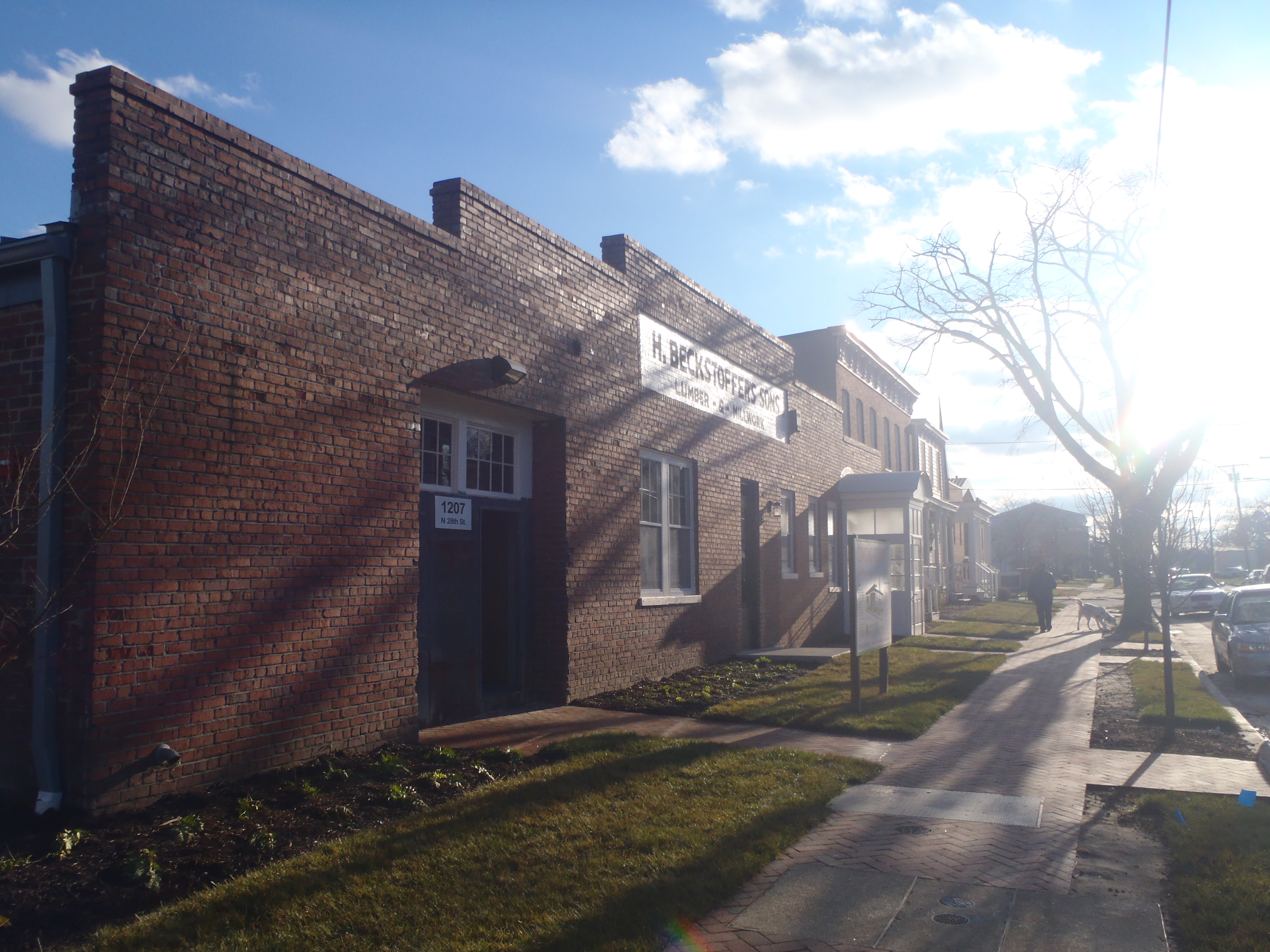
My favorite current adaptive reuse project in Richmond is the Live/Work Lofts at Beckstoffer’s Mill. I like this project because it’s compact (one city block), extremely well-done (down to the brick sidewalks), and it’s in the middle of a neighborhood. The old wood mill has been reimagined and resurrected for twenty-first century use. Yay for creativity and hard work in Church Hill.
This is a part of my, Cataloguing Richmond series on my RVA page.
Considering the trauma of urban destruction abroad, it’s not altogether surprising if the American city lost its ethos in the decades following WWII. While our cities were physically spared, our citizens may have lost faith in places that could now be so easily destroyed. In a matter of minutes, cities that were once homes became memories and photographs. While foreign nations surveyed the damage and made plans to rebuild, our nation realized that social damage was more difficult to restore. In this environment, such an urban rebirth would not suffice.
In contrast to the the restoration abroad, Americans returned home to find their cities inadequate to satisfy the need for privacy and control that accompanied post-war life. In a state of collective PTSD, upwardly mobile Americans fell into consumerist mania searching to restore the peace that had been lost during those war years. The dense urban spaces — those which had been so easily uprooted abroad — could no longer be trusted at home. As the banner photograph of this blog implies, the American city would soon be destroyed as well. Not as a destruction, but as a progression toward the better life many believed they would find at the end of the highway.
Sixty-six years later, many of us find ourselves still hopelessly desiring stability, but unable to remember the traditions and pride that once connected us to our cities. We also seem to carry an unspoken longing for that time when cities could be trusted and investment sustained. Uprooted and displaced, we move as much as the walls of our plastic cities: completely worthless to human memory and love.
In this third or fourth generation removed, I seem to notice that we are finally beginning to settle back into each other’s lives and our oldest spaces. We may have a very hard time excavating what was lost in the post-war mania, but it will be worth it, vale la pena.
Restoring trust in a city, like everything else, takes time.
“I just worry,” my dad told me one day this summer, “that there won’t be enough Shriners in the future to maintain hospitals like Scottish Rite (Hospital, Dallas).” “Well,” I responded, “why don’t you become a Shriner?”
Growing up, I never would have thought about fraternal societies. To be honest, Barney Flintstone’s membership in the Loyal Order of Water Buffaloes was the closest I ever came to even knowing they existed. Then I went to college, joined a fraternity, and never looked back … until now. I graduated in May and in the last few months, fraternal societies for grown men have started to make a lot more sense. I think it was when people started doing this weird thing — calling me a man instead of a guy — that I started to wonder what I was getting myself into. Isn’t being a man all about being lonely and depressed? Work all day then come home and sit in your house? Robert Putnam’s book Bowling Alone makes a strong case that we’re living more of our lives without each other. As a result, it doesn’t feel like there’s any benefit to this whole “guy-to-man” switch … just more responsibility. There’s nothing cool waiting for me on the other side. But in the context of our nation’s history, that wasn’t always the case. There was an era of the American city when the fabric of society was dense with organizations and groups that carried and supported you through all the stages of life.
Douglass Rae summarized this era of ‘urbanism’ in this way:
“All or virtually all of the people who were assembled by these organizations — whether for religious or a fraternal lodge meeting or a sporting contest — were members of locally grounded communities. And the acts of assembly and association almost certainly deepened and enriched participants sense of loyalty to and identity with place.” Rae, City: Urbanism and its end (2003).
Rae’s research focussed on the city of New Haven, Connecticut and the 100-year deterioration of urbanism. In his research, he documents how each city block in New Haven was once a thriving microcosm of society. Middle-class men and women were usually a part of several societies in the city for different purposes including fraternities, sports teams, and social clubs. It’s wasn’t easy life in 1900, but it was lived together.
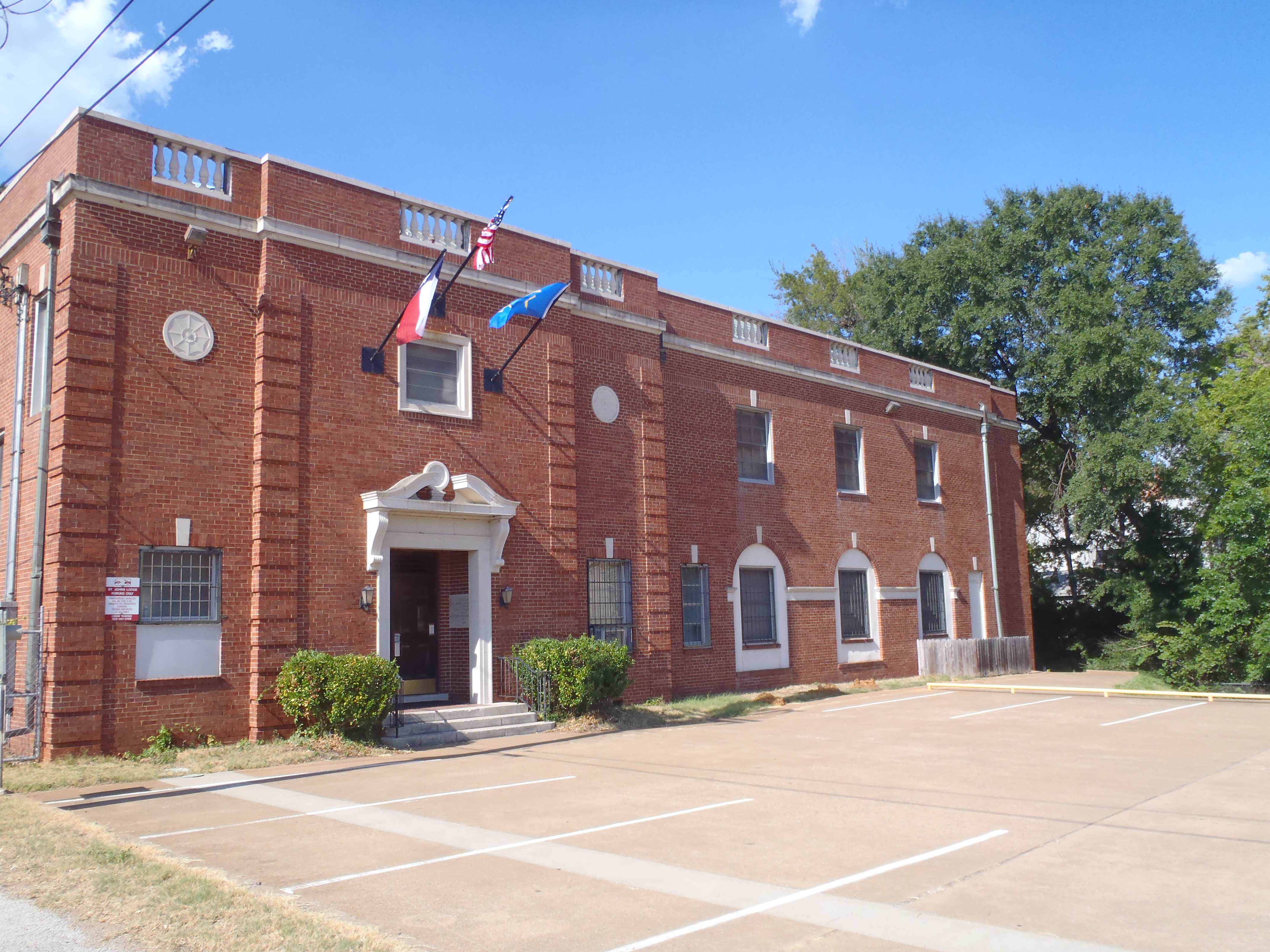
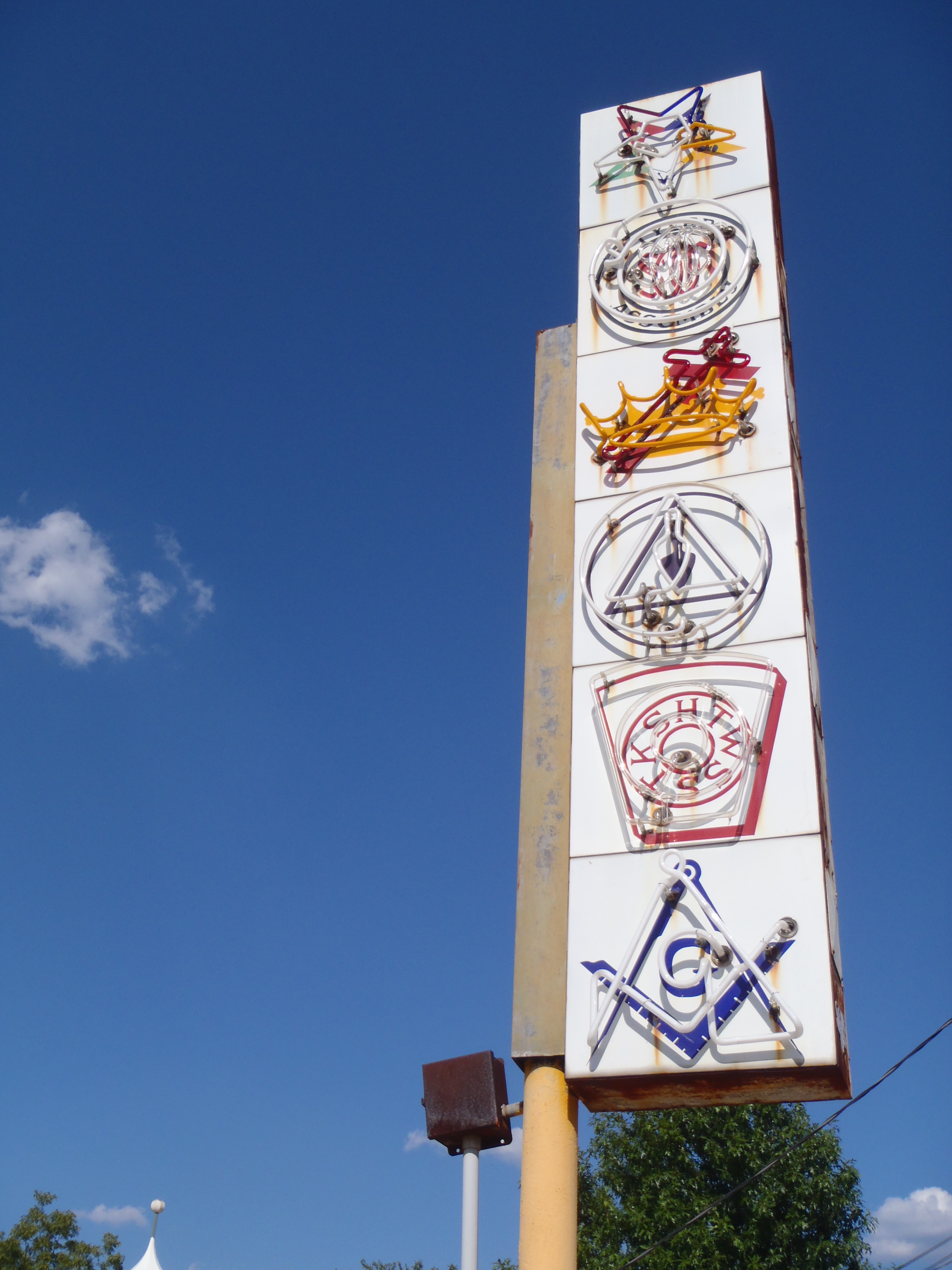
Today, things have changed. The America of 1900 no longer exists. But what I love about cities is that the buildings in our cities (the ones that survived) are the constructed monuments to our past. Tyler, TX is no exception. While they don’t hold the same place of prominence in the region, there are still buildings in Tyler that harken to an older era. The Masonic Lodge (pictured above), built in 1932 is the most striking downtown example that is still in use. I’ve driven by this building numerous times, but never thought it was special. Today, I almost felt like someone was going to come out and kidnap me for taking a photo of their building. The awesome neon sign (left) on the street is also worth noting … I don’t recognize some of the symbols, but I’m sure they all mean something to the men involved. The pentagram at the top looks slightly demonic, but I’d still think it was cool if my dad went to this building for a meeting once a week.
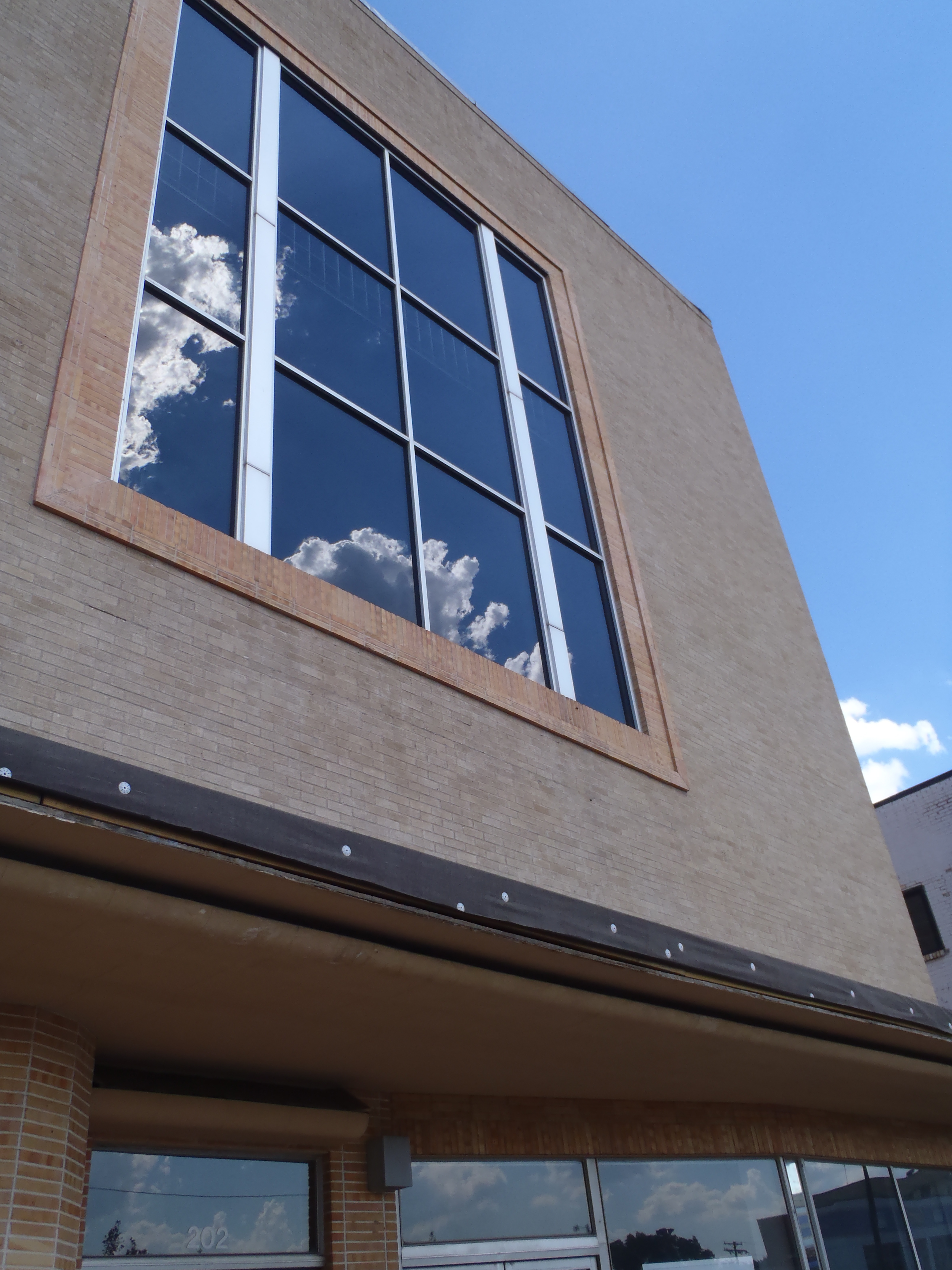
Other buildings in Tyler are no longer being used for their original purposes, but still bear the markings of early twentieth-century urbanism. The old Elk Lodge is one such building. I believe there is still a group of Elks in Tyler, but now they meet on the edge of the city in a newer lodge. It’s kind of a shame they moved, but I’m partially glad they did because the building is amazing and I got to walk through it today (without being properly initiated). It’s currently being renovated by Ron Mabry of Tyler for events in the city. I believe All Saints Episcopal is having a dance later on in the year. I hope that at least one high school student walking by notices the plaque on the building that states the founding purpose of the building: “Tyler Lodge No. 215, B. P. O. Elks, M. E. Danbom, Exalted Ruler.” The people on this plaque cared enough about each other to build a building where they could meet, talk about life, celebrate and mourn.
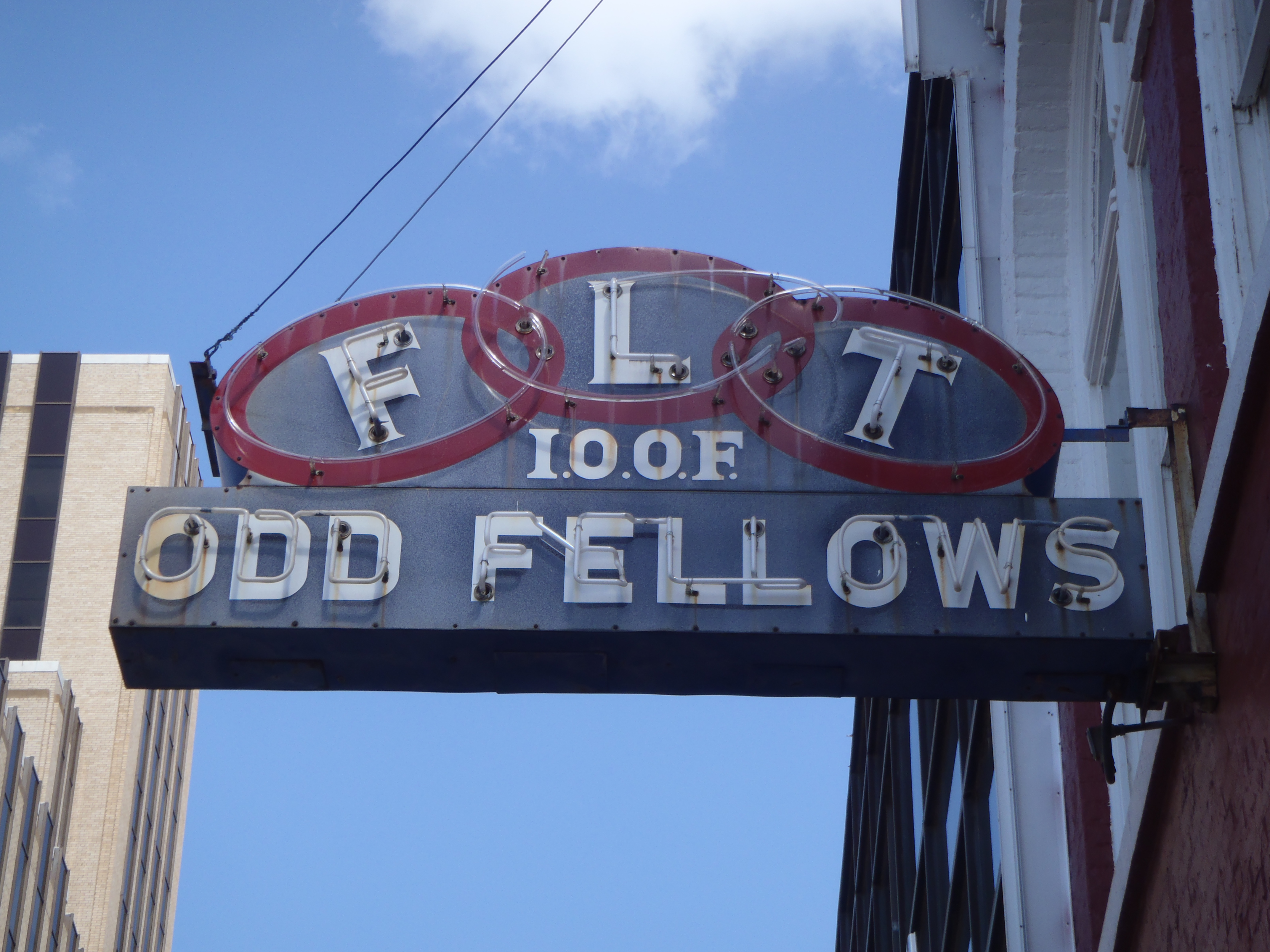
Only the oldest parts of our nation harbor these artifacts of the American past. It is always good to remember where we came from because it gives us a context for where we are. Plenty of people today are talking about why guys aren’t growing up, etc, but I don’t think they ever ask the question, “What’s waiting on the other side?” Yes, traditions are cumbersome and (quite necessarily) antiquated, but even in this postmodern society there is utility in having a structure to stand up under. There is a beauty in being told how to act. So don’t mock the Oddfellows, Lions, Masons, or Shriners. The men involved in these organizations are engaging in a tradition of American civil society that was once a grand element of this American life. Today, it is mostly just plaques on buildings … and a memory of how life could be.
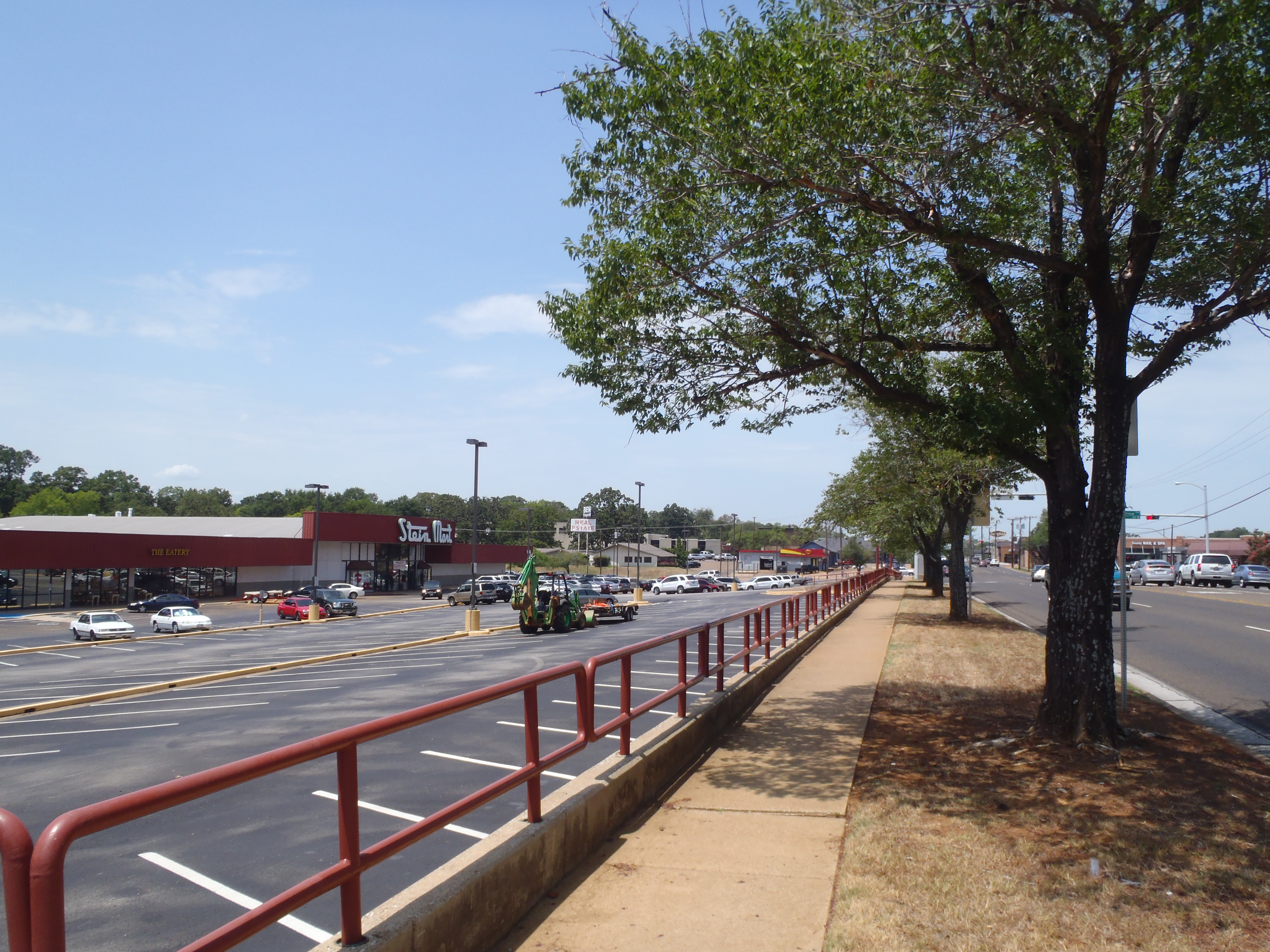
Here’s the deal: I want downtown to be cool, but I think we need more than one cool place. The historical buildings and “monuments” on the square are worth saving, but they shouldn’t have a monopoly on dense urban development in Tyler. I’m convinced that we can improve downtown and create more high-density developments at the same time. Most importantly, if we connect them to each other, their synergy will have far more positive social and economic impact than they could on their own.
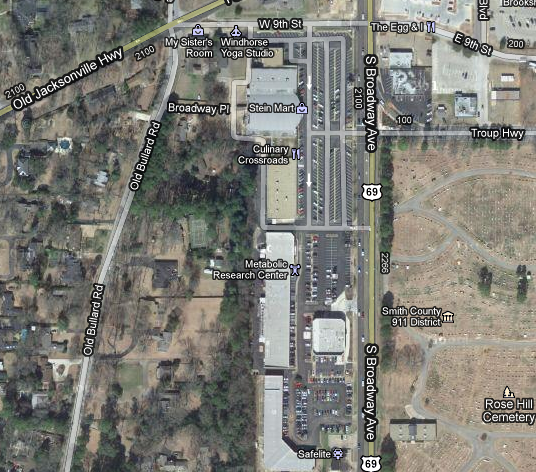
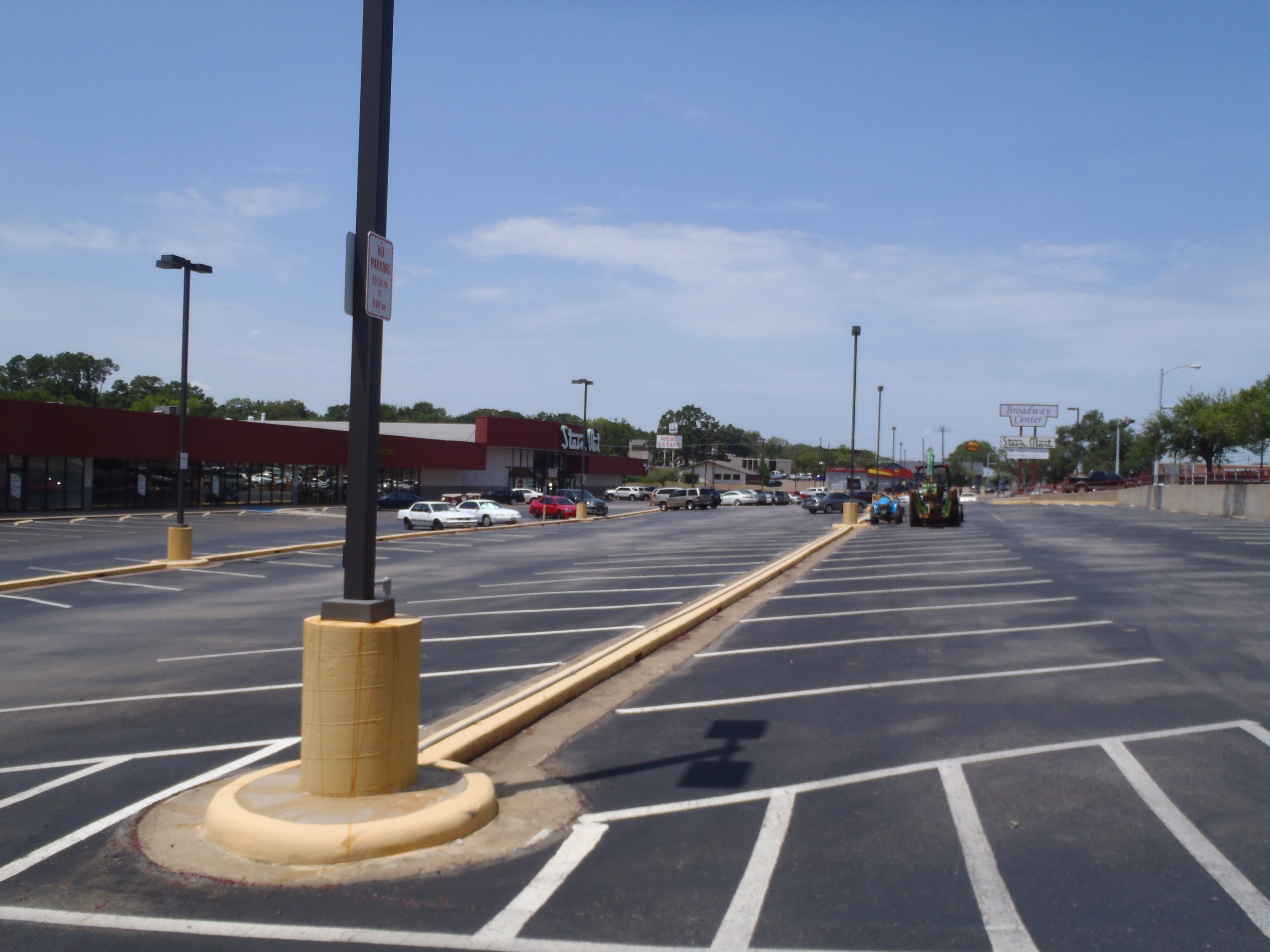
First stop: Broadway Center. Once we have finished building The Complete Loop, we should look to Broadway for the next great artery of development in Tyler. But, instead of the constant retail strip malls and big boxes that you see in South Tyler, this section of Broadway will augment the existing historic neighborhoods with new, high-density developments. Like two weights on the end of a barbell, Downtown and the redeveloped Bergfeld Center will anchor this region. See the difference? Instead of constant retail strip, we will concentrate businesses in two high-density places that will are in close proximity to valuable real estate. It’s better 🙂
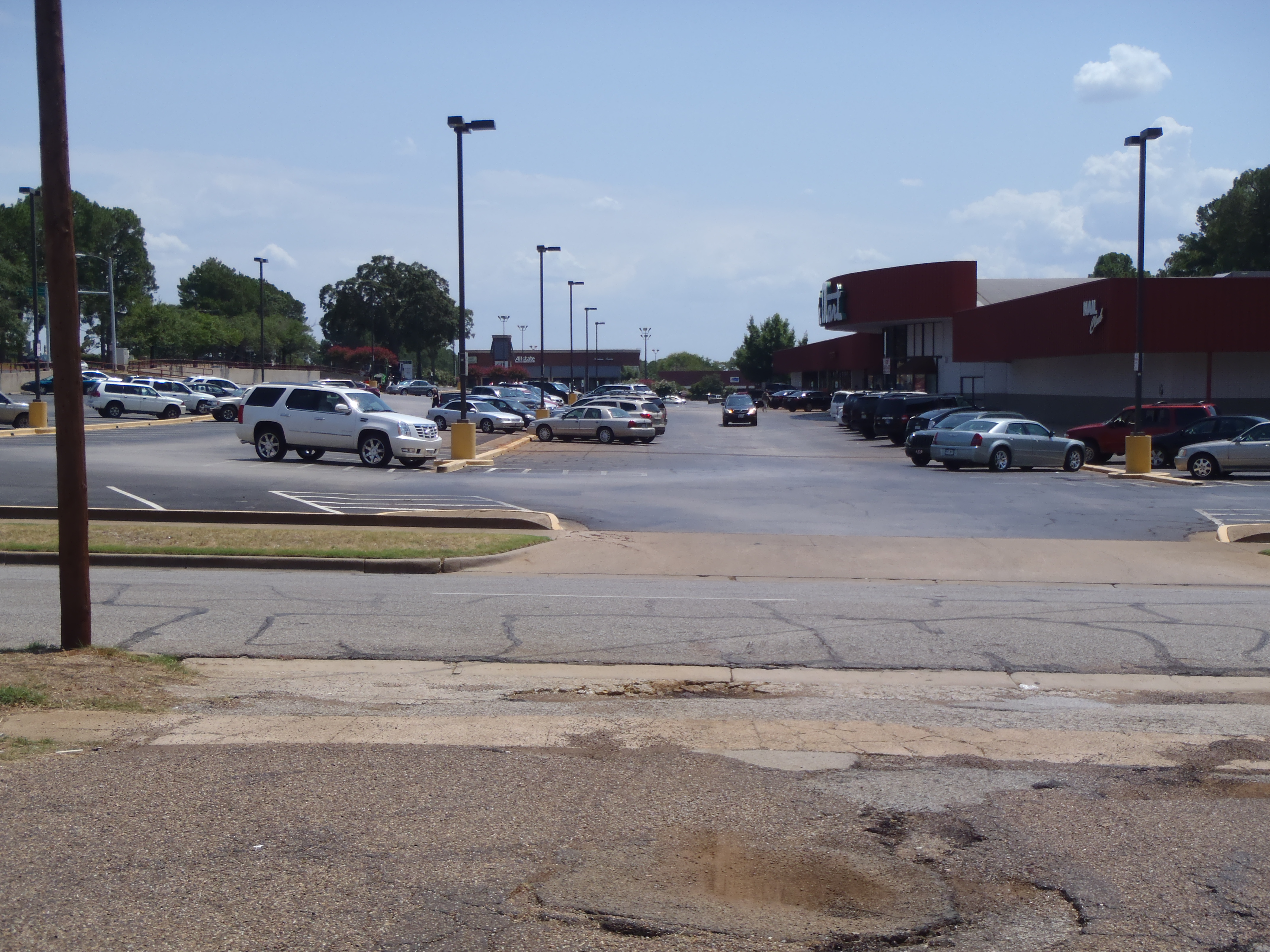
Rule #1: Every parking lot in this section has potential for development. It’s a pretty basic rule, but necessary. Building on parking lots has the capacity to transform ugly/boring/typical spaces into unique and attractive spaces. We also don’t often don’t even realize how incredibly big these parking lots are. We just get used to them so we don’t “see” them any more. I know, people have to park somewhere, but we also deserve to have a beautiful city, right? Let’s find a way to do both.
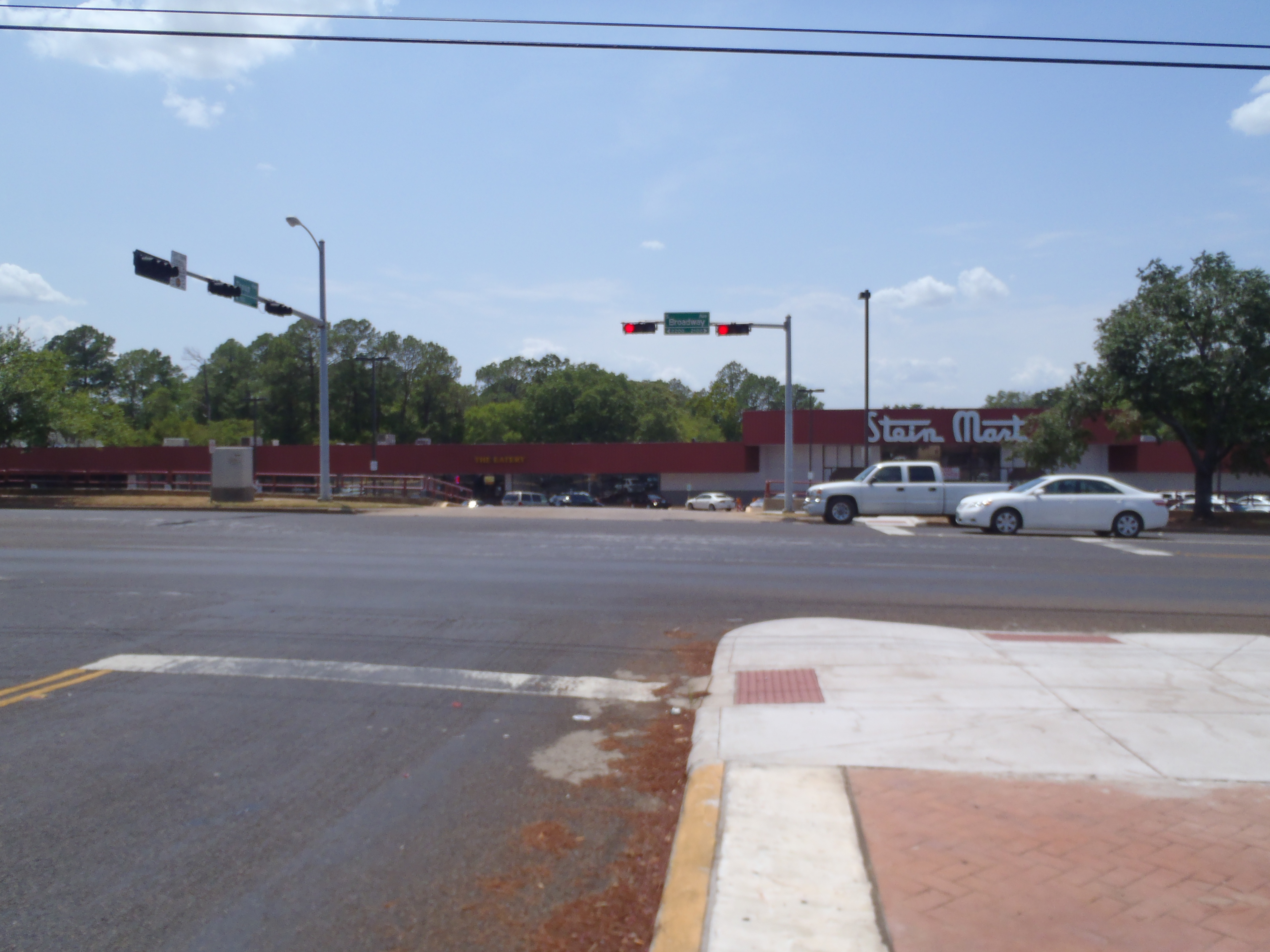
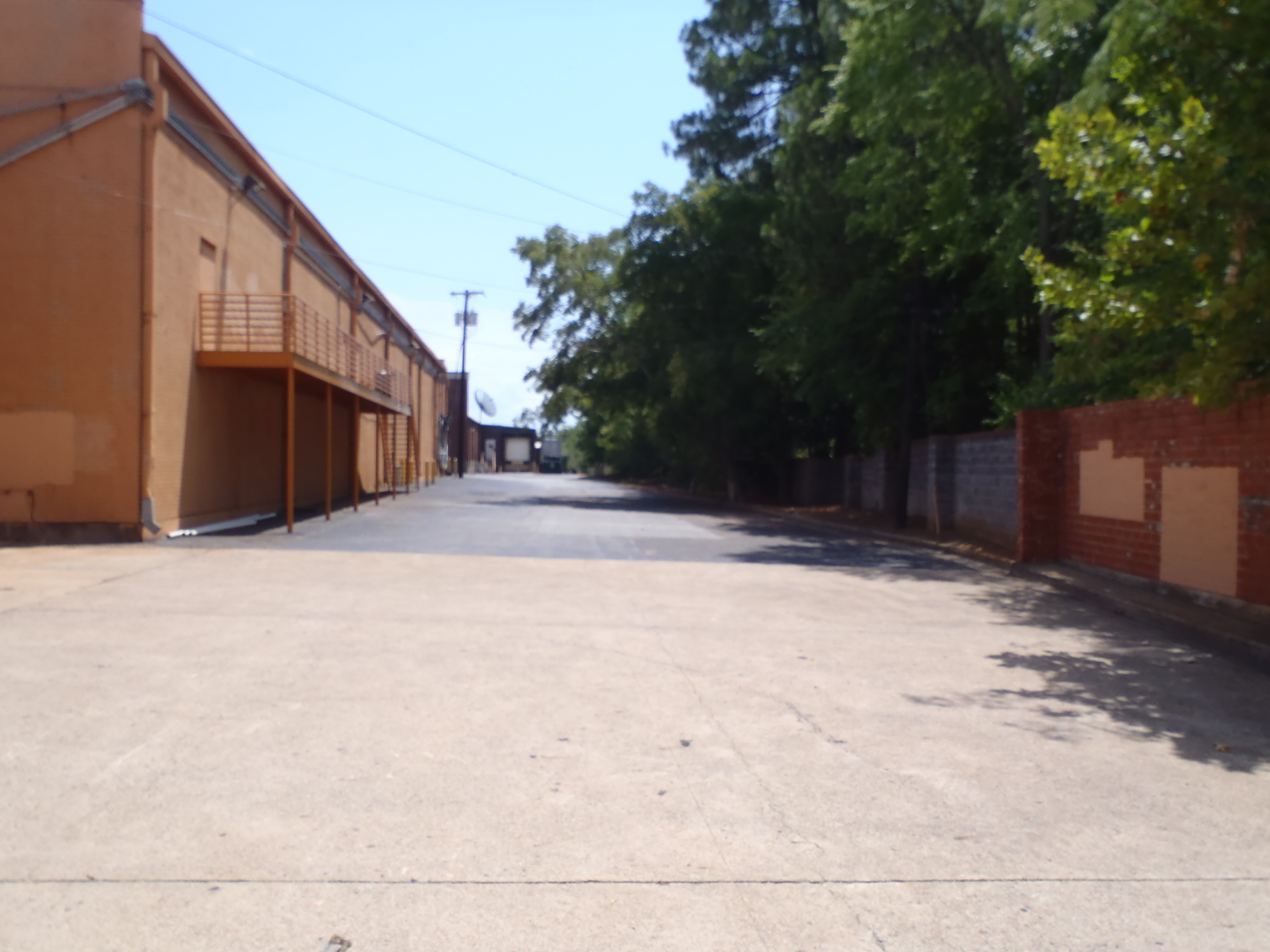
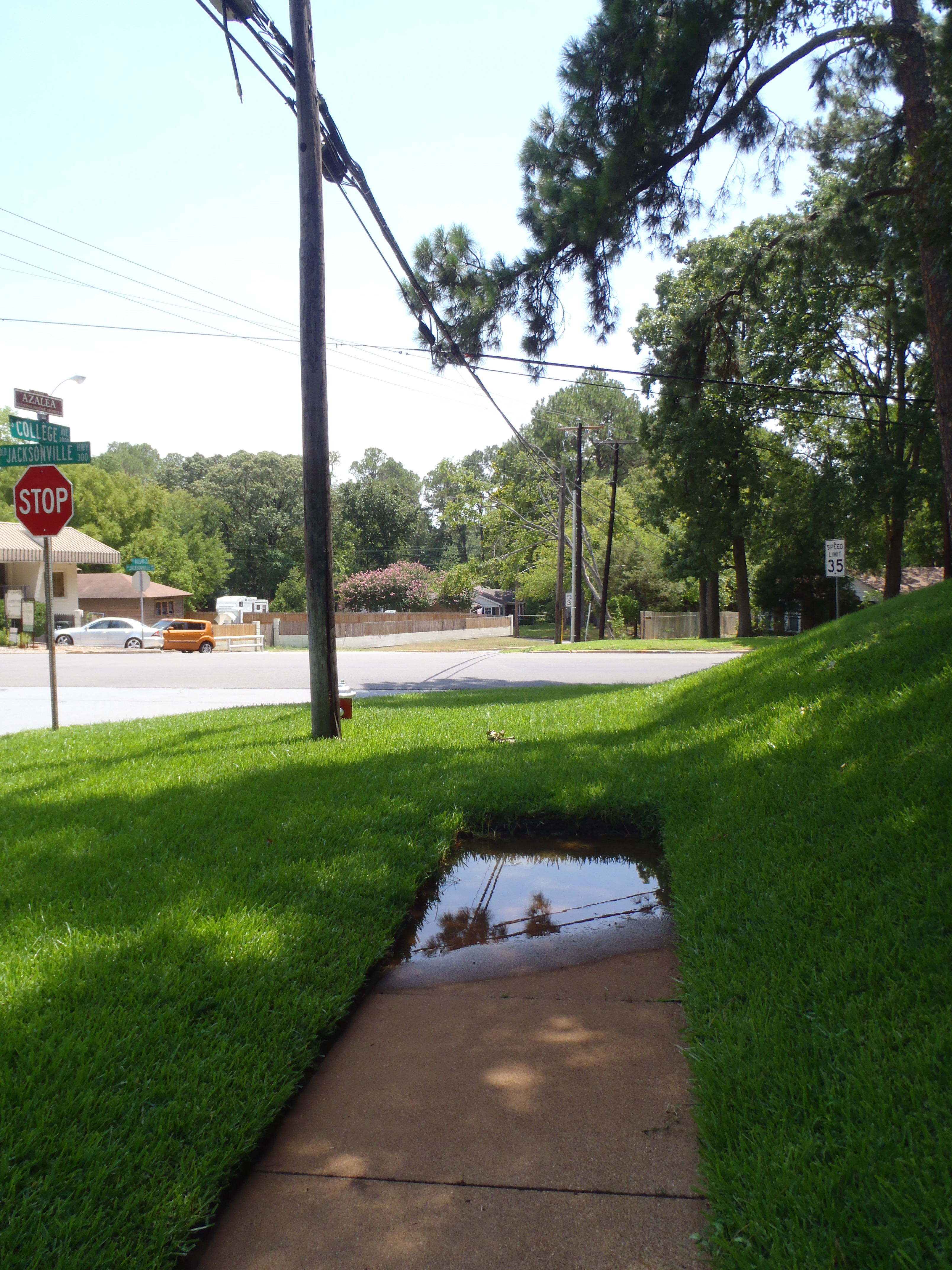
Rule #2: Reconnect the roads and the complete the grid. More roads means more access and more retail space. In regard to the issue of parking, it also means more on-street parking. If we connect Troup Highway (left) through what is now a parking lot and Stein Mart, it would meen a straight shot to Old Bullard and plenty of places to spend money. Additionally, the connectivity would invite residents of the nearby neighborhoods to visit the new shops, parks and restaurants on their morning walk. According to a recent traffic study, 30,000 cars per day drive by this spot on Broadway — Let’s give them more reason to stop. Also, in order to extend the grid, it would be great to build two new roads through this development in front of (to the right) and behind (left) what is now Stein Mart. This will complete the grid and create city blocks for more dense, protected urban development. Think less people would come? Think again. More people are likely to shop and spend their time in compact, beautiful spaces. These developments are essentially the free-market “one-stop-shop” developments that incorporate a multitude of uses into previously unloved space.
Rule #3: Build to the street on street level. This is important: Don’t pop it up with a “sporty” flight of stairs, don’t put parking in front, and do keep the street trees as a buffer. If there must be parking, put it on the inside of the development. The point is to make the development itself the advertisement for the development. Currently, with a football field of asphalt infront of the strip mall, you have to put a sign out front informing people exactly what it is. With the building built to the road, they will know what it is and they will appreciate the good urbanism.
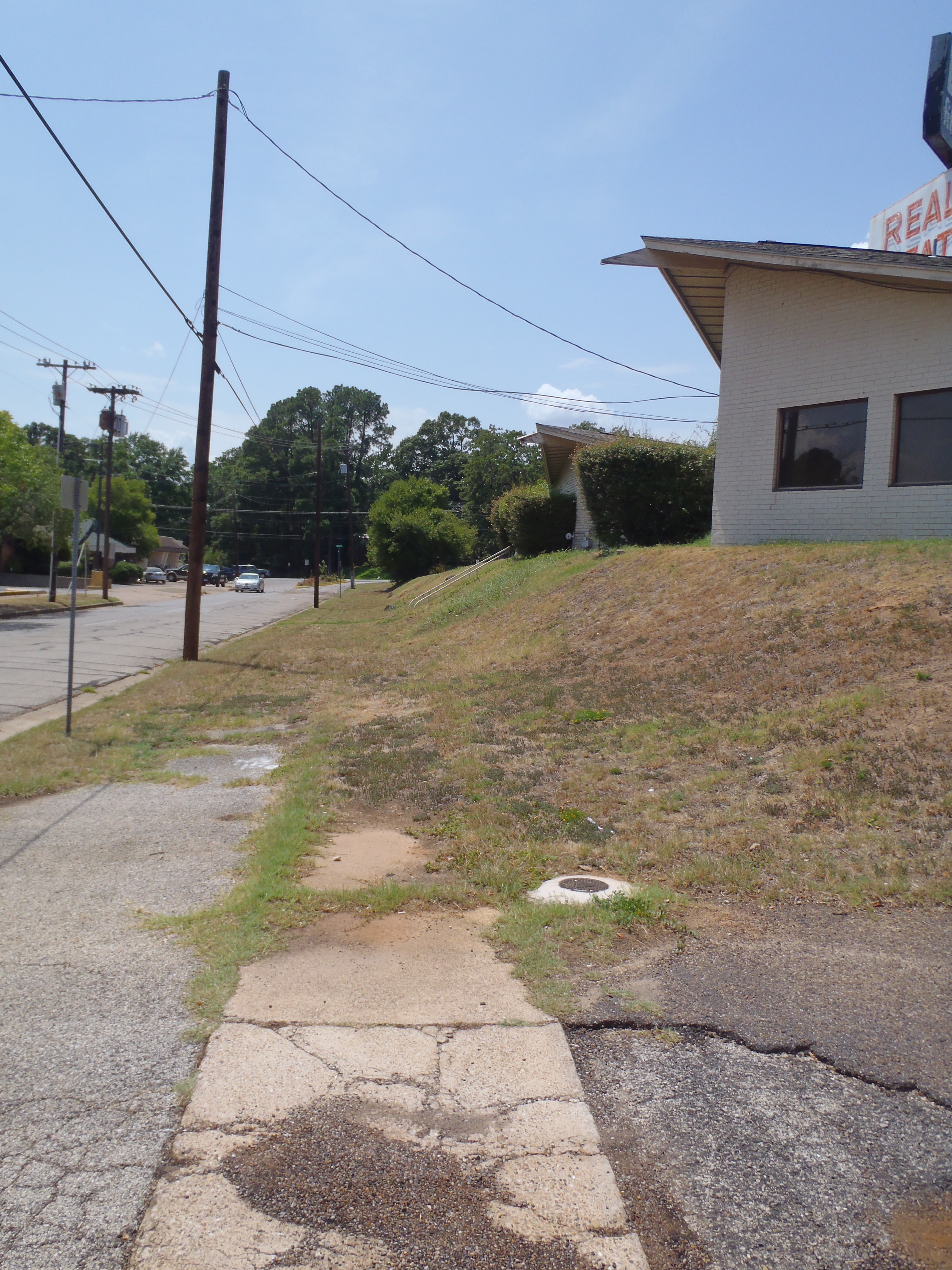
Rule #4: Finally, of course, make it walkable and bikeable. According to the recent Walk Score report, the most walkable cities in America are, as always, also the coolest cities in America. Tyler was not on the list. Many times when I walk in Tyler I have this feeling like I don’t belong. Today was no different … as I was walking down Old Bullard toward this development the sidewalk ended. There aren’t crosswalks across Old Jacksonville or Broadway and there isn’t a sidewalk along Ninth St. That’s just not acceptable … and more importantly not welcoming. With a little public investment, this could be a completely accessible and welcoming area for everyone.
So that’s the newest node! I’m gradually “Connecting the Dots” in Tyler and hoping one day someone will take my ideas and make lots of money with them.
Check out my other Tyler projects at my Tyler, TX page.
Right now, all I can think about is Creative Placemaking.
My friend Anne Tyler just told me about the term which she first encountered this summer during an internship in DC. She’s working at the National Endowment for the Arts (don’t throw stones) as a part of their newly created “Our Town” grant program. On July 12, 2011, the NEA posted a Press Release announcing the first round of grants totalling $6.5M. Through this program, the NEA will fund 51 communities that have a desire to reinvision neglected spaces for the purpose of encouraging creative people and collaborative culture. According to the Web site,
“Through Our Town … the National Endowment for the Arts will provide a limited number of grants, ranging from $25,000 to $250,000, for creative placemaking projects that contribute toward the livability of communities and help transform them into lively, beautiful, and sustainable places with the arts at their core.”
The idea is basically this: If you are a city, you want to be “creating” rather than “consuming.” In other words, you want to be the place that people look to for the next big idea rather than simply using old ideas from elsewhere. In order to be a city that creates, you must have a creative culture and places that attract and encourage creative people. If you do not have these places in your city, you will find yourself buying rather than producing ideas. Creative people who do not feel engaged will move to another place where they feel welcome. The creativity brain drain.
So how do you keep and attract young, creative talent?
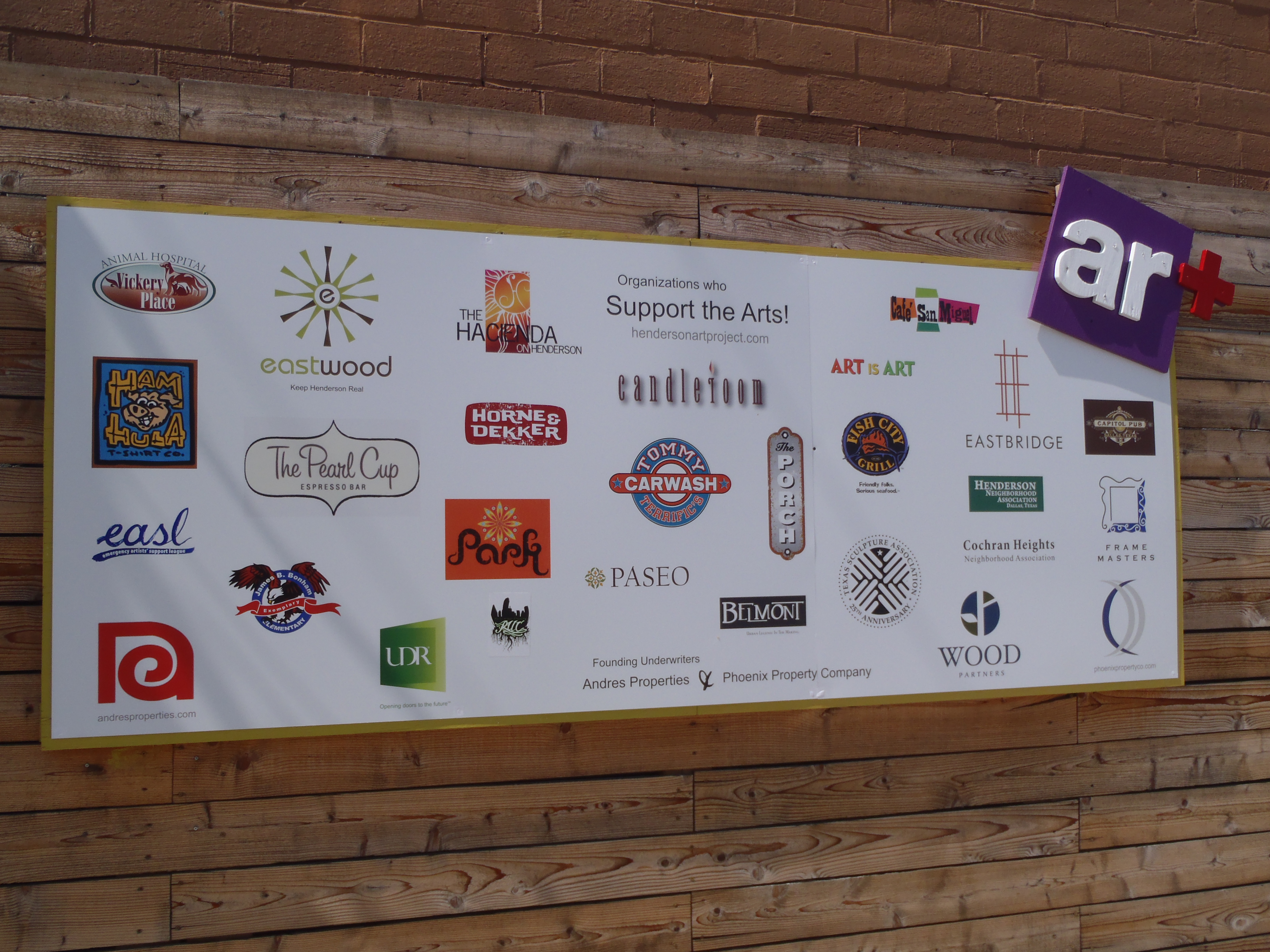
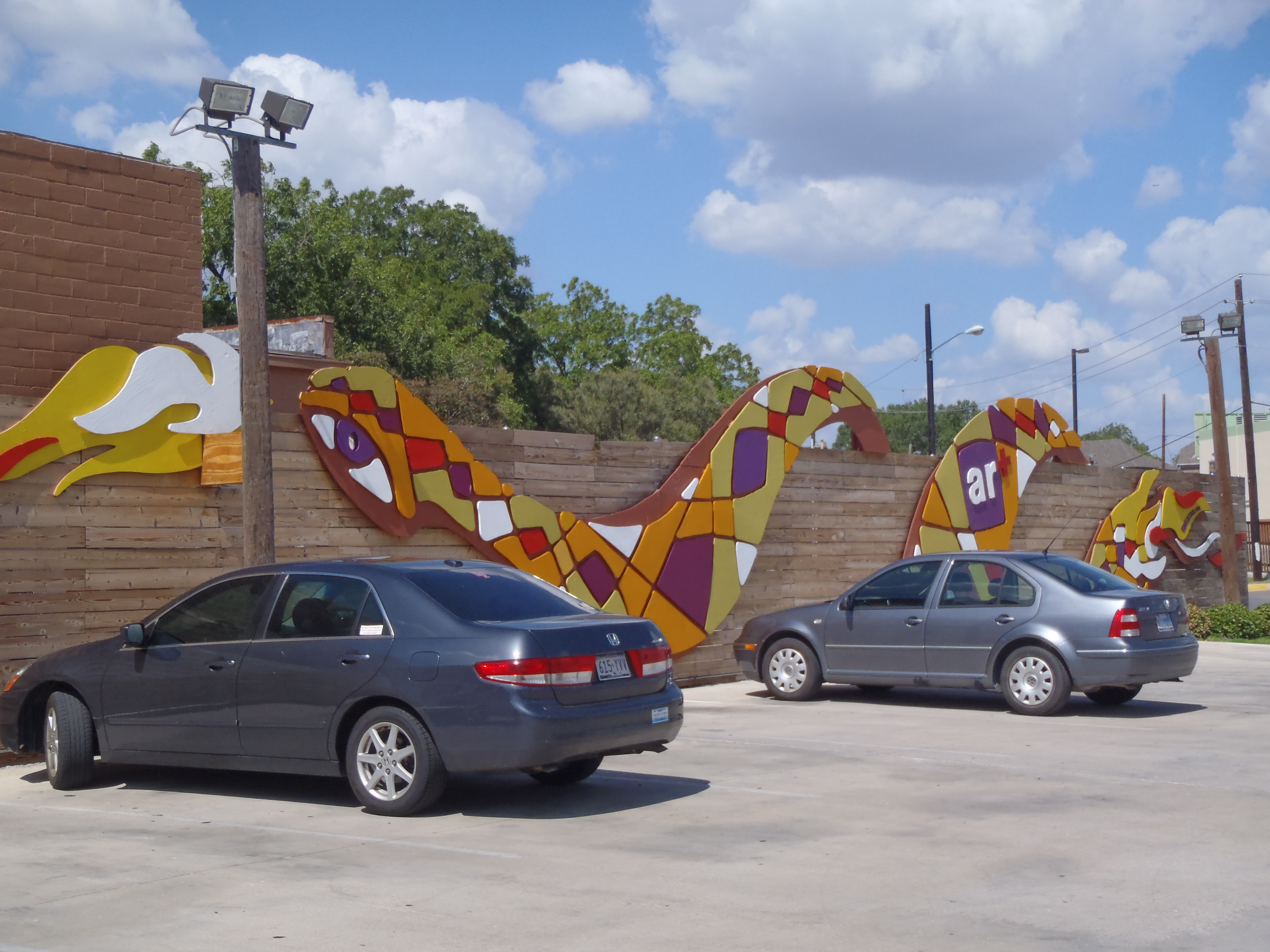
I drove to Dallas to find an example: The Knox-Henderson neighborhood. Many Texas would consider Knox-Henderson a gayborhood (rightly so), but as my friend Price always says, “Hey, they make nice things!” Indeed. The image to the right is of a sign on Henderson Ave. that lists the local businesses that support the arts in the neighborhood. When I saw this sign, I realized I had arrived. The Pearl Cup, my coffee destination, was one of the businesses listed that had contributed to the Henderson Art Project, a collaboration between local businesses and a larger property company. On the same wall, there is a huge flame/dragon/snake installation (pictured left) that takes up about half of the entire length. You can’t miss it … it’s huge. This and several other examples of public art (Included in the Picasa album at the end) are an example of what can happen when businesses realize the economic and cultural value of Creative Placemaking. The public art is a message to creative people: You will thrive here.
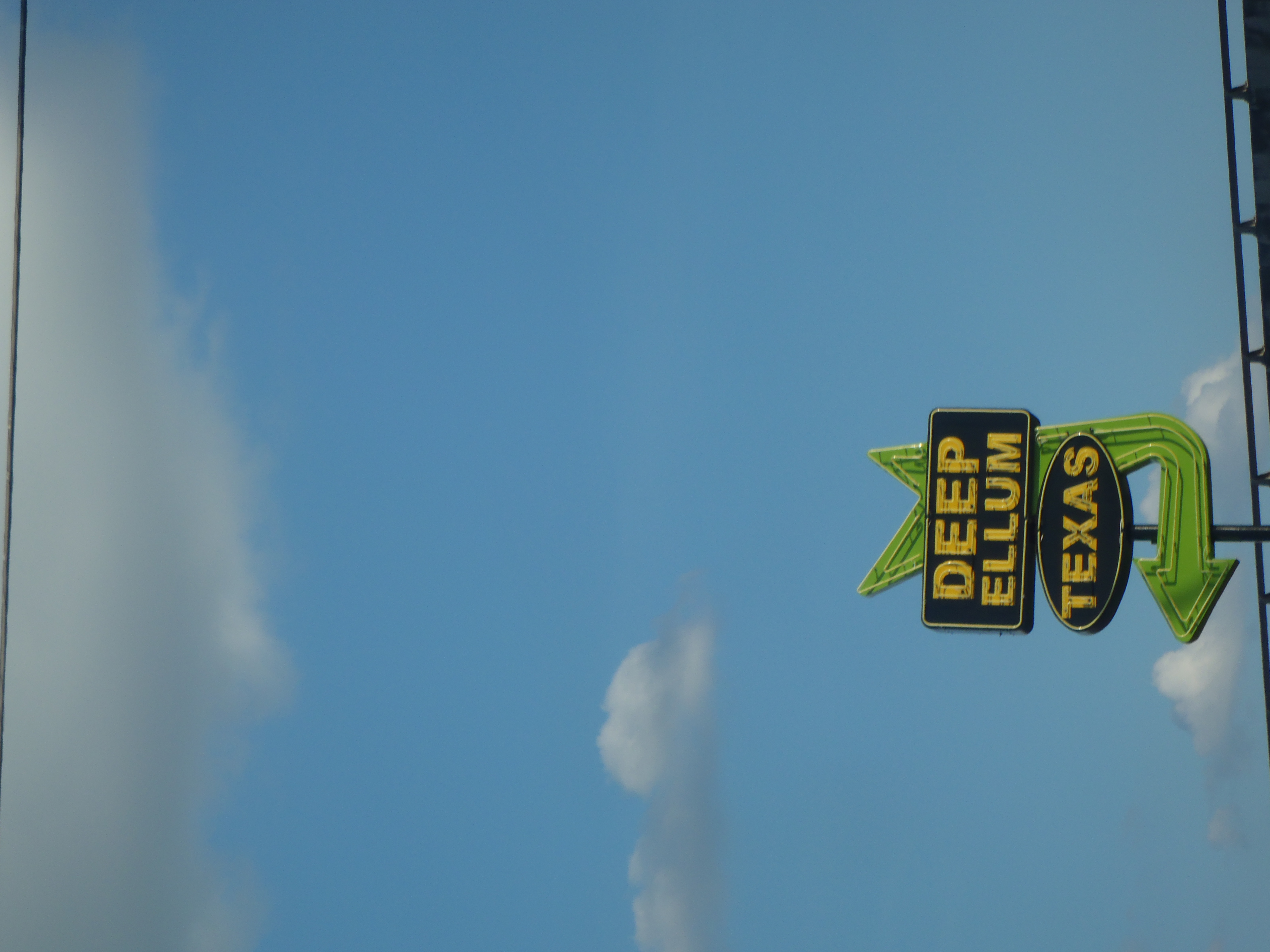
My second example of Creative Placemaking is slightly more dramatic and significantly more cool. I first visited Deep Ellum for a concert when I was a junior in high school. It wasn’t until last week that I went back. Ladies and gentlemen, Deep Ellum is the coolest neighborhood around. It kicks Uptown in the butt and gives Victory Park the finger while doing a wheelie down Main St. The reason why I had to include it as an example in this post is for two reasons: The artisan culture in Deep Ellum feels significantly more organic than in Knox-Henderson and the art itself is displayed on a far grander scale. The murals are the length of entire city blocks (see banner photo), the sculptures are often ten times the size of human scale and the art in general is prolific.
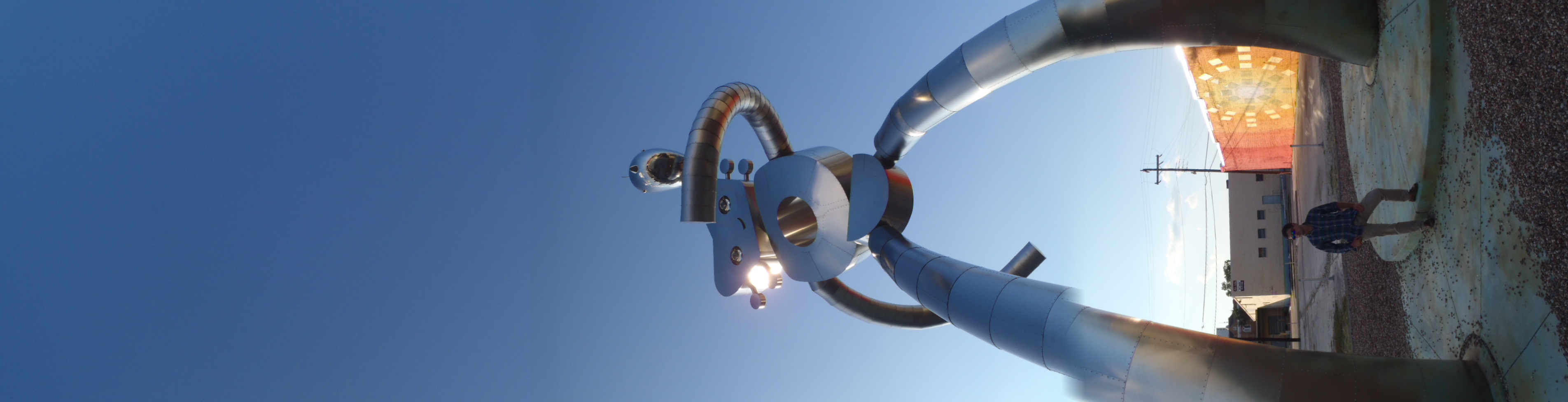
You can’t walk anywhere without seeing something that someone has improved with their imagination. The place feels very engaged. One of the best examples of public art in this neighborhood are the robot sculptures (pictured right) scattered around. They are huge, shiny and very unassuming. There’s no sign that says, “Look at what we did! We’re creative people!” They’re just there … waiting for people to stroll beside them or for an urbanist to take photos and blog about them. Of course, like all cool places, there are people that say Deep Ellum is DANGEROUS. According to the Dallas interactive crime statistics, there are more crimes here then in some places, but not significantly more. Regardless, my conviction is that crime does not get better when upstanding citizens move out of these neighborhoods. Cool places need cool people. In turn, cities need these cool places to thrive and attract new ideas. Many cities would be lucky to have one.
Hopefully, through the Our Town program, many cities will have neighborhoods like these two examples in Dallas. With these grants, the NEA is going beyond simply promoting art. The NEA is promoting the very places that inspire and cultivate art. The Our Town grants can be used for many different reasons, but their primary function is to energize cities to find ways to invite and invest in creative people. I feel like suddenly I have a term that describes a process that I have wanted to promote for a long time.
The NEA also funded a journal research that resulted in the publication of a journal article titled Creative Placemaking. This article is a must-read for anyone that wants to add lasting value to their city or real estate development.
If Jane Jacobs is famous for describing “the sidewalk ballet” outside her window in Greenwich Village, I would like to be the first to say Tyler is in a “sidewalk intermission.” There was a time when our downtown was full of people “dancing” around each other to get to the stores and offices, but I believe we are now experiencing the intermission that happens before a renaissance. Rather than hold on with nostalgia to a proud past, we have to look to the future and imagine how downtown will once again be great in a completely new way.
But when did we begin to neglect our downtown? Petula Clark’s famous ballad, “Downtown,” offers some insight into the process. “When you’re alone and life is making you lonely,” she sings, “you can always go downtown” … “everything’s waiting for you, downtown.” This song is such a incredible artifact of the 60s zeitgeist and a common reference point for urban historians. The paradigm shift is that in the twentieth century (many say after WWII), the dense urban spaces in America became places to visit rather than places to inhabit and as a result they became neither. The problem is that downtown will not always be “waiting for you” if there are not people living there and sustaining it while you’re gone. Like many cities with oil and money, Tyler followed the trend of outward growth and the commuter lifestyle. Fueled by our cheap, local oil we basically packed our cars and left downtown in the dust.
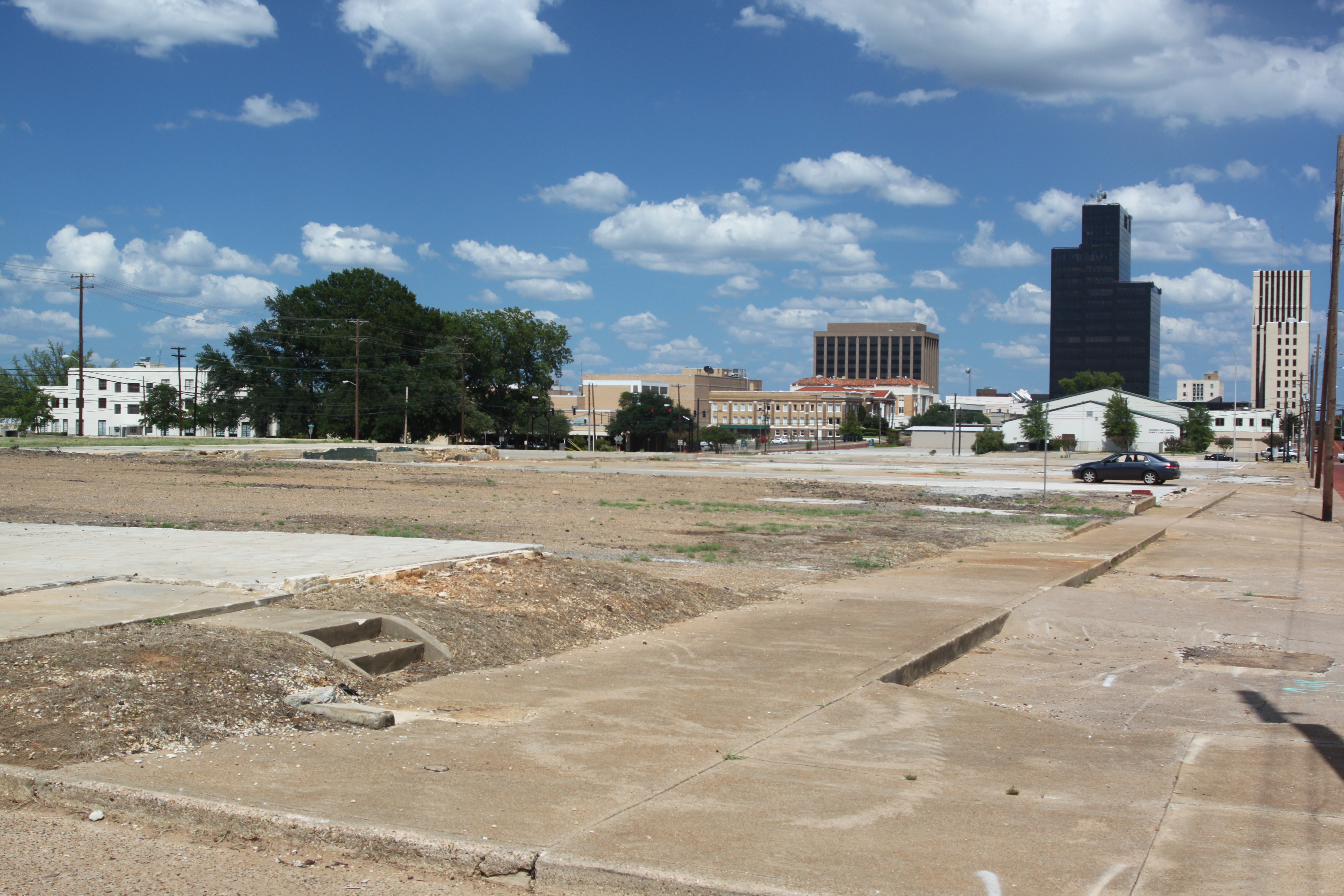
The result of this growth mentality is that we do not have the money to “care about what we already have.” For every new development in Tyler, the public sector is expected to provide roads, sewage, fire departments, police departments, schools, street lights, signs and other various forms of public services and infrastructure. This cost is significant and it is somewhat needless considering there are vast sums of land in the city where services already exist. As the city continues to cater to new developments, we do so rather than reinvesting the money into older, existing spaces elsewhere in the city. These images of Tyler’s downtown (below) are images of a city waiting to be reborn.
So here’s the basic dilemma: How does our local government incentivize businessmen to build on parking lots rather than horse ranches? I suppose it starts with a vision.
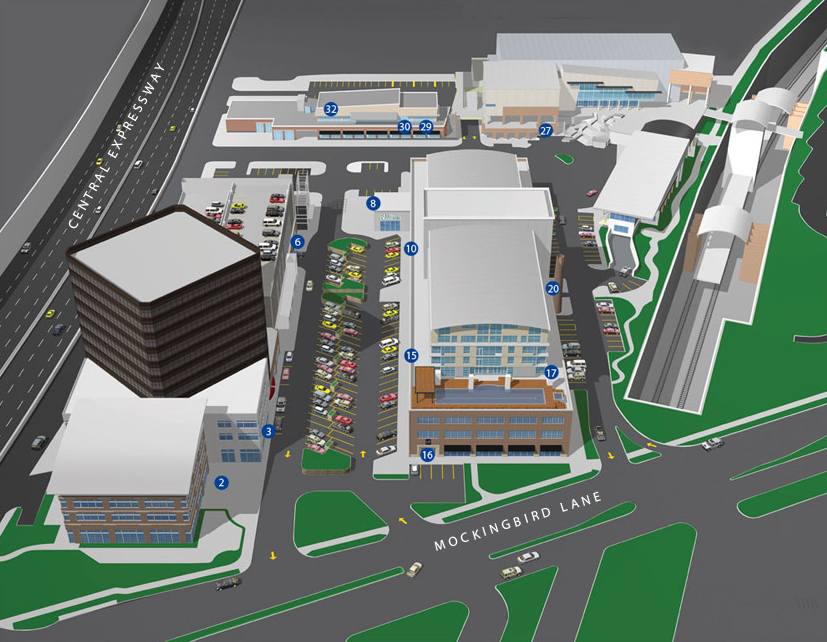
Empty lots, parking lots and vacant buildings are waiting for a renaissance. Young people, artisans, and creatives are looking for a place to find community. Some churches desire to feel more connected to the city. Our government deserves to reside in a place of prominence. This is my vision for downtown Tyler as a dense node of city life connected to the rest of the city by transportation and urban design. A great example of this sort of development is Mockingbird Station in Dallas. The place is an incredible example of the potential of a repurposed factory building that is now connected to the DART light rail. It’s attractive, interesting and it has created a significant draw for itself even in its relatively short lifetime. This is the vision I would like to cast for every empty lot in downtown Tyler. Could we do it?
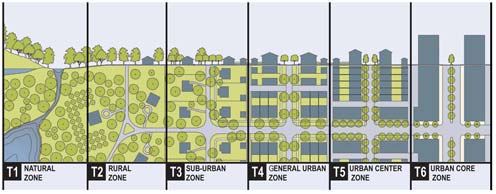
First, I suppose we need a zoning code that allows for a variety of living options such as row houses and lofts next door to hole-in-the wall cafes and shops. A place for people to live. One popular concept promoted by Duany Plater-Zyberk (pictured below) is called the Transect.
The transect is basically a zoning plan that allows for a wide variety of urban forms and gives the city a gradual progression from the urban core all the way out to nature. In addition to new zoning, I am (of course) confident that we need to “connect the dots” of high-density developments with a street car loop along beautiful avenues, bike lanes and sidewalks. All I want is one loop of public investment and long-term commitment to our existing city. The private-sector investments would be astounding. We have already begun to see developers look to the downtown with businesses such as Don Juan’s, Rick’s, Jake’s, the Downtown Coffee Lounge, Balance, and others. What these all need is to be more connected to the city and they will not simply exist as moments of brilliance. Instead, they will reside in an area inhabited by people that have pride in their business and share this pride throughout the city. These people also sustain the economy while visitors increasingly come enjoy the city life.
So there are economic arguments, community arguments, and even valid entertainment arguments for downtowns. To me, the argument for downtowns and urban spaces is more simple: Let’s turn this city (the whole city) into a source of pride. It’s not too late. I don’t want us to look back and wish we had taken our city a little more seriously. We need to allow for a little urban chaos, promote design oddities and find some way to discourage this endless leapfrog development to the next new loop. We need significant places and I believe we need to collectively begin to care about what we already have.
Check out my other Tyler projects at my Tyler, TX page.






 Highways and Hallowed Halls