Tag Archives: Tyler

Art project idea: yucca in red

One Saturday in early January, in the middle of cleaning and entertaining my kids, I got an idea for an art project and sketched the notes below.
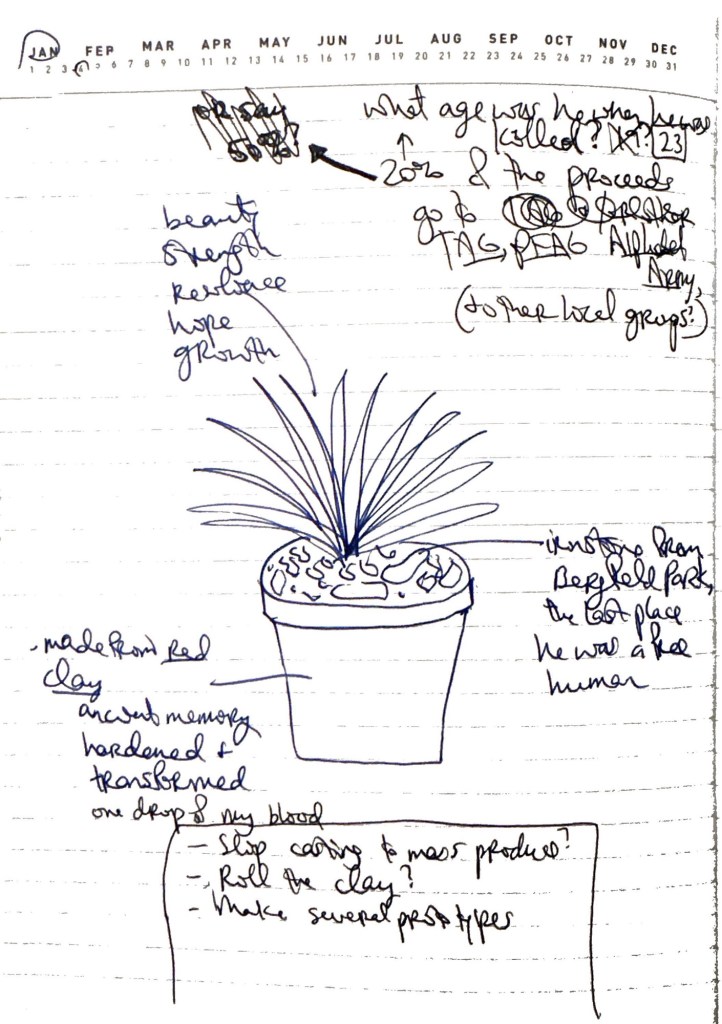
I’ve been really interested in the life and death of Nicholas West for a little over a year now and continue to feel a strong connection to his story.

The basic idea is…

  • A collection of pots thrown from red clay harvested in and around Noonday, TX where Nicholas was tortured and killed
  • The pots are different sizes with different biographical information about Nicholas like his birth and death years, text from obituaries, anything significant from his story
  • Each pot would have a drop or two of my own blood. I want to make people a little uncomfortable when they pick up the pot and read the description. I want to make his death more tangible and remind people that all soil has seen bloodshed of one kind or another. (On a more cosmic level, I also love the connection between the iron in our blood and the iron in the soil which was all stardust flung across the universe from dying supernovae.) I’ve noticed that men are pretty squeamish about the idea of the blood, and women I’ve told are much more supportive which makes me want to do it even more.
  • In the pot will be planted a Yucca filamentosa, native to the southeastern US (from Tyler to Richmond), very hardy, tropical, and structural. The yucca will grow to fit the size of the container that it is in, the yucca is resilient, and in the spring it has a bloom several feet above most other plants.
  • Yucca is also the first plant that I really noticed and developed a connection to. It is the first plant I remember finding and foraging and I’ve planted and potted at least five in the last two houses where we’ve lived. I was in a dark place in my life and my interest in plants, yucca specifically, was an encouragement that has continued to center me and excite me while also driving me a little crazy with more ideas than I’ll ever have time for.
  • While I still love the idea of Yucca, more recently I’ve considered Hesperaloe parviflora, also known as “red yucca” or “false yucca.” I noticed it in Texas at some point and planted it in my garden 3-4 years ago. I had a naturalist walk around with me and he commented that he liked seeing it growing in Richmond because he didn’t know that it could. I love the idea of a Texas transplant thriving in Richmond and the idea of it being a “false” yucca feels appropriate for the Southern culture of repression and how much of myself I held back from others for so long. Of course I love the red bloom, the color of blood and nectar for hummingbirds stopping for a moment on their impossible migration.
  • On the surface of the dirt in the pot I want to scatter bits of ironstone found at Bergfeld Park, the place where Nicholas was picked up, the last place he was free. On my most recent visit to Tyler I pocketed some pieces of the stone and brought them back to a potted yucca I have by our back porch. It has been special to me to have them there as a connection to home
  • I’d love to sell replicas of the different styles of pots and give a portion of the proceeds to local LGBT community organizations in the Tyler area.

It would take months or years to really do this as well as I would want to – I haven’t even fired a clay pot since high school. I’d need time to harvest the clay, prototype different styles, and learn how to make them consistently well, etc. So with all that considered in addition to the constraints of full-time employment/parenting life, I’ve accepted that I’m probably not going to attempt it, as much as I want to. It felt better to share the idea here and let it go rather than hold it too tightly.

4.22.25 – Since writing this post I’ve thought more about the possibility of partnering with an artist to make the pots that I could use to plant and we could market the project together. Even still I don’t think I have the time to do it well, but the partnership would be really rewarding and it’s much more realistic to lean on someone’s existing expertise rather than try and develop it myself. It also got me thinking outside the box even more. Maybe this idea should actually be an assignment for a class where everyone chooses an event that deserves more recognition and designs an installation to share the story. Maybe it should just be an online project that collects memories and details from his story. Or maybe this just needs to be a section of my own garden: a shrine to his life and a broader connection to my own story, my hometown, and the resilience, growth, and occasional moments of flourish.

4.24.25 – While reading about “The Burying Grounds Memorial” at the University of Richmond I learned that Yucca, “is often found in the cemeteries of enslaved people, serving as living grave markers.” I have only just gone a few steps down this rabbit hole, but I’ve already found some interesting articles and anecdotes that support using it for the project. It seems the plant has long served to mark the memory of people who might have otherwise been forgotten, to bind their restless spirits after life, and to provide permanent protection to their physical remains.

  • “Fieldstones. Yucca plants. Seashells. The last object a loved one touched. For centuries, these items, cultivated from lives and landscapes, marked many graves at burial places for Black people in America.” National Grographic
  • “Some of the plots were marked with pieces of quartz or with yucca plants, which were used by many Southern Black families who could not afford stones.” ProPublica
  • “The phrase “pushing up yucca” has been coined to describe these graveyards, and there was a Gullah belief that spiny plants restricted the movement of the spirits of the dead.” Society of Ethnobiology
  • “Spiky clumps of yucca dot Odd Fellows cemetery as further reminders that this patch of woods was once a curated (if not manicured) space. Though widely found in cemeteries across the country, in African-American tradition specifically, yucca binds restless spirits to their graves. Easily transplanted and nearly ever-lasting, yucca was sometimes planted near the head of a grave in lieu of an expensive stone marker.” Black Wide-Awake
  • “Yucca is another plant that marks many early graves even today. It can live hundreds of years and represents eternity. In many African American communities it was also traditionally thought that yucca kept restless spirits in the grave.” City of Birmingham
  • “Due to their association with cemeteries, the yucca plant has also taken on an association with the supernatural, as a way to ward off evil spirits.” Lumpkin County Historical Society

Hunger of the Pine

I remember exactly where I was sitting when my older brother told me the story of Nicholas West. In 1993, when West was 23 years old, he was picked up just blocks from my childhood home, taken to a clearing in some woods outside the city, brutalized, and killed for being gay. His murder was deemed a hate crime, two of the perpetrators received the death penalty and one is still serving a life sentence in prison. Earlier this year, thirty years after a crime he committed at just 17 years old, he was denied parole.

I had always known intuitively that Tyler was a conservative place, but this story captivated me as someone who had recently come out of the closet and was still trying to understand my own childhood. In a sort of backwards way I feel affirmed by the knowledge of his story and my own self-preservation reasons for staying in the closet for so long. His murder likely sent a chilling effect through the community and I imagine kept many people from coming out of the closet and/or from supporting their children from doing the same.

His story also helped to explain a strange vision I had in the summer of last year, months before I learned about Nicholas. One weekend day, struggling to be a good parent, I decided to take my oldest to a flower farm outside of Richmond. They had hay rides, play forts, a huge dirt pile (his favorite), and all-you-can eat grilled corn (with Tajin of course). On the way to the farm, we happened to drive past a large pine forest. As I watched the parallax of tall, narrow trees shift to my right I had a very clear vision: I was running for my life through the forest, chased by counselors from the Christian camp I attended as a child. It was a mix between Sothern Gothic and the music video for the alt J song, “Hunger of the Pine.” If they caught me, they were going to drag me back and force me into the closeted life I felt I’d narrowly escaped.

The vision surprised me for how clear and intense it was. Although I was well aware of the culture of homophobia, I had managed to avoid the worst of it. Homophobia mostly came to me through casual phrases (it was the era of “that’s so gay”) or religions conversations like my high school teacher telling me that it was a worse sin because it was a sin “against the body.” The story of Nicholas, one of visceral hatred, was recent enough to be very much a part of the culture and collective memory of the place that raised me even though I didn’t know about it at the time.

Ever since I had that vision I’ve looked at pine forests differently. I grew up in the Piney Woods of East Texas and I have plenty of childhood memories in the tall, quiet, spaces carpeted with pine needles that choke out any understory so you can see straight through them. I think they are beautiful, but like everything in the South (and anywhere) they hold dark secrets, secrets of terror and violence. Terror has been used to control many communities and its effects last long beyond the actual event. Terror changes the way that affected people experience a place. Even when hatred becomes more benign, the memory of the violence serves as a threat that it could happen again.

I’ve picked up lots of articles on this story during my deep dives:

I also recently watched Lone Star Hate, a documentary about the story, embedded below:

I was only five years old, probably asleep under the glow-in-the-dark stars of my room, when Nicholas West was picked up at the park nearby. In some ways I wish I had known about his story at a younger age. I wish I had known about all of these stories, the gay community, the mentors I didn’t have, the history I wasn’t told. Part of moving forward is going back and making those connections when I get the chance.

I’ll be in Tyler in a few weeks and this story is going to be on my mind. I certainly hope to visit the memorial stone in the park where Nicholas was picked up. On a later visit to the area, I’d love to connect with anyone that knew him or was friends with him at the time. I feel really connected to his story and want to know more about his life before it was defined by someone else’s hatred. I’ve also considered scheduling a visit with David McMillan some day. At 47 years old, he still has a barbaric amount of time in prison ahead of him as he pays for his role in the murder. I want to know how he found himself participating in that crime and what he thinks about it today.

While I have a tendency to focus on the sad aspects of this story (and most stories), I have also been incredibly inspired. I have learned about organizations like TAG, Alphabet Army, and PFLAG of East Texas. As someone who chose to escape, I am so proud of folks who have managed to stay and have committed to changing the culture for the better – I would love to support and visit for one of their events some day. There are also seeds of hope in my own story. It was in a journal that I purchased from Pine Cove Christian Camps of all places that I first came out to myself in middle school. It would be many years before I felt safe enough to come out to my friends and family, but that journal entry, among the prayer requests and gossip, was always important to me and a sweet, salient connection to my younger self.

We, the Mobile

As I rode home from work on Friday, I decided I needed to get out of Richmond. For me, a 70-mile drive to Charlottesville is far enough to feel like I got “away” from my routine life. That drive down I-64 was the beginning of an idea that has everything to do with highways and hallowed halls: the faster you can get somewhere the closer it feels.

I’ve been told that humans have always considered a reasonable commute to be about a half of an hour to an hour of travel. Walking, that would be about 3.5 miles. Driving, that could be a trip from Trenton to New York. Flying, that’s a D.C. to Chicago commute that no child dreams to have when they grow up. While the amount of time we travel to work has remained relatively the same, the increase in distance has been significant. The affects of this distance are profound.

In the early 1900s, before the Model T and good roads, many wealthy Americans owned second homes just outside the city. In Boston, for instance, this was the rural getaway known as Jamaca Plain. Near Richmond, it was the neighborhood of Bon Air. Originally a retreat ten miles outside the city, Bon Air was frequented by Richmonders who wanted to get “away” from the stifling life of an industrial city. Today, Bon Air is near the middle of a metropolitan region and considered just another inner suburb. Meanwhile, the wealthiest residents are more likely to have second homes in Sun Valley or Naples than rural Virgina. The idea of buying a second home 10 miles away seems absurd. The faster you can get somewhere, the closer it feels. But is it actually close?

Many American cities today are populated by the children of faraway parents that raised them and watched them leave. I am one of these children. I was given the chance to move over 1,000 miles from home to live somewhere new and exciting. I have been given the chance to go out on my own. But when did this become normal? We, the millennials, are the fifth generation of Americans with access to cheap gasoline and the third generation to grow up with interstate highways.

We grew up as the unsettled generation of an increasingly mobile nation. There have always been wealthy people, but there have not always been turbojets and 70 mph speed limits. This has changed the way we see distance and separation.

For instance, I live about three-and-a-half hours away from my hometown of Tyler, TX. By plane. So that’s about 22 hours away by car and 349 hours by foot. When I left Tyler for college I didn’t really think it was a big deal. Now, it feels significantly farther than I originally imagined. In my sixth year of life away from Texas I can say there is much I have learned while I’ve been away. I wouldn’t change my decision to leave if I had the chance. I love the city where I live and the university where I studied.

But there is this simple, lingering question I am asked every once in a while that I can never completely answer: “So, how’d you end up in Richmond?”

Like most, I tend to focus on the “pull” factors of migration. Oh, I came here for college and fell in love with the city. I usually also make a joke about how the University’s website was easy to navigate or that Richmond wasn’t as cold as Boston, another city I considered for school. But why, as a senior in high school, did I not consider a single school in Texas or even somewhere closer like New Orleans or St. Louis? Why the 1,000-mile trek? There are a few easy answers I can think of:

  1. My brothers did it
  2. My parents let us
  3. I knew I would only be “a flight away”

But that doesn’t really answer the question. While there was a draw to move away, there were also significant “push” factors that sent me away from my southern home. In the land of football and Rick Perry, I didn’t really think there was a place for a friendly writer trying to make a difference. I made lots of unfavorable generalizations to justify my move away, but at the same time I was more focussed on where I was headed. When I applied to college, I dreamed of a place where people liked to read and write, where Christians didn’t all look the same, and where it wasn’t weird to suck at basketball. I didn’t know if I would find that, but I figured it was worth a shot. Everywhere I went in Texas, I saw the same story and realized that, while I think it’s a great story, it would be a hard one to fit into.

So I got out. I became one of the many confused Texpatriots simultaneously displaying a Texas flag and critiquing that beautiful, mineral-rich place.

And here I am: living in an old mansion in Richmond, working at an amazing university that also happens to be my alma mater. My neighborhood is both dangerous and beautiful depending on who you ask. My house is used as a tutoring site for hundreds of kids each year. My city has representations of American architecture going back to the 1700s, fine art, public murals, excellent restaurants, and more. It’s not D.C., but it’s also not snooty and it suits me well.

And yet, if you notice, all the positives aren’t really adding up. There’s always the question, “But what?” Living in Richmond is awesome, but it involves this thing I call the golden triangle of growing up: the pull between a career, a significant other, and family/hometown.

This is how it plays out:

Whenever I think about moving home (or at least near family), my first thought is that I can’t go back until I get somewhere in my career. There’s not much of a market in Tyler for someone who made up their own major in college. Then, whenever I think about advancing my career (a word I routinely misspell) which might involve grad school somewhere far away, I immediately think about my girlfriend and wonder how the timing of both will work out. Thinking about our relationship then takes me back to thinking about moving home and I imagine a life of holiday swaps and long-distance in-laws. Again, when I think about home, I think about my career pulling me all across the nation and I wonder what my little sister will be up to as she finishes high school and enters young adulthood herself. I wonder if my parents will be sitting on our back patio enjoying those cool spring afternoons in Tyler while I’m who-knows-where doing who-knows-what. I think about my three older brothers who are all living in this golden triangle as well and I wonder if we will ever manage to live near each other again.

I wonder if I will ever get to move home and whether it will still be home when I get there.

When you’re in a relationship with someone that’s in a similar situation, you also realize that at some point one of you will have to bend for the other. That’s the compound reality of this golden triangle: both of you can never have all three at the same time. And since both people in relationships today have educations and aspirations, it takes a lot of energy to make it all line up. Often people choose to go their separate ways, some struggle through the long-distance life, and others manage to work it out in the same place. Even when it does work out, it can be a gauntlet of long-term planning and flexibility.

That brings me back to my trip to Charlottesville. I’m currently sitting at a coffee shop with four friends I’ve met since moving out to Virginia. Between the two couples and myself, we represent five home states: Tennessee, Ohio, Maine, Virginia and Texas. We are all living in the reality of the triangle:

I am from Tyler, TX and my girlfriend is from Medford, NJ and Sanibel, FL. We both currently live in Richmond, but our families are scattered from Florida to California. My friend, Max, who is originally from Portland, ME, currently works and lives in D.C. where he met his girlfriend, Shannon, a native Tennesseean (who also moved around growing up), in D.C. just before she moved to Charlottesville for law school at UVA. Max is currently applying to law schools around the mid-Atlantic region and hopes to end up somewhat close by. Margo, another friend from college, is currently living in her hometown of Cincinnati and hoping to start medical school in the fall. She got into the University of Cincinnati program but is trying her darndest to get into a med school in Virginia so she can live near her boyfriend, Joe. Joe, a native of Richmond (the only native Virginian in the group), is currently in the UVA post-bac program so that that he can apply for med schools this summer and start a year from now in the fall. If Margo starts the program in Cincinnati, he will likely move to Cincinnati to work while he does his best to get into the same program or, if he only gets into a program in Virginia, she may try and transfer after her first two years.

It’s no wonder some are calling us the most stressed-out generation.

Max made the comment last night that we are living in an era of “progressive instability” as young adults in Twenty-First-Century America.

“Dramatic instability,” he added.

Since the best opportunities are no longer nearby, we find ourselves settling into LDRs (long-distance relationships) while we find jobs or attend grad school. Even if you don’t want to go to grad school, you’ve most likely thought about it. Max made the comment that the economy expects us to have graduate educations, but doesn’t facilitate the experience. Also, with MBA programs like UVA’s Darden that charge $76,000 a year for in-state tuition, our generation is making history in the way of personal debt.

With the sluggish economy, vertical mobility is synonymous with geographic mobility and cross-country job searches are the norm. This was once the time of life when people began to build stability, moved home, and started a new chapter of life. Some of my friends have managed to work that out, but many of us genuinely didn’t know it was an option. We, the mobile, have followed the allure of big cities and fresh lives.

No longer a time for building community, the twenties have become a very dynamic stage of life. One misstep and you’ll be roadkill in this “Great Recession” that sees unemployment as a mark of personal failure: you can’t get a job if you don’t have experience and you can’t get experience if you don’t have a job. Of course, it can work out, but it’s a little terrifying at the same time. And we are all living in this reality from day to day. Every once in a while I think about all of this and I take a very deep breath. It’s just too much to consider it all at the same time.

In a decade, I hope I look back and laugh at the golden triangle of growing up. I hope we will have a chance to tell stories and swap war wounds on the other side. I hope we all keep our sanity in the process and I hope we remember what matters most. What makes people happy today is what made people happy thousands of years ago: close relationships, good work, and unconditional love.

In the world of the golden triangle, it’s simply a question of where.

From Drinking Songs to Pet Theories

I recently felt convicted on behalf of the individualistic, intellectual, global community. Didn’t we used to sing drinking songs together? It seems like these days we spend our time talking and debating rather than getting lost in something greater … something that unites.

I’ve been thinking a lot about the difference between beer and coffee. In 2010, Stephen Johnson gave a TED talk titled, “Where good ideas come from.” I highly recommend it. In his presentation, he argues that the advent of the English coffeehouse played a significant role in the development of ideas during the English enlightenment. With the coffee house, Johnson states, the English people moved from a perpetually drunk society to a stimulated community of thought and collaboration. The ideas that transformed society emerged, at least in part, from within the incubator of the coffeehouse. So I originally saw this as a good thing. Don’t we need good ideas to progress? Well, yes, but I think we’ve lost something in the process of becoming enlightened and thoughtful. In short, we’ve lost drinking songs. We’ve lost this social tradition that connected us to each other and our sense of belonging and place.

I see the effects of this coffeehouse culture on my own upbringing in Tyler, TX. My friends and I would often meet for coffee at the “local” Starbucks and talk about life. These were great times we spent laughing and solving the world’s problems. But they didn’t unite us or connect us to our city in a meaningful. We never spontaneously burst into song with steins of beer sloshing around as we sang, “Tyler, oh Tyler! Da-dum de-dum de-dum …” Or anything of the sort.

In addition, the people that did drink together in high school did not usually do so with members of the older generations because they were partaking in something that many consider immoral. Thus, if there were a drinking song for Tyler, they wouldn’t be singing it. Instead, they would still be stuck in the teenage ghetto while their parents either condoned or condemned from afar. It really is a tragedy. When it came time for me to look for colleges, I felt no remorse leaving that city in the dust. I had clearly not connected to it’s people or culture in such a way that made me feel like I belonged. I had not yet come of age.

Here’s the deal: It’s not about beer and it’s not exactly about drinking songs. It’s about the cultural traditions that unite people.

The thing about these traditions is that they have to be taught. This teaching process requires close, intergenerational relationships. Drinking songs clearly had an incredible ability to galvanize that “togetherness” of community because they eventually became Baptist hymns and even the national anthem of the USA. The difficult question for me is whether this generations is producing material that could be redeemed in the same way. Does our philosophizing  bring us together? As I sit here at my computer developing this theory I wonder if instead I could be singing a drinking song (or any song) with a group of people. Granted, it’s 10 a.m. on a Thursday, but my point is this: I don’t want to care more about my pet theories than our collective humanity.

I think it’s time to start singing.

Duck on Decorated Shed?

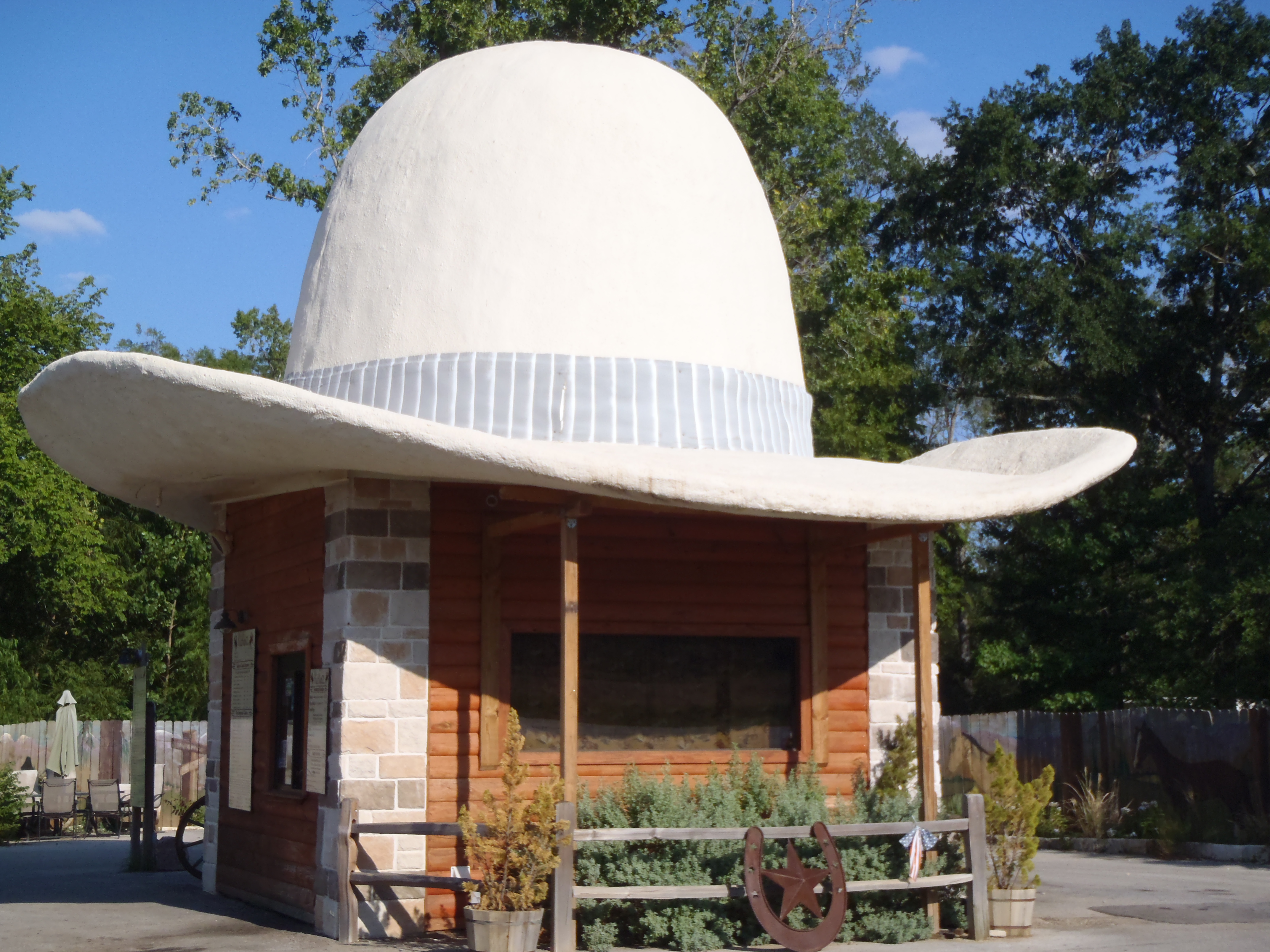
I don’t think Robert Venturi had any idea someone would ever take his duck and decorated shed concepts to this level. The (now patented) concept of building a huge, proportional hat onto a small square building was inspired by my hometown of Tyler, TX with the “Kicker’s” coffee franchise. The hat might even qualify as a duck? Be amazed:

Race in Tyler: A Pie Graph of Color

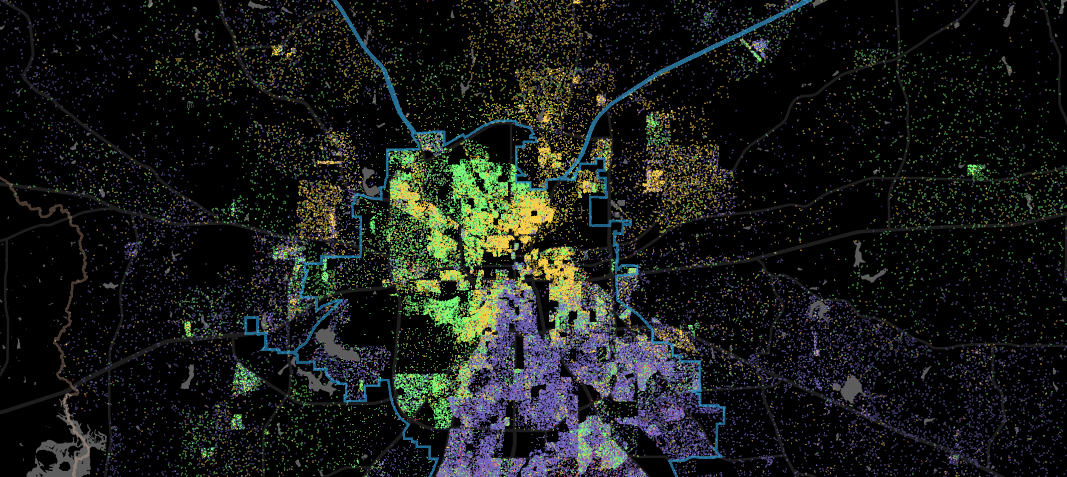
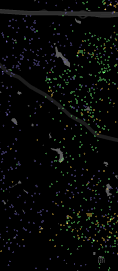
This is a response to a map of race in Tyler recently produced by Christopher Groskopf (@onyxfish) using the brand spankin’ new 2010 census data. He posted his analysis on the Web site hacktyler.com  titled “2010 Census: Racial diversity in Smith County.” Check it out:

In some ways, what I always knew makes much more sense after looking at this map. I now see that the original El Lugar is in the middle of the most Hispanic section of Tyler. Texas College and Martin Luther King Blvd are in the heart of Black Tyler. South Broadway, the site of most new development and big business in the city, is the backbone of White Tyler.

I think Groskopf’s work compliments thoughts that I and others have had on Tyler and gives me more of a context for the city over all.  Somehow with the language of the internet (which is beyond me)  he has illuminated my city in a way I have never before seen. Granted, some racial realities are not surprising, but the overall experience as a resident looking through this map is remarkable.

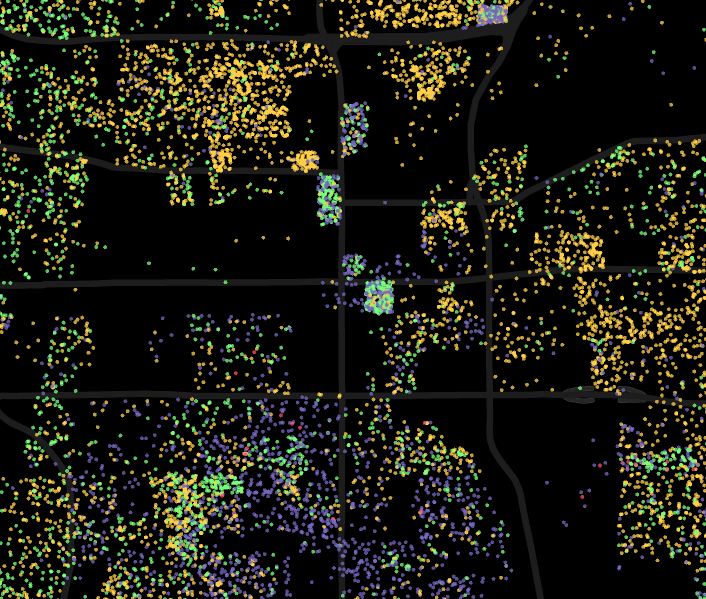
When I first looked a the map, my eyes immediately went downtown (pictured right). That black, vacuous space in the middle of my city. It may seem strange to be drawn to an empty space, but it’s because I have a different vision for downtown. In an earlier post, “C-T-D: Thoughts on Downtown,'” I tried to understand the idea of “downtown.” What is it supposed to be in relation to the city? If we understand the idea, then we have a standard of comparison for the reality. Here’s my standard: The first element of downtown is density, the second is urbanity, and the third is a creative economy. Looking at the black space of our downtown reminds me that it is still primarily a place to work and park your car. What would it look like if it was a place to live? Downtown could be the place where all three major pieces of the racial pie meet each other. It could be the center of city life and it could be a place where everyone feels welcome. I know there are dreams for the old King Chevrolet location and other vacant lots downtown … I hope we share these dreams with the rest of the city.

From downtown, my eyes zoom outward. I follow the three pieces of this pie from their smallest points to their largest and I’m amazed at the simplicity of the settlement patterns in our city. Groskopf mentioned the racial segregation in Chicago because in my experience that city is a patchwork of race. Tyler is more of a pie. The white population in Tyler is certainly the most homogenous, but there are some clear demarcations between the Black and Hispanic regions as well.

Here are specific observations:

Physical structures divide urban communities. The clearest example of this for me was the section of Paluxy just south of the Loop (pictured right). This photo is special to me because the black community to the right is in the middle of the huge white piece of the pie. The community also looks clearly sectioned off by Paluxy to the west (left) and other, smaller roads to the N,E, and S. On Google maps, this section doesn’t look any different. I have to admit I haven’t driven around these streets on either side of the color line, but I have this urge to go there and learn more about why the communities have settled in this way.

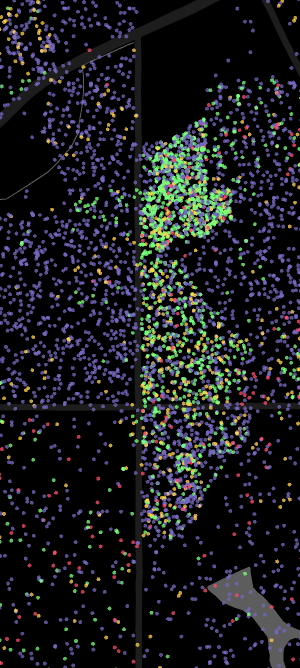
Invisible lines divide rural communities. I was really unaware of the racial breakdown of rural Tyler before looking at this map. It’s partly because I haven’t spent as much time in rural Smith County and it’s partly because it’s just a bigger amount of space to understand. I think it’s so interesting that north of Tyler the two pie pieces of Black and hispanic communities stops at this invisible line (pictured left) and then White communities continue all the way to the county line. BUT, to the east, there is no imaginary line and the rural Black population is sustained to the edge. I wonder what historical legacy or communal understanding has created these invisible lines? While roads and buildings sustain separation in the city, segregation in the rural areas of Smith County is a little more difficult to comprehend.

There is so much more to learn from this map. I have already spent over an hour looking at the dots on this black field and I’m still amazed at what they have to teach me. I will certainly be referencing this map until the next census and I look forward to thoughts and responses from my fellow Tylerites.

Check out my other Tyler projects at my Tyler, TX page.

New Term: Grand Obsolescence

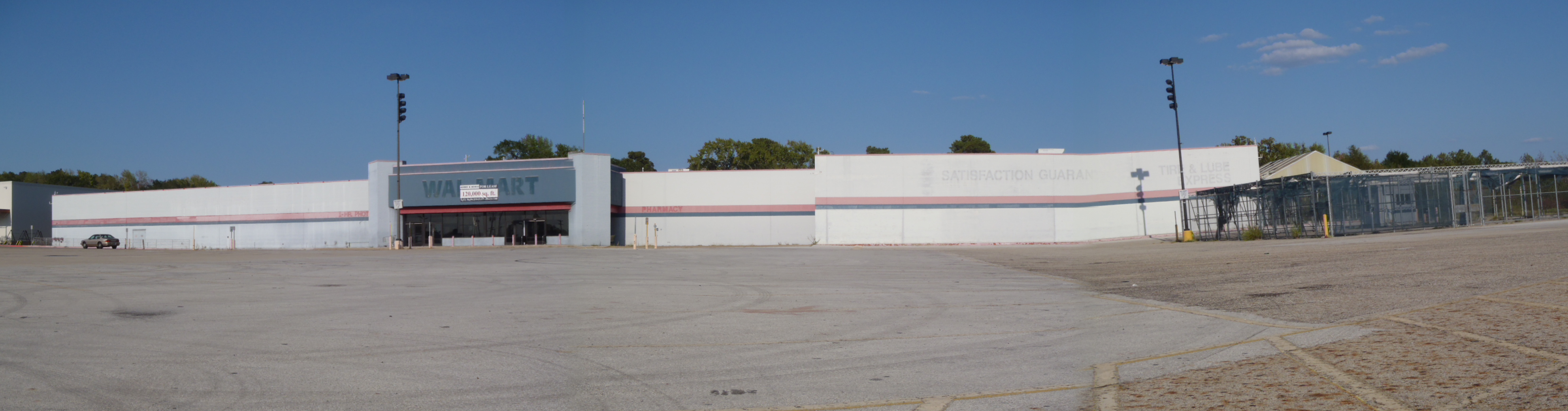
The term is usually “planned obsolescence,” but the word “planned” doesn’t exactly apply to what our cities look like today. So Grand Obsolescence is the term I guess I’ll to describe the spaces in our cities that have beed deemed worthless and discarded. Just like your iPhone 3 when the new one came out.

A Walmart was built on a highway in Tyler and surrounded by acres of asphalt. Then, Walmart built a supercenter right down the road and left this building to anyone that wants to spend the money to retrofit a warehouse. Thanks Walmart! The parking lot is now (obviously) underperforming asphalt and the building is vacant. The reality is: multi-nationals don’t have any concern for the long-term well-being of a city … they just need to make money. It’s up to the city to look out for itself and to prevent stymie process. The problem is usually a weak planning function and a city council that can only see $$$ with each new development. The result is cities that Kunstler says simply “aren’t worth caring about.” Of course, there is still plenty to care about, but the problem is that you have to drive farther to get to them. And even then … it’s still not usually impressive.

Maybe, we drive so fast we don’t notice these vacant buildings or maybe we just have low expectations. Maybe because our cities grow outward we don’t feel the need to look inward. All I know is, it ain’t pretty and we can do better.

Friday Photo: Tyler City Hall

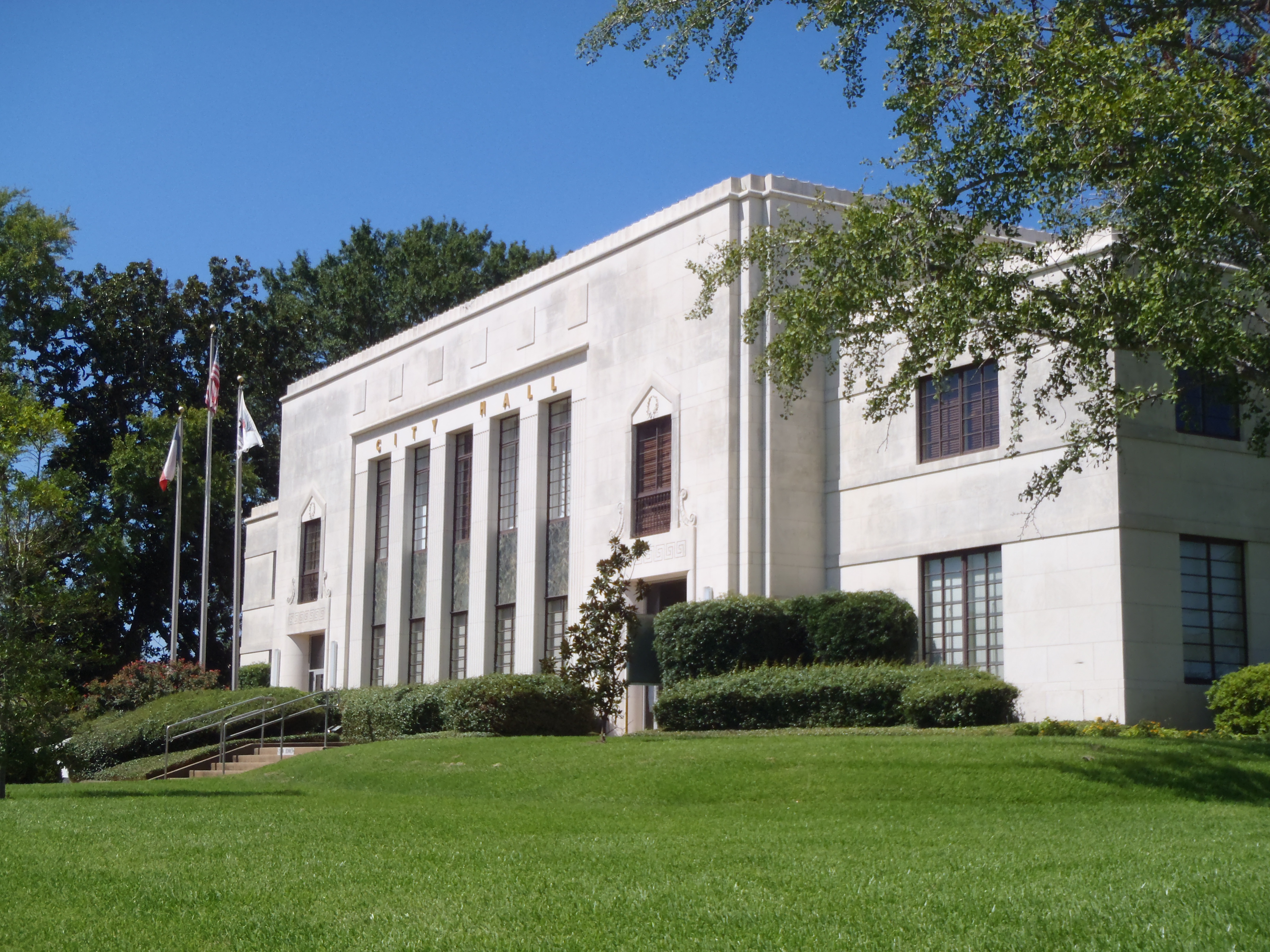
You might not know this (I didn’t until recently), but Tyler has a City Hall. The mayor and city manager work there along with other public officials and board members. It’s on Bonner Avenue just north of the wasteland formerly known as King Chevrolet. I like the building because it’s a decent Art Deco piece from the 30s when Tyler was awash in oil revenue and looking to the world for inspiration. It’s also surrounded by nice grounds, picnic tables, and benches. Take a look:

C-T-D: Conclusion to my time in this place called Tyler

I moved back to my hometown of Tyler in May to begin a brief, post-grad-limbo summer. Since I arrived, I have made it my hobby to explore the city, imagine its potential, and write a series of posts on my ideas. I called this, “Connecting-the-Dots,” because I believe that Tyler (like many cities) suffers from a lack of cohesion and identity. On the micro level, we lack special places (“dots”) fully enhanced with the cultures, traditions, and organizations that comprise our civil society. On the macro level, we lack the connections of transportation and urban design that unite the disparate pieces of what we consider to be a singular unit. I’ve been primarily guided by the question, “Where is Tyler?”

In my attempt to answer this question, I’ve spent my time looking for what I believe makes this city unique: what someone can find here that is not anywhere else in the same way. The places that I love the most are sometimes the places that are most unloved. In other words, the Rose Garden may not be as sexy as Chuy’s right now, but it is unique to Tyler unlike the Austin import. Business in North Tyler might not be as lucrative as its cousin on South Broadway, but it’s more creative, local and artisan. It’s the difference between Janie’s Cakes and the WallMart bakery, Stanley’s and Spring Creek, the Rose Garden and Faulkner Park, Balance and World Gym, La Favorita and Pasado’s.

Unfortunately, all of those places that I believe represent Tyler do not reside together in one awesome, dense, and diverse place. In my opinion, a visitor to this city needs a guide to properly experience what this city has to offer. But suppose there were such a singular place comprised of all the unique Tyler attractions. It would be remarkable. People would come from all over the region to be a part of it’s energy and excitement. Now, suppose there were two. Or three and a street car connecting them. Suppose you could go to one for dinner, the next for a concert and the third for coffee, dessert and drinks and never get into a car or leave your friends. Suppose everyone in East Texas heralded this as the “Tyler experience.” Suppose we leveraged what makes us unique in order to make us uniquely great.

Our city is positioned as a regional leader in oil & gas, the processing of roses, healthcare, higher education, retail, banking, legal and financial services. Suppose we were also known as a creative and innovative community that supports new ideas local aspirations. That is a dream many in this city have been fighting to realize. I believe it’s a dream worthy of this place called Tyler.

Lost Treasure: Stone Drainage Tunnel

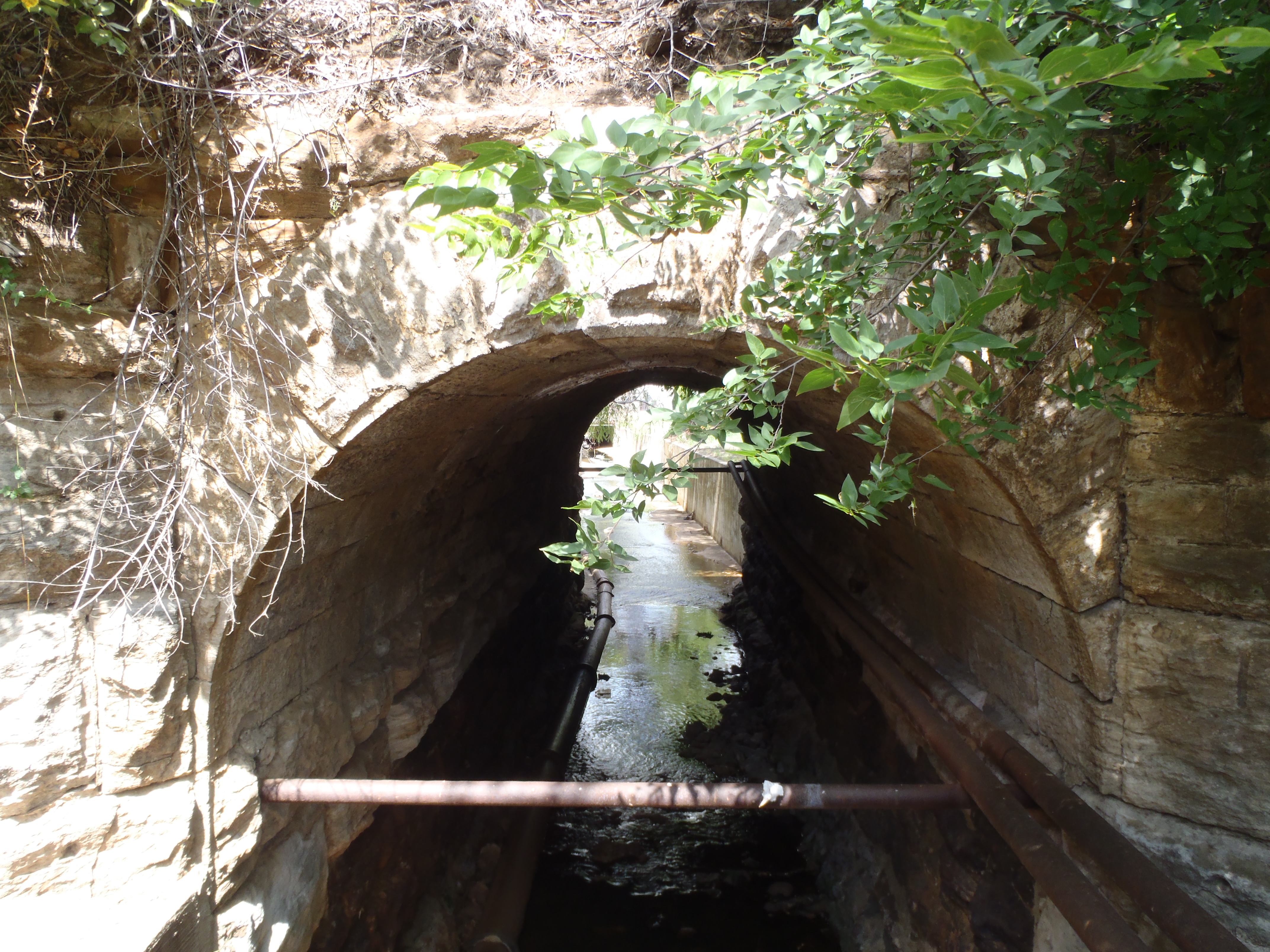
They don’t build ’em like they used to … so why don’t we take care of the old stuff? My “Lost Treasure” category is for structures and spaces that have been forgotten. The first entry is my favorite bit of public infrastructure in Tyler. The tunnel is a stone arch made of stone with a capstone that reads, “1880.” You might not have noticed it just east of the intersection of Elm St. and Fannin Ave. Here’s a link to the Google map aerial shot for reference. This is something worth restoring: