This Ignorant Present Revisited

A couple of months ago, I posted a quote from MacBeth that included the phrase, “this ignorant present.” I posted it because, for some reason, the idea really struck a cord with me.

Everywhere I go, I am asked variations the same question, “What’s in store for next year?” When I was a senior in college, I was asked this question. When I was a senior in high school, I was asked this question. I think before every big transition I have been conditioned to receive this question with either evasive answers or a scattershot of ideas and possible directions. Rarely (besides the college acceptance) have I been the sort of person to have an answer. Now, because I am currently working in a one-year program, the questions about the future have sort of carried on right through college graduation and into this year.

And I’ve noticed two things about this process: 1. Questions about the future make me uncomfortable and 2. I find myself asking these sorts of questions all the time. And then I started to wonder if maybe we are sort of all collectively making each other feel uncomfortable or unsatisfied with the present. Am I simply hoisting my discomfort onto my friends by asking them the same question that I myself am tired of hearing? Often, rather than enjoy the present, I am thinking about the future and I find that this ignorant present doesn’t seem to deserve our time in the context of the grand future we are supposed to be planning for ourselves. I know that lots of times these questions are well-meaning (or maybe an attempt on my part to make casual conversation), but I’m tired of the question and I want to respect the present.

I want to appreciate the present.

I also intend to put in serious work getting to the next step of my life … and I understand that I will always need to prepare for the future. But maybe I’m telling myself this as much as anyone else: the present is what we have. Conversations about the future, regardless of their intent, seem a bit assuming. This is, after all, the human experience we’re talking about so no matter what answer I give you when you ask the question (you know you want to) it’s with the understanding that life is going to happen regardless of what I say. So at this point, that seems like the only legitimate answer about what the future holds in store.

Life.

And more life.

Holy Moley Murals

The Richmond art scene has been blowing up for years. Now, in epic proportion, artists here have begun to reveal this transformation in the public realm.

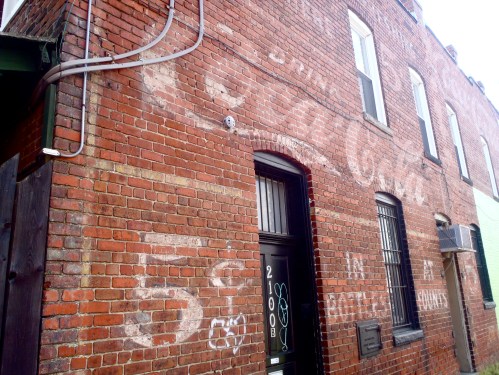
Rather than start with the newest, most epic murals (skip to the end if you want!), I want to put this Richmond mural passion in some context. Like all great American stories, it starts with Coca-Cola. This advertisement is located on the side of Globehopper at Main and 21st. I believe paintings like this became common starting in the mid-1800s along with the rise of the modern brand:

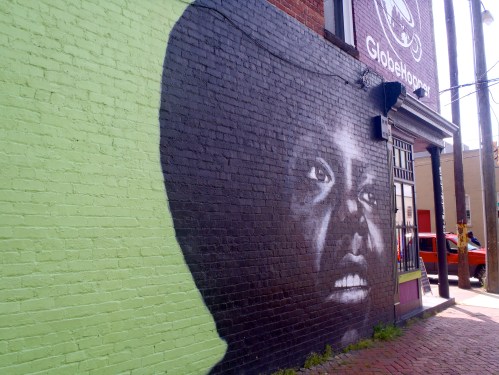
On the same wall, the Globehopper mural stands in vivid contrast:

I think this mural is Trask at his best and, in all honesty, I think I could end the story here. But alas that would not do justice to what is happening. These newest murals (the next two and the last one on this post) are apparently a part of the G40 Art Summit, a sort of obscure event that has come to energize the Richmond art scene for the month of April.

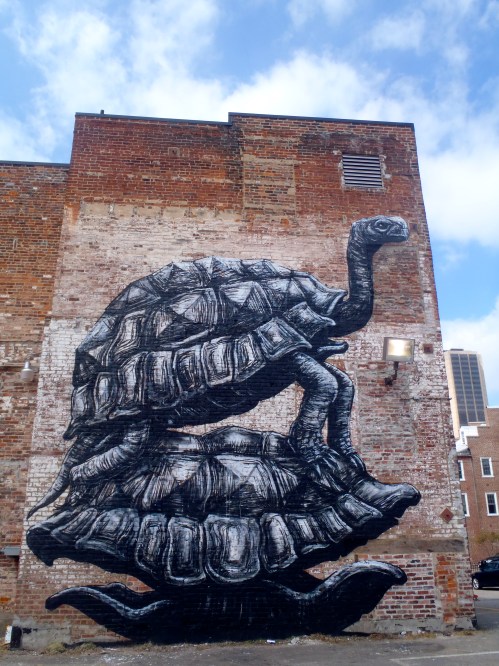
Writes Art Whino, “By inviting 13 of the top mural artists from around the globe to unleash their creativity to 20 large scale walls in a 10 block radius, it will surely become amazing artistic destination point for years to come.” As I drove west on Main St. I was soon greeted by one of these murals: the most epic (and hopeful) turtle I have ever seen. It’s being painted on the back wall of famed nightclub Have a Nice Day which means I’m surprised and impressed. And you may be amazed:

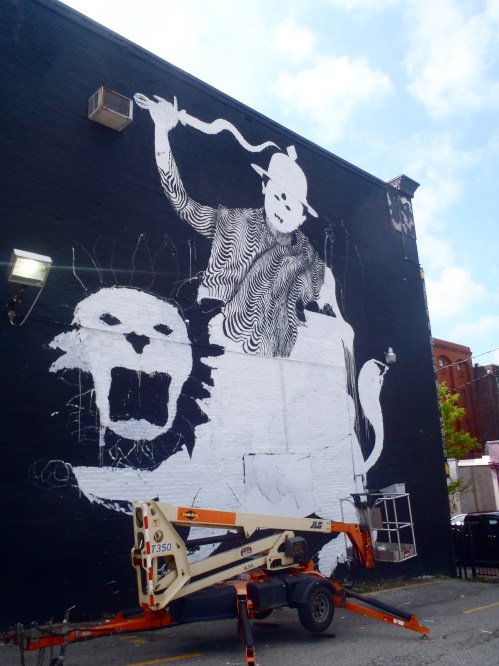
Somewhat more fittingly, Have a Nice Day is also adding a somewhat demonic-looking mural of a man whipping a lion (?) to their exterior wall facing Main. I can’t pass final judgement at this point because it’s not finished, but I do know this: There are epic murals in Richmond:

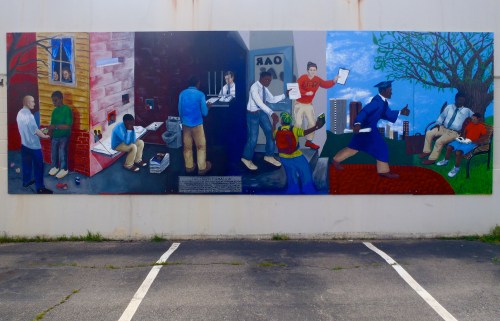
A little farther down Main, there is a mural that seems to have been commissioned by Offender Aid and Restoration of Richmond. While not the most epic, it is the most clear narrative portrayed in the murals I’ve seen lately and I appreciate OAR’s embracing the mural format in their latest outreach:

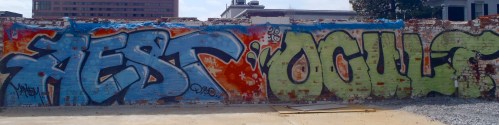
I also couldn’t help but include a snapshot of the graffiti located just a few blocks away from the mural above. While I’m not sure where “graffiti” becomes “mural,” I am sure it’s probably for a dumb reason so here’s my sample:

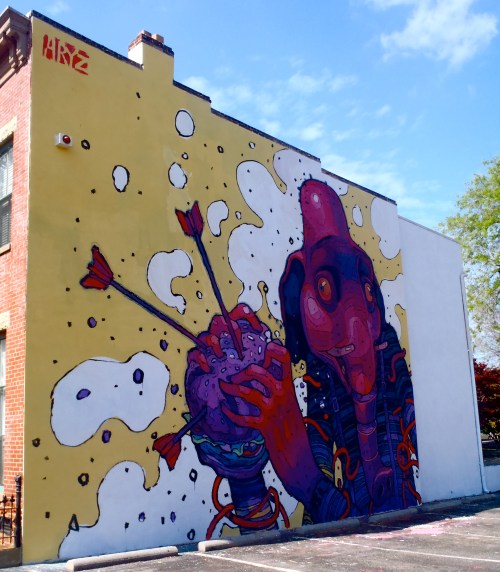
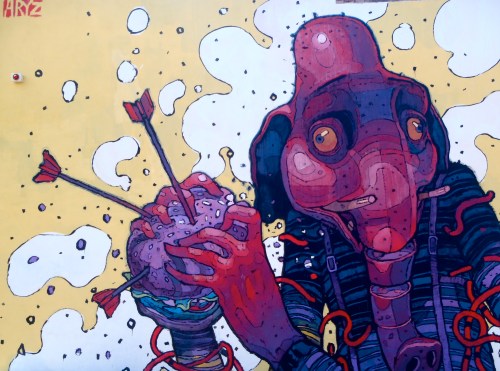
Finally, this mural is the last one I catalogued on my drive down Main St. and in some ways this one is the reason why I’m writing this post because it is the first I saw of the newest crop. It is, I believe, an elephant holding a hamburger that’s been shot with a few arrows … feast your eyes:

Here’s another view:

The only thing I can say at the end of a post like this is “holy. moley. murals.” What I love most about murals is that they take an everyday walk down a street and turn it into a free stroll through an art gallery. If you don’t like art, you might not like these murals, but you have to at least admit they are better than a blank wall. Creativity like this gives a city, and individual buildings, significance and character.

And the crazy thing is these are just the beginning … for examples of more epic murals check out this article by RVA News of other murals being painted around town this week. While I selected one street, they selected the entire arts district from Manchester to Broad St. I couldn’t be more pleased that my favorite city just got that much cooler.

And a little more bizarre.

Movement and Moment

Over the course of the past year, I’ve been writing my way through a bunch of different thoughts and ideas and the result has basically become the entirety of this blog. At the same time, I’ve also been gradually trying to connect the dots with one underlying theme: that life is all about circulation and significance, the movement as well as the moment.

Since my words don’t always make a lot of sense, I’m constantly trying to find new ways to explain myself and share what I think is interesting about the world: examples of circulation and significance in our daily lives. Most of these places are either what I consider Highways (circulation) or Hallowed Halls (significance). Today, I get to write about a place that embodies both of these characteristics and the tension that exists between the two.

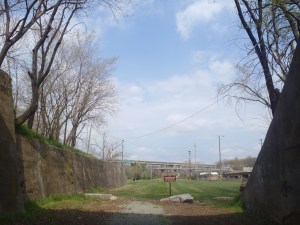
I recently visited the Negro Burial Ground just east of downtown Richmond in Shockoe Valley. My approach to this site was across a VCU parking lot and through a tunnel under Broad St. As you walk through the tunnel, you emerge onto a huge empty field of beautiful grass that was once yet another parking lot in downtown Richmond. In recent years, the asphalt was removed and this area was designated “A Place of Contemplation and Reflection.” I appreciate this area mostly because it’s a complicated place. There aren’t physical buildings that most people would consider “historic,” but what happened on this one piece of ground (the public execution and careless burial of enslaved and free people) is considered enough to make the place significant today. Once a place of fear and violence, it has been restored to the people of Richmond as a place of silence and careful thought.

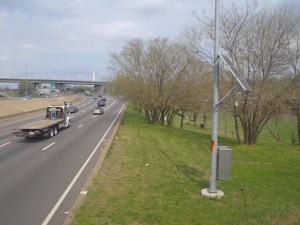
While I think the site itself is certainly worth visiting, what I really care about is a place located just above the actual burial grounds. From this vantage, you can see that less than 50 yards away from this place of contemplation is Interstate 95 in all of its glory. The cars and tractor trailers fly by on this crazy asphalt slingshot that shoots cars straight through the heart of my city. Like all highways, it’s a totally anonymous no man’s land where you don’t walk, you don’t slow down, and you don’t typically notice the historic burial grounds nearby. When you’re on a highway like this, you don’t care much for where you are because you’re more focussed on where you’re going. That’s essentially the nature of movement.

To get the photo above, I climbed up a little hill to the foot of the Broad St. bridge I had previously walked underneath. For a while, I just sat up on the hill and watched the disinterested movement of the highway next to the contemplative stillness of the old burial ground. I realized that we need both the movement and the moment, but I think sometimes we feel like we have to make a choice: You have to be either ambitious or thoughtful, motivated or lazy. When I experience a place like this, it reminds me that we should be aware of both aspects of life. It also makes me a little more hopeful that my writing is still relevant. What I have learned through writing this blog is still teaching me and making the world a more interesting place.

While I was looking out on the scene, I realized that photos and words are limited media for describing ideas such as movement and moment. So I filmed a brief and simple video (below) that might help to further explain this relationship. It’s much more about the idea than the video itself … and I recommend muting the video sound and listening to Lisbon, OH by Bon Iver while you watch it.

As always, more to come.

P.S.  to Gwarlingo for the movement/moment pairing … it used to be found in their explanation of the meaning of the word Guarlingo which is Welsh for the sound a grandfather clock makes before it strikes on the hour, “the movement before the moment.” Of course, my blog is about the movement and the moment, but I thought it was an interesting side note.

The Tributaries of Culture

I love an introduction that says, “this is what I learned from writing this book and this is how it has developed my perspective.” The following, from Bob Deans, does just that:

“Finally, the James became for me, not only the stage along which so much of our essential history has played out, but a living metaphor for who we are as a diverse and democratic rushing from the tributaries of varied cultures into a single stream held in its channel by the national story, shared inheritance, and common purpose that gather the American people as one.”
 
Deans, Bob. The River Where America Began, xv.
 

Hayden White on Narrative

I was looking back through The Houses of History the other day and I was struck (once again) by Hayden White’s article “The Fictions of Factual Representation.”

Here are two excerpts:

“Most nineteenth-century historians did not realize that, when it is a matter of trying to deal with past facts, the crucial consideration for him who would represent them faithfully are the notions he brings to his representation of the ways parts relate to the whole which they comprise.
 
They did not realize that the facts do not speak for themselves, but that the historian speaks for them, speaks on their behalf, and fashions the fragments of the past into a whole whose integrity is—in its representation—a purely discursive one.
 
Novelists might be dealing only with imaginary events whereas historians are dealing with real ones, but the process of fusing events, whether imaginary or real, into a comprehensible totality capable of serving as the object of representation, is a poetic process.”
 
“These fragments have to be put together to make a whole of a particular, not a general kind.”

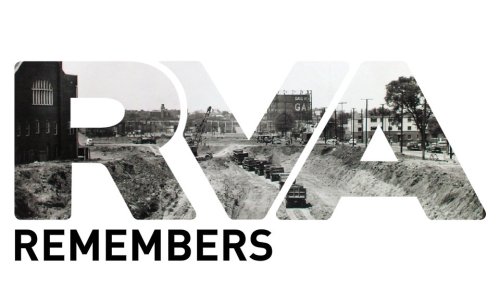
RVA Remembers

Make your own at http://rvacreates.com/generator.php

Whence, What, Whither

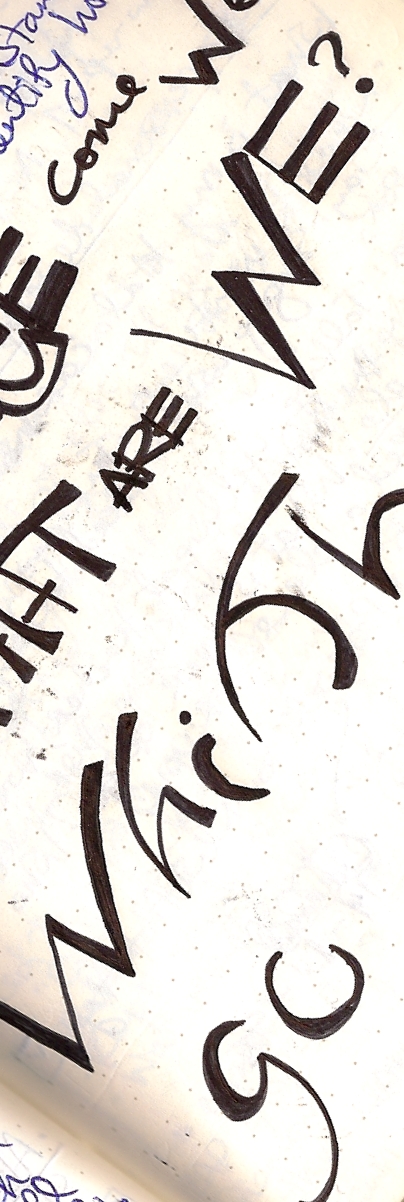
Last Saturday I was thinking about Paul Gauguin’s painting “Whence come we? What are we? Whither go we?” So as I thought about the questions, I wrote them out in some random fonts and scanned the page. I got one good scan, but I think I prefer the image below where the scanner randomly cropped it:

This Ignorant Present

I heard a quote from Macbeth that I thought was interesting:

“Thy letters have transported me beyond
This ignorant present, and I feel now
The future in the instant.”


Haunted Houses

Yesterday, I published a post titled, “The Memories That Haunt the Mind,” and today all I can think about is “haunted houses.” I see now that in many ways we are vessels of the past, old houses carrying memories of ghosts into the future. We are haunted houses.

I know this is a bit of a stretch, but I am, after all, a spatial thinker. It usually helps me to understand concepts if I can map them out in three dimensions. So when I encounter descriptions of places, I often read them as metaphors for life. Perhaps that is even the foundational process of this blog, but I digress. This morning as I read through Isaiah 64, I was struck by the language of lament for lost places. Babylon has invaded and destroyed all that was loved in Jerusalem and her people are mourning the loss. Verses 10 and 11 read,

“Your holy cities have become a wilderness; Zion has become a wilderness, Jerusalem a desolation. Our holy and beautiful house, where our fathers praised you, has been burned by fire, and all our pleasant places have become ruins.”
 

I feel in these verses such a nostalgia for places as they once were: the idealized past. This nostalgia also points to the attitude of the refuge struggling to find meaning in a foreign land. Of course, there is certainly the desperation of a prophet in exile: crying out to a God to which he has committed his life’s work. But most of all, as I moved through this passage, I sensed the sadness and defeat of desecration. At the time, the Jewish people believed that God actually dwelled in these places that were endowed with a holy purpose. The tabernacle and later the temple in Jerusalem. This place was everything. Losing the city and the temple was likely more devastating than anyone could have imagined.

I was most profoundly struck by one phrase:

Our holy and beautiful house.”

Just stop for a moment and think about the attitude of these words. “There was once a perfect place,” they seem to say, “and we have lost it.”

Then my mind began to wander through some old thoughts about Christianity. I began to think about how the death and resurrection of Christ was supposed to have replaced the need for physical places of worship. When Jesus died on the cross, it is said that the curtain in the temple was torn from top to bottom. The centralized era of this faith had come to an end.

Now, we believe that the human body itself is indwelled by the spirit of the Lord.  In I Corinthians 6:19-20 it states, “Do you not know that your body is a temple of the Holy Spirit, who is in you, whom you have received from God?  You are not your own; you were bought at a price.  Therefore honor God with your body.” Additionally, Matthew 19:20 reads, “For where two or three gather in my name, there am I with them.” Thus, we collectively constitute the holy places of worship in this decentralized era of the Christian faith. Forget the buildings, we are the church.

And then it hit me: everything in this passage in Isaiah can be read as a description of people’s lives on earth. I am the temple. Human civilization is the city. We are the “holy and beautiful house.” And we have been defiled. Created with a purpose, we have been invaded and torn down.

We have lost our dignity, hope, joy, confidence, heritage, tradition. Foundations have cracked. Collectively, we are Zion: struggling, wandering people far from each other, far from home.

And I immediately began to embrace this idea of desecration in myself, my family, my friends, my students, my community, my country. Every day I see people engaging the weight of life. They fight, they embrace, they give up. Every day. We may not fully comprehend our personal shame. Perhaps we don’t think that we were created for any sort of higher purpose. Perhaps we don’t think we have been desecrated. But as I continue to engage the darker side of life I see that we have a deep need to be restored to each other.

We need to painfully return and embrace ourselves: chaos and all.

We need to walk the halls of this haunted house, to run our hands over dusty railings, to notice what has been broken, and perhaps to even find that our fears were unfounded. Haunted houses, after all, are just houses with a stigma. But as the stigma pervades, the house deteriorates. The structure fulfills the prophecy of the stigma … and the cycle continues.

So my thought for today is this: Seek restoration or you may begin to believe the lies that you have been told about yourself. Your life may then follow the lies and become their conclusion. Restoration is not a quick process — it may take a lifetime — but I feel that it is the only proper response. As Dallas Willard writes in The Spirit of the Disciplines, “The very substance of our bodies is shaped by our actions, as well as by grace, into pathways of good and evil.” The spiritual disciplines, Willard would say, are the daily habits which continually align our lives to our purpose.

I don’t have answers (see the Rilke quote at the end of my previous post for my opinion on answers), but as I continue to engage my questions, I continue to find that we often have more need for healing than we desire to admit. I am a prime example of this.

At this point, I am thankful for where I am in the context of where I could be. Now, I continue to hope and pray for continual restoration in myself and in others.

The Memories that Haunt the Mind

In church on Sunday we sang a song titled, “We Cannot Measure How You Heal.” I’ll be honest, usually when I sing in church I don’t have a clue what I’m singing about, but as I sang through this hymn I was struck by it’s message. After we finished singing, I wrote down the following excerpt:

“But present too is love which tends the hurt we never hoped to find,
the private agonies inside, the memories that haunt the mind.
So some have come who need Your help and some have come to make amends,
as hands present in the touch of friends.
Lord, let Your Spirit meet us here to mend the body, mind, and soul, 
to disentangle peace from pain, and make Your broken people whole.”
 

Most days I don’t like to think that I’ve picked up some baggage over the course of my short life. I don’t have the sort of personality that likes to revisit old pain, but every once in a while I have no choice. When I least expect it, the past asserts itself on my present and clouds my vision of the future. We aren’t always aware of this pain, but we all carry with us “the memories that haunt the mind.”

These memories often hold us back because they remind us of our weakest, most vulnerable moments. They remind us of times when we felt unloved. They remind us of when we failed. In these memories there is a lie that we will never amount to any more than that little boy or that little girl. I hate lies, but I especially hate the lies that trap us with small dreams. In the same way that the hymn speaks to the hurt of our past, I have been thinking a lot about the fears of our future. Like memories of the past, these can paralyze us and steer us away from our calling. So the other day I came up with my own metaphor for life somewhat following in the legacy of Rilke’s Letter To a Young Poet #4:

Chaos and despair. The flower has fallen from your brown, curly hair. But look up to the field of new days the Lord has given you. Pick each one with joy and vigor knowing that it too will fall. When it dies it will become the earth that composes the future. But don’t simply examine the earth! You cannot possibly know how it will direct the color and shape of the future. Simply know that each day the flower is restored and replaced.
 
In the same way, don’t look past it to the other flowers in the field. They are like specks of color on a painting: limited representations of reality. A closer look doesn’t tell you any more than what you already knew: this day too will come. And when it does, as if sprouted from the canvas itself, that day will desire your attention and affection. But that day is not today.
 
Today, as is true in the case of a painting, you must take a step back and begin to simply appreciate what you cannot understand. The future for what it is.
 

So that’s my thought for today: what you can’t understand should not dictate your outlook. Rather, let what is true guide you and let yourself breathe in the space you have been given. Today. As Rilke writes,

“Don’t search for the answers, which could not be given to you now, because you would not be able to live them. And the point is, to live everything. Live the questions now. Perhaps then, someday far in the future, you will gradually, without even noticing it, live your way into the answer.”
 

Amen.