Category Archives: Significance

Movement and Moment

Over the course of the past year, I’ve been writing my way through a bunch of different thoughts and ideas and the result has basically become the entirety of this blog. At the same time, I’ve also been gradually trying to connect the dots with one underlying theme: that life is all about circulation and significance, the movement as well as the moment.

Since my words don’t always make a lot of sense, I’m constantly trying to find new ways to explain myself and share what I think is interesting about the world: examples of circulation and significance in our daily lives. Most of these places are either what I consider Highways (circulation) or Hallowed Halls (significance). Today, I get to write about a place that embodies both of these characteristics and the tension that exists between the two.
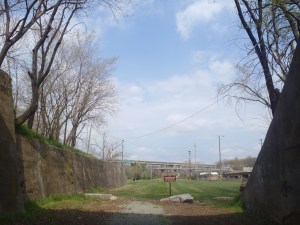
I recently visited the Negro Burial Ground just east of downtown Richmond in Shockoe Valley. My approach to this site was across a VCU parking lot and through a tunnel under Broad St. As you walk through the tunnel, you emerge onto a huge empty field of beautiful grass that was once yet another parking lot in downtown Richmond. In recent years, the asphalt was removed and this area was designated “A Place of Contemplation and Reflection.” I appreciate this area mostly because it’s a complicated place. There aren’t physical buildings that most people would consider “historic,” but what happened on this one piece of ground (the public execution and careless burial of enslaved and free people) is considered enough to make the place significant today. Once a place of fear and violence, it has been restored to the people of Richmond as a place of silence and careful thought.
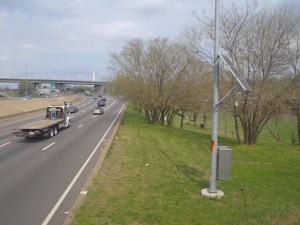
While I think the site itself is certainly worth visiting, what I really care about is a place located just above the actual burial grounds. From this vantage, you can see that less than 50 yards away from this place of contemplation is Interstate 95 in all of its glory. The cars and tractor trailers fly by on this crazy asphalt slingshot that shoots cars straight through the heart of my city. Like all highways, it’s a totally anonymous no man’s land where you don’t walk, you don’t slow down, and you don’t typically notice the historic burial grounds nearby. When you’re on a highway like this, you don’t care much for where you are because you’re more focussed on where you’re going. That’s essentially the nature of movement.

To get the photo above, I climbed up a little hill to the foot of the Broad St. bridge I had previously walked underneath. For a while, I just sat up on the hill and watched the disinterested movement of the highway next to the contemplative stillness of the old burial ground. I realized that we need both the movement and the moment, but I think sometimes we feel like we have to make a choice: You have to be either ambitious or thoughtful, motivated or lazy. When I experience a place like this, it reminds me that we should be aware of both aspects of life. It also makes me a little more hopeful that my writing is still relevant. What I have learned through writing this blog is still teaching me and making the world a more interesting place.

While I was looking out on the scene, I realized that photos and words are limited media for describing ideas such as movement and moment. So I filmed a brief and simple video (below) that might help to further explain this relationship. It’s much more about the idea than the video itself … and I recommend muting the video sound and listening to Lisbon, OH by Bon Iver while you watch it.

As always, more to come.

P.S.  to Gwarlingo for the movement/moment pairing … it used to be found in their explanation of the meaning of the word Guarlingo which is Welsh for the sound a grandfather clock makes before it strikes on the hour, “the movement before the moment.” Of course, my blog is about the movement and the moment, but I thought it was an interesting side note.
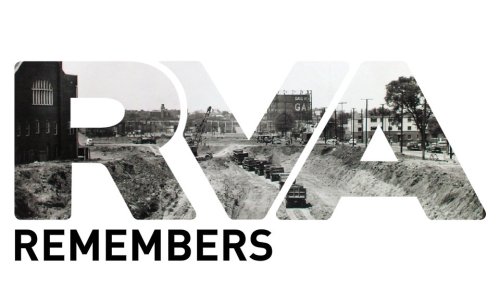
RVA Remembers

Make your own at http://rvacreates.com/generator.php

Whence, What, Whither

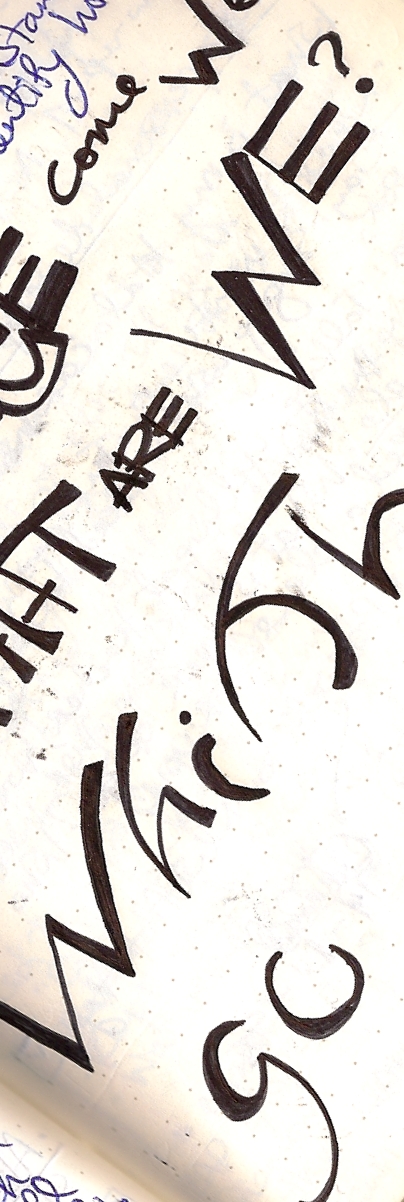
Last Saturday I was thinking about Paul Gauguin’s painting “Whence come we? What are we? Whither go we?” So as I thought about the questions, I wrote them out in some random fonts and scanned the page. I got one good scan, but I think I prefer the image below where the scanner randomly cropped it:

Haunted Houses

Yesterday, I published a post titled, “The Memories That Haunt the Mind,” and today all I can think about is “haunted houses.” I see now that in many ways we are vessels of the past, old houses carrying memories of ghosts into the future. We are haunted houses.

I know this is a bit of a stretch, but I am, after all, a spatial thinker. It usually helps me to understand concepts if I can map them out in three dimensions. So when I encounter descriptions of places, I often read them as metaphors for life. Perhaps that is even the foundational process of this blog, but I digress. This morning as I read through Isaiah 64, I was struck by the language of lament for lost places. Babylon has invaded and destroyed all that was loved in Jerusalem and her people are mourning the loss. Verses 10 and 11 read,

“Your holy cities have become a wilderness; Zion has become a wilderness, Jerusalem a desolation. Our holy and beautiful house, where our fathers praised you, has been burned by fire, and all our pleasant places have become ruins.”
 

I feel in these verses such a nostalgia for places as they once were: the idealized past. This nostalgia also points to the attitude of the refuge struggling to find meaning in a foreign land. Of course, there is certainly the desperation of a prophet in exile: crying out to a God to which he has committed his life’s work. But most of all, as I moved through this passage, I sensed the sadness and defeat of desecration. At the time, the Jewish people believed that God actually dwelled in these places that were endowed with a holy purpose. The tabernacle and later the temple in Jerusalem. This place was everything. Losing the city and the temple was likely more devastating than anyone could have imagined.

I was most profoundly struck by one phrase:

Our holy and beautiful house.”

Just stop for a moment and think about the attitude of these words. “There was once a perfect place,” they seem to say, “and we have lost it.”

Then my mind began to wander through some old thoughts about Christianity. I began to think about how the death and resurrection of Christ was supposed to have replaced the need for physical places of worship. When Jesus died on the cross, it is said that the curtain in the temple was torn from top to bottom. The centralized era of this faith had come to an end.

Now, we believe that the human body itself is indwelled by the spirit of the Lord.  In I Corinthians 6:19-20 it states, “Do you not know that your body is a temple of the Holy Spirit, who is in you, whom you have received from God?  You are not your own; you were bought at a price.  Therefore honor God with your body.” Additionally, Matthew 19:20 reads, “For where two or three gather in my name, there am I with them.” Thus, we collectively constitute the holy places of worship in this decentralized era of the Christian faith. Forget the buildings, we are the church.

And then it hit me: everything in this passage in Isaiah can be read as a description of people’s lives on earth. I am the temple. Human civilization is the city. We are the “holy and beautiful house.” And we have been defiled. Created with a purpose, we have been invaded and torn down.

We have lost our dignity, hope, joy, confidence, heritage, tradition. Foundations have cracked. Collectively, we are Zion: struggling, wandering people far from each other, far from home.

And I immediately began to embrace this idea of desecration in myself, my family, my friends, my students, my community, my country. Every day I see people engaging the weight of life. They fight, they embrace, they give up. Every day. We may not fully comprehend our personal shame. Perhaps we don’t think that we were created for any sort of higher purpose. Perhaps we don’t think we have been desecrated. But as I continue to engage the darker side of life I see that we have a deep need to be restored to each other.

We need to painfully return and embrace ourselves: chaos and all.

We need to walk the halls of this haunted house, to run our hands over dusty railings, to notice what has been broken, and perhaps to even find that our fears were unfounded. Haunted houses, after all, are just houses with a stigma. But as the stigma pervades, the house deteriorates. The structure fulfills the prophecy of the stigma … and the cycle continues.

So my thought for today is this: Seek restoration or you may begin to believe the lies that you have been told about yourself. Your life may then follow the lies and become their conclusion. Restoration is not a quick process — it may take a lifetime — but I feel that it is the only proper response. As Dallas Willard writes in The Spirit of the Disciplines, “The very substance of our bodies is shaped by our actions, as well as by grace, into pathways of good and evil.” The spiritual disciplines, Willard would say, are the daily habits which continually align our lives to our purpose.

I don’t have answers (see the Rilke quote at the end of my previous post for my opinion on answers), but as I continue to engage my questions, I continue to find that we often have more need for healing than we desire to admit. I am a prime example of this.

At this point, I am thankful for where I am in the context of where I could be. Now, I continue to hope and pray for continual restoration in myself and in others.

The Memories that Haunt the Mind

In church on Sunday we sang a song titled, “We Cannot Measure How You Heal.” I’ll be honest, usually when I sing in church I don’t have a clue what I’m singing about, but as I sang through this hymn I was struck by it’s message. After we finished singing, I wrote down the following excerpt:

“But present too is love which tends the hurt we never hoped to find,
the private agonies inside, the memories that haunt the mind.
So some have come who need Your help and some have come to make amends,
as hands present in the touch of friends.
Lord, let Your Spirit meet us here to mend the body, mind, and soul, 
to disentangle peace from pain, and make Your broken people whole.”
 

Most days I don’t like to think that I’ve picked up some baggage over the course of my short life. I don’t have the sort of personality that likes to revisit old pain, but every once in a while I have no choice. When I least expect it, the past asserts itself on my present and clouds my vision of the future. We aren’t always aware of this pain, but we all carry with us “the memories that haunt the mind.”

These memories often hold us back because they remind us of our weakest, most vulnerable moments. They remind us of times when we felt unloved. They remind us of when we failed. In these memories there is a lie that we will never amount to any more than that little boy or that little girl. I hate lies, but I especially hate the lies that trap us with small dreams. In the same way that the hymn speaks to the hurt of our past, I have been thinking a lot about the fears of our future. Like memories of the past, these can paralyze us and steer us away from our calling. So the other day I came up with my own metaphor for life somewhat following in the legacy of Rilke’s Letter To a Young Poet #4:

Chaos and despair. The flower has fallen from your brown, curly hair. But look up to the field of new days the Lord has given you. Pick each one with joy and vigor knowing that it too will fall. When it dies it will become the earth that composes the future. But don’t simply examine the earth! You cannot possibly know how it will direct the color and shape of the future. Simply know that each day the flower is restored and replaced.
 
In the same way, don’t look past it to the other flowers in the field. They are like specks of color on a painting: limited representations of reality. A closer look doesn’t tell you any more than what you already knew: this day too will come. And when it does, as if sprouted from the canvas itself, that day will desire your attention and affection. But that day is not today.
 
Today, as is true in the case of a painting, you must take a step back and begin to simply appreciate what you cannot understand. The future for what it is.
 

So that’s my thought for today: what you can’t understand should not dictate your outlook. Rather, let what is true guide you and let yourself breathe in the space you have been given. Today. As Rilke writes,

“Don’t search for the answers, which could not be given to you now, because you would not be able to live them. And the point is, to live everything. Live the questions now. Perhaps then, someday far in the future, you will gradually, without even noticing it, live your way into the answer.”
 

Amen.

Thoughts from “The Creative Call”

Some artistic people in my life are reading a book right now called The Creative Call. It’s great. There’s a lot of wisdom for people who feel like they never “found their artistic voice” or perhaps never identified as “creative.” If you lack a medium through which you can express the inexpressible, this book is for you. *Just as a side note, this book is a Christian perspective of creativity in life, but there are plenty of secular examples to choose from such as The War of Art and The Creative Habit that beckon readers to reengage their creative side without also talking faith and the Christian life.

The following paragraphs are some responses to a section of a chapter of The Creative Call … it’s nothing special, but I thought it might be an interesting way for others to get a glimpse into my personal relationship with art through the years. Also, I hope anyone that stumbles on this post might think about their own artistic story and find some of their own answers to these questions.

Was there an earlier time in life that you produced art?

I used to make more “creative things” (e.g. bean bags, necklaces, cities in the sand, scarves, castles, drawings) when I was younger. I wasn’t really that cool, but at the time it didn’t matter. Besides, I had the privilege of growing up in a group that didn’t really want to be cool relative to other communities … it was a nice social cocoon. Then I moved into junior high and high school and literally left it behind. No more art classes, no more random projects (that I recall) and seldom did I read for fun as I had in my childhood. I sort of lost that self-confidence that one needs to tinker alone for hours on end with no advice or affirmation.

I was gradually pulled outward as I matured into a more social, active life. As I moved through my room during this post-art era, I often viewed my old paintings and drawings as ruins in Middle Earth … relics of a lost civilization. While I moved on from these visual arts, I realize that I began to move into the “written arts.” This shift has continued from that time except for a few noteworthy ventures into painted worlds at “art parties” my senior year of high school and during a class on “Observational Painting” my junior year of college. Otherwise, I suppose, writing has become my voice. Here’s a relic from early high school: an example of this shift as I struggled through my early adolescence:

“Enter la chimera cha; take my sorrows, learn to draw. 
A sword to take the life of one seeking solace from the sun.
From afar it seems so sweet, upon arrival Charon greets. Means to end 
surreal strife, death alone—that radiant life.”
 

“I would practice art if only …”

I would practice my art more often if I weren’t always around people: drawn to connect and afraid to retreat. I recently read a quote from Stephen King’s On Writing: A Memoir of the Craft” in which he writes,

“It starts with this: put your desk in the corner, and every time you sit down there to write, remind yourself why it isn’t in the middle of the room. Life isn’t a support system for art. It’s the other way around.”
 

When I read this quote I realized that in the past decade of my life I’ve been stretched far too thin and removed my support system of art and creativity. I definitely need to stay connected to my community, but as I become more healthy I think I’ll learn to withdraw more often. I often find myself blogging late at night (currently 1 a.m.) because I’ve already committed the rest of my day.

“I’ll start making time for art when …”

I’ll start making time for art when I’m not doing this yearlong internship, when I have more direction for my first book, when I know that I will be able to support myself monetarily (any wealthy patrons out there?), or when I start a graduate program that requires me to daily engage my creative mind.

“I’d be doing my art right now if it weren’t for …”

I don’t really know what my art is. If it’s writing, then I think I am doing my art right now, but sometimes writing feels more like a conviction. I realized the other day that I feel compelled to write … it’s much less a hobby than it is a part of who I am. I also wonder if creativity can get lost in obnoxious intellectual thoughts.

As I continue to write, I want to push myself to more actively integrate my design and personal narrative to perhaps make the process more “creative.” Perhaps the end product would be “my art.”

“I’d always hoped that I’d …”

To be honest, I had always hoped that I would go completely off the deep end, produce something incredible, then die an early death. This thought first entered my mind as I read Housman’s “To An Athlete Dying Young” and lingered in the recesses for years to come. I wasn’t really morbid about the thought of dying young, but I distinctly remember thinking that my talent would be more influential as tragic unrealized potential. I’d always hoped that I would be tragic, but at the same time I almost always followed the rules.

“I wish I had the courage to …”

I wish I had the courage to tell my own story in a compelling and innovative way. And to let go of the hometown ties that hold me back and keep me from being exposed as a human with flaws and fears. I also wish I had the courage to get past my fear of public humiliation (and latent political ambition) to just be myself. I’m thankful that I have let go of most of the hang-ups from my earlier years, but there will always be something new.

“If I could go back in time I would …”

… produce more at an early age, stop feeling alone on the margins and embrace my strengths as gifts to be used. Also, I would learn how to play the piano and cook great food. I might even learn to dance.

My hope deferred is the thought of me as a classy, unique, professional person, confident, yet realistic and sincere. Right now, I’m afraid I hide behind my words too much. While I’m glad to have further honed this skill, I hope to eventually use writing in a less esoteric way that people can still appreciate and enjoy.

Favorite words (and phrases):

Portmanteau, sin qua non, mutatis mutandis, latent, urbane, nascent, apex, zenith, delight, hallowed, space, amaze, past, significance, embrace, huzzah, fearsome, boulevard, difference, terrifying, nostalgia, anticipate, potential, place, remain, resent, longing, resist, gruesome, lament, sunrise, society, dissonance.

Special thanks to @brainpicker‘s New Year’s Resolution Reading List: 9 Books on Reading and Writing for a great survey.

C is for Cemetery

Cemeteries are memory personified.

They are the tangible outcome of the human desire to be remembered. The desire to last beyond our death. They are the pyramids of the masses; each grave a person’s last chance to make their case for God and men. Cemeteries are also a halmark of civilized society … not everyone receives the dignity of a headstone. And because not all headstones are created equal, they’re also a tangible and public investment in the future of the family name.

In his book, The Language of Towns and Cities, Dhiru Thadani writes an entry for cemeteries that includes two photos of Hollywood Cemetery in Richmond. “Authentic towns and cities have cemeteries,” he writes, “and space should be planned to accommodate this essential component when designing new towns.” When I read this, I appreciated Thadani’s attention to the value of cemeteries in modern life. I also considered it a bit of a coup for Richmond considering the other noteworthy cemeteries in America. Then again, it’s completely justified.

There is something so basic and yet remarkable about the time and care that was taken in the planning and development of Hollywood Cemetery. It’s no wonder Richmond’s aristocracy used to picnic on the hills of Hollywood overlooking the James River. They escaped the smoke of the city, tidied up their family plot, and caught a cool breeze on warm summer days. Since the cemetery was first planned, it has been maintained, improved, and today remains a destination in this old American city. A brick walkway was added to create “President’s Circle” where two former US presidents are buried. The cemetery stands, in part, as a testament to the longevity of power and tradition in American society.
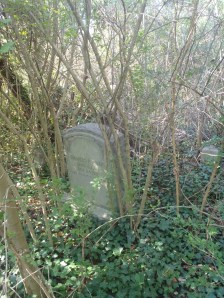
Another remarkable cemetery in Richmond, one that is not highlighted in Thadani’s epic, is Evergreen Cemetery. I visited Evergreen four days before I visited Hollywood and, as anyone would tell you, the difference is stark. Where one has improved, the other has declined. Where one is prominently placed on the hills overlooking the James, the other is beside a highway in Church Hill. Where one is a testament to power, the Other is a testament to the longevity of systemic stigmatization and shame.
At one time, Evergreen Cemetery must have been a place of prominence in the black community. At least a generation of leaders, their family and friends were buried in this place. The most noteworthy resident is of course the famed Maggie L. Walker: the first American woman to “charter a bank in the United States.” Her grave, like many others, is now shaded in the canopy of a forest that has grown where there was once a field. Mausoleums have been raided, pathways are hidden by brush, and the lives of black Richmond are gradually being lost to time.

With cemeteries, it’s always difficult to understand who is responsible for upkeep. The children of the deceased, the businessmen who sold the plots, or the society at large. The more fascinating question to me, of course, is not who, but why? At its most fundamental level, the maintenance of graves is actually a maintenance of one’s personal identity and heritage. In the case of Hollywood, this is both American and Confederate heritage. In both cases, the members of these groups seem totally unashamed of their pride. They live boldly in their past and work tirelessly to maintain the vestiges which prove it’s legitimacy.

In contrast, the people who would have maintained a place such as Evergreen were a vastly more manipulated and displaced group in the twentieth century. The successful class of black Richmonders, once confined to the city, were proud to erect monuments and sustain traditions that defied the white power structure’s condescending narrative of black inferiority. Once segregation was overthrown, however, many left the city behind and perhaps coincidently left behind their heritage as well. Of course, this is true of nearly every American who left the city in the twentieth century. And yet, one cemetery shines and the other is being slowly eroded by time.

“Segregated at Death” was a title that I considered for this post, but I decided that  it wasn’t the message with which I wanted to lead. I decided that it would be more worthwhile to simply present these two cemeteries and hopefully develop more of a holistic understanding of both (and cemeteries in general) in the context of the other. Thadani’s omission of Evergreen is unfortunate, but not unexpected: his work is often more concerned with aesthetic than politics. For me, I believe that if if we’re going to talk about cemeteries, we ought to at least consider both sides of the American color line to get the full story.

If anyone else wants to start tearing down trees at Evergreen let me know! I still think it can be saved and I would love to be a part of clearing the brush from old Richmond graves. The task is daunting (if you’ve been there, you know), but I think would be worth it.

Perhaps the more we work the more we will know why.

This slideshow requires JavaScript.

This post is a part of a series I’m putting together on my RVA page.

The Body of the Enemy

Tomorrow is the day we have set aside to commemorate the life of Dr. Martin Luther King Jr, one of the most famous leaders of the black struggle for dignity in the Western hemisphere. Whether King is remembered as the man who fought for equality or the pastor who taught the love of Jesus Christ, one thing is certain: King has been remembered.

This morning, I had the pleasure of visiting one of the greatest hallowed halls of American Christianity: The Washington National Cathedral. While it still feels a little odd that America has an official church, I am thankful that I had the opportunity to experience such a grand space in my nation’s capitol. In anticipation of the holiday, the memory of King was woven throughout nearly every message. My favorite example of this was the old testament reading:

“The man said, ‘They have gone away, for I heard them say, ‘Let us go to Dothan.’ So Joseph went after his brothers, and found them at Dothan. They saw him from a distance, and before he came near to them, they conspired to kill him. They said to one another, ‘Here comes this dreamer. Come now, let us kill him and throw him into one of the pits; then we shall say that a wild animal has devoured him, and we shall see what will become of his dreams'” (Genesis 37:17b-20).

As I heard the story of Joseph’s betrayal, I was struck by that line “and we shall see what will become of his dreams.” To the brothers, killing Joseph seemed the most conclusive way to end his behavior (and perhaps prevent similar behavior in the future). “He’s different, he doesn’t act like us, and he has received unmerited favor from our father … so we must end his life.” That, they believed, was the only way that they could sustain their fragile identities of tradition and status quo.

On April 4, 1968, a sad man named James Earl Ray believed much the same lie. He believed, I can only imagine, that the life of Dr. King was a constant and perfectly reasonable assault on his racist ideology. Thus, he killed the man that galvanized a movement that awoke a nation. But did he kill the dream?

In the story of Dr. King and of Joseph, I am reminded that people will go to great lengths to secure and maintain their place in society. This process could entail shunning someone or beating someone into submission, but in moments of greatest desperation, it is the life of the body, not the ideas of the person, that must be destroyed. This is most true in the case of Dr. King, who’s black skin alone was a political statement of insurrection to his assassin. I can think of many dramatic examples (“American Beauty,” for one) that convey the fear and rage that is felt toward someone who’s very existence seems to undermine the identity of another.

Still today, there are people who feel compelled to murder. In my city, homicides regularly remind me of this most basic fight for recognition and security. Men and women are killed for many reasons, but believe it is primarily motivated by a basic desire for power. White it is dramatic, murder of another cannot successfully heal the insecurities in the self. These insecurities are only momentarily mitigated by the finality of death.

James Earl Ray’s name is all but forgotten because the murder of MLK did not secure white supremacy as Ray intended. One bullet couldn’t stop millions of people. But he did, perhaps unknowingly, prevent us from forming a complex, humanized memory of the person of King. Today, the story of the man seems to have been set into a field of static nostalgia.

And now James Earl Ray is dead as well and I have to wonder why he even bothered to kill King in the first place. Murder is sad to me because it seems so foolish and all too common. Still, as long as murder exists there will be the temptation to end the life of the other. The body of the enemy, not the ideology of the self, seems like an easier place to affect change.

This is one of those sad realities, but I can’t let murder overshadow life. Instead, we must go on living with the discipline of faith and the hope that one day we will all be made whole. As King himself proclaimed the night before he was killed,

“I’m not worried about anything, I’m not fearing any man. Mine eyes have seen the glory of the coming of the Lord.”

Let it come.

P.S. My two most frequently visited MLK speaches:
King’s Mountaintop Speech
The Drum Major Instinct
 

A is for Adaptive Reuse

There is nothing more creative than adaptive reuse. In a world of earth movers and concrete slabs, redeveloping old buildings has become more rare than starting from scratch. Adaptive reuse forces creative builders to work in an existing space and create something that honors the history of the space while also recreates a new use for old bricks.

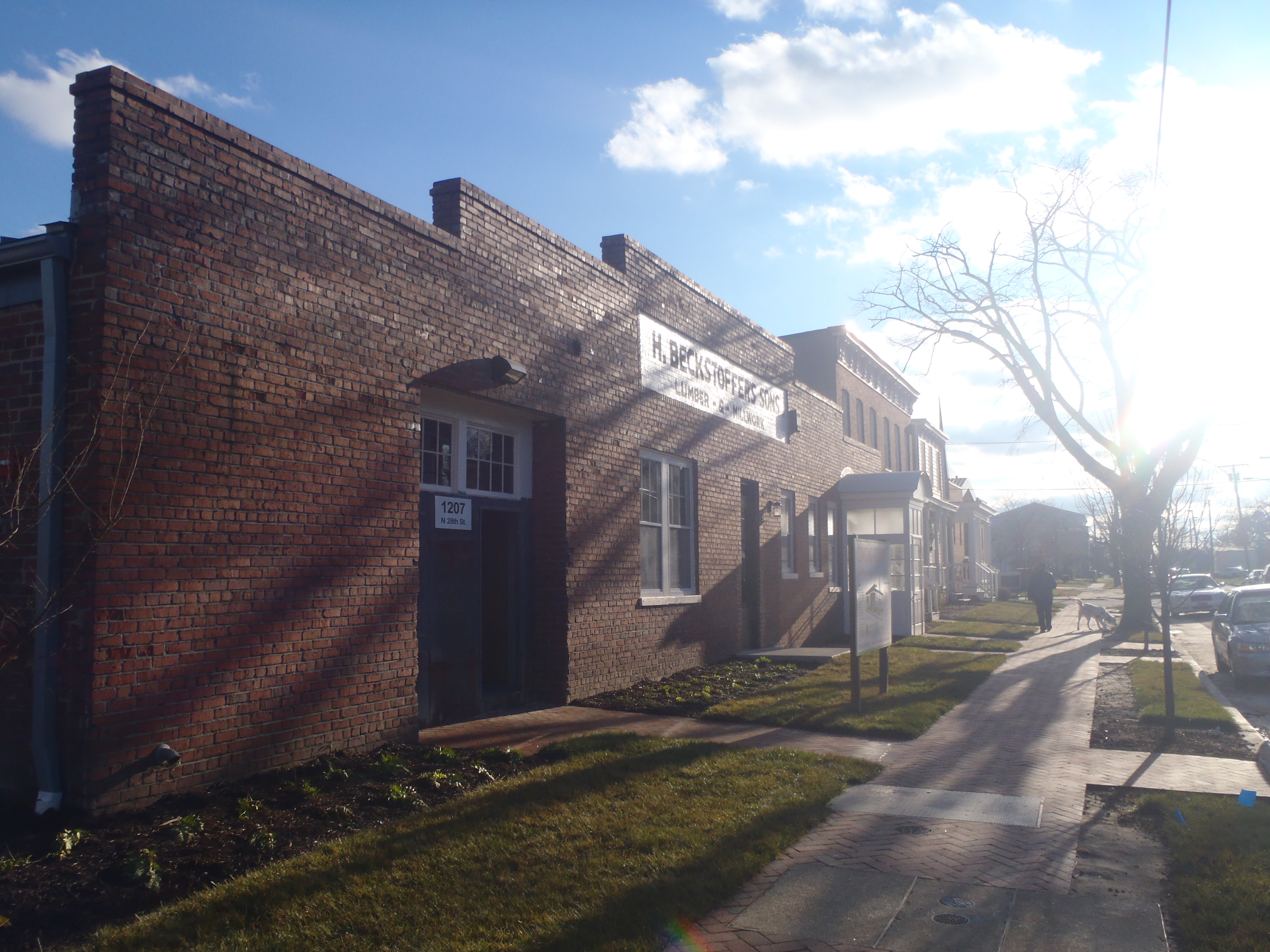
My favorite current adaptive reuse project in Richmond is the Live/Work Lofts at Beckstoffer’s Mill. I like this project because it’s compact (one city block), extremely well-done (down to the brick sidewalks), and it’s in the middle of a neighborhood. The old wood mill has been reimagined and resurrected for twenty-first century use. Yay for creativity and hard work in Church Hill.

This is a part of my, Cataloguing Richmond series on my RVA page.

D is for Duck

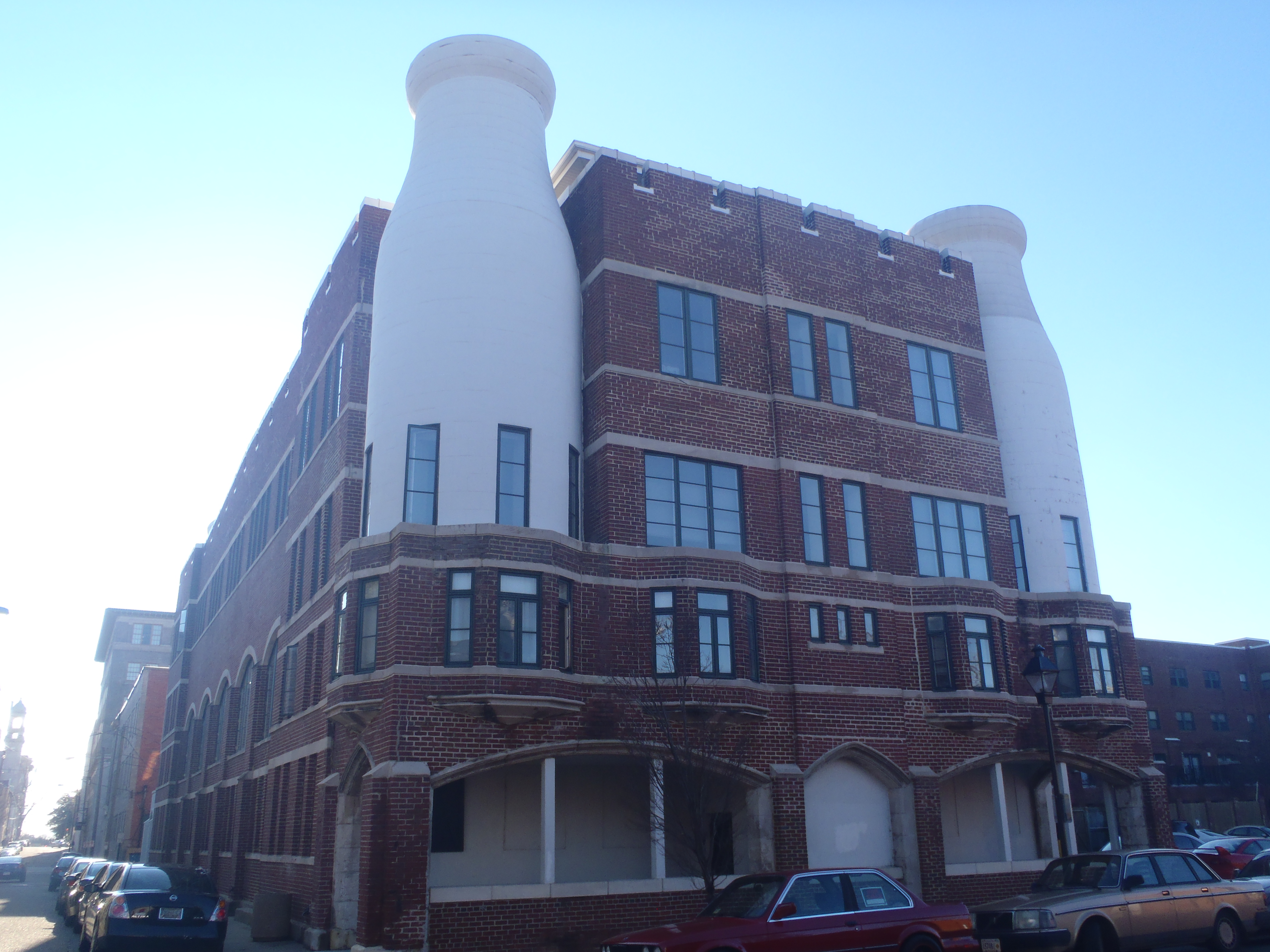
Since I’ve received so much feedback for an early post on the Kickers buildings in East Texas, I wanted to add a new post on a building in Richmond that attempts to “be” what it is (a “duck” a la Venturi). The old Richmond Dairy Company building on Jefferson and Marshall has intrigued me since the first day I saw it. An gothic-style brick building, there are three corners that were built out, rounded and shaped like giant milk bottles. The best thing about this building design? Don’t need a sign.

This post is part of a series I’m putting together on my RVA page.