For the last week or so I’ve been thinking about the Celtic holiday of Samhain. I don’t know much about the Celtic holidays, but I read a book once about a home called Bealtine Cottage and at the very least the idea of Bealtine planted a seed in my mind.
After some deep dives, I’ve learned that Samhain is essentially the “pagan” holiday that Catholics co-opted when they created All Hallows Eve (and All Souls, etc.). In a further twist of colonialism, it is also basically the origin of Dia de los Muertos – a holiday some see as a Catholic invention/amalgamation of existing rituals and beliefs.
Anyways, a witch on Instagram made a video saying that tonight is actually the best time to set resolutions and to plan for the work ahead. This night marks the end of the Celtic year and the beginning of the “dark half” of the year. This is a time when we are inside more, when gardens and farms have begun to rest. We often use this time to focus inward and draw close to friends, family, and partners.
With all this energy in the air, I decided it was time to take some small steps of preparation. With the help of our kids, we cleaned out several bags of toys and started to organize their play area. That felt like a nice small win. I am thinking about the fact that I’ll be inside more soon and feeling a desire to organize and repair more in general – there are so many projects that weigh me down more than I even realize.
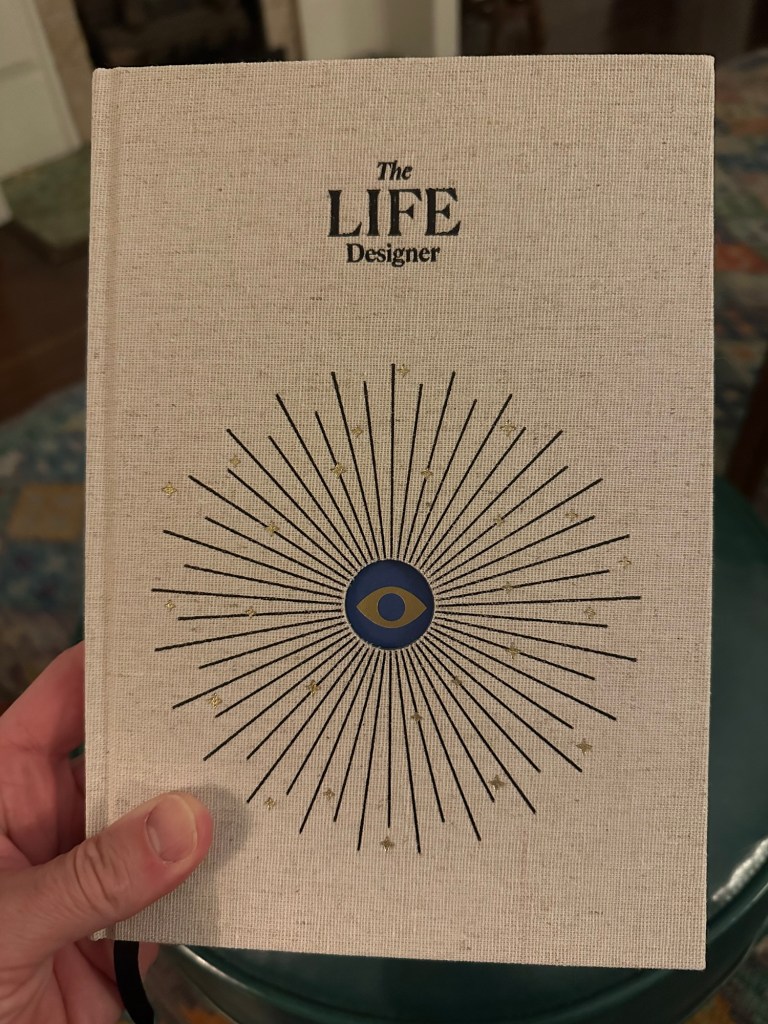
I also decided to start the new Life Designer workbook from Intelligent Change. I bought it before the Samhain connection, but soon realized that it would be perfect for this (new) new year.
At it’s core, it’s a workbook to plan the next ten years of my life. On October 31, 2035, I’ll be 47 years old. I actually started crying just typing that sentence.
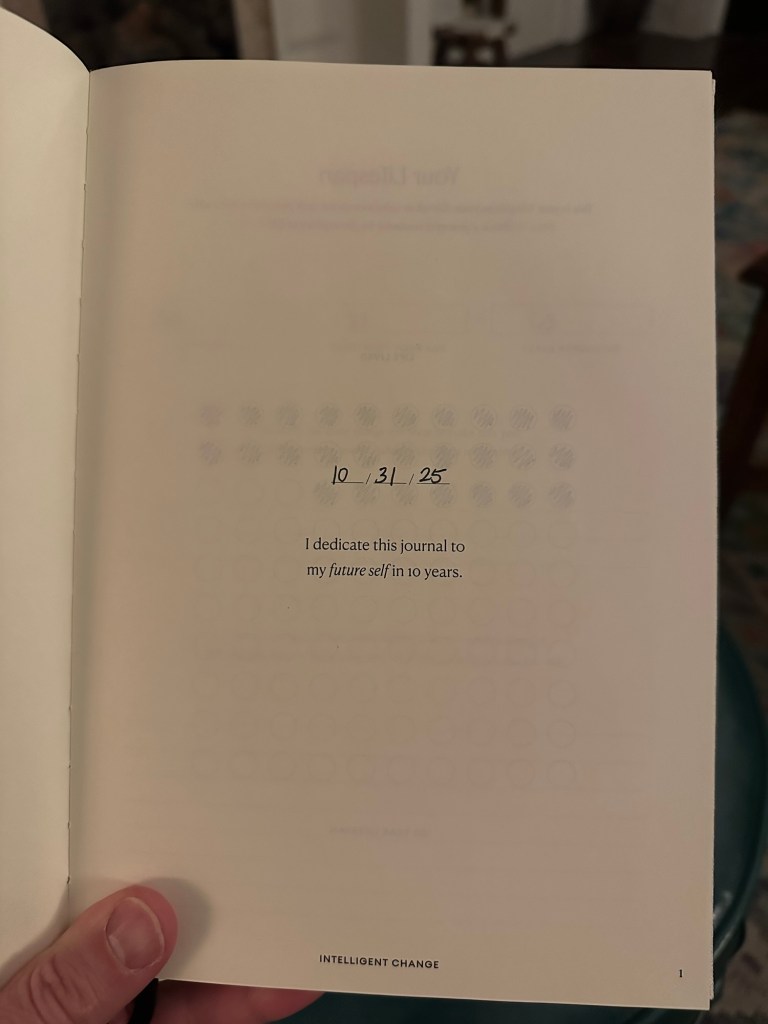
Oh, I also cried when I filled in this dedication page:
I really do not want to get older – I don’t know how else to say it. On the other hand, there have been so many days in my adult life that I’ve just wanted to be over so that I can sleep again.
I know that I have to fix my days before I can fix my years. And since I can’t avoid age, I can’t avoid work, I can’t avoid relationships, hopes, disappointments, responsibilities, etc., I know that it’s time to start thinking about what I want to build on the years I’ve lived so far. Because “the next ten years” are already here.
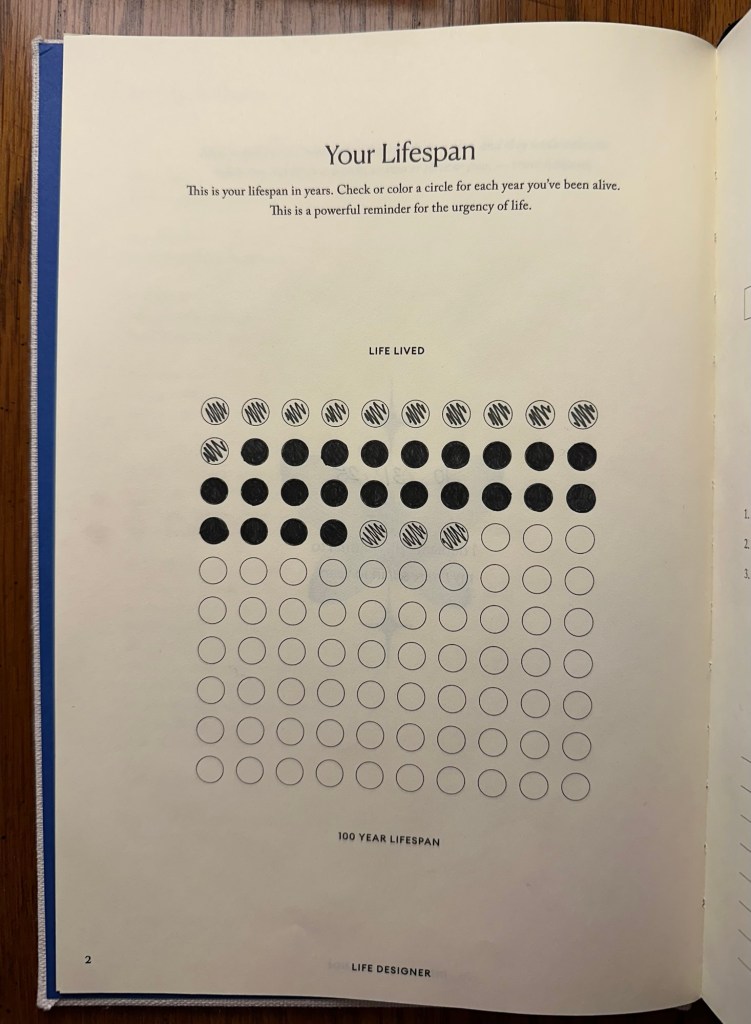
With my fear of getting older, it was encouraging to fill out this chart of the years that I’ve lived so far and see how many I presumably have left.
Even if I live to be 70 or 80 I still have a lot of life ahead of me. The first time I posted this page I did it wrong so this is a new photo. Also, I decided to black out the years that I was in the closet. I cried for a moment when it sunk in that I’ve only lived around 15 years of life not in the closet. Hiding took such a toll on me that I need to label those years differently. Also, being in the closet delays adolescence (like what a 15 year-old would be experiencing) so the past three years have looked very different than they would for someone who is not going through that.
I’ve only just started this workbook, and, based on the witch’s advice, I would like to finish it between now and the Winter Solstice. (update – I’m still working through it as of 1/20/26, but I’ll finish it when the time is right)
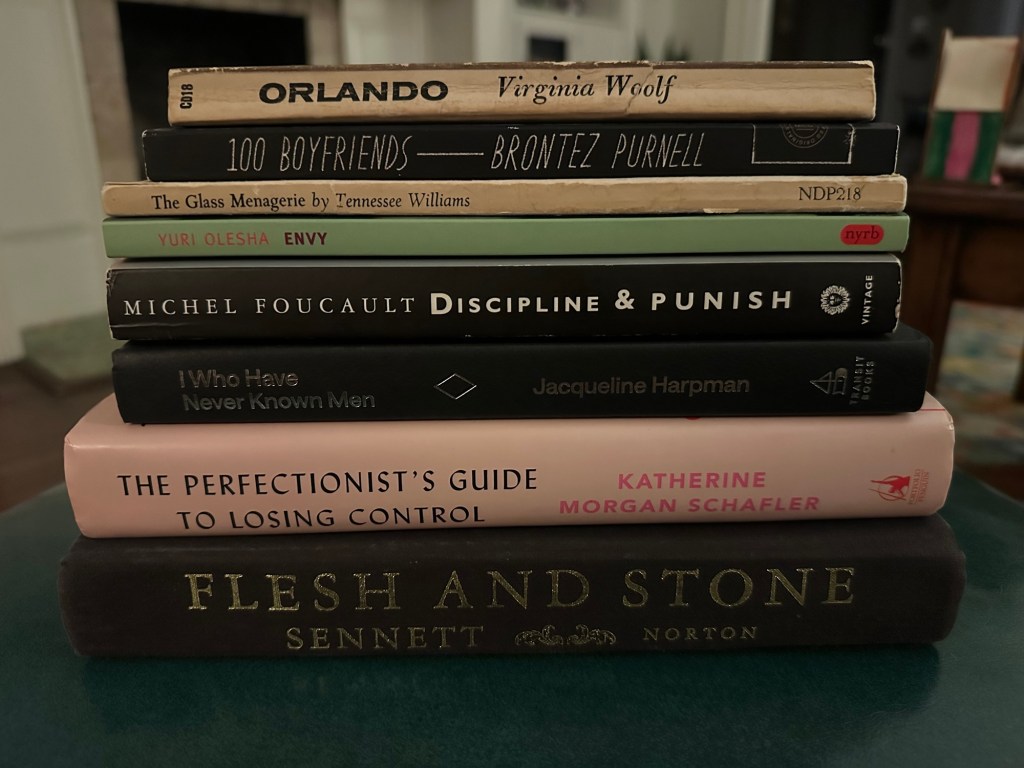
With the seasonal shift toward intentions, I also thought about books I might like to read over the next 12 months. I’ve pulled together a stack that I’m pretty excited about and replaced the one under my side table that has been sitting there for months (years?), mostly unappreciated. This new stack was chosen more carefully and I’d love to actually see the stack tick down as I read each one and the shelf empty by the next Samhain, 2026.
I started the Foucault and Sennett books around 2008 and 2011, respectively. I’ve only read the first chapter or so of each, but they have both been so influential to how I think about things that I’ve decided I’d like to finally finish them. Along with those two books, Orlando,100 Boyfriends, and The Glass Menagerie continue to round out my gay literature cannon. I Who Have Never Known Men and Envy (a personal problem, unfortunately) are two foreign language books I’m looking forward to. Finally, The Perfectionist’s Guide to Losing Control, a book I started during a hard time last year and have decided to pick back up during a new season of loss.
So much of this post may seem like I am trying to control my life, but I really do want to lose control more than anything. I want to let go of legalism, perfectionism, and self-criticism, especially. I am not going to feel like a failure if I don’t read all these books or achieve the life I envision exactly. I just know that there are some things in my life that almost never feel like work (even when they are work). I desire/intend to do much more of the work, to spend time with the people, and to inhabit the places that give me that kind of energy over the next 40 seasons of change.
When I finally started to come out of the closet, one of the ways that I processed my story was by reading through old journal entries.
So much has changed over the years and looking back has helped me connect with my younger self as well as understand why and how I managed to stay in the closet for so long. One particular aspect that feels important is that I had a long-term relationship with a “Christian counselor.”
The person I saw is a licensed therapist, but we always called what he did “Christian counseling.” And it did feel different from the therapy that I’ve experienced more recently. This post is not to drag an individual, but I am definitely critical of the idea of Christian counseling overall.
My main critique is simply that much of the “Christian” aspect is not based on research or best practices. For instance, here are some ways that Christian counseling is different from therapy in my experience:
My counselor prayed for me at the end of every session and asked that God would support me in my struggles. Prayer is seen as an encouragement, but in my experience it was often a way for me to give up control of my life to God. This prayer at the end of the session may have had the effect of undoing some of the progress I had made to become more self-determined.
They very frequently related my problems to “the fall” which basically means that my problems were a result of my “sin nature.” The emphasis on sin and “the fall” may have reinforced the feeling that my problems in life were intractable. In other words, I was not empowered to solve them.
My Christian counselor seemed a little too comfortable with my suffering. They did not really seem to think of it as something that needed to be fixed. Some things could be changed, but in general, Christianity and Christian counseling taught me that suffering was good for me, that it is God’s way of testing our character, and, bizarrely, that it means we are doing the right thing because God is teaching us something through the suffering.
I don’t remember them affirming my sexuality in a meaningful way, preferring to make general statements that were not untrue, but also not very helpful like, “It’s always going to be a part of you.”
One phrase they repeated many times was that “every man feels like they aren’t enough and every woman feels like they’re too much.” This was mentioned in individual therapy as well as in couples therapy. The idea apparently comes from God’s curse of Adam and Eve in Genesis which I might try to unpack in another post. For now, I’ll just say that I don’t typically find generalizations around gender to be helpful and that these kinds of religions aphorisms often end what could have otherwise been a productive inquiry.
When I first decided to start seeing a Christian counselor (with much encouragement), I was so scared to talk about my personal life that it certainly came as a relief to find someone I could trust. I needed a lot of help and in many ways found the support that I was looking for. It was even somewhat affirming to hear things like the idea that my sexual attraction would always be a part of me. I was raised to think of sexuality as something that could change so in this sense, I didn’t technically receive conversion therapy. I feel like what I received was more similar to the hypnosis in “Get Out.”
If you haven’t seen it, the general premise of the movie is that old, wealthy white people pay to have their brains transplanted into younger, Black bodies so that they can be active and young again. Before the transplant can happen, however, the victim had to be hypnotized so that their consciousness is sunken to a deep part of the brain stem. With the completion of the brain transplant, the consciousness of the older person has essentially replaced that of the younger person – they think, talk, operate the body, etc. But the hypnotized consciousness is never fully removed. It stays in the brain stem unless it’s triggered by a flashing light like that of a camera and the trapped person escapes back into their body (very dramatically) until they are hypnotized again into the subconscious.
In discussing drafts of this blog post with friends (both gay and straight) I received encouragement that the metaphor was helpful for understanding their experience in Christianity. Many aspects of our lives can be suppressed and there are triggers/moments when we wake up to realize we aren’t really the ones living them. One time in grad school a classmate told me that when he first met me he thought that I was gay. I was shocked and I completely froze in the middle of our conversation – I have no idea what I even said in response. Years later my therapist (not a Christian counselor) asked me if I thought I had disassociated. After some thought I told him that it was actually the opposite – I had been disassociated and his question has brought me back into myself. I was just too afraid of the world to say anything.
I have thought about the sunken place and identified with the idea of it for many years. One thing I want to add is that when I was in Christianity there was a part of me that wanted to stay in the sunken place – out of fear, self-preservation, rewards in heaven, etc. In that sense, the Christian counselor is sort of a co-conspirator in the sunken place. They know that the liberation queer Christians seek in counseling is constrained by the rules of their shared faith so they help their clients find significance and meaning within the sunken place rather than providing them with the tools they need to get out. I do believe that this is why I felt safe with a Christian counselor, but also why I eventually grew out of the limited support they were able to provide.
Even though my counselor and I agreed my sexuality would always be with me, the agreement was that it shouldn’t need to “dictate” my decisions or be a significant part of my life. In our conversations, my sexuality was more of a “thorn in the flesh” kind of situation where it would be something that God would use to teach and humble me. My counselor encouraged me to talk about it, but not in the sense of coming out. It could just “be there,” under the surface, suffering silently, for my entire life. The Christian, I was told, is divorced from their sexuality.
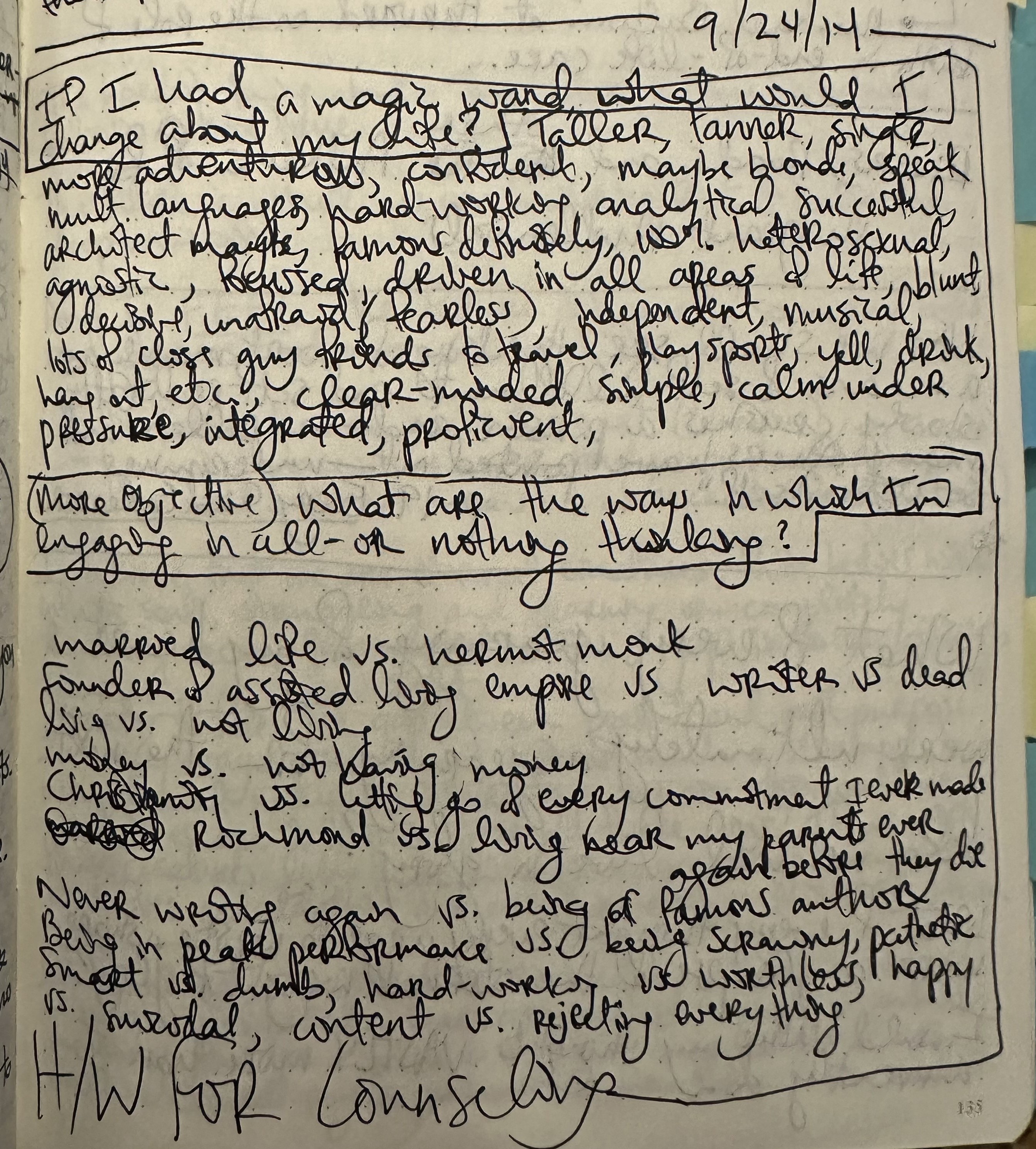
When I was 26 years old I wrote the reflection below as homework for counseling. (For a link to a transcript of this handwriting, click here.)
I was very clearly holding on to a lot of internalized homophobia, but I do not remember my Christian counselor seeing this as a problem or helping me to recognize and let go of it. “If I had a magic wand,” I wrote, I would have made myself “100% heterosexual.” I was struggling with body-image issues, self-criticism, and a general lack of confidence. I wrote that I wanted lots of close guy friends, but had to couch it in masculine terms like “play sports, yell, drink” rather than just say I wanted to be around men because I wanted to. I couldn’t say I wanted to dance with them, kiss them, laugh with them, go to the beach or Broadway, etc.
Looking back at this entry I am reminded that I talked and wrote about my own death a lot in those years. I felt trapped by my life. Rather than encourage me to come out of the closet and let go of my fears, I was encouraged to pray about my sadness, share my story with other Christians, and keep my life moving forward trusting that God would figure it out for me along the way.
Instead, I wish I had been encouraged to take risks and actually listen to my needs in a way that might have helped me find a supportive community, my voice, or a life that I desired. I am grateful for the safety of my counseling experience. I also can’t help but feel like during those years I was drowning and every time I came up for air my Christian counselor gently pushed me back under water.
I have at times considered my experience in religion as a kind of brainwashing, but as I’ve reflected more (and read some critiques of the idea of brainwashing) I’ve become more specific about the ways I was shaped by religion as I experienced it. I believe that my religious life resulted in a decreased self-esteem, inability to listen to my intrinsic desires, and a fear of the outside world that left me overly cautious in my decision-making, isolated from my community, and overwhelmed by the pressure of evangelism.
Maybe a more accurate and contemporary term would be that I was groomed. I was groomed to look for someone to take care of me, handle all my problems, and essentially to live my life on my behalf. I was groomed to give up agency, blame myself for my problems, and wallow in my sadness rather than solve my problems and move on.
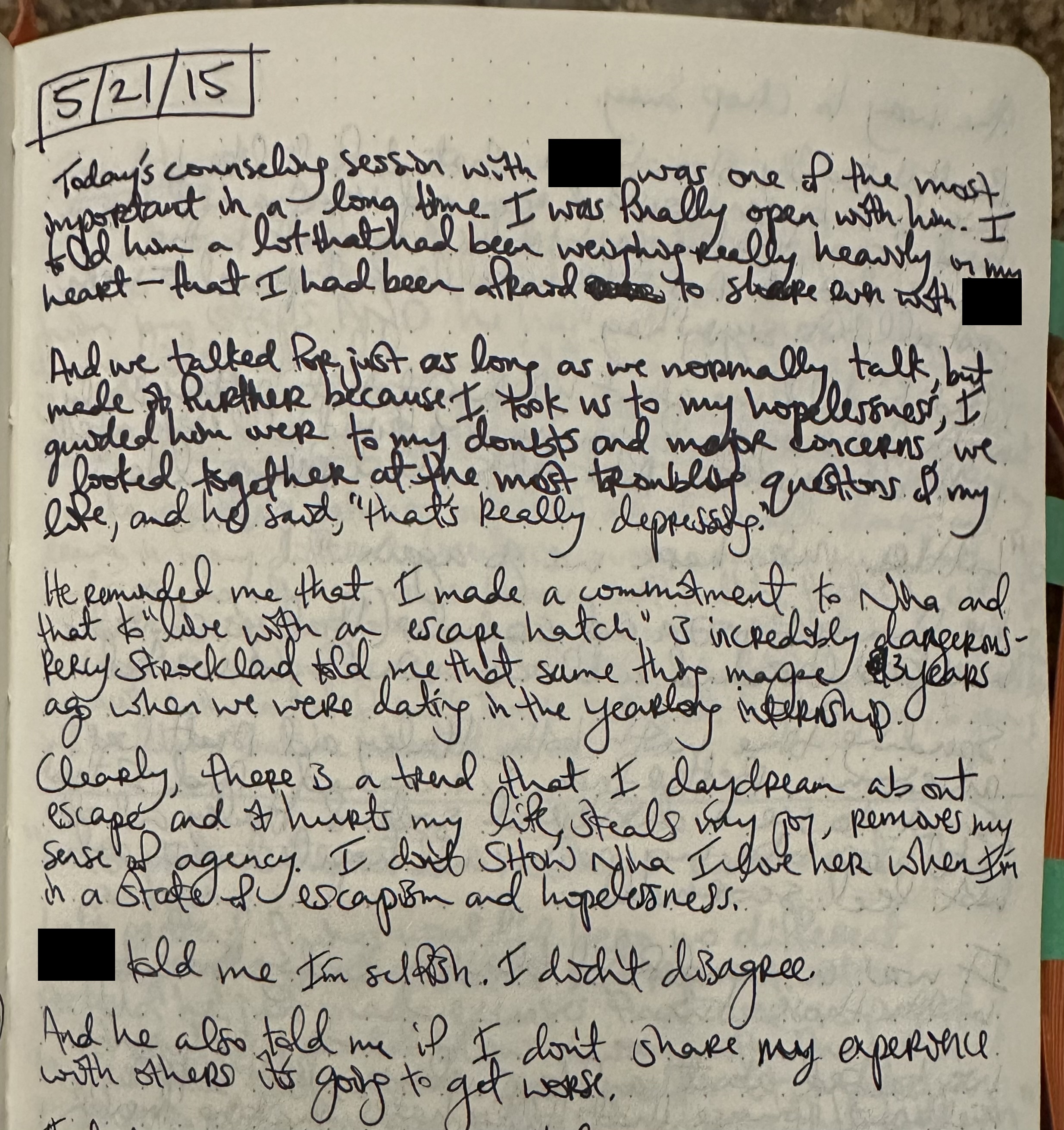
Below is a journal entry where I reflected on a time when I shared more with my counselor about my sexuality (with their name covered) and “felt a peace” about my life despite my reservations. (For a link to a transcript of this handwriting, click here.)
Looking back on this journal entry after coming out I wrote “WHAT THE FUCK” on a Post-it note and stuck it to the top of the page. It’s painful to remember how repressed I was and sad to see how much it affected my quality of life. These journal entries seem like moments when I almost made progress then, with encouragement from my counselor, recommitted to the status quo. I wanted to change my life, but I was too afraid to do it. Instead of help me push through the fear, I was told that I was selfish and reminded that promises are binding for life.
It’s weird to think that sadness, loneliness, and hopelessness could be interpreted as selfishness, but within the context of Christianity it does make sense. Your life exists for the glory of God and longing for anything other than the life you’ve been given is placing your own self-interest above God’s plans. This perspective fit into my worldview at the time and I didn’t question it.
I also think that I accepted what they told me out of self-interest and self-preservation. I was overwhelmed by the amount of change that might occur in my life if I actually came out. I thought the whole world would fall apart. I thought I would be an embarrassment to my family, and I was probably even afraid of losing my marriage. My spouse and I had become huge sources of support for each other over the years and our relationship felt too important to lose.
In reflecting on this journal entry, I wish the person counseling me had told me some of the lessons I have learned since we ended our time together. I wish they had told me that clear is kind, that love cannot exist without honesty, and that my partner and I were strong enough for the truth that I was holding in my heart. I wish he had told me that I needed to let go of the responsibilities and obligations I felt to everyone but myself.
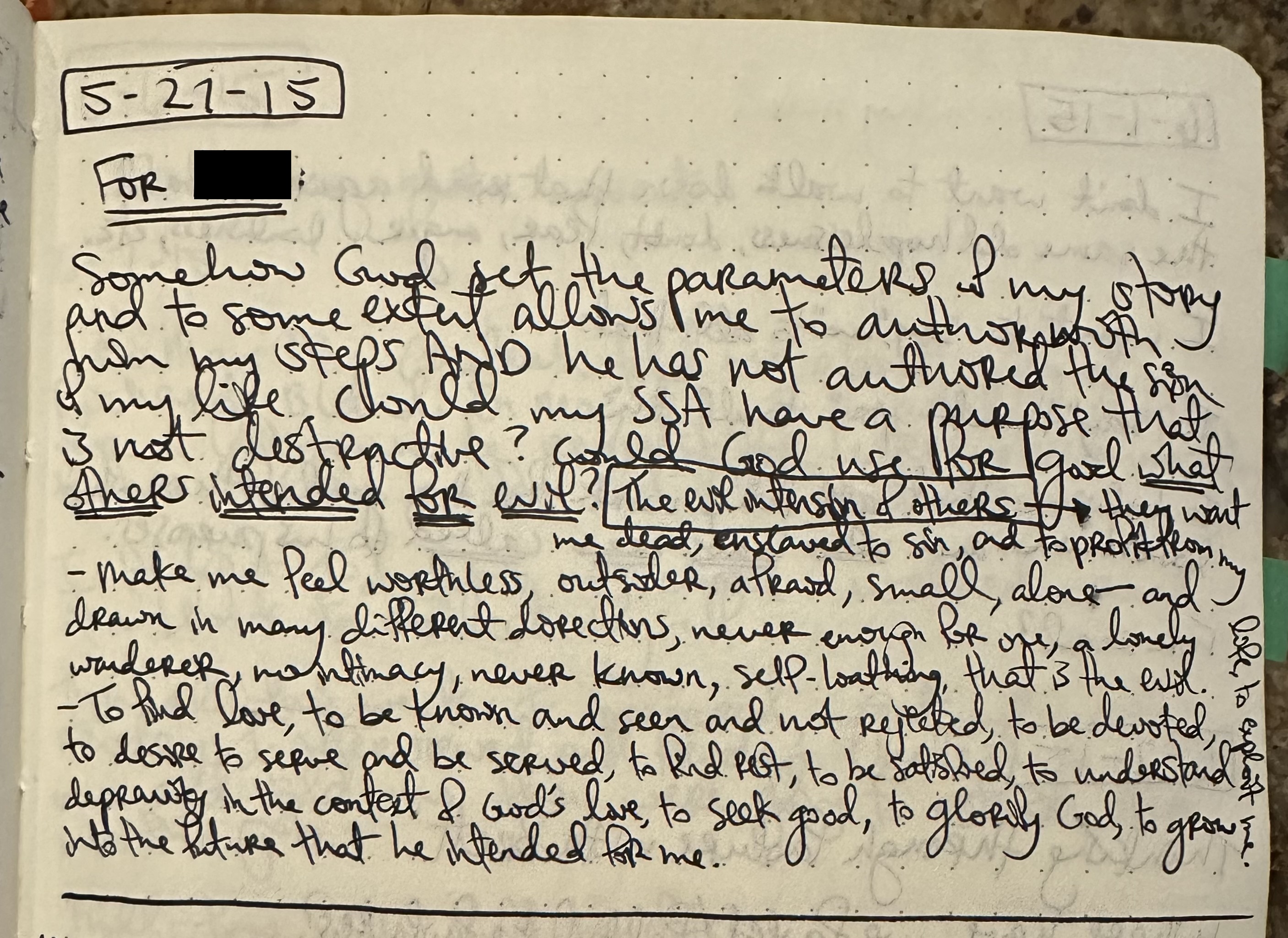
The next journal entry is a reflection I wrote in advance of counseling or as homework after a counseling session. (For a link to a transcript of this handwriting, click here.)
In this reflection find myself, once again, giving control of my life to God and hoping for the best. God “set the parameters of my life” and I was trying to accept that and believe that these parameters were placed in my best interest.
Part of what made God’s plan good, I thought, was that I was being protected from the LGBT community. I had been led to believe that the LGBT community was dangerous and essentially evil. I write, “they want me dead, enslaved to sin, and to profit from my life, to exploit me.” I had been taught to have so much irrational fear towards the very people who might have wanted the best for me. As I have come out of the closet I have not felt worthless, like an outsider, afraid, small, or alone. I have felt the exact opposite. I have felt understood, safe, and affirmed. All this fear of the outside world feels a little cultish actually. I was isolated from my community, too afraid to explore and find out whether happiness could exist outside the world that I had known.
One thing I’m still thinking about after reading this journal entry is how I believed that I could only feel “known and seen” within the context of Christianity while I was very fervently (consciously or unconsciously) holding back a huge part of my life. How could I believe that coming out of the closet and joining the LGBT community would make me feel “never known” and “self-loathing” when the opposite is so obviously the case?
It’s a bit of a mindfuck, but after some reflection, I think I have finally wrapped my head around it. I think Christianity successfully convinced me that my sexuality was not a part of me, and that actually much of “me” was not a part of me. Instead, my true self, the one that mattered, was the ideal self that God was theoretically transforming me into.
So I could truly believe that I wasn’t being dishonest or holding anything back from anyone while staying in the closet because I was sharing with the world what was true about me – what God had done in my life and the plans God had for my life. That was the version of me that I wanted to be “known and seen” and that was the only version of me that deserved to be known and seen. That was the version I could plan a future for. The rest of me was essentially disregarded as sin or evil. I was taught to repent of all of the bad parts of me and run away from them, to take those thoughts “captive,” and literally for those parts of me to die. In this way, much of me, not just my sexuality, was hypnotized into the sunken place.
If those parts of me including my sexuality had been killed/taken captive/left behind, then I wasn’t really hiding anything because it wasn’t there anymore. And if it “came up” every once in a while I just had to pray about it and ask that it would go away again so I could go back to living my true life as God intended – the only life that I wanted others to see and know. My dishonesty was completely justified, sanctioned, and encouraged by the Christian faith, at least in my personal experience of it.
It has been a painful, healing process for me to piece together these three artifacts from my past. For many years my journal was a safe space for me – one of the only safe spaces in the world. It feels very liberating to finally let these words out into the world as they always should have been.
When I was in high school we read a poem in class about an athlete dying young – I’m pretty sure it was this one. I remember thinking that if I died before I had the chance to be a failure I would be more likely to leave a good legacy. In retrospect, I think that the pressure of life, especially the pressure of achieving success while also being in the closet, was draining a lot of my joy and energy. I knew that at some point I would burn out.
In my high school years I actually thought God might have promised me I would die young. If I stayed in the closet for my faith it seemed like an early death was God holding up their end of the bargain. Twenty or so years on earth seemed doable, but much more than that was hard to imagine. Being a closeted gay adolescent in the church left me feeling committed to my path and hopeless that it could actually work out in my favor. Going to heaven was the primary reward I was presented with in these years so it makes sense that when life felt overwhelming that’s where my mind would wander.
I didn’t really plan much past my early 20s, basically college was as far as I got in my mind. I couldn’t imagine the future in any kind of hopeful way so I just took life one day, month, and year at a time. When my tragic early death never happened I felt pretty behind and unprepared. Since I thought it was something God had promised, it may have even caused my faith to wane when I was left to figure out the years I hadn’t planned for. (As I scrambled it didn’t feel like God had planned much for those years either.) It wasn’t always conscious, but it does seem pretty clear in retrospect.
The other day on the way to therapy I saw an activity bus from an assisted living facility and cried for most of the rest of the drive. I worked in assisted living so I have some personal experience with how sad and lonely those places can be. In these moments I think I’m already grieving the future I feel is coming for me. Many people close to me have tried to reassure me about the future and remind me how far I’ve come. I actually have a very long blog post draft called, “The Future is Home,” in which I have tried to convince myself for more than a decade that it’s going to be ok. Rationally I want to believe them (and myself), but emotionally I just can’t.
Adolescence is supposed to be a time of exploration. It’s supposed to be a time when you get to know yourself, try on different identities, express desire, start to experience autonomy and independence. My experience of adolescence was closer to one of commitment before exploration – what Marcia would call identity Foreclosure. Now I am finally (really) exploring and, even though I have felt late to the party at times, I am very grateful to be here.
I do think that I will get to a point where I am optimistic about the future. I am already “less hopeless” at least which feels like progress. Even writing this blog post has made me feel better about things in the moment, probably because writing is something that I enjoy and it is a relief to write out thoughts that have been on my mind. I have also given myself the freedom to explore without making promises the way I did the first time around. I gave away all my agency at a young age and I’m too prone to do it again. Instead, I’m just following the energy of my life as best I can. The more my life feels like home right now the more likely I’ll be able to imagine it for myself down the road.
I remember exactly where I was sitting when my older brother told me the story of Nicholas West. In 1993, when West was 23 years old, he was picked up just blocks from my childhood home, taken to a clearing in some woods outside the city, brutalized, and killed for being gay. His murder was deemed a hate crime, two of the perpetrators received the death penalty and one is still serving a life sentence in prison. Earlier this year, thirty years after a crime he committed at just 17 years old, he was denied parole.
I had always known intuitively that Tyler was a conservative place, but this story captivated me as someone who had recently come out of the closet and was still trying to understand my own childhood. In a sort of backwards way I feel affirmed by the knowledge of his story and my own self-preservation reasons for staying in the closet for so long. His murder likely sent a chilling effect through the community and I imagine kept many people from coming out of the closet and/or from supporting their children from doing the same.
His story also helped to explain a strange vision I had in the summer of last year, months before I learned about Nicholas. One weekend day, struggling to be a good parent, I decided to take my oldest to a flower farm outside of Richmond. They had hay rides, play forts, a huge dirt pile (his favorite), and all-you-can eat grilled corn (with Tajin of course). On the way to the farm, we happened to drive past a large pine forest. As I watched the parallax of tall, narrow trees shift to my right I had a very clear vision: I was running for my life through the forest, chased by counselors from the Christian camp I attended as a child. It was a mix between Sothern Gothic and the music video for the alt J song, “Hunger of the Pine.” If they caught me, they were going to drag me back and force me into the closeted life I felt I’d narrowly escaped.
The vision surprised me for how clear and intense it was. Although I was well aware of the culture of homophobia, I had managed to avoid the worst of it. Homophobia mostly came to me through casual phrases (it was the era of “that’s so gay”) or religions conversations like my high school teacher telling me that it was a worse sin because it was a sin “against the body.” The story of Nicholas, one of visceral hatred, was recent enough to be very much a part of the culture and collective memory of the place that raised me even though I didn’t know about it at the time.
Ever since I had that vision I’ve looked at pine forests differently. I grew up in the Piney Woods of East Texas and I have plenty of childhood memories in the tall, quiet, spaces carpeted with pine needles that choke out any understory so you can see straight through them. I think they are beautiful, but like everything in the South (and anywhere) they hold dark secrets, secrets of terror and violence. Terror has been used to control many communities and its effects last long beyond the actual event. Terror changes the way that affected people experience a place. Even when hatred becomes more benign, the memory of the violence serves as a threat that it could happen again.
I’ve picked up lots of articles on this story during my deep dives:
I also recently watched Lone Star Hate, a documentary about the story, embedded below:
I was only five years old, probably asleep under the glow-in-the-dark stars of my room, when Nicholas West was picked up at the park nearby. In some ways I wish I had known about his story at a younger age. I wish I had known about all of these stories, the gay community, the mentors I didn’t have, the history I wasn’t told. Part of moving forward is going back and making those connections when I get the chance.
I’ll be in Tyler in a few weeks and this story is going to be on my mind. I certainly hope to visit the memorial stone in the park where Nicholas was picked up. On a later visit to the area, I’d love to connect with anyone that knew him or was friends with him at the time. I feel really connected to his story and want to know more about his life before it was defined by someone else’s hatred. I’ve also considered scheduling a visit with David McMillan some day. At 47 years old, he still has a barbaric amount of time in prison ahead of him as he pays for his role in the murder. I want to know how he found himself participating in that crime and what he thinks about it today.
While I have a tendency to focus on the sad aspects of this story (and most stories), I have also been incredibly inspired. I have learned about organizations like TAG, Alphabet Army, and PFLAG of East Texas. As someone who chose to escape, I am so proud of folks who have managed to stay and have committed to changing the culture for the better – I would love to support and visit for one of their events some day. There are also seeds of hope in my own story. It was in a journal that I purchased from Pine Cove Christian Camps of all places that I first came out to myself in middle school. It would be many years before I felt safe enough to come out to my friends and family, but that journal entry, among the prayer requests and gossip, was always important to me and a sweet, salient connection to my younger self.
Last fall I took two online classes through the local community college as prerequisites for a graduate program that I eventually decided not to pursue. Along the way, I discovered James Marcia.
Marcia contributes the idea that as someone enters each stage of identity development they tend to move into four alternative statuses: identity diffusion, identity foreclosure, identity moratorium, and identity achievement.
These four alternatives are connected by the presence or absence of two characteristics: crisis and commitment. The experience of crisis, to Marcia, involves an individual exploring options as their identity develops. Commitment is the moment the individual decides to invest in one option and integrate it into to their newly resolved identity.
There are four different combinations of crisis and commitment that a person may find themselves experiencing during their development. Identity diffusion is the state of a person who has not explored meaningful alternatives and also has not made an identity commitment. Perhaps, they have been made by others to feel powerless to true exploration and commitment or it may be they are simply content and comfortable. An individual who makes a commitment without exploring options is said to be in identity foreclosure. They’ve confidently ended their journey before they even started, often accepting their received culture and path. Identity moratorium is the state of an individual who has explored meaningful alternatives, but has not yet made a meaningful, lasting commitment.
At the end of a crisis, if the person is to have developed in a new way, they will examine all of the options they have explored during their crisis and commit to the one or few that most define their identity in this new context. This is called identity achievement.
It’s certainly not a passive process. Most current research suggests that major identity shifts occur during late adolescence and early adulthood when individuals are embracing their independence and exploring on their own. In early adulthood there is an emergence of identity that is more vetted and integrated. But the process is never finished.
The final truth that I learned from Marcia, for me, is the most encouraging. He believes that in order to achieve a positive identity, most individuals go through “MAMA” cycles: from moratorium (that is, exploring without a commitment) to achievement (choosing and recommitting to your identity) and then back again. “Marcia agues that the first identity is just that—it should not be viewed as the final product.”
With each relationship, job, community, major world event, or other change in life, we are given the chance to reconsider our beliefs and identity. The MAMA cycles are healthy. That was positive news to me—as a somewhat impulsive explorer—and an affirmation that searching is healthy. We can always decide to return to what we already knew to be true, but knowing that we have explored our options will provide necessary assurance along the way.
I’ve primarily learned about Marcia through the textbook Children by John Santrock (2013). All quotes and paraphrases here are from that work.
I’m thankful for the Adam Lauver sharing his thoughts on this Rilke letter and the rest of the collection which I own, but have still not finished. Maybe this is the encouragement I’ve been needing 🙂 I’ve reblogged his post here for anyone else who is interested in a little encouragement today. It’s not an answer to your questions, it’s a new metaphor for your life.
During my first year of college, I struggled a good bit. On the outside, I was effortless: taking upper-level seminars, making friends with the president. But on the inside, I was asking big, fundamental questions about myself and about life. And I was, for the first time, on my own. During this time (as with much of my life since then) I began to reach out for life preservers—little bits that I could cling to for hope and assurance in the “goodness” of the future.
One such bit of wisdom was “Letter 4” from Ranier Maria Rilka written to a young poet. The interim chaplain at the time emailed the piece to me and I will never forget reading it one night while “studying” in the library. I read the words “Live the questions now” and my eyes began to open to a new perspective on life and a new peace I had never previously comprehended. Rilke continues, “Perhaps you will then gradually, without noticing it, live along some distant day into the answer.”
“You are so young, so before all beginning, and I want to beg you, as much as I can, dear sir, to be patient toward all that is unsolved in your heart and to try to love the questions themselves like locked rooms and like books that are written in a very foreign tongue. Do not now seek the answers, which cannot be given you because you would not be able to live them. And the point is, to live everything. Live the questions now. Perhaps you will then gradually, without noticing it, live along some distant day into the answer.” – Rainer Maria Rilke, Letters to a Young Poet
I recently came across a used copy of Letters to a Young Poet, which I’ve been meaning to read for a long time now. As I was leafing through it in the book store, I noticed that there was…
“Cities have become the career dressing rooms for young adults. They have become the place where people go in their twenties to try on different identities. Then, once they know who they are, they leave.”
“One of the great dangers of transformational work is that the ego attempts to sidestep deep psychological work by leaping into the transcendent too soon. This is because the ego always fancies itself much more ‘advanced’ than it actually is.”
The quote above has become one of the defining quotes of my year. To me, it means it’s not enough to talk about practices for healthy life, you have to be willing to submit yourself to a process. You actually have to do the work.
This idea comes from a book about a system of personality types that has, in some ways, become my current practice of self-knowledge and discovery. For those of you who may be worried, it’s more psychological work than spiritual practice. The Enneagram has in no way usurped my Christian faith, but, to the contrary, has led me to a deeper understanding of my personal brand of depravity (in other words, how I personally manifest brokenness) and given me a vocabulary for understanding myself and my behavior. Also, when I talk about the Enneagram, it is through the lens of one book, The Wisdom of the Enneagram. To my knowledge, it’s the most thorough one of its kind.
I almost can’t imagine my life before the Enneagram, the book, and the quote.
For those of you who haven’t heard of the Enneagram, it is a vastly complex system for understanding different personalities. Unlike the Myers-Briggs and others, it does not prescribe static labels or obscure beaver-otter-retriever metaphors. It contains nine personality types that have somewhat recently been placed on the ancient nine-point symbol of the Enneagram.
Beyond the nine main types, each type has “wing” personality types of the immediate numbers (e.g. “9 with a 1 or 8 wing”) which does not define their dominant motivators, but is still highly influential in their way of life. Furthermore, each personality type assumes the negative or positive qualities of another personality type when the person is unhealthy or healthy respectively. Thus, a domineering eight becomes more helpful like a two when healthy and more controlling and secretive like a five when unhealthy. So there are nine types, 18 sub-types, and the ability to “catch” you at any stage of development along the way to maturity.
Now, take a deep breath.
When I first learned about the Enneagram I was surrounded by two good friends who also happen to identify as sevens. That’s me! I thought, as one friend read the description of the “busy, fun-loving” personality type I so longed to embody. This seemed to explain why I was always distracting myself by looking for cool articles about my passions, stop motion videos and infographics on the internet and sharing them with my friends. I’m just a scattered seven, afraid of my past and searching for newer, more exciting experiences to assuage my pain.
But then people were like, hold up. I sort of act like my friends that are sevens in social settings, but there are some aspects of my life that don’t match up: My car is organized and vacuumed, I have a LinkedIn, and I talk about adventures way more than I actually go on them. And then it all made sense, you’re a three! With a two wing! You’re “the charmer,” always looking for another way to help someone and improve your image. And at the time this seemed to really fit.
As I started to look at my life, I became painfully aware of the fact that I have spent countless hours crafting an image for myself whether on social network sites, through this blog and in my personal relationships with others. I hated myself because I began to perceive all my pursuits (my hobbies and jobs) as mere image maintenance for my troubled ego. I started beating myself up for caring so much about what other people thought about me and this made me care even more about what other people thought than I had before. All about image and success? I wondered to myself if all my work were just to create a name and a desirable image as the three is prone to do.
Then all the sudden I had this realization: Work? Beating myself up? Passions? None of these tendencies fit either of the two personalities that I had previously considered for myself. Sevens are way too carefree to think that what they’re doing is work (“life’s an adventure!”) and threes are too busy fitting in and receiving awards (of the traditional sort) to really beat themselves up for failing to meet personal standards. Besides, if my desire were to have a good image, I wouldn’t type blog posts longer than 1400 words!
At long last, after about eight months of wrestling with this whole Enneagram idea, I found a personality type that describes me so well it hurts: I am a one.
My girlfriend (also, almost definitely a one) and I laughed our way through the entire section on this type, its tendencies, and our own stories from the past. We would read the first sentence of a paragraph, have an entire conversation, then realize that our conversation was almost identical to the rest of the paragraph we were on. The one is the personality that is essentially trying to prove its worth, its reason for existing. One’s are also impatient, think they know the right way things should be done, and, when healthy, champion reform throughout society.
Who would have guessed it? Probably all of my friends, family, and acquaintances. It’s so obvious now looking back on my time in college. If I wasn’t ranting about the administration I was organizing to get sidewalks built or developing plans for the student composting system. Always. Always. Always looking at what could be fixed/changed rather than what was going well. I also realized that I was sometimes so perfectionistic in my work that if I couldn’t do it perfectly, I would give up and do it poorly last minute. Then, I would beat myself up for not living up to my expectations of myself and fall into an emotional tailspin (ones move to fours under stress) and feel like I had lost myself entirely.
Conversely, some of the most difficult moments of growth in my life continue to be the times when I realize I am impatient with someone else’s way of doing things. I also realize now that my personality is to feel self-righteous and to orient myself away from other people in an attempt to feel personally just and good. That is, after all, what my personality is striving to be: good. But since no human can reach their personal standards of perfection, as I gradually mature I find more value in other people’s standards and processes while also transitioning from judgement to discernment. Rather than rely on a good-bad dichotomy to deceive my guilty ego, I develop more internal self-confidence and open myself up to more external disorder. I learn to embrace the grey of life.
Why have I put myself through this process? Because the Enneagram has forced me to examine my behaviors, thoughts and instincts in way that I would have never done otherwise. Furthermore, what I have learned has also been supported by other books I’m reading, most specifically Integrity by Henry Cloud and The Spirit of the Disciplines by Dallas Willard. One of Cloud’s quotes in particular seemed to encapsulate this realization:
“This process is called assimilation and accommodation. Which means someone has graduated past childhood levels of information processing and can adapt to reality and make external reality their own. I will repeat that for emphasis: it is the ability to make external reality one’s own reality.”
This sort of maturity does not come easily. We all have delusions, but it is knowing our delusions that will allow us to operate in the complex world effectively and honestly. Also, it is only “deep psychological work” that will force us to remember the parts of our lives that we desire to forget (our weakness and shortcoming) and integrate these into our more realistic and honest identity.
Thanks for making it to the end! You deserve a prize. And that prize should be a copy of the Enneagram book … and friends to share the journey.
As always, and most definitely, more to come.
Opening quote: Don Riso and Russ Hudson. The Wisdom of the Enneagram, 10.Second quote: Dallas Willard. Integrity, 135.
I have recently come to the conclusion that life is a combination of therapy and trauma. There are moments in between, of course, but these are often forgotten.
I’m not really thinking of therapy in the strictly medical sense. I think of therapy more as an overcoming of the past. Two months ago I wrote a similar post from a slightly different perspective. At the time, I saw our selves as haunted houses full of fear and stigma. The ghosts, I thought, were the memories of trauma. And the therapy for trauma I described in this way:
“We need to painfully return to embrace ourselves: chaos and all.We need to walk the halls of this haunted house, to run our hands over dusty railings, to notice what has been broken, and perhaps to even find that our fears were unfounded.”
At the time, I don’t think I really respected the difficulty of therapy. That is, I don’t think I understood how difficult it can be to work through and overcome the past. I also had a shallow understanding of the memories of trauma I carry within myself. Now, I see that embracing ourselves “chaos and all” is a much more difficult and long road, but no less worthwhile.
My next thought is also related to how we form memory and how events in retrospect can become therapeutic while others later seem traumatic. The former are the stories we tell ourselves from the past that help us to understand the kind of person that we are and want to be. The other stories, the stories of trauma, are the stories that we usually ignore or try and laugh about and forget. These are the stories that remind us of who we don’t want to be.
These are the stories we ignore … as well as the people and places with which they are associated.
But they are as intimately “us” as are the stories we enjoy hearing about ourselves. They shape the way we approach every situation. These stories affect the way we interact with other people, perceive authority figures, the opposite sex, peers, coworkers. And since each of us carries different traumatic experiences, each of us will see vastly different activities as therapeutic. For me, baseball was a sport that I was never good at. Struck out in T-ball, put away the bat, gave the pants to a friend’s little brother, and never looked back. So when I threw a baseball with one of my friends the other day, for the first time in about a decade, it was actually a strange sort of therapy.
For someone else, public speaking might be a therapy. For another, going back home is either therapy or trauma depending on how productive we think that it is vs. how much we revert to the person we are trying to forget. We all fear different things in order to protect ourselves, but these fears are usually more internal than we realize: hanging out with the old traumatic stories we love to hate.
As we interact with the past we don’t get rid of it, but, rather we grow to understand it and appreciate it. We also learn more about our negative cycles and can catch ourselves before they set in. Unfortunately, this process never ends, but I imagine it develops over time. I suppose that’s really the goal of these sorts of processes anyways: longevity. The more we’re willing to submit ourselves to life, to therapy, the more we’ll develop and mature. So here’s to long, healthy lives. Here’s to the good and the bad and the perfectly normal in between.
↬@Spozbo and the semi-controversial David Deida for leading me to consider the benefits of therapy not as something to fear, but as something integral to healthy human development: life as therapy.
Over the course of the past year, I’ve been writing my way through a bunch of different thoughts and ideas and the result has basically become the entirety of this blog. At the same time, I’ve also been gradually trying to connect the dots with one underlying theme: that life is all about circulation and significance, the movement as well as the moment.
Since my words don’t always make a lot of sense, I’m constantly trying to find new ways to explain myself and share what I think is interesting about the world: examples of circulation and significance in our daily lives. Most of these places are either what I consider Highways (circulation) or Hallowed Halls (significance). Today, I get to write about a place that embodies both of these characteristics and the tension that exists between the two.
I recently visited the Negro Burial Ground just east of downtown Richmond in Shockoe Valley. My approach to this site was across a VCU parking lot and through a tunnel under Broad St. As you walk through the tunnel, you emerge onto a huge empty field of beautiful grass that was once yet another parking lot in downtown Richmond. In recent years, the asphalt was removed and this area was designated “A Place of Contemplation and Reflection.” I appreciate this area mostly because it’s a complicated place. There aren’t physical buildings that most people would consider “historic,” but what happened on this one piece of ground (the public execution and careless burial of enslaved and free people) is considered enough to make the place significant today. Once a place of fear and violence, it has been restored to the people of Richmond as a place of silence and careful thought.
While I think the site itself is certainly worth visiting, what I really care about is a place located just above the actual burial grounds. From this vantage, you can see that less than 50 yards away from this place of contemplation is Interstate 95 in all of its glory. The cars and tractor trailers fly by on this crazy asphalt slingshot that shoots cars straight through the heart of my city. Like all highways, it’s a totally anonymous no man’s land where you don’t walk, you don’t slow down, and you don’t typically notice the historic burial grounds nearby. When you’re on a highway like this, you don’t care much for where you are because you’re more focussed on where you’re going. That’s essentially the nature of movement.
To get the photo above, I climbed up a little hill to the foot of the Broad St. bridge I had previously walked underneath. For a while, I just sat up on the hill and watched the disinterested movement of the highway next to the contemplative stillness of the old burial ground. I realized that we need both the movement and the moment, but I think sometimes we feel like we have to make a choice: You have to be either ambitious or thoughtful, motivated or lazy. When I experience a place like this, it reminds me that we should be aware of both aspects of life. It also makes me a little more hopeful that my writing is still relevant. What I have learned through writing this blog is still teaching me and making the world a more interesting place.
While I was looking out on the scene, I realized that photos and words are limited media for describing ideas such as movement and moment. So I filmed a brief and simple video (below) that might help to further explain this relationship. It’s much more about the idea than the video itself … and I recommend muting the video sound and listening to Lisbon, OH by Bon Iver while you watch it.
P.S. ↬ to Gwarlingo for the movement/moment pairing … it used to be found in their explanation of the meaning of the word Guarlingo which is Welsh for the sound a grandfather clock makes before it strikes on the hour, “the movement before the moment.” Of course, my blog is about the movement and the moment, but I thought it was an interesting side note.


 I recently visited the Negro Burial Ground just east of downtown Richmond in Shockoe Valley. My approach to this site was across a VCU parking lot and through a tunnel under Broad St. As you walk through the tunnel, you emerge onto a huge empty field of beautiful grass that was once yet another parking lot in downtown Richmond. In recent years, the asphalt was removed and this area was designated “A Place of Contemplation and Reflection.” I appreciate this area mostly because it’s a complicated place. There aren’t physical buildings that most people would consider “historic,” but what happened on this one piece of ground (the public execution and careless burial of enslaved and free people) is considered enough to make the place significant today. Once a place of fear and violence, it has been restored to the people of Richmond as a place of silence and careful thought.
 While I think the site itself is certainly worth visiting, what I really care about is a place located just above the actual burial grounds. From this vantage, you can see that less than 50 yards away from this place of contemplation is Interstate 95 in all of its glory. The cars and tractor trailers fly by on this crazy asphalt slingshot that shoots cars straight through the heart of my city. Like all highways, it’s a totally anonymous no man’s land where you don’t walk, you don’t slow down, and you don’t typically notice the historic burial grounds nearby. When you’re on a highway like this, you don’t care much for where you are because you’re more focussed on where you’re going. That’s essentially the nature of movement.
 Highways and Hallowed Halls