Behind the house where I grew up there is an undeveloped lot of trees and grass. As a child, my neighbors and I often climbed over the back wall into this untamed world. We constructed imaginary realms and a gateway to the outside. We even gave it a creative name: Trocourba.
Always fair (even as children), I remember we pulled the name from fragments of each of our respective school mascots: Trojans, Cougars, and Braves. As children, we saw this lot as an empty palate for us to fill with our imagination. Much of what we built has been lost, but I still walk through those woods when I’m home and remember the days spent claiming and naming that empty space.
***
This post is about the attitude of the explorer: the belief that discovering a place makes it “new.” And if it’s new then it’s never been named. We name things every day in order to claim them and make sense of them. In order to understand a place, we give it a name. It makes it familiar.
What first started me thinking about the idea of “naming and claiming” was a conversation I had with my high school students last year. I was teaching the “pre-European” section of a class on Richmond history and we started to discuss the word “savage.” This post is a follow-up to my fascination with the word “savage” over a year ago.
The concept and conviction of savagery, I realized, is a necessary precursor to the process of “naming new worlds.” There are two primary steps in this process. First, discovered lands are proclaimed “new” simply because nothing there is familiar and, second, the existing names for that land (and all inhabitants) are deemed illegitimate. In my class, we discussed the British invasion of present-day Virginia, but that’s not the only example of “savage” places being invaded. Many years after the US gained independence from the British monarchy, the kingdoms of Europe made similar claims on land in Africa. Much of this continent was subdued by the military might and shameful brutality of early Europe. As tribes and kingdoms in Africa fell, new nations were formed.
It was time for some new names:
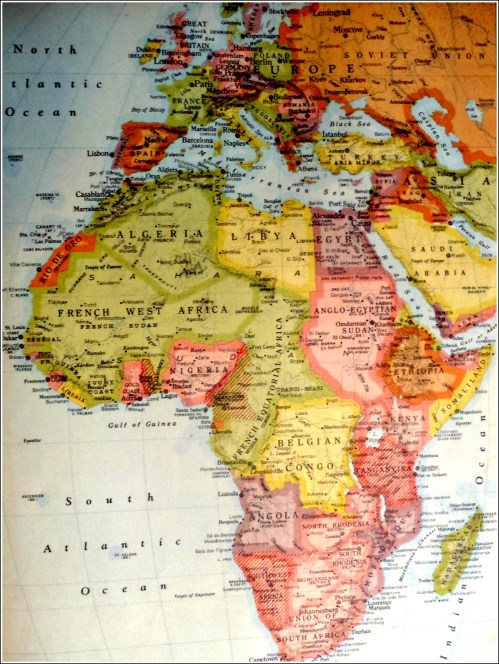
Many of these names have been changed in the past 50 years of independence, but the legacy of colonization, of course, lives on.
In my search to understand this connection between mapmaking and empire, I remembered one of my favorite sections in the play, Tamburlaine, by Christopher Marlowe. Tamburlaine is a play about a man that seems superhuman in his ambition and his strength. In one scene, Tamburlaine discusses the growth of his kingdom by using the metaphor of a map and a pen:
“Zenocrate, were Egypt Jove’s own land,
Yet would I with my sword make Jove to stoop.
I will confute those blind geographers
That make a triple region in the world,
Excluding regions which I mean to trace,
And with this pen reduce them to a map,
Calling the provinces, cities and towns
After my name and thine, Zenocrate”
(Marlowe, Tamburlaine, I, iv, 72-79).
Here Marlowe conveys the dreams of a new map for a new kingdom with a new king. Tamburlaine connects the map of the world to his goals for military conquest and his desire for increase. With these words he boldly speaks the future into existence. He, like many leaders throughout history, desires to claim the earth as an extension of himself and his power. His kingdom will be as large as his desire because his strength will not be stopped in his pursuit.
This confidence is not unique to Tamburlaine or fiction at all. There are many examples of powerful men looking over other people’s land with greed. These days we all understand this idea of a “nation” as if it is the way that we’ve always structured the world, but that is not the case. As we shifted to nations from the former powerful families, kingdoms, and empires, many voices of dissent were silenced as neat maps were drawn by powerful hands. Here’s a few examples (with dissenting factions in parenthesis):
- The United States of America (The Lakota, The Sioux)
- The Democratic Republic of Congo (The Banyamulenge)
- The United Kingdom (Northern Ireland)
- China (The Uighur, The Tibetan)
- Iraq (The Kurds)
In America, we expanded our borders with military victories and the conviction that God Almighty had ordained our growth. In other nations, it was a colonizing force that created new borders with little regard for indigenous territories or cultural differences. While the colonizing or invading forces subdued, they claimed the land and it’s “inferior” inhabitants. In nearly every single case, it went something like this:
“Sorry, that place you call home isn’t your home any more. Oh, and stop calling it that. It’s not called that any more. You’re pronouncing it wrong. How could you be so stupid?”
***
This is the power of names. When a name is given, it becomes familiar. When the name of a place is changed, natives become foreigners. Dignity is stripped. Identity is lost. And there is a deep unquenchable resentment that lives on in hearts and minds.
We are all a part of this legacy. We are all naming or being named.

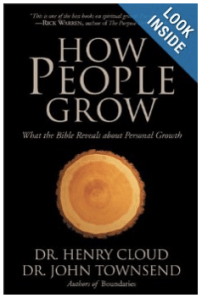 This book is for people who want to grow and for people who facilitate growth in others. It’s also from both the perspective of Christian doctrine and psychological research which I appreciated. I think I was a little ahead of myself reading it, but it will definitely be on my shelf for future reference. There are so many amazing takeaways from this book that I can’t list them all, but one of the biggest lessons for me was that it all starts with acceptance.
 Highways and Hallowed Halls