Moses to Zuckerberg: A Position of Power

Mark Zuckerberg is the Robert Moses of the twenty-first century. Never elected, powerful beyond imagination. Not from the right family, but more influential. Not a member of Phoenix, but extremely selective. Not in the game, but driven to rewrite its rules. Robert Moses experienced similar social exclusion at Yale. Similar to Zuckerberg, this exclusion drove him. On Moses, Caro writes,

“Alongside the massive cathedrals of Yale’s traditions, buttressed by prejudice and pride, Bob Moses had erected his own small but sturdy structure. ‘In our little world…,” Bacon was to say, “he made himself a position of power.’ 

In light of Moses’ later career, that was the key point” (Caro, 47).

From his Ivy League education, Zuckerberg didn’t look to New York for power, that traditional American icon. The internet and computers were dramatically reshaping global influence in Silicon Valley.

In grand New York, Moses planned and completed massive public works projects to connect the boroughs and the region while Zuckerberg, from a garage in the valley, constructed a virtual bridge to connect the entire world. Through their efforts, these two men shaped the world that we inhabit today.

Facebook’s Twitter description states, “Giving people the power to share and make the world more open and connected.” Essentially they want to democratize the world, to end exclusivity. Moses also worked to make the city more accessible for the average American (as long as they could afford a car) and used his power to force roads through old-money estates in Long Island and elsewhere.

Someone from a powerful, WASP background wouldn’t work to undermine regional power. But neither of these men had much to loose. Moses was a Jew, didn’t know how to drive a car and spent his life building roads, bridges and tunnels. Zuckerberg (also of Jewish descent) is a socially awkward computer hacker who made billions connecting “friends” around the world.

Zuckerberg and Moses both lived life on the margins of traditional power.  As a result, they both developed a deep understanding of power. And when they realized that power wouldn’t engage them as equals … they turned it on its head. Both knew they could not win at the old game, both knew that the game had a weakness, and both were smart and industrious enough to exploit it.

Both created new worlds and situated themselves comfortably in the center.

Duck on Decorated Shed?

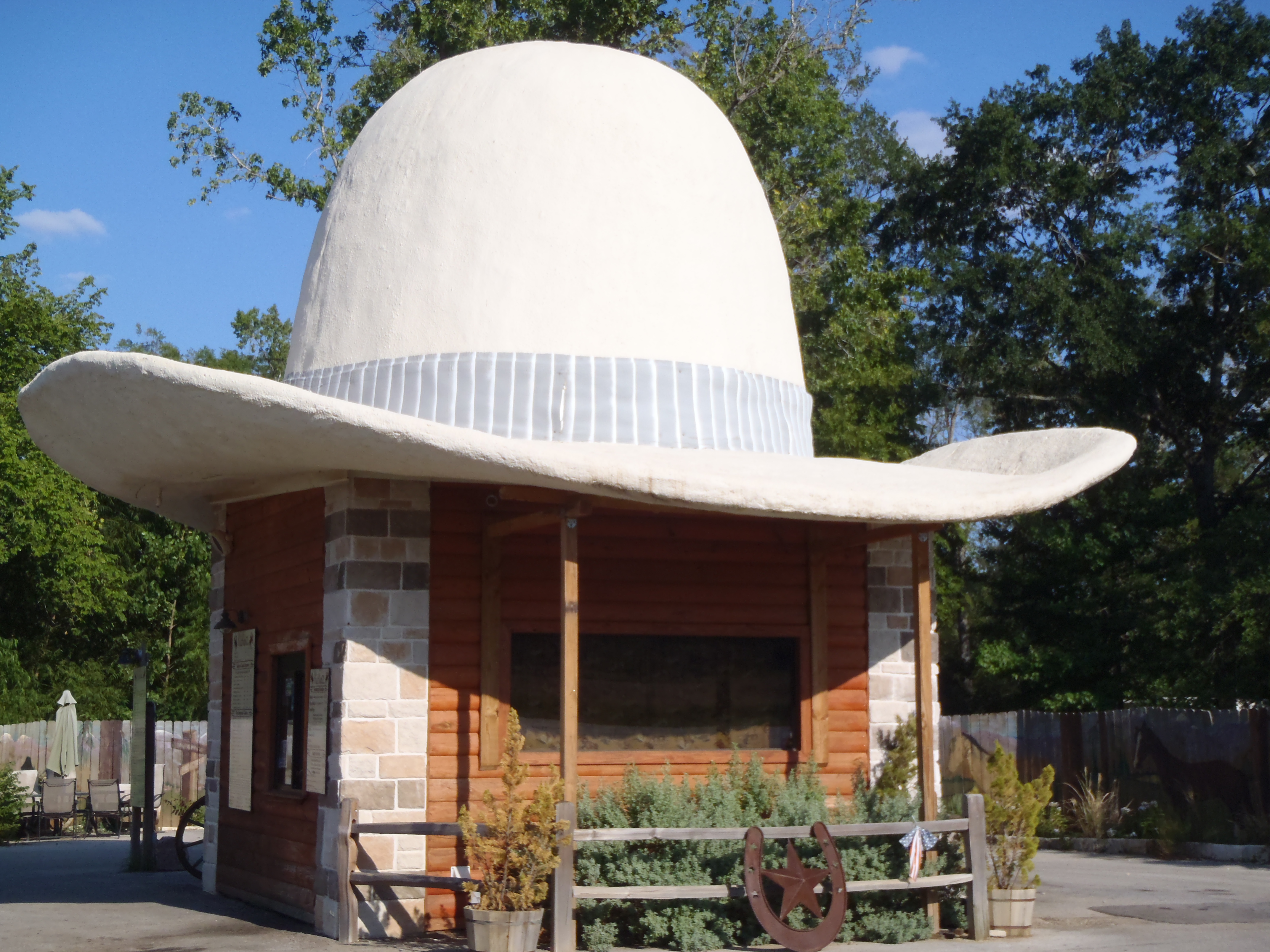
I don’t think Robert Venturi had any idea someone would ever take his duck and decorated shed concepts to this level. The (now patented) concept of building a huge, proportional hat onto a small square building was inspired by my hometown of Tyler, TX with the “Kicker’s” coffee franchise. The hat might even qualify as a duck? Be amazed:

Elks, Masons, and Odd Fellows: antiquated past or valuable tradition?

“I just worry,” my dad told me one day this summer, “that there won’t be enough Shriners in the future to maintain hospitals like Scottish Rite (Hospital, Dallas).” “Well,” I responded, “why don’t you become a Shriner?”

Growing up, I never would have thought about fraternal societies. To be honest, Barney Flintstone’s membership in the Loyal Order of Water Buffaloes was the closest I ever came to even knowing they existed. Then I went to college, joined a fraternity, and never looked back … until now. I graduated in May and in the last few months, fraternal societies for grown men have started to make a lot more sense. I think it was when people started doing this weird thing — calling me a man instead of a guy — that I started to wonder what I was getting myself into. Isn’t being a man all about being lonely and depressed? Work all day then come home and sit in your house? Robert Putnam’s book Bowling Alone makes a strong case that we’re living more of our lives without each other. As a result, it doesn’t feel like there’s any benefit to this whole “guy-to-man” switch … just more responsibility. There’s nothing cool waiting for me on the other side. But in the context of our nation’s history, that wasn’t always the case. There was an era of the American city when the fabric of society was dense with organizations and groups that carried and supported you through all the stages of life.

Douglass Rae summarized this era of ‘urbanism’ in this way:

“All or virtually all of the people who were assembled by these organizations — whether for religious or a fraternal lodge meeting or a sporting contest — were members of locally grounded communities. And the acts of assembly and association almost certainly deepened and enriched participants sense of loyalty to and identity with place.” Rae, City: Urbanism and its end (2003).

Rae’s research focussed on the city of New Haven, Connecticut and the 100-year deterioration of urbanism. In his research, he documents how each city block in New Haven was once a thriving microcosm of society. Middle-class men and women were usually a part of several societies in the city for different purposes including fraternities, sports teams, and social clubs. It’s wasn’t easy life in 1900, but it was lived together.
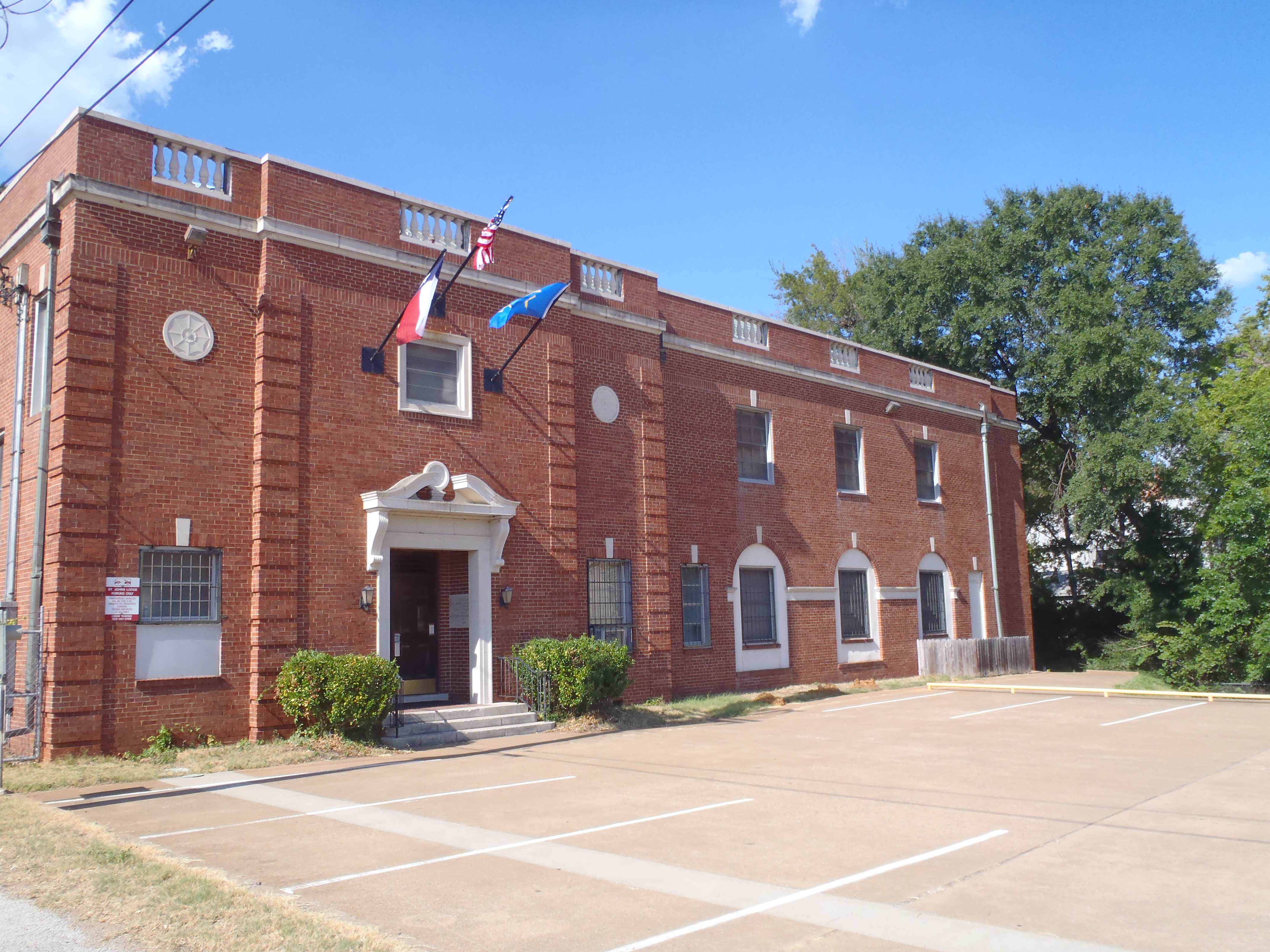
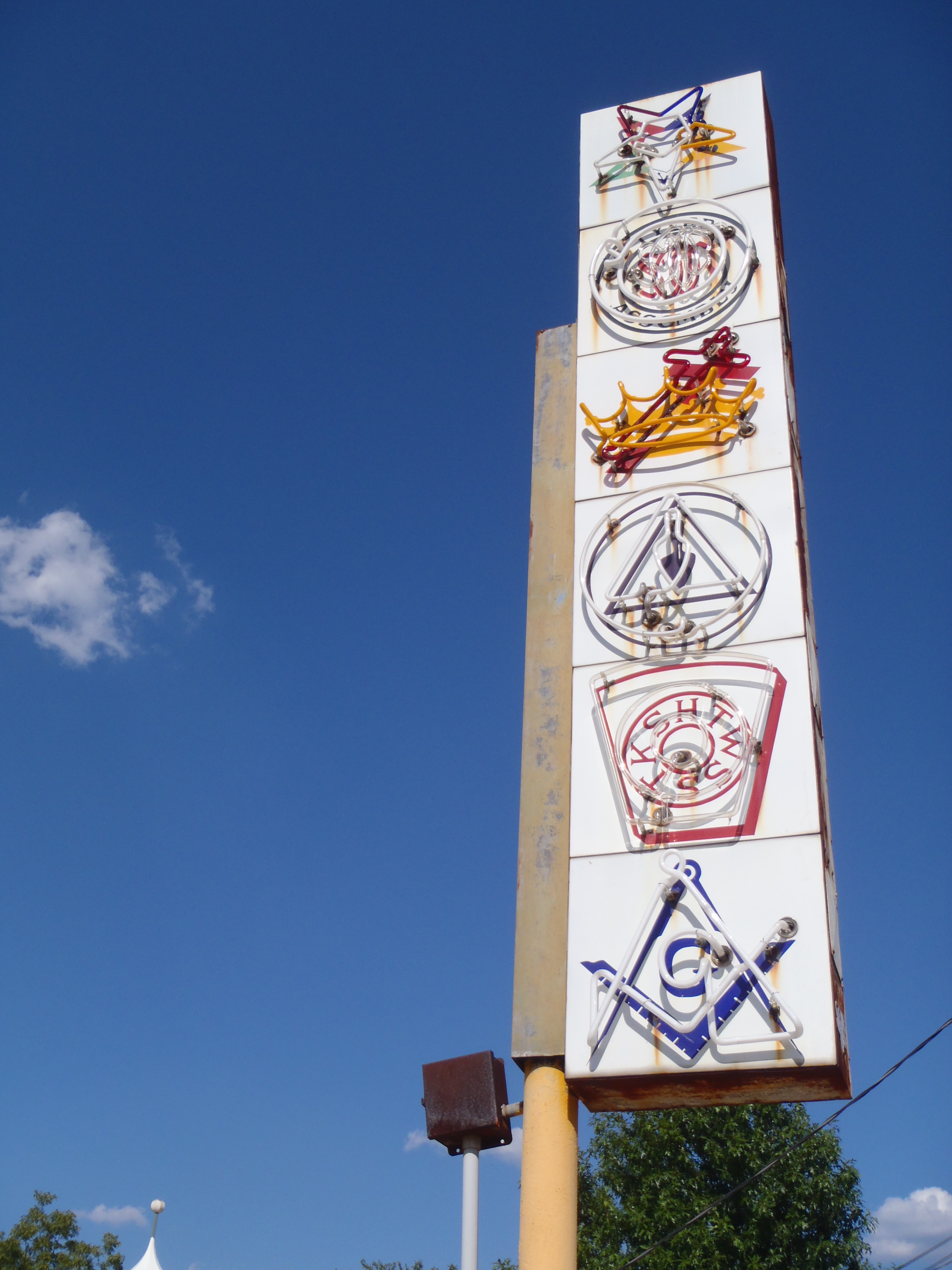
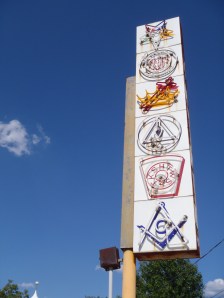
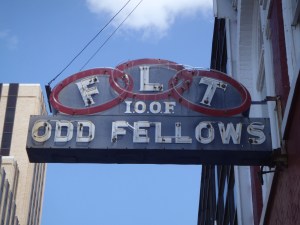
Today, things have changed. The America of 1900 no longer exists. But what I love about cities is that the buildings in our cities (the ones that survived) are the constructed monuments to our past. Tyler, TX is no exception. While they don’t hold the same place of prominence in the region, there are still buildings in Tyler that harken to an older era. The Masonic Lodge (pictured above), built in 1932 is the most striking downtown example that is still in use. I’ve driven by this building numerous times, but never thought it was special. Today, I almost felt like someone was going to come out and kidnap me for taking a photo of their building. The awesome neon sign (left) on the street is also worth noting … I don’t recognize some of the symbols, but I’m sure they all mean something to the men involved. The pentagram at the top looks slightly demonic, but I’d still think it was cool if my dad went to this building for a meeting once a week.
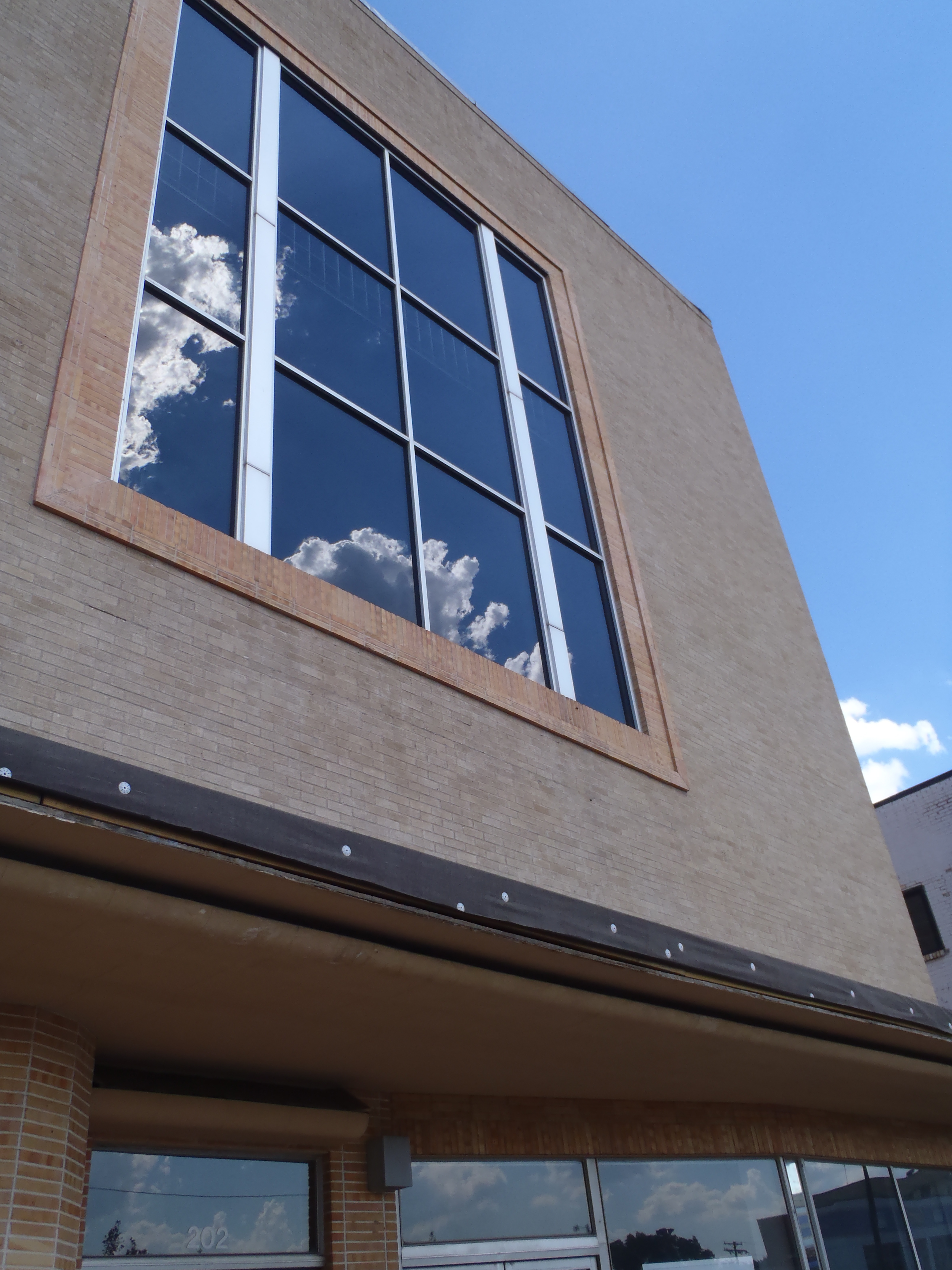
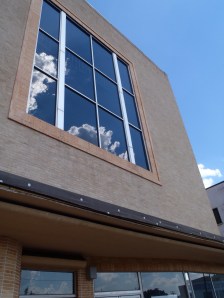
Other buildings in Tyler are no longer being used for their original purposes, but still bear the markings of early twentieth-century urbanism. The old Elk Lodge is one such building. I believe there is still a group of Elks in Tyler, but now they meet on the edge of the city in a newer lodge. It’s kind of a shame they moved, but I’m partially glad they did because the building is amazing and I got to walk through it today (without being properly initiated). It’s currently being renovated by Ron Mabry of Tyler for events in the city. I believe All Saints Episcopal is having a dance later on in the year. I hope that at least one high school student walking by notices the plaque on the building that states the founding purpose of the building: “Tyler Lodge No. 215, B. P. O. Elks, M. E. Danbom, Exalted Ruler.” The people on this plaque cared enough about each other to build a building where they could meet, talk about life, celebrate and mourn.
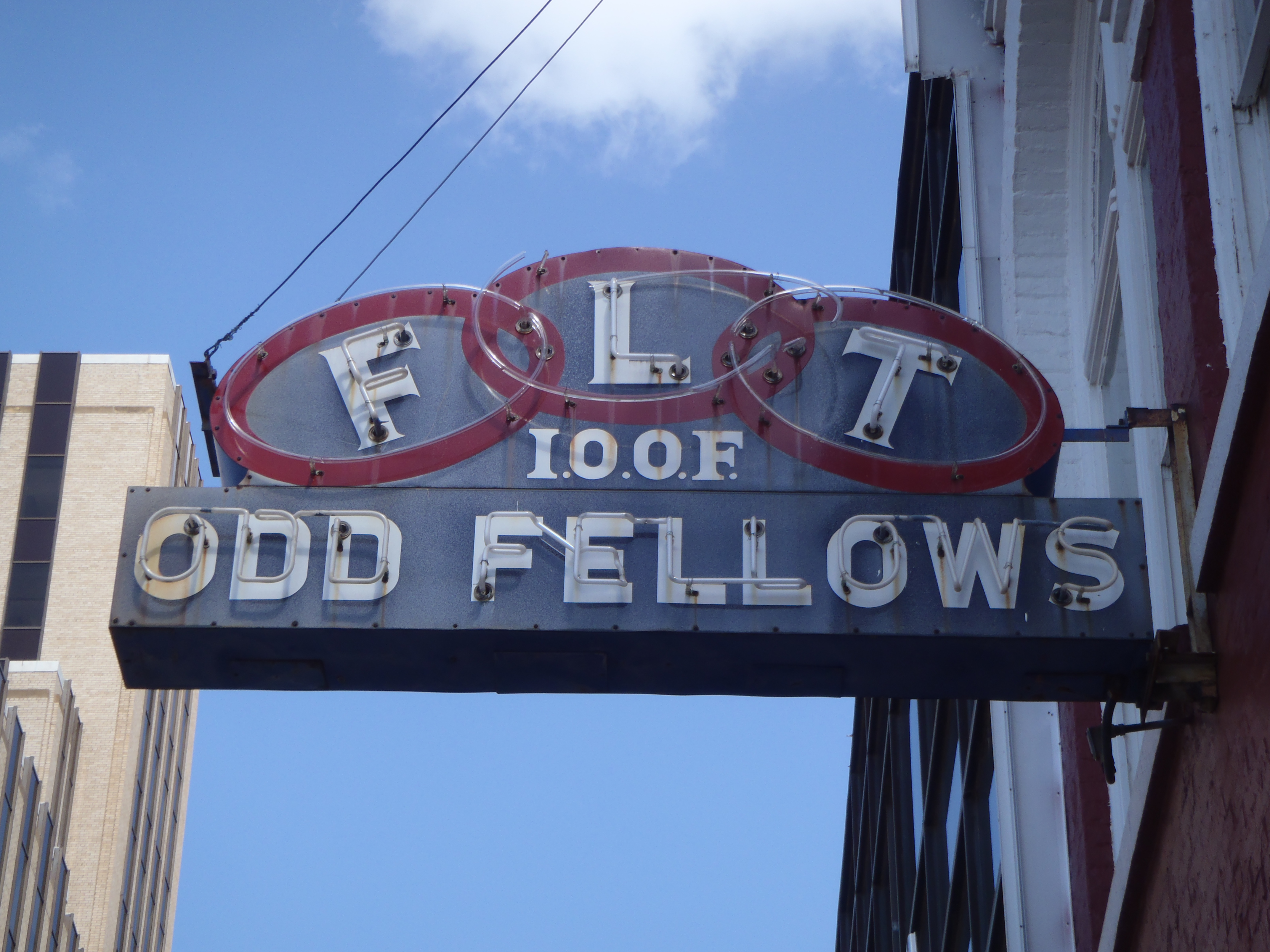
Only the oldest parts of our nation harbor these artifacts of the American past. It is always good to remember where we came from because it gives us a context for where we are. Plenty of people today are talking about why guys aren’t growing up, etc, but I don’t think they ever ask the question, “What’s waiting on the other side?” Yes, traditions are cumbersome and (quite necessarily) antiquated, but even in this postmodern society there is utility in having a structure to stand up under. There is a beauty in being told how to act. So don’t mock the Oddfellows, Lions, Masons, or Shriners. The men involved in these organizations are engaging in a tradition of American civil society that was once a grand element of this American life. Today, it is mostly just plaques on buildings … and a memory of how life could be.

Weekend Graphic: The Origins of “Dumb Growth” (1946)

Click the photo to maximize:

The summer after my sophomore year, I interned at Partnership for Smarter Growth, a non-profit in Richmond devoted to containing the sprawl and reinvesting in the core. During this summer, I discovered a vocabulary to help me define what it was about new cities that I didn’t like. “They’re just not cool,” I thought in high schoool, “and there just aren’t any people.” After the summer at PSG, concepts such as connectivity, the human scale, walkability, mixed-use, access, density and others began to shift my mind to what we called “smart growth.” I have always been an advocate of smart growth, I just never knew what to call it

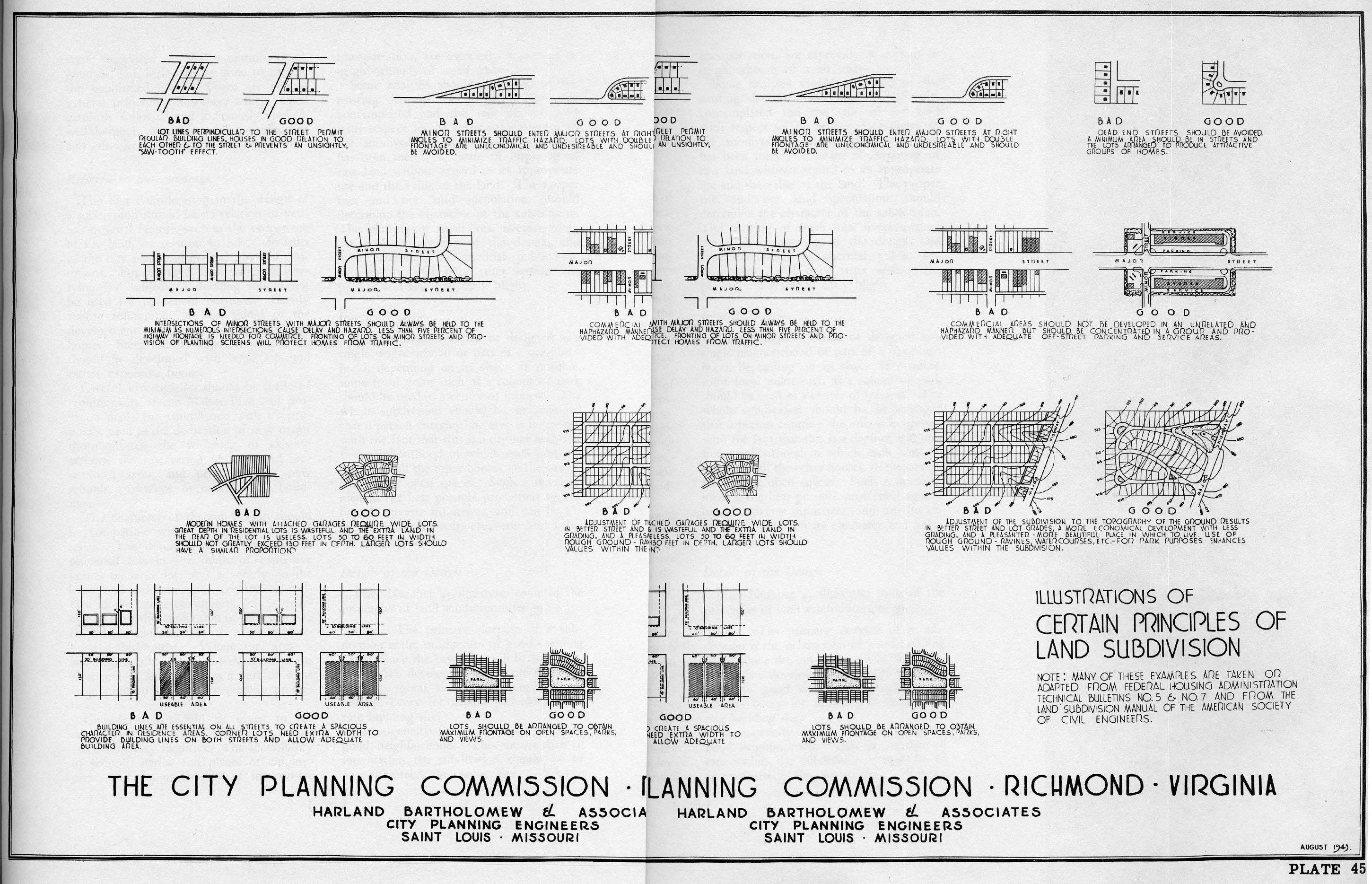
This perspective is why I found the graphic for this weekend particularly moving. I stared at these two pages in disbelief. I had found the origins of what I guess you could call “dumb growth” in Richmond. I don’t want to make it personal if you live on a cul-de-sac … it’s not about that it’s about how the city functions as a whole. During the 40s, Richmond embarked on a planning process to move the city into the twentieth century. As a part of this proces, the planning firm, Harland Bartholomew and Associates, developed this “bad/good” depiction of urban forms.  Over sixty years later, many people are still busy working to undo the spirit of this graphic and its affect on the American city: curvy roads, culs de sac, congested arteries, and a general disconnect between most segments of metropolitan society.

Race in Tyler: A Pie Graph of Color

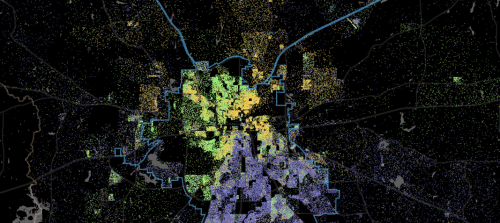
This is a response to a map of race in Tyler recently produced by Christopher Groskopf (@onyxfish) using the brand spankin’ new 2010 census data. He posted his analysis on the Web site hacktyler.com  titled “2010 Census: Racial diversity in Smith County.” Check it out:

In some ways, what I always knew makes much more sense after looking at this map. I now see that the original El Lugar is in the middle of the most Hispanic section of Tyler. Texas College and Martin Luther King Blvd are in the heart of Black Tyler. South Broadway, the site of most new development and big business in the city, is the backbone of White Tyler.

I think Groskopf’s work compliments thoughts that I and others have had on Tyler and gives me more of a context for the city over all.  Somehow with the language of the internet (which is beyond me)  he has illuminated my city in a way I have never before seen. Granted, some racial realities are not surprising, but the overall experience as a resident looking through this map is remarkable.

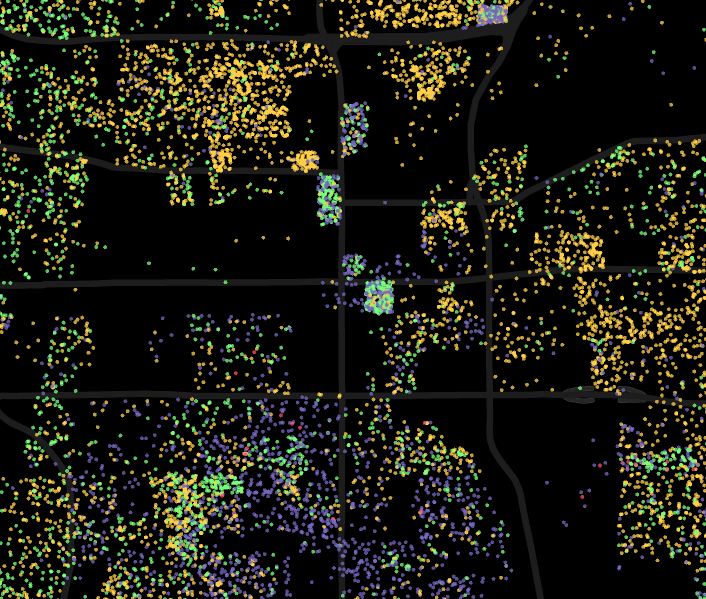
When I first looked a the map, my eyes immediately went downtown (pictured right). That black, vacuous space in the middle of my city. It may seem strange to be drawn to an empty space, but it’s because I have a different vision for downtown. In an earlier post, “C-T-D: Thoughts on Downtown,'” I tried to understand the idea of “downtown.” What is it supposed to be in relation to the city? If we understand the idea, then we have a standard of comparison for the reality. Here’s my standard: The first element of downtown is density, the second is urbanity, and the third is a creative economy. Looking at the black space of our downtown reminds me that it is still primarily a place to work and park your car. What would it look like if it was a place to live? Downtown could be the place where all three major pieces of the racial pie meet each other. It could be the center of city life and it could be a place where everyone feels welcome. I know there are dreams for the old King Chevrolet location and other vacant lots downtown … I hope we share these dreams with the rest of the city.

From downtown, my eyes zoom outward. I follow the three pieces of this pie from their smallest points to their largest and I’m amazed at the simplicity of the settlement patterns in our city. Groskopf mentioned the racial segregation in Chicago because in my experience that city is a patchwork of race. Tyler is more of a pie. The white population in Tyler is certainly the most homogenous, but there are some clear demarcations between the Black and Hispanic regions as well.

Here are specific observations:

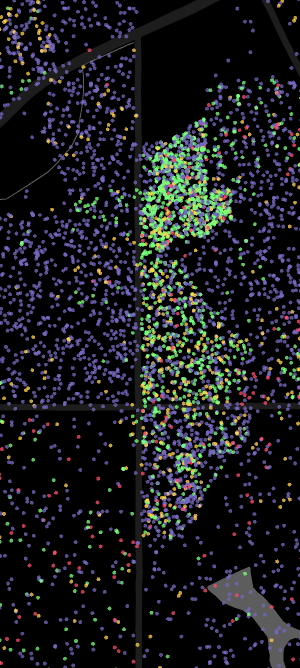
Physical structures divide urban communities. The clearest example of this for me was the section of Paluxy just south of the Loop (pictured right). This photo is special to me because the black community to the right is in the middle of the huge white piece of the pie. The community also looks clearly sectioned off by Paluxy to the west (left) and other, smaller roads to the N,E, and S. On Google maps, this section doesn’t look any different. I have to admit I haven’t driven around these streets on either side of the color line, but I have this urge to go there and learn more about why the communities have settled in this way.

Invisible lines divide rural communities. I was really unaware of the racial breakdown of rural Tyler before looking at this map. It’s partly because I haven’t spent as much time in rural Smith County and it’s partly because it’s just a bigger amount of space to understand. I think it’s so interesting that north of Tyler the two pie pieces of Black and hispanic communities stops at this invisible line (pictured left) and then White communities continue all the way to the county line. BUT, to the east, there is no imaginary line and the rural Black population is sustained to the edge. I wonder what historical legacy or communal understanding has created these invisible lines? While roads and buildings sustain separation in the city, segregation in the rural areas of Smith County is a little more difficult to comprehend.

There is so much more to learn from this map. I have already spent over an hour looking at the dots on this black field and I’m still amazed at what they have to teach me. I will certainly be referencing this map until the next census and I look forward to thoughts and responses from my fellow Tylerites.

Check out my other Tyler projects at my Tyler, TX page.

The Place of Learning

An ordinary room can become a place of learning, imagination, creativity, and new ideas. But it can also become a place of chaos, frustration, depression, stress, anxiety, fear, and resentment. When I was young, I didn’t really appreciate the work it takes to transform a room into an environment that encourages learning. In about a month, that will be my new responsibility.

As a teacher, I’m basically charged with the responsibility of a room and a group of high school students. My students and I will both enter that room with expectations and apprehensions. Will I succeed? Will I look dumb? Will others respect me? Doesn’t matter how old you are … these questions go through your head when you prepare to do something you’ve never done before. And I, the person charged with sharing new information in this room, do have these and other questions to ask myself. Rather than continue to focus on my responsibility, tantamount to my success will be the ability to convey the idea that we (the “teacher” and the “students”) are all charged with turning that anonymous, empty room into a place of learning.

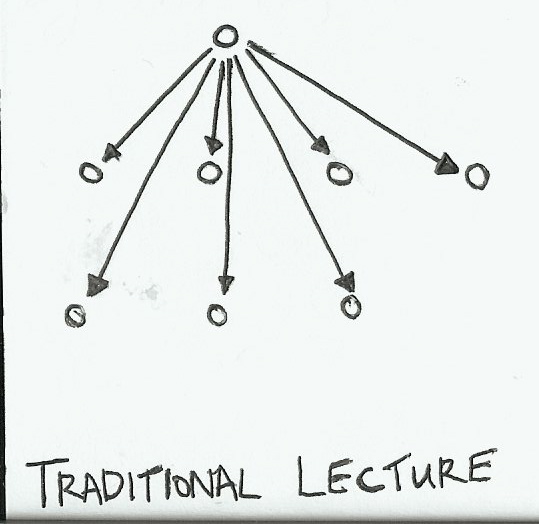
To me, a “place” is essentially an ongoing communal project within a given space. People talk about “creating place” and I think we may be talking too much about buildings and trees. The way I see it is that places are created and sustained by a group of people. The murals and cafes are the positive effects of an engaged group, but not the goal itself. Some people involved in creating a place of learning have more responsibility than others, but one person cannot create a place on their own. I’ve drawn a few power map doodles to discuss my ideas of education and teaching. Above, I’ve included a doodle of a “traditional lecture” model of teaching. This model is employed in many traditional hierarchical organizations such as the military, fraternities, churches, corporations, many low-income schools and some universities. In this model, the teacher (the circle at the top) is the dispenser of information to the students. Whether they understand the information is not readily apparent because they are not encouraged to react or “translate” the information into their own perspective. They are not given the chance to apply the information to what they already know.

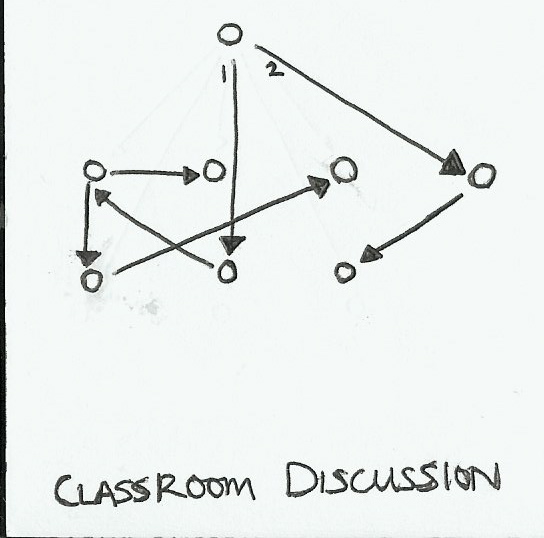
In my second doodle, “Classroom Discussion,” the teacher (again, the top circle) introduces an idea to the classroom (1) which then elicits a response from a student whose response then resonates with another student and so on. Then the teacher introduces a second idea (2) which engages a previously unengaged student whose response resonates with the last student in the classroom. This discussion encourages students to enter into the process of turning the classroom into a place of learning. It engages them and provides the opportunity for the students to inform the classroom with their own lived experience and perspective. As Surowiecki argues in The Wisdom of Crowds, a diversity of opinions in a room is far more worthwhile than the perspective of one person. Even if that person is a “teacher.”

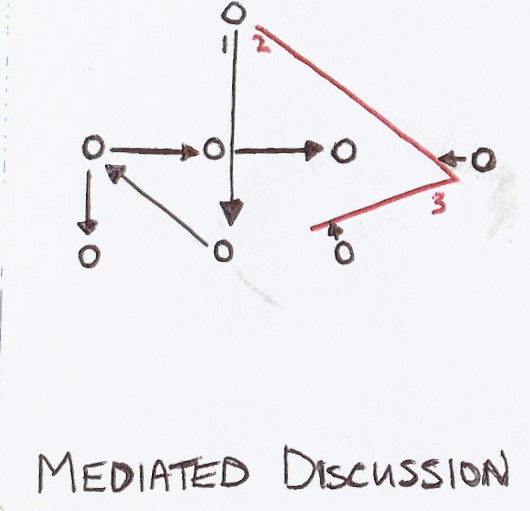
The third doodle, “Mediated Discussion,” is a more realistic version of the classroom discussion. Sometimes, students are not fully committed to transforming the room into a place of learning. Sometimes students aren’t willing to give up the goal that they had when they entered the room: Perhaps to make a name for themselves or create a little chaos. In the mediated discussion (right), the teacher introduces an idea (1), this idea resonates with a student whose response then continues the chain and encourages other students to share their thoughts. At the same time, the teacher extends vested power (2) and prevents two students from asserting their ideas on the rest of the class. I am fiercely democratic, but I also understand that strong leadership has a place in the classroom and elsewhere. Not everyone is always on board with the goal.

I recently watched the movie Buck and it was an inspiration. I never thought a horse movie could ever teach me so much about people and teaching. What Buck Brannaman discusses in relation to horses finds a direct parallel in the human experience. “Your horse is a mirror to your soul,” says Buck, “Sometimes you might not like what you see … sometimes you will.” I think the same could be said for your children and your students. In fact, everyone you affect with your wake tells you about yourself (Idea cite). I hope that in creating this place of learning I will be patient and understanding like Buck. He understands where horses are coming from — their fears, apprehensions, and previous experiences — and invites them to trust his correction and accept his leadership. I look forward to learning how to teach effectively, to drawing more doodles and to hearing more theories on how to improve. Here’s to trial and error.

New Term: Grand Obsolescence

The term is usually “planned obsolescence,” but the word “planned” doesn’t exactly apply to what our cities look like today. So Grand Obsolescence is the term I guess I’ll to describe the spaces in our cities that have beed deemed worthless and discarded. Just like your iPhone 3 when the new one came out.

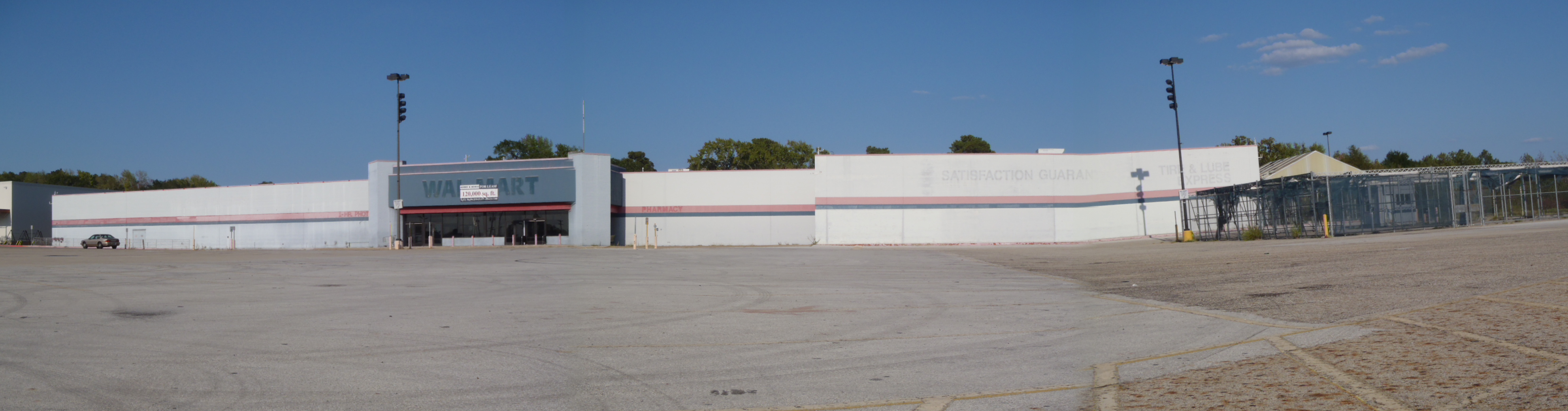
A Walmart was built on a highway in Tyler and surrounded by acres of asphalt. Then, Walmart built a supercenter right down the road and left this building to anyone that wants to spend the money to retrofit a warehouse. Thanks Walmart! The parking lot is now (obviously) underperforming asphalt and the building is vacant. The reality is: multi-nationals don’t have any concern for the long-term well-being of a city … they just need to make money. It’s up to the city to look out for itself and to prevent stymie process. The problem is usually a weak planning function and a city council that can only see $$$ with each new development. The result is cities that Kunstler says simply “aren’t worth caring about.” Of course, there is still plenty to care about, but the problem is that you have to drive farther to get to them. And even then … it’s still not usually impressive.

Maybe, we drive so fast we don’t notice these vacant buildings or maybe we just have low expectations. Maybe because our cities grow outward we don’t feel the need to look inward. All I know is, it ain’t pretty and we can do better.

Weekend Graphic: The Lady and the Car (1950)

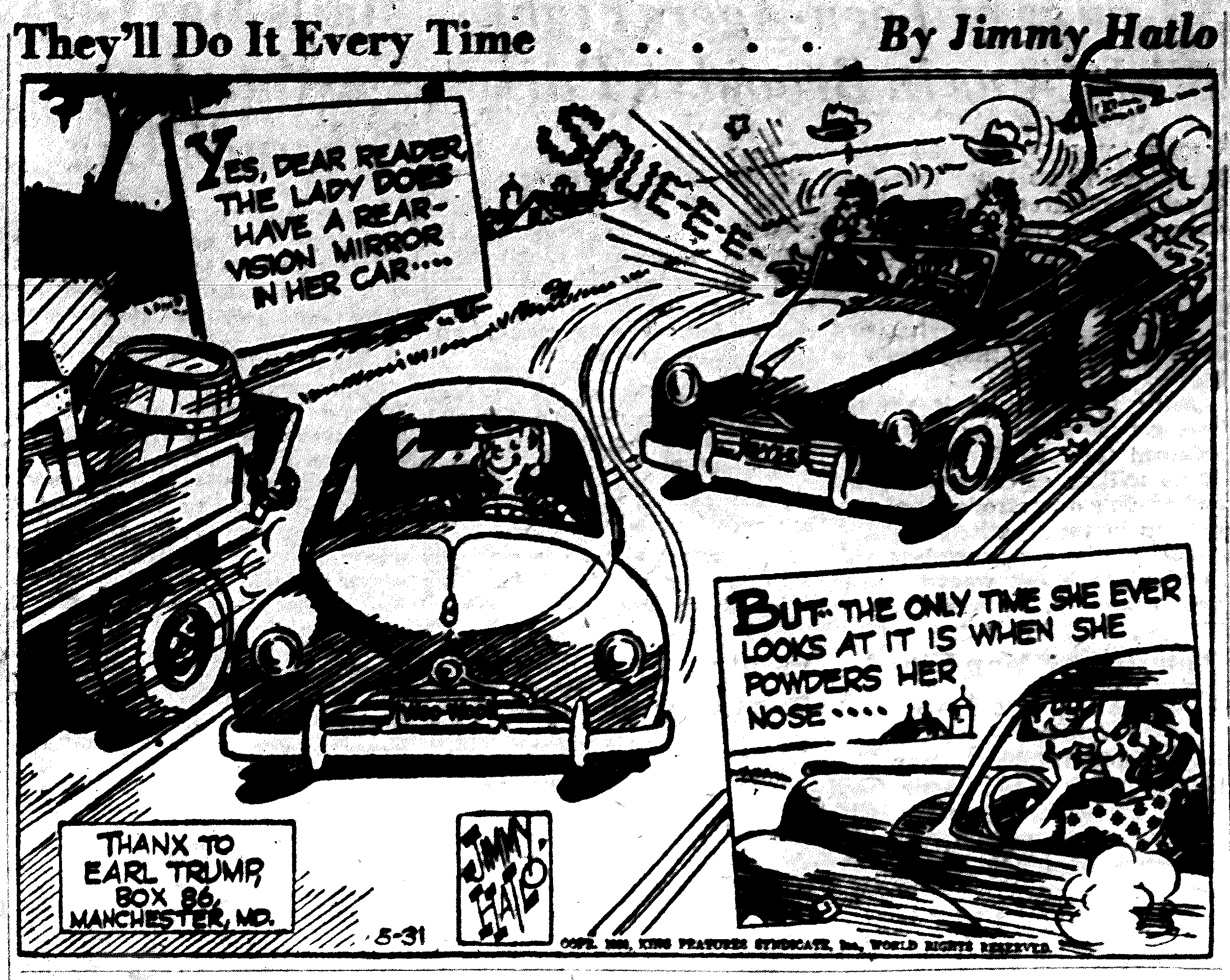
On May 31, 1950, the Richmond Times-Dispatch ran a cartoon titled “They’ll Do It Every Time.” I guess the “bad driver” trope was the 1950s alternative to the “captive wife.” It’s pretty self explanatory:

Friday Photo: Tyler City Hall

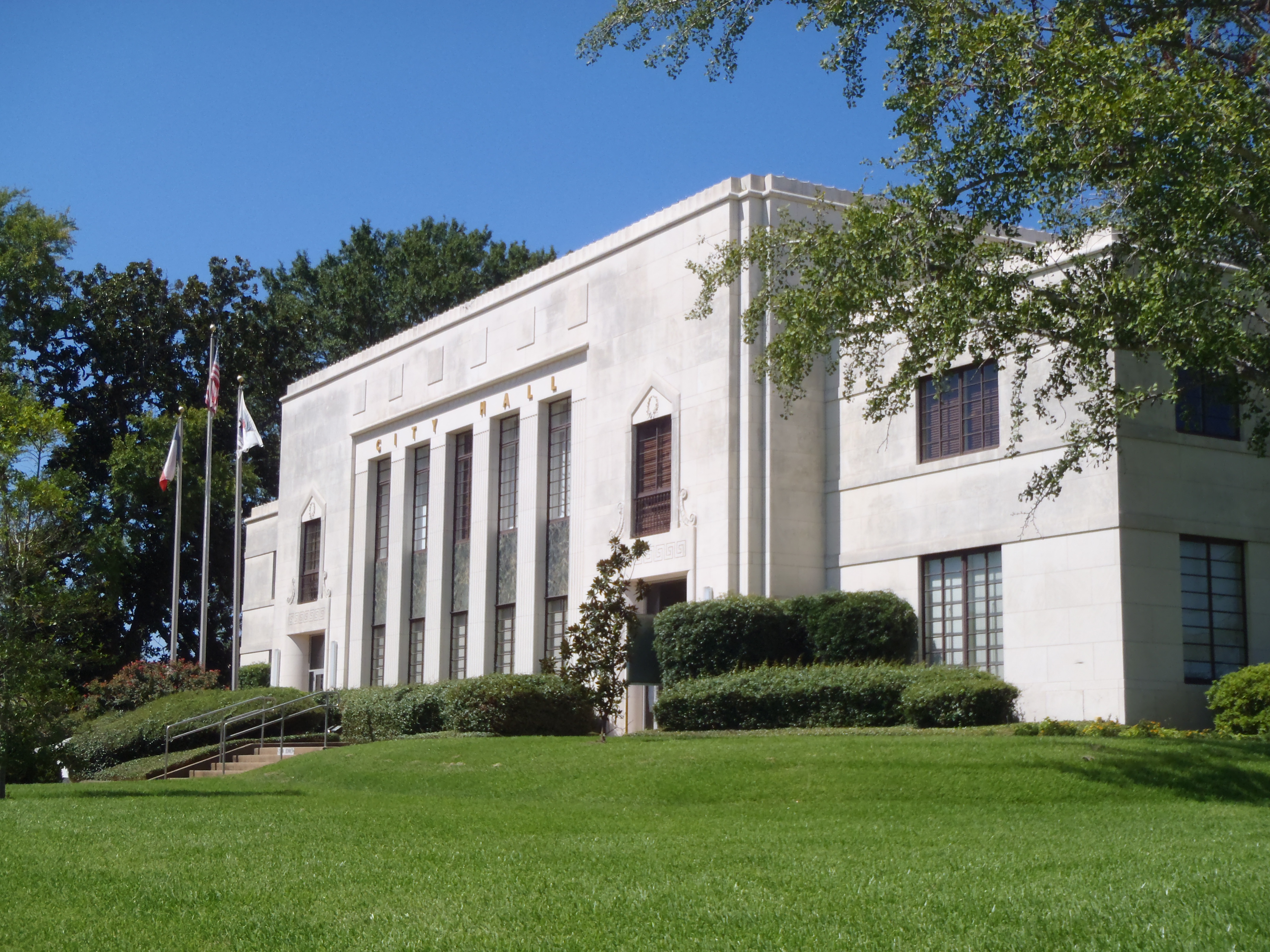
You might not know this (I didn’t until recently), but Tyler has a City Hall. The mayor and city manager work there along with other public officials and board members. It’s on Bonner Avenue just north of the wasteland formerly known as King Chevrolet. I like the building because it’s a decent Art Deco piece from the 30s when Tyler was awash in oil revenue and looking to the world for inspiration. It’s also surrounded by nice grounds, picnic tables, and benches. Take a look:

C-T-D: Conclusion to my time in this place called Tyler

I moved back to my hometown of Tyler in May to begin a brief, post-grad-limbo summer. Since I arrived, I have made it my hobby to explore the city, imagine its potential, and write a series of posts on my ideas. I called this, “Connecting-the-Dots,” because I believe that Tyler (like many cities) suffers from a lack of cohesion and identity. On the micro level, we lack special places (“dots”) fully enhanced with the cultures, traditions, and organizations that comprise our civil society. On the macro level, we lack the connections of transportation and urban design that unite the disparate pieces of what we consider to be a singular unit. I’ve been primarily guided by the question, “Where is Tyler?”

In my attempt to answer this question, I’ve spent my time looking for what I believe makes this city unique: what someone can find here that is not anywhere else in the same way. The places that I love the most are sometimes the places that are most unloved. In other words, the Rose Garden may not be as sexy as Chuy’s right now, but it is unique to Tyler unlike the Austin import. Business in North Tyler might not be as lucrative as its cousin on South Broadway, but it’s more creative, local and artisan. It’s the difference between Janie’s Cakes and the WallMart bakery, Stanley’s and Spring Creek, the Rose Garden and Faulkner Park, Balance and World Gym, La Favorita and Pasado’s.

Unfortunately, all of those places that I believe represent Tyler do not reside together in one awesome, dense, and diverse place. In my opinion, a visitor to this city needs a guide to properly experience what this city has to offer. But suppose there were such a singular place comprised of all the unique Tyler attractions. It would be remarkable. People would come from all over the region to be a part of it’s energy and excitement. Now, suppose there were two. Or three and a street car connecting them. Suppose you could go to one for dinner, the next for a concert and the third for coffee, dessert and drinks and never get into a car or leave your friends. Suppose everyone in East Texas heralded this as the “Tyler experience.” Suppose we leveraged what makes us unique in order to make us uniquely great.

Our city is positioned as a regional leader in oil & gas, the processing of roses, healthcare, higher education, retail, banking, legal and financial services. Suppose we were also known as a creative and innovative community that supports new ideas local aspirations. That is a dream many in this city have been fighting to realize. I believe it’s a dream worthy of this place called Tyler.