
Looking through Google maps I spotted this section of downtown Detroit, almost completely erased for a highway and parking lots:
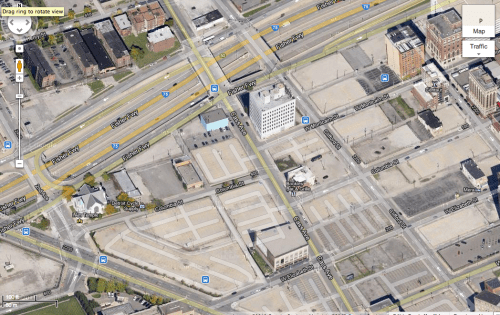
Looking through Google maps I spotted this section of downtown Detroit, almost completely erased for a highway and parking lots:
Posted in Lost Treasure, Movement
Tagged asphalt, cars, destruction, Detroit, downtown, highways, Loss, Parking lots
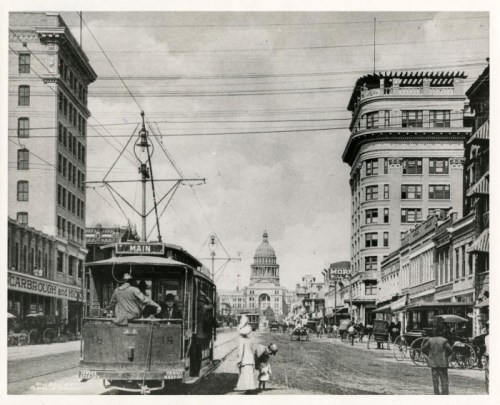
“Not Even Past,” a blog produced by the history department at the University of Texas at Austin, just posted a piece about streetcars in the city. It’s amazing how similar the story of one American city is to the next.
Posted in Lost Treasure, Memory, Movement
Tagged Austin, history department, Not Even Past, Streetcar, Texas, transportation, university of texas at austin
“Cities have become the career dressing rooms for young adults. They have become the place where people go in their twenties to try on different identities. Then, once they know who they are, they leave.”
The Social Animal, 188-189
Posted in Ambition, Movement, Significance
Tagged Career, Cities, David Brooks, identity, The Social Animal, twenties
After months of reading, I have finished William Zinsser’s affectionate guide: On Writing Well. I’ve learned more about writing from this book than any other single source. I’ve also been entertained and moved to tears along the way. That dual quality, reflects Zinsser, “seems to me to be a good day’s work.”
I will never truly be finished with Zinsser and his legacy; as I start projects in the future I’m sure I’ll keep him nearby for regular reference. This book is truly a guide in the most relatable of ways: Zinsser’s voice takes you on a journey and never leaves your side. Here are a few of the many annotated, starred, and underlined bits that charmed me along the way:
“Clutter is the official language used by corporations to hide their mistakes.”
“Believe in your own identity and your own opinions. Writing is an act of ego, and you might as well admit it. Use its energy to keep yourself going.”
“Nouns now turn overnight into verbs.”
“Our daily landscape is thick with absurd messages and portents. Notice them.”
“Don’t hedge your prose with little timidities. Good writing is lean and confident.”
“You’ll find the solution if you look for the human element.”
“She wrote well because she was a clear thinker and had a passion for her subject.”
“We are suspicious of pretentiousness, of all the fad words that the social scientists have coined to avoid making themselves clear to ordinary mortals. I urge you to be natural. How we write and how we talk is how we define ourselves.”
“Criticism is the stage on which journalists do their fanciest strutting.”
“This heightening of some crazy truth—to a level where it will be seen as crazy—is the essence of what serious humorists are trying to do.”
“Taste chooses words that have surprise, strength and precision.”
“We are a culture that worships the winning result: the league championship, the high test score. Coaches are paid to win, teachers are valued for getting students into the best colleges. Less glamorous gains made along the way—learning, wisdom, growth, confidence, dealing with failure—aren’t given the same respect because they can’t be given a grade.”
“Moral: any time you can tell a story in the form of a quest or a pilgrimage you’ll be ahead of the game.”
“One of the saddest sentences I know is “I wish I had asked my mother about that. Or my father. Or my grandmother. Or my grandfather.”
“Writers are the custodians of memory.”
“But the final advantage is the same one that applies in every other competitive venture. If you would like to write better than everybody else, you have to want to write better than everybody else.”
“A good editor likes nothing better than a piece of copy he hardly has to touch. A bad editor has a compulsion to tinker, proving with busywork that he hasn’t forgotten the minutia of grammar and usage. He is a literal fellow, catching the cracks in the road but not enjoying the scenery. Very often it simply doesn’t occur to him that a writer is writing by ear, trying to achieve a particular sound or cadence, or playing with words just for the pleasures of wordplay.”
“You will write only as well as you make yourself write.”
I believe that the beauty of D.C. is the simplicity of a good plan: symmetry, long vistas, and grand terminals. All of these qualities are found in the allée.
Here is a photo I took while walking the National Mall:
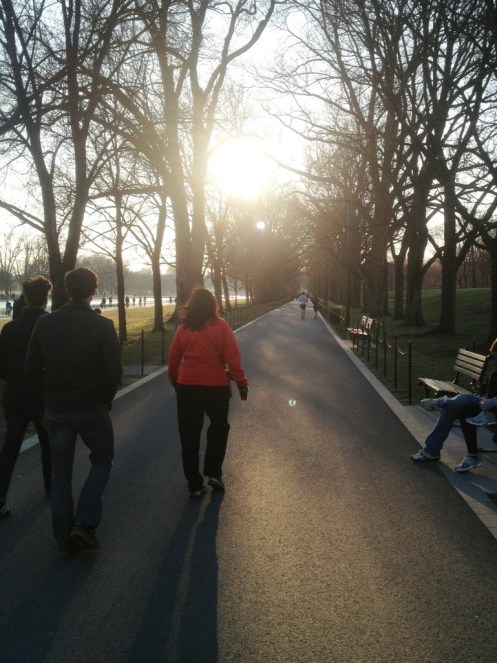
What I love about the allée is that it’s so simple. With a straight path and some lovely trees we could turn any formless green space into a memorable experience.
With the allée, a simple path becomes dramatic. A walk becomes an journey.
Posted in Creativity, Movement, Significance
Tagged allée, city, Garden, walk, Washington D.C.
At the Lincoln Memorial, beneath the text of the Gettysburg Address, there is a room with an elevator and a door. In this room, while waiting for an elevator that never came, I noticed a sign for the US National Parks Service:
“That’s interesting,” I thought, “Native Americans and bison.” Two groups that my ancestors hunted to the brink of extinction. Yet, today they symbolize the preservation of our wild frontier.
Whoops.
After I made this connection, the looming text of the Gettysburg Address started to feel like a grand contradiction. This speech was given almost three decades before the Wounded Knee Massacre that finally ended the American Indian Wars. When he gave the speech, Lincoln made the bold claim that the phrase, “all men are created equal,” applied to enslaved people, but he made no mention of the other war out West.
Instead, he said that “our forefathers brought forth on this continent a new nation, conceived in liberty…” It was an incredible proposition (and it’s a remarkable nation), but our forefathers needed a clean slate for this new, great nation. So they drove away all signs that this wasn’t a new or completely pure endeavor.
Native Americans were quarantined to the remotest sections of this land-rich nation. Today, many residents of the reservations live in poverty, many desire cultural and traditional significance, and many long for the places of their forefathers.
This world wasn’t new when America was founded. Freedom wasn’t truly extended when the Civil War ended. Today, we are living the dreams of Europeans that took a chance.
The rest is complicated/history.
Posted in Memory, Movement, Weekend Graphic
Tagged bison, equality, Gettysburg Address, Lincoln, Native American history

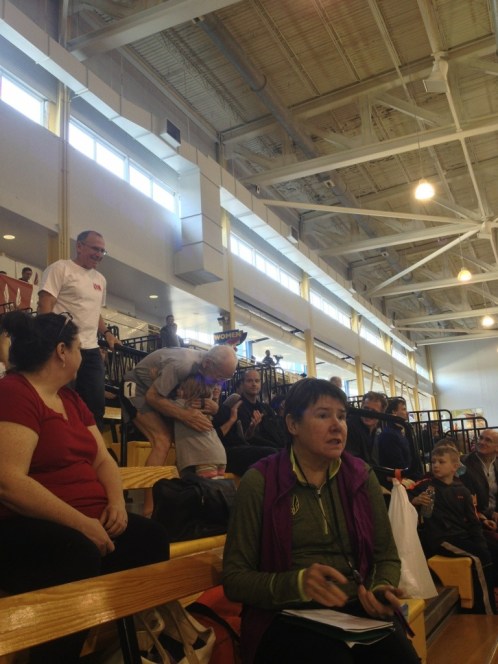
In the past 24 hours, my 95-year-old granddad has set and broken 4 world records. Two races to go.*
His life is truly a testament to the value of consistency and hard work. For the first 90 years of his life, he lived and worked. For the past five years, he has won.
But the beauty of his story is not in his gold medals and world records. The beauty in his story is not mere longevity or discipline. The beauty lies in his faith in God and identity in his plans. He said a few years ago (after a stroke) that he might never run again. He was as content that day as he was today as the first officially recorded man his age to run the mile.
And through the years, he has loved his family with a commitment that deserves more honor than any metal can bestow. Fifteen of us came to watch him this weekend. At the end of the race today, the first person to greet him was his great granddaughter.
Winning a race is not about crossing a finish line. Winning is about loving and being loved along the way. Winning is about remembering what really matters.
This is the life of a champion:
*He ended up setting world records for the last two races as well
I found this image on one of my favorite blogs, Colossal. It seemed like a perfect example of the truth that cities are not a place where you have to get stuck. Investing in a city (and making it your home) doesn’t make you dependent. Cities are an adventure. There is some danger in this adventure, but without high risk there’s no chance for high reward. This photo also reminded me of one of my favorite Foucault quotes from an essay I first read five years ago: “Of Other Spaces.” He writes,
“In civilizations without boats, dreams dry up, espionage takes the place of adventure, and the police take the place of pirates.”
With twenty-first century communication and connections, the modern city has become a boat (er, turtle) and if you are willing to commit, it will eventually take you somewhere completely new:

Posted in Movement
Tagged Colossal, Moving cities, The street art and drawings of IEMZA, This is colossal
You know that brief moment in “Tarzan” when he is flying through the air between vines? That’s basically been my life for the last five years.
Like many of you, I left my family and friends to start college in Richmond. My first night in town, I had dinner with a student named Dan and listened while he shared his story. He became my first friend and connection to this place.
The next day, he introduced me to a few of his friends and his favorite professor. We laughed, they made fun of each other, and I began to imagine that life on this campus might actually work. In some small way, I was closer to home.
I had no idea how fast time in college would move. I especially didn’t know how significant those first few friends would be in providing me with advice as I made my way through the maze of classes, programs and professors. Without their help, I might have never found that sneaky second vine.
Looking back, I wonder why I listened at all. I could have disregarded their advice and found my own way. But for some reason I appreciated their experience and trusted strangers in a strange place.
Lesson #1: When life gives you strangers, hear them out. At the very least, you’ll have a story to tell. At best, you’ll have a new guide to show you the way.
These new friends told me which classes to take (and which not to take), welcomed me into their community and drove me to the ER when I fell out of a tree and broke my arm. That’s right, this Tarzan metaphor just got real.
Not much has changed from those early days in Richmond. If I’m honest, the vines just feel farther apart and the fall much farther below. The only difference is that I now have faith that someone will introduce me to someone who can show me the way.
I’ve also matured a little since then. I certainly appreciate people more than I used to. While I usually took advice from others, I also regularly took it for granted.
Appreciating our mentors doesn’t mean we have to become our mentors, but it does mean that we have to give some effort. We have to be willing to say yes to something new and outside of our comfort zone.
Lesson #2: Receiving advice means humbling yourself long enough to actually listen.
I’ve also learned (many times over) that being mentored isn’t simply about receiving advice. Mentoring is not a product to consume or even a loan to repay. It’s also not supposed to make me feel good about myself or confirm what I already know. At its best, mentoring is a truth and a challenge. Mentoring first says, “I think you can do it,” and then, “Here’s what it’s going to take.”
Being mentored then becomes more about making choices than discussing ideas. When you receive wise counsel, it’s not a hypothetical in a book; it’s wisdom applied to your life. Receive it and say, “Thank you.”
Lesson #3: The more often you ignore someone else’s advice (for no good reason), the less likely they will be to share it.
When we commit to being mentored, we become a part of generations of mentors who have been acquiring and passing down wisdom for years. Open yourself up to wise counsel, prepare to be honest, and be willing to be wrong. Then, if you really want to be stretched, you can become a mentor yourself.
You may think that you’re not patient enough to mentor or that you don’t have enough time. But that is exactly why you should do it. If life gives you a chance to grow in a new (and uncomfortable) direction, shouldn’t you take it?
You can become more patient and eventually learn how to make time for the relationships that matter most. You can have the chance to pass on what was taught and the advice you have been given. And, for what it’s worth, I think you’d make a great mentor.
This article first appeared in print on January 30, 2013, in The Collegian.
As I rode home from work on Friday, I decided I needed to get out of Richmond. For me, a 70-mile drive to Charlottesville is far enough to feel like I got “away” from my routine life. That drive down I-64 was the beginning of an idea that has everything to do with highways and hallowed halls: the faster you can get somewhere the closer it feels.
I’ve been told that humans have always considered a reasonable commute to be about a half of an hour to an hour of travel. Walking, that would be about 3.5 miles. Driving, that could be a trip from Trenton to New York. Flying, that’s a D.C. to Chicago commute that no child dreams to have when they grow up. While the amount of time we travel to work has remained relatively the same, the increase in distance has been significant. The affects of this distance are profound.
In the early 1900s, before the Model T and good roads, many wealthy Americans owned second homes just outside the city. In Boston, for instance, this was the rural getaway known as Jamaca Plain. Near Richmond, it was the neighborhood of Bon Air. Originally a retreat ten miles outside the city, Bon Air was frequented by Richmonders who wanted to get “away” from the stifling life of an industrial city. Today, Bon Air is near the middle of a metropolitan region and considered just another inner suburb. Meanwhile, the wealthiest residents are more likely to have second homes in Sun Valley or Naples than rural Virgina. The idea of buying a second home 10 miles away seems absurd. The faster you can get somewhere, the closer it feels. But is it actually close?
Many American cities today are populated by the children of faraway parents that raised them and watched them leave. I am one of these children. I was given the chance to move over 1,000 miles from home to live somewhere new and exciting. I have been given the chance to go out on my own. But when did this become normal? We, the millennials, are the fifth generation of Americans with access to cheap gasoline and the third generation to grow up with interstate highways.
We grew up as the unsettled generation of an increasingly mobile nation. There have always been wealthy people, but there have not always been turbojets and 70 mph speed limits. This has changed the way we see distance and separation.
For instance, I live about three-and-a-half hours away from my hometown of Tyler, TX. By plane. So that’s about 22 hours away by car and 349 hours by foot. When I left Tyler for college I didn’t really think it was a big deal. Now, it feels significantly farther than I originally imagined. In my sixth year of life away from Texas I can say there is much I have learned while I’ve been away. I wouldn’t change my decision to leave if I had the chance. I love the city where I live and the university where I studied.
But there is this simple, lingering question I am asked every once in a while that I can never completely answer: “So, how’d you end up in Richmond?”
Like most, I tend to focus on the “pull” factors of migration. Oh, I came here for college and fell in love with the city. I usually also make a joke about how the University’s website was easy to navigate or that Richmond wasn’t as cold as Boston, another city I considered for school. But why, as a senior in high school, did I not consider a single school in Texas or even somewhere closer like New Orleans or St. Louis? Why the 1,000-mile trek? There are a few easy answers I can think of:
But that doesn’t really answer the question. While there was a draw to move away, there were also significant “push” factors that sent me away from my southern home. In the land of football and Rick Perry, I didn’t really think there was a place for a friendly writer trying to make a difference. I made lots of unfavorable generalizations to justify my move away, but at the same time I was more focussed on where I was headed. When I applied to college, I dreamed of a place where people liked to read and write, where Christians didn’t all look the same, and where it wasn’t weird to suck at basketball. I didn’t know if I would find that, but I figured it was worth a shot. Everywhere I went in Texas, I saw the same story and realized that, while I think it’s a great story, it would be a hard one to fit into.
So I got out. I became one of the many confused Texpatriots simultaneously displaying a Texas flag and critiquing that beautiful, mineral-rich place.
And here I am: living in an old mansion in Richmond, working at an amazing university that also happens to be my alma mater. My neighborhood is both dangerous and beautiful depending on who you ask. My house is used as a tutoring site for hundreds of kids each year. My city has representations of American architecture going back to the 1700s, fine art, public murals, excellent restaurants, and more. It’s not D.C., but it’s also not snooty and it suits me well.
And yet, if you notice, all the positives aren’t really adding up. There’s always the question, “But what?” Living in Richmond is awesome, but it involves this thing I call the golden triangle of growing up: the pull between a career, a significant other, and family/hometown.
This is how it plays out:
Whenever I think about moving home (or at least near family), my first thought is that I can’t go back until I get somewhere in my career. There’s not much of a market in Tyler for someone who made up their own major in college. Then, whenever I think about advancing my career (a word I routinely misspell) which might involve grad school somewhere far away, I immediately think about my girlfriend and wonder how the timing of both will work out. Thinking about our relationship then takes me back to thinking about moving home and I imagine a life of holiday swaps and long-distance in-laws. Again, when I think about home, I think about my career pulling me all across the nation and I wonder what my little sister will be up to as she finishes high school and enters young adulthood herself. I wonder if my parents will be sitting on our back patio enjoying those cool spring afternoons in Tyler while I’m who-knows-where doing who-knows-what. I think about my three older brothers who are all living in this golden triangle as well and I wonder if we will ever manage to live near each other again.
I wonder if I will ever get to move home and whether it will still be home when I get there.
When you’re in a relationship with someone that’s in a similar situation, you also realize that at some point one of you will have to bend for the other. That’s the compound reality of this golden triangle: both of you can never have all three at the same time. And since both people in relationships today have educations and aspirations, it takes a lot of energy to make it all line up. Often people choose to go their separate ways, some struggle through the long-distance life, and others manage to work it out in the same place. Even when it does work out, it can be a gauntlet of long-term planning and flexibility.
That brings me back to my trip to Charlottesville. I’m currently sitting at a coffee shop with four friends I’ve met since moving out to Virginia. Between the two couples and myself, we represent five home states: Tennessee, Ohio, Maine, Virginia and Texas. We are all living in the reality of the triangle:
I am from Tyler, TX and my girlfriend is from Medford, NJ and Sanibel, FL. We both currently live in Richmond, but our families are scattered from Florida to California. My friend, Max, who is originally from Portland, ME, currently works and lives in D.C. where he met his girlfriend, Shannon, a native Tennesseean (who also moved around growing up), in D.C. just before she moved to Charlottesville for law school at UVA. Max is currently applying to law schools around the mid-Atlantic region and hopes to end up somewhat close by. Margo, another friend from college, is currently living in her hometown of Cincinnati and hoping to start medical school in the fall. She got into the University of Cincinnati program but is trying her darndest to get into a med school in Virginia so she can live near her boyfriend, Joe. Joe, a native of Richmond (the only native Virginian in the group), is currently in the UVA post-bac program so that that he can apply for med schools this summer and start a year from now in the fall. If Margo starts the program in Cincinnati, he will likely move to Cincinnati to work while he does his best to get into the same program or, if he only gets into a program in Virginia, she may try and transfer after her first two years.
It’s no wonder some are calling us the most stressed-out generation.
Max made the comment last night that we are living in an era of “progressive instability” as young adults in Twenty-First-Century America.
“Dramatic instability,” he added.
Since the best opportunities are no longer nearby, we find ourselves settling into LDRs (long-distance relationships) while we find jobs or attend grad school. Even if you don’t want to go to grad school, you’ve most likely thought about it. Max made the comment that the economy expects us to have graduate educations, but doesn’t facilitate the experience. Also, with MBA programs like UVA’s Darden that charge $76,000 a year for in-state tuition, our generation is making history in the way of personal debt.
With the sluggish economy, vertical mobility is synonymous with geographic mobility and cross-country job searches are the norm. This was once the time of life when people began to build stability, moved home, and started a new chapter of life. Some of my friends have managed to work that out, but many of us genuinely didn’t know it was an option. We, the mobile, have followed the allure of big cities and fresh lives.
No longer a time for building community, the twenties have become a very dynamic stage of life. One misstep and you’ll be roadkill in this “Great Recession” that sees unemployment as a mark of personal failure: you can’t get a job if you don’t have experience and you can’t get experience if you don’t have a job. Of course, it can work out, but it’s a little terrifying at the same time. And we are all living in this reality from day to day. Every once in a while I think about all of this and I take a very deep breath. It’s just too much to consider it all at the same time.
In a decade, I hope I look back and laugh at the golden triangle of growing up. I hope we will have a chance to tell stories and swap war wounds on the other side. I hope we all keep our sanity in the process and I hope we remember what matters most. What makes people happy today is what made people happy thousands of years ago: close relationships, good work, and unconditional love.
In the world of the golden triangle, it’s simply a question of where.
Posted in Ambition, Education, Movement
Tagged becoming an adult, Bon Air, Darden, golden triangle, grad school, Richmond, TX, Tyler, young adult life
 Highways and Hallowed Halls