Tag Archives: RVA

Minor League City

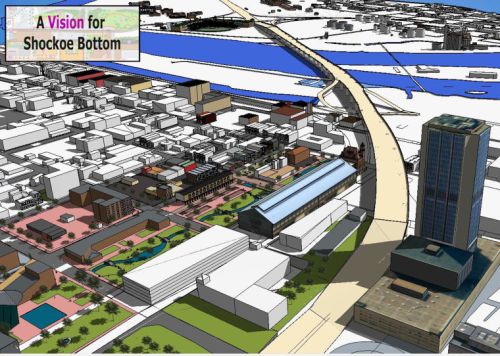
The mayor of Richmond has plans to build a new baseball stadium in the historic neighborhood of Shockoe Bottom. It’s been called, “the best ballpark in minor league baseball.” In the past two months, this plan has provoked fierce debates in Richmond. Part of the opposition has been to the planning process. The Mayor chose to develop the plan without meaningful public input. Furthermore, there are reasons to believe the plan itself does not meet the full potential of this land in the heart of our city. Here is what it would look like:
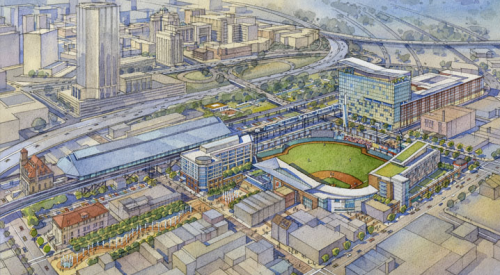
Jones Plan

Of all the ways to present this plan to the people of Richmond, Mayor Jones chose what I call the “blitzkrieg method.” That’s where politicians attempt to stun the public with a fully developed plan without getting any public input. This also happens to be the method that Richmond leaders chose when first planning I-95 straight through Shockoe Bottom and Jackson Ward. This method is the most “efficient” on the front end, but results in bad ideas down the road because there is so little information being shared. Mayor Jones and his team followed this planning model because they knew that Richmonders didn’t want a baseball stadium in Shockoe Bottom. They knew that there would be no chance for constructive criticism.

Rather than listen and seek to understand the opposition, Mayor Jones had people put together this plan then he threw a party for himself to celebrate:

New Ballpark

Here’s a link to the complete RTD coverage of the story if you’re interested.

When I first saw the “LovingRVA” plan I was definitely impressed. I thought it was beautiful and coherent. I was amazed that the footprint of the ballpark could somehow miss all the slave auction sites in Shockoe Bottom. I didn’t understand how the stadium actually fit, but it seemed to make sense. Also, I was pleased that the designs included other elements that I could get more excited about such as this “Slavery and Freedom Heritage Site” over Lumpkin’s Jail:
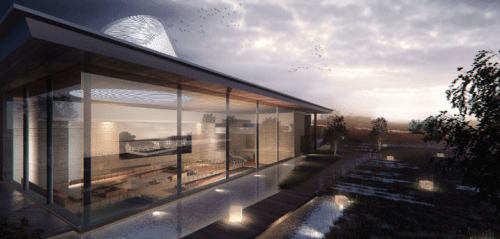
Slavery-Freedom

The plan also includes a grocery store, a hotel for visitors, and even more apartments to bring people to Shockoe Bottom. It seemed like they thought of everything.

And that’s when I realized I’d been blitzed.

As I followed the story and talked with others I realized the flashy plan simply wasn’t ready.  Mayor Jones had “thought of everything” in a paternalistic way because he didn’t want public input. Mayor Jones feared it would be immediately rejected by a vocal community of people that care deeply about the past and the future of this city.

But that’s an area of disagreement because Jones seems to believe that the future of the city is this baseball stadium. So Jones is trying to push the plan through.

Mayor Jones and his allies seem to have a short-sighted concern for the present. In 50 years, he most likely won’t be around to help the next generation of Richmonders figure out what to do with another old, dilapidated sports arena. And he doesn’t seem to care.

People in favor of this “ballpark + hotel + grocery + heritage site plan” seem to have very little patience for the planning process. Proponents seem to have very little patience at all. And proponents also seem to think that bad ideas become good ideas after a few years of sitting on the shelf. There is an unbelievable excitement for the plan, almost a greed, that has clouded our logic. This perspective can be seen in a post a friend left on my Facebook page:

“… while this may not be the ideal, it’s a good plan with a lot of stake holders, public and private, that want to see it work. No, I don’t like how it was put together any more than anybody else. But this is the best, most workable plan to resolve the seemingly never-ending stadium debate that I’ve seen in 6 1/2 years I’ve lived in Richmond.”

In a recent article in the Richmond Times Dispatch, Mayor Jones said something similar:

“Jones said the city needs to act swiftly in order to have a new stadium ready by 2016 and because others are ‘eyeing’ the $11 million that then-Gov. Bob McDonnell proposed in the state budget for the slavery commemoration.

The mayor also said it’s not good for the city to have a prolonged debate involving ‘people who are anti-growth and anti-economic development.'”

Ok, we’re all tired of the ballpark debate. But is the best response to just say, “Forget it, let’s spend $80M on this plan so we can be sure we won’t ever have to hear about it again.”

Proponents of the Jones plan are acting like this is the first time we ever had pretty plans drawn for our city. They tell me this is the best thing for Richmond. They argue that this is going to put money into Richmond’s schools and pave our streets. They say they are “loving” RVA.

So anyone who opposes the plan hates Richmond, wants to defund the schools, and hopes the city spirals into ruin and shame. And that’s what’s so ridiculous about the rhetoric in this ballpark conversation. Most reasonable people believe the benefits to the tax base will be marginal. There are new businesses and apartments being built in Richmond every year. Each has made a small contribution to the city’s tax base. The impact of the Mayor’s project will not be any more significant.

Of course, it will be publicized 10x as loudly.

And besides, every added bit is just a ruse to distract us from the baseball park. Jones knew that it would be politically divisive so he loaded the ballpark down with a “something for everyone” patchwork plan to make it more acceptable to a wide audience. A week after the ballpark plan came out, I joked to some of my friends that I would actually prefer the ballpark plan if we simply removed the ballpark. The smaller elements seemed to properly fit the neighborhood and also fill a need.

The ballpark itself is just a shortsighted, small-town idea. I remember when I was a sophomore in college the city of Richmond floated the idea of a ballpark in Shockoe and it was generally opposed. Those opponents (along with a host of new allies) are still not impressed. To them, it’s not about a flashy or beautiful plan. It’s about determining the best use of valuable, urban space. And they believe that baseball in Shockoe is fundamentally a bad idea.

In response, they have drafted this plan:
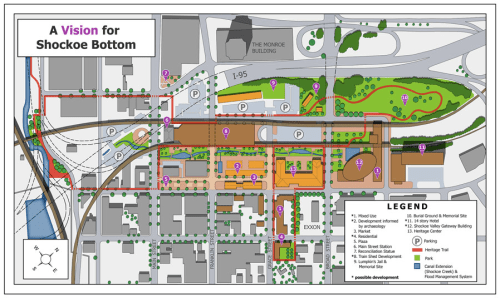
Shockoe

Here’s another view from above:

new shockoe vision

This alternative plan fits the street grid. It honors the natural features of Shockoe Valley. It provides for a full museum devoted to the history of Richmond and the city’s role in international trade of enslaved people. It’s still very preliminary because they haven’t been given much time, but it’s a move in a new direction for Shockoe Bottom and the city of Richmond. This plan allows Richmond to accurately and adequately tell a story that is globally significant. This history is not just a “black eye” for Richmond. The era of slavery is quite possibly Richmond’s most important moment in global history.

One vocal supporter of the Jones plan told me this new option is “ridiculous.” He told me the private investment will never agree to the plan without the ballpark. But it seems like he and others are too distracted by $125 million and projected future revenue to think critically about other options to this plan. We’re all acting as if we’ve never seen this kind of money before. Fresh Market just built within the Richmond tax base. Our universities have been flooding the local market with construction projects every year. The $30 million First Freedom Center in Shockoe Slip is projected to bring “162 construction jobs, 76 hotel jobs, and $930,000 a year in tax revenue for Richmond.” The McGuire Woods building currently under construction “represents a combined investment of more than $110 million.” The new VCU children’s hospital up the hill is costing an estimated $168  million and, when completed, will provide numerous year-round, entry-level jobs to residents of the city and nearby East End.

Clearly, we don’t need to build a baseball park just to convince a little private investment. Without the baseball stadium, they say, no one will want to build in a flood plain.  So why don’t we encourage more development on the many hills of Richmond where we don’t need the ballpark concourse in the first place?

Have you seen the old Gamble’s Hill neighborhood lately? There are nearly three full city blocks taken up by parking lots and it’s located directly adjacent to downtown Richmond. Not in a flood plain. Also, what about the old Murphy’s Hotel location at 8th and Broad? Or the half-block space by Center Stage? What about Manchester? Is there any comparative analysis of these locations to determine their potential for generating more tax revenue for the city?

Richmond desperately needs more tax revenue. We don’t desperately need a new  minor league baseball stadium. The two seem to be getting confused.

I’ve heard a lot of people talking about “private investment,” but I haven’t heard many people getting creative about the many sources of funding at our disposal. To build something great, Richmond could allocate tax revenue, apply to federal/state/foundation grants, ask the universities to pitch in, and seek out private donations from the wealthiest Richmonders down to the average citizen. Below are two world-class projects that were paid through generous donations from citizens, corporations, foundations and local tax dollars.

Millenium Park in Chicago:
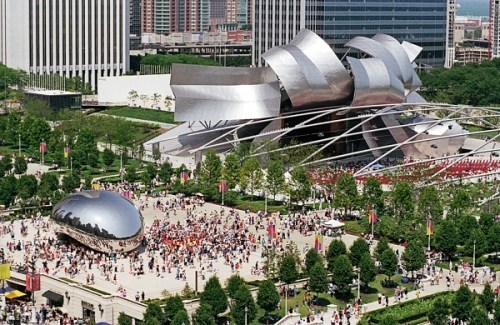
millenium

And Klyde Warren Park built directly over a highway in downtown Dallas:
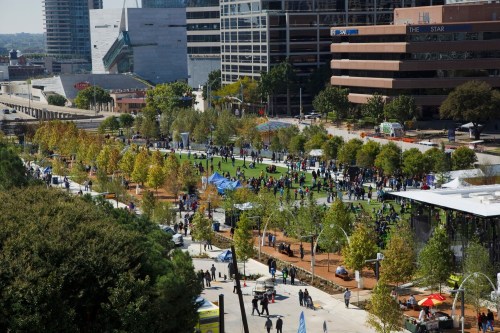
Klyde

These are not examples of what we should do necessarily. These are examples to say, “If we build something that people are excited about, they might be willing to pitch in.” There are many wealthy Richmonders and foundations who would consider signing onto a plan for Richmond that is both world-class and enduring. The ballpark would be neither.

I also don’t trust the statistics that are being used to convince me that the ballpark is a good idea financially. I worry that we’re putting too much hope in the projections of tax revenue and not spending enough time developing the project itself. Instead of building an “OK” project with the hope of later economic vitality, we should build something that is world-class so that in the worst-case scenario (where overall tax revenue changes very little) we will at least still have something that is world-class. This is simply an argument for making the most of the variables that we can control rather than pushing through something less-than-stellar to get to the variables we can’t necessarily control. Also, if it’s a good idea it should be able to stand for itself.

That brings me to my closing thoughts on the idea of a ballpark in Shockoe.

Richmond should leverage assets that are world-class and significant to the identity of Richmond. If we’re going to spend over $80 million on a project, why don’t we spend it on something that people will visit from more than 10 miles away? Why don’t we build something timeless?

I love the Flying Squirrels. I don’t believe they are integral to the success of the city of Richmond. Richmond is made up of artists, businesspeople, state and local governments, universities, entrepreneurs, historic buildings and neighborhoods, the James River rapids, and many incredible institutions that are more pervasive and invested than a baseball team that has been here for a couple of years. Together, those assets could become world-class.

Minor league baseball will always be minor league. At this point in the debate, it actually makes me sad for Richmond that our leader is putting all of his political clout behind this plan. When you take a step back from the glitzy designs and ancillary projects you realize that it’s just a minor league baseball stadium.

At first, I couldn’t tell why I was so annoyed by the Jones plan. Was I just another development-averse history buff?

No. I realized it’s because I am embarrassed for Richmond. I have come to love this place that educated me and gave me my first job. I’ve travelled the world and I believe that this city could become something truly noteworthy. I think that Richmond could make national or international news for a project that is unique and inspiring.

We could make a statement that is thought-provoking. We could shift a trend or start a conversation. I want the rest of the world to wish they had been here sooner. I want them to feel like they missed out. I want Richmond to be one step ahead.

And minor league baseball is not a step ahead of anyone. In fact, it’s more of a step behind. By investing millions of dollars into a feeder team, we are simply reinforcing the second-rate status of our city to the major league team that we serve. Furthermore, by continuing to grovel for minor league baseball we are giving more and more legitimacy to the world-class cities where baseball has long been king. We did the same thing with the Redskins training camp. I know the Redskins camp is cool, but it basically says: we’re on the outskirts of greatness. As an institution, baseball is the same way. It has nothing to do with Richmond. It is not “our best side.” It’s not “ours” at all. And yet every few years one of our leaders gets the idea that it’s our ticket to fame.

Somehow, we have begun to believe that our city will be saved by the construction of a temporary stadium for a team that’s not even formally connected to our city. Baseball doesn’t make cities great. Great cities make for great institutions.

For the past 60 years, the leadership in Richmond have sliced and diced our city’s most historic core. In an effort to save these places, they’ve destroyed them. With broad brush strokes, the current mayor and his allies are fighting for more of the same. Instead of restoring the oldest neighborhood in Richmond (one of the oldest in Virginia), we want to dig it out and haul it away.

A few weeks ago, Mayor Jones took city council and the press to Durham to learn about their baseball stadium and to talk about how local leadership managed to sidestep democracy during the planning process. Jones and others got all excited about what they learned there just like they did in Denver and Norfolk and everywhere else. But I’m so tired of Richmond leadership going to other cities to find the answers to our problems. If they had to drive somewhere, they should have driven two hours north to D.C. where locals are developing world-class ideas and feeding world-class aspirations.

And I don’t want to hear about the Nats stadium as an argument in favor of a ballpark in Shockoe Bottom. The stadium in D.C. is tucked away in the southeast corner of the city. What’s at the center of D.C.? The Mall:
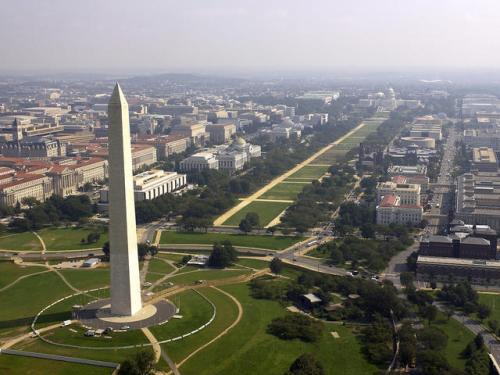
Sky-View-national_mall-

The center of New York is Central Park:
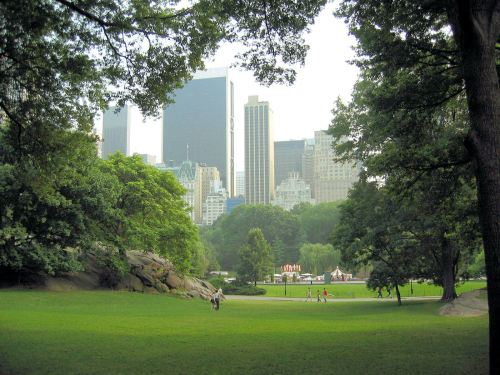
central park

Boston has the Boston Common and Emerald Necklace, San Francisco has Golden Gate Park, the list goes on. Great cities have at their core beautiful, timeless spaces where people have been congregating daily for centuries.

What about cities with ballparks downtown? Detroit:

detroit

Charlotte:

Generial aerial views on uptown / downtown / city center Charlotte skyline

I know everyone loves Charlotte right now, but look at how much land is taken by highways, parking lots, and the stadium. These were once neighborhoods where people lived, shopped, worshiped and recreated. Not to mention that some of these developments went through the heart of the city’s black community, Second Ward. That neighborhood was cleared starting in 1963, paved, and later sold and developed because “no one seemed to want it.”

I contend that the urban stadium is not a symbol of progress, but an admission of defeat. It’s significant that few thriving cities have a stadium at their core in the way that Richmond is proposing. In contrast, these cities have consistently committed to improving the quality of daily life from transportation to housing to public art and institutions of learning to public spaces and recreation. That is what makes a city worth visiting. That is what makes a great city great: connecting valuable assets with efficient and beautiful public investment.

And this is why I get angry every time I hear that phrase, “This is why we can’t have nice things.” That statement is said to people like me who don’t support the ballpark, a “nice thing” I apparently “don’t deserve.” There is so much wrong with the comment, but the most clear response is that Richmond deserves nicer things. In the instance of this ballpark plan we have set our sights so sadly low.

But this was not always the case. When Rachel Flynn was Director of Planning and Development, Richmonders passed a thoughtful and comprehensive plan for downtown that, if enacted, would finally unite the core of this city in a way that is sensible and beautiful. It would transform Richmond.

The plan was democratically developed, it was given a thorough review, and I’m guessing Jones hopes it will remain forgotten like every other world-class idea that Ms. Flynn gifted this city. Two years after this plan was passed she was demoted and run off by our small-town politics. She has since worked for Otak, and she is now the Director of Urban Planing in Oakland, California. I guess she’s better off without us, but Richmond will never know how much it has missed by losing someone so brilliant who loved Richmond so well.

Here’s a page from the downtown plan published in 2009:
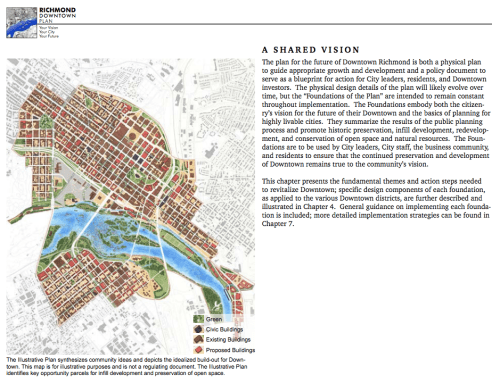
Richmond Downtown Plan

For the rest of the plan, click here.

The Richmond Downtown Plan was guided by seven core principles:

  1. Variety and choice
  2. Traditional city
  3. Urban architecture
  4. Green
  5. River
  6. History
  7. Mixed-income

These are principles that sought to make Richmond a more livable, historically relevant, and desirable city. This plan would enhance Richmond’s world-class assets without being over-bearing. It would create a city that is accessible and integrated. In contrast, Mayor Jones’ primary goal seems to be generating more tax revenue. But he has missed the point: people invest in cities when they invest in themselves. Sidewalks, street trees, parks, bike lanes, public art: These are a few ways that Richmond could continue to make itself more attractive to private investment.

Large single-use projects such as the Coliseum, the Greater Richmond Convention Center, City Stadium, and the Redskins Training Camp (even the Siegel Center and Robins Stadium) have moments of vibrant activity connected by long stretches of nothing. Small businesses nearby rarely benefit from their proximity.  Visitors come for events then leave without stopping nearby. Everything, from food to entertainment, is provided “in house.” These big venues serve a valuable function in the city, but should be relegated to the edges where no one will notice their vacuous presence.

The center of a city should exist to facilitate and enhance residents’ daily lives.

***

In a few weeks, the Richmond City council may vote to construct a stadium so insignificant it will never be written about in any noteworthy international or national publication or be visited by leaders from beyond our state. It will exist for approximately 50 years and then it will surely be destroyed.

At that point I suppose the people of Richmond will once again be given a chance to discuss the value of their history and identity to the rest of the nation and the world. Perhaps at that point Richmond will look to rebuild the baseball stadium elsewhere and restore the historic urban grid laid out by William Mayo in 1737. We might replace it with something that is uniquely “Richmond.” Until then, I suppose we’ll have whatever our elected officials decide is best for us.

If the stadium is constructed, many people will try and claim that it has resulted in great advancements for our city. It will not take much for this project to be deemed a success. But we will never get the chance to know what the space could have been. Richmond never got the chance to dream.

If we want to build a new centerpiece for Richmond. If we want a “crown jewel” development for our city, here is my advice:

Build something that will still be relevant in 100 years.
Build something that people will travel more than 10 miles to visit.
Build something that will be open to visitors all hours of the day.
Build something connected to the history and identity of Richmond.
Build something that will make generations of Richmond proud.
Build something that will turn heads.
Build something that is architecturally innovative.
Build something that is innovative in general.
Build something that is environmentally integrated.
Build something that is thoughtful.
Build something that is the first of its kind.
Build something that is truly world-class.

We are living in the midst of a renaissance in Richmond, but the guy at the top seems to have completely missed it. Some might say that my hopes are too lofty for Richmond. Maybe I’m the deluded one. Or maybe I’m just worried that we’re moving in the wrong direction.

World-class cities are not built on a foundation of minor-league ideas.
Generations of Mentors

You know that brief moment in “Tarzan” when he is flying through the air between vines? That’s basically been my life for the last five years.

Like many of you, I left my family and friends to start college in Richmond. My first night in town, I had dinner with a student named Dan and listened while he shared his story. He became my first friend and connection to this place.

The next day, he introduced me to a few of his friends and his favorite professor. We laughed, they made fun of each other, and I began to imagine that life on this campus might actually work. In some small way, I was closer to home.

I had no idea how fast time in college would move. I especially didn’t know how significant those first few friends would be in providing me with advice as I made my way through the maze of classes, programs and professors. Without their help, I might have never found that sneaky second vine.

Looking back, I wonder why I listened at all. I could have disregarded their advice and found my own way. But for some reason I appreciated their experience and trusted strangers in a strange place.

Lesson #1: When life gives you strangers, hear them out. At the very least, you’ll have a story to tell. At best, you’ll have a new guide to show you the way.

These new friends told me which classes to take (and which not to take), welcomed me into their community and drove me to the ER when I fell out of a tree and broke my arm. That’s right, this Tarzan metaphor just got real.

Not much has changed from those early days in Richmond. If I’m honest, the vines just feel farther apart and the fall much farther below. The only difference is that I now have faith that someone will introduce me to someone who can show me the way.

I’ve also matured a little since then. I certainly appreciate people more than I used to. While I usually took advice from others, I also regularly took it for granted.

Appreciating our mentors doesn’t mean we have to become our mentors, but it does mean that we have to give some effort. We have to be willing to say yes to something new and outside of our comfort zone.

Lesson #2: Receiving advice means humbling yourself long enough to actually listen.

I’ve also learned (many times over) that being mentored isn’t simply about receiving advice. Mentoring is not a product to consume or even a loan to repay. It’s also not supposed to make me feel good about myself or confirm what I already know. At its best, mentoring is a truth and a challenge. Mentoring first says, “I think you can do it,” and then, “Here’s what it’s going to take.”

Being mentored then becomes more about making choices than discussing ideas. When you receive wise counsel, it’s not a hypothetical in a book; it’s wisdom applied to your life. Receive it and say, “Thank you.”

Lesson #3: The more often you ignore someone else’s advice (for no good reason), the less likely they will be to share it.

When we commit to being mentored, we become a part of generations of mentors who have been acquiring and passing down wisdom for years. Open yourself up to wise counsel, prepare to be honest, and be willing to be wrong. Then, if you really want to be stretched, you can become a mentor yourself.

You may think that you’re not patient enough to mentor or that you don’t have enough time. But that is exactly why you should do it. If life gives you a chance to grow in a new (and uncomfortable) direction, shouldn’t you take it?

You can become more patient and eventually learn how to make time for the relationships that matter most. You can have the chance to pass on what was taught and the advice you have been given. And, for what it’s worth, I think you’d make a great mentor.

This article first appeared in print on January 30, 2013, in The Collegian.

Start at the Edge

As a resident of Richmond for the past five years, I have had the privilege of living through an exciting and dynamic season of change. It seems that after about 60 years of condescension and loss, it’s becoming a good time to be an American city. It’s a good time to be Richmond.

So, with that in mind, I was a little surprised when I read three editorials recently published in the Richmond Times-Dispatch addressing the “issue” of the view of Richmond from the highway. As I read each article, I felt that importance had been placed, not on the city, but on the opinions of passersby. This editorial is a response to those articles and perhaps generations of similar articles that have come before them. I believe that before we have a conversation about Richmond, we need to have an understanding of how the city changed during the twentieth century and more importantly what changed about the way we talk about cities in general.

My undergraduate education on the urban crisis in America presented changes in the city as a process of politics, prejudice, and technological advancement. More recently, I have come to understand the urban crisis as a gradual shift in investment and perception that took the American city, a source of pride, and turned it into a mark of shame. Furthermore, I understand the urban crisis as a rhetorical war between old and new. The goal of the war, as with any, was to frame the other as “backward” and the self as “progressive.” While Richmond attempted to maintain dignity, new technologies seemed dissatisfied with older cities: You’re too compact, too dilapidated, too prone to riot and rot.

As each new suburb was developed it became yet another statement to the American people pointing toward the promise of new, more civilized places with room to roam and play. Within this promise there was also a clear distinction being made from the archaic, dark city where most Americans at the time resided. As with all major shifts, the new way of doing things had to work to undo the more traditional ways of life. Many believe that the post-war zeitgeist of modernization, on a national level, did much to shift popular opinion. But on a local level, citizens of the Richmond metro-region still had to prove to residents that there was a more abundant life to be lived on the other side of the city limits.

This was accomplished through a series of events: The celebrated opening of Willow Lawn Shopping Center (1956), the construction of the Richmond-Petersburg Turnpike (1959), the failure of plans for consolidation with Henrico (1967) and other semi-related moments along the way. Each of these also had their corollary effect on the life of the city exemplified by events such as the closing of Miller and Rhodes/Thalhimers, the destruction of urban neighborhoods, and the political isolation that conclusively trapped and humbled this once-proud American city.

As money and people continued to migrate to the suburbs, local officials turned their attention from annexation to urban renewal. “If we can’t have the suburbs,” I imagine them thinking, “we have to do something about this city.” But rather than invest in what already existed, they fixated on dreams of what could be. “We get it” they tried to say “and we’ll fix it,” just don’t move your family to the suburbs.

As Silver writes, the city then “embraced urban renewal with a sense of urgency unprecedented in Richmond … Consolidation would have afforded vast new areas for growth and would have enabled the city to continue its policy of neglect toward inner-city areas” (254). Now left to embrace the demands of reality, Richmond’s city fathers sold out and destroyed much that today would protected as historical. They were always looking to what the city could be rather than accepting the city as is.

To me, this moment of urban renewal was a sign that the suburbs had won the war. This was the point in the story where it was finally decided that new was in fact better than old: Look! Even the city hates the city. In the decades that followed the tumultuous 60s and 70s, much has been said of the potential of cities, but almost all of it with the understanding that cities have something to prove. To this day, the standard to which Americans hold their cities is strangely high while their commitment to funding urban institutions and infrastructure is remarkably low. As Kunstler might argue, this is because we are no longer a nation of citizens; we are a nation of consumers.

Additionally, it seems that many of us have a powerful aversion to cities because we’re still trapped by the negative stigma established all those years ago. While local boosters proclaim, “Richmond is a city of art and great food!” critics reply, “Parking lots! Potholes! Prostitutes!” And regardless of their merit, these conversations do little to change the paradigm.

In this sadly familiar conversation, the subject is always “the city.” The place that needs to change is the city. The place that we want to love is the city. But this is not the perspective of an insider. Instead, we need to recognize that this critique is one of suburban condescension. The suburbs are still trying to prove their worth and their legitimacy and they are still quick to do so by orienting themselves against the “corrupt” and ” inefficient” locality they are ashamed to call neighbor, but delighted to visit for a basketball game.

We cannot have a productive conversation about Richmond until we move past the negative stigma that outsiders have placed on the city and begin to see Richmond as good once again. We should welcome visitors to come and enjoy themselves in the city, but our ultimate concern must be with the needs and desires of existing residents. Developments in Richmond should be for the city, not at the city’s expense, because that is what we can sustain and appreciate. And no longer should we consider developments for someone else to enjoy.

We have nothing to prove and everything to gain.

Holy Moley Murals

The Richmond art scene has been blowing up for years. Now, in epic proportion, artists here have begun to reveal this transformation in the public realm.

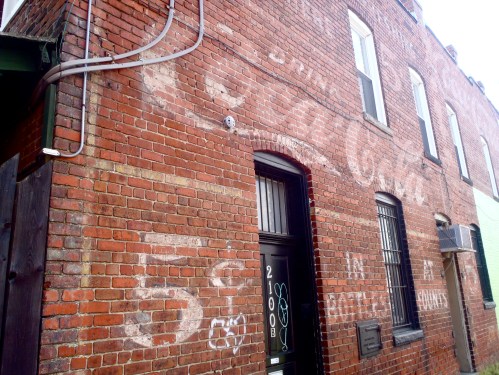
Rather than start with the newest, most epic murals (skip to the end if you want!), I want to put this Richmond mural passion in some context. Like all great American stories, it starts with Coca-Cola. This advertisement is located on the side of Globehopper at Main and 21st. I believe paintings like this became common starting in the mid-1800s along with the rise of the modern brand:

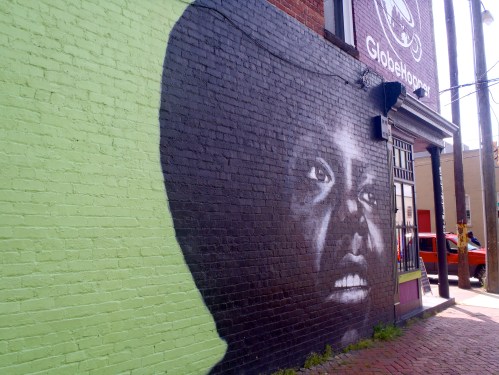
On the same wall, the Globehopper mural stands in vivid contrast:

I think this mural is Trask at his best and, in all honesty, I think I could end the story here. But alas that would not do justice to what is happening. These newest murals (the next two and the last one on this post) are apparently a part of the G40 Art Summit, a sort of obscure event that has come to energize the Richmond art scene for the month of April.

Writes Art Whino, “By inviting 13 of the top mural artists from around the globe to unleash their creativity to 20 large scale walls in a 10 block radius, it will surely become amazing artistic destination point for years to come.” As I drove west on Main St. I was soon greeted by one of these murals: the most epic (and hopeful) turtle I have ever seen. It’s being painted on the back wall of famed nightclub Have a Nice Day which means I’m surprised and impressed. And you may be amazed:

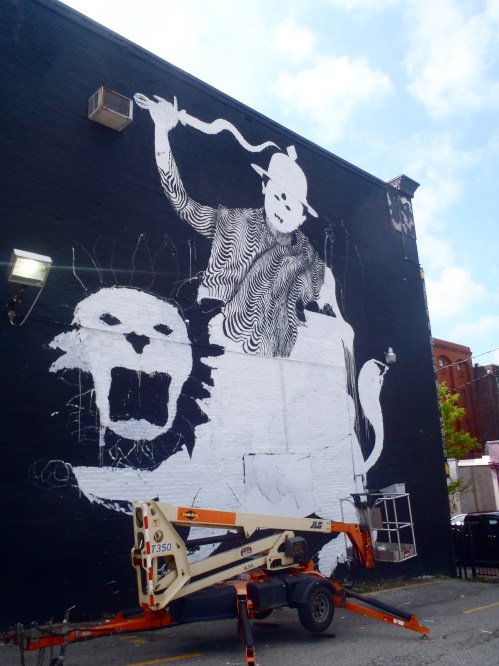
Somewhat more fittingly, Have a Nice Day is also adding a somewhat demonic-looking mural of a man whipping a lion (?) to their exterior wall facing Main. I can’t pass final judgement at this point because it’s not finished, but I do know this: There are epic murals in Richmond:

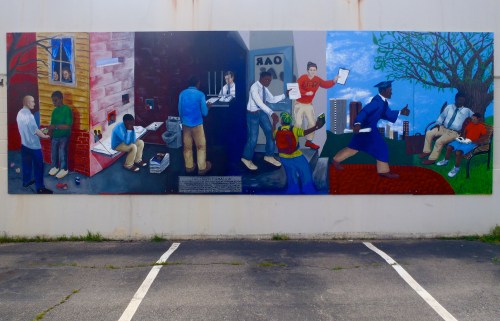
A little farther down Main, there is a mural that seems to have been commissioned by Offender Aid and Restoration of Richmond. While not the most epic, it is the most clear narrative portrayed in the murals I’ve seen lately and I appreciate OAR’s embracing the mural format in their latest outreach:

I also couldn’t help but include a snapshot of the graffiti located just a few blocks away from the mural above. While I’m not sure where “graffiti” becomes “mural,” I am sure it’s probably for a dumb reason so here’s my sample:

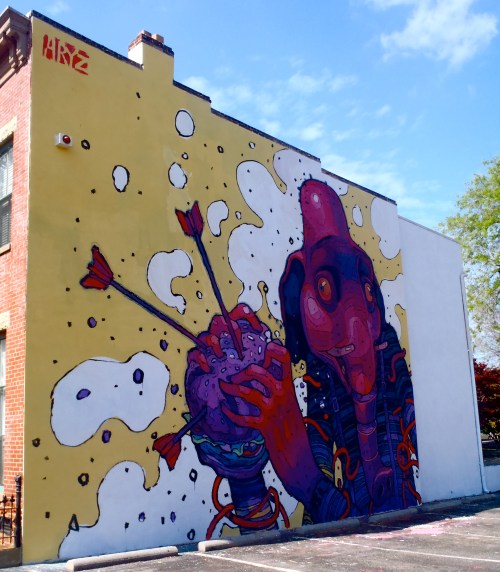
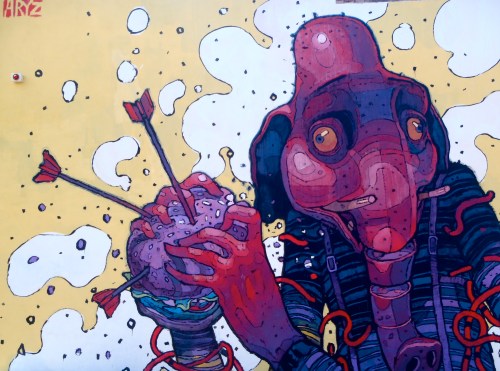
Finally, this mural is the last one I catalogued on my drive down Main St. and in some ways this one is the reason why I’m writing this post because it is the first I saw of the newest crop. It is, I believe, an elephant holding a hamburger that’s been shot with a few arrows … feast your eyes:

Here’s another view:

The only thing I can say at the end of a post like this is “holy. moley. murals.” What I love most about murals is that they take an everyday walk down a street and turn it into a free stroll through an art gallery. If you don’t like art, you might not like these murals, but you have to at least admit they are better than a blank wall. Creativity like this gives a city, and individual buildings, significance and character.

And the crazy thing is these are just the beginning … for examples of more epic murals check out this article by RVA News of other murals being painted around town this week. While I selected one street, they selected the entire arts district from Manchester to Broad St. I couldn’t be more pleased that my favorite city just got that much cooler.

And a little more bizarre.

A is for Adaptive Reuse

There is nothing more creative than adaptive reuse. In a world of earth movers and concrete slabs, redeveloping old buildings has become more rare than starting from scratch. Adaptive reuse forces creative builders to work in an existing space and create something that honors the history of the space while also recreates a new use for old bricks.

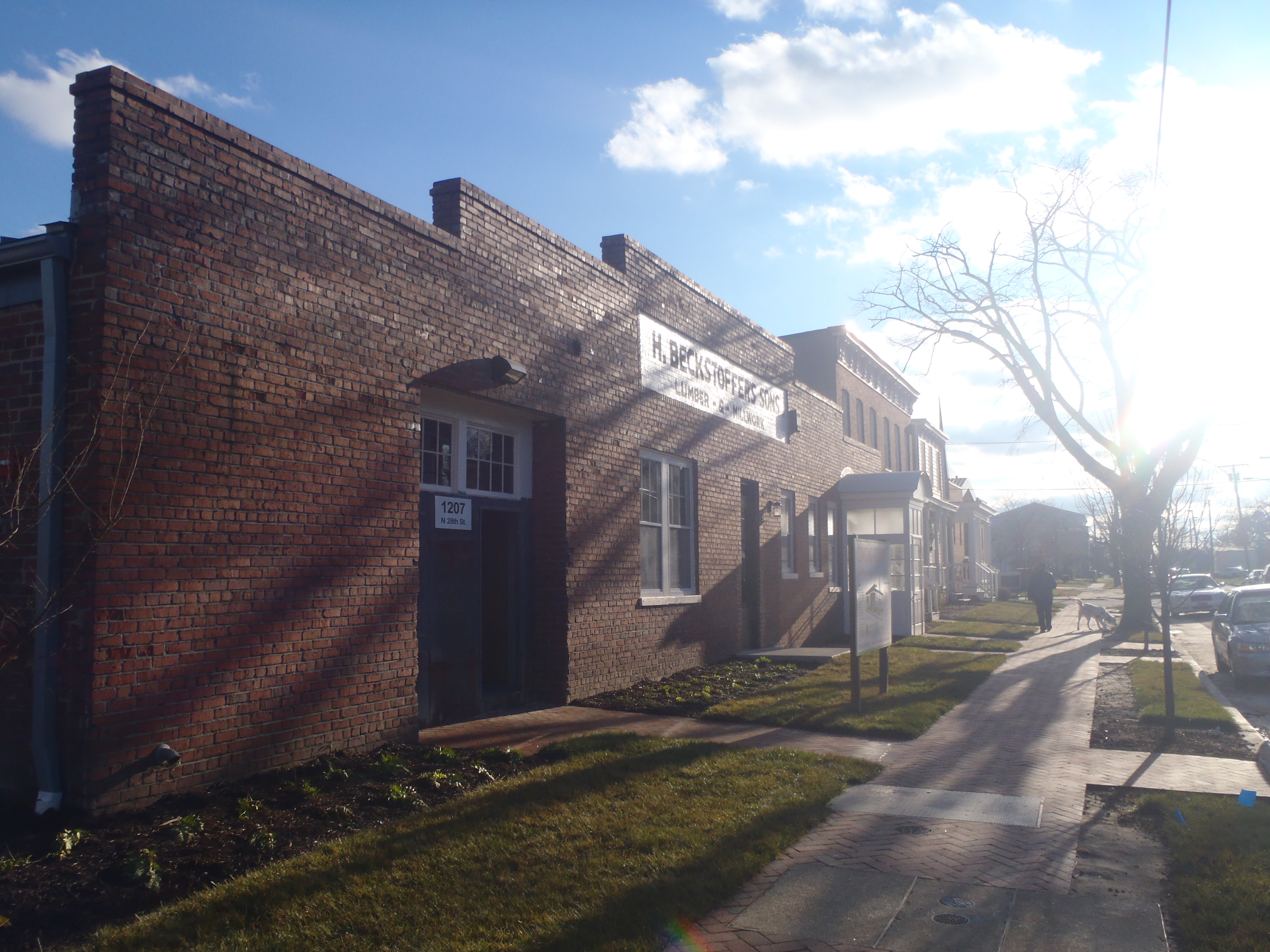
My favorite current adaptive reuse project in Richmond is the Live/Work Lofts at Beckstoffer’s Mill. I like this project because it’s compact (one city block), extremely well-done (down to the brick sidewalks), and it’s in the middle of a neighborhood. The old wood mill has been reimagined and resurrected for twenty-first century use. Yay for creativity and hard work in Church Hill.

This is a part of my, Cataloguing Richmond series on my RVA page.

A Vantage

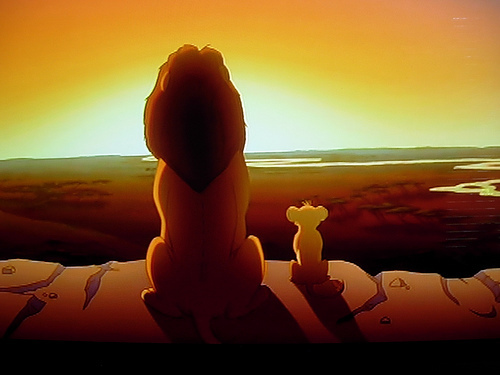
This week I have been teaching my high school students about imagination, appreciation, curiosity and innovation. The joys of alternative education 🙂 During this time, I’ve made some (albeit naive) teacher observations and formulated some theories to help myself improve and better understand what I’m doing. The most valuable lesson so far is this: The classroom is a vantage. From this vantage, we see the world for its order and structure. As Mufasa took Simba to the mountaintop, so do we teachers take our students to the classroom to make sense of the world in which they live.

From the vantage of Pride Rock, Mufasa shared with Simba the details of his kingdom: Places to go and places to avoid. At the same time, he is also sharing the weight of the responsibility of the kingdom (which I see as knowledge, adulthood, and the unknown future).  In this moment, he is imparting an understanding of life from the mountaintop because that is where the chaos of life begins to make sense. That is the place of perspective. Without the context of perspective we will hardly understand the significance of the information we retain.

One important point is that a mountaintop is positioned far away from life on the ground below. That’s not a bad thing! I think the “ivory tower” critique of education sometimes directs us to teach a more “realistic” education. But this is a mistake. Instead of making our education realistic, we believe that education must be detached from reality in order to prepare students for the abstract and unpredictable future. Is the future reality? No. We can only speculate how our students will use the information we teach them and we must give them the ability to make connections on their own. The ability to imagine the future and prepare for its challenges.

This capacity for imagination is becoming a subject of discussion as a skill that can (and should) be taught. In a PBS Newshour production, “Conversation: Imagination in Education,” Jeffrey Brown interviewed the director of the Lincoln Center Institute for the Arts in Education, Scott Noppe-Brandon. Brown asked, “What would [imagination in education] look like? What would be an example of putting imagination into the skill set and into the curriculum?” To this question, Mr. Noppe-Brandon responded,

“It’s taking issues like, ‘How do you get kids to notice deeply? How do you get them to attend to details and information in front of them? How do you get them to notice patterns and make connections and be reflective and tolerate ambiguity? Elements like that that combined over time start to build that cognitive capacity for imaginative thinking.” Imagine how differently we would teach if we believed this … the excitement in our voices as we say, “Look out over this world of information and conquer it with your mind.”

In my attempt to teach this concept to my students, I landed on the following formula:

Imagination + Creativity + Knowledge + Appreciation + Hard Work = Innovation.

Hopefully, my students will begin to value the ideas in their minds, appreciate the ideas of others and make connections between the two and reality. Reality is  not always the sort of place where people develop the capacity for creativity and imagination. That’s why we have the classroom. The classroom is a vantage. Every other hour of the day is enough reality for now.

Weekend Graphic: The Lady and the Car (1950)

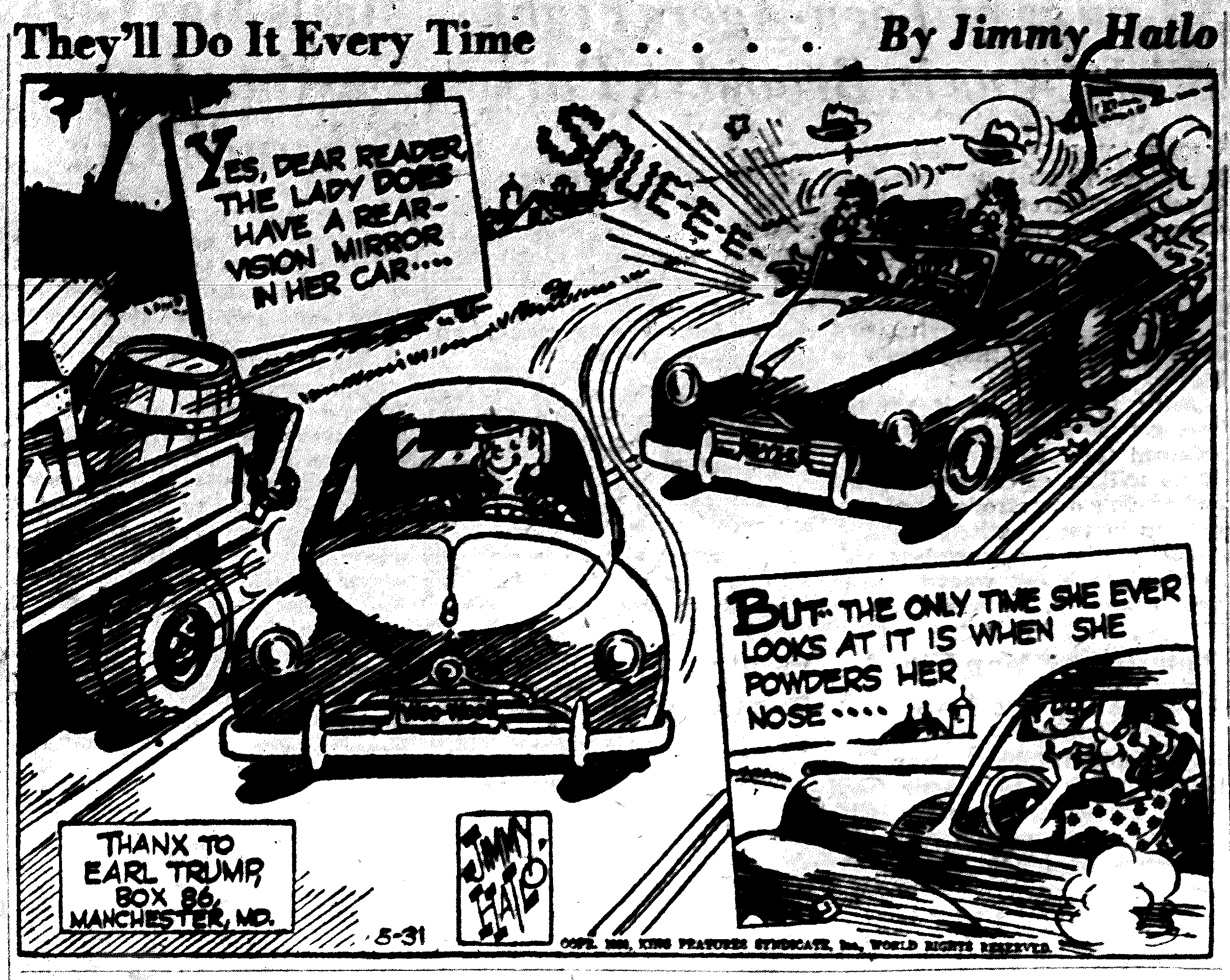
On May 31, 1950, the Richmond Times-Dispatch ran a cartoon titled “They’ll Do It Every Time.” I guess the “bad driver” trope was the 1950s alternative to the “captive wife.” It’s pretty self explanatory:

Weekend Graphic: Why are freeways built in cities? (1951)

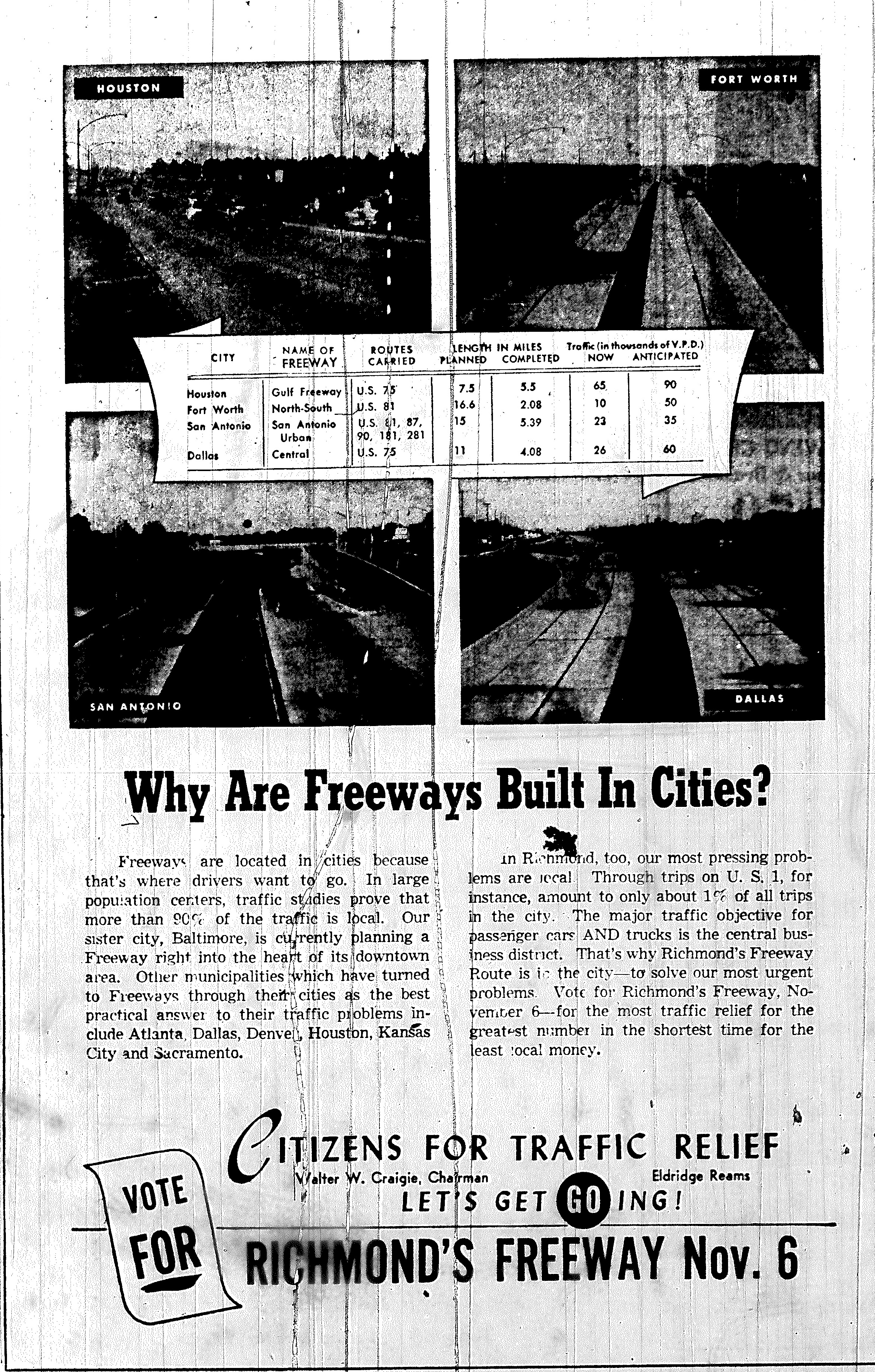
On Nov. 2, 1951, Citizens for Traffic Relief ran a political ad in the Richmond Times-Dispatch titled “Why Are Freeways Built in Cities?” This ad was purchased in anticipation of the second public referendum related to the Richmond-Petersburg Turnpike (which failed). It reads,

This as was especially interesting to me as a child of Texas. Looking back 60 years it’s amazing that it seemed like a good idea to pattern Richmond’s regional development after a city like Houston.

“When Everybody Has a Car”

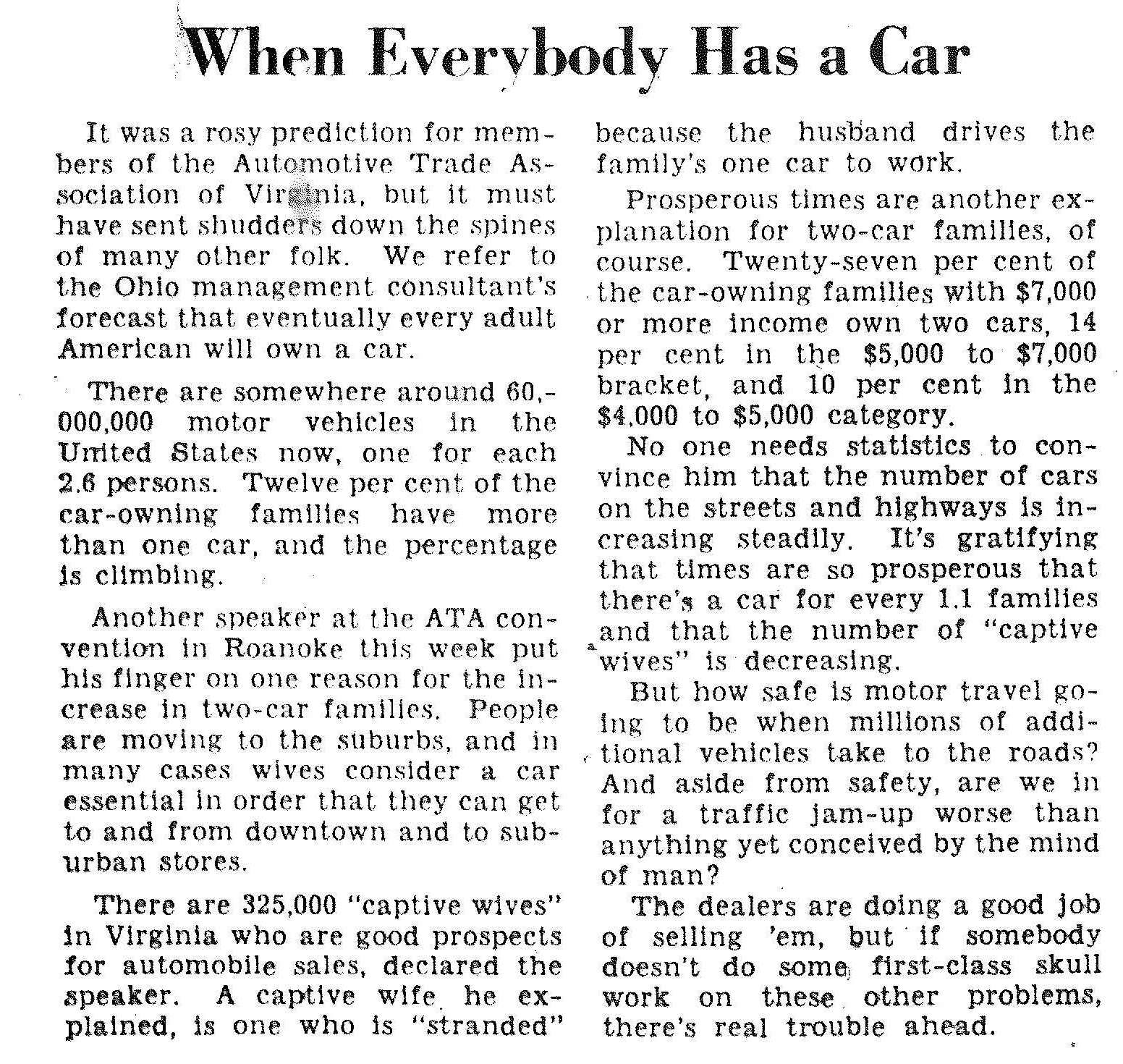
On Monday Nov. 14 1965, the Richmond Times-Dispatch published an article in the opinion section. It reads,

In the 1950s and 60s, members of the automobile hegemony often made grand statements. I’m amazed that even in 1965 this one sounded like a bad idea.

On Plans and the Future

On November 3, 1951, Robert LeRoy Shepherd wrote an opinion article in the Richmond Times-Dispatch titled “Freedom, Independence, Taxes and the Freeway.” I found this article 60 years after it was written and was struck by the candor of his voice and the content of his message: Plans for the future must respond to reality.

At the time it was written, the city was in the midst of a highway battle over the plans for the Richmond-Petersburg Turnpike (what is now a section of I-95). As was common practice at the time, Richmond politicians contracted large firms to develop plans for this expressway without significant input from the residents of the city. As a result, the thought of destroying the city for a highway divided citizens and outraged residents. Many conceded that the city fathers had already decided what would be best for Richmond, but fought to make their voices heard during the second public referendum of the highway plan.

Uncertainty filled the minds of Richmonders who were unsure whether their city would be completely transformed by this idea proffered by huge national planning firms and local politicians. The highway plan would result in the destruction of large sections of the city and would forever change the way people move throughout the region. On a more philosophical level, the plans for the highway also seemed to fundamentally question the legitimacy of the physical structure city. After 210 years of individuals shaping the built environment, an outside idea was being presented as more legitimate. At this moment of crisis in the battle for Richmond’s future, Shepherd wrote a philosophical piece that questioned the idea of a highway in Richmond and made a simple, yet compelling argument for democracy in the midst of the American highway era.

At this point in time, the Richmond Times-Dispatch was not new to articles and ads related to the expressway.  Leading up to the referendum on November there were dozens of references to the highway including political ads, cartoons, editorials, news articles, and opinion submissions. Many of these references simply recycled the same ideas and arguments for or against the highway plan. In these arguments it was too expensive or it was the ultimate solution to traffic, either not the will of the people or a well-developed plan vetted by studies and experts.

Amidst the banal arguments, Shepherd’s article called Richmonders to think critically about the process of planning a highway in the 50s. He was not enamored by the professional firms that planned the highway or their ideas for the future of Richmond. Instead, he writes, “Inflexible plans result in a fixation of mind. Steering them becomes an obsession kindred to a driver’s headlong dash above or over a freeway.” To Shepherd, politicians in Richmond were  trying to make the plan fit an unwilling populace. To Shepherd, the future was not so easy to predict.

While many framed the highways as American progress, Shepherd framed the highway plan as megalomania. He compares the politics to Alexander the Great, Caesar, Hitler, Hirohito, and the British Empire. The one thing in common was the concept of invasion and empire, but more philosophically the empires were imposed and forced on unprepared societies. The empires constantly developed their ability to transform the life of citizens in order to complete the assimilation of diverse societies. The highway was no exception. Plans for the city of Richmond were meticulously developed before being presented to the people of Richmond and expected to impress and amaze. The highway was an idea from the outside that was forced upon cities in America and unwilling to change or shift to fit the will of the people.

To Shepherd, these plans did not make sense in context because they weren’t democratic. “Taxes and plans?” writes Shepherd, “Yes.” In some instances it is wise to plan for the future and prepare for potential changes and developments, “But [while] some lead to the freedom of men, others lead to a fixation of mind and bondage just a binding as chains.” Today we are living the legacy of these plans and I believe we finally beginning to understand the captivity of which Shepherd spoke. While the highway seemed like an opportunity for growth, it has become a fundamental aspect of American life. What was once vehemently opposed has now become part of routine commutes and shopping trips.

Many people look at cities without any sort of historic lens or context, but a deeper understanding of the politics of a place will give us a better understanding of the place itself. As we continually struggle to recover our buried past we will likely find similar instances where democracy failed and voices were silenced. Uncovering these voices will further illuminate our nation’s past and present and allow us to begin to right our future.