Delusions

For the past few months I’ve been writing about identity and perspective. My primary goal during this process has been to answer the following question:

Along the way, I’ve considered various delusions that we humans believe about ourselves and each other … and I’ve found many of these within myself. It’s been a pretty worthwhile experience, but recently I was amazed by a passage from the Hebrew prophecy found in Isaiah. It is perhaps the most profound answer to my question.

Reading Isaiah 44:13-20 is a humbling experience. Here is an excerpt:
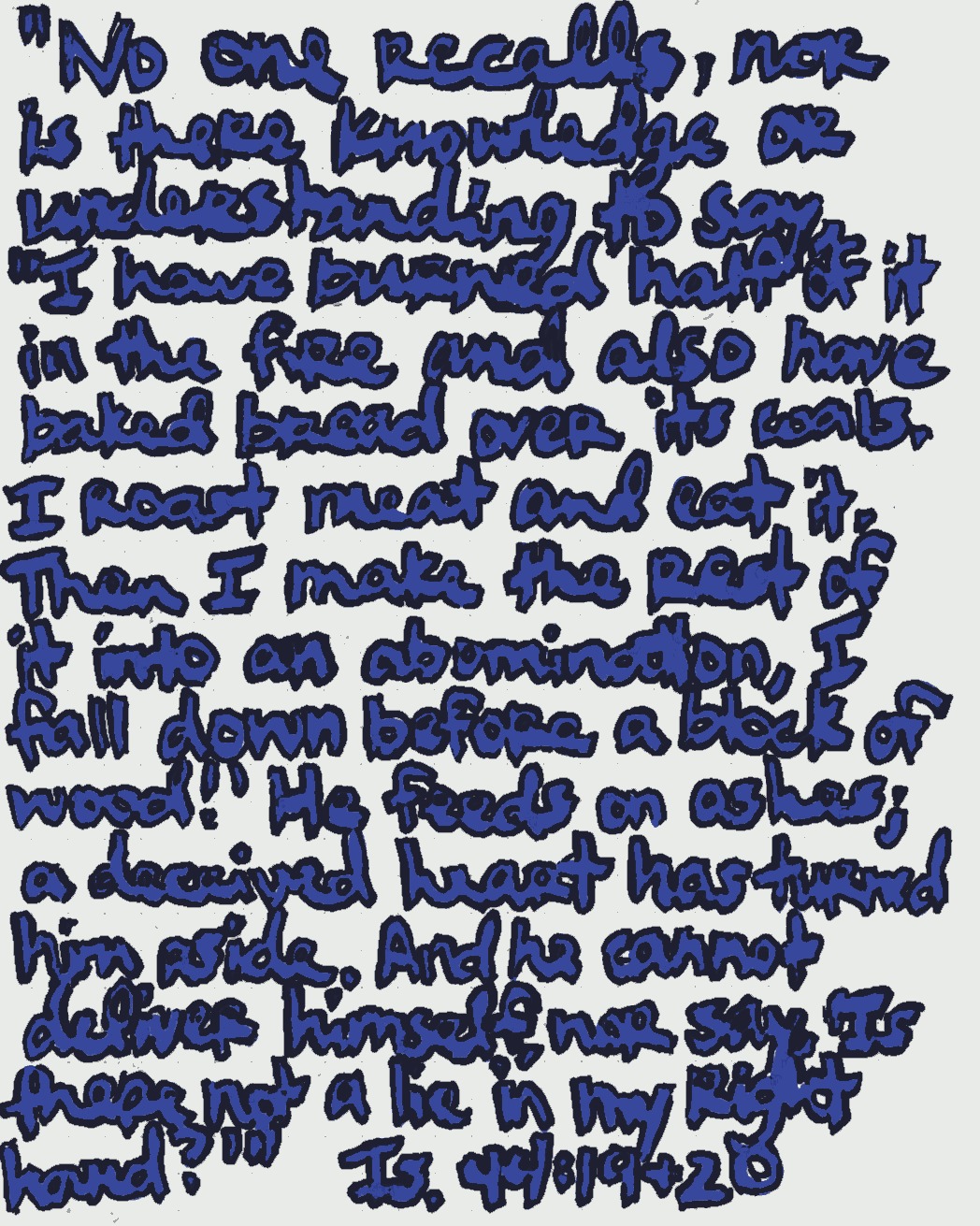
This passage is a profound metaphor for the lies that we tell ourselves.

The man in the story worships something that is temporary, a wooden idol. Something that he himself created. Alone in his own world, the man has convinced himself that he is in the presence of greatness. This thing then becomes the object of his worship.

I love the first line, “No one recalls.” It reminds the reader that the man in the story has not been afforded the same perspective that makes his delusion obvious.

Then I wonder, how many lies have we told ourselves? The first that comes to mind is my Facebook page. When I look at it, do I not believe what I see? In my heart, I know that I am more complex than this one page, but on a daily basis I put that knowledge aside and believe the lie that I have created for myself and others. I literally give of my time and energy to supporting that “Facebook me” that sustains this limited identity.

We humans create many amazing things. We also often like to convince other people that these things are important … sometimes we even convince ourselves. Then we unwittingly begin, ever so slowly, to sacrifice our “selves” to the thing that we have created. Some major examples that come to mind are empires, corporations, religions, and nations. Each one of these entities is created and buttressed by the energy of human work, but many still believe that their individual lives are less important than the entity being sustained.

To these we give our time, our money, our creativity, and our lives.

Finally, it seems that the difficulty of my favorite question is that it inserts doubt into our enlightenment notions of human reason. As humans, we often employ our own reason to save ourselves from delusion. This endeavor, I believe, has had limited success. This is because I have found that every such human attempt toward salvation or enlightenment (even this blog) can itself become a new object of worship and delusion. So here is my desire: To find those humans who are pointing their lives toward something that is not made, discovered or achieved by men. That, to me, is the Christian walk. It is not to sustain a structure or to defend an ideology. It is to follow a path that no human could (or would) have ever devised.

As I mentioned earlier, the oposite of delusion is perspective. Without something outside of the human experience, we will never see ourselves properly and we will be perennially stuck like gerbils on an exercise wheel. Perspective allows us to first see the wheel (the ideology, culture, addiction) that was created by men and then to leave the wheel entirely. This is the beginning of a journey of faith.

Many people would say that, as a Christian, I fit the description of the deluded man I described above. They say that I worship something that has been created by men … not dissimilar from the example in Isaiah 44. They say that the Bible is simply paper and ink and that I’m defending an idol. I can’t say that they’re wrong and I’m right. I can only say that the more I search for even a glimpse of eternal perspective the more I am drawn back to my Christian faith. This faith is not easy, or white, or  American, or something for which I feel personally responsible.

It is difficult and uncertain and leads me to constantly see myself in a new light.

At this point, that’s the only conclusion I can think to give this post. I will continue to interrogate my delusions and I hope to continue to learn more about my perspective on myself and others. All the while, I’ll be personally seeking the Truth that opens my eyes to the man-made objects that I continue to worship each day. Giving them up may seem irrational, but they are the exercise wheel and I would like to soon step off.

Amen.

This post is a part of my “Savage Faces, Human Places” series that I’m putting together in my section on Power.
A is for Agricultural Urbanism

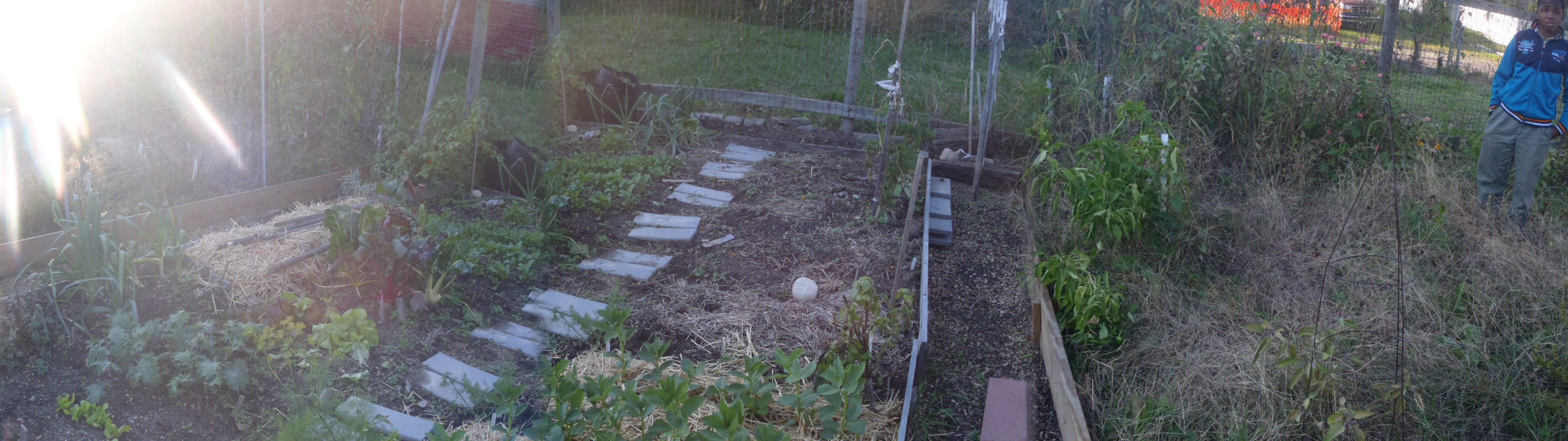
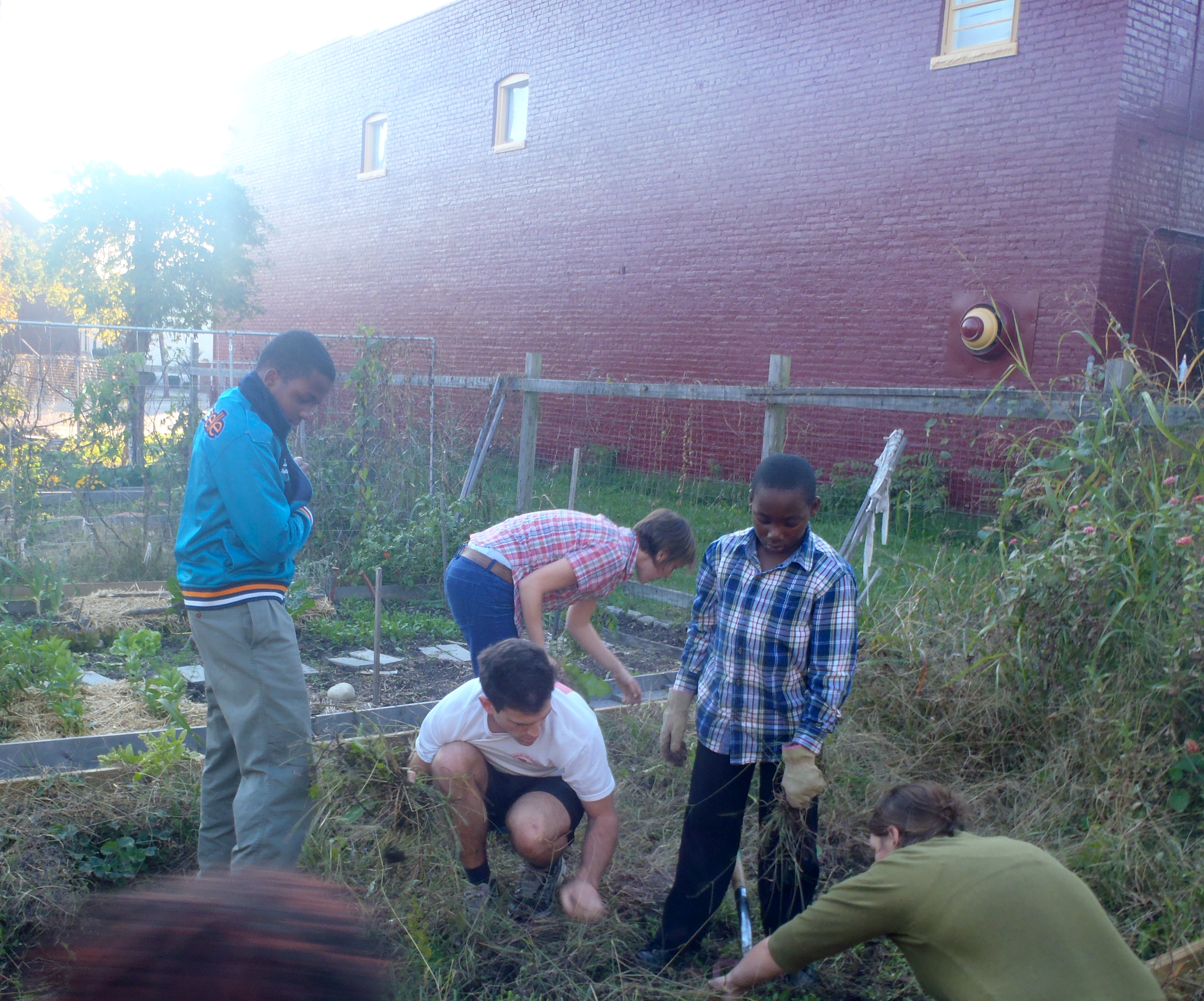
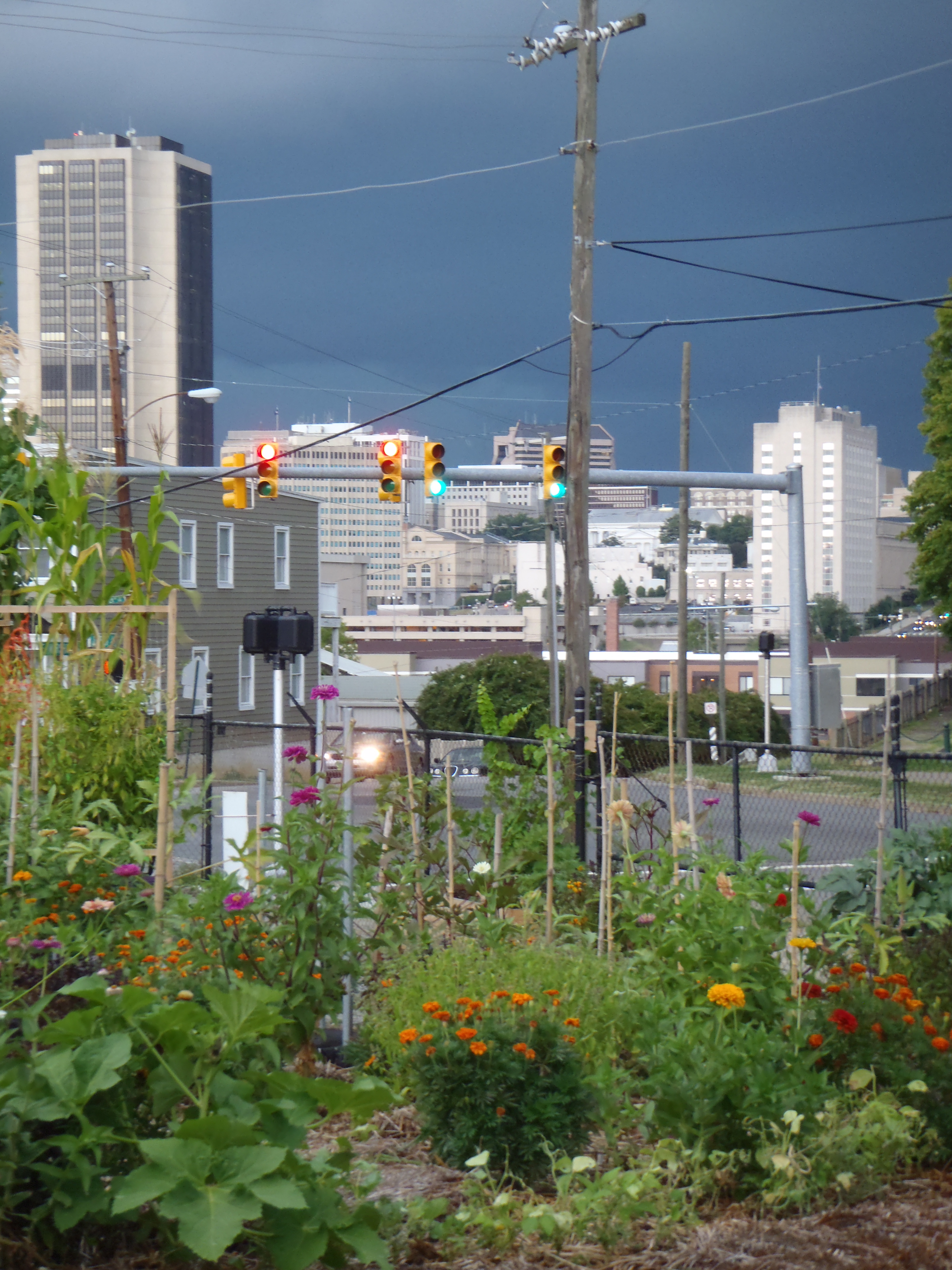
Tricycle Gardens is a local organization that has taken to transforming parking lots and empty space into beautiful, collaborative, and interactive green space. Dhiru Thadani would describe their work as specifically: Community Gardens, Allotment Gardens, and Container Gardens. I usually describe them as fun for everyone. Here are some examples:

This is the first post in my, “Cataloguing Richmond,” series saved in “RVA.”

Not “the Poor Kid”

I’ve been sitting on this post for weeks, but last night’s South Park episode put me over the edge … “The Poor Kid” is both funny and excellent commentary on the ways in which we see ourselves and each other.

The main point of the plot (aside from mocking the Penn State scandal) revolves around Eric Cartman’s constant attempt to solidify his identity as “not the poorest kid in school.” The introduction of course begins with Cartman realizing that he is, in fact, the poorest kid in school. A terrible blow for his shallow identity. He then fakes a meth lab in order to get the attention of CPS and a new start as a foster child in small-town Colorado. Ridiculous, yes, but I bet everyone who reads this post (or watches the episode) can relate to such a desperate attempt to restore their identity rather than own up to reality and move on.

Cartman’s first conversation at his new school highlights this experience:

“O.K. All right, so listen, I know our family is poor, ok, but before we lived here, Kenny was actually poorer than me so technically he’s the poorest kid at this school.”
 
“What are you talking about? The poor kid at this school is Jacob Hallery.” “Really?”
 
“Yeah, dude. His dad died five years ago and his mom went crazy from depression so she can’t even keep a job.”
 
“YES!! Did you hear that, Kenny? We’re good! I seriously didn’t think we’d stand a chance but everything’s gonna be O.K.! (singing now) Cause I’m not, I’m not the poor kid in schoooooool.”
 

The point is not that Cartman’s mean, although he is. The point is that he’s saying what everyone else is thinking. I laugh because I know it’s true. More broadly, I laugh because the greater message is that we generally follow the human instinct to identify ourselves against others rather than towards ourselves or a purpose.

So this post is about our perspective and identity as well as the external places and people that give us a standard from which we may contrast ourselves. In the same way that Cartman feels relieved by the presence of a “poorest kid” in school, I’ve found that we all believe, in some small way, that we will be “O.K.” as long as we’re not the worst.

For me, if I found that I actually was the worst (e.g. being one of two in the first round cut from the basketball team in 7th grade), then I just decided that it wasn’t worth my time. Ever. But no matter how well I invested my energy in other places, I still felt the need to “beat” basketball (or whatever it was at the time) by thinking of jocks as uneducated or otherwise illigitimize general athletics. In this way, I propped myself up on a prejudice that made me feel more intelligent, industrious and orderly.

In short, this is Orientalism.

Originally used to denote academic and artistic work focussed on “Eastern nations,” Orientalism has now become the term for a strong critique that debunks the very perspective it used to denote. In 1978, Edward Said published the book Orientalism which fundamentally shifted the usage of the word from the study of “The Orient” to the actual perspective with which “the Orient” had been studied and the imaginary space was created as a result. Today, his ideas form a sort of standing check on every scholar attempting to “understand” anything remotely foreign or exotic. The reason why this concept is still important is that Orientalism (the critique) states that the very act of such research is fundamentally a form of identity formation rather than simply an intellectual pursuit for understanding.

I propped up my identity on the myth of the “uneducated athlete,” Cartman celebrated the existence of a “poor kid” on which he could rest his shallow pride, and Orientalists may have sought the “Orient” in order to further the narrative of the progressive, industrious, and powerful West.

At its best, this sort of identity gives people confidence and empowers them to remove themselves from negative influences. At worst, the Orientalist perspective is a delusion completely unable to engage reality. This delusion can lead individuals as well as entire nations to stigmatize other people and regions as inferior to the point of dehumanizing the other. As Ziauddin Sardar writes,

“Orientalism’s failure, Said argues, has ‘been a human as much as an intellectual one; for in having to take up a position of irreducible opposition to a region of the world it considered alien to its own, Orientalism failed to identify with human experience, failed also to see it as human experience’ (Sardar, Orientalism,” 74).

In other words, the perspective established it’s object of study as so distinct that it no longer engaged the complexities of human experience. After years of this study, the Orient became as much a myth as a reality. More broadly, this perspective can prevent individuals from forming whole and healthy identities if they are positioned in opposition to imaginary people and places.

Some more fine examples of this perspective in action are the “rebellious youth,” the “corrupt inner-city,” and “the backward south.” Implicit in each of these titles is the presence of an onlooker (Adults, suburbs, and the Northeast) employing this dehumanizing Orientalist lens. In the context of my general thoughts on “savagery” I believe that everyone, to some extent, believes in this notion of the Orient. The farther away from yourself that you find this ‘other,’ the saver and more comfortable you may feel. The closer the ‘other’ is to yourself, the more unsettled and protective.

Either way, the more we work to prop up these identities, the more unhealthy our lives will become. Humans are complex … we can seek to understand each other as long as we accept that we never truly will. It’s more difficult, but I think this acceptance will allow us to be a little more realistic about ourselves and each other.

That’s the point of this post … and this series: “Savage Places, Human Places

P.S. Nina just called me out the other day for still maintaining that “all b-school students” are completely out of touch with society. So this never stops … and it never should because humans are complicated. Amen.

This post is a continuation of my “Savage Faces, Human Places” series that I’m putting together in my section on Power.
Plastic Cities

Considering the trauma of urban destruction abroad, it’s not altogether surprising if the American city lost its ethos in the decades following WWII. While our cities were physically spared, our citizens may have lost faith in places that could now be so easily destroyed. In a matter of minutes, cities that were once homes became memories and photographs. While foreign nations surveyed the damage and made plans to rebuild, our nation realized that social damage was more difficult to restore. In this environment, such an urban rebirth would not suffice.

In contrast to the the restoration abroad, Americans returned home to find their cities inadequate to satisfy the need for privacy and control that accompanied post-war life. In a state of collective PTSD, upwardly mobile Americans fell into consumerist mania searching to restore the peace that had been lost during those war years. The dense urban spaces — those which had been so easily uprooted abroad — could no longer be trusted at home. As the banner photograph of this blog implies, the American city would soon be destroyed as well. Not as a destruction, but as a progression toward the better life many believed they would find at the end of the highway.

Sixty-six years later, many of us find ourselves still hopelessly desiring stability, but unable to remember the traditions and pride that once connected us to our cities. We also seem to carry an unspoken longing for that time when cities could be trusted and investment sustained. Uprooted and displaced, we move as much as the walls of our plastic cities: completely worthless to human memory and love.

In this third or fourth generation removed, I seem to notice that we are finally beginning to settle back into each other’s lives and our oldest spaces. We may have a very hard time excavating what was lost in the post-war mania, but it will be worth it, vale la pena.

Restoring trust in a city, like everything else, takes time.

Savage Faces, Human Places

I’ve been thinking about the word “savage” for about a month now. What does it mean? Who uses it? What purpose does it serve in society? At this point, I think I’m about ready to move on.

I may break up this piece later and turn it into more of a series … for now, here’s where I’ve landed:

According to the Wiktionary entry, the word originated in the “Latin silvaticus (‘wild’; literally, ‘of the woods’)” then moved through late Latin and French to English and eventually became the word “savage” as we know it today. The first thing I notice is that the word has always had an implicit vantage built into it. This unspoken perspective is the place from which savagery was determined. “Of the woods” can be read as “not from the city” or at the very least, “not of us.”

My first question quickly emerged, “From where is this word spoken?”

A few weeks ago, my Richmond Perspectives class discussed the relationship between the Native American Chief Powhatan and the English settler/invader John Smith. One of my handouts that week included the following insight on an entry in John Smith’s journal:

“‘Powhatan carried himself so proudly, yet discretely, in his savage manner, as made us all admire his natural gifts,’ Smith wrote, ‘considering his education.’ Majestic, mighty, and prideful Powhatan may well have been, but, in Smith’s eyes, he was still, and ever would be, a savage” (The River Where America Began, 77). 
 

This quote moved me to wonder about Smith and the British perspective at the time. Was there something particularly savage about Powhatan or had Smith simply decided that every person he encountered would be savage? Clearly, thousands of Native Americans believed Powhatan to be an effective leader, but Smith couldn’t see past his seventeenth-century English perspective of the “New World.” From this vantage, the entire territory, Powhatan’s chiefdom and beyond, was “savage” before it was even encountered.

There was something within John Smith’s mind that prevented him from developing an appreciation for the powerful leader with which he dealt. I’ve landed on three posible explanations for this: 1. Smith came here believing that every inhabitant was inferior, 2. Smith was legitimately shocked by Powhatan’s physical appearance or behavior and lastly, 3. Smith was afraid of Powhatan and used words such as “savage” to demean him and minimize his power.

When I read this quote with my students, I asked them what thought in particular about the word savage. I was actually surprised to hear that they use the world all the time. To them, “savage” is a joke to make fun of friends when they’re not acting proper or just to make fun of someone in general. One mentioned that the projects in Richmond are savage. Another joked that it’s savage when you pick up food off the ground and eat it. I think this conversation actually filled the rest of class and I left that day with a lot to think about.

My history class had just launched itself into the twenty-first century.

When I first started writing this post, I realized the topic was making connections to all sorts of other ideas and semi-related thoughts. This post is the first paragraph of that original piece and I’ll publish the rest in segments. I’m also starting a new page titled, “Power,” where I’ll store these and others because I think perspective and “savagery” are linked to how we position ourselves in relation to each other … identity is a powerful thing.

This post is this first of my “Savage Faces, Human Places” series that I’m putting together in my section on Power.

MADD Highways

If I were a historian, I might write a book about the relationship between the drinking age and car driving in America. I might wonder how much of our lives have been fragmented by these two devices. I might marvel at their intertwined stories and their combined affect on the way we live. I might mourn the loss of American tradition and culture.

I think I might be too emotionally invested to be a historian.

From Drinking Songs to Pet Theories

I recently felt convicted on behalf of the individualistic, intellectual, global community. Didn’t we used to sing drinking songs together? It seems like these days we spend our time talking and debating rather than getting lost in something greater … something that unites.

I’ve been thinking a lot about the difference between beer and coffee. In 2010, Stephen Johnson gave a TED talk titled, “Where good ideas come from.” I highly recommend it. In his presentation, he argues that the advent of the English coffeehouse played a significant role in the development of ideas during the English enlightenment. With the coffee house, Johnson states, the English people moved from a perpetually drunk society to a stimulated community of thought and collaboration. The ideas that transformed society emerged, at least in part, from within the incubator of the coffeehouse. So I originally saw this as a good thing. Don’t we need good ideas to progress? Well, yes, but I think we’ve lost something in the process of becoming enlightened and thoughtful. In short, we’ve lost drinking songs. We’ve lost this social tradition that connected us to each other and our sense of belonging and place.

I see the effects of this coffeehouse culture on my own upbringing in Tyler, TX. My friends and I would often meet for coffee at the “local” Starbucks and talk about life. These were great times we spent laughing and solving the world’s problems. But they didn’t unite us or connect us to our city in a meaningful. We never spontaneously burst into song with steins of beer sloshing around as we sang, “Tyler, oh Tyler! Da-dum de-dum de-dum …” Or anything of the sort.

In addition, the people that did drink together in high school did not usually do so with members of the older generations because they were partaking in something that many consider immoral. Thus, if there were a drinking song for Tyler, they wouldn’t be singing it. Instead, they would still be stuck in the teenage ghetto while their parents either condoned or condemned from afar. It really is a tragedy. When it came time for me to look for colleges, I felt no remorse leaving that city in the dust. I had clearly not connected to it’s people or culture in such a way that made me feel like I belonged. I had not yet come of age.

Here’s the deal: It’s not about beer and it’s not exactly about drinking songs. It’s about the cultural traditions that unite people.

The thing about these traditions is that they have to be taught. This teaching process requires close, intergenerational relationships. Drinking songs clearly had an incredible ability to galvanize that “togetherness” of community because they eventually became Baptist hymns and even the national anthem of the USA. The difficult question for me is whether this generations is producing material that could be redeemed in the same way. Does our philosophizing  bring us together? As I sit here at my computer developing this theory I wonder if instead I could be singing a drinking song (or any song) with a group of people. Granted, it’s 10 a.m. on a Thursday, but my point is this: I don’t want to care more about my pet theories than our collective humanity.

I think it’s time to start singing.

Performing the Vantage

My last post described the classroom as a vantage from which we learn about the world. Tonight, I don’t think I’ll be able to go to sleep if I don’t write about my next thought: Performing the Vantage. I want to talk about how we can perform this theoretical space and what that might mean for my work.

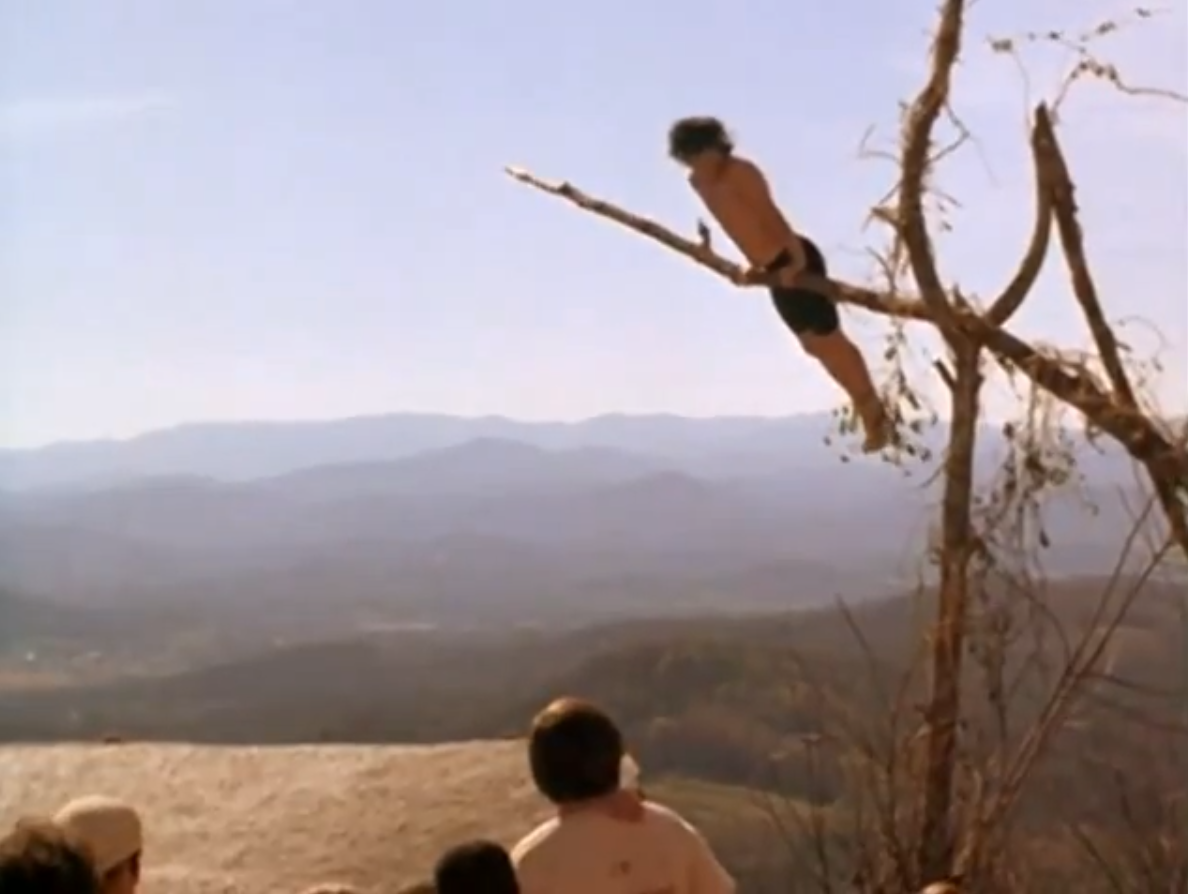
First of all, I have to admit that some days I feel a little crazy. At first this was a little unsettling, but now I’m totally comfortable with the fact that some days I learn more than I teach. These are the days that I feel like Ben Stiller as Tony in the legendary movie “Heavyweights.” To the right is a scene from this movie where Stiller is certainly “performing the vantage.” but it doesn’t help the fact that he’s emotionally unstable. His character understands the idea of the mountaintop experience, but doesn’t realize that it takes more than just a mountaintop to inspire change. It’s not what happens on the mountaintop, it’s how life on the ground is transformed as a result. So performing the vantage can’t become more important than building relationships with the people in our lives. Then, when the moment is right, speak as if you are looking out over the vast open spaces and share your wonder and amazement with the people around you.

I actually believe that if I pretended that I was on a mountain these moments would be more significant. In some ways, this is how I trick myself into believing that I’m not just in any other room … that this room is somehow more conducive to learning. Of course, every class will require a different level of discipline and correction. Some will never reach the moment of wonder when the mountaintop can be reached, but I have been thankful for these moments in the past two weeks and I look forward to improving my ability to notice them in the future. The more I notice these moments, the more I will be able to capitalize on their emotional impact.

What are some potential shortfalls to this perspective? In my post, “A Vantage,” I compared teaching to Mufasa showing Simba his kingdom. This metaphor helps me to further explain the potential shortfalls of performing this vantage in the classroom:

Mountaintop Shortfall #1: Basically, they might not believe that you’re Mufasa. They might not believe that you have any right to show them the kingdom. They might believe that you don’t have anything of worth to give them. They might not appreciate you. They might forsake their inheritance.

Mountaintop Shortfall #2: You might not believe that they are Simba. You might not truly believe that they deserve to inherit the kingdom that you have seen. You might hope they drop out so you don’t have to put up with them any longer. You might forget that you were once Simba.

Mountaintop Shortfall #3: The classroom lingers on the mountaintop for too long. We were not meant to settle into our vantage. Instead, it is meant to be the underlying goal that we reach it every day in order to remind ourselves why we’re there. From the ground we learn how to work; from the vantage we are reminded of its ultimate purpose.

I have experienced all of these shortfalls in just two weeks of class … and I’ve also seen the positive results of the vantage. I suppose those are the moments that I “live for.” I am a beginner to this whole teaching thing so I’m just trying to understand what its all about. As I read in Teaching with Love and Logic, “Great teachers are experimenters.”

Base camp here we come.

A Vantage

This week I have been teaching my high school students about imagination, appreciation, curiosity and innovation. The joys of alternative education 🙂 During this time, I’ve made some (albeit naive) teacher observations and formulated some theories to help myself improve and better understand what I’m doing. The most valuable lesson so far is this: The classroom is a vantage. From this vantage, we see the world for its order and structure. As Mufasa took Simba to the mountaintop, so do we teachers take our students to the classroom to make sense of the world in which they live.

From the vantage of Pride Rock, Mufasa shared with Simba the details of his kingdom: Places to go and places to avoid. At the same time, he is also sharing the weight of the responsibility of the kingdom (which I see as knowledge, adulthood, and the unknown future).  In this moment, he is imparting an understanding of life from the mountaintop because that is where the chaos of life begins to make sense. That is the place of perspective. Without the context of perspective we will hardly understand the significance of the information we retain.

One important point is that a mountaintop is positioned far away from life on the ground below. That’s not a bad thing! I think the “ivory tower” critique of education sometimes directs us to teach a more “realistic” education. But this is a mistake. Instead of making our education realistic, we believe that education must be detached from reality in order to prepare students for the abstract and unpredictable future. Is the future reality? No. We can only speculate how our students will use the information we teach them and we must give them the ability to make connections on their own. The ability to imagine the future and prepare for its challenges.

This capacity for imagination is becoming a subject of discussion as a skill that can (and should) be taught. In a PBS Newshour production, “Conversation: Imagination in Education,” Jeffrey Brown interviewed the director of the Lincoln Center Institute for the Arts in Education, Scott Noppe-Brandon. Brown asked, “What would [imagination in education] look like? What would be an example of putting imagination into the skill set and into the curriculum?” To this question, Mr. Noppe-Brandon responded,

“It’s taking issues like, ‘How do you get kids to notice deeply? How do you get them to attend to details and information in front of them? How do you get them to notice patterns and make connections and be reflective and tolerate ambiguity? Elements like that that combined over time start to build that cognitive capacity for imaginative thinking.” Imagine how differently we would teach if we believed this … the excitement in our voices as we say, “Look out over this world of information and conquer it with your mind.”

In my attempt to teach this concept to my students, I landed on the following formula:

Imagination + Creativity + Knowledge + Appreciation + Hard Work = Innovation.

Hopefully, my students will begin to value the ideas in their minds, appreciate the ideas of others and make connections between the two and reality. Reality is  not always the sort of place where people develop the capacity for creativity and imagination. That’s why we have the classroom. The classroom is a vantage. Every other hour of the day is enough reality for now.

On Jobs and Place

Right now it seems like everyone is talking about jobs and the economy. I saw Obama in Richmond yesterday talking about jobs, Republicans are hoping that the lack of jobs will help get Obama ousted, and many Americans are looking for jobs just about anywhere. All the while, it seems that we’re missing a relatively important point: Where are these jobs going to be created? I’d like to drastically shift this dialogue to the specific places and communities where these theoretical jobs will appear. First, we need to care about where we live.

For the record, the government may temporarily rehab existing jobs (e.g. highway repair), but this is neither innovative nor sustainable. In my opinion, the American government effectively sustains much of our society, but is not a trustworthy engine of growth. The American government has a longevity and reliability that makes for a comfortable place to live and do business.

Within this context, it is hard-working, intelligent and creative people that can add new and innovative jobs to our economy.

Unfortunately, most people in America aren’t able to make the proper connections that lead to new businesses. This is because the creation of a job requires a new idea, a connected network, sufficient capital and a knowledge of and commitment to a particular community. This community serves as the proving ground for these soon-to-be business owners and provides them with a knowledge base of needs and trends.

In a recent video posted by the National Endowment for the Arts, Christine Harris described the “creative economy” and a network of “creative industries” in the greater Milwaukee region. She defines these creative industries as “organizations, individuals, and companies whose products and services originate in artistic, cultural, crative, and/or aesthetic content.” These industries span a the gamut of traditional sectors and together comprise the creative economy.

The organization developing this network, Creative Alliance Milwaukee, works to bring together men and women in the creative economy who are working to move the region and create jobs.  One noteworthy example that Harris cites the time the CEO of a flooring company visited hosted by the creative alliance. businesses. She recalls the story in this way,

“Within a month of that meeting, he had hired one of our visual artists to design a new flooring pattern. That artist now has a royalty fee. And he has since then hired two other artists. They have royalty fees and he has products that no one else in the world has.”
 
We cannot talk about job creation without discussing the relationships involved in commerce and innovation. This is ultimately the foundation of local economy.

Rather than rely on our government for jobs, I want us to rely on our government for the environment in which jobs are created. We have amazing political stability in America: That can sustain job creation. We have a wide-stretched infrastructure in America: (as much as I hate highways) That can sustain job creation. Maintaining these constants will be necessary to improving our economy, but will not create long-term positions in the workforce.

That’s our job.