
-
Search It!
-
Recent Entries
-
Links
Away for now
The book has been written but not yet been read and
the life of the love of the living and dead are searching
the highs and finding the blows
of the fight and the trauma of flight too great
for the one lonely death of the unknown life
untried and untrue,
but unlived and through you I have found that my blood courses too
and my muscles, my eyes, my skin can be used when aligned
to his will to his glory his story of me and my sad little life made anew
from on high to become little like that of his and his alone
on the mountain at dawn getting
away from the work and
away from the tears to laugh and
sing the praises of life made right made day
made green with buds on branches made dead
by years of living inside of my head and denying the water of his divine truth
killing myself and wanting to lose the only thing I was ever given:
my life and my all
to the garbage, I said and to hell with my future
I will make more as a moral for others in death,
and in dying make them finally find their loves and their lives
unloved as mine was over too early and as if the universe
now had a debt to be paid
with the zeal of the rest of those still living
in my memory and for my name, but how vain! and how selfish!
to think that my fall woud be so tragic that others would be moved
by my own sudden end
and Christ’s irony is that my life now is work and the cross is my death every day at sunrise,
new life,
new breath,
new radiant death
and a new vision for myself through his eyes and his mind
that I could not work to find or discern and
now realize it is merely the beginning of things unseen
and life undreamed, resung, reseemed — wrinkles and scars remain
and nothing can be taken away fully forgotten or totally boxed
even life itself is here in this moment and he is faithful to get me where I am going
as long as I am faithful to get away from wherever I am
and he will remove me if I am deemed unfit, unfight, unprepared for the work
and he will take me to this place of ‘away’
of a way that I have not bothered to embrace and have not truly tried.
I do not wish to read this book.
I don’t want to know how the story ends.
I still want to escape sometimes and go nowhere, but he pulls me back to himself,
his places, and his people for his will.
And all I can do is look with him to the new
where he lives.
The rest is too much.
One day,
but for now,
I am away.
Considering Fiction
This week I have committed to writing a bad short story. I don’t know what it’s about or how long it’s going to be, but it’s going to happen. It’s already getting too snarky (a common pitfall) so I was particularly challenged by this quote by Andre Dubus in this week’s NYT Book Review editorial,
“It seems to me that the primary job of the artist is the paint in the grey, to capture the texture of this life without moralizing or pontificating. This is a sustained act of empathy …”
I have become increasingly interested in empathy lately, but I have only marginally allowed it to influence my writing for the past year. Perhaps as I begin to write (and read) more fiction I will become more empathetic and gradually see the world through a more complex perspective.
I’m interested to see where this direction takes me … or where I take my writing in the process.
The moment of impact
Around 9:25 this morning, I was hit by a car while driving the bus.
As I entered an intersection, a car to my left ran a stop sign and I instantly knew we weren’t going to make it in time. That was the moment of realization.
The next moment, I screamed, “Oh my God!” and looked at the street in front of me and away from the car as it hit. That was the moment of reaction. I may have also sped up or slammed on the breaks, but I can’t remember at this point.
Then, the car slammed into my door and the front end of the bus I was driving. That was the moment of impact.
In the three hours after, I pulled the bus off the road, called 911, swapped information, started to feel sorry for the guy that hit me, got a friend to pick up the students, got a ride to the graduation, cried during the entire ceremony, ate food, and introduced my parents to all my friends. It was an amazing, but there was still part of me that hadn’t quite forgotten that I was hit by a car earlier in the morning. The phrase “shaken up” even started to make a little more sense.
There are so many moments in one day, but they don’t all create lasting memories. After today I realized that if there’s one thing that does seem to create memories, it’s impact. Even after this great day, I have images burned in my mind of the car to my left, as it entered the intersection, and the view out the windshield as I screamed and it knocked the bus sideways.
When miles of force are compressed into fractions of seconds, the memory of trauma can last a lifetime. After the wreck, I even realized I was carrying the tension with me in my neck and lower back.
My students who were on the bus during the wreck were already making jokes a few hours later. One came up to me and laughed and said, “Oh my God … BAM!” a few times. All I could do was laugh. It seemed like a good way to remember the experience. I could think that it was a terrible day. Of course, it was a hard morning, but it was also kind of hilarious.
To be honest, it was also kind of miraculous. No one dead, no one hurt, everyone got to the graduation on time, the other guy had insurance. It’s hard to think of a wreck as a miracle — that is, it’s hard to think of the moment of impact as a miraculous moment — because it seems so violent. But if I’m stuck with the memory forever I don’t want to simply hold onto the violence of the moment.
I want to retell the story in the way that my student told it: to entertain. I also want to tell it in the way that I’m currently thinking about it: to inspire. It happened. I figure I should go ahead and make something out of it.
That way, it won’t be waste. It will be a story worth telling.
Somewhere between here and there
I drove pretty fast. Tie on the seat beside me on my suit jacket and portfolio of resumes. I calculated how late I would be for the job I didn’t want. Really, for the interview for the job I didn’t want. Maybe five minutes late? Sixty miles an hour is one mile a minute and I guess 70 miles/hour is a little more road in a little less time. Margeaux, the gatekeeper of this job, is now perhaps wondering where I am.
I tie my tie while sitting in my car. Too short. Four times a charm and I get it right as I put my jacket on and step out into the summer heat, walk to the building, to the elevator (check myself in the reflection), up to the third floor, and inside the room to my right.
I awkwardly move to a chair to sit down when, a voice and “May I help you?” redirect me to the woman at the desk on wall to my left.
“Oh, yes. I’m here to see Margeaux.” (Stupid, I don’t even remember her last name. I start to remember I hate this suit.)
“Are you here for an interview?”
Yes. “Have you already graduated from law school?” No. And I think to myself, “There are law school graduates sitting in leather chairs filling out forms on clipboards at temp agencies.” No, but that does sound worse.
“Here you go. The application is double-sided.” Great! Thanks. I walk to one of the chairs along the back wall. I’ve almost been here before, but I’m not exactly sure where.
Filling out the form, I notice that, while I have some qualifications, the questions are all in a different language. Supervisor? Firm? The woman’s question about law school is still bouncing around my head as I look at the two people sitting near me, the woman behind the front desk, men in suits walk by talking loudly.
Name: check. Employment history: sort of check. And then I read the contract: temporary work, weekly time sheets, legal this, jargon that. Money slowly collecting somewhere at the top and me filling out this form realizing that this half-hearted attempt to be employed was, perhaps, the most depressing moment of this exhausting week. “I need to get out of here,” I realized as I crossed my left leg over my right and then switched them back again. I started to rehearse some lines in my head as if they had been written somewhere else:
“Sorry, I think I’m gonna take myself out of this process. I just realized I don’t want this job and I don’t really want to waste any more of y’alls time.”
Nothing in the room feels the same as it had before. I realize that Margeaux, wherever she is, will not see me in this suit and tie. The older woman to my right, still filling out the forms, can have the job. And for some reason I feel like she deserves it. Or better.
So I walk back to the woman behind the front desk, mumble my semi-rehearsed explanation, and she replies with a little curiosity, “O.K.? I’ll tell Margeaux,” and I say thanks. I leave. I walk out of the room to the right and into the elevator hall where I see myself again in those shiny, gold doors. I walk through the lobby on the first floor of this building somewhere between here and there and once outside again feel hot summer sun.
At my car, I smile. And smile as I put my jacket back onto the seat to my right under the portfolio and resumes and the pen I accidentally stole in the process.
“That” I say out loud, “was the right thing to do.” And I smile some more as I back out of the space and drive toward the exit. I smile as I drive in the wrong direction, check my map, and get back on track.
For some bizarre reason, my primary goal at this point becomes finding a Starbucks. Perhaps, because I know that I’ll find one. Perhaps, because I know I have been there before. And where better to reflect on this experience?
As Gaskins nears I-64, I see the green logo to my right: I knew there would be one. I kind of hate and love that I was right, walk in, get the coffee that everyone claims they hate, and sit down to write this story. But as I write, I also take in my surroundings. I feel like I have seen this tile before, the gold bags of coffee, the photos of scooters on cobblestone streets, the music overhead, and the “Oh! I love that carwash!” But where is that scooter? Where is that cobblestone street? Somewhere between here and there, is a Starbucks and an empty leather chair. And a woman named Margeaux, the Gatekeeper.
And me: still smiling as this reflection now moves through the present and into the future. As I walk out the door, I drop the cup into the trashcan, and walk to the door of my car. I’m still smiling to myself because I’m not sure if I should really feel successful about my day, but I do. I took my skills with me when I left that room. I took my experience, my interests, my creativity. I literally took myself and, in a strange way, found myself.
And throughout the day I became increasingly sure: It was the right thing to do.
History
“The last chapter in any successful genocide is the one in which the oppressor can remove their hands and say, ‘My God, what are these people doing to themselves? They’re killing each other. They’re killing themselves while we watch them die.”
If you have not yet watched Aaron Huey’s TED talk, “America’s native prisoners of war,” you should probably do that before reading this post.
The quote above, taken from Huey’s speech, has taught me so much about loss, abandonment, and the legacy of systemic oppression. His description of the Native American experience describes so well the power of stigma and blame: “You are the savage,” says stigma, “you did this to yourself.” It’s the same way much of America still views inner-city neighborhoods that were abandoned by the middle class decades ago. It’s the sort of condescending lens through which the exploiter will always view the exploited. The effect can be seen in West Virginia and Louisiana, oil-rich Nigeria, and even Wounded Knee, South Dakota: #4 on Wikipedia’s List of the four poorest places in the United States. Still.
Huey continues to explain his perspective on European settlement throughout American history. “This is how we came to own these united states.” He says, “This is the legacy of Manifest Destiny. Prisoners are still born into prisoner-of-war camps long after the guards are gone. These are the bones left after the best meat has been taken.”
People are trapped by the past, he says, they cannot escape because their identity has been crushed. They cannot escape. And where would they go? While federally recognized Americans inhabit much of the fertile soil on this continent, there are still Native Americans living in the desserts, the outskirts, the badlands of our nation. He earlier describes the word Wasi’chu (lit. “taking the fat) as the word used to describe white people. This is a derogatory word, but it is not negative in a sense because it is directed at the exploiter, the “one who takes the best meat.” And so this nation continues to stretch its influence across this land, one settlement at a time.
I suppose my charge is simple: remember the past to have a context for the present. And don’t just remember Gone with the Wind; remember the stories that haven’t been packaged and sold to you. And “Give back the Black Hills,” says Huwy, “It’s not your business what they do with them.” In other words, when there is reason to believe that wrong has been done, the best time to work through the past is now.
Posted in Ambition, Perception
Tagged Aaron Huwy, Lakota, Manifest Destiny, stigma, TED, Wasi'chu, Wounded Knee
7 – 3 – 1: My Journey Through the Enneagram
“One of the great dangers of transformational work is that the ego attempts to sidestep deep psychological work by leaping into the transcendent too soon. This is because the ego always fancies itself much more ‘advanced’ than it actually is.”
The quote above has become one of the defining quotes of my year. To me, it means it’s not enough to talk about practices for healthy life, you have to be willing to submit yourself to a process. You actually have to do the work.
This idea comes from a book about a system of personality types that has, in some ways, become my current practice of self-knowledge and discovery. For those of you who may be worried, it’s more psychological work than spiritual practice. The Enneagram has in no way usurped my Christian faith, but, to the contrary, has led me to a deeper understanding of my personal brand of depravity (in other words, how I personally manifest brokenness) and given me a vocabulary for understanding myself and my behavior. Also, when I talk about the Enneagram, it is through the lens of one book, The Wisdom of the Enneagram. To my knowledge, it’s the most thorough one of its kind.
I almost can’t imagine my life before the Enneagram, the book, and the quote.
For those of you who haven’t heard of the Enneagram, it is a vastly complex system for understanding different personalities. Unlike the Myers-Briggs and others, it does not prescribe static labels or obscure beaver-otter-retriever metaphors. It contains nine personality types that have somewhat recently been placed on the ancient nine-point symbol of the Enneagram.
Beyond the nine main types, each type has “wing” personality types of the immediate numbers (e.g. “9 with a 1 or 8 wing”) which does not define their dominant motivators, but is still highly influential in their way of life. Furthermore, each personality type assumes the negative or positive qualities of another personality type when the person is unhealthy or healthy respectively. Thus, a domineering eight becomes more helpful like a two when healthy and more controlling and secretive like a five when unhealthy. So there are nine types, 18 sub-types, and the ability to “catch” you at any stage of development along the way to maturity.
Now, take a deep breath.
When I first learned about the Enneagram I was surrounded by two good friends who also happen to identify as sevens. That’s me! I thought, as one friend read the description of the “busy, fun-loving” personality type I so longed to embody. This seemed to explain why I was always distracting myself by looking for cool articles about my passions, stop motion videos and infographics on the internet and sharing them with my friends. I’m just a scattered seven, afraid of my past and searching for newer, more exciting experiences to assuage my pain.
But then people were like, hold up. I sort of act like my friends that are sevens in social settings, but there are some aspects of my life that don’t match up: My car is organized and vacuumed, I have a LinkedIn, and I talk about adventures way more than I actually go on them. And then it all made sense, you’re a three! With a two wing! You’re “the charmer,” always looking for another way to help someone and improve your image. And at the time this seemed to really fit.
As I started to look at my life, I became painfully aware of the fact that I have spent countless hours crafting an image for myself whether on social network sites, through this blog and in my personal relationships with others. I hated myself because I began to perceive all my pursuits (my hobbies and jobs) as mere image maintenance for my troubled ego. I started beating myself up for caring so much about what other people thought about me and this made me care even more about what other people thought than I had before. All about image and success? I wondered to myself if all my work were just to create a name and a desirable image as the three is prone to do.
Then all the sudden I had this realization: Work? Beating myself up? Passions? None of these tendencies fit either of the two personalities that I had previously considered for myself. Sevens are way too carefree to think that what they’re doing is work (“life’s an adventure!”) and threes are too busy fitting in and receiving awards (of the traditional sort) to really beat themselves up for failing to meet personal standards. Besides, if my desire were to have a good image, I wouldn’t type blog posts longer than 1400 words!
At long last, after about eight months of wrestling with this whole Enneagram idea, I found a personality type that describes me so well it hurts: I am a one.
My girlfriend (also, almost definitely a one) and I laughed our way through the entire section on this type, its tendencies, and our own stories from the past. We would read the first sentence of a paragraph, have an entire conversation, then realize that our conversation was almost identical to the rest of the paragraph we were on. The one is the personality that is essentially trying to prove its worth, its reason for existing. One’s are also impatient, think they know the right way things should be done, and, when healthy, champion reform throughout society.
Who would have guessed it? Probably all of my friends, family, and acquaintances. It’s so obvious now looking back on my time in college. If I wasn’t ranting about the administration I was organizing to get sidewalks built or developing plans for the student composting system. Always. Always. Always looking at what could be fixed/changed rather than what was going well. I also realized that I was sometimes so perfectionistic in my work that if I couldn’t do it perfectly, I would give up and do it poorly last minute. Then, I would beat myself up for not living up to my expectations of myself and fall into an emotional tailspin (ones move to fours under stress) and feel like I had lost myself entirely.
Conversely, some of the most difficult moments of growth in my life continue to be the times when I realize I am impatient with someone else’s way of doing things. I also realize now that my personality is to feel self-righteous and to orient myself away from other people in an attempt to feel personally just and good. That is, after all, what my personality is striving to be: good. But since no human can reach their personal standards of perfection, as I gradually mature I find more value in other people’s standards and processes while also transitioning from judgement to discernment. Rather than rely on a good-bad dichotomy to deceive my guilty ego, I develop more internal self-confidence and open myself up to more external disorder. I learn to embrace the grey of life.
Why have I put myself through this process? Because the Enneagram has forced me to examine my behaviors, thoughts and instincts in way that I would have never done otherwise. Furthermore, what I have learned has also been supported by other books I’m reading, most specifically Integrity by Henry Cloud and The Spirit of the Disciplines by Dallas Willard. One of Cloud’s quotes in particular seemed to encapsulate this realization:
“This process is called assimilation and accommodation. Which means someone has graduated past childhood levels of information processing and can adapt to reality and make external reality their own. I will repeat that for emphasis: it is the ability to make external reality one’s own reality.”This sort of maturity does not come easily. We all have delusions, but it is knowing our delusions that will allow us to operate in the complex world effectively and honestly. Also, it is only “deep psychological work” that will force us to remember the parts of our lives that we desire to forget (our weakness and shortcoming) and integrate these into our more realistic and honest identity.
Thanks for making it to the end! You deserve a prize. And that prize should be a copy of the Enneagram book … and friends to share the journey.
As always, and most definitely, more to come.
Opening quote: Don Riso and Russ Hudson. The Wisdom of the Enneagram, 10. Second quote: Dallas Willard. Integrity, 135.Posted in Perception, Significance
Tagged Christianity, community, Dallas Willard, Don Riso, Enneagram, identity, Integrity, Questions, Russ Hudson, Theory
Start at the Edge (cont.)
Yesterday, I read the weekend commentary from the Richmond Times-Dispatch titled “Direct traffic to our creative capital” (follow this link for one editorial and you will also see a link for “related” articles) and felt kind of compelled to write a response. The first section of this post yesterday was directly related to the way we talk about Richmond and why we are stuck in an outdated paradigm.
Now, I want to write the article I really intended to write all along: My opinions on how we should focus future developments in the city of Richmond.
#1 We need more people
Some Richmonders still cling the idea that a beautiful city is one that is relatively quiet and “clean,” but in reality many city functions cannot survive without a critical mass of residents. Case in point, many people (including myself) have been talking about trolleys in Richmond. “We invented them! Bring them back!” But we can’t just talk about “trolleys in Richmond” and not make some account for the changes that have occurred since 1888 when they first rolled out. In 1900, just a decade later, Richmond’s population density according to the census was 16,000 people per square mile. That was the highest population density of any city in the south (Christopher Silver, Twentieth-Century Richmond, 63). Compared to the measly 3,415 citizens per square mile living in Richmond today, the Richmond of 1900 was clearly capable of supporting systems of mass transit. Today, we just aren’t in the same place. I wrote once about the idea of “Longing for a Heyday” and how I/we sometimes look to some time in the past when cities were great. I don’t think we need that sort of shallow nostalgia, but rather a reasoned comparison between the Richmond of the past and the Richmond of today.
Our primary goal should be to get people here in the highest density possible. Remove all restrictions on ancillary unit rentals, remove unnecessary P&Z, and bring neighborhoods back to downtown: row houses and mansions alike. Get the density up, then we can talk about street cars et. al.
#2 Distrust Regional Collaboration
When multiple localities have vastly different values and strong competitive interest, collaboration is strained at best. Chesterfield wants more retail/corporate, Henrico wants more of everything, and Richmond wants to become a creative, welcoming city for all. What is there to talk about? Richmond needs to distrust regional collaboration at the government level and continue to invest in the physical condition as well as the residents of the city. Like I said in my last post, compared to the past 60 years, it’s a good time to be an American city. The tide is turning in our favor and if we are patient enough we may later return to the bargaining table with more than humble requests. Also, if the ballpark isn’t good enough, let the Squirrels go. We can use that space for a new neighborhood (see #1) and add to the growing Northside community.
#3 Cover the Highway
I was speechless when I read the commentary printed by the Richmond Times-Dispatch this weekend. Speechless. I don’t know Josh Dare, Tom Silvestri, or Sean Connaughton personally, but I imagine them to be very nice people. I also imagine them to be a lot like my parents’ friends which means we could definitely get along over drinks or dinner, but every once in a while I might have to bite my tongue. And that is what I did as I read through their commentary while sitting around others in a public space.
Here is my reply to the idea of improving the highway experience: First, don’t hold the highway against the people of Richmond. It exists as yet another shameful reminder of how Richmond officials often destroyed the city they were charged to represent. As most Richmonders are now aware, the people of Richmond soundly defeated the highway plan in the 50s only to later be sidestepped by a policy loophole. Second, want to make a statement? Cover the highway. The entire stretch from Shockoe Bottom to beyond Jackson Ward. Take a tip from Dallas, Boston, and Hamburg: Urban highways are bad business.
Cover the highway, build a park, and reconnect the city. The statement this would make is that we care more about the wellbeing of committed, local citizens than the opinions of temporary passersby and we would rather move them along to their destination with as little harm to the city as possible. Besides, if they do have a destination (which is most likely) they really just want a Wawa coffee and some gas for their car.
#4 Build on the parking lots
I know, I know, I know. We need to have parking lots because we have to make sure that everyone can drive and park where they work and play, etc. But if we are going to move forward, we must build on our parking lots. This isn’t really up for debate. Look at what was once the neighborhood of Gamble’s Hill and tell me that you like things the way they are. We must build on our parking lots and reclaim this valuable (and finite) urban space.
#5 Start at the edge
Finally, the real conversation is not about strangers on the highway, it’s about residents in the neighborhoods surrounding our city. What do they think about us? Why do they feel so confident about their relative position? The redevelopment policy that Richmond should begin to pursue should be a two-pronged policy targeting not just the core, but also the edge of this city. We’re not going to expand our boundaries so we might as well dig some trenches and settle in. This is what the city fathers should have done 60 years ago. Rather than bring the blight of the suburbs into the heart of the city, we take the beauty of the city to the edge of the suburbs. Begin to create a stark contrast from city to county along every major corridor with street trees, bike lanes, on-street parking, and high-density development. Build brick and stone columns at the border denoting that the driver has left or entered a place that cares just as much about the space between buildings as it does about what is on the shelves inside.
Stake a claim. Start at the edge.
Start at the Edge
As a resident of Richmond for the past five years, I have had the privilege of living through an exciting and dynamic season of change. It seems that after about 60 years of condescension and loss, it’s becoming a good time to be an American city. It’s a good time to be Richmond.
So, with that in mind, I was a little surprised when I read three editorials recently published in the Richmond Times-Dispatch addressing the “issue” of the view of Richmond from the highway. As I read each article, I felt that importance had been placed, not on the city, but on the opinions of passersby. This editorial is a response to those articles and perhaps generations of similar articles that have come before them. I believe that before we have a conversation about Richmond, we need to have an understanding of how the city changed during the twentieth century and more importantly what changed about the way we talk about cities in general.
My undergraduate education on the urban crisis in America presented changes in the city as a process of politics, prejudice, and technological advancement. More recently, I have come to understand the urban crisis as a gradual shift in investment and perception that took the American city, a source of pride, and turned it into a mark of shame. Furthermore, I understand the urban crisis as a rhetorical war between old and new. The goal of the war, as with any, was to frame the other as “backward” and the self as “progressive.” While Richmond attempted to maintain dignity, new technologies seemed dissatisfied with older cities: You’re too compact, too dilapidated, too prone to riot and rot.
As each new suburb was developed it became yet another statement to the American people pointing toward the promise of new, more civilized places with room to roam and play. Within this promise there was also a clear distinction being made from the archaic, dark city where most Americans at the time resided. As with all major shifts, the new way of doing things had to work to undo the more traditional ways of life. Many believe that the post-war zeitgeist of modernization, on a national level, did much to shift popular opinion. But on a local level, citizens of the Richmond metro-region still had to prove to residents that there was a more abundant life to be lived on the other side of the city limits.
This was accomplished through a series of events: The celebrated opening of Willow Lawn Shopping Center (1956), the construction of the Richmond-Petersburg Turnpike (1959), the failure of plans for consolidation with Henrico (1967) and other semi-related moments along the way. Each of these also had their corollary effect on the life of the city exemplified by events such as the closing of Miller and Rhodes/Thalhimers, the destruction of urban neighborhoods, and the political isolation that conclusively trapped and humbled this once-proud American city.
As money and people continued to migrate to the suburbs, local officials turned their attention from annexation to urban renewal. “If we can’t have the suburbs,” I imagine them thinking, “we have to do something about this city.” But rather than invest in what already existed, they fixated on dreams of what could be. “We get it” they tried to say “and we’ll fix it,” just don’t move your family to the suburbs.
As Silver writes, the city then “embraced urban renewal with a sense of urgency unprecedented in Richmond … Consolidation would have afforded vast new areas for growth and would have enabled the city to continue its policy of neglect toward inner-city areas” (254). Now left to embrace the demands of reality, Richmond’s city fathers sold out and destroyed much that today would protected as historical. They were always looking to what the city could be rather than accepting the city as is.
To me, this moment of urban renewal was a sign that the suburbs had won the war. This was the point in the story where it was finally decided that new was in fact better than old: Look! Even the city hates the city. In the decades that followed the tumultuous 60s and 70s, much has been said of the potential of cities, but almost all of it with the understanding that cities have something to prove. To this day, the standard to which Americans hold their cities is strangely high while their commitment to funding urban institutions and infrastructure is remarkably low. As Kunstler might argue, this is because we are no longer a nation of citizens; we are a nation of consumers.
Additionally, it seems that many of us have a powerful aversion to cities because we’re still trapped by the negative stigma established all those years ago. While local boosters proclaim, “Richmond is a city of art and great food!” critics reply, “Parking lots! Potholes! Prostitutes!” And regardless of their merit, these conversations do little to change the paradigm.
In this sadly familiar conversation, the subject is always “the city.” The place that needs to change is the city. The place that we want to love is the city. But this is not the perspective of an insider. Instead, we need to recognize that this critique is one of suburban condescension. The suburbs are still trying to prove their worth and their legitimacy and they are still quick to do so by orienting themselves against the “corrupt” and ” inefficient” locality they are ashamed to call neighbor, but delighted to visit for a basketball game.
We cannot have a productive conversation about Richmond until we move past the negative stigma that outsiders have placed on the city and begin to see Richmond as good once again. We should welcome visitors to come and enjoy themselves in the city, but our ultimate concern must be with the needs and desires of existing residents. Developments in Richmond should be for the city, not at the city’s expense, because that is what we can sustain and appreciate. And no longer should we consider developments for someone else to enjoy.
We have nothing to prove and everything to gain.
Photos from the Capital
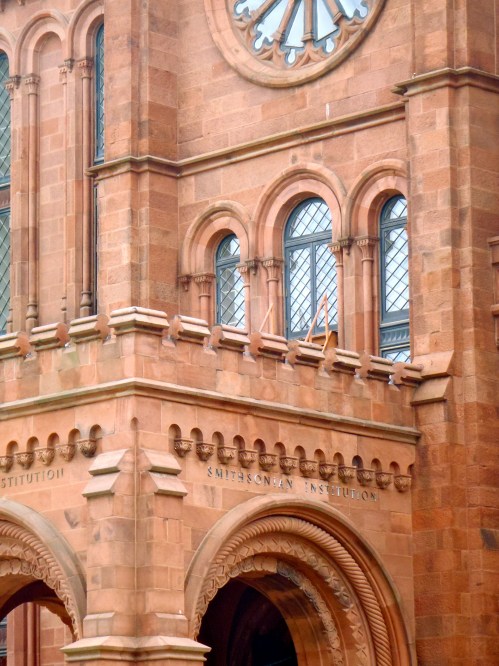
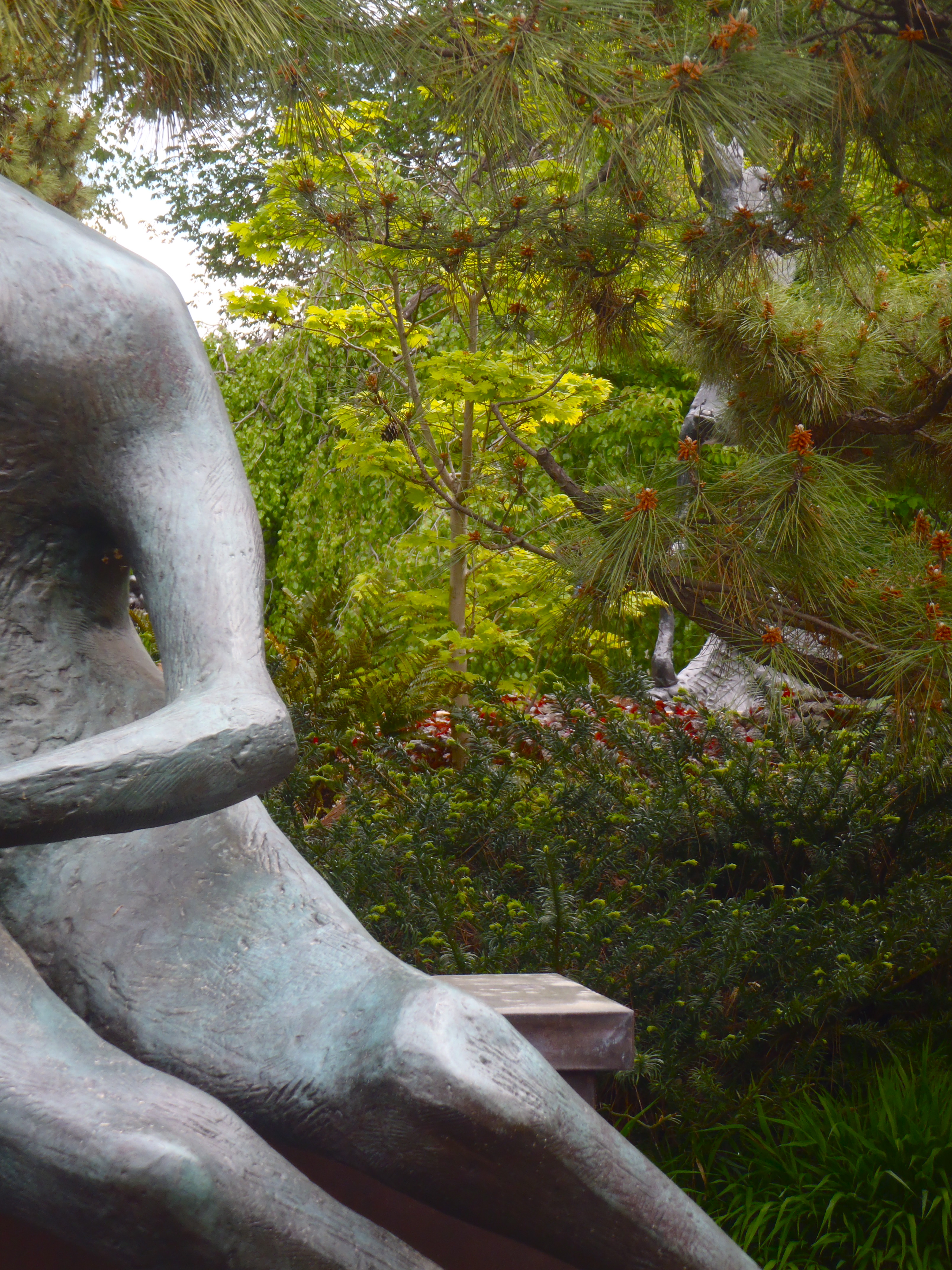
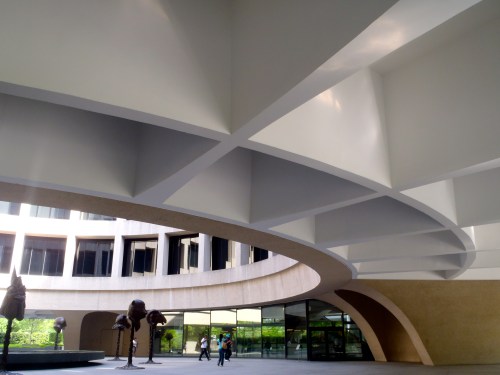
I loved D.C. even before I knew that I loved cities in general. There was something about the power, the tradition, and the variety of architectural styles placed within the order of the L’Enfant Plan. So when I visited recently, began to remember why I loved the city then and found a few more reasons to love it now: A red castle, a circle of art, and a statue in a garden. Enjoy:
The Smithsonian Castle
The Hirshhorn Museum
Posted in Creativity, Significance, Space
Tagged Artifact, D.C., Hirshhorn Museum, History, Power, The Smithsonian Institution
 Highways and Hallowed Halls