Category Archives: Ambition

Detroit! Books! Adventure!

I’m going to Detroit. In preparation, I’m putting together a reading list, calling interesting people for advice, and working my network to put together a legendary survey of this monumental city. I will likely post about Detroit in advance of my trip, potentially during the trip, and certainly after the trip. For now, here’s my reading list:

When I was in college, I loved to plan trips like this so I’m beyond excited to get back into the fun. Can’t forget about fun 🙂 Maybe one day I’ll have a job that encourages me to plan trips to places that have a story to tell, lessons to learn, and a creative vision for the future. Until then, Detroit awaits.

Career Dressing Rooms

“Cities have become the career dressing rooms for young adults. They have become the place where people go in their twenties to try on different identities. Then, once they know who they are, they leave.”

The Social Animal, 188-189

The Final Advantage

After months of reading, I have finished William Zinsser’s affectionate guide: On Writing Well. I’ve learned more about writing from this book than any other single source. I’ve also been entertained and moved to tears along the way. That dual quality, reflects Zinsser, “seems to me to be a good day’s work.”

I will never truly be finished with Zinsser and his legacy; as I start projects in the future I’m sure I’ll keep him nearby for regular reference. This book is truly a guide in the most relatable of ways: Zinsser’s voice takes you on a journey and never leaves your side. Here are a few of the many annotated, starred, and underlined bits that charmed me along the way:

“Clutter is the official language used by corporations to hide their mistakes.”

“Believe in your own identity and your own opinions. Writing is an act of ego, and you might as well admit it. Use its energy to keep yourself going.”

“Nouns now turn overnight into verbs.”

“Our daily landscape is thick with absurd messages and portents. Notice them.”

“Don’t hedge your prose with little timidities. Good writing is lean and confident.”

“You’ll find the solution if you look for the human element.”

“She wrote well because she was a clear thinker and had a passion for her subject.”

“We are suspicious of pretentiousness, of all the fad words that the social scientists have coined to avoid making themselves clear to ordinary mortals. I urge you to be natural. How we write and how we talk is how we define ourselves.”

“Criticism is the stage on which journalists do their fanciest strutting.”

“This heightening of some crazy truth—to a level where it will be seen as crazy—is the essence of what serious humorists are trying to do.”

“Taste chooses words that have surprise, strength and precision.”

“We are a culture that worships the winning result: the league championship, the high test score. Coaches are paid to win, teachers are valued for getting students into the best colleges. Less glamorous gains made along the way—learning, wisdom, growth, confidence, dealing with failure—aren’t given the same respect because they can’t be given a grade.”

“Moral: any time you can tell a story in the form of a quest or a pilgrimage you’ll be ahead of the game.”

“One of the saddest sentences I know is “I wish I had asked my mother about that. Or my father. Or my grandmother. Or my grandfather.”

“Writers are the custodians of memory.”

“But the final advantage is the same one that applies in every other competitive venture. If you would like to write better than everybody else, you have to want to write better than everybody else.”

“A good editor likes nothing better than a piece of copy he hardly has to touch. A bad editor has a compulsion to tinker, proving with busywork that he hasn’t forgotten the minutia of grammar and usage. He is a literal fellow, catching the cracks in the road but not enjoying the scenery. Very often it simply doesn’t occur to him that a writer is writing by ear, trying to achieve a particular sound or cadence, or playing with words just for the pleasures of wordplay.”

“You will write only as well as you make yourself write.”

A race

20130323-151353.jpg

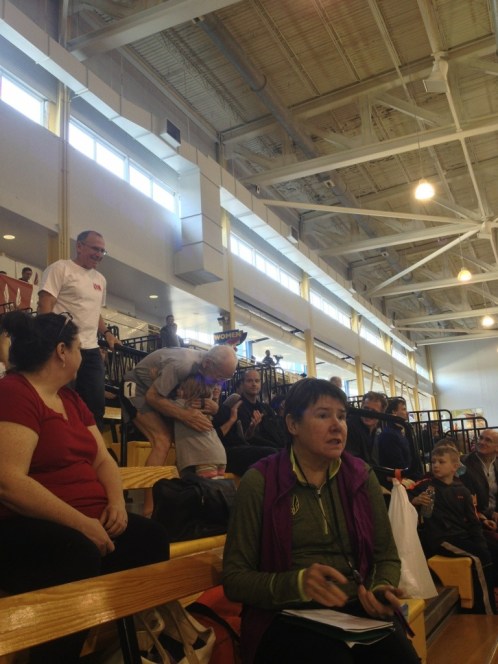
In the past 24 hours, my 95-year-old granddad has set and broken 4 world records. Two races to go.*

His life is truly a testament to the value of consistency and hard work. For the first 90 years of his life, he lived and worked. For the past five years, he has won.

But the beauty of his story is not in his gold medals and world records. The beauty in his story is not mere longevity or discipline. The beauty lies in his faith in God and identity in his plans. He said a few years ago (after a stroke) that he might never run again. He was as content that day as he was today as the first officially recorded man his age to run the mile.

And through the years, he has loved his family with a commitment that deserves more honor than any metal can bestow. Fifteen of us came to watch him this weekend. At the end of the race today, the first person to greet him was his great granddaughter.

Winning a race is not about crossing a finish line. Winning is about loving and being loved along the way. Winning is about remembering what really matters.

This is the life of a champion:

20130323-170014.jpg

*He ended up setting world records for the last two races as well

We, the Mobile

As I rode home from work on Friday, I decided I needed to get out of Richmond. For me, a 70-mile drive to Charlottesville is far enough to feel like I got “away” from my routine life. That drive down I-64 was the beginning of an idea that has everything to do with highways and hallowed halls: the faster you can get somewhere the closer it feels.

I’ve been told that humans have always considered a reasonable commute to be about a half of an hour to an hour of travel. Walking, that would be about 3.5 miles. Driving, that could be a trip from Trenton to New York. Flying, that’s a D.C. to Chicago commute that no child dreams to have when they grow up. While the amount of time we travel to work has remained relatively the same, the increase in distance has been significant. The affects of this distance are profound.

In the early 1900s, before the Model T and good roads, many wealthy Americans owned second homes just outside the city. In Boston, for instance, this was the rural getaway known as Jamaca Plain. Near Richmond, it was the neighborhood of Bon Air. Originally a retreat ten miles outside the city, Bon Air was frequented by Richmonders who wanted to get “away” from the stifling life of an industrial city. Today, Bon Air is near the middle of a metropolitan region and considered just another inner suburb. Meanwhile, the wealthiest residents are more likely to have second homes in Sun Valley or Naples than rural Virgina. The idea of buying a second home 10 miles away seems absurd. The faster you can get somewhere, the closer it feels. But is it actually close?

Many American cities today are populated by the children of faraway parents that raised them and watched them leave. I am one of these children. I was given the chance to move over 1,000 miles from home to live somewhere new and exciting. I have been given the chance to go out on my own. But when did this become normal? We, the millennials, are the fifth generation of Americans with access to cheap gasoline and the third generation to grow up with interstate highways.

We grew up as the unsettled generation of an increasingly mobile nation. There have always been wealthy people, but there have not always been turbojets and 70 mph speed limits. This has changed the way we see distance and separation.

For instance, I live about three-and-a-half hours away from my hometown of Tyler, TX. By plane. So that’s about 22 hours away by car and 349 hours by foot. When I left Tyler for college I didn’t really think it was a big deal. Now, it feels significantly farther than I originally imagined. In my sixth year of life away from Texas I can say there is much I have learned while I’ve been away. I wouldn’t change my decision to leave if I had the chance. I love the city where I live and the university where I studied.

But there is this simple, lingering question I am asked every once in a while that I can never completely answer: “So, how’d you end up in Richmond?”

Like most, I tend to focus on the “pull” factors of migration. Oh, I came here for college and fell in love with the city. I usually also make a joke about how the University’s website was easy to navigate or that Richmond wasn’t as cold as Boston, another city I considered for school. But why, as a senior in high school, did I not consider a single school in Texas or even somewhere closer like New Orleans or St. Louis? Why the 1,000-mile trek? There are a few easy answers I can think of:

  1. My brothers did it
  2. My parents let us
  3. I knew I would only be “a flight away”

But that doesn’t really answer the question. While there was a draw to move away, there were also significant “push” factors that sent me away from my southern home. In the land of football and Rick Perry, I didn’t really think there was a place for a friendly writer trying to make a difference. I made lots of unfavorable generalizations to justify my move away, but at the same time I was more focussed on where I was headed. When I applied to college, I dreamed of a place where people liked to read and write, where Christians didn’t all look the same, and where it wasn’t weird to suck at basketball. I didn’t know if I would find that, but I figured it was worth a shot. Everywhere I went in Texas, I saw the same story and realized that, while I think it’s a great story, it would be a hard one to fit into.

So I got out. I became one of the many confused Texpatriots simultaneously displaying a Texas flag and critiquing that beautiful, mineral-rich place.

And here I am: living in an old mansion in Richmond, working at an amazing university that also happens to be my alma mater. My neighborhood is both dangerous and beautiful depending on who you ask. My house is used as a tutoring site for hundreds of kids each year. My city has representations of American architecture going back to the 1700s, fine art, public murals, excellent restaurants, and more. It’s not D.C., but it’s also not snooty and it suits me well.

And yet, if you notice, all the positives aren’t really adding up. There’s always the question, “But what?” Living in Richmond is awesome, but it involves this thing I call the golden triangle of growing up: the pull between a career, a significant other, and family/hometown.

This is how it plays out:

Whenever I think about moving home (or at least near family), my first thought is that I can’t go back until I get somewhere in my career. There’s not much of a market in Tyler for someone who made up their own major in college. Then, whenever I think about advancing my career (a word I routinely misspell) which might involve grad school somewhere far away, I immediately think about my girlfriend and wonder how the timing of both will work out. Thinking about our relationship then takes me back to thinking about moving home and I imagine a life of holiday swaps and long-distance in-laws. Again, when I think about home, I think about my career pulling me all across the nation and I wonder what my little sister will be up to as she finishes high school and enters young adulthood herself. I wonder if my parents will be sitting on our back patio enjoying those cool spring afternoons in Tyler while I’m who-knows-where doing who-knows-what. I think about my three older brothers who are all living in this golden triangle as well and I wonder if we will ever manage to live near each other again.

I wonder if I will ever get to move home and whether it will still be home when I get there.

When you’re in a relationship with someone that’s in a similar situation, you also realize that at some point one of you will have to bend for the other. That’s the compound reality of this golden triangle: both of you can never have all three at the same time. And since both people in relationships today have educations and aspirations, it takes a lot of energy to make it all line up. Often people choose to go their separate ways, some struggle through the long-distance life, and others manage to work it out in the same place. Even when it does work out, it can be a gauntlet of long-term planning and flexibility.

That brings me back to my trip to Charlottesville. I’m currently sitting at a coffee shop with four friends I’ve met since moving out to Virginia. Between the two couples and myself, we represent five home states: Tennessee, Ohio, Maine, Virginia and Texas. We are all living in the reality of the triangle:

I am from Tyler, TX and my girlfriend is from Medford, NJ and Sanibel, FL. We both currently live in Richmond, but our families are scattered from Florida to California. My friend, Max, who is originally from Portland, ME, currently works and lives in D.C. where he met his girlfriend, Shannon, a native Tennesseean (who also moved around growing up), in D.C. just before she moved to Charlottesville for law school at UVA. Max is currently applying to law schools around the mid-Atlantic region and hopes to end up somewhat close by. Margo, another friend from college, is currently living in her hometown of Cincinnati and hoping to start medical school in the fall. She got into the University of Cincinnati program but is trying her darndest to get into a med school in Virginia so she can live near her boyfriend, Joe. Joe, a native of Richmond (the only native Virginian in the group), is currently in the UVA post-bac program so that that he can apply for med schools this summer and start a year from now in the fall. If Margo starts the program in Cincinnati, he will likely move to Cincinnati to work while he does his best to get into the same program or, if he only gets into a program in Virginia, she may try and transfer after her first two years.

It’s no wonder some are calling us the most stressed-out generation.

Max made the comment last night that we are living in an era of “progressive instability” as young adults in Twenty-First-Century America.

“Dramatic instability,” he added.

Since the best opportunities are no longer nearby, we find ourselves settling into LDRs (long-distance relationships) while we find jobs or attend grad school. Even if you don’t want to go to grad school, you’ve most likely thought about it. Max made the comment that the economy expects us to have graduate educations, but doesn’t facilitate the experience. Also, with MBA programs like UVA’s Darden that charge $76,000 a year for in-state tuition, our generation is making history in the way of personal debt.

With the sluggish economy, vertical mobility is synonymous with geographic mobility and cross-country job searches are the norm. This was once the time of life when people began to build stability, moved home, and started a new chapter of life. Some of my friends have managed to work that out, but many of us genuinely didn’t know it was an option. We, the mobile, have followed the allure of big cities and fresh lives.

No longer a time for building community, the twenties have become a very dynamic stage of life. One misstep and you’ll be roadkill in this “Great Recession” that sees unemployment as a mark of personal failure: you can’t get a job if you don’t have experience and you can’t get experience if you don’t have a job. Of course, it can work out, but it’s a little terrifying at the same time. And we are all living in this reality from day to day. Every once in a while I think about all of this and I take a very deep breath. It’s just too much to consider it all at the same time.

In a decade, I hope I look back and laugh at the golden triangle of growing up. I hope we will have a chance to tell stories and swap war wounds on the other side. I hope we all keep our sanity in the process and I hope we remember what matters most. What makes people happy today is what made people happy thousands of years ago: close relationships, good work, and unconditional love.

In the world of the golden triangle, it’s simply a question of where.

History

“The last chapter in any successful genocide is the one in which the oppressor can remove their hands and say, ‘My God, what are these people doing to themselves? They’re killing each other. They’re killing themselves while we watch them die.”

If you have not yet watched Aaron Huey’s TED talk, “America’s native prisoners of war,” you should probably do that before reading this post.

The quote above, taken from Huey’s speech, has taught me so much about loss, abandonment, and the legacy of systemic oppression. His description of the Native American experience describes so well the power of stigma and blame: “You are the savage,” says stigma, “you did this to yourself.” It’s the same way much of America still views inner-city neighborhoods that were abandoned by the middle class decades ago. It’s the sort of condescending lens through which the exploiter will always view the exploited. The effect can be seen in West Virginia and Louisiana, oil-rich Nigeria, and even Wounded Knee, South Dakota: #4 on Wikipedia’s List of the four poorest places in the United States. Still.

Huey continues to explain his perspective on European settlement throughout American history. “This is how we came to own these united states.” He says, “This is the legacy of Manifest Destiny. Prisoners are still born into prisoner-of-war camps long after the guards are gone. These are the bones left after the best meat has been taken.”

People are trapped by the past, he says, they cannot escape because their identity has been crushed. They cannot escape. And where would they go? While federally recognized Americans inhabit much of the fertile soil on this continent, there are still Native Americans living in the desserts, the outskirts, the badlands of our nation. He earlier describes the word Wasi’chu (lit. “taking the fat) as the word used to describe white people. This is a derogatory word, but it is not negative in a sense because it is directed at the exploiter, the “one who takes the best meat.” And so this nation continues to stretch its influence across this land, one settlement at a time.

I suppose my charge is simple: remember the past to have a context for the present. And don’t just remember Gone with the Wind; remember the stories that haven’t been packaged and sold to you. And “Give back the Black Hills,” says Huwy, “It’s not your business what they do with them.” In other words, when there is reason to believe that wrong has been done, the best time to work through the past is now.

Start at the Edge (cont.)

Yesterday, I read the weekend commentary from the Richmond Times-Dispatch titled “Direct traffic to our creative capital” (follow this link for one editorial and you will also see a link for “related” articles) and felt kind of compelled to write a response. The first section of this post yesterday was directly related to the way we talk about Richmond and why we are stuck in an outdated paradigm.

Now, I want to write the article I really intended to write all along: My opinions on how we should focus future developments in the city of Richmond.

#1 We need more people

Some Richmonders still cling the idea that a beautiful city is one that is relatively quiet and “clean,” but in reality many city functions cannot survive without a critical mass of residents. Case in point, many people (including myself) have been talking about trolleys in Richmond. “We invented them! Bring them back!” But we can’t just talk about “trolleys in Richmond” and not make some account for the changes that have occurred since 1888 when they first rolled out. In 1900, just a decade later, Richmond’s population density according to the census was 16,000 people per square mile. That was the highest population density of any city in the south (Christopher Silver, Twentieth-Century Richmond, 63). Compared to the measly 3,415 citizens per square mile living in Richmond today, the Richmond of 1900 was clearly capable of supporting systems of mass transit. Today, we just aren’t in the same place. I wrote once about the idea of “Longing for a Heyday” and how I/we sometimes look to some time in the past when cities were great. I don’t think we need that sort of shallow nostalgia, but rather a reasoned comparison between the Richmond of the past and the Richmond of today.

Our primary goal should be to get people here in the highest density possible. Remove all restrictions on ancillary unit rentals, remove unnecessary P&Z, and bring neighborhoods back to downtown: row houses and mansions alike. Get the density up, then we can talk about street cars et. al.

#2 Distrust Regional Collaboration

When multiple localities have vastly different values and strong competitive interest, collaboration is strained at best. Chesterfield wants more retail/corporate, Henrico wants more of everything, and Richmond wants to become a creative, welcoming city for all. What is there to talk about? Richmond needs to distrust regional collaboration at the government level and continue to invest in the physical condition as well as the residents of the city. Like I said in my last post, compared to the past 60 years, it’s a good time to be an American city. The tide is turning in our favor and if we are patient enough we may later return to the bargaining table with more than humble requests. Also, if the ballpark isn’t good enough, let the Squirrels go. We can use that space for a new neighborhood (see #1) and add to the growing Northside community.

#3 Cover the Highway

I was speechless when I read the commentary printed by the Richmond Times-Dispatch this weekend. Speechless. I don’t know Josh Dare, Tom Silvestri, or Sean Connaughton personally, but I imagine them to be very nice people. I also imagine them to be a lot like my parents’ friends which means we could definitely get along over drinks or dinner, but every once in a while I might have to bite my tongue. And that is what I did as I read through their commentary while sitting around others in a public space.

Here is my reply to the idea of improving the highway experience: First, don’t hold the highway against the people of Richmond. It exists as yet another shameful reminder of how Richmond officials often destroyed the city they were charged to represent. As most Richmonders are now aware, the people of Richmond soundly defeated the highway plan in the 50s only to later be sidestepped by a policy loophole. Second, want to make a statement? Cover the highway. The entire stretch from Shockoe Bottom to beyond Jackson Ward. Take a tip from Dallas, Boston, and Hamburg: Urban highways are bad business.

Cover the highway, build a park, and reconnect the city. The statement this would make is that we care more about the wellbeing of committed, local citizens than the opinions of temporary passersby and we would rather move them along to their destination with as little harm to the city as possible. Besides, if they do have a destination (which is most likely) they really just want a Wawa coffee and some gas for their car.

#4 Build on the parking lots

I know, I know, I know. We need to have parking lots because we have to make sure that everyone can drive and park where they work and play, etc. But if we are going to move forward, we must build on our parking lots. This isn’t really up for debate. Look at what was once the neighborhood of Gamble’s Hill and tell me that you like things the way they are. We must build on our parking lots and reclaim this valuable (and finite) urban space.

#5 Start at the edge

Finally, the real conversation is not about strangers on the highway, it’s about residents in the neighborhoods surrounding our city. What do they think about us? Why do they feel so confident about their relative position? The redevelopment policy that Richmond should begin to pursue should be a two-pronged policy targeting not just the core, but also the edge of this city. We’re not going to expand our boundaries so we might as well dig some trenches and settle in. This is what the city fathers should have done 60 years ago. Rather than bring the blight of the suburbs into the heart of the city, we take the beauty of the city to the edge of the suburbs. Begin to create a stark contrast from city to county along every major corridor with street trees, bike lanes, on-street parking, and high-density development. Build brick and stone columns at the border denoting that the driver has left or entered a place that cares just as much about the space between buildings as it does about what is on the shelves inside.

Stake a claim. Start at the edge.

Start at the Edge

As a resident of Richmond for the past five years, I have had the privilege of living through an exciting and dynamic season of change. It seems that after about 60 years of condescension and loss, it’s becoming a good time to be an American city. It’s a good time to be Richmond.

So, with that in mind, I was a little surprised when I read three editorials recently published in the Richmond Times-Dispatch addressing the “issue” of the view of Richmond from the highway. As I read each article, I felt that importance had been placed, not on the city, but on the opinions of passersby. This editorial is a response to those articles and perhaps generations of similar articles that have come before them. I believe that before we have a conversation about Richmond, we need to have an understanding of how the city changed during the twentieth century and more importantly what changed about the way we talk about cities in general.

My undergraduate education on the urban crisis in America presented changes in the city as a process of politics, prejudice, and technological advancement. More recently, I have come to understand the urban crisis as a gradual shift in investment and perception that took the American city, a source of pride, and turned it into a mark of shame. Furthermore, I understand the urban crisis as a rhetorical war between old and new. The goal of the war, as with any, was to frame the other as “backward” and the self as “progressive.” While Richmond attempted to maintain dignity, new technologies seemed dissatisfied with older cities: You’re too compact, too dilapidated, too prone to riot and rot.

As each new suburb was developed it became yet another statement to the American people pointing toward the promise of new, more civilized places with room to roam and play. Within this promise there was also a clear distinction being made from the archaic, dark city where most Americans at the time resided. As with all major shifts, the new way of doing things had to work to undo the more traditional ways of life. Many believe that the post-war zeitgeist of modernization, on a national level, did much to shift popular opinion. But on a local level, citizens of the Richmond metro-region still had to prove to residents that there was a more abundant life to be lived on the other side of the city limits.

This was accomplished through a series of events: The celebrated opening of Willow Lawn Shopping Center (1956), the construction of the Richmond-Petersburg Turnpike (1959), the failure of plans for consolidation with Henrico (1967) and other semi-related moments along the way. Each of these also had their corollary effect on the life of the city exemplified by events such as the closing of Miller and Rhodes/Thalhimers, the destruction of urban neighborhoods, and the political isolation that conclusively trapped and humbled this once-proud American city.

As money and people continued to migrate to the suburbs, local officials turned their attention from annexation to urban renewal. “If we can’t have the suburbs,” I imagine them thinking, “we have to do something about this city.” But rather than invest in what already existed, they fixated on dreams of what could be. “We get it” they tried to say “and we’ll fix it,” just don’t move your family to the suburbs.

As Silver writes, the city then “embraced urban renewal with a sense of urgency unprecedented in Richmond … Consolidation would have afforded vast new areas for growth and would have enabled the city to continue its policy of neglect toward inner-city areas” (254). Now left to embrace the demands of reality, Richmond’s city fathers sold out and destroyed much that today would protected as historical. They were always looking to what the city could be rather than accepting the city as is.

To me, this moment of urban renewal was a sign that the suburbs had won the war. This was the point in the story where it was finally decided that new was in fact better than old: Look! Even the city hates the city. In the decades that followed the tumultuous 60s and 70s, much has been said of the potential of cities, but almost all of it with the understanding that cities have something to prove. To this day, the standard to which Americans hold their cities is strangely high while their commitment to funding urban institutions and infrastructure is remarkably low. As Kunstler might argue, this is because we are no longer a nation of citizens; we are a nation of consumers.

Additionally, it seems that many of us have a powerful aversion to cities because we’re still trapped by the negative stigma established all those years ago. While local boosters proclaim, “Richmond is a city of art and great food!” critics reply, “Parking lots! Potholes! Prostitutes!” And regardless of their merit, these conversations do little to change the paradigm.

In this sadly familiar conversation, the subject is always “the city.” The place that needs to change is the city. The place that we want to love is the city. But this is not the perspective of an insider. Instead, we need to recognize that this critique is one of suburban condescension. The suburbs are still trying to prove their worth and their legitimacy and they are still quick to do so by orienting themselves against the “corrupt” and ” inefficient” locality they are ashamed to call neighbor, but delighted to visit for a basketball game.

We cannot have a productive conversation about Richmond until we move past the negative stigma that outsiders have placed on the city and begin to see Richmond as good once again. We should welcome visitors to come and enjoy themselves in the city, but our ultimate concern must be with the needs and desires of existing residents. Developments in Richmond should be for the city, not at the city’s expense, because that is what we can sustain and appreciate. And no longer should we consider developments for someone else to enjoy.

We have nothing to prove and everything to gain.

This Ignorant Present Revisited

A couple of months ago, I posted a quote from MacBeth that included the phrase, “this ignorant present.” I posted it because, for some reason, the idea really struck a cord with me.

Everywhere I go, I am asked variations the same question, “What’s in store for next year?” When I was a senior in college, I was asked this question. When I was a senior in high school, I was asked this question. I think before every big transition I have been conditioned to receive this question with either evasive answers or a scattershot of ideas and possible directions. Rarely (besides the college acceptance) have I been the sort of person to have an answer. Now, because I am currently working in a one-year program, the questions about the future have sort of carried on right through college graduation and into this year.

And I’ve noticed two things about this process: 1. Questions about the future make me uncomfortable and 2. I find myself asking these sorts of questions all the time. And then I started to wonder if maybe we are sort of all collectively making each other feel uncomfortable or unsatisfied with the present. Am I simply hoisting my discomfort onto my friends by asking them the same question that I myself am tired of hearing? Often, rather than enjoy the present, I am thinking about the future and I find that this ignorant present doesn’t seem to deserve our time in the context of the grand future we are supposed to be planning for ourselves. I know that lots of times these questions are well-meaning (or maybe an attempt on my part to make casual conversation), but I’m tired of the question and I want to respect the present.

I want to appreciate the present.

I also intend to put in serious work getting to the next step of my life … and I understand that I will always need to prepare for the future. But maybe I’m telling myself this as much as anyone else: the present is what we have. Conversations about the future, regardless of their intent, seem a bit assuming. This is, after all, the human experience we’re talking about so no matter what answer I give you when you ask the question (you know you want to) it’s with the understanding that life is going to happen regardless of what I say. So at this point, that seems like the only legitimate answer about what the future holds in store.

Life.

And more life.

RVA Remembers

Make your own at http://rvacreates.com/generator.php