Tag Archives: Visions

Samhain, 2025

For the last week or so I’ve been thinking about the Celtic holiday of Samhain. I don’t know much about the Celtic holidays, but I read a book once about a home called Bealtine Cottage and at the very least the idea of Bealtine planted a seed in my mind.

After some deep dives, I’ve learned that Samhain is essentially the “pagan” holiday that Catholics co-opted when they created All Hallows Eve (and All Souls, etc.). In a further twist of colonialism, it is also basically the origin of Dia de los Muertos – a holiday some see as a Catholic invention/amalgamation of existing rituals and beliefs.

Anyways, a witch on Instagram made a video saying that tonight is actually the best time to set resolutions and to plan for the work ahead. This night marks the end of the Celtic year and the beginning of the “dark half” of the year. This is a time when we are inside more, when gardens and farms have begun to rest. We often use this time to focus inward and draw close to friends, family, and partners.

With all this energy in the air, I decided it was time to take some small steps of preparation. With the help of our kids, we cleaned out several bags of toys and started to organize their play area. That felt like a nice small win. I am thinking about the fact that I’ll be inside more soon and feeling a desire to organize and repair more in general – there are so many projects that weigh me down more than I even realize.

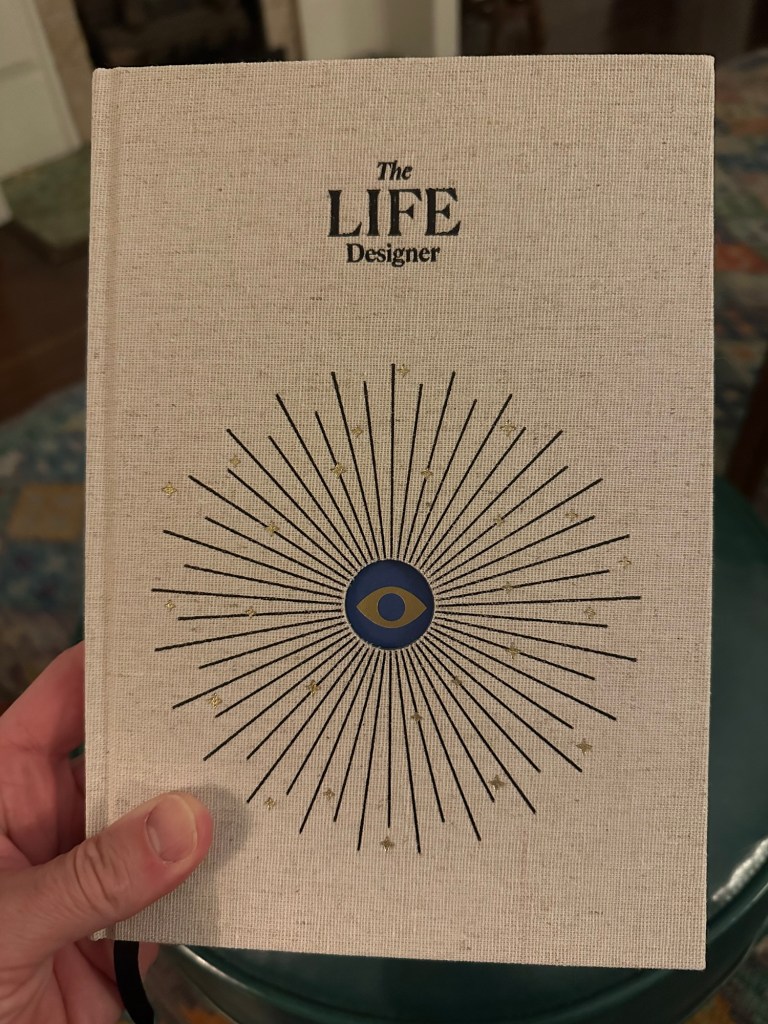
I also decided to start the new Life Designer workbook from Intelligent Change. I bought it before the Samhain connection, but soon realized that it would be perfect for this (new) new year.
At it’s core, it’s a workbook to plan the next ten years of my life. On October 31, 2035, I’ll be 47 years old. I actually started crying just typing that sentence.

Oh, I also cried when I filled in this dedication page:
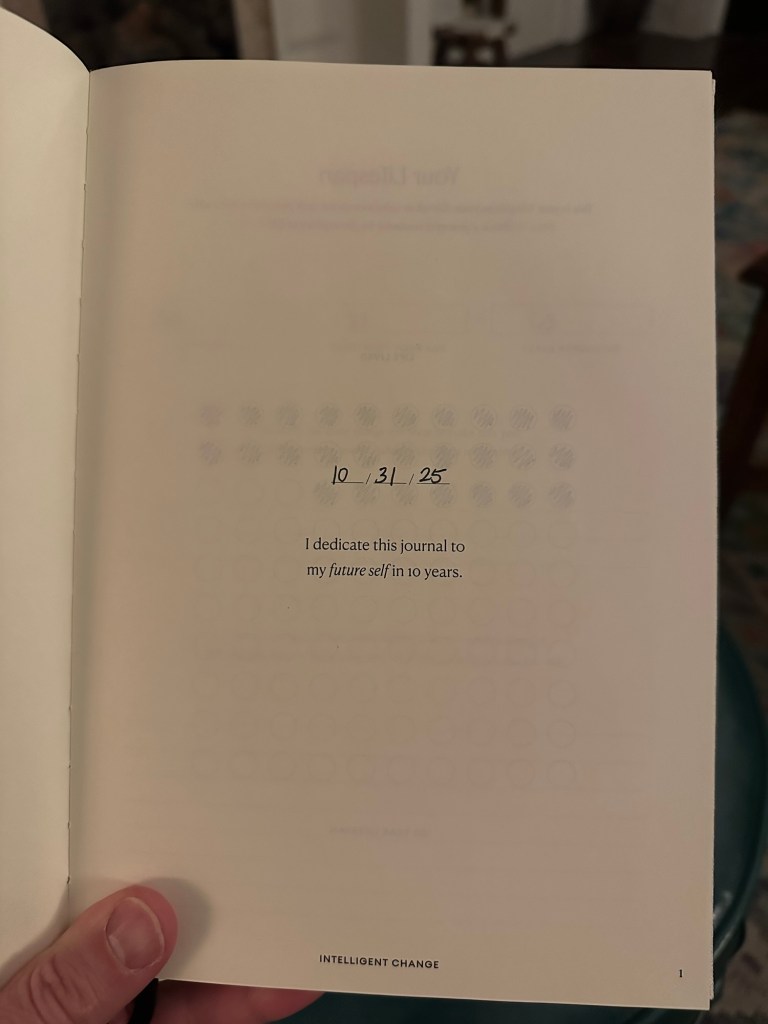
I really do not want to get older – I don’t know how else to say it. On the other hand, there have been so many days in my adult life that I’ve just wanted to be over so that I can sleep again.

I know that I have to fix my days before I can fix my years. And since I can’t avoid age, I can’t avoid work, I can’t avoid relationships, hopes, disappointments, responsibilities, etc., I know that it’s time to start thinking about what I want to build on the years I’ve lived so far. Because “the next ten years” are already here.

With my fear of getting older, it was encouraging to fill out this chart of the years that I’ve lived so far and see how many I presumably have left.
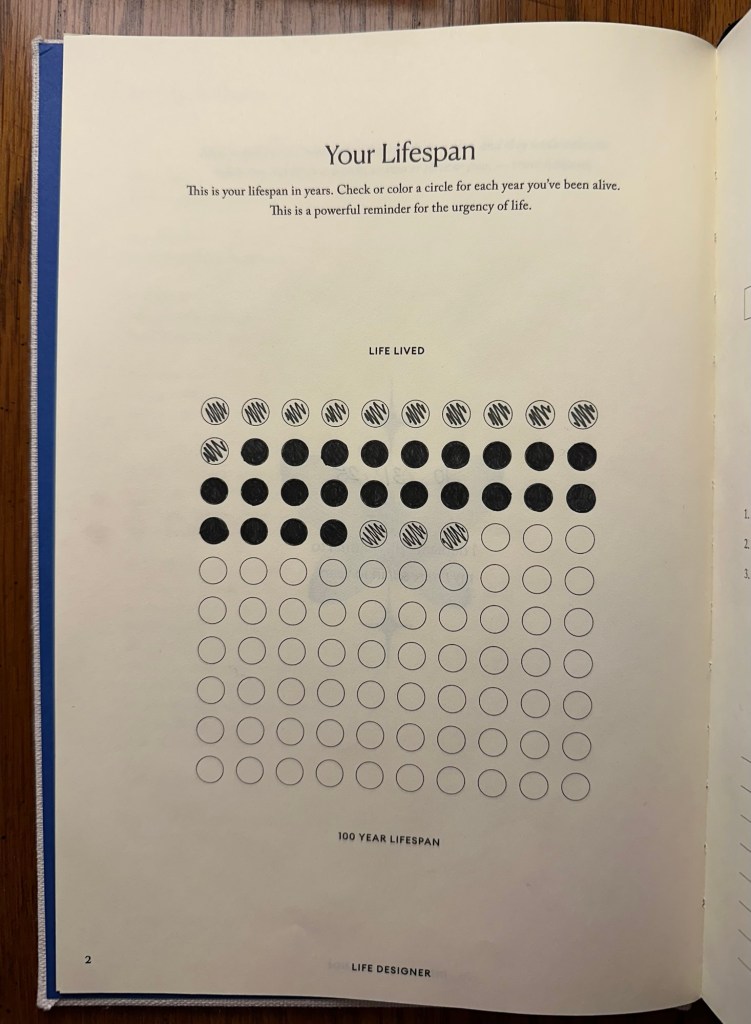
Even if I live to be 70 or 80 I still have a lot of life ahead of me. The first time I posted this page I did it wrong so this is a new photo. Also, I decided to black out the years that I was in the closet. I cried for a moment when it sunk in that I’ve only lived around 15 years of life not in the closet. Hiding took such a toll on me that I need to label those years differently. Also, being in the closet delays adolescence (like what a 15 year-old would be experiencing) so the past three years have looked very different than they would for someone who is not going through that.

It’s exciting to think about the people and places that will be a part of my life over the next ten years or more and a little sad to think about the people and places that won’t. Making choices is part of the deal – even in ten years I can’t have it all, but with intention I hope to have a life that I want. I’ve only just started this workbook, and, based on the witch’s advice, I would like to finish it between now and the Winter Solstice.

With the seasonal shift toward intentions, I also thought about books I might like to read over the next 12 months. I’ve pulled together a stack that I’m pretty excited about and replaced the one under my side table that has been sitting there for months (years?), mostly unappreciated. This new stack was chosen more carefully and I’d love to actually see the stack tick down as I read each one and the shelf empty by the next Samhain, 2026.
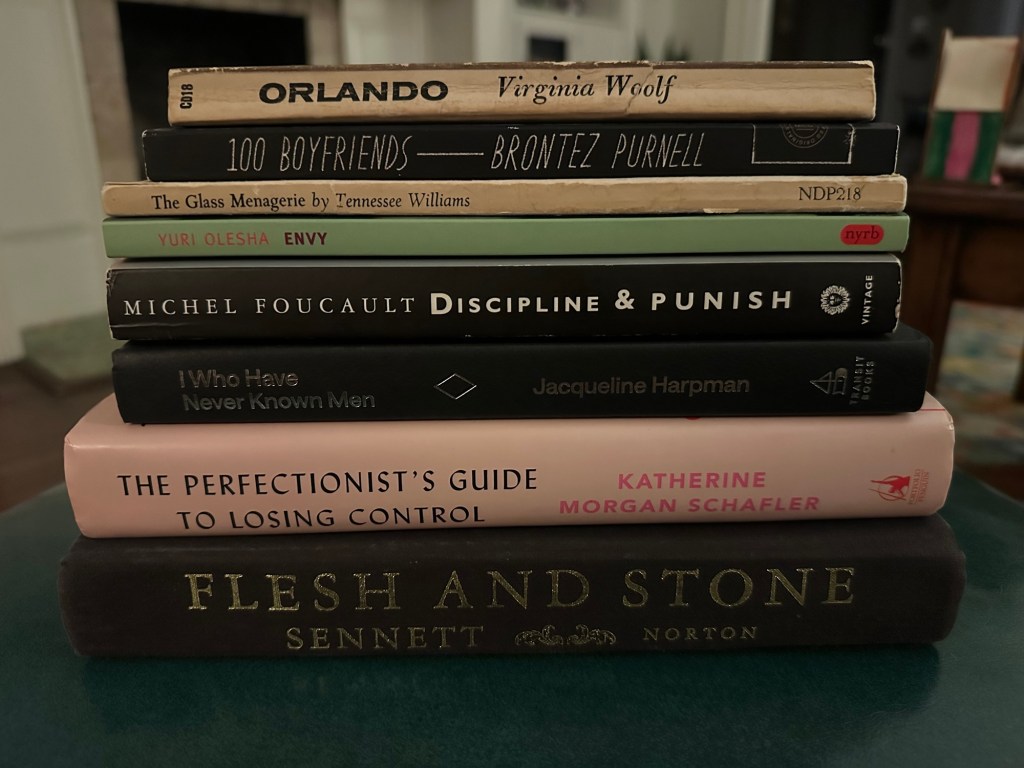
I started the Foucault and Sennett books around 2008 and 2011, respectively. I’ve only read the first chapter or so of each, but they have both been so influential to how I think about things that I’ve decided I’d like to finally finish them. Along with those two books, Orlando, 100 Boyfriends, and The Glass Menagerie continue to round out my gay literature cannon. I Who Have Never Known Men and Envy (a personal problem, unfortunately) are two foreign language books I’m looking forward to. Finally, The Perfectionist’s Guide to Losing Control, a book I started during a hard time last year and have decided to pick back up during a new season of loss.

So much of this post may seem like I am trying to control my life, but I really do want to lose control more than anything. I want to let go of legalism, perfectionism, and self-criticism, especially. I am not going to feel like a failure if I don’t read all these books or achieve the life I envision exactly. I just know that there are some things in my life that almost never feel like work (even when they are work). I desire/intend to do much more of the work, to spend time with the people, and to inhabit the places that give me that kind of energy over the next 40 seasons of change.
Crowdsourced Rewilding in Richmond (and beyond)

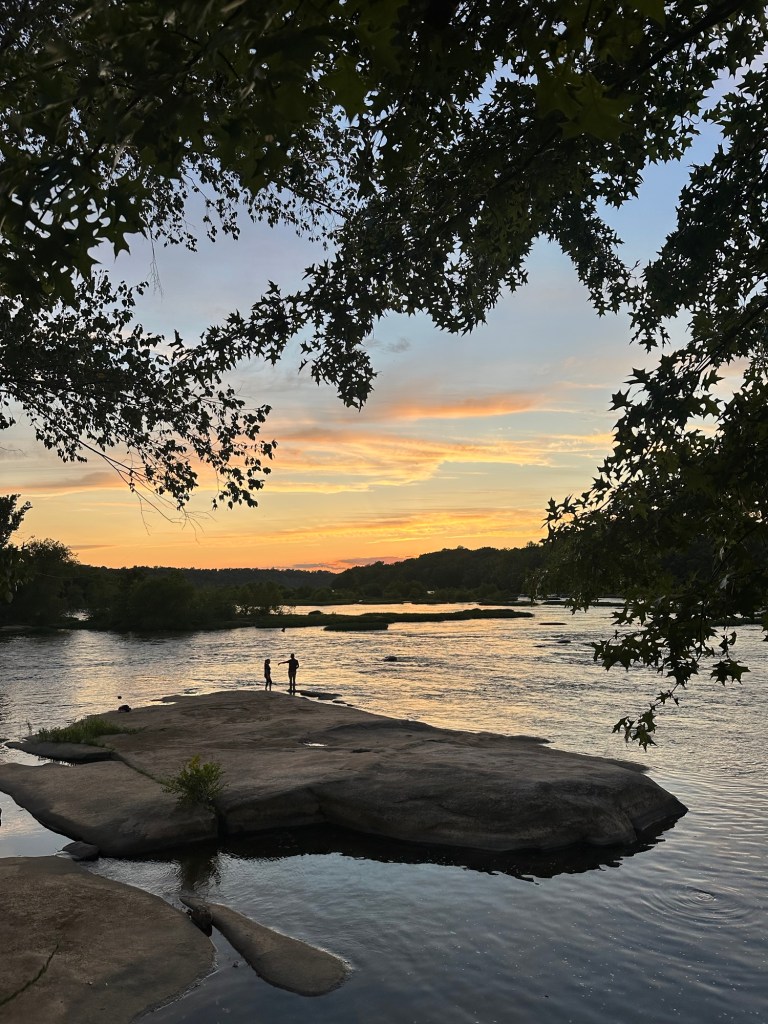
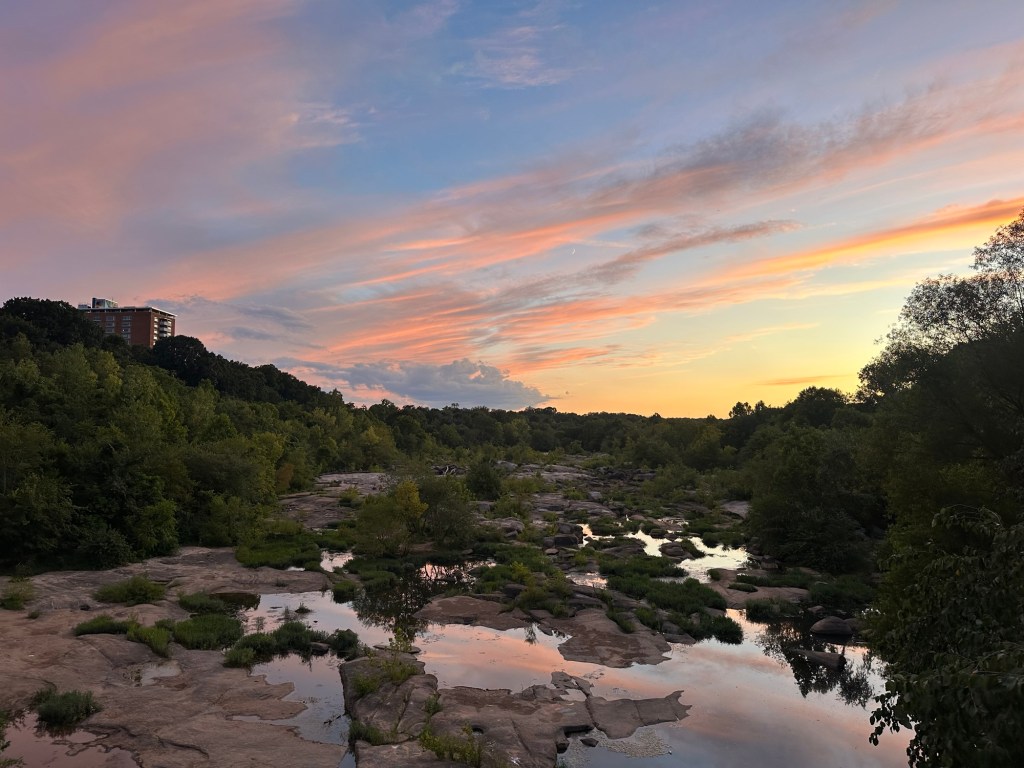
Over the past couple of months I’ve rediscovered the loop walk around Belle Isle. I’ve been spending time in more secluded areas of the river lately and had forgotten how beautiful it is with sweeping views, changing topography, and people everywhere enjoying the water and trails. 

One morning in September, I also noticed something else: I hadn’t seen a single bumblebee on the entire walk. I started to look more closely and in two months I’ve only seen bumblebees two times, a total of four, all on bluestem goldenrod. Otherwise, the forests and fields of the island seem sort of oddly quiet.

Not only have I not seen many bumblebees, but I also haven’t other bees, wasps, butterflies, bugs, or birds like goldfinches, hummingbirds, and cardinals.

I think the reason I’m noticing this absence now is that I’ve been gardening for a decade or so and I love to see plants as a part of the whole ecosystem. Over the past six years especially my current garden has come alive in a way that gives me a lot of joy. I see more bumblebees on a single anise hyssop at the same time than I have on Belle Isle recently. For the past week, panicled aster (Symphyotrichum lanceolatum) has been in full bloom around my house and there are more bees and bumblebees than I could ever count. I see goldfinches eating coneflower seeds, hummingbirds on the cardinal flower, and monarchs on the milkweed.

And my garden is definitely not the only one. Richmond is full of gardeners who are planting native or “nearly native” plants and attracting all kinds of birds and the bees. Which got me thinking: What if we could somehow organize everyone to invest their energy into the JRPS?

I’ve been toying with this idea for a little while now and I see it working something like this:

  • Starting with Belle Isle, a list of 30 or so first-round parcels are identified. These should be small, edges, islands, and otherwise manageable, well-defined parcels. These kinds of spaces would be really easy to manage and would have a lot of nice visibility:
  • These plots are designated as full sun, part sun, part shade, and full shade with a list of plants that are approved to be planted in the area. They could also be designated for tall, medium, and short-growing plants depending on the location.
  • A call is put out into the community for interested gardeners to join the program
  • Selected participants are placed in an orientation and trained on the process of invasive species removal, which plants that are pre-approved for planting, and the general overview of the program
  • Approved gardeners then “claim” plots on the map and the first thing they would do is string a simple string and stick barrier around their plot with a sign that explains the program and the project – they would take a photo of this and post it to a google doc or app as a record of their project for someone to verify compliance and serve as a “before” photo for the plot
  • The gardeners would work at their own pace to fully remove the invasives and replace them with the native plants appropriate for the amount of sunlight and location of that plot. A photo would be uploaded for every day of work on the plot and for all subsequent maintenance visits.
  • Gardeners would be expected to maintain their plot for as long as they are in the program including weeding invasives and tending to the plot for other needs.
  • If they have capacity (looking at you, retired gardeners!), they could select multiple plots depending on availability
  • Gardeners would also be asked to provide seeds and seedlings to a community crowdsourced greenhouse. Gardeners who don’t have time to garden their own plot could opt to only participate in this donation program for their seeds and volunteer seedlings to be used by other gardeners around the project site
  • Once the initial phase is complete, a detailed GIS map of the landscape is drawn to divide the entire island into small, garden-sized parcels, maybe 400 sqft each
  • The plots would then be organized in order of priority
    • Areas around all entrances/exits to the island
    • Areas along high-traffic pathways
    • Areas along low-traffic pathways
    • Areas in the interior of the woods and fields of the island
  • These plots would be assigned to more trained volunteers as the program continued to grow. If possible, a landscape team could be hired to plan the overall layout of the island and select a smaller number of plants for each location to provide a little more guidance on the final product

I know this is a little far-fetched and that there are already organizations doing a lot of this work. But this does feel on some level possible. The local knowledge, technology, and tools are all available.

I also think the sooner we start the better. Plants are basically seed factories. Once we start to establish a wider diversity of plants they will start to continue the work for us in spreading throughout the area.

In a very non-scientific search, there are 129 plants listed as native to Virginia on the Prairie Moon Nursery website which seems like a good place to start. With some professional consultation, we could finalize a list of plants, divide them up by their planting guides, and start some test gardens around the island. With so many deer living in the JRPS, it will be important to prioritize aromatic, deer-resistant plants like Purple giant hyssop (Agastache scrophulariifolia) and Yellow giant hyssop (Agastache nepetoides). These will have a better chance of becoming established over time. I have gardened with Anise hyssop (Agastache foeniculum) for years and love the way that it spreads, attracts bumblebees, and blooms successively throughout the summer, but it doesn’t appear to be native to this region. Another deer-resistant perennial that I would like to see is Rattlesnake master (Eryngium yuccifolium). It is very hardy, spreads generously, and attracts wasps, bees, beetles, and other small flying insects.

The middle of the island contains an open prairie that could be restored in the same way as the forests and trails. It seems to have full and partial sun exposure which would create an opportunity for many sun-loving perennials and grasses. More deep-rooted grasses would also provide an amazing opportunity for carbon sequestration. It seems like switchgrass and big bluestem are valuable in this way, but I’m sure there is an argument for most native grasses.

If there is a concern with the JRPS looking too manicured, I would support limiting the list of plants and also planning large colonies of a single flowering plant along with native ferns and grasses rather than a high diversity of plants in a single plot. It could look more natural for the species to be grouped like they have spread over time.

I think this project would work well on a stand-alone website with a front end that promoted the program and receives donations and a member login portal where members can manage their plots, post photos, and record donations.

The program could be funded in part through sales of excess seeds and plants grown in the shared greenhouse. It might even be possible to apply for carbon credits if the restoration were successful and extensive to warrant that. Of course, there are also grants and billionaires.

Once the program is functional, it could be expanded to include the entire JRPS. I can imagine there are many gardeners who would prefer to work in their neighborhood parks for convenience and sense of personal ownership. Every year there could be an outdoor awards ceremony on the island, etc. To scale this, we could sell licenses to other municipalities who could buy into the program and use the training materials, website design, etc. to manage their own crowdsourced rewilding programs. Training materials would be adapted to the native plants of that area, but otherwise could be fairly interchangeable.

I’ve really enjoyed imagining a Belle Isle that is buzzing with life, an oasis in the middle of a manicured/ruined landscape, and a pocket of life to inspire more and more people to garden with nature in mind. I don’t know exactly how, but I do believe it should happen. There is no way any of us would regret it.

Art project idea: yucca in red

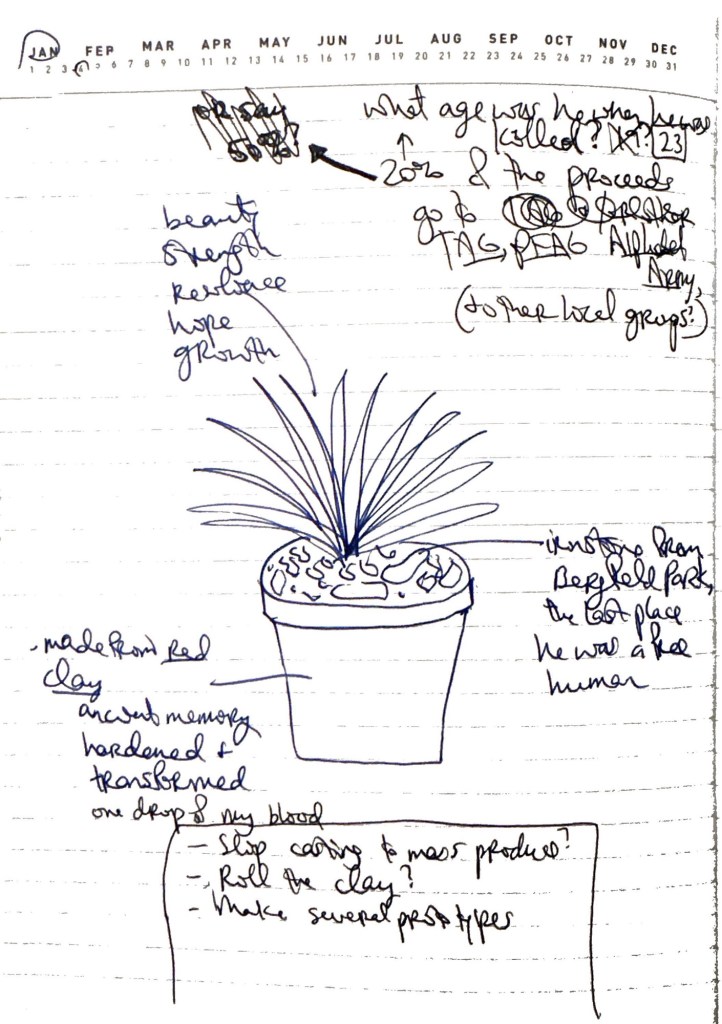
One Saturday in early January, in the middle of cleaning and entertaining my kids, I got an idea for an art project and sketched the notes below.

I’ve been really interested in the life and death of Nicholas West for a little over a year now and continue to feel a strong connection to his story.

The basic idea is…

  • A collection of pots thrown from red clay harvested in and around Noonday, TX where Nicholas was tortured and killed
  • The pots are different sizes with different biographical information about Nicholas like his birth and death years, text from obituaries, anything significant from his story
  • Each pot would have a drop or two of my own blood. I want to make people a little uncomfortable when they pick up the pot and read the description. I want to make his death more tangible and remind people that all soil has seen bloodshed of one kind or another. (On a more cosmic level, I also love the connection between the iron in our blood and the iron in the soil which was all stardust flung across the universe from dying supernovae.) I’ve noticed that men are pretty squeamish about the idea of the blood, and women I’ve told are much more supportive which makes me want to do it even more.
  • In the pot will be planted a Yucca filamentosa, native to the southeastern US (from Tyler to Richmond), very hardy, tropical, and structural. The yucca will grow to fit the size of the container that it is in, the yucca is resilient, and in the spring it has a bloom several feet above most other plants.
  • Yucca is also the first plant that I really noticed and developed a connection to. It is the first plant I remember finding and foraging and I’ve planted and potted at least five in the last two houses where we’ve lived. I was in a dark place in my life and my interest in plants, yucca specifically, was an encouragement that has continued to center me and excite me while also driving me a little crazy with more ideas than I’ll ever have time for.
  • While I still love the idea of Yucca, more recently I’ve considered Hesperaloe parviflora, also known as “red yucca” or “false yucca.” I noticed it in Texas at some point and planted it in my garden 3-4 years ago. I had a naturalist walk around with me and he commented that he liked seeing it growing in Richmond because he didn’t know that it could. I love the idea of a Texas transplant thriving in Richmond and the idea of it being a “false” yucca feels appropriate for the Southern culture of repression and how much of myself I held back from others for so long. Of course I love the red bloom, the color of blood and nectar for hummingbirds stopping for a moment on their impossible migration.
  • On the surface of the dirt in the pot I want to scatter bits of ironstone found at Bergfeld Park, the place where Nicholas was picked up, the last place he was free. On my most recent visit to Tyler I pocketed some pieces of the stone and brought them back to a potted yucca I have by our back porch. It has been special to me to have them there as a connection to home
  • I’d love to sell replicas of the different styles of pots and give a portion of the proceeds to local LGBT community organizations in the Tyler area.

It would take months or years to really do this as well as I would want to – I haven’t even fired a clay pot since high school. I’d need time to harvest the clay, prototype different styles, and learn how to make them consistently well, etc. So with all that considered in addition to the constraints of full-time employment/parenting life, I’ve accepted that I’m probably not going to attempt it, as much as I want to. It felt better to share the idea here and let it go rather than hold it too tightly.

4.22.25 – Since writing this post I’ve thought more about the possibility of partnering with an artist to make the pots that I could use to plant and we could market the project together. Even still I don’t think I have the time to do it well, but the partnership would be really rewarding and it’s much more realistic to lean on someone’s existing expertise rather than try and develop it myself. It also got me thinking outside the box even more. Maybe this idea should actually be an assignment for a class where everyone chooses an event that deserves more recognition and designs an installation to share the story. Maybe it should just be an online project that collects memories and details from his story. Or maybe this just needs to be a section of my own garden: a shrine to his life and a broader connection to my own story, my hometown, and the resilience, growth, and occasional moments of flourish.

4.24.25 – While reading about “The Burying Grounds Memorial” at the University of Richmond I learned that Yucca, “is often found in the cemeteries of enslaved people, serving as living grave markers.” I have only just gone a few steps down this rabbit hole, but I’ve already found some interesting articles and anecdotes that support using it for the project. It seems the plant has long served to mark the memory of people who might have otherwise been forgotten, to bind their restless spirits after life, and to provide permanent protection to their physical remains.

  • “Fieldstones. Yucca plants. Seashells. The last object a loved one touched. For centuries, these items, cultivated from lives and landscapes, marked many graves at burial places for Black people in America.” National Grographic
  • “Some of the plots were marked with pieces of quartz or with yucca plants, which were used by many Southern Black families who could not afford stones.” ProPublica
  • “The phrase “pushing up yucca” has been coined to describe these graveyards, and there was a Gullah belief that spiny plants restricted the movement of the spirits of the dead.” Society of Ethnobiology
  • “Spiky clumps of yucca dot Odd Fellows cemetery as further reminders that this patch of woods was once a curated (if not manicured) space. Though widely found in cemeteries across the country, in African-American tradition specifically, yucca binds restless spirits to their graves. Easily transplanted and nearly ever-lasting, yucca was sometimes planted near the head of a grave in lieu of an expensive stone marker.” Black Wide-Awake
  • “Yucca is another plant that marks many early graves even today. It can live hundreds of years and represents eternity. In many African American communities it was also traditionally thought that yucca kept restless spirits in the grave.” City of Birmingham
  • “Due to their association with cemeteries, the yucca plant has also taken on an association with the supernatural, as a way to ward off evil spirits.” Lumpkin County Historical Society

Vision for an urban valley in Richmond

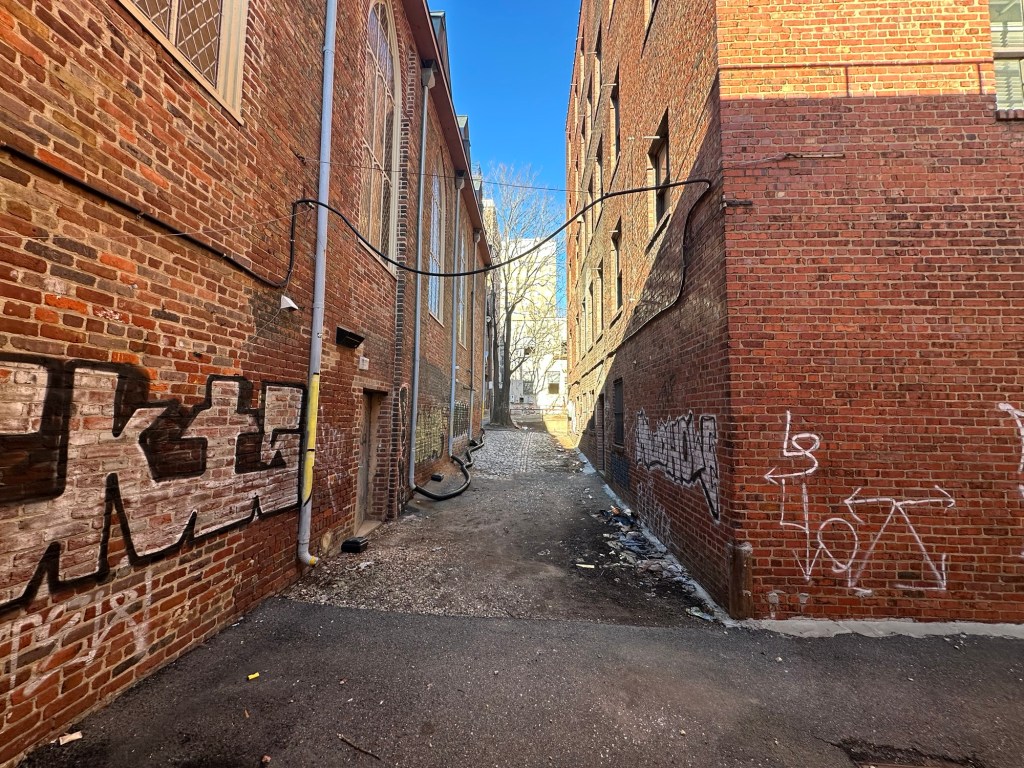
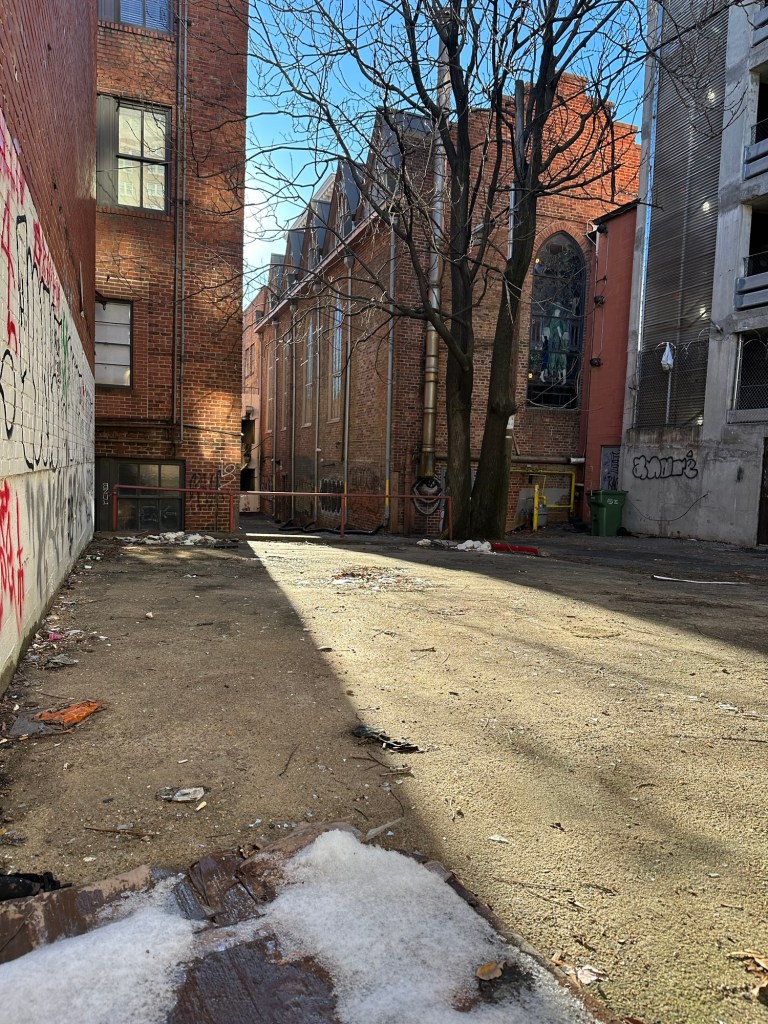
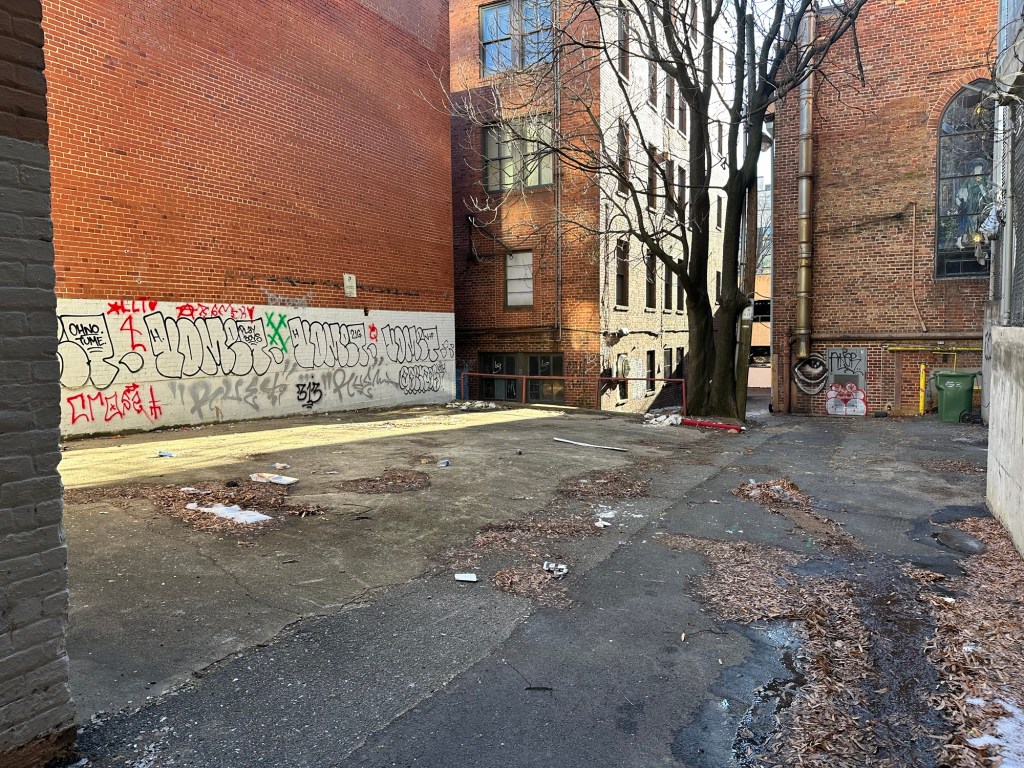
The other day while I was walking through downtown Richmond I stumbled on a small space with huge potential. It’s basically just a concrete slab, but what makes it special is that it’s located right in the middle of a city block. The concrete is connected to one building that forms an “L” around it. The area is accessible by three different alleys which all meet at the base of a somewhat beautiful, mature tree.

With some love, this could be a place to congregate just like the La Colombe near Logan Circle in D.C. The benefits of using these interior spaces is that they are quieter than the city streets and they are often cooler in the summer months because the buildings provide shade. They are cozy spaces, the diffused light is relaxing, and there is something charming about the irregular shapes. I love the surprise and delight of waking down an alley, turning a corner, and finding something you wouldn’t have expected,

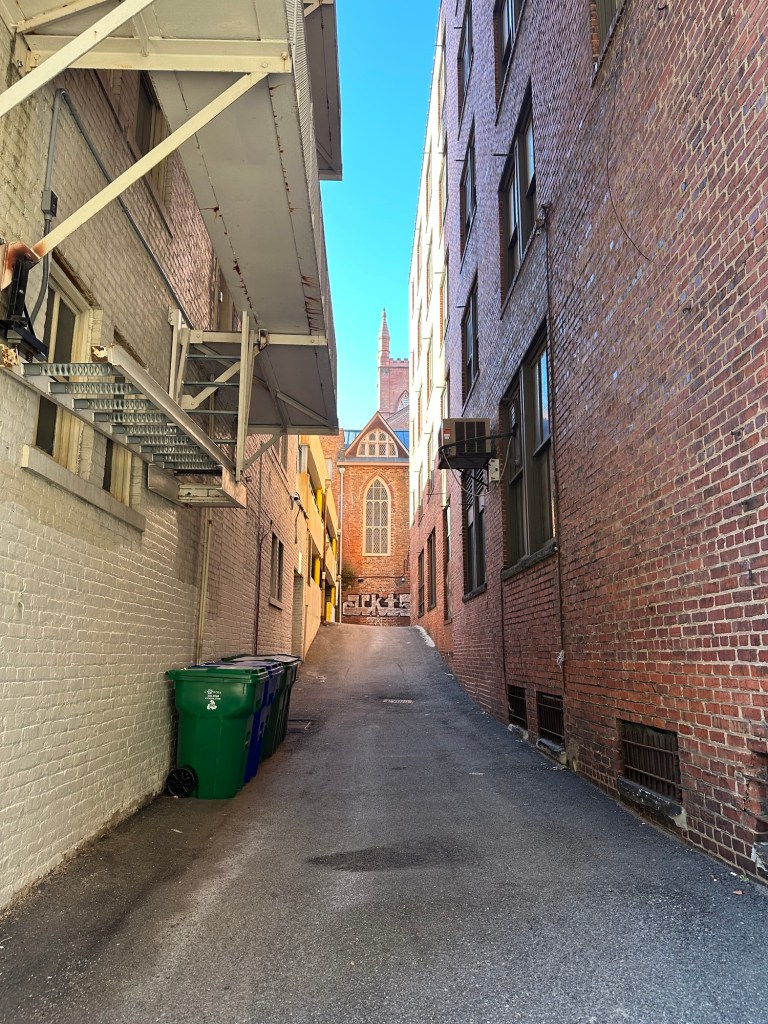
The approach that is most familiar to me (I actually worked and parked in the building to the left years ago) is below. I love the way the buildings frame the old window and steeple of Second Presbyterian.

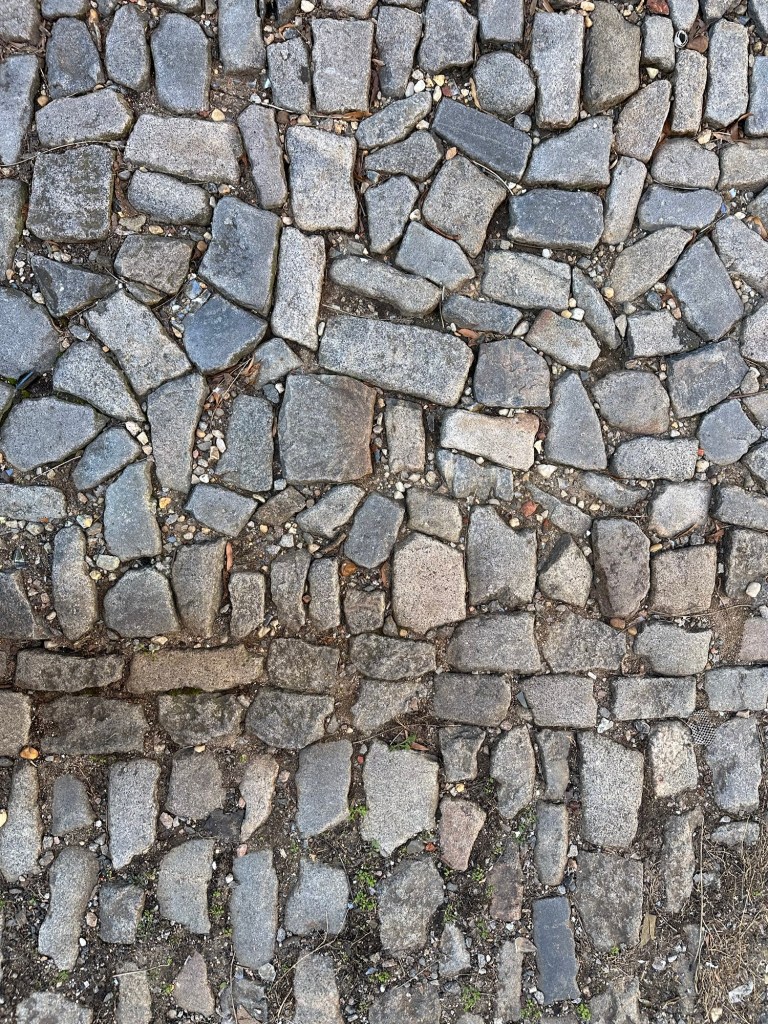
After you turn to the right, you start to get a glimpse of the destination. The area also starts to become more charming: the alley transitions to cobblestone, instead of a parking garage you have old brick and stained glass, and the tree is visible as well.

Despite being completely forgotten and unloved these granite stones are beautiful and the whole section would clean up very nicely.

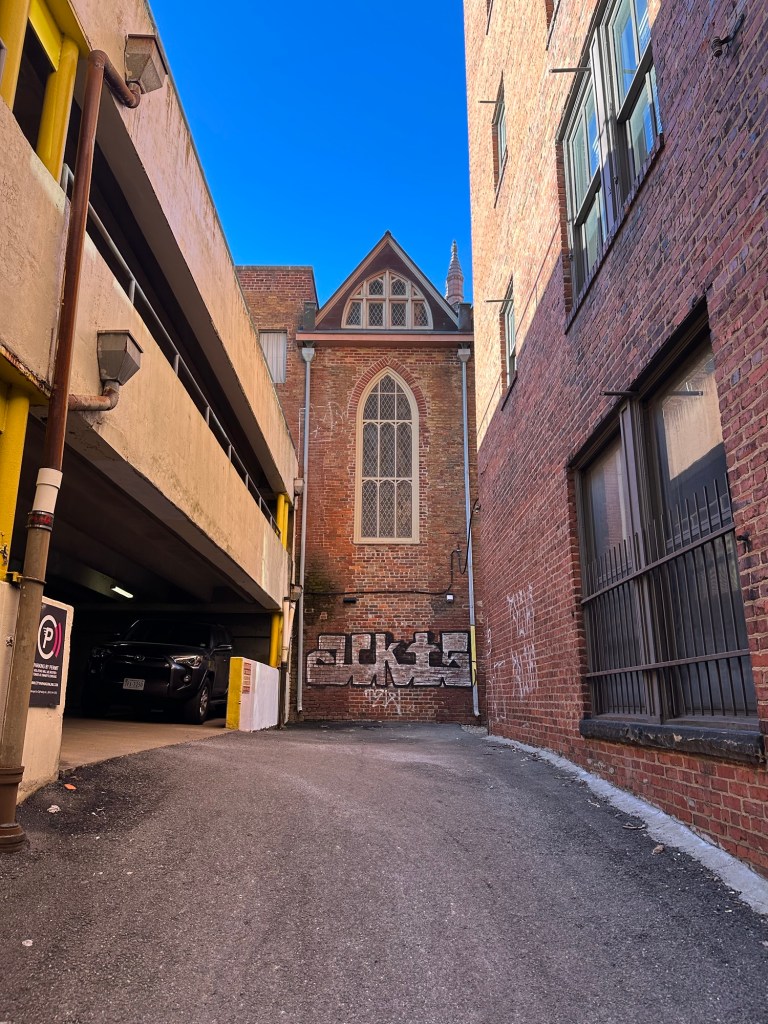
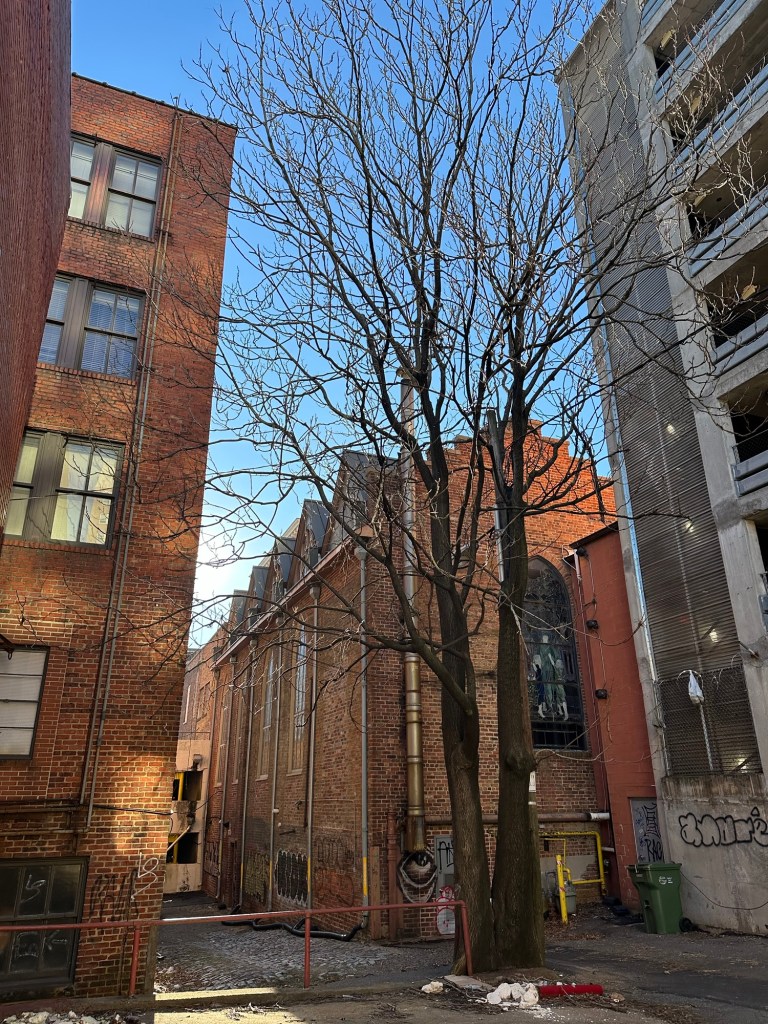
This is the view from the space that I’m interested in. I appreciate how much there is to look at even in this small space. It feels like the medieval section of a city: winding, ad hoc, dense, and built to the human scale. The tree would also provide shade in the summer and a beautiful accent.

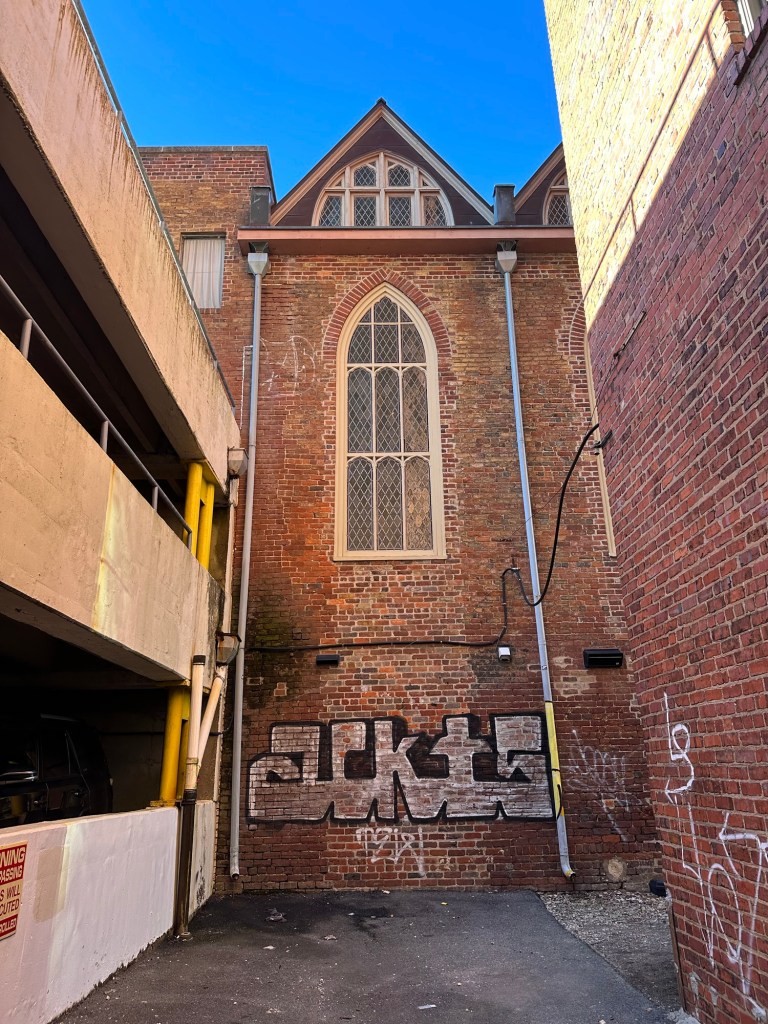
Here are two views of the actual space.

I am so in love with this idea. I had a similar vision for a space in Tyler many years ago and still believe in the potential of this sort of retrofit to bring new life and charm to cities. Whatever zoning process that’s required should be fast-tracked. Whatever the building around this space becomes (it’s currently being renovated), this should be a cafe or similar commercial space, with bistro lights, live music, and otherwise completely transformed into a beautiful and charming refuge in the middle of downtown Richmond.

Perspective

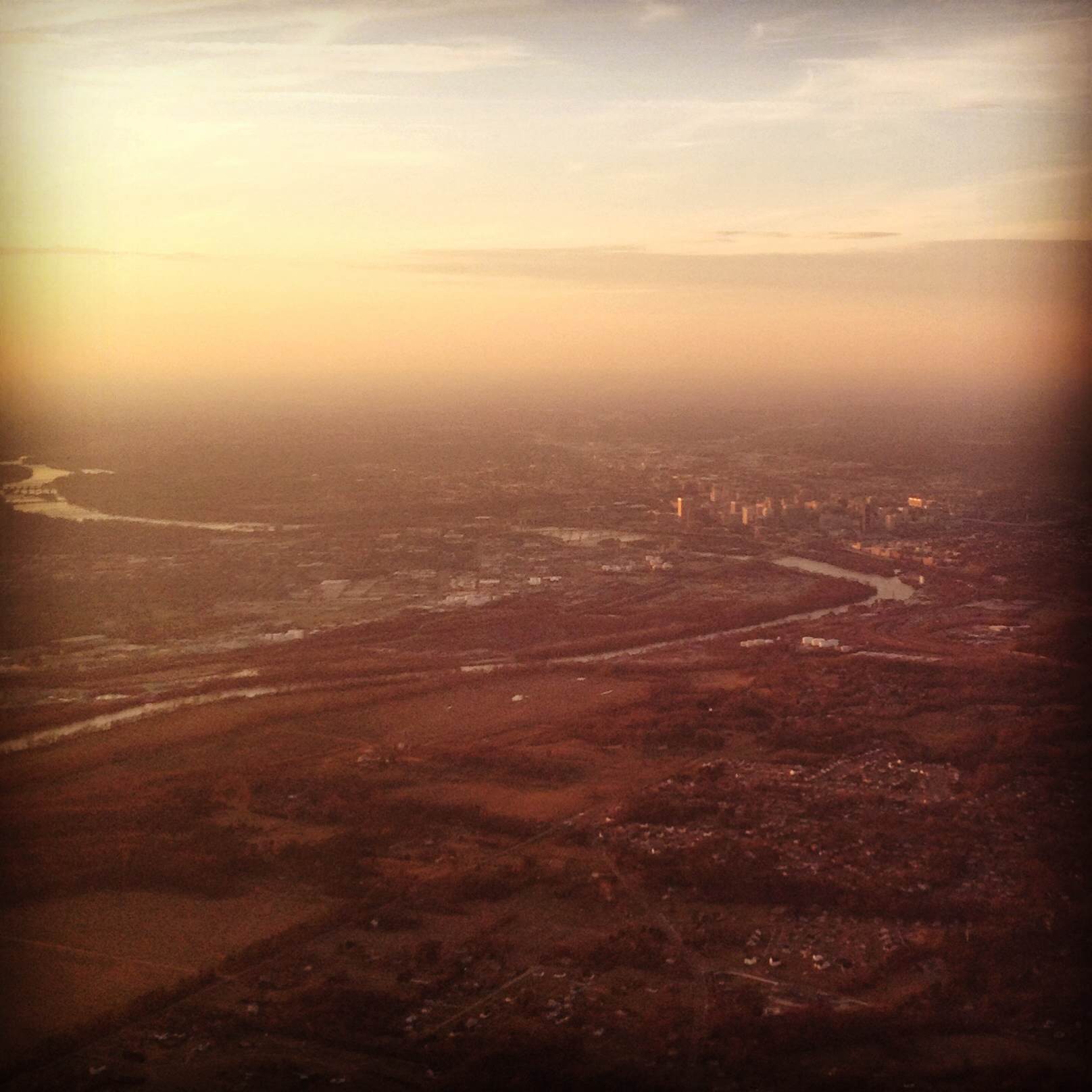
As I flew out of Richmond last week, I got a rare glimpse of the city at dusk:

River city

I just stared at that settlement on the banks of the James River and wondered what the next 400 years might bring. In the city of Richmond, there is the past, the present and the future. That makes us fortunate and it makes us complicated.

To move forward, we will have to make some sense of ourselves and our story.

In the past few months I’ve travelled all over the country: from Philadelphia to Dallas, to San Francisco. With each trip I’ve found new perspective on this current phase of the development of the city of Richmond. I’ve also found some clarity for myself and settled into four areas of focus for my writing:

1. Current events in context: If I ever write about current events, it will be to analyze and contextualize the story. I spent three years studying the debates in Richmond regarding the construction of the Richmond Petersburg Turnpike. That work left me particularly interested in economic development strategies and plans for improving the American city.

2. Drawings for the future: Like many of us, I’m constantly imagining new uses for old spaces and I’ve decided I’m finally going to get these on paper. I’m actually planning to draw them out. It will probably be pretty ugly at first, but I’m hoping to read a little on technique and improve over time.

3. The psychology of the city: I’ve been noticing for years that the city of Richmond has a certain personality. This personality comes out in furious debates as well as mundane daily life. Since college I’ve also entered the world of cognitive psychology, therapy, management, and organizational behavior. I’ve read books, met with academics, and watched every video I find. Insight from these fields will be my lens for understanding what’s going on in this crazy place.

4. The history of the history: There are so many stories being told about Richmond. I want to take those stories and study them to understand the different ways that we describe ourselves. I’m obsessed with historiography and excited to dive back into that field for a series of posts about the different ways we talk about our past. This is connected to the psychological perspective as well: how we talk about Richmond says a lot about how we think of ourselves.

I want a future for this city that is unique and authentic. I want Richmond to develop a maturity as a place that takes all of it’s qualities and integrates them into a coherent whole. As with personal development, this will require a lot of work. In a way, collective therapy. And all because we believe there is a best possible future for this city and that future must include a coherent, honest, and accepting understanding of the past and present.

As always, more to come.

Start at the Edge

As a resident of Richmond for the past five years, I have had the privilege of living through an exciting and dynamic season of change. It seems that after about 60 years of condescension and loss, it’s becoming a good time to be an American city. It’s a good time to be Richmond.

So, with that in mind, I was a little surprised when I read three editorials recently published in the Richmond Times-Dispatch addressing the “issue” of the view of Richmond from the highway. As I read each article, I felt that importance had been placed, not on the city, but on the opinions of passersby. This editorial is a response to those articles and perhaps generations of similar articles that have come before them. I believe that before we have a conversation about Richmond, we need to have an understanding of how the city changed during the twentieth century and more importantly what changed about the way we talk about cities in general.

My undergraduate education on the urban crisis in America presented changes in the city as a process of politics, prejudice, and technological advancement. More recently, I have come to understand the urban crisis as a gradual shift in investment and perception that took the American city, a source of pride, and turned it into a mark of shame. Furthermore, I understand the urban crisis as a rhetorical war between old and new. The goal of the war, as with any, was to frame the other as “backward” and the self as “progressive.” While Richmond attempted to maintain dignity, new technologies seemed dissatisfied with older cities: You’re too compact, too dilapidated, too prone to riot and rot.

As each new suburb was developed it became yet another statement to the American people pointing toward the promise of new, more civilized places with room to roam and play. Within this promise there was also a clear distinction being made from the archaic, dark city where most Americans at the time resided. As with all major shifts, the new way of doing things had to work to undo the more traditional ways of life. Many believe that the post-war zeitgeist of modernization, on a national level, did much to shift popular opinion. But on a local level, citizens of the Richmond metro-region still had to prove to residents that there was a more abundant life to be lived on the other side of the city limits.

This was accomplished through a series of events: The celebrated opening of Willow Lawn Shopping Center (1956), the construction of the Richmond-Petersburg Turnpike (1959), the failure of plans for consolidation with Henrico (1967) and other semi-related moments along the way. Each of these also had their corollary effect on the life of the city exemplified by events such as the closing of Miller and Rhodes/Thalhimers, the destruction of urban neighborhoods, and the political isolation that conclusively trapped and humbled this once-proud American city.

As money and people continued to migrate to the suburbs, local officials turned their attention from annexation to urban renewal. “If we can’t have the suburbs,” I imagine them thinking, “we have to do something about this city.” But rather than invest in what already existed, they fixated on dreams of what could be. “We get it” they tried to say “and we’ll fix it,” just don’t move your family to the suburbs.

As Silver writes, the city then “embraced urban renewal with a sense of urgency unprecedented in Richmond … Consolidation would have afforded vast new areas for growth and would have enabled the city to continue its policy of neglect toward inner-city areas” (254). Now left to embrace the demands of reality, Richmond’s city fathers sold out and destroyed much that today would protected as historical. They were always looking to what the city could be rather than accepting the city as is.

To me, this moment of urban renewal was a sign that the suburbs had won the war. This was the point in the story where it was finally decided that new was in fact better than old: Look! Even the city hates the city. In the decades that followed the tumultuous 60s and 70s, much has been said of the potential of cities, but almost all of it with the understanding that cities have something to prove. To this day, the standard to which Americans hold their cities is strangely high while their commitment to funding urban institutions and infrastructure is remarkably low. As Kunstler might argue, this is because we are no longer a nation of citizens; we are a nation of consumers.

Additionally, it seems that many of us have a powerful aversion to cities because we’re still trapped by the negative stigma established all those years ago. While local boosters proclaim, “Richmond is a city of art and great food!” critics reply, “Parking lots! Potholes! Prostitutes!” And regardless of their merit, these conversations do little to change the paradigm.

In this sadly familiar conversation, the subject is always “the city.” The place that needs to change is the city. The place that we want to love is the city. But this is not the perspective of an insider. Instead, we need to recognize that this critique is one of suburban condescension. The suburbs are still trying to prove their worth and their legitimacy and they are still quick to do so by orienting themselves against the “corrupt” and ” inefficient” locality they are ashamed to call neighbor, but delighted to visit for a basketball game.

We cannot have a productive conversation about Richmond until we move past the negative stigma that outsiders have placed on the city and begin to see Richmond as good once again. We should welcome visitors to come and enjoy themselves in the city, but our ultimate concern must be with the needs and desires of existing residents. Developments in Richmond should be for the city, not at the city’s expense, because that is what we can sustain and appreciate. And no longer should we consider developments for someone else to enjoy.

We have nothing to prove and everything to gain.

“When Everybody Has a Car”

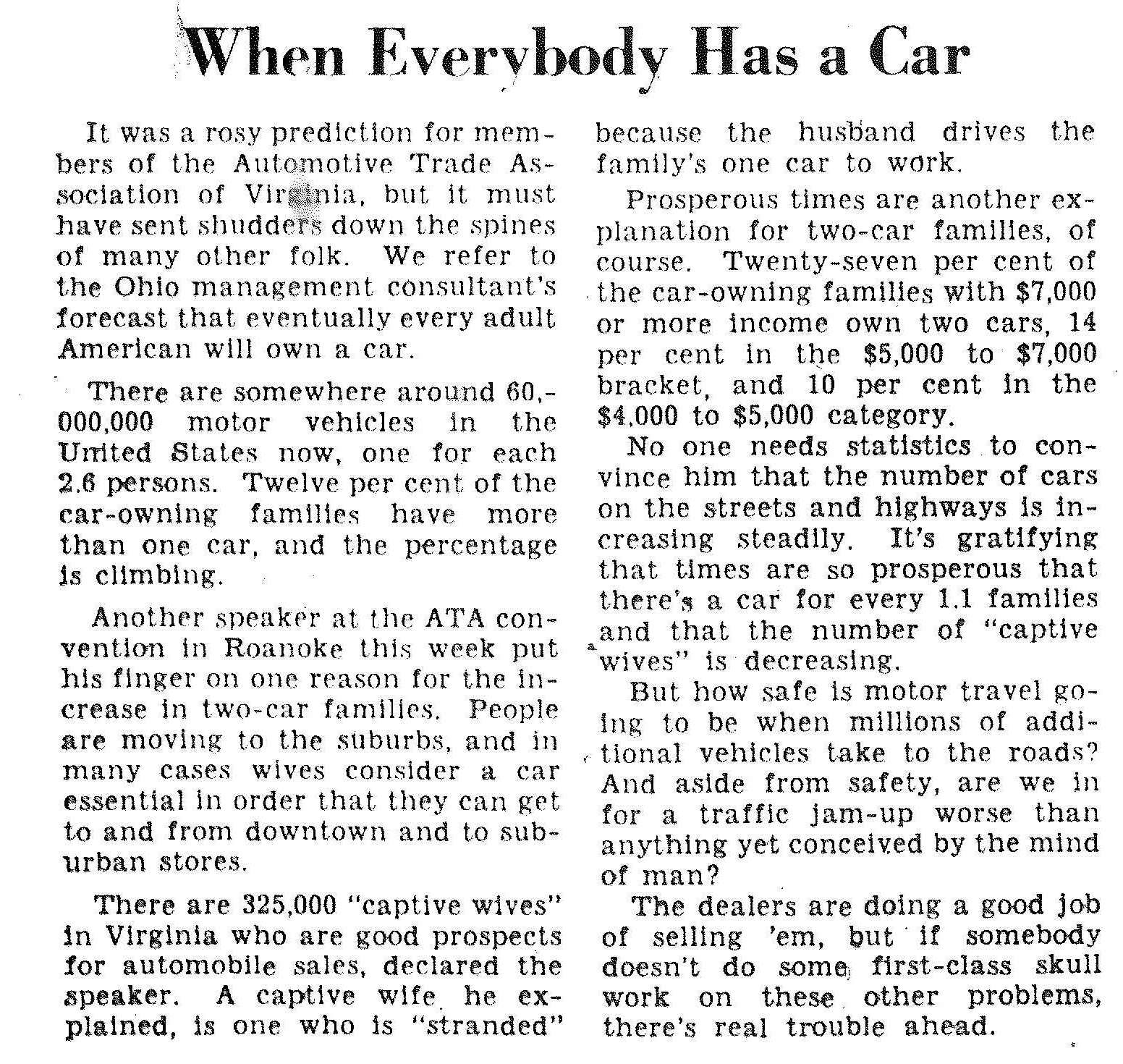
On Monday Nov. 14 1965, the Richmond Times-Dispatch published an article in the opinion section. It reads,

In the 1950s and 60s, members of the automobile hegemony often made grand statements. I’m amazed that even in 1965 this one sounded like a bad idea.

The Rose Park

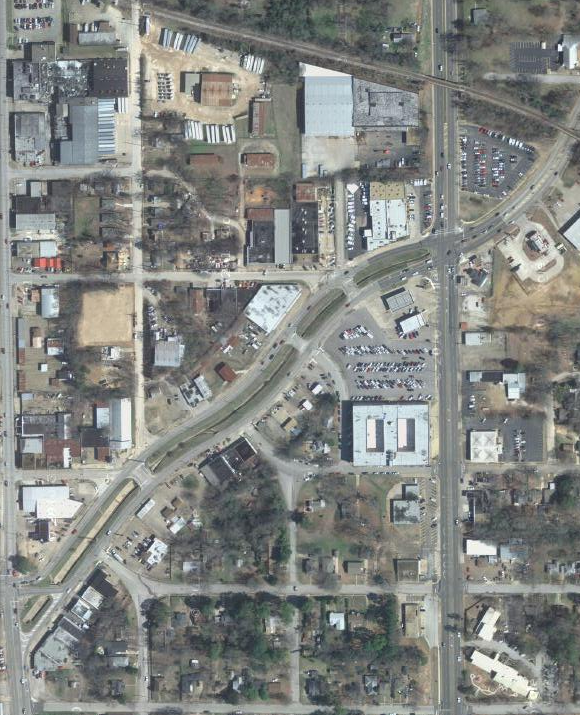
Look at the image below. What do you see?

I see a rose.

The stem of the rose (S. Glenwood Blvd.) extends as a greenway belt from the bottom left corner toward the upper right. It curves along the stream in between the grass of the greenbelt. At the end of the stem, there is a parking lot in a shape that resembles a flower bud. It seems like a perfect fit for the Rose Capitol … especially considering it’s in The Rose District, my fictitious plan for the area of land around the Rose Garden Complex. The Rose Park would be the perfect way to say, “Welcome to Tyler, we like roses a lot.” Since we pretty much control the commercial rose industry in the USA … I’d say roses like us too.

The Rose Park is the perfect way to welcome visitors into this city that has been celebrating the rose industry for decades. As you drive into Tyler on Glenwood, the road is suddenly transformed into a tree-lined parkway with a creek running down the middle of it. Brick sidewalks run along this parkway as it wanders past the junk shops and the Cotton Belt Building. The sidewalks of this parkway then ends with a crosswalk across the intersection that has been rebuilt to accommodate a larger number of walkers and bikers. The bike/ped crossing leads across the intersection into the parking lot that has been transformed into a park of flowers. From the sky, the stem and rose form a clear picture of the city’s identity. From the road, drivers get a glimpse of the park and begin to feel like they have formally entered Tyler.

The Rose Park should be a part of a bigger network of trails and parks in the Rose District. These would all make this an area of the city that is accessible, functional and proud. In it’s current form, this is just a road and a parking lot. But in a few years it could be a purposeful use of space and an excellent entry to this city.

Check out my other Tyler projects at my Tyler, TX page.

Connecting the Dots: Intro

Imagine if Tyler decided to take a few areas, increase their eminence, and connect them to each other. My latest concept, Connecting the Dots (C-T-D), outlines a long-term process of public and private investment that I’ll complete in the next three followup posts.

The basic idea is often called Transit-oriented development. It’s the idea that we need to begin considering land use and transportation as one unified city function. You see, for the past century or so we have built our cities without considering how people will travel  because access to a car was generally assumed. And, I might add, those without cars were not usually considered valuable (i.e. profitable). Cities have grown rapidly and died gradually with this sort of development because 1. The roads cost too much, 2. New developments make older ones obsolete, and 3. New developments often have difficulty maintaining lasting significance past their prime. This paradigm is the Gander Mountain, it’s the church my family goes to, it’s the Hollywood Tyler Rose theater, and it’s the majority of this city.

But it wasn’t always this way. There was a brief time in history somewhere between horses and cars that we travelled on fixed tracks. During this time, (often) private corporations ran street cars through a partnership with municipalities in order to provide transportation for locals or visitors when they entered the train station, “Welcome to Richmond.” Now, it seems that the main city function is to facilitate transportation through the building of roads rather than to provide transportation for the general public. “But,” you say, “Tyler has a bus system already.” Yes it’s true, but in this post I want to argue that the bus system has not succeeded in unifying our city. Besides, we don’t have many significant areas to visit. What we have is a lot of stores, schools, restaurants and other businesses scattered over 49.3 square miles of asphalt, concrete and St. Augustine grass. Where, I wonder, is Tyler in all of this?

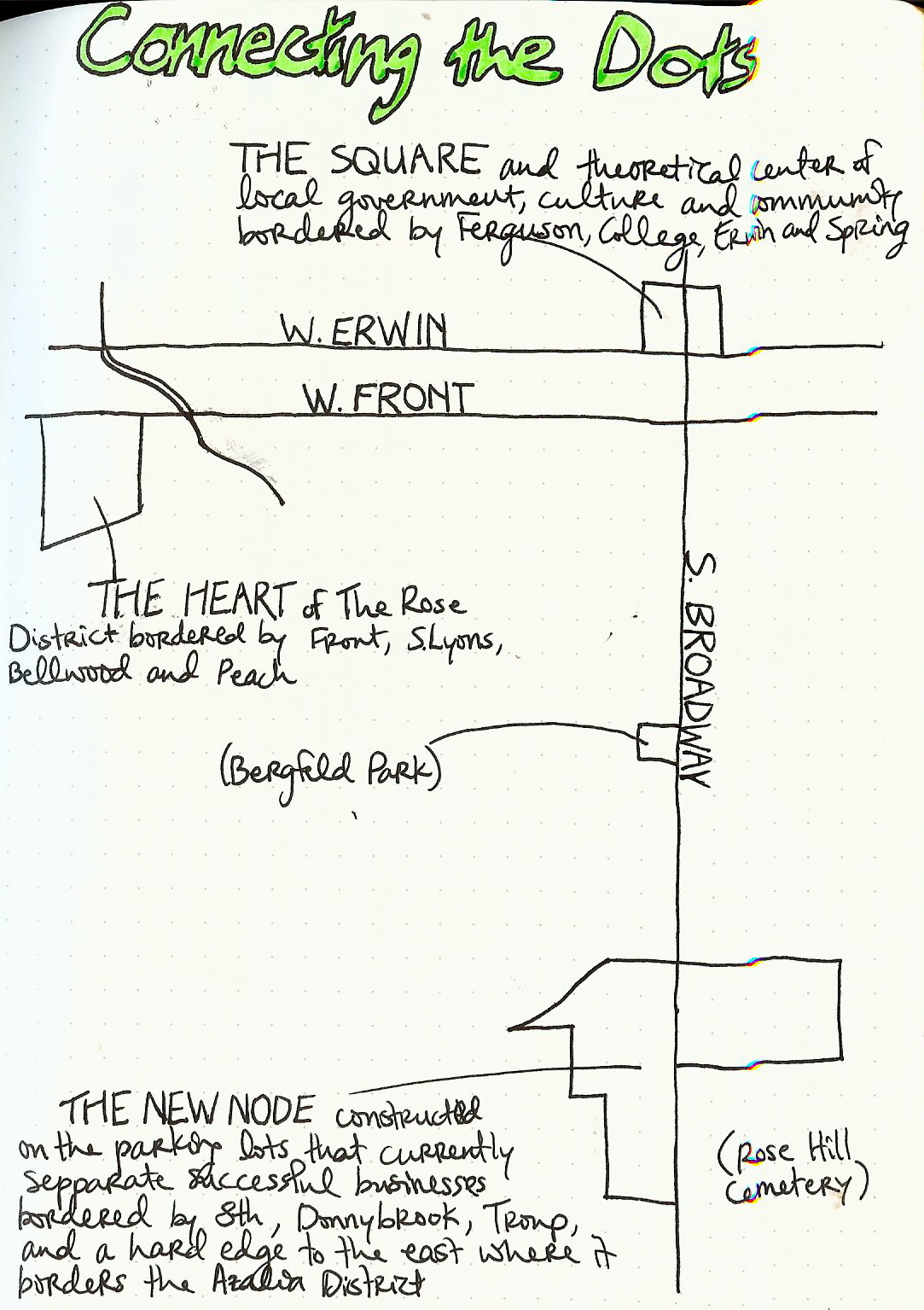
C-T-D seeks to revisit that earlier era of development for a 21st Century application. I have decided to start macro with this first piece (perhaps a look at Tyler 10 years down the road) then followup with more micro concepts for each individual node that I’ve proposed: The Rose District, The Square (with my Urban Valley), and a New Node that I haven’t named yet (ideas?). Each of these locations will be connected to each other with complete streets. This will also provide an alternative to cars and increase their viability as destinations. Completing streets will finally reconnect our asphalt to our buildings after decades of disconnected drives. Also, a recent report promoted by Smart Growth America shows that sidewalks and bike lanes increase the economic vitality of a region. That means more jobs! Eventually, we would add light rail trains (or BRT) to these streets in a circuit in order to properly move citizens from one location to the next.

I personally prefer light rail (yes, in Tyler) because it makes such a statement of  commitment to a given space. Light rail is also not as stigmatized as busses. Besides, it’s just plain cool. Check out the loop (below) I’ve devised for the light rail and complete streets:

Of course, in order to connect the dots … we first need dots to connect. This process involves developing three high-density, mixed use, cool (this is not a joke), and interesting nodes. These nodes are special, they have names and unique characteristics and an eminence that draws people to visit.

Check out my other Tyler projects at my Tyler, TX page.

P.S. I recently returned from a trip to Seattle and Portland and I brought back ideas, the book 101 Things I Learned in Architecture School,  and a Leuchtturm1917 journal with dots instead of lines. Let the games begin.

Gallery

C-T-D: The Rose District

This gallery contains 1 photos.

The other night I couldn’t sleep because I kept thinking about this one section of Tyler. The latest iteration of the city within my mind is a revision of a section of Tyler which can be accessed via Google maps … Continue reading