
Tag Archives: education

The Enrollment Cliff and the Silver Wave

I recently read an article about three colleges in Virginia that are showing signs of financial trouble. Apparently the “enrollment cliff” is set to begin next year and all institutions of higher education in the US will be affected by a shrinking domestic applicant pool. Some Virginia schools like Sweet Briar College have threatened closure and others, including HBCUs such as St. Paul’s College, have ceased operations.

The article reminded me of an idea I’ve been mulling over for at least a decade: that colleges and universities could somehow incorporate retirement communities into their campus life. While the enrollment cliff approaches, the Silver Wave (or Tsunami) is already over a decade in and will increase in the years to come. By 2030, there will be nearly a billion people over the age of 65 worldwide – by that same year, older Americans will make up 21 percent of the population.

This post is more of a brain dump, but I do hope to do more research, look into case studies, and hopefully plan some field trips to consider the different aspects of an intergenerational college campus. The following are some potential positive outcomes I’ve considered over the years.

  • There are obviously incredible financial benefits to building retirement communities. Baby Boomers will need places to live and they have the wealth and benefits to afford high-quality options.
  • Retirees will have the benefit of living in a vibrant place full of enrichment opportunities including
    • Cultural events
    • Continuing education
    • Sports
    • Dining options
    • Wellness facilities
  • Retirees could elect to be buried on campus in a cemetery or columbarium, a beautiful location where they could be remembered and visited
  • Retirees could serve in a number of capacities on campus
    • Formal and informal boards for oversight
    • Advisers for student organizations
    • Mentors for students
    • Serve in the career center based on their professional experiences
    • Volunteer in the community
  • Students from many different disciplines could benefit from having older neighbors
    • Psychology students would benefit from their research being more diverse in terms of age
    • History students could practice interviews and gathering personal narratives and incorporate first hand sources, artifacts, and perspectives into their research
    • Students in the medical and allied health professions would benefit from practical experience volunteering with community members that have health needs
    • Business students could do market research to understand the needs and desires of a growing consumer population
    • Philosophy students could consider the meaning of life with people who are near the end of it
    • Biology students could study their bodies after death to learn about degenerative diseases
  • Colleges and universities could bring a new and innovative option to the market
    • With a commitment to diversity and inclusion these communities could be safe spaces for individuals at the end of life
    • With their beautiful and walkable campuses, colleges would be the ideal setting for active, enriching retirement life
    • With their endowments, colleges could invest in all sorts of solutions to improve quality of life for residents in ways that aren’t available to existing retirement communities
  • There is enough demand for retirement communities and the associated labor that institutions could even transition into “work college” models like Berea, Warren Wilson, and others to reduce or remove the need for tuition

While writing this post I learned for the first time that there is a project underway to “reimagine” the empty campus of St. Paul’s College which seems exciting. A non-profit, SPC4LIFE, is organizing to purchase and reopen the college in some capacity and their mission, “creating an equitable, family-based academic environment,” seems to align beautifully with a multi-generational campus design.

Ever since St. Paul’s College closed I’ve been imagining it as the perfect location to try something like this. It’s only an hour outside Richmond and only a little farther from Durham which seems like a good location – inexpensive and accessible. One of my favorite aspects of the college campus is how integrated it is with the town of Lawrenceville, a historic and walkable area with amenities for residents to enjoy. A lot of the town appears to have been demolished, but there might still be enough of a historic core to inspire rezoning if needed and future dense, mixed-use developments.

I am definitely going to follow along with their progress and I am going to plan a visit some day to see the town, the campus, and imagine what it could all look like with some vision and a lot of work.
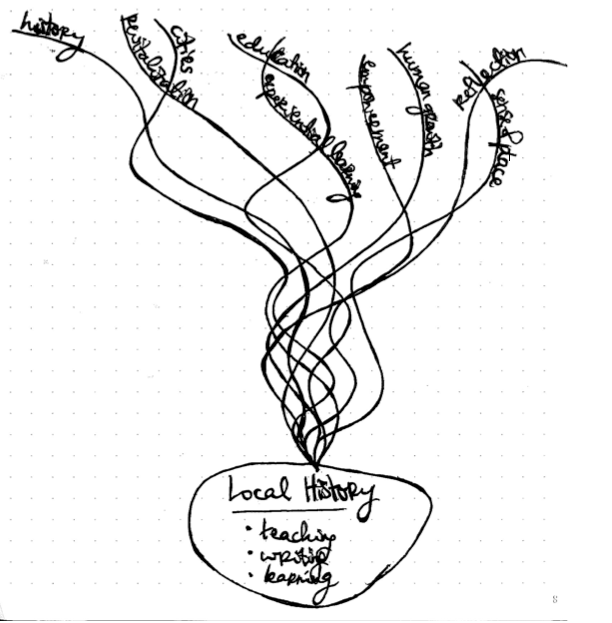
Career Brainstorm

While flying back to Richmond a few weeks ago, I drew up a brainstorm for my future. All of the sudden, it became clear that local history is something that I could champion for a lifetime. It’s not really a brainstorm. It’s an observation of my past and a hope that, with a lot of work, all of my various interests might be resolved into one goal:

Future Brainstorm

Reflex Relearned

Over the course of the past year, I have written and thought about the effects of stress and trauma. I have wondered about how the major traumas and micro traumas might have affected how we inhabit our communities and the ways in which we react to the stress of life. Yesterday, I listened to the This American Life podcast, “Back to School.” It’s a very well-done take on early childhood development and what some believe teachers should be expected to “actually accomplish” in their work.

In it, there is an amazing conversation about the affects of stress biologically and the long term affects of stress psychologically. What does it do to the brain when each day there is a stressful event that triggers a flood of adrenaline? How do humans develop when they are always tensing up, afraid of the unwarranted (and unpredictable) verbal or physical lashing? What Ira Glass says, is that, “When the brain does something over and over and over again, it creates pathways that get more and more ingrained.” The fight or flight response thus becomes one of the primary responses in the affected brain and one of the primary responses in the child’s life. Fight or flight.

If you’ve ever been a teacher this is perhaps not news to you. You might have experienced one of these two responses as you placed a worksheet on a student’s desk or passed out a graded quiz. You may have seen a student place his or her head on the desk during class because the numbers on the page might as well be written in Chinese: their brain is not connecting. Glass shares that over time the adrenaline rush during these traumatic moments stunts the development of a section of the brain called the prefrontal cortex, “where a lot of these non-cognitive skills happen — self-control and impulse control, certain kinds of memory and reasoning. Skills they call executive functions.” Without these executive functions, students cannot sit still, engage information, and reason a thoughtful response.

There are even ways that I can see these pathways in my own brain and and how stress has affected my own experience. How I interact with some sorts of people, how I believe I am perceived when I walk into a room, when and where I feel confident. All of these have developed over years through a series of unstructured, unplanned, semi-traumatic events that have brought me to this point in time. Granted, these traumas are minor in scale in comparison to many. I have been blessed to grow up in a world where I felt safe to play outside and to spend vacation with my relatives.

Still, as I grow up (however reluctantly) I am finding that I have these reflexes within me that emerge under certain types of stress. Because the prefrontal cortex is where a lot of non-cognitive skills happen, I am not totally in control of these responses. I can only be aware of myself and the ways in which I affect others in order to preempt my more negative, learned reflexes. Also, I believe that leaning into these harmful reflexes and embracing activities that may conjure up these responses (in a safe space) will allow me to reteach my brain new responses and to integrate new positive experiences into my identity. I can effectively relearn a reflex. This is is most commonly called therapy or, more simply, personal growth.

Below is a transcript of the excerpted conversation on the effects of stress. I highly recommend listening to the whole piece, but also take some time to read through and contemplate the conversation below. For me, it is a profoundly important take-away because it has everything to do with my current work as well as my life of personal evaluation. Enjoy:

“Ira Glass

But in addition to all the bad things that are likely to happen to them as adults, there’s also the effect that long-term stress has on them when they’re still kids, especially on their brains and their ability to learn.

Nadine Burke Harris

If you look on the molecular level, you’re walking through the forest and you see a bear, right? So you can either fight the bear or run from the bear. That’s kind of your fight or flight system. Right?

Ira Glass

Right.

Nadine Burke Harris

And your body releases a ton of adrenalin, right? Which is your short-term stress hormone, and something else called cortisol, which tends to be more of a long-term stress hormone. And this dilates your pupils, gets your heart beating fast. Your skin gets cold and clammy. That’s because you’re shunting blood from anywhere that isn’t absolutely necessary to the muscles that you need to be able to run from that bear.

The other thing that it does– now, you can imagine that if you’re about to fight a bear, you need some gumption to fight that bear, right? So it kind of shuts off the thinking portion of your brain, right? That executive function cognitive part. And it turns on the real primal aggression and the things that you need to be able to think that you’re going to go into a fight with a bear and come out on the winning side.

Ira Glass

Yeah.

Nadine Burke Harris

And that’s really good if you’re in a forest and there’s a bear. The problem is when that bear comes home from the bar every night. Right? And for a lot of these kids, what happens is that this system, this fight or flight response, which is an emergency response in your body, it’s activated over and over and over again. And so that’s what we were seeing in the kids that I was caring for.

Ira Glass

When the brain does something over and over and over again, it creates pathways that get more and more ingrained. So this kind of repeated stress affects the development of these kids’ brains. And especially affected in this situation is a specific part of the brain that’s called the prefrontal cortex, which is where a lot of these non-cognitive skills happen– self-control and impulse control, certain kinds of memory and reasoning. Skills they call executive functions.

If you’re in a constant state of emergency, that part of your brain just doesn’t develop the same. Doctors can see the differences on brain scans. Dr. Burke Harris says that for these kids, the bear basically never goes away. They still feel its effects even when they’re just trying to sit there quietly in English class.

Nadine Burke Harris

And if right at that moment someone asks you, “Oh, could you please diagram this sentence? Or could you please divide two complex numbers?” You’d be like, what are you talking about? And so that’s what we were seeing in the kids that I was caring for, is that a lot of them had a terrible time paying attention. They have a hard time sitting still.

Ira Glass

And you hear about this in lots of schools. Head Start teachers in one survey said that over a fourth of their low income students had serious self-control and behavior problems. Nadine Burke Harris says that it’s true for her patients, the ones with adverse childhood experiences like neglect, domestic violence, a parent with mental illness or substance abuse.

Nadine Burke Harris

For our kids, if they had four or more adverse childhood experiences, their odds of having learning or behavior problems in school was 32 times as high as kids who had no adverse childhood experiences.”

Performing the Vantage

My last post described the classroom as a vantage from which we learn about the world. Tonight, I don’t think I’ll be able to go to sleep if I don’t write about my next thought: Performing the Vantage. I want to talk about how we can perform this theoretical space and what that might mean for my work.

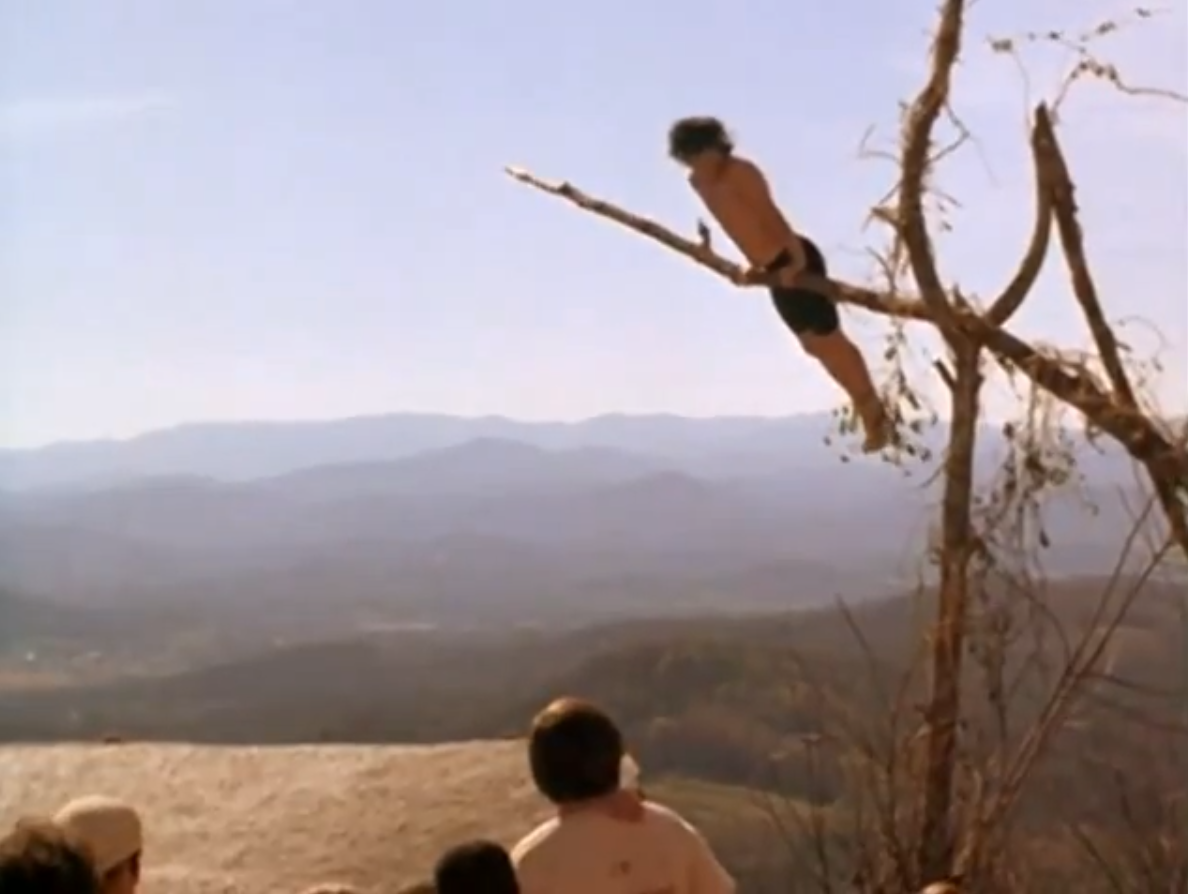
First of all, I have to admit that some days I feel a little crazy. At first this was a little unsettling, but now I’m totally comfortable with the fact that some days I learn more than I teach. These are the days that I feel like Ben Stiller as Tony in the legendary movie “Heavyweights.” To the right is a scene from this movie where Stiller is certainly “performing the vantage.” but it doesn’t help the fact that he’s emotionally unstable. His character understands the idea of the mountaintop experience, but doesn’t realize that it takes more than just a mountaintop to inspire change. It’s not what happens on the mountaintop, it’s how life on the ground is transformed as a result. So performing the vantage can’t become more important than building relationships with the people in our lives. Then, when the moment is right, speak as if you are looking out over the vast open spaces and share your wonder and amazement with the people around you.

I actually believe that if I pretended that I was on a mountain these moments would be more significant. In some ways, this is how I trick myself into believing that I’m not just in any other room … that this room is somehow more conducive to learning. Of course, every class will require a different level of discipline and correction. Some will never reach the moment of wonder when the mountaintop can be reached, but I have been thankful for these moments in the past two weeks and I look forward to improving my ability to notice them in the future. The more I notice these moments, the more I will be able to capitalize on their emotional impact.

What are some potential shortfalls to this perspective? In my post, “A Vantage,” I compared teaching to Mufasa showing Simba his kingdom. This metaphor helps me to further explain the potential shortfalls of performing this vantage in the classroom:

Mountaintop Shortfall #1: Basically, they might not believe that you’re Mufasa. They might not believe that you have any right to show them the kingdom. They might believe that you don’t have anything of worth to give them. They might not appreciate you. They might forsake their inheritance.

Mountaintop Shortfall #2: You might not believe that they are Simba. You might not truly believe that they deserve to inherit the kingdom that you have seen. You might hope they drop out so you don’t have to put up with them any longer. You might forget that you were once Simba.

Mountaintop Shortfall #3: The classroom lingers on the mountaintop for too long. We were not meant to settle into our vantage. Instead, it is meant to be the underlying goal that we reach it every day in order to remind ourselves why we’re there. From the ground we learn how to work; from the vantage we are reminded of its ultimate purpose.

I have experienced all of these shortfalls in just two weeks of class … and I’ve also seen the positive results of the vantage. I suppose those are the moments that I “live for.” I am a beginner to this whole teaching thing so I’m just trying to understand what its all about. As I read in Teaching with Love and Logic, “Great teachers are experimenters.”

Base camp here we come.