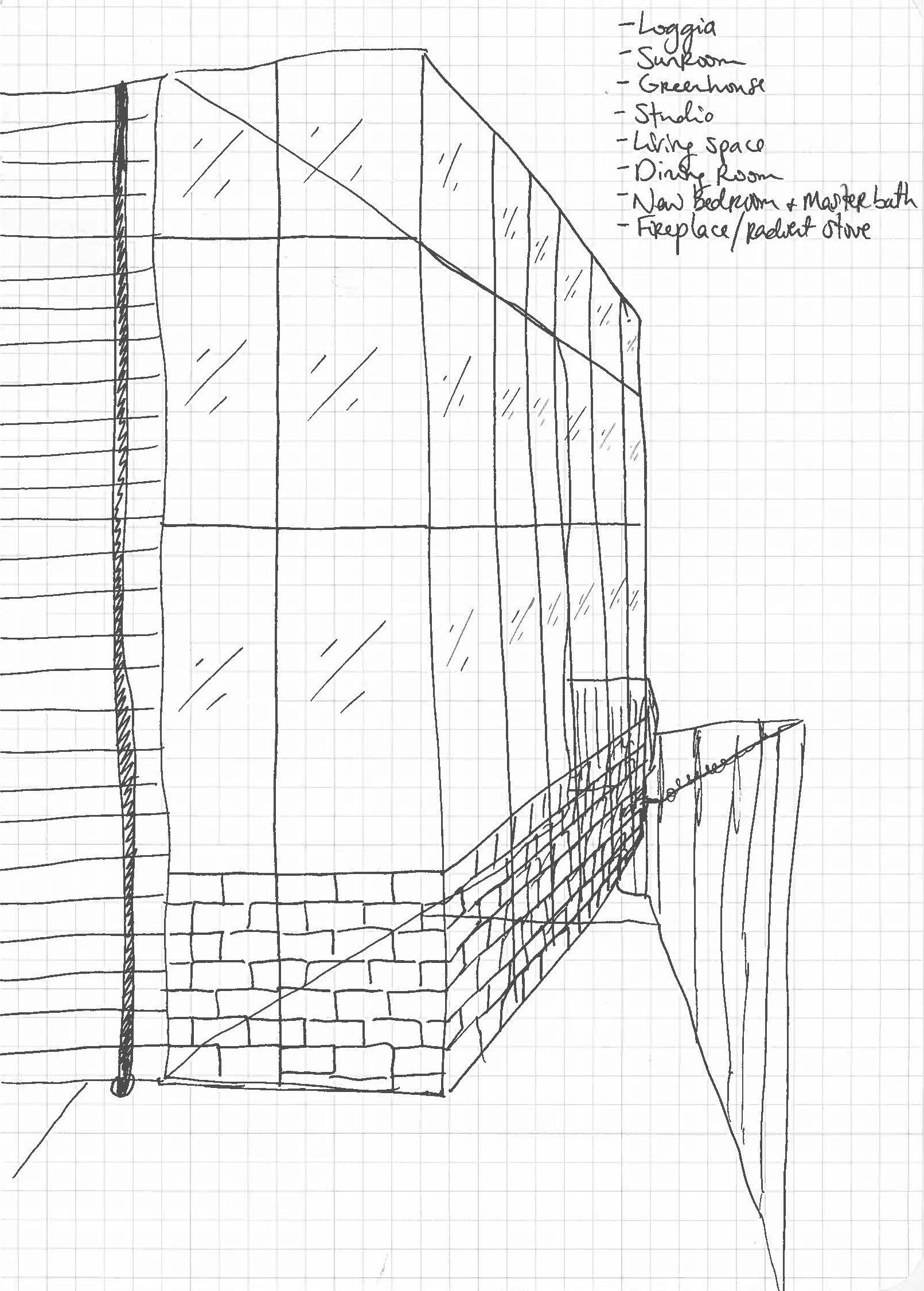
I was going through some old planners this morning (trying to clear out as much clutter as possible these days) and I found this drawing for a house we used to live in. The house is pretty small so I wanted to add on a space the length of the back of the building to serve as a flex lounge/dining area with a wood stove.
The house has an unloved gravel area in the back that would definitely not be missed. The design would have been terrible for insulation with all that glass (on a north-facing side no less), but I still like the drawing and thought it would be fun to save and share.
For the last week or so I’ve been thinking about the Celtic holiday of Samhain. I don’t know much about the Celtic holidays, but I read a book once about a home called Bealtine Cottage and at the very least the idea of Bealtine planted a seed in my mind.
After some deep dives, I’ve learned that Samhain is essentially the “pagan” holiday that Catholics co-opted when they created All Hallows Eve (and All Souls, etc.). In a further twist of colonialism, it is also basically the origin of Dia de los Muertos – a holiday some see as a Catholic invention/amalgamation of existing rituals and beliefs.
Anyways, a witch on Instagram made a video saying that tonight is actually the best time to set resolutions and to plan for the work ahead. This night marks the end of the Celtic year and the beginning of the “dark half” of the year. This is a time when we are inside more, when gardens and farms have begun to rest. We often use this time to focus inward and draw close to friends, family, and partners.
With all this energy in the air, I decided it was time to take some small steps of preparation. With the help of our kids, we cleaned out several bags of toys and started to organize their play area. That felt like a nice small win. I am thinking about the fact that I’ll be inside more soon and feeling a desire to organize and repair more in general – there are so many projects that weigh me down more than I even realize.
I also decided to start the new Life Designer workbook from Intelligent Change. I bought it before the Samhain connection, but soon realized that it would be perfect for this (new) new year.
At it’s core, it’s a workbook to plan the next ten years of my life. On October 31, 2035, I’ll be 47 years old. I actually started crying just typing that sentence.
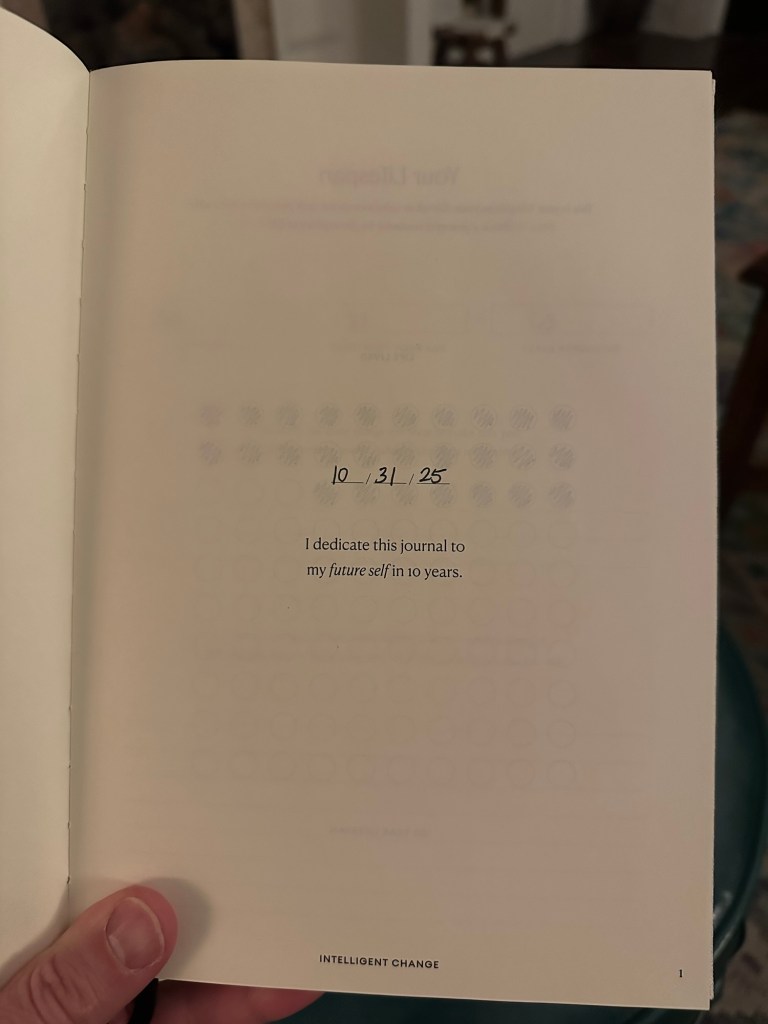
Oh, I also cried when I filled in this dedication page:
I really do not want to get older – I don’t know how else to say it. On the other hand, there have been so many days in my adult life that I’ve just wanted to be over so that I can sleep again.
I know that I have to fix my days before I can fix my years. And since I can’t avoid age, I can’t avoid work, I can’t avoid relationships, hopes, disappointments, responsibilities, etc., I know that it’s time to start thinking about what I want to build on the years I’ve lived so far. Because “the next ten years” are already here.
With my fear of getting older, it was encouraging to fill out this chart of the years that I’ve lived so far and see how many I presumably have left.
Even if I live to be 70 or 80 I still have a lot of life ahead of me. The first time I posted this page I did it wrong so this is a new photo. Also, I decided to black out the years that I was in the closet. I cried for a moment when it sunk in that I’ve only lived around 15 years of life not in the closet. Hiding took such a toll on me that I need to label those years differently. Also, being in the closet delays adolescence (like what a 15 year-old would be experiencing) so the past three years have looked very different than they would for someone who is not going through that.
I’ve only just started this workbook, and, based on the witch’s advice, I would like to finish it between now and the Winter Solstice. (update – I’m still working through it as of 1/20/26, but I’ll finish it when the time is right)
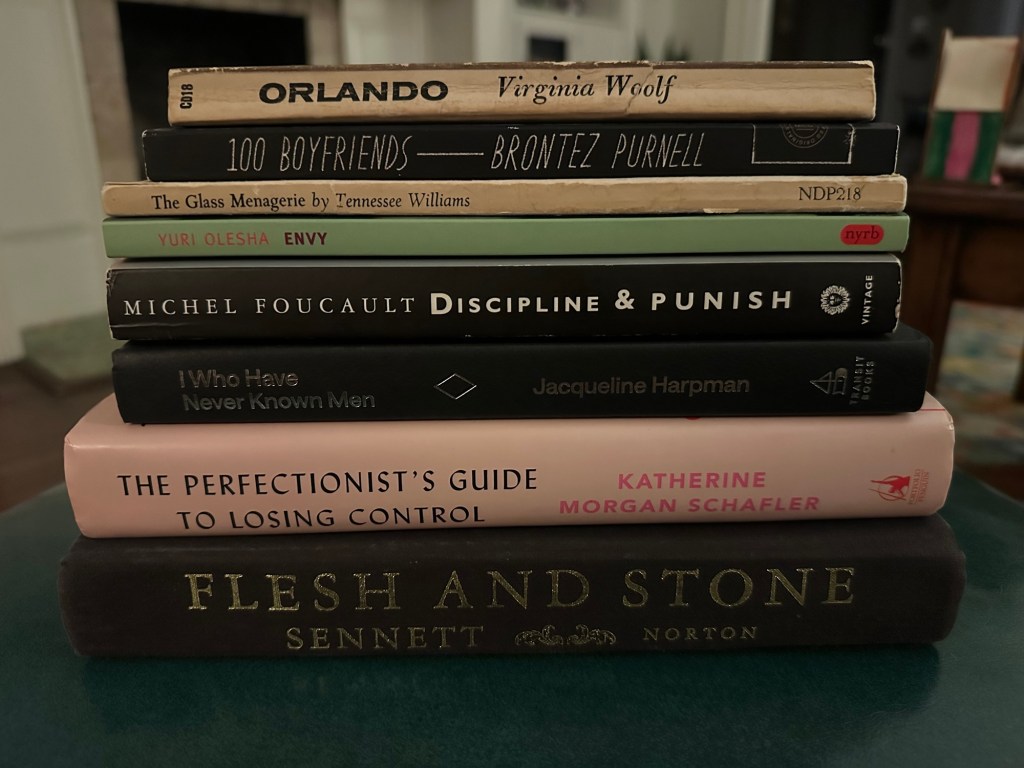
With the seasonal shift toward intentions, I also thought about books I might like to read over the next 12 months. I’ve pulled together a stack that I’m pretty excited about and replaced the one under my side table that has been sitting there for months (years?), mostly unappreciated. This new stack was chosen more carefully and I’d love to actually see the stack tick down as I read each one and the shelf empty by the next Samhain, 2026.
I started the Foucault and Sennett books around 2008 and 2011, respectively. I’ve only read the first chapter or so of each, but they have both been so influential to how I think about things that I’ve decided I’d like to finally finish them. Along with those two books, Orlando,100 Boyfriends, and The Glass Menagerie continue to round out my gay literature cannon. I Who Have Never Known Men and Envy (a personal problem, unfortunately) are two foreign language books I’m looking forward to. Finally, The Perfectionist’s Guide to Losing Control, a book I started during a hard time last year and have decided to pick back up during a new season of loss.
So much of this post may seem like I am trying to control my life, but I really do want to lose control more than anything. I want to let go of legalism, perfectionism, and self-criticism, especially. I am not going to feel like a failure if I don’t read all these books or achieve the life I envision exactly. I just know that there are some things in my life that almost never feel like work (even when they are work). I desire/intend to do much more of the work, to spend time with the people, and to inhabit the places that give me that kind of energy over the next 40 seasons of change.
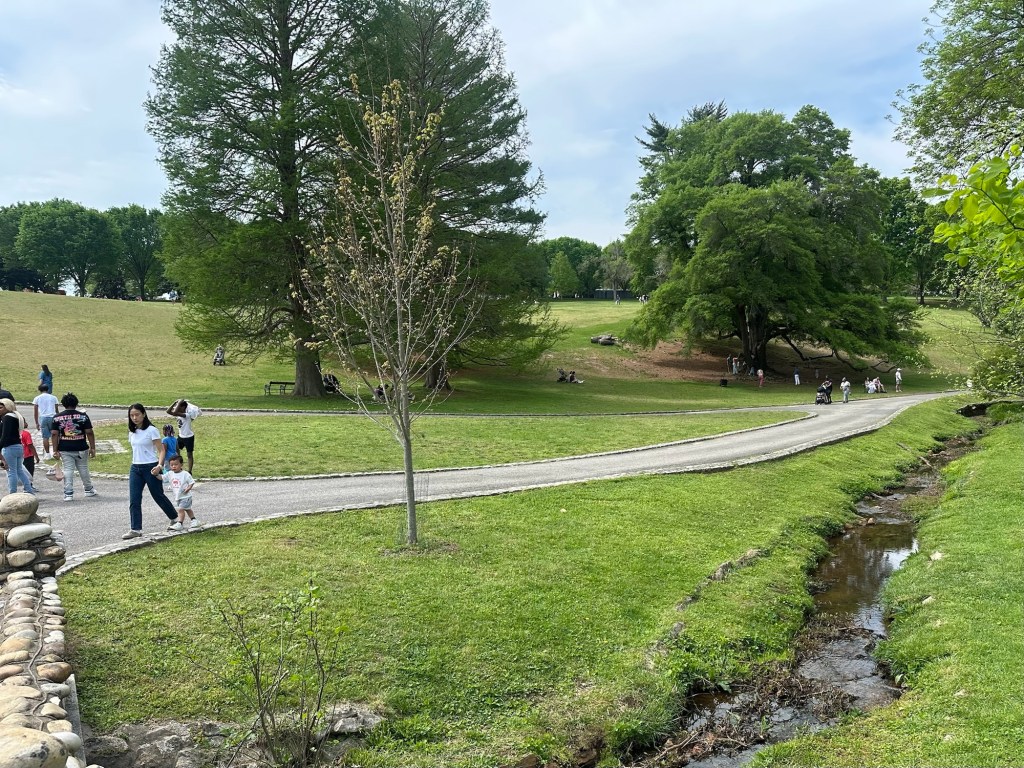
During a recent visit to Maymont I noticed a small island of grass that I can’t stop thinking about. It feels like the perfect opportunity for a small meadow of perennials at the intersection of the more formal Maymont Mansion and more “natural” Robins Nature Center and Maymont Farm sections of the property.
The long, tear-drop shaped island of grass is in the middle of the photo below, but of course I already have ideas for the area along the creek as well.
Compared to the yucca project, this feels somewhat realistic. I would need to borrow black tarps to kill the grass, enlist some volunteers to clear the area a month or so later, install plants collected from my garden, and spread leaf mulch in between. It would be nice to put a small stick and twine “fence” along the edge while it’s getting established as well as a “Prairie in Progress” sign and some educational materials about the benefits of these types of gardens.
The cost of this could be essentially free. Here is a list of plants I can think of off the top of my head that I would be able to contribute:
Anise hyssop
Echinacea / coneflower
Mountain mint
Showy goldenrod
Milkweed (1 or more varieties depending on how they spread)
Coreopsis
Panicled aster
Rudbeckia / black-eyed Susan
Rattlesnake master
Spiderwort
Wild garlic
Aromatic aster
Bee balm
Foxglove beardtongue
Groundcovers including violet and wild strawberry
While doable, it would still require a lot of work obviously. I would need them to commit to watering for the first couple of months after install and provide ongoing support like cutting it all down to about a foot off the ground in the fall, weeding, and continuing to add more plants. Still too much for me right now, but a really fun thought.
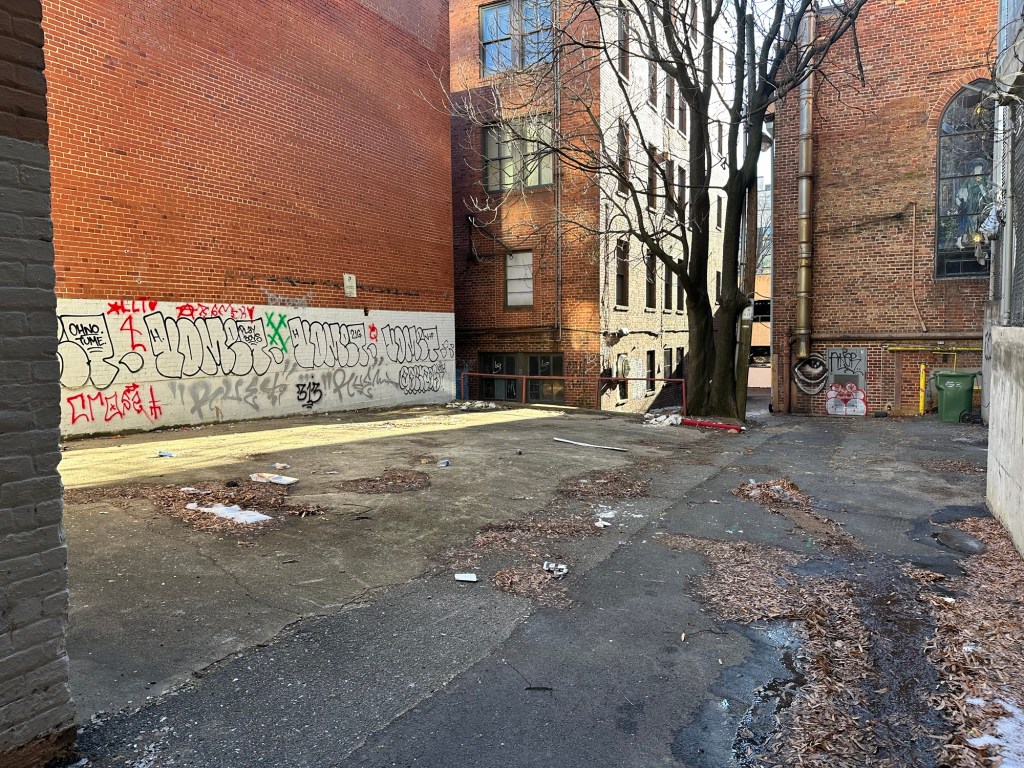
The other day while I was walking through downtown Richmond I stumbled on a small space with huge potential. It’s basically just a concrete slab, but what makes it special is that it’s located right in the middle of a city block. The concrete is connected to one building that forms an “L” around it. The area is accessible by three different alleys which all meet at the base of a somewhat beautiful, mature tree.
With some love, this could be a place to congregate just like the La Colombe near Logan Circle in D.C. The benefits of using these interior spaces is that they are quieter than the city streets and they are often cooler in the summer months because the buildings provide shade. They are cozy spaces, the diffused light is relaxing, and there is something charming about the irregular shapes. I love the surprise and delight of waking down an alley, turning a corner, and finding something you wouldn’t have expected,
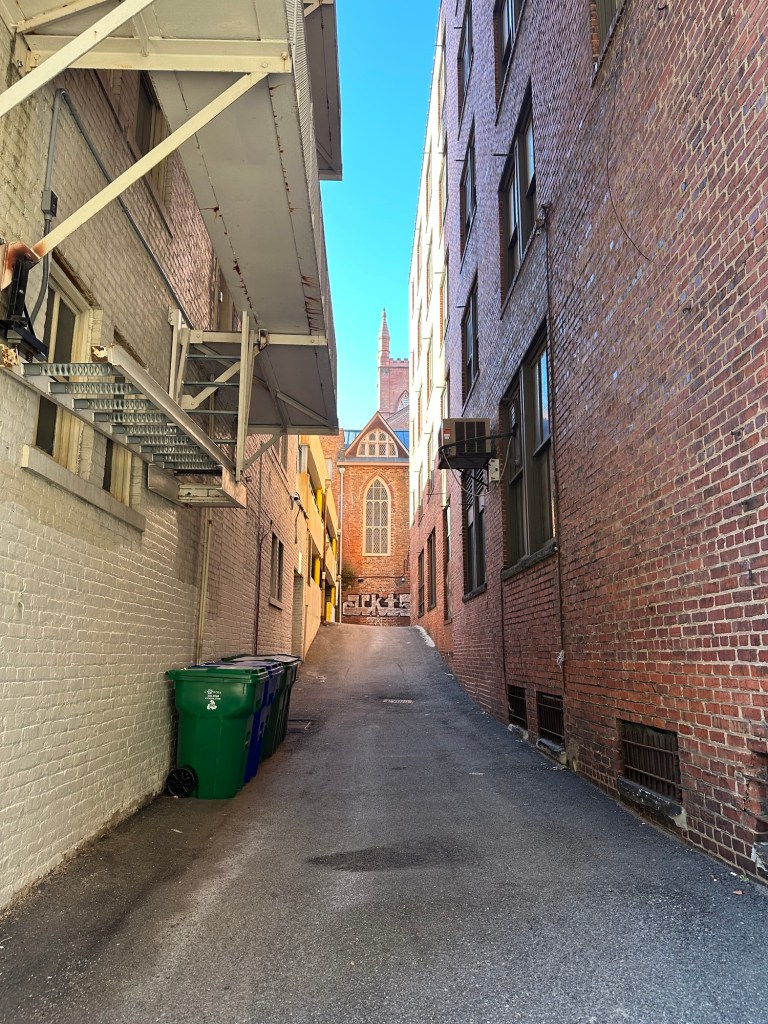
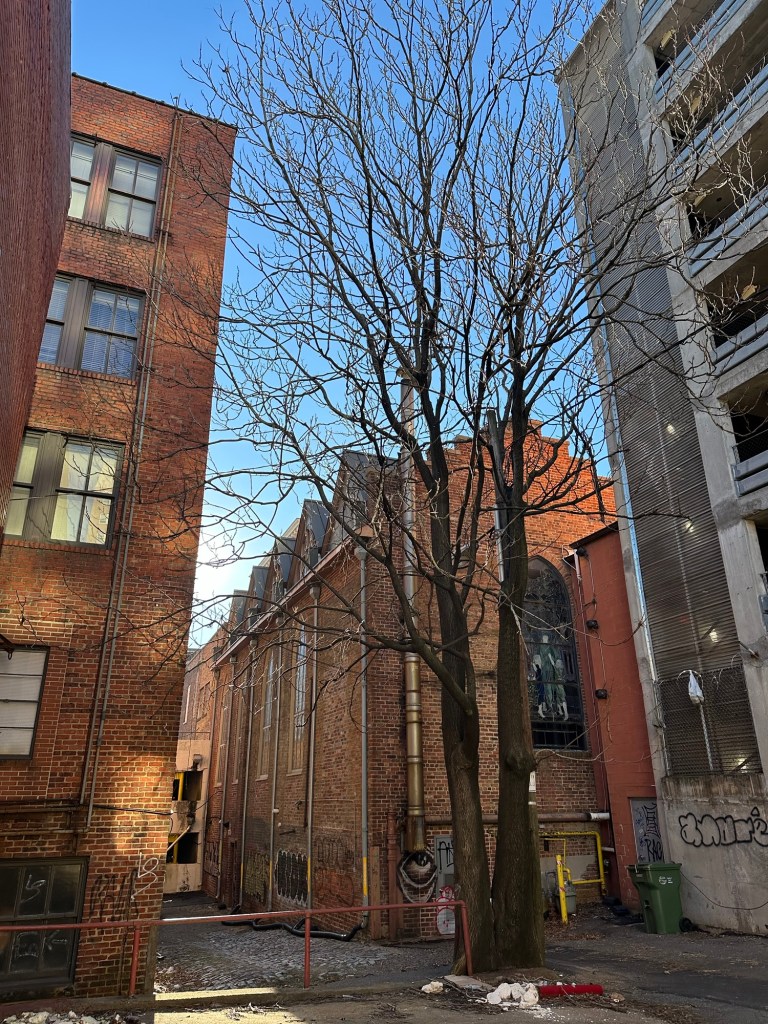
The approach that is most familiar to me (I actually worked and parked in the building to the left years ago) is below. I love the way the buildings frame the old window and steeple of Second Presbyterian.
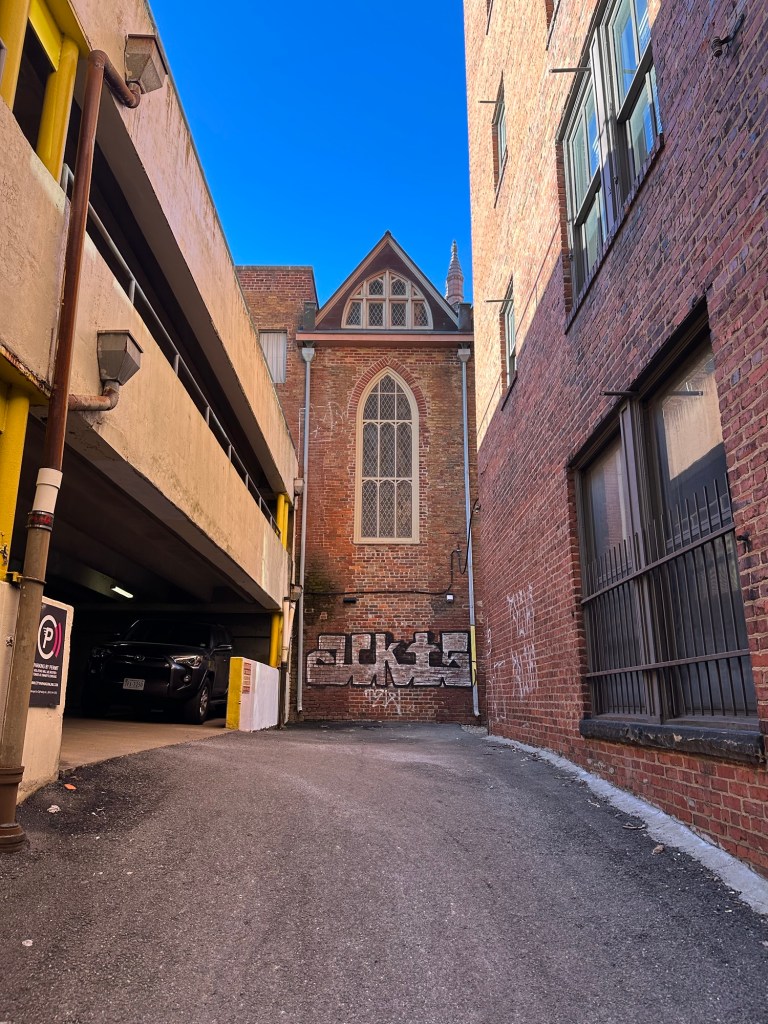
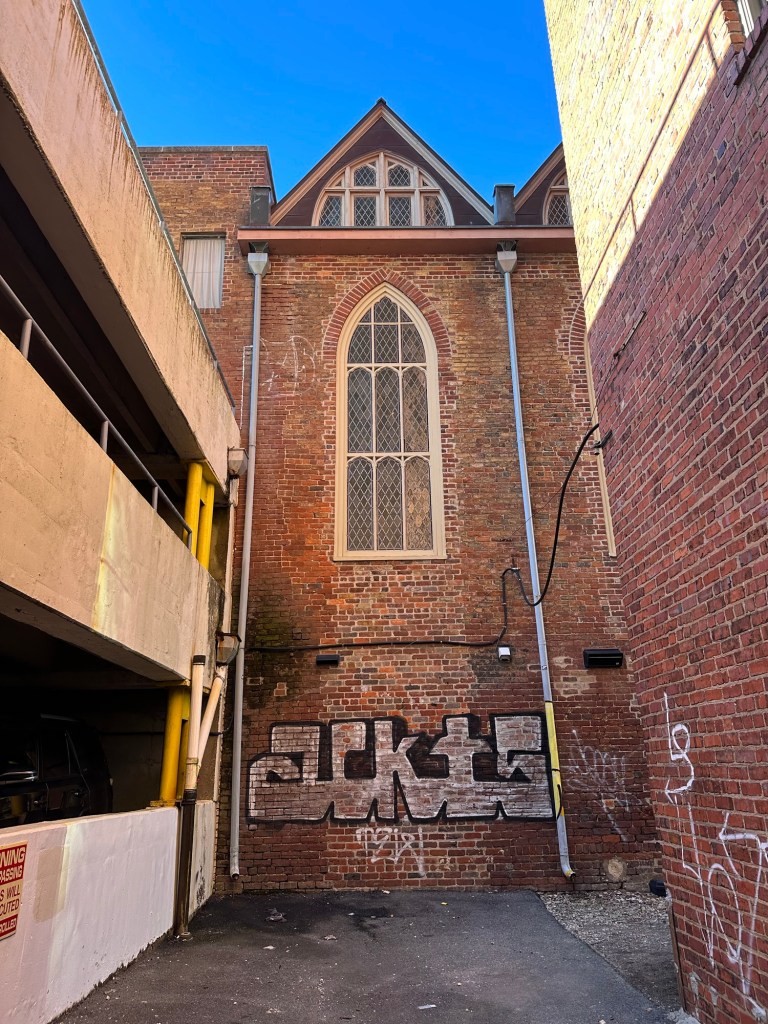
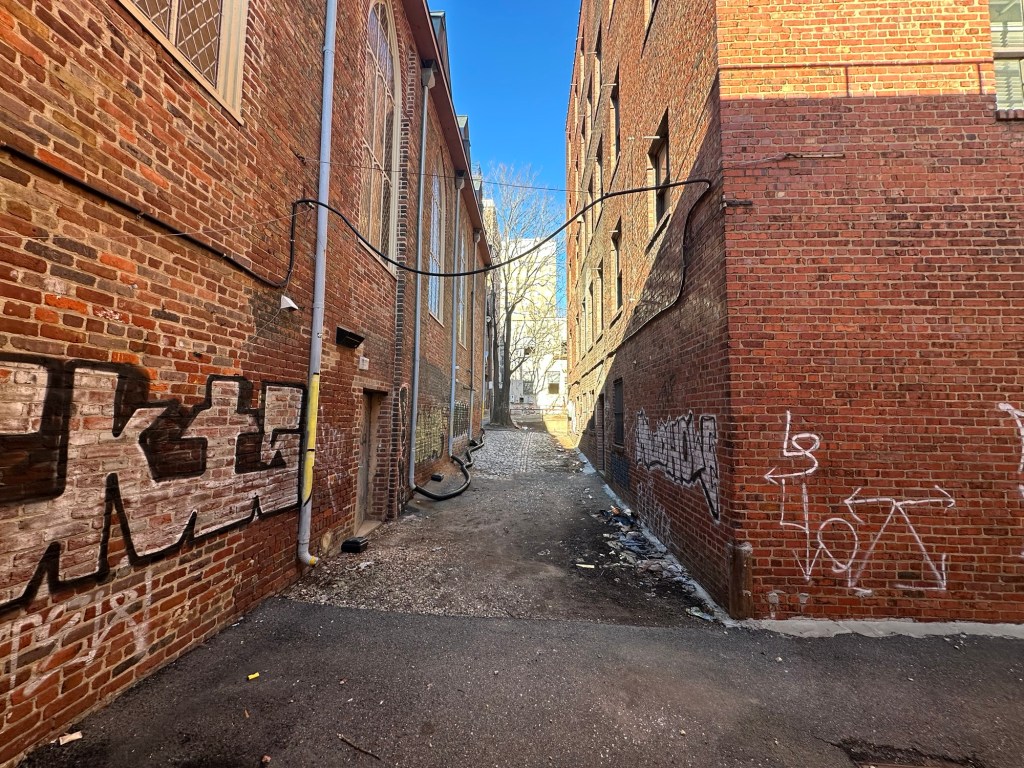
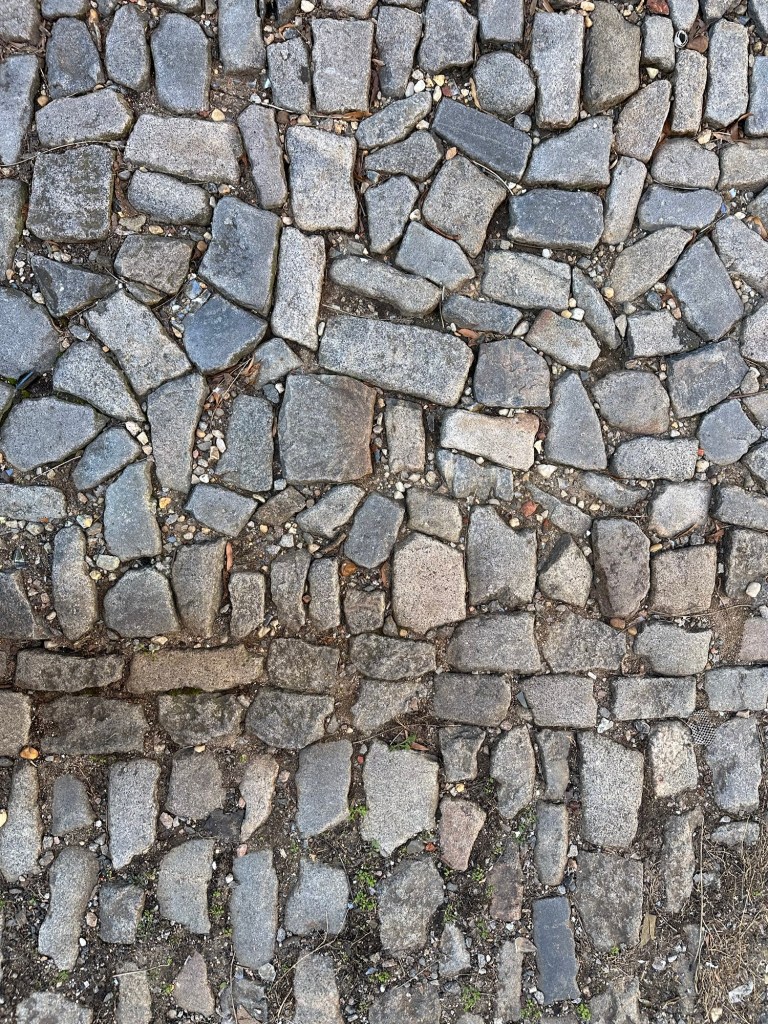
After you turn to the right, you start to get a glimpse of the destination. The area also starts to become more charming: the alley transitions to cobblestone, instead of a parking garage you have old brick and stained glass, and the tree is visible as well.
Despite being completely forgotten and unloved these granite stones are beautiful and the whole section would clean up very nicely.
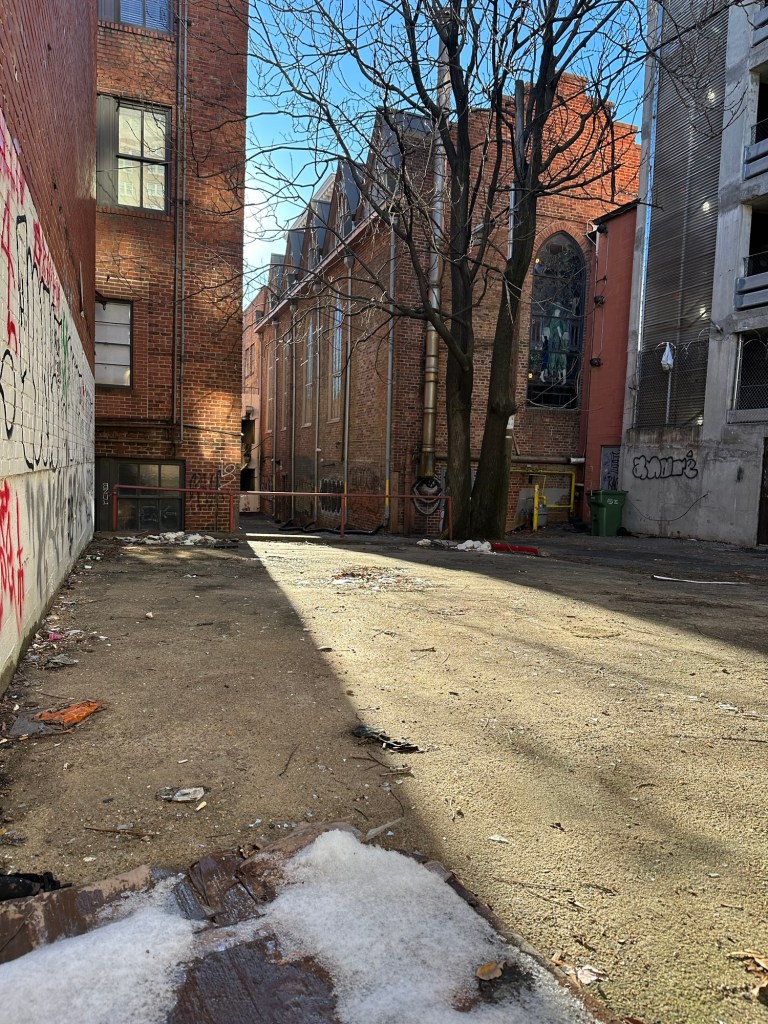
This is the view from the space that I’m interested in. I appreciate how much there is to look at even in this small space. It feels like the medieval section of a city: winding, ad hoc, dense, and built to the human scale. The tree would also provide shade in the summer and a beautiful accent.
Here are two views of the actual space.
I am so in love with this idea. I had a similar vision for a space in Tyler many years ago and still believe in the potential of this sort of retrofit to bring new life and charm to cities. Whatever zoning process that’s required should be fast-tracked. Whatever the building around this space becomes (it’s currently being renovated), this should be a cafe or similar commercial space, with bistro lights, live music, and otherwise completely transformed into a beautiful and charming refuge in the middle of downtown Richmond.
A few weeks ago I woke up with a lot of climate anxiety. I could hear rain on the roof of our house – rain that 50 years ago might have been snow or sleet. We had just returned from a trip to New York City where it had also rained on an unseasonably warm December evening. I had global temperature charts and thoughts about crazy weather stressing me out before I even got out of bed.
When I came downstairs, the first thing my kids wanted to do was play with toys that we brought back from the city. As a parent I’m used to suspending whatever anxiety or “grown up things” are on my mind to enjoy my kids in the moment. On this particular day I found myself playing with, of all things, Magic Snow. It really is pretty cool. You add water to this very fine powder and it grows into a fluffy snow that we played with for an hour or more before school. On the inside I was wondering if at some point magic snow would be the only snow left. On the outside I was laughing and enjoying myself and the simple joy of parenthood
Since that day, my five-year-old asked several times if we were going to have a white Christmas and whether it was going to snow at all this winter. My niece also recently asked her mom if it was going to snow this winter and when she heard it might not immediately said, “We have to compost!!” Sometimes parenting feels a little bit like the movie “Room” where you are creating a reality within the safety and coziness of your house, neighborhood, etc. On the other hand, while I do want to keep my anxiety to myself, I don’t want to try and keep reality out more than I have to. I want to start to bring in age-appropriate books and conversations about climate change just like I want to do with other complex topics. This experience also pushed me to focus on solutions rather than abstract fears and sadness for a lost planet that we haven’t even entirely lost. So, yes, I’m going to continue to compost and I want to start buying carbon offsets again. I’m probably going to buy a children’s book like Bright New World or one of these. While I read about a hopeful future to my kids I hope to start to believe it for myself.
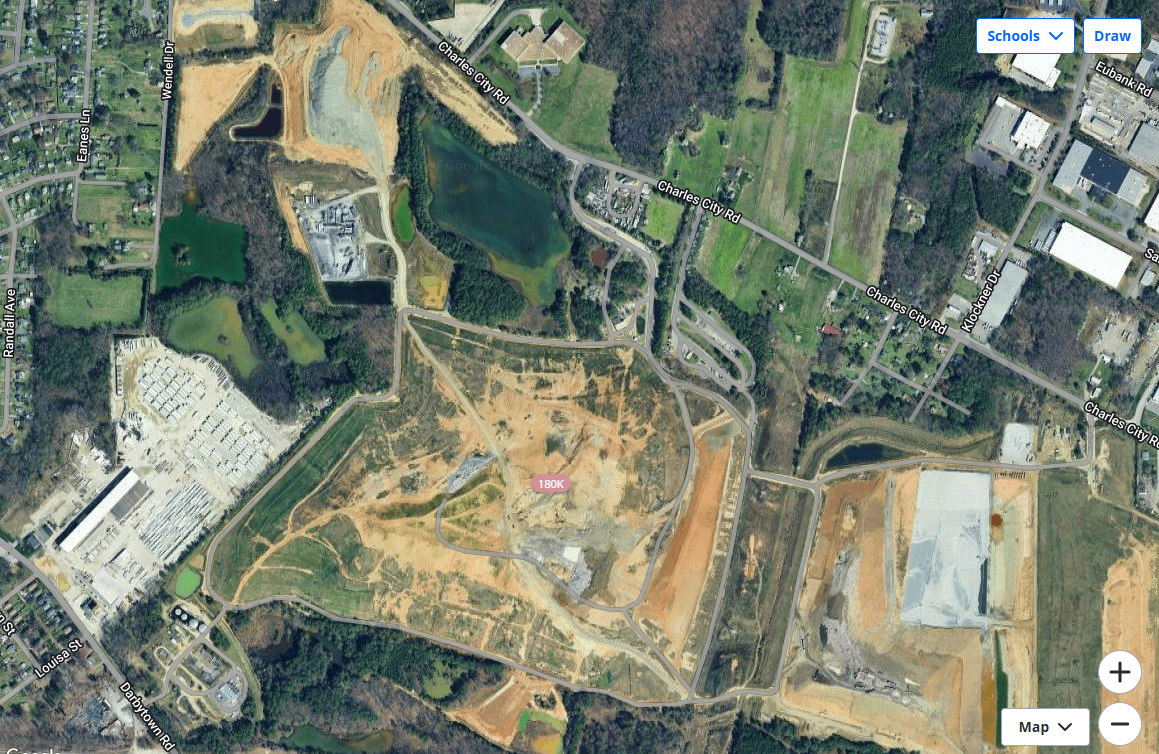
Yesterday morning I found myself dreaming about a plot of land for sale in East End Henrico County, just outside Richmond city limits. It’s 8.72 acres for $180K located very close to the center of the city and I think it would be an amazing chance to plant a pollinator meadow to restore the ecosystem and have it be managed as a park by Henrico County.
I’m imagining walking trails, giant woodland sculptures, and it might have some elevation that could be fun with a lookout tower at the top. The grounds at Glenstone would be a good inspiration. This plot of land looks like part of the East End Henrico landfill – I think the one that was shut down by Henrico County. I’m sure there are liabilities with owning a former landfill (environmental concerns, seepage, etc.), but I know it’s been done before and this could be a good chance to do it in the Richmond region.
I already emailed the Capital Region Land Conservancy, and I probably won’t go any further with the idea, but I wanted to at least post it here as a personal memory of the dream. At some point this is exactly the kind of restoration project I’d like to be a part of.
Update: I heard back from the Executive Director at CRLC and he told me that the information on Zillow was incorrect – there are actually only two acres for sale about seven miles west of the location – kind of bizarre. I still love the idea of course 🙂
I recently read an article about three colleges in Virginia that are showing signs of financial trouble. Apparently the “enrollment cliff” is set to begin next year and all institutions of higher education in the US will be affected by a shrinking domestic applicant pool. Some Virginia schools like Sweet Briar College have threatened closure and others, including HBCUs such as St. Paul’s College, have ceased operations.
The article reminded me of an idea I’ve been mulling over for at least a decade: that colleges and universities could somehow incorporate retirement communities into their campus life. While the enrollment cliff approaches, the Silver Wave (or Tsunami) is already over a decade in and will increase in the years to come. By 2030, there will be nearly a billion people over the age of 65 worldwide – by that same year, older Americans will make up 21 percent of the population.
This post is more of a brain dump, but I do hope to do more research, look into case studies, and hopefully plan some field trips to consider the different aspects of an intergenerational college campus. The following are some potential positive outcomes I’ve considered over the years.
There are obviously incredible financial benefits to building retirement communities. Baby Boomers will need places to live and they have the wealth and benefits to afford high-quality options.
Retirees will have the benefit of living in a vibrant place full of enrichment opportunities including
Cultural events
Continuing education
Sports
Dining options
Wellness facilities
Retirees could elect to be buried on campus in a cemetery or columbarium, a beautiful location where they could be remembered and visited
Retirees could serve in a number of capacities on campus
Formal and informal boards for oversight
Advisers for student organizations
Mentors for students
Serve in the career center based on their professional experiences
Volunteer in the community
Students from many different disciplines could benefit from having older neighbors
Psychology students would benefit from their research being more diverse in terms of age
History students could practice interviews and gathering personal narratives and incorporate first hand sources, artifacts, and perspectives into their research
Students in the medical and allied health professions would benefit from practical experience volunteering with community members that have health needs
Business students could do market research to understand the needs and desires of a growing consumer population
Philosophy students could consider the meaning of life with people who are near the end of it
Biology students could study their bodies after death to learn about degenerative diseases
Colleges and universities could bring a new and innovative option to the market
With a commitment to diversity and inclusion these communities could be safe spaces for individuals at the end of life
With their beautiful and walkable campuses, colleges would be the ideal setting for active, enriching retirement life
With their endowments, colleges could invest in all sorts of solutions to improve quality of life for residents in ways that aren’t available to existing retirement communities
There is enough demand for retirement communities and the associated labor that institutions could even transition into “work college” models like Berea, Warren Wilson, and others to reduce or remove the need for tuition
While writing this post I learned for the first time that there is a project underway to “reimagine” the empty campus of St. Paul’s College which seems exciting. A non-profit, SPC4LIFE, is organizing to purchase and reopen the college in some capacity and their mission, “creating an equitable, family-based academic environment,” seems to align beautifully with a multi-generational campus design.
Ever since St. Paul’s College closed I’ve been imagining it as the perfect location to try something like this. It’s only an hour outside Richmond and only a little farther from Durham which seems like a good location – inexpensive and accessible. One of my favorite aspects of the college campus is how integrated it is with the town of Lawrenceville, a historic and walkable area with amenities for residents to enjoy. A lot of the town appears to have been demolished, but there might still be enough of a historic core to inspire rezoning if needed and future dense, mixed-use developments.
I am definitely going to follow along with their progress and I am going to plan a visit some day to see the town, the campus, and imagine what it could all look like with some vision and a lot of work.
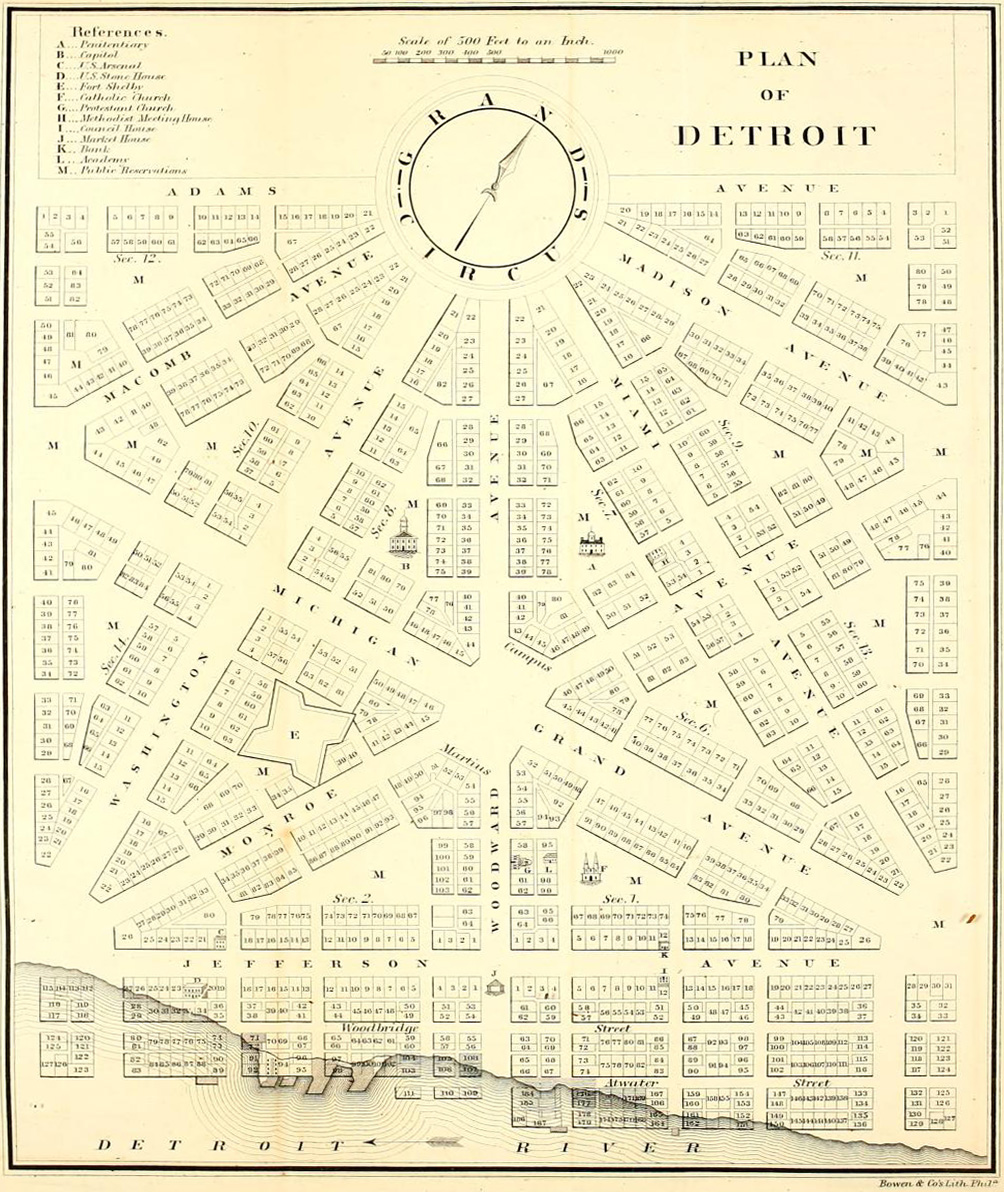
There was a time when Detroit was in worse shape than today. In 1805, the entire settlement burned. There may have remained remnants of buildings and streets, but for the most part, Detroit was simply a memory.
Just a few years before this fire, America invested in the idea of a completely master planned city: Washington D.C. There had been many American cities planned out of the raw earth, but none compared to the beauty and design of D.C. When Detroit burned, Augustus Woodward looked east for inspiration and found this new vision for the city called Detroit:
In the two centuries that followed, this city grew to nearly 2 million residents and has now shrunk to a little more than 700,000. It’s easy to look at Detroit today and marvel at its losses. But we have to remember that fire. When Detroit lost everything, before the world knew her name, one person rose to draw this vision. He found inspiration in another great American city and drew a plan that became the backbone of an empire. It remains mostly intact to this day.
While bulldozers roam the city demolishing abandoned buildings by the 10,000s, as the earth returns to prairie as it was found over 300 years ago, residents of the city are wondering what could possibly become of this place. When I visited in 2013 I met so many people excited to tell me about the recent improvements: new jobs, new businesses, arts and culture. A few months later, the city declared bankruptcy and Kevin Orr took control of the city’s fate.
I’ll be going back to Detroit this summer and I can’t wait to see what has happened in a year: to walk around and experience it for myself. There’s so much to learn in that place: inspiration, caution, fuel for my endless curiosity, and context for the situation in Richmond and other American cities.
Until then, I’ll be wondering how a Shinola watch can cost $950 while this house was recently listed for $100. Until then.
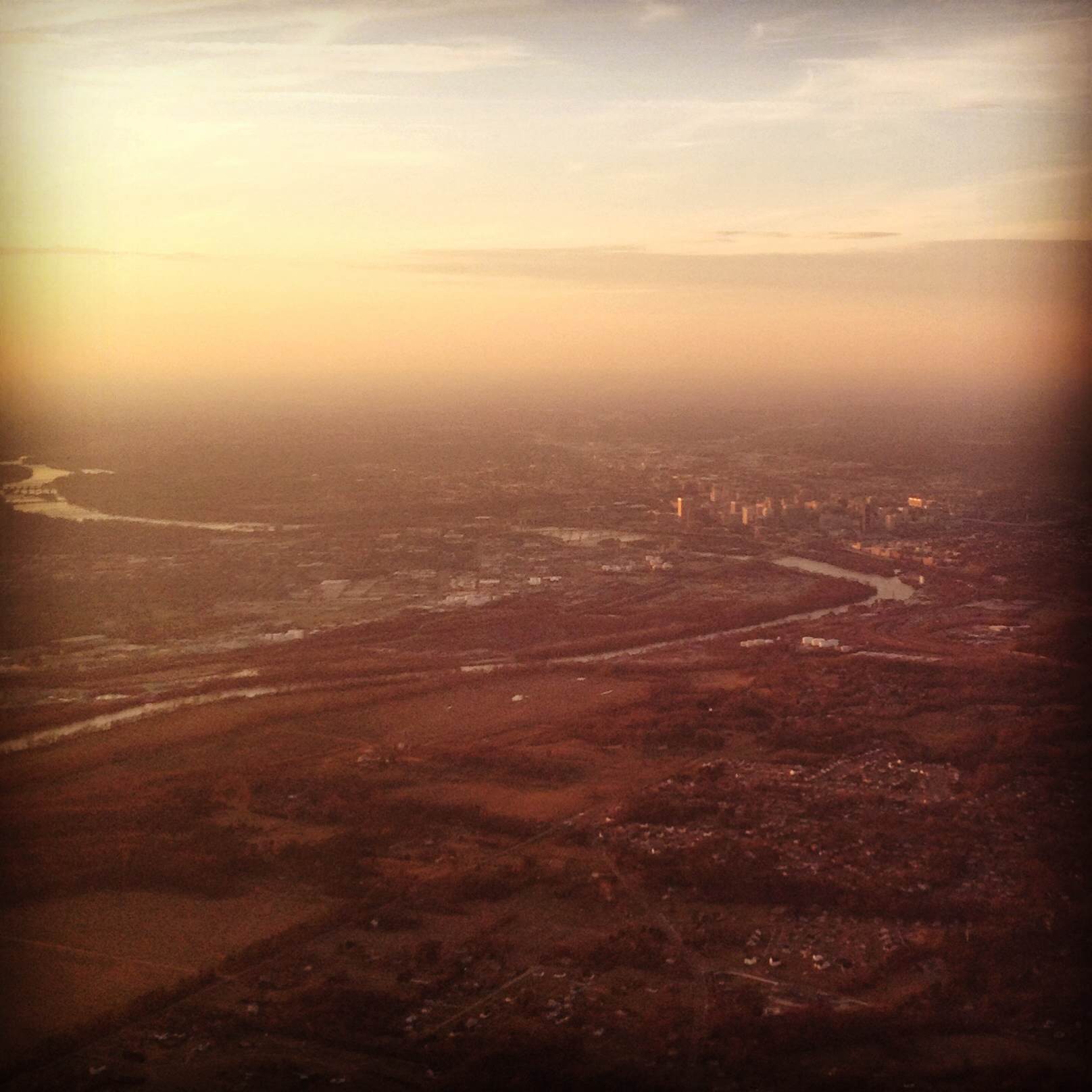
As I flew out of Richmond last week, I got a rare glimpse of the city at dusk:
I just stared at that settlement on the banks of the James River and wondered what the next 400 years might bring. In the city of Richmond, there is the past, the present and the future. That makes us fortunate and it makes us complicated.
To move forward, we will have to make some sense of ourselves and our story.
In the past few months I’ve travelled all over the country: from Philadelphia to Dallas, to San Francisco. With each trip I’ve found new perspective on this current phase of the development of the city of Richmond. I’ve also found some clarity for myself and settled into four areas of focus for my writing:
1. Current events in context: If I ever write about current events, it will be to analyze and contextualize the story. I spent three years studying the debates in Richmond regarding the construction of the Richmond Petersburg Turnpike. That work left me particularly interested in economic development strategies and plans for improving the American city.
2. Drawings for the future: Like many of us, I’m constantly imagining new uses for old spaces and I’ve decided I’m finally going to get these on paper. I’m actually planning to draw them out. It will probably be pretty ugly at first, but I’m hoping to read a little on technique and improve over time.
3. The psychology of the city: I’ve been noticing for years that the city of Richmond has a certain personality. This personality comes out in furious debates as well as mundane daily life. Since college I’ve also entered the world of cognitive psychology, therapy, management, and organizational behavior. I’ve read books, met with academics, and watched every video I find. Insight from these fields will be my lens for understanding what’s going on in this crazy place.
4. The history of the history: There are so many stories being told about Richmond. I want to take those stories and study them to understand the different ways that we describe ourselves. I’m obsessed with historiography and excited to dive back into that field for a series of posts about the different ways we talk about our past. This is connected to the psychological perspective as well: how we talk about Richmond says a lot about how we think of ourselves.
I want a future for this city that is unique and authentic. I want Richmond to develop a maturity as a place that takes all of it’s qualities and integrates them into a coherent whole. As with personal development, this will require a lot of work. In a way, collective therapy. And all because we believe there is a best possible future for this city and that future must include a coherent, honest, and accepting understanding of the past and present.
Dear friends, colleagues, and activists in Richmond,
For the past several months I’ve been hearing an “access to jobs” argument for regional transit in the Richmond Region. This argument proposes to connect poor residents in Richmond with entry-level jobs in the surrounding counties.
I’m afraid this approach will not be received well.
I believe the statistics and I understand the need for jobs in Richmond on a very personal level. I just don’t think the current approach is savvy. When I see Powerpoint slides depicting the number of people in Richmond who need jobs and the number of entry-level positons in the counties, this is what I hear:
“Hey Henrico and Chesterfield, look, we have all these people that need entry-level jobs and you have all these entry-level jobs. Wanna pay to transport our least-well-off residents to your strip malls and corporate offices so they can take work from your growing poor and immigrant populations?”
Wow. Is that how they managed regional public transit in other cities? By shaming municipalities into investing into something that their own residents don’t yet desire? Is that how we make decisions in Richmond? Do the counties even need Richmonders to fill those jobs? Something tells me that if the entry-level jobs in the counties weren’t being filled employers in the counties would be pressuring their local leaders for regional transit. I have heard no such demand.
I am 100% committed to advocating for a more efficient system of transportation in this region. I am open to the idea of BRT being the model for that system. I want more density, more connectivity, and healthier communities in Richmond. But I don’t think that framing this particular initiative as a social justice issue is going to get us anywhere. Is it a social justice issue? Of course. People should not have to own a car to get a job. Is that the best way to approach the topic with our more conservative and flighty neighbors?
By all means, no.
Busses in America are already stigmatized. Let’s stop exacerbating the problem. Instead, let’s find and emphasize more reasons why our neighbors could benefit from regional public transit. Here are a few to start: safe and reliable transportation for the young and elderly, a chance for residents to work with WiFi on their daily commute, and an option to travel downtown quickly without the stress and hassle of parking. I also read a great article a while ago about the therapeutic qualities of the D.C. Metro and I LOVE this piece by a man who wrote and illustrated a book while riding the train to work. Here’s a video from NextCity with countless more: “God Created Transit.”
The one benefit that I’ve heard mentioned, economic revitalization, should be more celebrated and emphasized! Transit-oriented development has incredible potential in this low-density region and streets like Hull and Broad are full of vacant lots ready for new development. Also, in order to make transit viable we’re going to need the density of nodes along the BRT corridor so it’s integral to the success of the project itself.
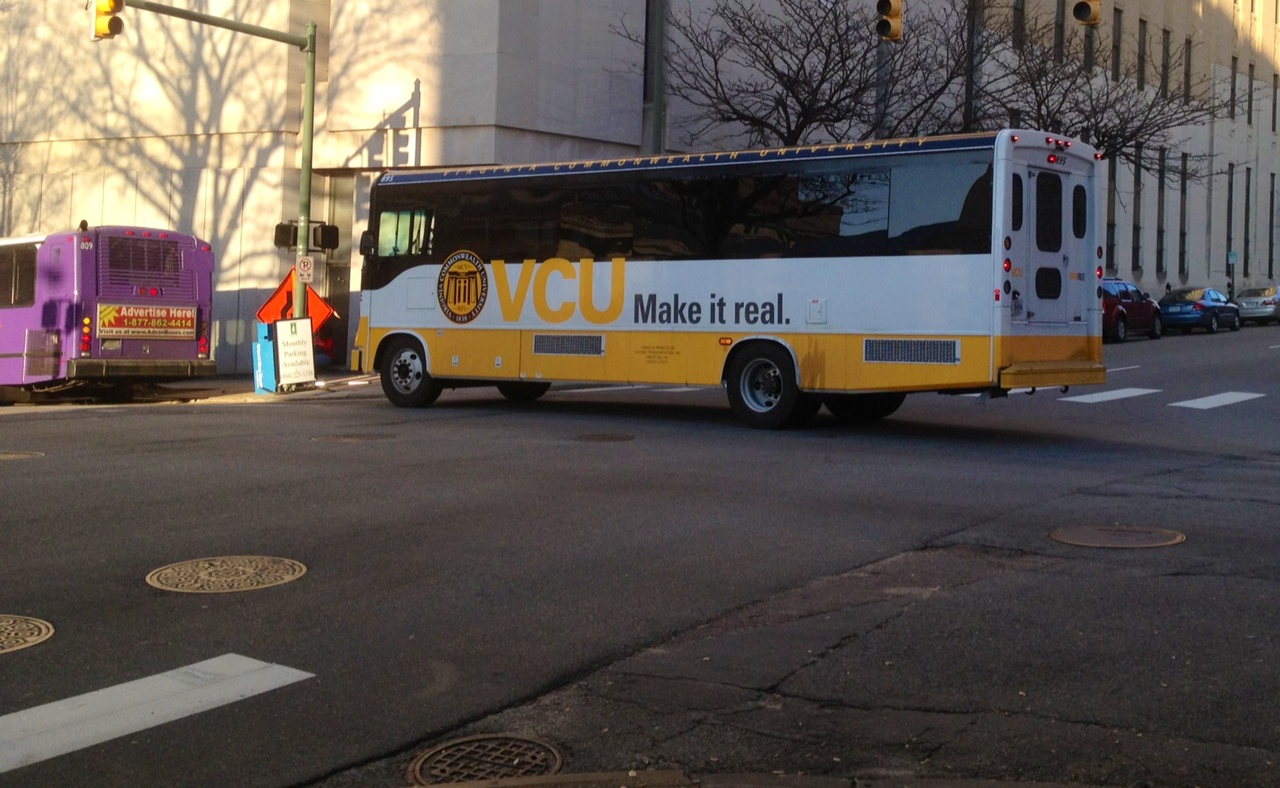
I don’t want us to see public transit as an indulgence that the suburbs have to buy in order to cover their sins of wealth and security. Public transit is a relaxing, efficient, and social way to travel. In the past year, I’ve made new friends, reconnected with acquaintances, and laughed with my coworkers on the bus to and from work. I love the bus and I invite the rest of the region to consider whether more of our neighborhoods should enjoy access to public transit as I do.
In short, public transit is a party and everyone’s invited. It’s just that some in this region are going to have to drive to get there.



 Highways and Hallowed Halls