Category Archives: Movement

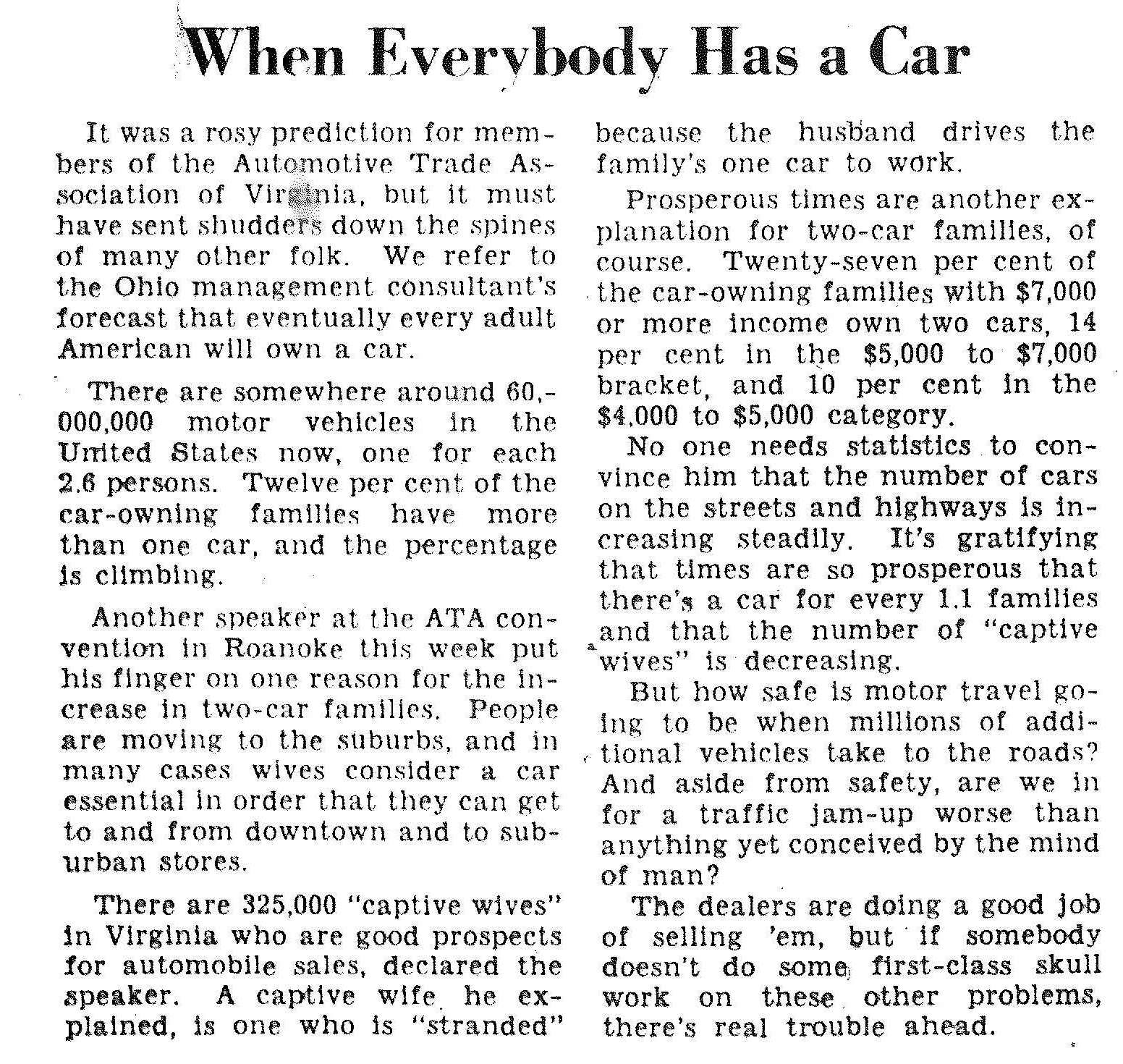
“When Everybody Has a Car”

On Monday Nov. 14 1965, the Richmond Times-Dispatch published an article in the opinion section. It reads,

In the 1950s and 60s, members of the automobile hegemony often made grand statements. I’m amazed that even in 1965 this one sounded like a bad idea.

C-T-D: The Complete Loop

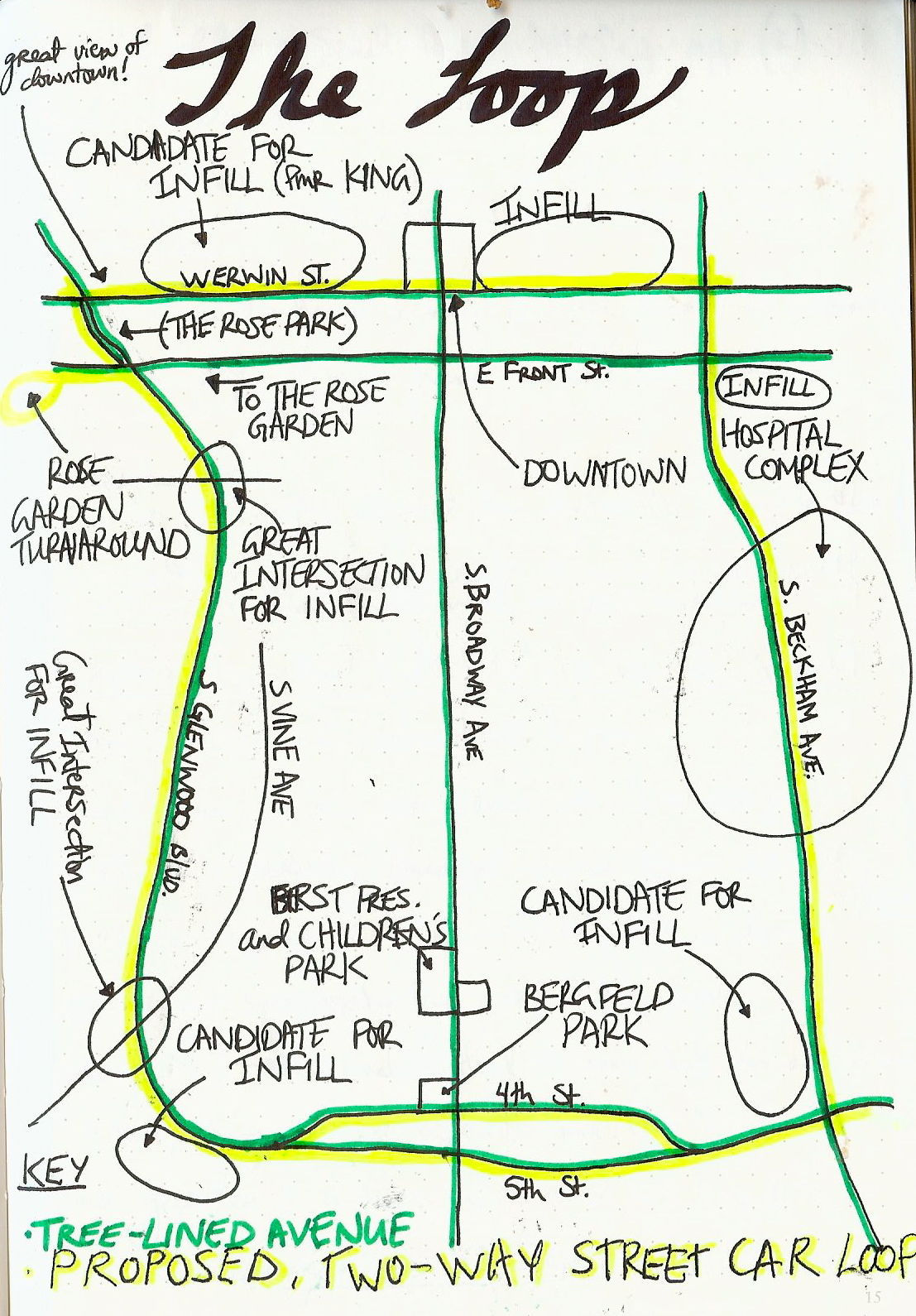
Ok, I’m changing my vision for reconnecting Tyler. In my post “Connecting the Dots: Intro,” I called for a loop of streets to be beautified with bike lanes, street trees as well as connected with street cars. My original vision saw the street car loop connecting down Broadway, but today I changed my mind. My imaginary Tyler now has a network of complete streets and a two-way street car loop. The map I have drawn (to the right) is the culmination of about a month of work on my Connecting the Dots project (C-T-D). It’s not a conclusion, but this is this skeleton that will be my foundation for future posts on infill development in Tyler. These developments are the dots themselves: The high-density nodes that should be developed throughout the older parts of Tyler. “The Loop” is the public investment that is necessary to make the entire concept a reality.

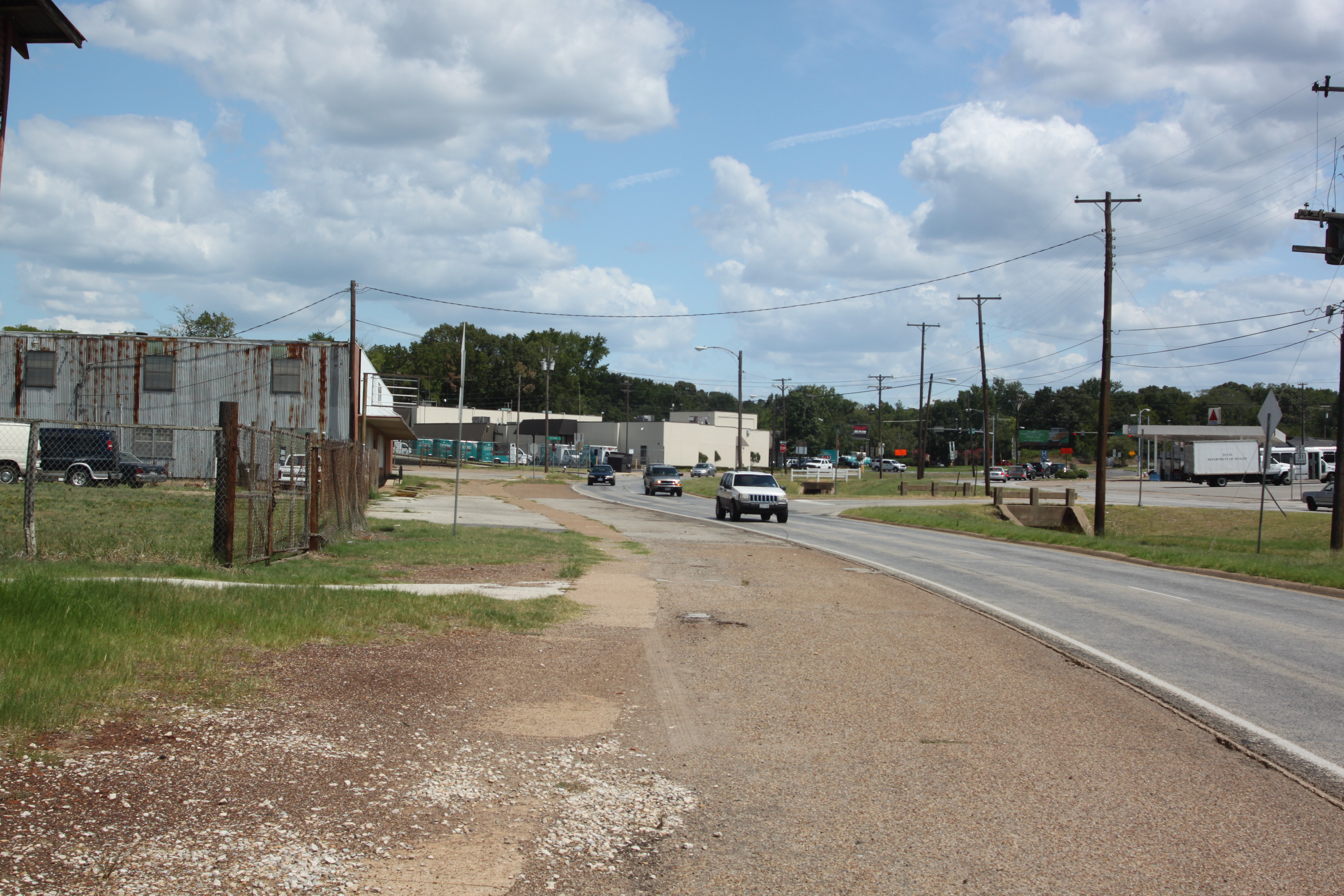
It begins with a paradigm shift from the current philosophy on street construction in Tyler. Currently, a street in Tyler (left) is where cars drive. While it seems like a basic statement, this is a relatively new phenomenon credited to 20th century engineers and planners who gave cars complete precedence in matters of urban travel. Before the advent of the automobile, streets were places to walk, gather, transport and protest. Bicyclists were the first promoters of “good streets” in America and streetcars (started in Richmond, VA) were the first modes of suburbanization. When the car became affordable, it trumped all of these previous developments and occluded their progression. In the past century, streets became very dangerous spaces as car-related deaths increased. The gathering spaces in America were lost. In his TED Talk, “The Tragedy of Suburbia“* (*F-Bomb warning) James Howard Kunstler argued,

“The public realm in America has two roles: It is the dwelling place of our civic life and it is the physical manifestation of the common good. And when you degrade the public realm you will automatically degrade the quality of your civic life and the character of all the enactments of your public life and communal life. The public realm comes mostly in the form of the street in America …”

In Tyler, we have certainly experienced this degradation of the quality of our civic life. There are few public gathering spaces. Just so we’re clear, Starbucks is not a public space, it is a private, money-making enterprise. There were once some incredible public spaces in the city, but many were destroyed or neglected … the downtown square is a sad example. Public space today is a scattered system of lovely public parks typically accesible by car. Our streets are often these large asphalt rivers running through the city with cars zooming by at deadly speeds. I drive one of these cars so I understand their utility, but I also understand the benefits of alternative transportation.

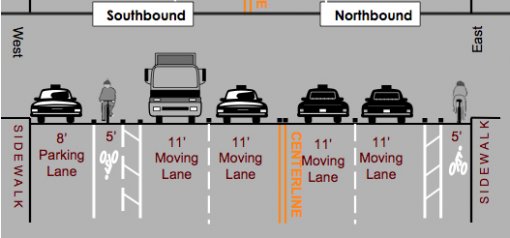
The National Complete Streets Coalition (NCSC) states that “Complete Streets are for everyone.” While there is no singular definition of a complete street, NCSC states that a city committed to transportation choices will ensure that “every transportation project will make the street network better and safer for drivers, transit users, pedestrians, and bicyclists – making your town a better place to live.” (NCSC also listed the “elements of an ideal Complete Streets policy” to help local citizens tailor the concept to their locality.) Thus, a complete street will have defined spaces designated to those citizens not driving in cars:

I really can’t expound on this concept any more except to say this: Complete Streets are a message to the citizens of a city. It says, “Come outside, experience our streets and enjoy your city.” Currently, the message is, “Drive here, this speed, when I say go.”

The next stage in revitalizing this section of the city is the addition of a two-way street car loop. This will be an incredible statement of commitment from the public sector and will stimulate private investment at every point along the route. In my map (above) I have designated some locations that are prime for infill development. These typically have a ton of underperforming asphalt and outdated strip centers. The street car loop will be a convenient novelty for tourists as well as a viable commuting opportunity for a number of large employers along the loop. In addition, the street car loop will finally connect the parts of Tyler that are culturally, financially and historically significant: The Rose Garden, downtown, the hospital district, and the Azalea District. I’ll admit, the primary shortcoming of this loop is that it currently ignores the area north of the square. I response, I think that Broadway should be “completed” all the way to Gentry (banner photo of this post) which should also be retrofitted with bike lanes and street trees all the way to the amazing Caldwell Zoo. If you haven’t driven on Gentry lately you might not know how big that street is … it is due for a full retrofit.

So this is my “Complete Loop.” Unlike the car loop (323), it’s beautiful and versatile and it invites everyone to come and enjoy.

Check out my other Tyler projects at my Tyler, TX page.

*I also had a policy thought: Developments and businesses along The Loop would be exempt from zoning laws that require on-site parking. Instead, public parking would be provided at points along The Loop to encourage a “park-and-ride” system.

The Rose Park

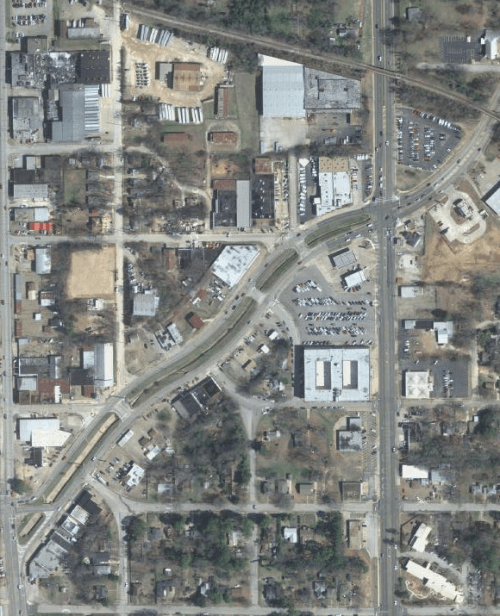
Look at the image below. What do you see?

I see a rose.

The stem of the rose (S. Glenwood Blvd.) extends as a greenway belt from the bottom left corner toward the upper right. It curves along the stream in between the grass of the greenbelt. At the end of the stem, there is a parking lot in a shape that resembles a flower bud. It seems like a perfect fit for the Rose Capitol … especially considering it’s in The Rose District, my fictitious plan for the area of land around the Rose Garden Complex. The Rose Park would be the perfect way to say, “Welcome to Tyler, we like roses a lot.” Since we pretty much control the commercial rose industry in the USA … I’d say roses like us too.

The Rose Park is the perfect way to welcome visitors into this city that has been celebrating the rose industry for decades. As you drive into Tyler on Glenwood, the road is suddenly transformed into a tree-lined parkway with a creek running down the middle of it. Brick sidewalks run along this parkway as it wanders past the junk shops and the Cotton Belt Building. The sidewalks of this parkway then ends with a crosswalk across the intersection that has been rebuilt to accommodate a larger number of walkers and bikers. The bike/ped crossing leads across the intersection into the parking lot that has been transformed into a park of flowers. From the sky, the stem and rose form a clear picture of the city’s identity. From the road, drivers get a glimpse of the park and begin to feel like they have formally entered Tyler.

The Rose Park should be a part of a bigger network of trails and parks in the Rose District. These would all make this an area of the city that is accessible, functional and proud. In it’s current form, this is just a road and a parking lot. But in a few years it could be a purposeful use of space and an excellent entry to this city.

Check out my other Tyler projects at my Tyler, TX page.

On Space and Place: Terms Defined

Over the course of this blog, I will often write about space and place. This post is my attempt to clarify these two terms because they are ultimately the two underlying concepts of each post. While I draw from theorists such as Foucault and Said, I have eventually developed my own way of thinking about life through these lenses.

The two words, in my opinion, are completely distinct from each other. Space is the void. Space is the physical, tangible built environment in which we live. Space is buildings, roads, houses, parks, landscapes. Space is the void. Place is the life. Place is the culture that is created within a space.  Place is what makes a house a home. Place is created when people congregate, communicate, experience each other. Place is a conversation in a coffee shop or a fight outside your house. Place is the life.

These concepts of space and place are often used in casual conversation. Consider the phrase, “I’m just not in the right place to make that sort of decision.” This common refusal is usually considered metaphorical as in an emotional state or a level of maturity. But, what if the person is thinking of actual places where they have experienced significant emotional attachment to other people and are not prepared to enter those places again. Or what if the person has a close tie to a person that lives in another space and they aren’t willing to leave? These are the memory places that are informing the person as they make the decision to move forward or remain.

We all know spaces such as these where we have invested time, emotion and energy to create place with another. We have struggled to be accepted into the group of people that make up these places or we have revelled in our influence over them. It is in these places of human interaction that we struggled through love, lust, pleasure, loss, enlightenment, rejection and friendship to eventually reach some sort of comfort. No matter how frightening these places are, what is more frightening is the thought of leaving them. In these places we become ourselves, we find our identities and we are unsure how that will change when we leave.

Pardon the long quote below … I think it helps me to understand what I am saying:

In his book Repairing the American Metropolis, Douglas Kelbaugh writes, “As others have pointed out, spatial boundaries demarcate the beginning of a place as much as the ending of a place and its power. Boundless architectural and urban space has less nearness, less presence. Limits are what differentiate place from raw space,  whether they separate sacred from profane space or one secular space from another.”

The “spatial boundaries” which demarcate place are the physical boundaries which affect the human interaction within that space. These are often used to enhance the experience of existing in a certain space, but they cannot alone create space. Without humans a space is meaningless. In the same way, it is humans that give space meaning regardless of the intent of the design of the place. All throughout history there have theories about cities which attempt to create the perfect society with the perfect spaces. Le Corbusier’s La Ville radieuse is a common example of this delusional habit. But we have learned time and time again that you can’t solve problems with new space: Housing projects and suburbs are two great examples. They were both dreams for a better life, but both inhabit miserable and satisfied people alike.

It is places that people crave. To me, it is not easy to create place with another. To be honest, many people don’t create place because they don’t linger in a space for long enough. Think about a highway. It is the space par excellence. There is only movement and stigma on the highway — no life, no place. It is one, uniform, vacuous space. And how many of us spend hours each day in these spaces? In contrast, a place can be anywhere. I remember four friends and I had an impromptu gathering in a chapel recently that created the most beautiful place of fellowship. I recently wrote that graduation was an instantly nostalgic place where people gathered from all over the world. It was not “The University of Richmond” that weekend, but instead it was transformed by the presence of a multitude of people that had gathered for the same purpose.

I don’t want to limit myself with these terms, but I sincerely believe they illuminate my perspective on the city and society. I will likely link back to this post many times in the future for reference … they’re my words, but the concepts belong to many people. I’m excited to see how far I can take them.

*Repairing the American Metropolis: Common Place Revisited.  Douglas S. Kelbaugh

 

Gallery

Movement and Waste

This gallery contains 1 photos.

Americans waste a lot: Food, toys, paper cups. If we’re not wasting something (e.g. a power tool) we’re usually storing it which is really just a prolonged and more passive form of waste. We know we waste. It’s something we hear … Continue reading

Gallery

Biopower, repentance and traffic court

“[T]he judicial institution is increasingly incorporated into a continuum of apparatuses (medical, administrative, and so on) whose functions are for the most part regulatory” (Foucault, The Will to Knowledge, 1976, 144, Found in “Sovereign Power and Biopower“). Today I went … Continue reading

On Plans and the Future

On November 3, 1951, Robert LeRoy Shepherd wrote an opinion article in the Richmond Times-Dispatch titled “Freedom, Independence, Taxes and the Freeway.” I found this article 60 years after it was written and was struck by the candor of his voice and the content of his message: Plans for the future must respond to reality.

At the time it was written, the city was in the midst of a highway battle over the plans for the Richmond-Petersburg Turnpike (what is now a section of I-95). As was common practice at the time, Richmond politicians contracted large firms to develop plans for this expressway without significant input from the residents of the city. As a result, the thought of destroying the city for a highway divided citizens and outraged residents. Many conceded that the city fathers had already decided what would be best for Richmond, but fought to make their voices heard during the second public referendum of the highway plan.

Uncertainty filled the minds of Richmonders who were unsure whether their city would be completely transformed by this idea proffered by huge national planning firms and local politicians. The highway plan would result in the destruction of large sections of the city and would forever change the way people move throughout the region. On a more philosophical level, the plans for the highway also seemed to fundamentally question the legitimacy of the physical structure city. After 210 years of individuals shaping the built environment, an outside idea was being presented as more legitimate. At this moment of crisis in the battle for Richmond’s future, Shepherd wrote a philosophical piece that questioned the idea of a highway in Richmond and made a simple, yet compelling argument for democracy in the midst of the American highway era.

At this point in time, the Richmond Times-Dispatch was not new to articles and ads related to the expressway.  Leading up to the referendum on November there were dozens of references to the highway including political ads, cartoons, editorials, news articles, and opinion submissions. Many of these references simply recycled the same ideas and arguments for or against the highway plan. In these arguments it was too expensive or it was the ultimate solution to traffic, either not the will of the people or a well-developed plan vetted by studies and experts.

Amidst the banal arguments, Shepherd’s article called Richmonders to think critically about the process of planning a highway in the 50s. He was not enamored by the professional firms that planned the highway or their ideas for the future of Richmond. Instead, he writes, “Inflexible plans result in a fixation of mind. Steering them becomes an obsession kindred to a driver’s headlong dash above or over a freeway.” To Shepherd, politicians in Richmond were  trying to make the plan fit an unwilling populace. To Shepherd, the future was not so easy to predict.

While many framed the highways as American progress, Shepherd framed the highway plan as megalomania. He compares the politics to Alexander the Great, Caesar, Hitler, Hirohito, and the British Empire. The one thing in common was the concept of invasion and empire, but more philosophically the empires were imposed and forced on unprepared societies. The empires constantly developed their ability to transform the life of citizens in order to complete the assimilation of diverse societies. The highway was no exception. Plans for the city of Richmond were meticulously developed before being presented to the people of Richmond and expected to impress and amaze. The highway was an idea from the outside that was forced upon cities in America and unwilling to change or shift to fit the will of the people.

To Shepherd, these plans did not make sense in context because they weren’t democratic. “Taxes and plans?” writes Shepherd, “Yes.” In some instances it is wise to plan for the future and prepare for potential changes and developments, “But [while] some lead to the freedom of men, others lead to a fixation of mind and bondage just a binding as chains.” Today we are living the legacy of these plans and I believe we finally beginning to understand the captivity of which Shepherd spoke. While the highway seemed like an opportunity for growth, it has become a fundamental aspect of American life. What was once vehemently opposed has now become part of routine commutes and shopping trips.

Many people look at cities without any sort of historic lens or context, but a deeper understanding of the politics of a place will give us a better understanding of the place itself. As we continually struggle to recover our buried past we will likely find similar instances where democracy failed and voices were silenced. Uncovering these voices will further illuminate our nation’s past and present and allow us to begin to right our future.