Tag Archives: writing

Revenge body (of work)

Over the past little while I have been processing the loss of a very significant relationship. When I look online for guidance, a lot of people say that exercise is the best way through. Exercise helps people regain confidence and independence as they grieve. The end result is their “revenge body.”

The revenge body says two things at the same time: Look at how well I’m doing/what you’re missing out on and also look at how much I miss you. It’s a positive outlet for the emotions and also a confirmation that those feelings are being felt.

I’ve never been a gym rat (except for one year in high school), and I already feel pretty good about my body thanks to being vegan and active. So instead of working out, I realized pretty quickly that writing was going to be my outlet. It always has been, but I’ve noticed myself leaning into it much more regularly, almost constantly, these days.

At some point I started to think of it as my revenge body of work.

Writing basically serves the same purpose as exercise to me. I enjoy it, it’s a distraction from life, it gives me space to process, and I can take a step back and look at all that I’ve written with a sense of pride. To some, it might even make me more attractive. It’s also a reminder of that person: the way they encouraged, read, and even reviewed specific posts in advance. The reminders are everywhere.

I have more time on my own these days, more brain space, and to some extent more clarity, all of which have been fueling my creative habit. I’ve wanted to write more regularly since I started this blog, but at some point early in my career I decided it was trivial. Then, I felt like I didn’t have anything I really wanted to share.

Coming out of the closet has given me so MUCH to say (110 drafts and counting) that I think I needed a disruption to push me to start getting more of it out there. And just like with revenge bodies, I’ve started to let go of the idea that it needs to be perfect. The value is in the action, the regularity, and the simultaneous memory and movement of letting go.

Losing a friend

A little over three years ago, in the early days of fall, I noticed myself looking forward to the first frost. It had been a season of upheaval in my life and I was tired. Everything in the garden felt like too much: the tomato plants were enormous, mosquitoes continued to test my sanity, and even trees seemed tired from the growth.

I was excited for the cold-weather months. It can be a relief when everything outside looks like death and the work (for a time) is done. I looked forward to hikes and runs when you can see straight through the faded underbrush. What I did not know at that time, when the sunlight cuts across the landscape and flies and dust dance in the cool, dry air of harvest, is that in a couple of months I would lose one of my closest friends forever.

Unable to control the weather, I started to cut back in my own ways. I aggressively unsubscribed myself from email lists. My inbox had become overrun just like everything else. I also decided to stop drinking coffee. I noticed it was making me more anxious than focused, my mind a glutton for information, too busy with ideas and making connections to focus on tasks at work. With less caffeine I found myself breathing more deeply, crying more easily.

As time wound into winter, the landscape began to feel more manageable and muted. There were few weeds to pull, nothing to prune or harvest. During winter we find comfort knowing that nature is just resting, that everything is gone for a time, that there will be flowers and fruit again.

On the night of Christmas Eve, just past the darkest night of the year, I got a text from a friend asking me to call. I immediately felt that someone had died. When I finally reached her, she told me something unimaginable. After I got off the phone, I called another of my closest friends and shared what I couldn’t even fully believe myself.

Then all of the sudden, in my grief and loss, I wanted every bit of the chaos to come back. I wanted to get caught up in the weeds, the insects, the relentless advance of kudzu. The land, now bare and clear, felt more acute, more permanent, more extreme, life cleared out and put away. I wanted the change of seasons that felt familiar, the loss that turns back into life.

At the same time, I was grateful that I had been listening to my sadness over the previous months. I felt like my emotions were very accessible to me in the early days of grief and acceptance. Many times I wondered if leaving religion had also prepared me to grieve.

Sometimes I feel like religions treat death like it’s perennial or cyclical rather than permanent. They believe (and maybe I still believe on some level) that the person has been reborn instead of accepting that they are gone forever. This is just my personal experience, but it has always felt too soon, like a silver lining, to say that someone is in a better place before someone else has let them go.

I want to tie this up with some kind of “and yet” sentence where I channel my inner Margaret Renkl and talk about being grateful for the things that are going well, but it feels more appropriate to just accept and metabolize the loss.

Nature is full of metaphors of rebirth and renewal, but sometimes things do just die. Sometimes species go extinct. Climate change is looking very one-directional these days. So when spring came, and warmer temperatures brought ephemerals, buds, and other signs of life, he was still gone.

Summer followed and my friend was not here to enjoy the cool river on a hot, humid day, or whatever beach trip he had been planning with his family. Fall came around before too long and he wasn’t trick-or-treating or getting cozy on a couch. Then winter again and we all relived in our own way the experience of losing him that cold night. That is cyclical, I suppose. I am always grateful for the chance to remember him, see mutual friends, and let him go all over again.

Being Out Intellectually

From an early age, I considered sexuality to be primarily a spiritual issue. The Bible and the church were the only sources I could consult on the issue of sex and sexuality. I accepted it as an implicit truth that it was a sin to be anything other than straight (even for a moment), but beyond just a sin, it was a shame. A shame on yourself, your family, and all kinds of things could go wrong if the secret were to be revealed.

As I have come out of the closet, I have allowed aspects of myself to finally relax in ways that I wasn’t ever able to do. I have allowed myself to embrace my gay cultural interests. I have allowed myself to embrace my gay social, relational, and style interests. But for a long time I was still repressed in my intellectual life. Even as I started to read and watch and embrace gay culture, my brain wasn’t thinking critically about any of it in the way that I have loved to think about so many other things. Over time I have realized that I trained my brain to immediately set aside any thought that might have been deemed too gay to share. These thoughts were set aside long before they could form a sentence or an essay or even just come up in conversation. With some conscious effort I’ve started to catch myself just before setting an idea aside. With encouragement, I’ve started to write these ideas down as blog post drafts. I’ve started to accept that I have tons of opinions on gay culture, history, humor, and theory and these have always informed how I see the world even before I was aware of it.

Becoming aware of my own thoughts has been a process of liberation. When I lived in fear I was trained to contain myself within the boundaries of a homophobic culture and religion. Being liberated from that culture and religion meant truly believing that they had no control over my life, present or eternal. Once liberated, my mind still needed acceptance and exposure to gradually become confident enough to start to share. Friends, family, and significant others have been a safe haven for me to share as well as a source of inspiration, new directions, healthy disagreement, and perspectives.

Early on in my coming out journey, a friend (we love our straight allies) shared with me a beautiful speech by Stephen Fry on the significance of Oscar Wilde. I was so incredibly moved by aspects of the story of Oscar Wilde that I had never heard before. I was also moved by the confidence of this gay man who was able to inform his interests with his personal experience while still maintaining a level of intellectual rigor. I had been extremely aware of Wilde as a teenager, I knew he was gay or at least rumored to be gay, and I noticed whenever I saw his name or a picture of him. Despite my obvious interest, I consciously avoided Picture of Dorian Gray my senior year and even avoided talking to classmates that read it. Instead, I chose to read (most of ) the more socially acceptable Crime and Punishment. I was somewhat interested in Dostoyevsky and the book was interesting, but I really didn’t enjoy reading it and I wasn’t really excited to research the life of the author and the cultural themes of guilt, mental illness, etc. I was actively suppressing my desires – I didn’t even know what it felt like to do otherwise.

More recently, I finally did read Wilde’s famous novel and loved every page. Looking back I wonder if I would have been thrilled as an adolescent to find a book that was so personally engaging and to read about an individual with a story and a sexuality that I could relate to. If at that young age I had read Wilde instead, would that have changed what I studied in college and grad school? Would it have affected the direction of my career and other life choices? It’s cathartic to reimagine the past in a way that was more free, accepting, and intrinsically motivated. A past where I trusted myself, listened to my heart, and shared what was on my mind. I’m not regretting the choices I made, I’m wondering how I can change the way I make choices today and going forward. Along the way I have been grateful to receive book and movie recommendations that have given me so much joy, catharsis and perspective.

I’m early in this journey of allowing myself to be gay intellectually and at times it’s been a little embarrassing to feel so behind. I know I’m not quite ready to be a critic because I’ve loved nearly everything I’ve read and basically every gay story makes me cry. Even the acknowledgements section of some books has made me cry as I have considered the partners and community that support an author in their work. I have more emotions to release than I could have ever imagined. At the same time, while my heart is being nourished, my mind is being coaxed into the light, invited to make connections and observations, compare books and movies, consider timelines, politics, cultures, and geographies. With the desires and emotions of my heart, I also care personally about these issues and feel strongly about them in a way that I think will make the intellectual work come naturally – I don’t have to convince myself to be interested.

Over the past few years my brain has finally started to naturally make connections . I have wondered about the political usefulness of homophobia for blackmail, the lasting cultural affects of France and Italy being some of the earlier European countries to decriminalize gay sex, the connection between replacement theory and the religious demands of procreation. In general, these have been passing thoughts, but eventually I think they may start to become something I would write about and share. Before coming out, I didn’t even have a base of knowledge to draw from, a sense of what has already been explored, and references to help me understand. Now that I’m out and exploring I’m excited to write, and speak, and live more from the heart as well as from my mind. My primary goal right now is to enjoy myself and the journey. I have a lot of energy, previously spent on repression, that I am more than happy to put to a better use.

Impossible

There is a scene in Yes, Daddy that I think about every once in a while. Jonah, the main character, is on the beach with a man who is holding him captive in his house compound nearby. While they walk, Jonah sees an old friend from work. The friend is with another guy who Jonah learns is his boyfriend. In that moment, Jonah is trapped in his life psychologically, physically, and financially, in contrast to his friend who is free, authentic, and enjoying what appears to be a mature, healthy, romantic relationship. They are on the same beach, but they are not the same. Jonah was trained to be controlled, through religion, he was trained to give up agency, he was trained to look for a savior. He had chosen to leave the city and ignore this friend – he had actively sought out the man that had taken his freedom away. Throughout the book, you realize that Jonah doesn’t get to do the normal “boyfriend thing,” he doesn’t get to just enjoy his life. Those things are a fantasy. They are like a movie he is watching. It is impossible to climb into the screen and join them. He can’t even be sure that he would be happy and satisfied there if he could.

I remember almost every interaction I ever had with a gay person (or someone I perceived to be gay) while I was in the closet. In high school I remember a student that I didn’t know looking at me in a way while I showered (in my bathing suit) after swim practice one night. I remember the younger brother of a classmate talking to me in the hallway near the auditorium and poking his finger into my chest in a way that made me feel uncomfortable. I remember a phone call with a guy who had moved to Tyler after Hurricane Katrina – he said, “you’re mine and will always be mine,” or something like that – while I talked to him on my cell phone under the taxidermied cougar outside the school gym one evening during a basketball game. All of these moments basically freaked me out. For all of them I remember exactly where I was, what I was looking at, what was around me, the time of day, etc.

After high school, I remember two guys at J. Crew that I shopped near for a moment over 10 years ago. I remember a guy in an a Capella group in college slapping my butt, the stranger that dropped his number on my table at a coffee shop a week before my wedding. I remember inhabiting gay spaces, a gay sports bar in DC, a gay bar in Charlottesville. I saw gay wedding announcements, watched innumerable YouTube videos of guys dancing so freely that I cried.

In all of these moments, what was so unsettling was that I felt like I was being seen. I felt like I was being pulled into reality – like they were actually kind of waking me up from my disassociation. As I came out of the closet, it followed me. The fear, the self-criticism, the willingness to give it all away, the lack of faith that happiness is something truly accessible to me. As I entered relationships, entered new spaces, even physically connected, I felt like there was always this layer of cellophane between me and that world. It had a shimmer. Inhabiting gay homes was sometimes even uncomfortable. I was often so dissociated I didn’t realize all the feelings I was feeling and definitely not relaxed enough to acknowledge it in the moment. Even as I was being warmly welcomed I felt like I didn’t really belong, not just in their home, but in their reality.

I can’t say exactly why I felt these ways. I’ve given myself permission to not always know (or try to know) why some things are the way they are. But it is important to recognize the way these feelings affected my relationships, especially connections early on. I spent so much time in awe – like those stereotypical orphans in old movies watching a family eat a meal. It was overwhelming to be face-to-face with a life that I had denied myself, that was denied to me, that to an extent I didn’t even know existed.

One unfortunate aspect of repression is that I sometimes forgot other people were struggling as much as I was, even the ones who had come out of the closet. Early on, gay life seemed so desirable and gave me so much energy that I couldn’t even imagine why someone out of the closet would be unhappy. Repression inflated the sense of freedom I assumed they were experiencing. It also prevented me from realizing how hard they had worked to have the life they lived and how much energy it required to maintain it.

On the other hand, it’s also true that they were even more free and uninhibited than I realized. Grief has come to me in waves over the last few years as I have realized how much I gave up by staying in the closet: the places, events, organizations, friendships, and experiences I denied myself. It’s stereotypical to say that it was easier when I was in the closet and didn’t know how much I was missing out on. Although staying in the closet kept me safe and did preserve a small measure of inner peace, it was extremely fragile and very frequently unsettled. As much as I tried to avoid queer culture to preserve that inner peace, it was impossible to really maintain that distance. I regularly caught glimpses of articles, Instagram accounts, or people that reminded me of what I was missing out on. Over time, these moments all added up to a deep and secret sadness I carried for so long I nearly forgot about it. The more I have opened up my life the more I have grieved everything that I missed. Early on, I cried all the time as I let go of deep layers of pain, loneliness, and sadness. The grief has been a relief and a release. It has felt healing and life-giving. Grief comes with any loss and the greater the loss the greater the grief.

Coming out of the closet for me has been a little different from traditional grief because it is grieving something I never had in the first place – something I didn’t even fully comprehend. Seeing gay life in person is reckoning with its existence, it’s beauty, it’s sadness, it’s joy. Even though it seemed inaccessible, it was always just around the corner, it was even in the same room, at times. I could have taken one step, could have reached out to touch it, could have changed course with just a few simple words. But I didn’t. I had been taught to be afraid, taught to perform. So, instead, I froze, I cried in secret, laughed in secret, constructed a world just for me where I tried to feel safe and happy. My life in the closet was “real,” but I was not fully participating in it so it’s also true that it wasn’t really “mine.” The majority/straight world was also an experience that didn’t fully belong to me. It’s crazy how something can be both boring and stressful at the same time. Many friendships were born during those years that gave me life, many memories gave me joy, but much of it also gives me sadness and all of it feels like a bit of a dream.

As I have come out and taken steps to live honestly I’ve had the funny realization that my life is now a fantasy too. I’ve been to gay events and destinations, I’ve read books, watched movies, made friends across the country, found and lost love, found pleasure and joy. Although they feel fleeting to me still, these moments are becoming less the exception, and more secure, more predictable, more comfortable. I have found a measure of freedom that is outside the grasp of many people. There are some who aren’t even free within themselves. Others may feel like they have invested so much time and energy into their closeted life they would be giving up too much to let it all go. They might break under the weight of their grief if they opened that door – at least for a time it might feel impossible. But holding on to that life requires constant attention and effort that seems to never provide anything in return. And many of the things that seem impossible actually become the most natural thing we have ever done.

I used to think I would die young, now I can’t imagine growing old

When I was in high school we read a poem in class about an athlete dying young – I’m pretty sure it was this one. I remember thinking that if I died before I had the chance to be a failure I would be more likely to leave a good legacy. In retrospect, I think that the pressure of life, especially the pressure of achieving success while also being in the closet, was draining a lot of my joy and energy. I knew that at some point I would burn out.

In my high school years I actually thought God might have promised me I would die young. If I stayed in the closet for my faith it seemed like an early death was God holding up their end of the bargain. Twenty or so years on earth seemed doable, but much more than that was hard to imagine. Being a closeted gay adolescent in the church left me feeling committed to my path and hopeless that it could actually work out in my favor. Going to heaven was the primary reward I was presented with in these years so it makes sense that when life felt overwhelming that’s where my mind would wander.

I didn’t really plan much past my early 20s, basically college was as far as I got in my mind. I couldn’t imagine the future in any kind of hopeful way so I just took life one day, month, and year at a time. When my tragic early death never happened I felt pretty behind and unprepared. Since I thought it was something God had promised, it may have even caused my faith to wane when I was left to figure out the years I hadn’t planned for. (As I scrambled it didn’t feel like God had planned much for those years either.) It wasn’t always conscious, but it does seem pretty clear in retrospect.

The other day on the way to therapy I saw an activity bus from an assisted living facility and cried for most of the rest of the drive. I worked in assisted living so I have some personal experience with how sad and lonely those places can be. In these moments I think I’m already grieving the future I feel is coming for me. Many people close to me have tried to reassure me about the future and remind me how far I’ve come. I actually have a very long blog post draft called, “The Future is Home,” in which I have tried to convince myself for more than a decade that it’s going to be ok. Rationally I want to believe them (and myself), but emotionally I just can’t.

Adolescence is supposed to be a time of exploration. It’s supposed to be a time when you get to know yourself, try on different identities, express desire, start to experience autonomy and independence. My experience of adolescence was closer to one of commitment before exploration – what Marcia would call identity Foreclosure. Now I am finally (really) exploring and, even though I have felt late to the party at times, I am very grateful to be here.

I do think that I will get to a point where I am optimistic about the future. I am already “less hopeless” at least which feels like progress. Even writing this blog post has made me feel better about things in the moment, probably because writing is something that I enjoy and it is a relief to write out thoughts that have been on my mind. I have also given myself the freedom to explore without making promises the way I did the first time around. I gave away all my agency at a young age and I’m too prone to do it again. Instead, I’m just following the energy of my life as best I can. The more my life feels like home right now the more likely I’ll be able to imagine it for myself down the road.

Career Brainstorm

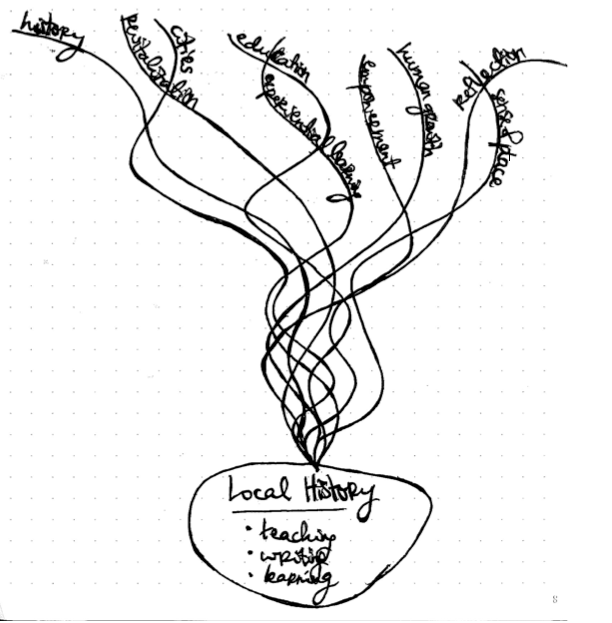
While flying back to Richmond a few weeks ago, I drew up a brainstorm for my future. All of the sudden, it became clear that local history is something that I could champion for a lifetime. It’s not really a brainstorm. It’s an observation of my past and a hope that, with a lot of work, all of my various interests might be resolved into one goal:

Future Brainstorm

Thoughts from “The Creative Call”

Some artistic people in my life are reading a book right now called The Creative Call. It’s great. There’s a lot of wisdom for people who feel like they never “found their artistic voice” or perhaps never identified as “creative.” If you lack a medium through which you can express the inexpressible, this book is for you. *Just as a side note, this book is a Christian perspective of creativity in life, but there are plenty of secular examples to choose from such as The War of Art and The Creative Habit that beckon readers to reengage their creative side without also talking faith and the Christian life.

The following paragraphs are some responses to a section of a chapter of The Creative Call … it’s nothing special, but I thought it might be an interesting way for others to get a glimpse into my personal relationship with art through the years. Also, I hope anyone that stumbles on this post might think about their own artistic story and find some of their own answers to these questions.

Was there an earlier time in life that you produced art?

I used to make more “creative things” (e.g. bean bags, necklaces, cities in the sand, scarves, castles, drawings) when I was younger. I wasn’t really that cool, but at the time it didn’t matter. Besides, I had the privilege of growing up in a group that didn’t really want to be cool relative to other communities … it was a nice social cocoon. Then I moved into junior high and high school and literally left it behind. No more art classes, no more random projects (that I recall) and seldom did I read for fun as I had in my childhood. I sort of lost that self-confidence that one needs to tinker alone for hours on end with no advice or affirmation.

I was gradually pulled outward as I matured into a more social, active life. As I moved through my room during this post-art era, I often viewed my old paintings and drawings as ruins in Middle Earth … relics of a lost civilization. While I moved on from these visual arts, I realize that I began to move into the “written arts.” This shift has continued from that time except for a few noteworthy ventures into painted worlds at “art parties” my senior year of high school and during a class on “Observational Painting” my junior year of college. Otherwise, I suppose, writing has become my voice. Here’s a relic from early high school: an example of this shift as I struggled through my early adolescence:

“Enter la chimera cha; take my sorrows, learn to draw. 
A sword to take the life of one seeking solace from the sun.
From afar it seems so sweet, upon arrival Charon greets. Means to end 
surreal strife, death alone—that radiant life.”
 

“I would practice art if only …”

I would practice my art more often if I weren’t always around people: drawn to connect and afraid to retreat. I recently read a quote from Stephen King’s On Writing: A Memoir of the Craft” in which he writes,

“It starts with this: put your desk in the corner, and every time you sit down there to write, remind yourself why it isn’t in the middle of the room. Life isn’t a support system for art. It’s the other way around.”
 

When I read this quote I realized that in the past decade of my life I’ve been stretched far too thin and removed my support system of art and creativity. I definitely need to stay connected to my community, but as I become more healthy I think I’ll learn to withdraw more often. I often find myself blogging late at night (currently 1 a.m.) because I’ve already committed the rest of my day.

“I’ll start making time for art when …”

I’ll start making time for art when I’m not doing this yearlong internship, when I have more direction for my first book, when I know that I will be able to support myself monetarily (any wealthy patrons out there?), or when I start a graduate program that requires me to daily engage my creative mind.

“I’d be doing my art right now if it weren’t for …”

I don’t really know what my art is. If it’s writing, then I think I am doing my art right now, but sometimes writing feels more like a conviction. I realized the other day that I feel compelled to write … it’s much less a hobby than it is a part of who I am. I also wonder if creativity can get lost in obnoxious intellectual thoughts.

As I continue to write, I want to push myself to more actively integrate my design and personal narrative to perhaps make the process more “creative.” Perhaps the end product would be “my art.”

“I’d always hoped that I’d …”

To be honest, I had always hoped that I would go completely off the deep end, produce something incredible, then die an early death. This thought first entered my mind as I read Housman’s “To An Athlete Dying Young” and lingered in the recesses for years to come. I wasn’t really morbid about the thought of dying young, but I distinctly remember thinking that my talent would be more influential as tragic unrealized potential. I’d always hoped that I would be tragic, but at the same time I almost always followed the rules.

“I wish I had the courage to …”

I wish I had the courage to tell my own story in a compelling and innovative way. And to let go of the hometown ties that hold me back and keep me from being exposed as a human with flaws and fears. I also wish I had the courage to get past my fear of public humiliation (and latent political ambition) to just be myself. I’m thankful that I have let go of most of the hang-ups from my earlier years, but there will always be something new.

“If I could go back in time I would …”

… produce more at an early age, stop feeling alone on the margins and embrace my strengths as gifts to be used. Also, I would learn how to play the piano and cook great food. I might even learn to dance.

My hope deferred is the thought of me as a classy, unique, professional person, confident, yet realistic and sincere. Right now, I’m afraid I hide behind my words too much. While I’m glad to have further honed this skill, I hope to eventually use writing in a less esoteric way that people can still appreciate and enjoy.

Favorite words (and phrases):

Portmanteau, sin qua non, mutatis mutandis, latent, urbane, nascent, apex, zenith, delight, hallowed, space, amaze, past, significance, embrace, huzzah, fearsome, boulevard, difference, terrifying, nostalgia, anticipate, potential, place, remain, resent, longing, resist, gruesome, lament, sunrise, society, dissonance.

Special thanks to @brainpicker‘s New Year’s Resolution Reading List: 9 Books on Reading and Writing for a great survey.