
Tag Archives: Richard Sennett

Samhain, 2025

For the last week or so I’ve been thinking about the Celtic holiday of Samhain. I don’t know much about the Celtic holidays, but I read a book once about a home called Bealtine Cottage and at the very least the idea of Bealtine planted a seed in my mind.

After some deep dives, I’ve learned that Samhain is essentially the “pagan” holiday that Catholics co-opted when they created All Hallows Eve (and All Souls, etc.). In a further twist of colonialism, it is also basically the origin of Dia de los Muertos – a holiday some see as a Catholic invention/amalgamation of existing rituals and beliefs.

Anyways, a witch on Instagram made a video saying that tonight is actually the best time to set resolutions and to plan for the work ahead. This night marks the end of the Celtic year and the beginning of the “dark half” of the year. This is a time when we are inside more, when gardens and farms have begun to rest. We often use this time to focus inward and draw close to friends, family, and partners.

With all this energy in the air, I decided it was time to take some small steps of preparation. With the help of our kids, we cleaned out several bags of toys and started to organize their play area. That felt like a nice small win. I am thinking about the fact that I’ll be inside more soon and feeling a desire to organize and repair more in general – there are so many projects that weigh me down more than I even realize.

I also decided to start the new Life Designer workbook from Intelligent Change. I bought it before the Samhain connection, but soon realized that it would be perfect for this (new) new year.
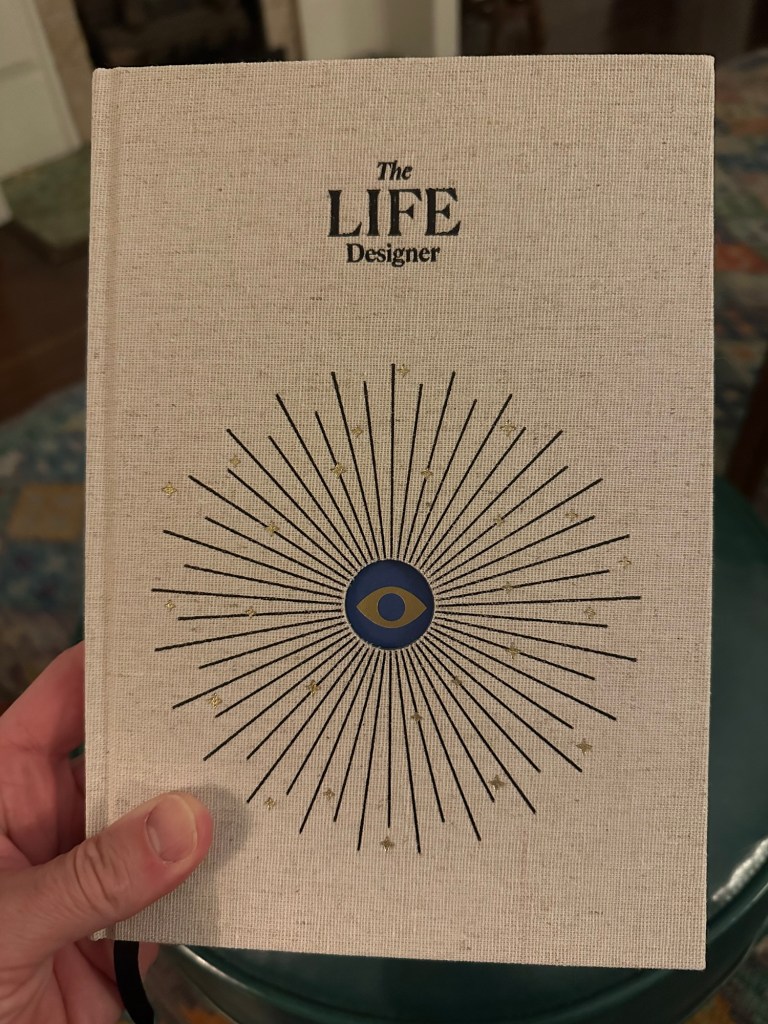
At it’s core, it’s a workbook to plan the next ten years of my life. On October 31, 2035, I’ll be 47 years old. I actually started crying just typing that sentence.

Oh, I also cried when I filled in this dedication page:
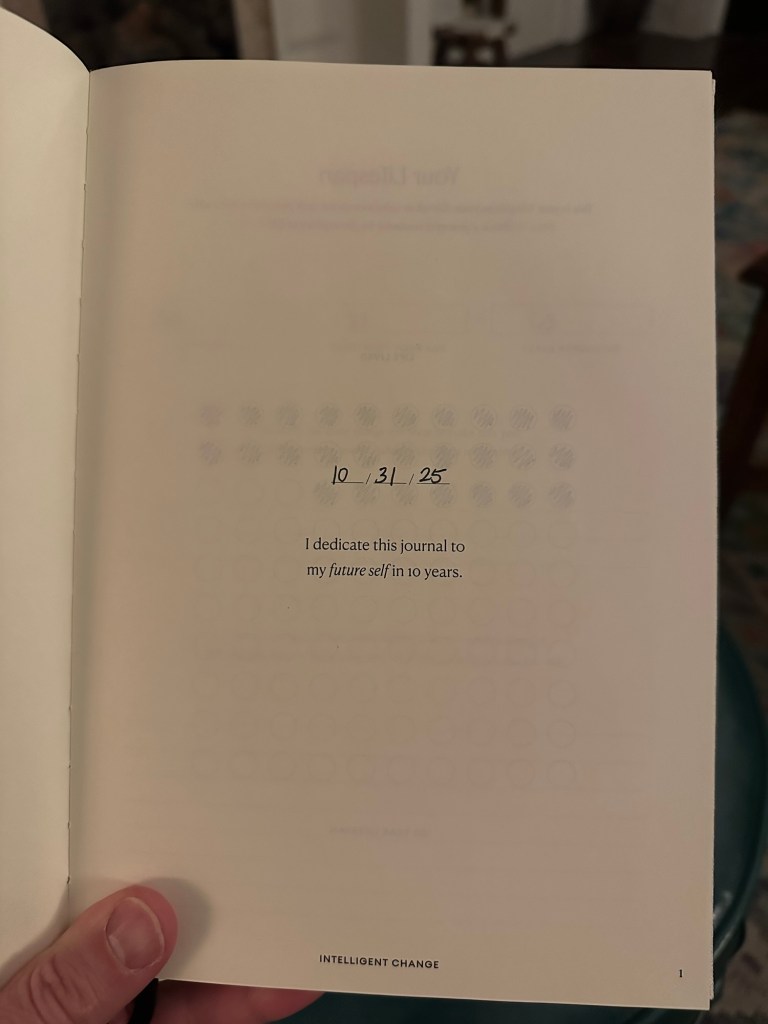
I really do not want to get older – I don’t know how else to say it. On the other hand, there have been so many days in my adult life that I’ve just wanted to be over so that I can sleep again.

I know that I have to fix my days before I can fix my years. And since I can’t avoid age, I can’t avoid work, I can’t avoid relationships, hopes, disappointments, responsibilities, etc., I know that it’s time to start thinking about what I want to build on the years I’ve lived so far. Because “the next ten years” are already here.

With my fear of getting older, it was encouraging to fill out this chart of the years that I’ve lived so far and see how many I presumably have left.
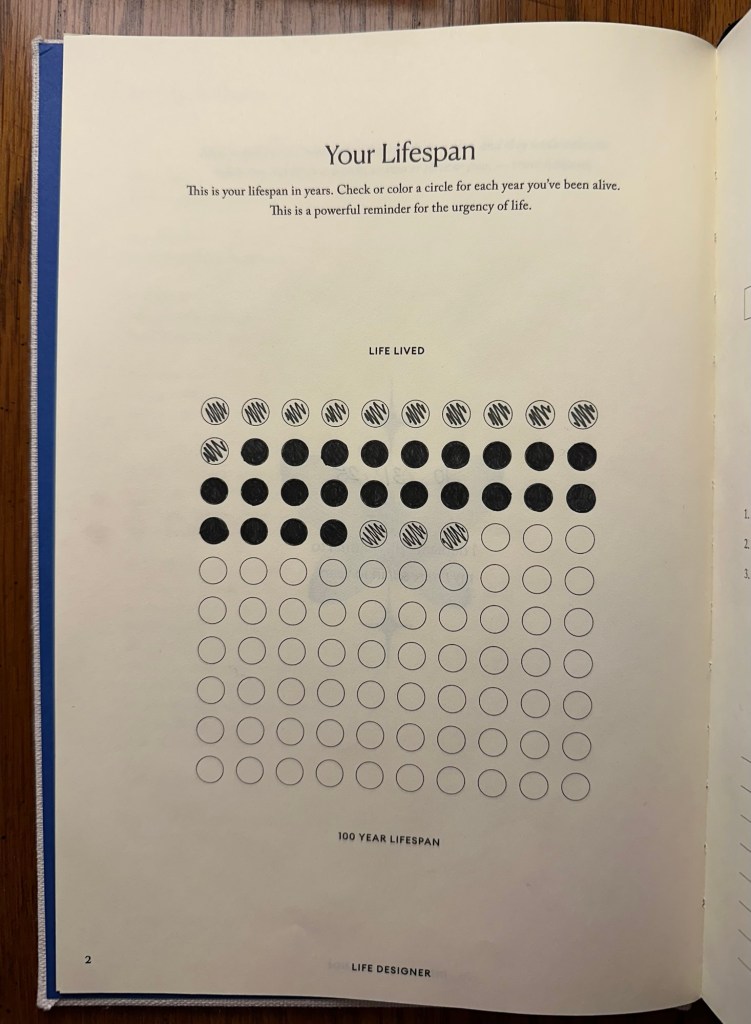
Even if I live to be 70 or 80 I still have a lot of life ahead of me. The first time I posted this page I did it wrong so this is a new photo. Also, I decided to black out the years that I was in the closet. I cried for a moment when it sunk in that I’ve only lived around 15 years of life not in the closet. Hiding took such a toll on me that I need to label those years differently. Also, being in the closet delays adolescence (like what a 15 year-old would be experiencing) so the past three years have looked very different than they would for someone who is not going through that.

It’s exciting to think about the people and places that will be a part of my life over the next ten years or more and a little sad to think about the people and places that won’t. Making choices is part of the deal – even in ten years I can’t have it all, but with intention I hope to have a life that I want. I’ve only just started this workbook, and, based on the witch’s advice, I would like to finish it between now and the Winter Solstice.

With the seasonal shift toward intentions, I also thought about books I might like to read over the next 12 months. I’ve pulled together a stack that I’m pretty excited about and replaced the one under my side table that has been sitting there for months (years?), mostly unappreciated. This new stack was chosen more carefully and I’d love to actually see the stack tick down as I read each one and the shelf empty by the next Samhain, 2026.
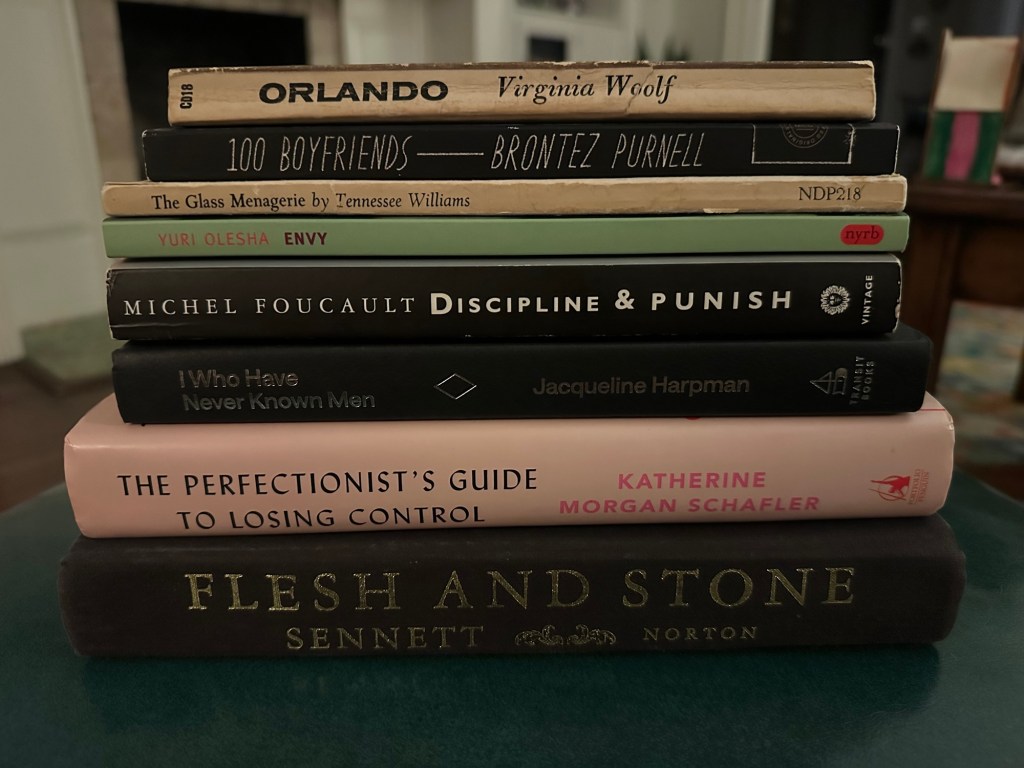
I started the Foucault and Sennett books around 2008 and 2011, respectively. I’ve only read the first chapter or so of each, but they have both been so influential to how I think about things that I’ve decided I’d like to finally finish them. Along with those two books, Orlando, 100 Boyfriends, and The Glass Menagerie continue to round out my gay literature cannon. I Who Have Never Known Men and Envy (a personal problem, unfortunately) are two foreign language books I’m looking forward to. Finally, The Perfectionist’s Guide to Losing Control, a book I started during a hard time last year and have decided to pick back up during a new season of loss.

So much of this post may seem like I am trying to control my life, but I really do want to lose control more than anything. I want to let go of legalism, perfectionism, and self-criticism, especially. I am not going to feel like a failure if I don’t read all these books or achieve the life I envision exactly. I just know that there are some things in my life that almost never feel like work (even when they are work). I desire/intend to do much more of the work, to spend time with the people, and to inhabit the places that give me that kind of energy over the next 40 seasons of change.

Thoughts on Richard Sennett’s “Flesh and Stone”

The other day I read the introduction to Richard Sennett’s, Flesh and Stone: The Body and the City in Western Civilization. What an incredible piece — perfect example of why I love introductory essays.

Sennett here is writing a history of the physical aspect of life in the cities I have been learning about all my life: Athens, Rome, Paris, London. He isn’t interested in an intellectual history: just a bunch of Western thoughts traveling along from one place to another. Instead, he writes, “I was prompted to write this history out of bafflement with a contemporary problem: the sensory deprivation which seems to curse most modern building: the dullness, the monotony, and the tactile sterility which afflicts the urban environment.” With the context of history, Sennett introduces us to the ways citizens have lived differently in the past and the role of the city in protecting and facilitating human interactions.

Additionally, Sennett conjures a common conflict within this history that sets Western cultures in opposition to the body. He writes, “Western civilization has had persistent trouble in honoring the dignity of the body and diversity of human bodies …” from the Greek ideal of male athletes to the multicultural communities of modern Greenwich Village (15).

Consistently returning to the current experience, Sennett writes that rather than interacting with other people while accomplishing daily tasks, even literally bumping into them, many of us live from one contained space to another: the home, the car, the office.

Today, more sensory experiences are now consumed with little required input. Pleasure and pain are most often experienced through television, movies, and video games and even the greatest cities are most often viewed through the windshield of a car. Distances that once involved hours and innumerable human interactions now require only 10-15 minutes of driving. “Both the highway engineer and the television director create what could be called ‘freedom from resistance.'” Sennett is writing from the vantage of this society we’ve created for ourselves in order to prevent unplanned, unwarranted encounter. “Thus the new geography reinforces the mass media. The traveller, like the television viewer, experiences the world in narcotic terms…” (18).

After looking through my books, multiple friends have commented that the large font of Flesh and Stone “stands out” on the shelf or that the title is “weird”. I think Sennett (or his publisher) chose the title partly in order to make people uncomfortable. The fact that it sounds sort of like an adult romance novel is definitely connected to Sennett’s thoughts on contemporary life and our discomfort with even the word “flesh.” Sennett is concerned for the experience of the body in the city in and most importantly the way that social behavior reinforces social connection far more than in merely romantic terms. He writes, “much as today in small southern Italian towns a person will reach out and grip you hand or forearm in order to talk seriously to you” (21).

When I read that particular example I was struck by the simple idea of it and how far it is from normal behavior among my friends and family. Sennett writes to teach us about ourselves and the lives that we live, sometimes prescribed by urban design and other times by cultural tradition we have forgot to even notice

Finally, Sennett concludes with a personal note about the origins of his research, particularly within the context of his friendship to the late Michel Foucault. When they began in the 1970s, he writes that Foucault envisioned human bodies as constrained by tradition, culture, and “choked by the knot of power.” But as he observed Foucault in his last days, Sennett noticed that the fixation on power and control began to relax. As a result, the book that he completed is not the research that Sennett began decades before.

Particularly, he pushed his research beyond simply the realm of human sexuality and, to honor his late friend, embrace the numerous aspects of life that provide meaning and value. He writes, “If liberating the body from Victorian sexual constraints was a great event in modern culture, this liberation also entailed the narrowing of physical sensibility to sexual desire” (26). This narrowing, to Sennett, is no longer necessary or helpful toward understanding human social interaction. As in the example from Italy (I think the Instagram account @notmynonni is a fitting connection here) there are a million meaningful moments in a life that deserve our attention.

Ever-committed also to his hope in the potential of the city, Sennett writes from the Judeo-Christian perspective that the body is connected to the spirit, valued and important. Although I don’t think Sennett is a Christian today (in more recent interviews it seems like he identifies as a secular humanist), at the time of writing this book he identified as a “believer” and acknowledged this perspective in his research. While conceding the Biblical idea of “the fall” and great separation between humans (loss of trust, for example) he also shares the way that his faith weaves into his research and his own stubborn optimism.

Somewhere between the chaos of the past and the isolation of modern life, Sennett ultimately writes, “to show how those who have been exiled from the Garden might find a home in the city.”