From an early age, I considered sexuality to be primarily a spiritual issue. The Bible and the church were the only sources I could consult on the issue of sex and sexuality. I accepted it as an implicit truth that it was a sin to be anything other than straight (even for a moment), but beyond just a sin, it was a shame. A shame on yourself, your family, and all kinds of things could go wrong if the secret were to be revealed.
As I have come out of the closet, I have allowed aspects of myself to finally relax in ways that I wasn’t ever able to do. I have allowed myself to embrace my gay cultural interests. I have allowed myself to embrace my gay social, relational, and style interests. But for a long time I was still repressed in my intellectual life. Even as I started to read and watch and embrace gay culture, my brain wasn’t thinking critically about any of it in the way that I have loved to think about so many other things. Over time I have realized that I trained my brain to immediately set aside any thought that might have been deemed too gay to share. These thoughts were set aside long before they could form a sentence or an essay or even just come up in conversation. With some conscious effort I’ve started to catch myself just before setting an idea aside. With encouragement, I’ve started to write these ideas down as blog post drafts. I’ve started to accept that I have tons of opinions on gay culture, history, humor, and theory and these have always informed how I see the world even before I was aware of it.
Becoming aware of my own thoughts has been a process of liberation. When I lived in fear I was trained to contain myself within the boundaries of a homophobic culture and religion. Being liberated from that culture and religion meant truly believing that they had no control over my life, present or eternal. Once liberated, my mind still needed acceptance and exposure to gradually become confident enough to start to share. Friends, family, and significant others have been a safe haven for me to share as well as a source of inspiration, new directions, healthy disagreement, and perspectives.
Early on in my coming out journey, a friend (we love our straight allies) shared with me a beautiful speech by Stephen Fry on the significance of Oscar Wilde. I was so incredibly moved by aspects of the story of Oscar Wilde that I had never heard before. I was also moved by the confidence of this gay man who was able to inform his interests with his personal experience while still maintaining a level of intellectual rigor. I had been extremely aware of Wilde as a teenager, I knew he was gay or at least rumored to be gay, and I noticed whenever I saw his name or a picture of him. Despite my obvious interest, I consciously avoided Picture of Dorian Gray my senior year and even avoided talking to classmates that read it. Instead, I chose to read (most of ) the more socially acceptable Crime and Punishment. I was somewhat interested in Dostoyevsky and the book was interesting, but I really didn’t enjoy reading it and I wasn’t really excited to research the life of the author and the cultural themes of guilt, mental illness, etc. I was actively suppressing my desires – I didn’t even know what it felt like to do otherwise.
More recently, I finally did read Wilde’s famous novel and loved every page. Looking back I wonder if I would have been thrilled as an adolescent to find a book that was so personally engaging and to read about an individual with a story and a sexuality that I could relate to. If at that young age I had read Wilde instead, would that have changed what I studied in college and grad school? Would it have affected the direction of my career and other life choices? It’s cathartic to reimagine the past in a way that was more free, accepting, and intrinsically motivated. A past where I trusted myself, listened to my heart, and shared what was on my mind. I’m not regretting the choices I made, I’m wondering how I can change the way I make choices today and going forward. Along the way I have been grateful to receive book and movie recommendations that have given me so much joy, catharsis and perspective.
I’m early in this journey of allowing myself to be gay intellectually and at times it’s been a little embarrassing to feel so behind. I know I’m not quite ready to be a critic because I’ve loved nearly everything I’ve read and basically every gay story makes me cry. Even the acknowledgements section of some books has made me cry as I have considered the partners and community that support an author in their work. I have more emotions to release than I could have ever imagined. At the same time, while my heart is being nourished, my mind is being coaxed into the light, invited to make connections and observations, compare books and movies, consider timelines, politics, cultures, and geographies. With the desires and emotions of my heart, I also care personally about these issues and feel strongly about them in a way that I think will make the intellectual work come naturally – I don’t have to convince myself to be interested.
Over the past few years my brain has finally started to naturally make connections . I have wondered about the political usefulness of homophobia for blackmail, the lasting cultural affects of France and Italy being some of the earlier European countries to decriminalize gay sex, the connection between replacement theory and the religious demands of procreation. In general, these have been passing thoughts, but eventually I think they may start to become something I would write about and share. Before coming out, I didn’t even have a base of knowledge to draw from, a sense of what has already been explored, and references to help me understand. Now that I’m out and exploring I’m excited to write, and speak, and live more from the heart as well as from my mind. My primary goal right now is to enjoy myself and the journey. I have a lot of energy, previously spent on repression, that I am more than happy to put to a better use.
There is a scene in Yes, Daddy that I think about every once in a while. Jonah, the main character, is on the beach with a man who is holding him captive in his house compound nearby. While they walk, Jonah sees an old friend from work. The friend is with another guy who Jonah learns is his boyfriend. In that moment, Jonah is trapped in his life psychologically, physically, and financially, in contrast to his friend who is free, authentic, and enjoying what appears to be a mature, healthy, romantic relationship. They are on the same beach, but they are not the same. Jonah was trained to be controlled, through religion, he was trained to give up agency, he was trained to look for a savior. He had chosen to leave the city and ignore this friend – he had actively sought out the man that had taken his freedom away. Throughout the book, you realize that Jonah doesn’t get to do the normal “boyfriend thing,” he doesn’t get to just enjoy his life. Those things are a fantasy. They are like a movie he is watching. It is impossible to climb into the screen and join them. He can’t even be sure that he would be happy and satisfied there if he could.
I remember almost every interaction I ever had with a gay person (or someone I perceived to be gay) while I was in the closet. In high school I remember a student that I didn’t know looking at me in a way while I showered (in my bathing suit) after swim practice one night. I remember the younger brother of a classmate talking to me in the hallway near the auditorium and poking his finger into my chest in a way that made me feel uncomfortable. I remember a phone call with a guy who had moved to Tyler after Hurricane Katrina – he said, “you’re mine and will always be mine,” or something like that – while I talked to him on my cell phone under the taxidermied cougar outside the school gym one evening during a basketball game.
I remember two guys that I shopped near at a J Crew over ten years ago. I remember a guy in an a Capella group in college slapping my butt while we played beer pong, the stranger that dropped his number on my table at a coffee shop a week before my wedding. I remember inhabiting gay spaces, a gay sports bar in DC, a gay bar in Charlottesville. I saw gay wedding announcements, watched YouTube videos of guys dancing so freely that I cried. All of these moments were very unsettling – I wouldn’t say they were traumatic, but for each of them I remember exactly where I was standing, details about my surroundings, the time of day, who else was there, etc. I was “faking it” for a lot of my life and these moments called me out on my bs.
In all of these interactions, what was so unsettling was that I felt like I was being truly seen. I was being pulled into reality – like they were actually kind of waking me up from my disassociation. As I came out of the closet, the closet followed me. The fear, the self-criticism, the willingness to give it all away, the lack of faith that happiness is something truly accessible to me. As I entered relationships, entered new spaces, even physically connected, I felt like there was always this layer of cellophane between me and that world. It had a shimmer. I was sometimes very stressed out on the inside and I had a hard time recognizing all the feelings I was feeling much less actually acknowledge them in the moment. Even as I was being warmly welcomed I felt like I didn’t really belong, not just in their life, but in their reality.
I can’t say exactly why I felt these ways. I’ve given myself permission to not always know (or try to know) why some things are the way they are. I am certainly working through personality and attachment issues that exacerbated these feelings for me vs. potentially other people coming out of the closet. These feelings affected my relationships in ways that I very much want to resolve – through work and also by just living more life. It was overwhelming in those early days to be face-to-face with a life that I had denied myself, that was denied to me, that to an extent I didn’t even know existed.
One unfortunate aspect of repression is that I sometimes forgot other people were struggling as much as I was. Early on, gay life seemed so desirable and gave me so much energy that I couldn’t even imagine why someone out of the closet would be unhappy. Repression inflated the sense of freedom I assumed they were experiencing. It also prevented me from realizing how hard they had worked to have the life they lived and how much energy it required to maintain it.
On the other hand, it’s also true that they were even more free and uninhibited than I realized. Grief has come to me in waves over the last few years as I have realized how much I gave up by staying in the closet: the places, events, organizations, friendships, and experiences I denied myself. In some ways it was easier when I was in the closet and didn’t know how much I was missing out on. Although staying in the closet kept me safe and did preserve a small measure of inner peace, but it was extremely fragile. As much as I tried to avoid queer culture to preserve that inner peace, it was impossible to really maintain that distance. I regularly caught glimpses of articles, Instagram accounts, or people that reminded me of what I was missing out on. Over time, these moments all added up to a deep and secret sadness I carried for so long I nearly forgot about it. The more I have opened up my life the more I have grieved everything that I missed. Early on, I cried all the time as I let go of deep layers of pain, loneliness, and sadness. The grief has been a relief and a release. It has felt healing and life-giving. Grief comes with any loss and the greater the loss the greater the grief.
Coming out of the closet for me has been a little different from traditional grief because it is grieving something I never had in the first place – something I didn’t even fully comprehend. Seeing gay life is reckoning with its existence, it’s beauty, it’s sadness, it’s joy. Even though it seemed inaccessible, it was always just around the corner, it was even in the same room, at times. I could have taken one step, could have reached out to touch it, could have changed course with just a few simple words. But I didn’t. I had been taught to be afraid, taught to perform. So, instead, I froze, I cried in secret, laughed in secret, listened to music in secret, constructed a world just for me where I tried to feel safe and happy. My life in the closet was “real,” but I was not fully participating in it so it’s also true that it wasn’t really “mine.” The straight world was also an experience that didn’t fully belong to me. It’s crazy how something can be both boring and stressful at the same time. Many friendships were born during those years that gave me life, many memories gave me joy, but much of it also gives me sadness and all of it feels like a bit of a dream.
As I have come out and taken steps to live honestly I’ve had the funny realization that my life is now a fantasy to someone else. I’ve been to gay events and destinations, I’ve read books, watched movies, made friends across the country, found and lost love, found pleasure and joy. Although they feel fleeting to me still, these moments are becoming less the exception, and more secure, more predictable, more comfortable. I have found a measure of freedom that is outside the grasp of many people. There are some who aren’t even free within themselves. Others may feel like they have invested so much time and energy into their closeted life they would be giving up too much to let it all go. They might break under the weight of their grief if they opened that door – at least for a time it might feel impossible. But holding on to that life requires constant attention and effort that seems to never provide anything in return. And many of the things that seem impossible actually become the most natural thing we have ever done.
When I finally started to come out of the closet, one of the ways that I processed my story was by reading through old journal entries.
So much has changed over the years and looking back has helped me connect with my younger self as well as understand why and how I managed to stay in the closet for so long. One particular aspect that feels important is that I had a long-term relationship with a “Christian counselor.”
The person I saw is a licensed therapist, but we always called what he did “Christian counseling.” And it did feel different from the therapy that I’ve experienced more recently. This post is not to drag an individual, but I am definitely critical of the idea of Christian counseling overall.
My main critique is simply that much of the “Christian” aspect is not based on research or best practices. For instance, here are some ways that Christian counseling is different from therapy in my experience:
My counselor prayed for me at the end of every session and asked that God would support me in my struggles. Prayer is seen as an encouragement, but in my experience it was often a way for me to give up control of my life to God. This prayer at the end of the session may have had the effect of undoing some of the progress I had made to become more self-determined.
They very frequently related my problems to “the fall” which basically means that my problems were a result of my “sin nature.” The emphasis on sin and “the fall” may have reinforced the feeling that my problems in life were intractable. In other words, I was not empowered to solve them.
My Christian counselor seemed a little too comfortable with my suffering. They did not really seem to think of it as something that needed to be fixed. Some things could be changed, but in general, Christianity and Christian counseling taught me that suffering was good for me, that it is God’s way of testing our character, and, bizarrely, that it means we are doing the right thing because God is teaching us something through the suffering.
I don’t remember them affirming my sexuality in a meaningful way, preferring to make general statements that were not untrue, but also not very helpful like, “It’s always going to be a part of you.”
One phrase they repeated many times was that “every man feels like they aren’t enough and every woman feels like they’re too much.” This was mentioned in individual therapy as well as in couples therapy. The idea apparently comes from God’s curse of Adam and Eve in Genesis which I might try to unpack in another post. For now, I’ll just say that I don’t typically find generalizations around gender to be helpful and that these kinds of religions aphorisms often end what could have otherwise been a productive inquiry.
When I first decided to start seeing a Christian counselor (with much encouragement), I was so scared to talk about my personal life that it certainly came as a relief to find someone I could trust. I needed a lot of help and in many ways found the support that I was looking for. It was even somewhat affirming to hear things like the idea that my sexual attraction would always be a part of me. I was raised to think of sexuality as something that could change so in this sense, I didn’t technically receive conversion therapy. I feel like what I received was more similar to the hypnosis in “Get Out.”
If you haven’t seen it, the general premise of the movie is that old, wealthy white people pay to have their brains transplanted into younger, Black bodies so that they can be active and young again. Before the transplant can happen, however, the victim had to be hypnotized so that their consciousness is sunken to a deep part of the brain stem. With the completion of the brain transplant, the consciousness of the older person has essentially replaced that of the younger person – they think, talk, operate the body, etc. But the hypnotized consciousness is never fully removed. It stays in the brain stem unless it’s triggered by a flashing light like that of a camera and the trapped person escapes back into their body (very dramatically) until they are hypnotized again into the subconscious.
In discussing drafts of this blog post with friends (both gay and straight) I received encouragement that the metaphor was helpful for understanding their experience in Christianity. Many aspects of our lives can be suppressed and there are triggers/moments when we wake up to realize we aren’t really the ones living them. One time in grad school a classmate told me that when he first met me he thought that I was gay. I was shocked and I completely froze in the middle of our conversation – I have no idea what I even said in response. Years later my therapist (not a Christian counselor) asked me if I thought I had disassociated. After some thought I told him that it was actually the opposite – I had been disassociated and his question has brought me back into myself. I was just too afraid of the world to say anything.
I have thought about the sunken place and identified with the idea of it for many years. One thing I want to add is that when I was in Christianity there was a part of me that wanted to stay in the sunken place – out of fear, self-preservation, rewards in heaven, etc. In that sense, the Christian counselor is sort of a co-conspirator in the sunken place. They know that the liberation queer Christians seek in counseling is constrained by the rules of their shared faith so they help their clients find significance and meaning within the sunken place rather than providing them with the tools they need to get out. I do believe that this is why I felt safe with a Christian counselor, but also why I eventually grew out of the limited support they were able to provide.
Even though my counselor and I agreed my sexuality would always be with me, the agreement was that it shouldn’t need to “dictate” my decisions or be a significant part of my life. In our conversations, my sexuality was more of a “thorn in the flesh” kind of situation where it would be something that God would use to teach and humble me. My counselor encouraged me to talk about it, but not in the sense of coming out. It could just “be there,” under the surface, suffering silently, for my entire life. The Christian, I was told, is divorced from their sexuality.
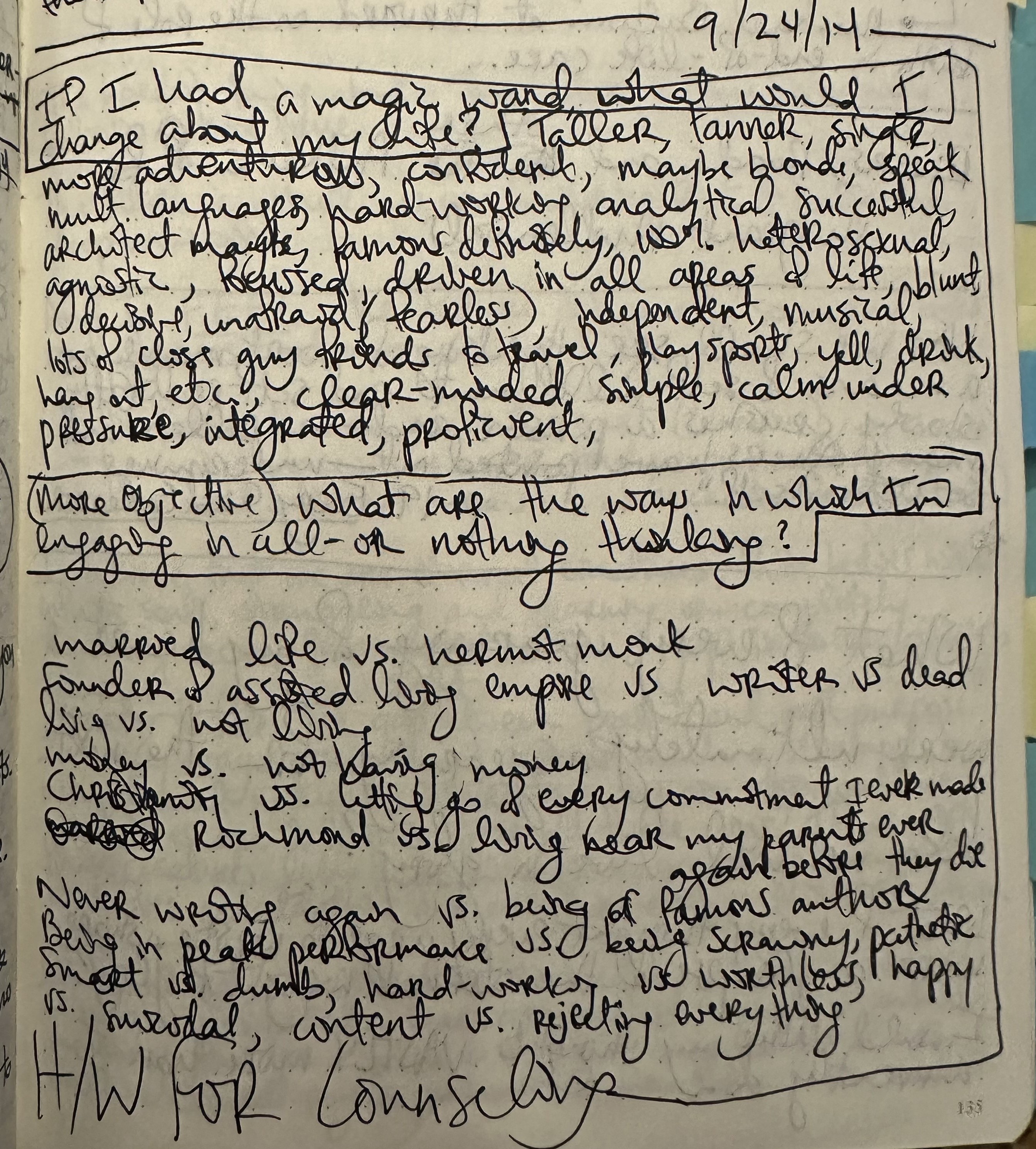
When I was 26 years old I wrote the reflection below as homework for counseling. (For a link to a transcript of this handwriting, click here.)
I was very clearly holding on to a lot of internalized homophobia, but I do not remember my Christian counselor seeing this as a problem or helping me to recognize and let go of it. “If I had a magic wand,” I wrote, I would have made myself “100% heterosexual.” I was struggling with body-image issues, self-criticism, and a general lack of confidence. I wrote that I wanted lots of close guy friends, but had to couch it in masculine terms like “play sports, yell, drink” rather than just say I wanted to be around men because I wanted to. I couldn’t say I wanted to dance with them, kiss them, laugh with them, go to the beach or Broadway, etc.
Looking back at this entry I am reminded that I talked and wrote about my own death a lot in those years. I felt trapped by my life. Rather than encourage me to come out of the closet and let go of my fears, I was encouraged to pray about my sadness, share my story with other Christians, and keep my life moving forward trusting that God would figure it out for me along the way.
Instead, I wish I had been encouraged to take risks and actually listen to my needs in a way that might have helped me find a supportive community, my voice, or a life that I desired. I am grateful for the safety of my counseling experience. I also can’t help but feel like during those years I was drowning and every time I came up for air my Christian counselor gently pushed me back under water.
I have at times considered my experience in religion as a kind of brainwashing, but as I’ve reflected more (and read some critiques of the idea of brainwashing) I’ve become more specific about the ways I was shaped by religion as I experienced it. I believe that my religious life resulted in a decreased self-esteem, inability to listen to my intrinsic desires, and a fear of the outside world that left me overly cautious in my decision-making, isolated from my community, and overwhelmed by the pressure of evangelism.
Maybe a more accurate and contemporary term would be that I was groomed. I was groomed to look for someone to take care of me, handle all my problems, and essentially to live my life on my behalf. I was groomed to give up agency, blame myself for my problems, and wallow in my sadness rather than solve my problems and move on.
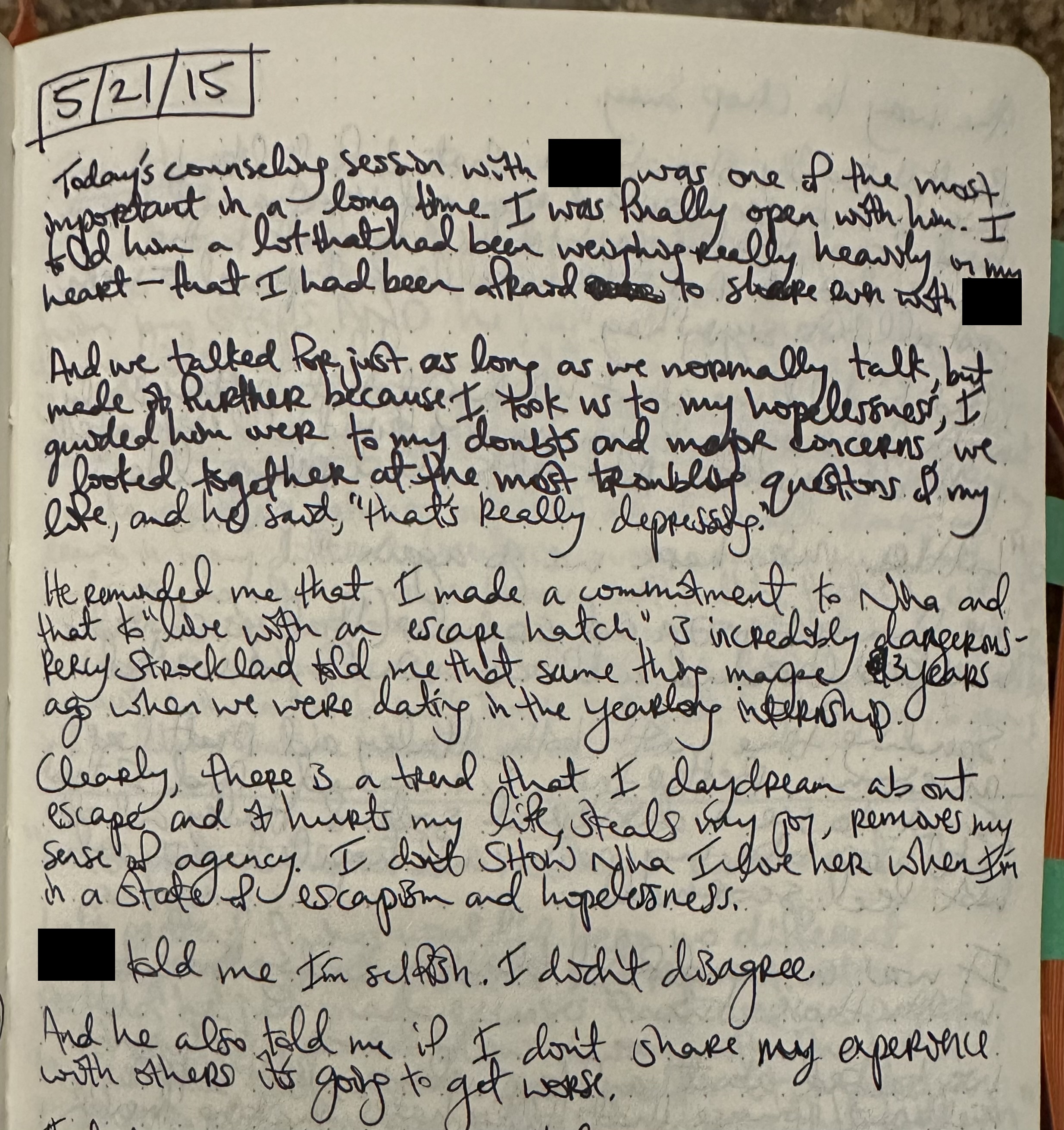
Below is a journal entry where I reflected on a time when I shared more with my counselor about my sexuality (with their name covered) and “felt a peace” about my life despite my reservations. (For a link to a transcript of this handwriting, click here.)
Looking back on this journal entry after coming out I wrote “WHAT THE FUCK” on a Post-it note and stuck it to the top of the page. It’s painful to remember how repressed I was and sad to see how much it affected my quality of life. These journal entries seem like moments when I almost made progress then, with encouragement from my counselor, recommitted to the status quo. I wanted to change my life, but I was too afraid to do it. Instead of help me push through the fear, I was told that I was selfish and reminded that promises are binding for life.
It’s weird to think that sadness, loneliness, and hopelessness could be interpreted as selfishness, but within the context of Christianity it does make sense. Your life exists for the glory of God and longing for anything other than the life you’ve been given is placing your own self-interest above God’s plans. This perspective fit into my worldview at the time and I didn’t question it.
I also think that I accepted what they told me out of self-interest and self-preservation. I was overwhelmed by the amount of change that might occur in my life if I actually came out. I thought the whole world would fall apart. I thought I would be an embarrassment to my family, and I was probably even afraid of losing my marriage. My spouse and I had become huge sources of support for each other over the years and our relationship felt too important to lose.
In reflecting on this journal entry, I wish the person counseling me had told me some of the lessons I have learned since we ended our time together. I wish they had told me that clear is kind, that love cannot exist without honesty, and that my partner and I were strong enough for the truth that I was holding in my heart. I wish he had told me that I needed to let go of the responsibilities and obligations I felt to everyone but myself.
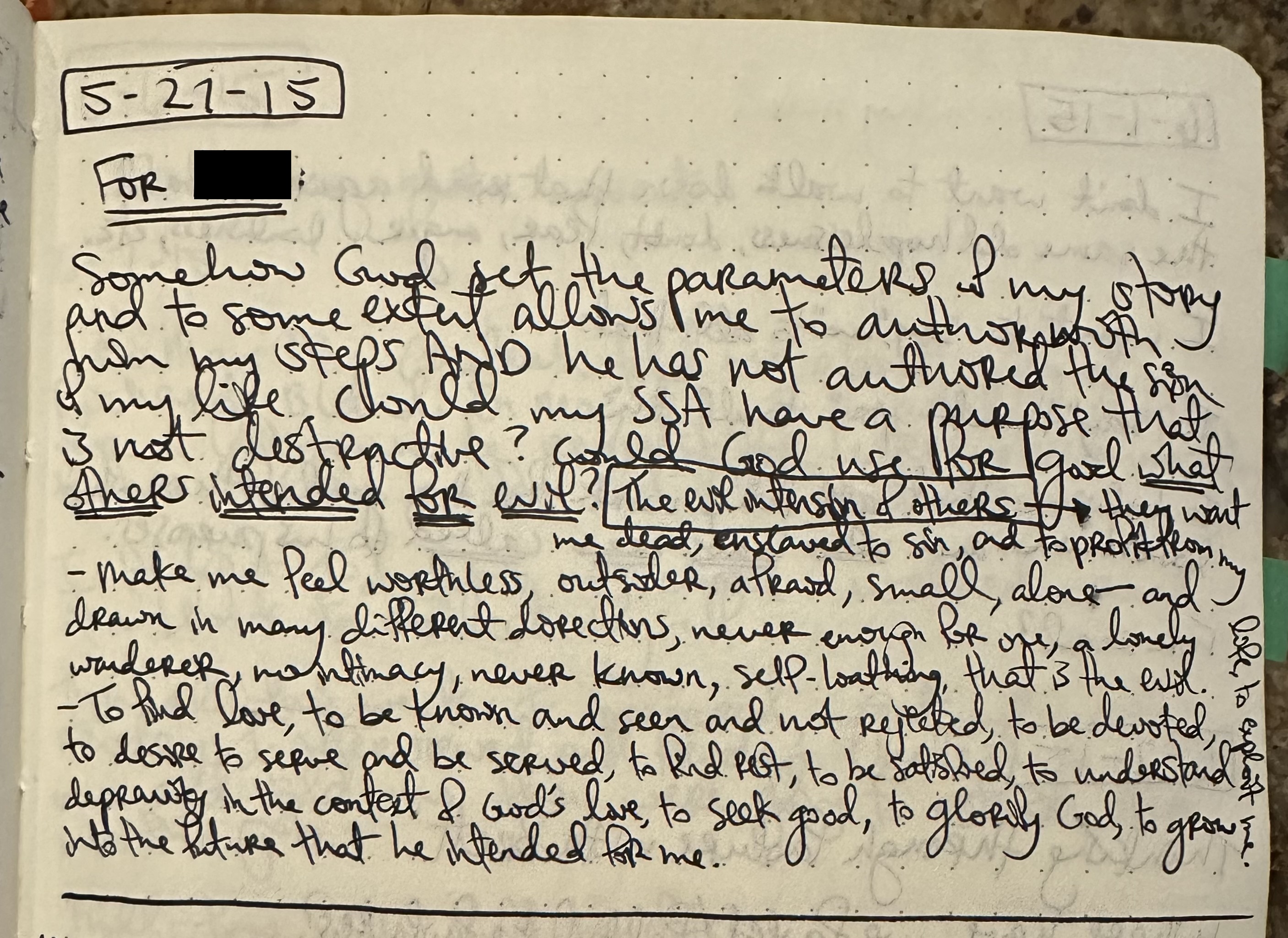
The next journal entry is a reflection I wrote in advance of counseling or as homework after a counseling session. (For a link to a transcript of this handwriting, click here.)
In this reflection find myself, once again, giving control of my life to God and hoping for the best. God “set the parameters of my life” and I was trying to accept that and believe that these parameters were placed in my best interest.
Part of what made God’s plan good, I thought, was that I was being protected from the LGBT community. I had been led to believe that the LGBT community was dangerous and essentially evil. I write, “they want me dead, enslaved to sin, and to profit from my life, to exploit me.” I had been taught to have so much irrational fear towards the very people who might have wanted the best for me. As I have come out of the closet I have not felt worthless, like an outsider, afraid, small, or alone. I have felt the exact opposite. I have felt understood, safe, and affirmed. All this fear of the outside world feels a little cultish actually. I was isolated from my community, too afraid to explore and find out whether happiness could exist outside the world that I had known.
One thing I’m still thinking about after reading this journal entry is how I believed that I could only feel “known and seen” within the context of Christianity while I was very fervently (consciously or unconsciously) holding back a huge part of my life. How could I believe that coming out of the closet and joining the LGBT community would make me feel “never known” and “self-loathing” when the opposite is so obviously the case?
It’s a bit of a mindfuck, but after some reflection, I think I have finally wrapped my head around it. I think Christianity successfully convinced me that my sexuality was not a part of me, and that actually much of “me” was not a part of me. Instead, my true self, the one that mattered, was the ideal self that God was theoretically transforming me into.
So I could truly believe that I wasn’t being dishonest or holding anything back from anyone while staying in the closet because I was sharing with the world what was true about me – what God had done in my life and the plans God had for my life. That was the version of me that I wanted to be “known and seen” and that was the only version of me that deserved to be known and seen. That was the version I could plan a future for. The rest of me was essentially disregarded as sin or evil. I was taught to repent of all of the bad parts of me and run away from them, to take those thoughts “captive,” and literally for those parts of me to die. In this way, much of me, not just my sexuality, was hypnotized into the sunken place.
If those parts of me including my sexuality had been killed/taken captive/left behind, then I wasn’t really hiding anything because it wasn’t there anymore. And if it “came up” every once in a while I just had to pray about it and ask that it would go away again so I could go back to living my true life as God intended – the only life that I wanted others to see and know. My dishonesty was completely justified, sanctioned, and encouraged by the Christian faith, at least in my personal experience of it.
It has been a painful, healing process for me to piece together these three artifacts from my past. For many years my journal was a safe space for me – one of the only safe spaces in the world. It feels very liberating to finally let these words out into the world as they always should have been.
I remember exactly where I was sitting when my older brother told me the story of Nicholas West. In 1993, when West was 23 years old, he was picked up just blocks from my childhood home, taken to a clearing in some woods outside the city, brutalized, and killed for being gay. His murder was deemed a hate crime, two of the perpetrators received the death penalty and one is still serving a life sentence in prison. Earlier this year, thirty years after a crime he committed at just 17 years old, he was denied parole.
I had always known intuitively that Tyler was a conservative place, but this story captivated me as someone who had recently come out of the closet and was still trying to understand my own childhood. In a sort of backwards way I feel affirmed by the knowledge of his story and my own self-preservation reasons for staying in the closet for so long. His murder likely sent a chilling effect through the community and I imagine kept many people from coming out of the closet and/or from supporting their children from doing the same.
His story also helped to explain a strange vision I had in the summer of last year, months before I learned about Nicholas. One weekend day, struggling to be a good parent, I decided to take my oldest to a flower farm outside of Richmond. They had hay rides, play forts, a huge dirt pile (his favorite), and all-you-can eat grilled corn (with Tajin of course). On the way to the farm, we happened to drive past a large pine forest. As I watched the parallax of tall, narrow trees shift to my right I had a very clear vision: I was running for my life through the forest, chased by counselors from the Christian camp I attended as a child. It was a mix between Sothern Gothic and the music video for the alt J song, “Hunger of the Pine.” If they caught me, they were going to drag me back and force me into the closeted life I felt I’d narrowly escaped.
The vision surprised me for how clear and intense it was. Although I was well aware of the culture of homophobia, I had managed to avoid the worst of it. Homophobia mostly came to me through casual phrases (it was the era of “that’s so gay”) or religions conversations like my high school teacher telling me that it was a worse sin because it was a sin “against the body.” The story of Nicholas, one of visceral hatred, was recent enough to be very much a part of the culture and collective memory of the place that raised me even though I didn’t know about it at the time.
Ever since I had that vision I’ve looked at pine forests differently. I grew up in the Piney Woods of East Texas and I have plenty of childhood memories in the tall, quiet, spaces carpeted with pine needles that choke out any understory so you can see straight through them. I think they are beautiful, but like everything in the South (and anywhere) they hold dark secrets, secrets of terror and violence. Terror has been used to control many communities and its effects last long beyond the actual event. Terror changes the way that affected people experience a place. Even when hatred becomes more benign, the memory of the violence serves as a threat that it could happen again.
I’ve picked up lots of articles on this story during my deep dives:
I also recently watched Lone Star Hate, a documentary about the story, embedded below:
I was only five years old, probably asleep under the glow-in-the-dark stars of my room, when Nicholas West was picked up at the park nearby. In some ways I wish I had known about his story at a younger age. I wish I had known about all of these stories, the gay community, the mentors I didn’t have, the history I wasn’t told. Part of moving forward is going back and making those connections when I get the chance.
I’ll be in Tyler in a few weeks and this story is going to be on my mind. I certainly hope to visit the memorial stone in the park where Nicholas was picked up. On a later visit to the area, I’d love to connect with anyone that knew him or was friends with him at the time. I feel really connected to his story and want to know more about his life before it was defined by someone else’s hatred. I’ve also considered scheduling a visit with David McMillan some day. At 47 years old, he still has a barbaric amount of time in prison ahead of him as he pays for his role in the murder. I want to know how he found himself participating in that crime and what he thinks about it today.
While I have a tendency to focus on the sad aspects of this story (and most stories), I have also been incredibly inspired. I have learned about organizations like TAG, Alphabet Army, and PFLAG of East Texas. As someone who chose to escape, I am so proud of folks who have managed to stay and have committed to changing the culture for the better – I would love to support and visit for one of their events some day. There are also seeds of hope in my own story. It was in a journal that I purchased from Pine Cove Christian Camps of all places that I first came out to myself in middle school. It would be many years before I felt safe enough to come out to my friends and family, but that journal entry, among the prayer requests and gossip, was always important to me and a sweet, salient connection to my younger self.

 Highways and Hallowed Halls