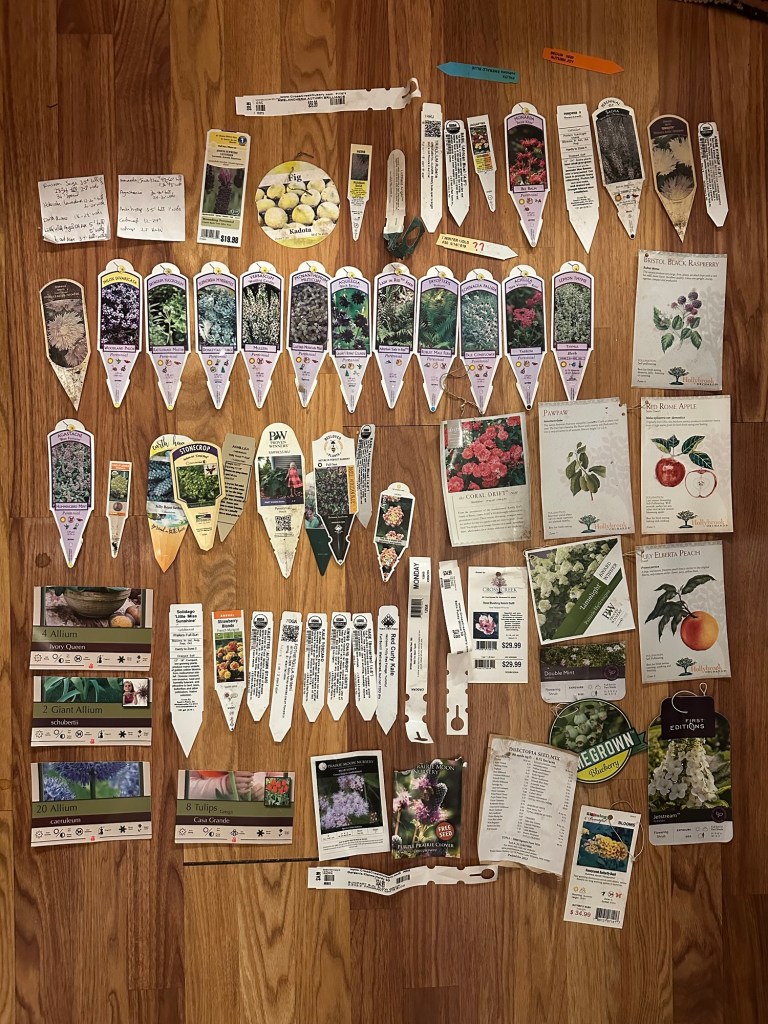
I was getting ready for a party recently when I decided it would be a good idea to clean out a random cabinet in the kitchen. I found these old plant tags from the early years of gardening our current house and couldn’t throw them away without snapping a picture. Some of these plants are still thriving, some have spread themselves around the garden, and many have died.
The COVID years of my gardening hobby feel a bit manic to me at the moment. I remember going to plant nurseries when we first moved in like I NEEDED to fill a garden while I was still overwhelmed with the idea of mowing the yard. It is also sweet to remember purchasing and planting each of these. It’s all part of the process – planting, growing, harvest, renewal. I’m still in the phase of winter (and parenthood) where the thought of plants and gardens is exhausting to me, but this little memory moment is giving me a glimmer of hope for bluer skies, buzzing bees, and the delightful surprises of a garden brought back to life.
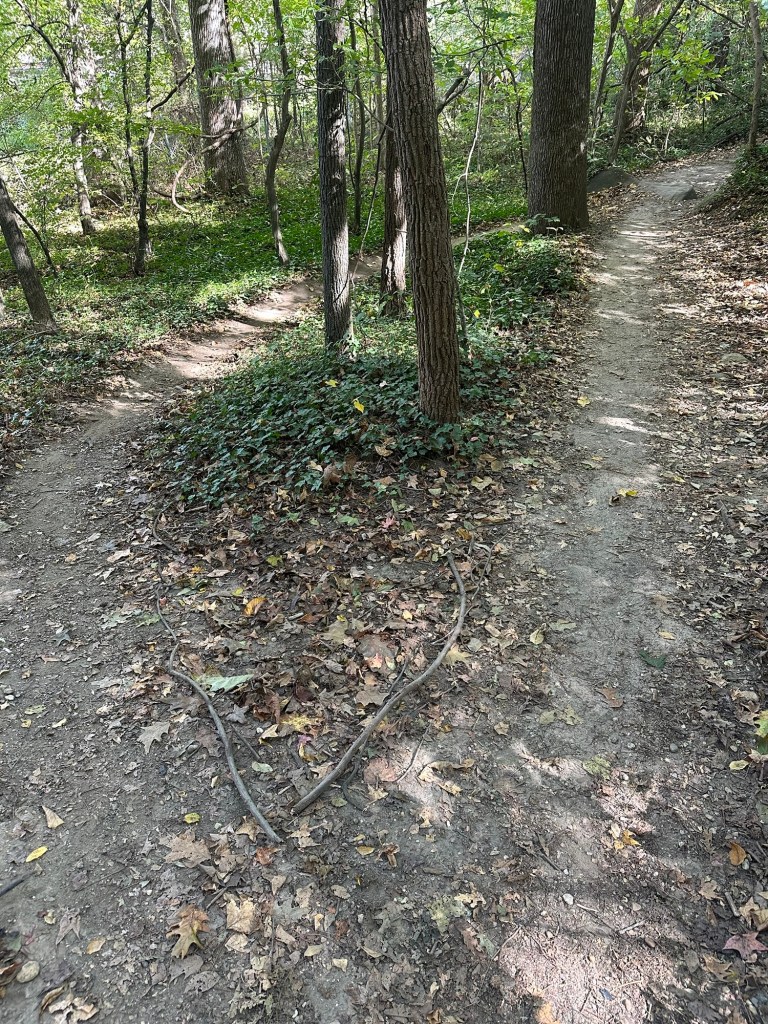
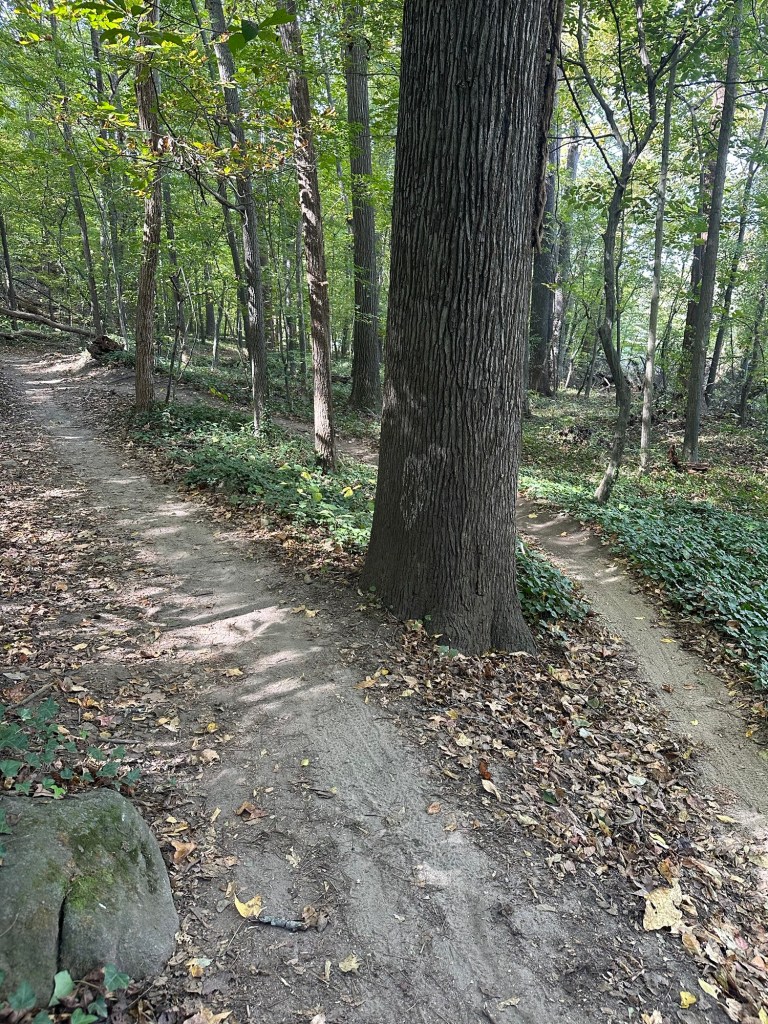
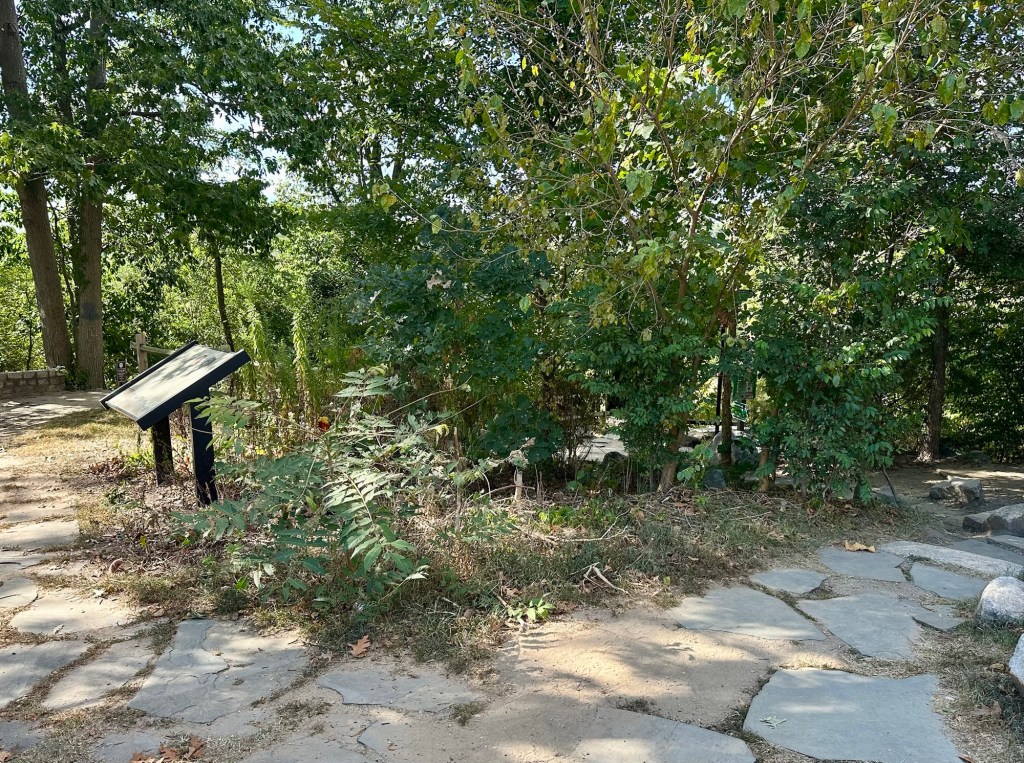
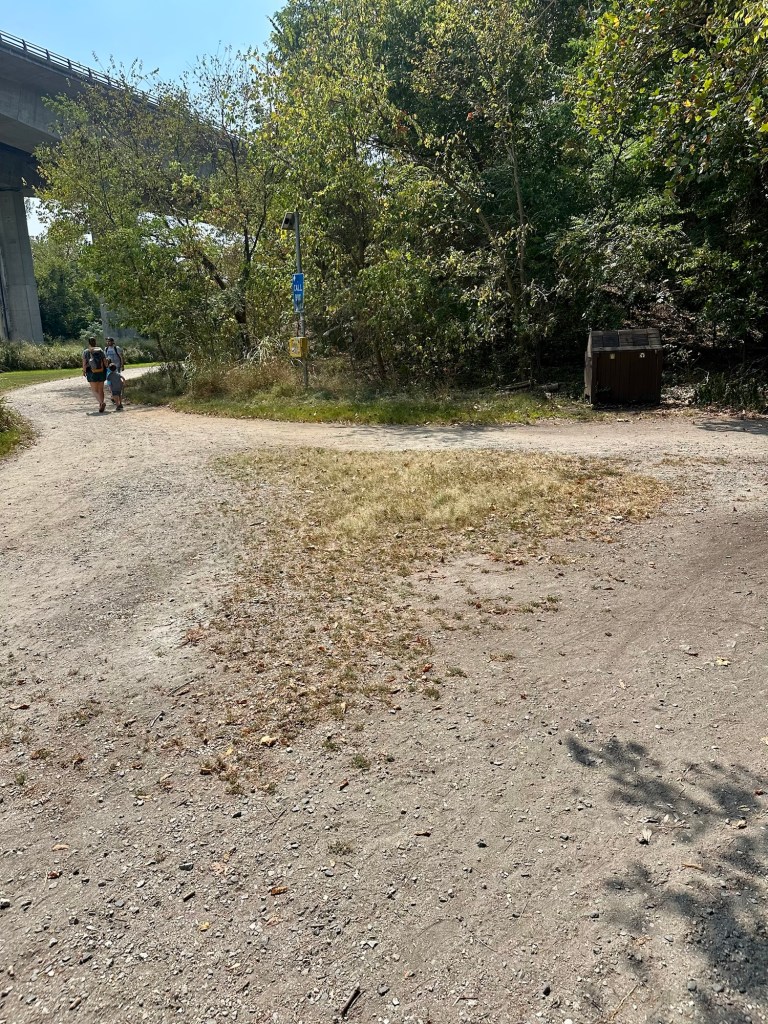
The other day I walked by this little island of English Ivy in the James River Parks System and dreamed about filling it with native plants.
Considering the size of the JRPS and the extent of the invasive species domain, these little slivers are exciting to me as a manageable place to start restoring the native undergrowth. I could easily dig up and replace this ivy in a weekend. It also feels strategic to start with these small protected areas deep in the forest – each established native plant will begin producing seeds and spores that will start to spread by the thousands.
These seeds and spores will build up in the forest seed bank so that any time the soil is disturbed (including when native plants are removed) the seeds will already be in the soil, ready for the chance to take over. It’s ultimately much cheaper than purchasing the seeds themselves and the sooner we get those plants in the ground the sooner they start to do that work.
I’ve already written some thoughts on this idea of rewilding the JRPS so I do have a grand vision for the area, but in general I am a piecemeal gardener. I usually prefer to work slowly, one section at at time, and whenever I see these little moments I can’t help but connect the dots and see the vision coming to life.
A little over three years ago, in the early days of fall, I noticed myself looking forward to the first frost. It had been a season of upheaval in my life and I was tired. Everything in the garden felt like too much: the tomato plants were enormous, mosquitoes continued to test my sanity, and even trees seemed tired from the growth.
I was excited for the cold-weather months. It can be a relief when everything outside looks like death and the work (for a time) is done. I looked forward to hikes and runs when you can see straight through the faded underbrush. What I did not know at that time, when the sunlight cuts across the landscape and flies and dust dance in the cool, dry air of harvest, is that in a couple of months I would lose one of my closest friends forever.
Unable to control the weather, I started to cut back in my own ways. I aggressively unsubscribed myself from email lists. My inbox had become overrun just like everything else. I also decided to stop drinking coffee. I noticed it was making me more anxious than focused, my mind a glutton for information, too busy with ideas and making connections to focus on tasks at work. With less caffeine I found myself breathing more deeply, crying more easily.
As time wound into winter, the landscape began to feel more manageable and muted. There were few weeds to pull, nothing to prune or harvest. During winter we find comfort knowing that nature is just resting, that everything is gone for a time, that there will be flowers and fruit again.
On the night of Christmas Eve, just past the darkest night of the year, I got a text from a friend asking me to call. I immediately felt that someone had died. When I finally reached her, she told me something unimaginable. After I got off the phone, I called another of my closest friends and shared what I couldn’t even fully believe myself.
Then all of the sudden, in my grief and loss, I wanted every bit of the chaos to come back. I wanted to get caught up in the weeds, the insects, the relentless advance of kudzu. The land, now bare and clear, felt more acute, more permanent, more extreme, life cleared out and put away. I wanted the change of seasons that felt familiar, the loss that turns back into life.
At the same time, I was grateful that I had been listening to my sadness over the previous months. I felt like my emotions were very accessible to me in the early days of grief and acceptance. Many times I wondered if leaving religion had also prepared me to grieve.
Sometimes I feel like religions treat death like it’s perennial or cyclical rather than permanent. They believe (and maybe I still believe on some level) that the person has been reborn instead of accepting that they are gone forever. This is just my personal experience, but it has always felt too soon, like a silver lining, to say that someone is in a better place before someone else has let them go.
I want to tie this up with some kind of “and yet” sentence where I channel my inner Margaret Renkl and talk about being grateful for the things that are going well, but it feels more appropriate to just accept and metabolize the loss.
Nature is full of metaphors of rebirth and renewal, but sometimes things do just die. Sometimes species go extinct. Climate change is looking very one-directional these days. So when spring came, and warmer temperatures brought ephemerals, buds, and other signs of life, he was still gone.
Summer followed and my friend was not here to enjoy the cool river on a hot, humid day, or whatever beach trip he had been planning with his family. Fall came around before too long and he wasn’t trick-or-treating or getting cozy on a couch. Then winter again and we all relived in our own way the experience of losing him that cold night. That is cyclical, I suppose. I am always grateful for the chance to remember him, see mutual friends, and let him go all over again.
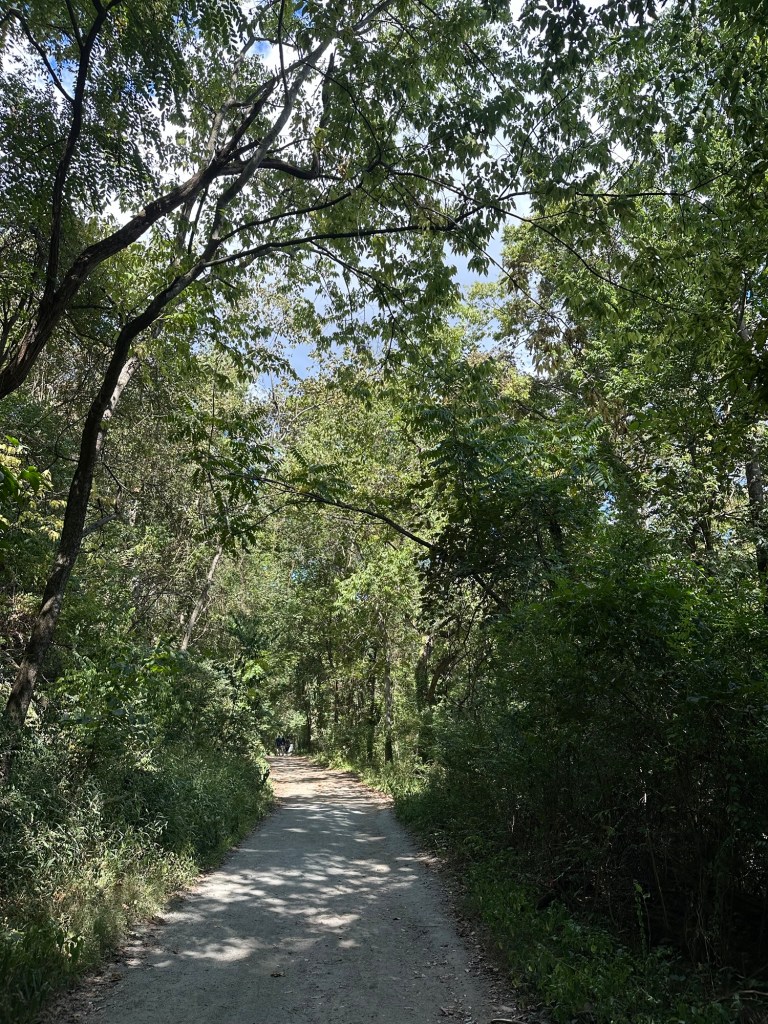
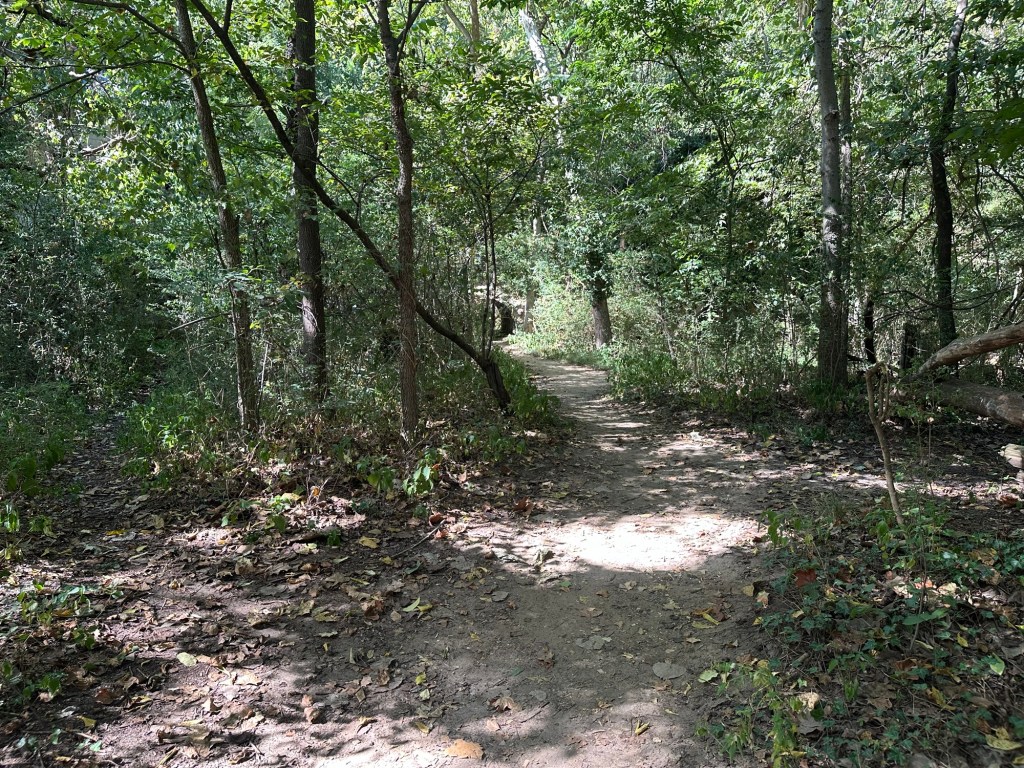
Over the past couple of months I’ve rediscovered the loop walk around Belle Isle. I’ve been spending time in more secluded areas of the river lately and had forgotten how beautiful it is with sweeping views, changing topography, and people everywhere enjoying the water and trails.
One morning in September, I also noticed something else: I hadn’t seen a single bumblebee on the entire walk. I started to look more closely and in two months I’ve only seen bumblebees two times, a total of four, all on bluestem goldenrod. Otherwise, the forests and fields of the island seem sort of oddly quiet.
Not only have I not seen many bumblebees, but I also haven’t other bees, wasps, butterflies, bugs, or birds like goldfinches, hummingbirds, and cardinals.
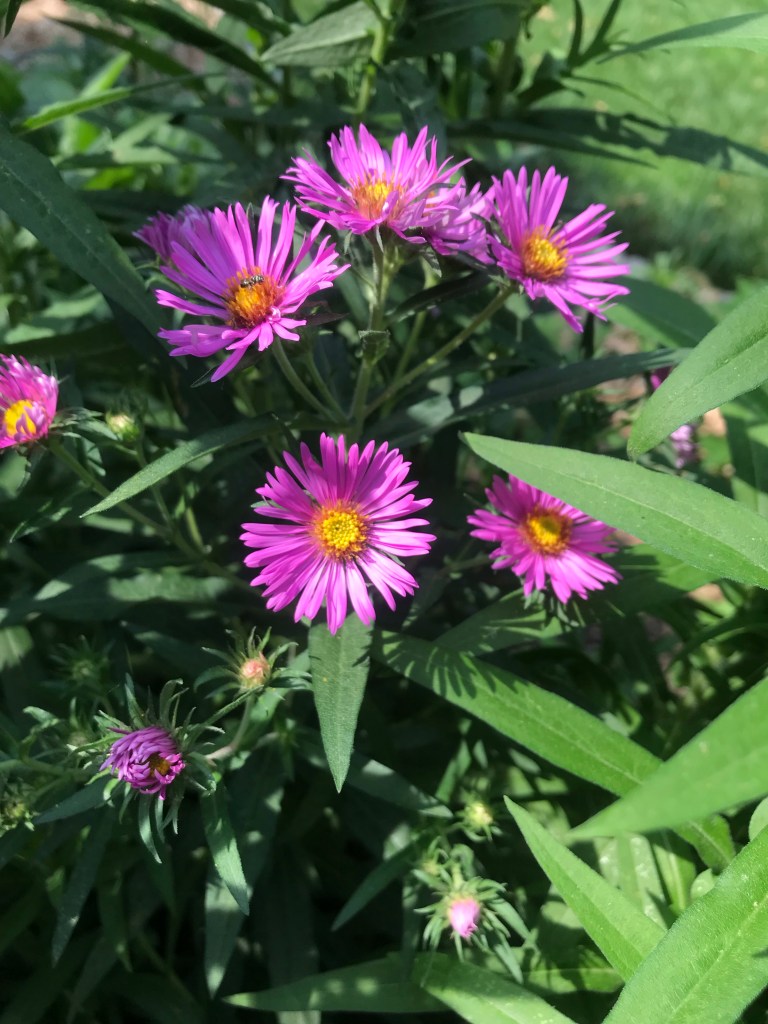
I think the reason I’m noticing this absence now is that I’ve been gardening for a decade or so and I love to see plants as a part of the whole ecosystem. Over the past six years especially my current garden has come alive in a way that gives me a lot of joy. I see more bumblebees on a single anise hyssop at the same time than I have on Belle Isle recently. For the past week, panicled aster (Symphyotrichum lanceolatum) has been in full bloom around my house and there are more bees and bumblebees than I could ever count. I see goldfinches eating coneflower seeds, hummingbirds on the cardinal flower, and monarchs on the milkweed.
And my garden is definitely not the only one. Richmond is full of gardeners who are planting native or “nearly native” plants and attracting all kinds of birds and the bees. Which got me thinking: What if we could somehow organize everyone to invest their energy into the JRPS?
I’ve been toying with this idea for a little while now and I see it working something like this:
Starting with Belle Isle, a list of 30 or so first-round parcels are identified. These should be small, edges, islands, and otherwise manageable, well-defined parcels. These kinds of spaces would be really easy to manage and would have a lot of nice visibility:
These plots are designated as full sun, part sun, part shade, and full shade with a list of plants that are approved to be planted in the area. They could also be designated for tall, medium, and short-growing plants depending on the location.
A call is put out into the community for interested gardeners to join the program
Selected participants are placed in an orientation and trained on the process of invasive species removal, which plants that are pre-approved for planting, and the general overview of the program
Approved gardeners then “claim” plots on the map and the first thing they would do is string a simple string and stick barrier around their plot with a sign that explains the program and the project – they would take a photo of this and post it to a google doc or app as a record of their project for someone to verify compliance and serve as a “before” photo for the plot
The gardeners would work at their own pace to fully remove the invasives and replace them with the native plants appropriate for the amount of sunlight and location of that plot. A photo would be uploaded for every day of work on the plot and for all subsequent maintenance visits.
Gardeners would be expected to maintain their plot for as long as they are in the program including weeding invasives and tending to the plot for other needs.
If they have capacity (looking at you, retired gardeners!), they could select multiple plots depending on availability
Gardeners would also be asked to provide seeds and seedlings to a community crowdsourced greenhouse. Gardeners who don’t have time to garden their own plot could opt to only participate in this donation program for their seeds and volunteer seedlings to be used by other gardeners around the project site
Once the initial phase is complete, a detailed GIS map of the landscape is drawn to divide the entire island into small, garden-sized parcels, maybe 400 sqft each
The plots would then be organized in order of priority
Areas around all entrances/exits to the island
Areas along high-traffic pathways
Areas along low-traffic pathways
Areas in the interior of the woods and fields of the island
These plots would be assigned to more trained volunteers as the program continued to grow. If possible, a landscape team could be hired to plan the overall layout of the island and select a smaller number of plants for each location to provide a little more guidance on the final product
I know this is a little far-fetched and that there are already organizations doing a lot of this work. But this does feel on some level possible. The local knowledge, technology, and tools are all available.
I also think the sooner we start the better. Plants are basically seed factories. Once we start to establish a wider diversity of plants they will start to continue the work for us in spreading throughout the area.
In a very non-scientific search, there are 129 plants listed as native to Virginia on the Prairie Moon Nursery website which seems like a good place to start. With some professional consultation, we could finalize a list of plants, divide them up by their planting guides, and start some test gardens around the island. With so many deer living in the JRPS, it will be important to prioritize aromatic, deer-resistant plants like Purple giant hyssop (Agastache scrophulariifolia) and Yellow giant hyssop (Agastache nepetoides). These will have a better chance of becoming established over time. I have gardened with Anise hyssop (Agastache foeniculum) for years and love the way that it spreads, attracts bumblebees, and blooms successively throughout the summer, but it doesn’t appear to be native to this region. Another deer-resistant perennial that I would like to see is Rattlesnake master (Eryngium yuccifolium). It is very hardy, spreads generously, and attracts wasps, bees, beetles, and other small flying insects.
The middle of the island contains an open prairie that could be restored in the same way as the forests and trails. It seems to have full and partial sun exposure which would create an opportunity for many sun-loving perennials and grasses. More deep-rooted grasses would also provide an amazing opportunity for carbon sequestration. It seems like switchgrass and big bluestem are valuable in this way, but I’m sure there is an argument for most native grasses.
If there is a concern with the JRPS looking too manicured, I would support limiting the list of plants and also planning large colonies of a single flowering plant along with native ferns and grasses rather than a high diversity of plants in a single plot. It could look more natural for the species to be grouped like they have spread over time.
I think this project would work well on a stand-alone website with a front end that promoted the program and receives donations and a member login portal where members can manage their plots, post photos, and record donations.
The program could be funded in part through sales of excess seeds and plants grown in the shared greenhouse. It might even be possible to apply for carbon credits if the restoration were successful and extensive to warrant that. Of course, there are also grants and billionaires.
Once the program is functional, it could be expanded to include the entire JRPS. I can imagine there are many gardeners who would prefer to work in their neighborhood parks for convenience and sense of personal ownership. Every year there could be an outdoor awards ceremony on the island, etc. To scale this, we could sell licenses to other municipalities who could buy into the program and use the training materials, website design, etc. to manage their own crowdsourced rewilding programs. Training materials would be adapted to the native plants of that area, but otherwise could be fairly interchangeable.
I’ve really enjoyed imagining a Belle Isle that is buzzing with life, an oasis in the middle of a manicured/ruined landscape, and a pocket of life to inspire more and more people to garden with nature in mind. I don’t know exactly how, but I do believe it should happen. There is no way any of us would regret it.
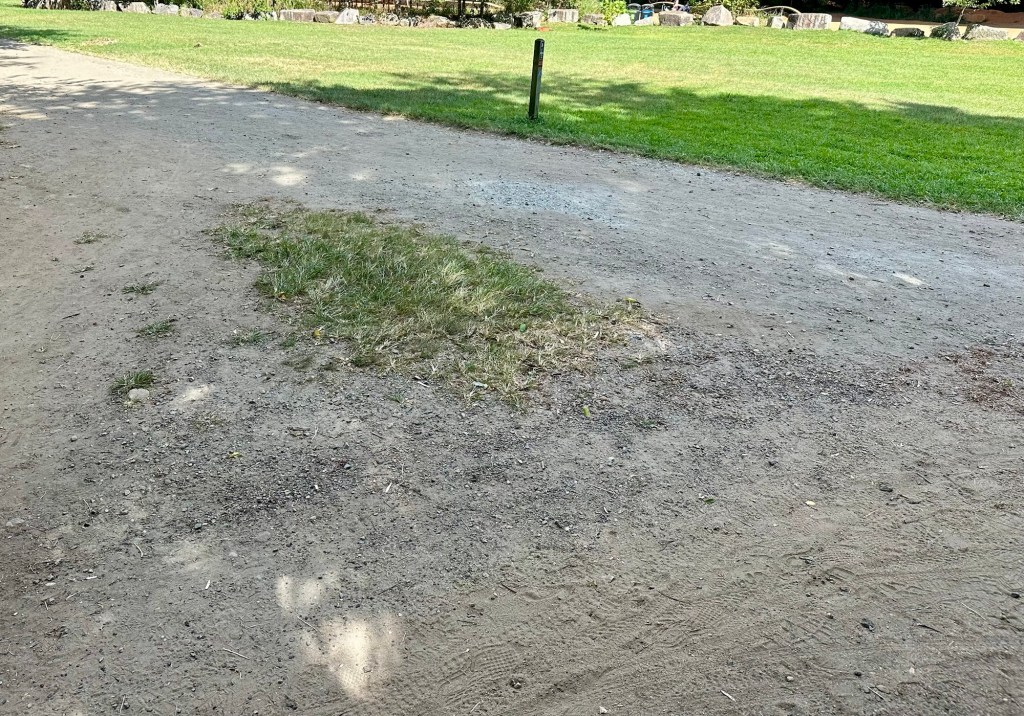
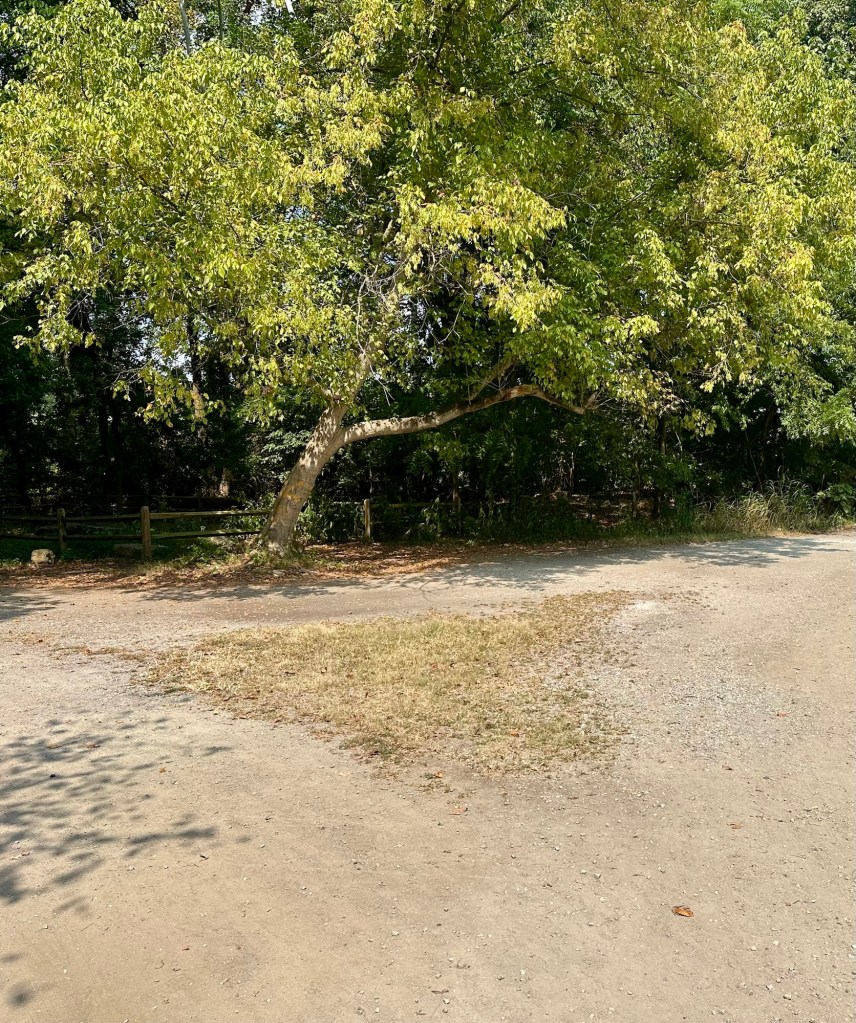
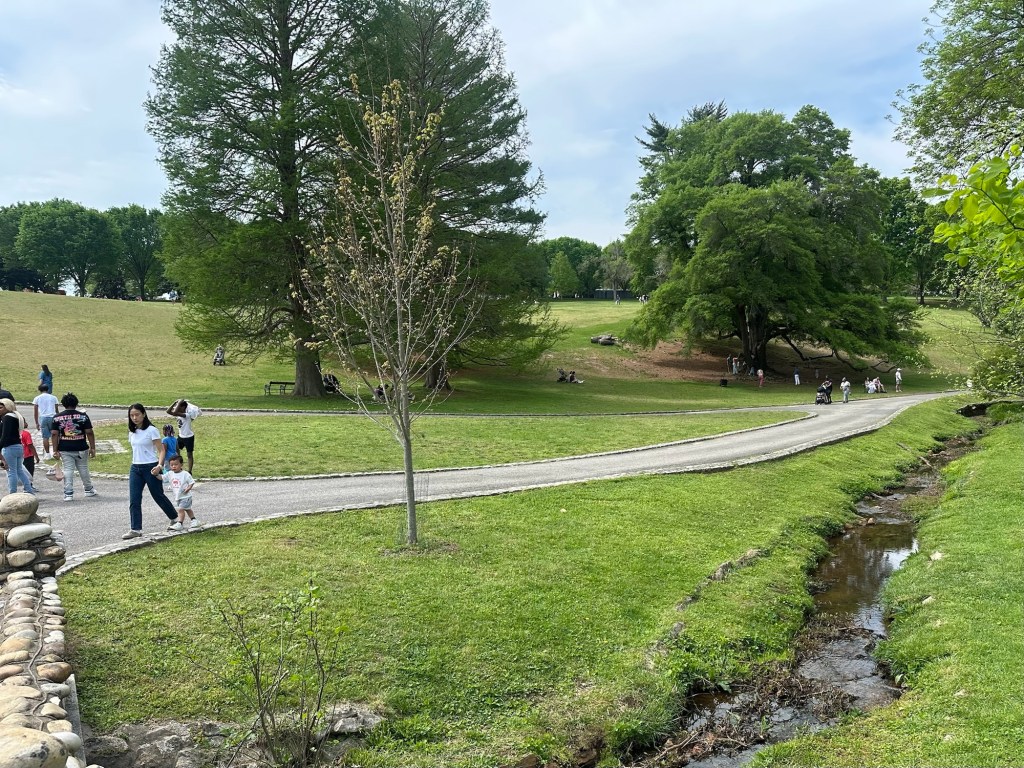
During a recent visit to Maymont I noticed a small island of grass that I can’t stop thinking about. It feels like the perfect opportunity for a small meadow of perennials at the intersection of the more formal Maymont Mansion and more “natural” Robins Nature Center and Maymont Farm sections of the property.
The long, tear-drop shaped island of grass is in the middle of the photo below, but of course I already have ideas for the area along the creek as well.
Compared to the yucca project, this feels somewhat realistic. I would need to borrow black tarps to kill the grass, enlist some volunteers to clear the area a month or so later, install plants collected from my garden, and spread leaf mulch in between. It would be nice to put a small stick and twine “fence” along the edge while it’s getting established as well as a “Prairie in Progress” sign and some educational materials about the benefits of these types of gardens.
The cost of this could be essentially free. Here is a list of plants I can think of off the top of my head that I would be able to contribute:
Anise hyssop
Echinacea / coneflower
Mountain mint
Showy goldenrod
Milkweed (1 or more varieties depending on how they spread)
Coreopsis
Panicled aster
Rudbeckia / black-eyed Susan
Rattlesnake master
Spiderwort
Wild garlic
Aromatic aster
Bee balm
Foxglove beardtongue
Groundcovers including violet and wild strawberry
While doable, it would still require a lot of work obviously. I would need them to commit to watering for the first couple of months after install and provide ongoing support like cutting it all down to about a foot off the ground in the fall, weeding, and continuing to add more plants. Still too much for me right now, but a really fun thought.
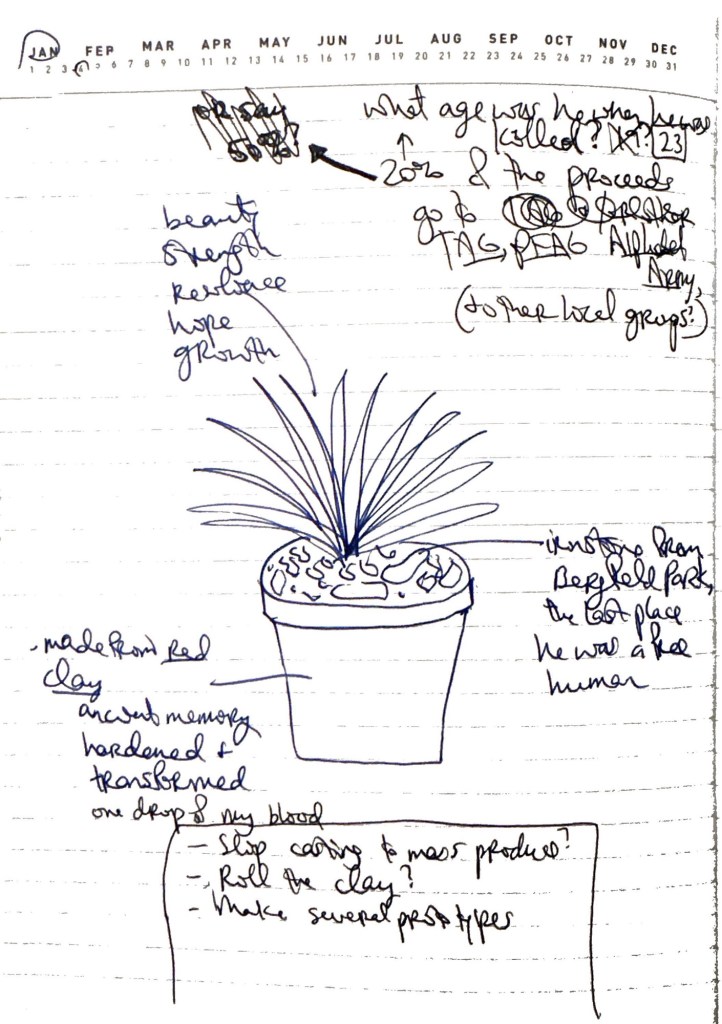
One Saturday in early January, in the middle of cleaning and entertaining my kids, I got an idea for an art project and sketched the notes below.
I’ve been really interested in the life and death of Nicholas West for a little over a year now and continue to feel a strong connection to his story.
The basic idea is…
A collection of pots thrown from red clay harvested in and around Noonday, TX where Nicholas was tortured and killed
The pots are different sizes with different biographical information about Nicholas like his birth and death years, text from obituaries, anything significant from his story
Each pot would have a drop or two of my own blood. I want to make people a little uncomfortable when they pick up the pot and read the description. I want to make his death more tangible and remind people that all soil has seen bloodshed of one kind or another. (On a more cosmic level, I also love the connection between the iron in our blood and the iron in the soil which was all stardust flung across the universe from dying supernovae.) I’ve noticed that men are pretty squeamish about the idea of the blood, and women I’ve told are much more supportive which makes me want to do it even more.
In the pot will be planted a Yucca filamentosa, native to the southeastern US (from Tyler to Richmond), very hardy, tropical, and structural. The yucca will grow to fit the size of the container that it is in, the yucca is resilient, and in the spring it has a bloom several feet above most other plants.
Yucca is also the first plant that I really noticed and developed a connection to. It is the first plant I remember finding and foraging and I’ve planted and potted at least five in the last two houses where we’ve lived. I was in a dark place in my life and my interest in plants, yucca specifically, was an encouragement that has continued to center me and excite me while also driving me a little crazy with more ideas than I’ll ever have time for.
While I still love the idea of Yucca, more recently I’ve considered Hesperaloe parviflora, also known as “red yucca” or “false yucca.” I noticed it in Texas at some point and planted it in my garden 3-4 years ago. I had a naturalist walk around with me and he commented that he liked seeing it growing in Richmond because he didn’t know that it could. I love the idea of a Texas transplant thriving in Richmond and the idea of it being a “false” yucca feels appropriate for the Southern culture of repression and how much of myself I held back from others for so long. Of course I love the red bloom, the color of blood and nectar for hummingbirds stopping for a moment on their impossible migration.
On the surface of the dirt in the pot I want to scatter bits of ironstone found at Bergfeld Park, the place where Nicholas was picked up, the last place he was free. On my most recent visit to Tyler I pocketed some pieces of the stone and brought them back to a potted yucca I have by our back porch. It has been special to me to have them there as a connection to home
I’d love to sell replicas of the different styles of pots and give a portion of the proceeds to local LGBT community organizations in the Tyler area.
It would take months or years to really do this as well as I would want to – I haven’t even fired a clay pot since high school. I’d need time to harvest the clay, prototype different styles, and learn how to make them consistently well, etc. So with all that considered in addition to the constraints of full-time employment/parenting life, I’ve accepted that I’m probably not going to attempt it, as much as I want to. It felt better to share the idea here and let it go rather than hold it too tightly.
4.22.25 – Since writing this post I’ve thought more about the possibility of partnering with an artist to make the pots that I could use to plant and we could market the project together. Even still I don’t think I have the time to do it well, but the partnership would be really rewarding and it’s much more realistic to lean on someone’s existing expertise rather than try and develop it myself. It also got me thinking outside the box even more. Maybe this idea should actually be an assignment for a class where everyone chooses an event that deserves more recognition and designs an installation to share the story. Maybe it should just be an online project that collects memories and details from his story. Or maybe this just needs to be a section of my own garden: a shrine to his life and a broader connection to my own story, my hometown, and the resilience, growth, and occasional moments of flourish.
4.24.25 – While reading about “The Burying Grounds Memorial” at the University of Richmond I learned that Yucca, “is often found in the cemeteries of enslaved people, serving as living grave markers.” I have only just gone a few steps down this rabbit hole, but I’ve already found some interesting articles and anecdotes that support using it for the project. It seems the plant has long served to mark the memory of people who might have otherwise been forgotten, to bind their restless spirits after life, and to provide permanent protection to their physical remains.
“Fieldstones. Yucca plants. Seashells. The last object a loved one touched. For centuries, these items, cultivated from lives and landscapes, marked many graves at burial places for Black people in America.” National Grographic
“Some of the plots were marked with pieces of quartz or with yucca plants, which were used by many Southern Black families who could not afford stones.” ProPublica
“The phrase “pushing up yucca” has been coined to describe these graveyards, and there was a Gullah belief that spiny plants restricted the movement of the spirits of the dead.” Society of Ethnobiology
“Spiky clumps of yucca dot Odd Fellows cemetery as further reminders that this patch of woods was once a curated (if not manicured) space. Though widely found in cemeteries across the country, in African-American tradition specifically, yucca binds restless spirits to their graves. Easily transplanted and nearly ever-lasting, yucca was sometimes planted near the head of a grave in lieu of an expensive stone marker.” Black Wide-Awake
“Yucca is another plant that marks many early graves even today. It can live hundreds of years and represents eternity. In many African American communities it was also traditionally thought that yucca kept restless spirits in the grave.” City of Birmingham
“Due to their association with cemeteries, the yucca plant has also taken on an association with the supernatural, as a way to ward off evil spirits.” Lumpkin County Historical Society
3.31.26 – It would be very interesting to also shoot the clay several times (perhaps even the number of times Nicholas was shot if that is published information) when it is still wet and let it harden in whatever shape it takes with the bullets. The violence of guns is something we are too numb to in the US and we need to be forced to think more clearly about how terrible they really are.
If I make multiple pots in a series, the one with bullet holes could be separate from the one with the printed information and others.
Welcome to the world, little seed. We’ve been waiting for you.
Every rain, every flower, every bee, every beautiful dappled moment of summer were for you. Every leaf now dry and cracked on the ground was an engine of energy for your growth.
And now you’re here, ready with the fuel and protection you need to start the next chapter.
May you fly to the place where you were meant to land. May you dig down deep and find it within yourself to transform in the way that you know you know how.
May the deep, ancient memory guide you in the months to come. While most of us rest, you will be cracking, freezing, opening up the most sensitive parts of yourself to the world.
You will put down roots, once you have exhausted the fuel you were given, you will start to draw nutrients from the world and find your own sources of strength and sustenance.
May you grow, may you bloom with radiance, may you be visited by insects – your connections to the world beyond.
And when you have finished your work, may you produce seeds of your own, a part of yourself that will live on through the dark nights ahead.
When my dad was growing up in Dallas, he remembers a truck fogging his entire neighborhood with DDT. One time, he was killing hornets with a tennis racquet in his front yard when the truck drove by and most fell to the ground before he could kill any more.
After nearly a century of ruthlessly effective pesticides and the steady march of habitat loss, many insect populations have been devastated, a fraction of what they once were. I have heard stories of fireflies numbering in the thousands on a summer night while now there are maybe a dozen if any at all. When I search online for a blog post like this, I frequently get websites for exterminating the insects that I’m trying to learn about. Of course, there are insects I don’t like. I started an organic mosquito control program this year and I spread carpenter ant bait around my deck every once in a while. I’ve never had a roach problem, but if I did I’m sure I’d call someone. I like to think the active centipede population in the basement keeps them all in check.
I was raised to appreciate insects and in recent years I’ve started to care even more. I do what I can to help out by plating beneficial plants and offering decomposing waste in the compost. For the most part, I just enjoy these creatures and appreciate all the crazy shapes and personalities that insects bring.
***
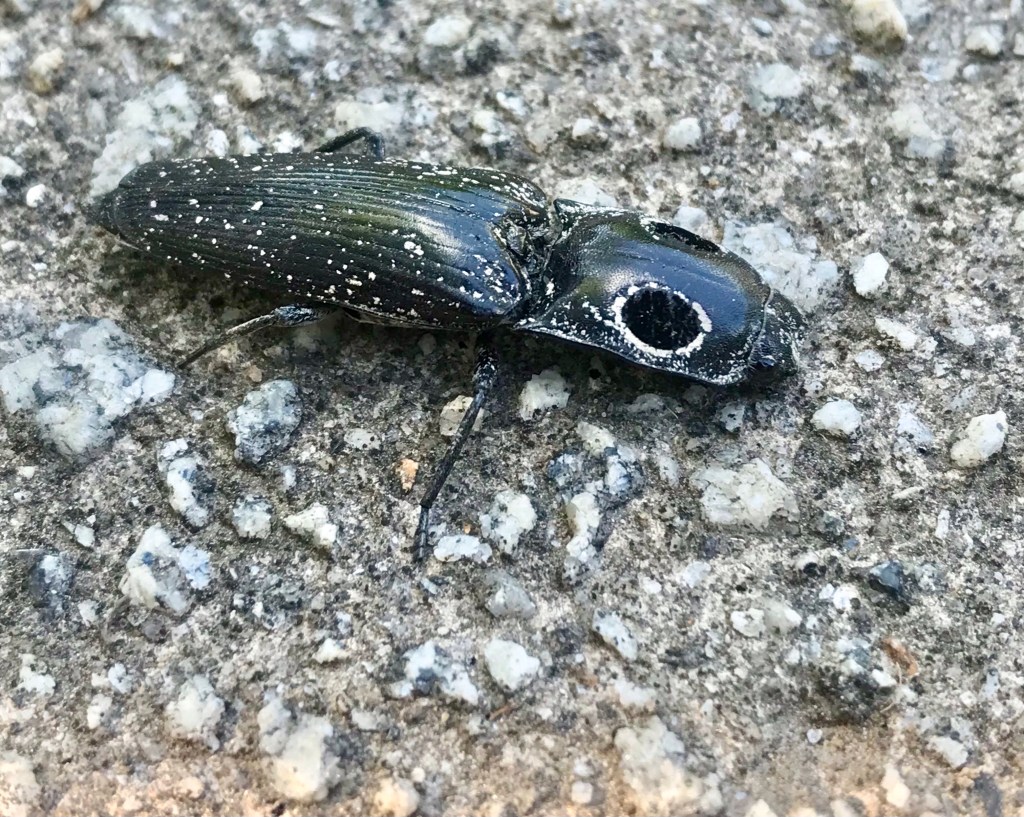
May 2 – This was the first time I’ve ever seen an eastern eyed click beetle. The false eyes as a defense mechanism definitely made me look twice and feel like it was watching me as much as I was watching it.
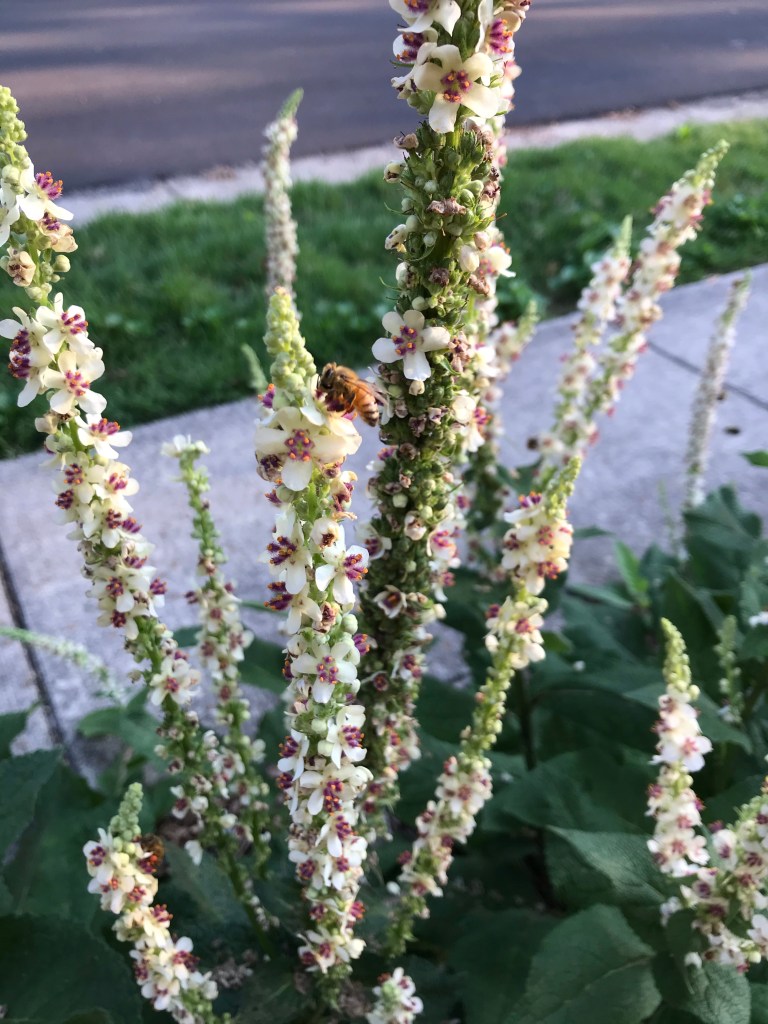
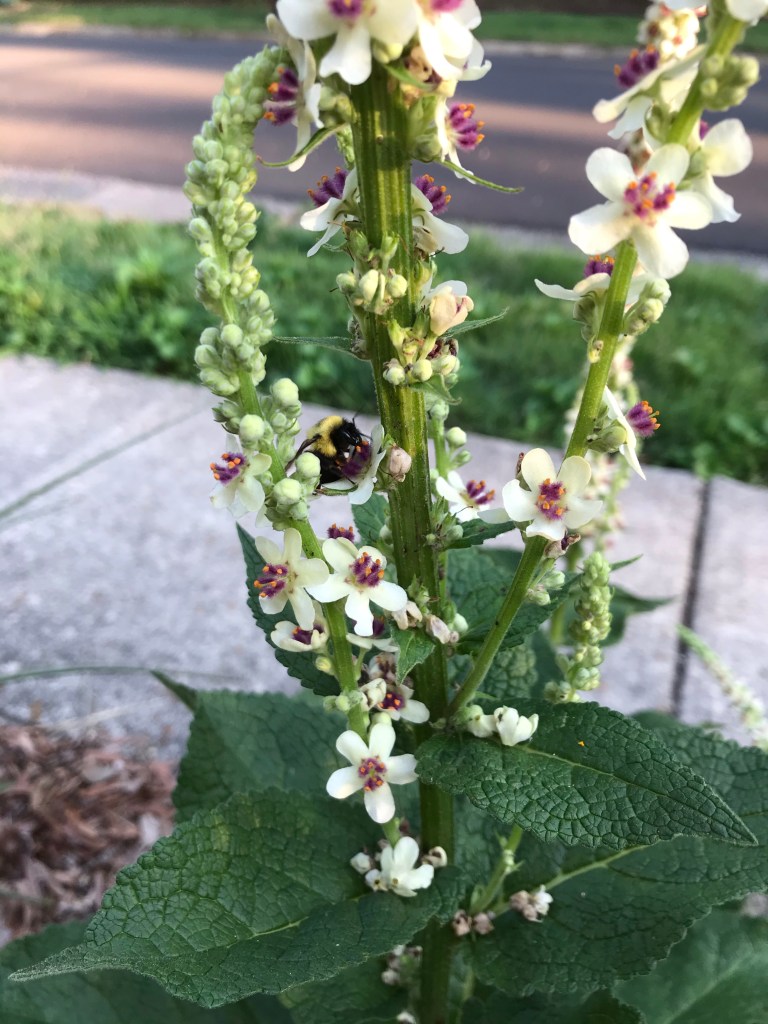
June 1 – The earliest major pollinator show of spring around here is watching honey bees and bumblebees swarm a pair of Verbascum chaixii ‘Wedding Candles’ (aka Mullein). I first noticed this burst of activity last year and was very much looking forward to it this spring.
June 10 – It’s been a long time since I was this excited about an insect. When I first saw this hummingbird moth on some English lavender I was confused in the way that whomever named it obviously was as well. It hovers and flits just like a hummingbird and has what looks like the beak of a hummingbird, but it is actually a moth with a long tongue for drawing nectar.
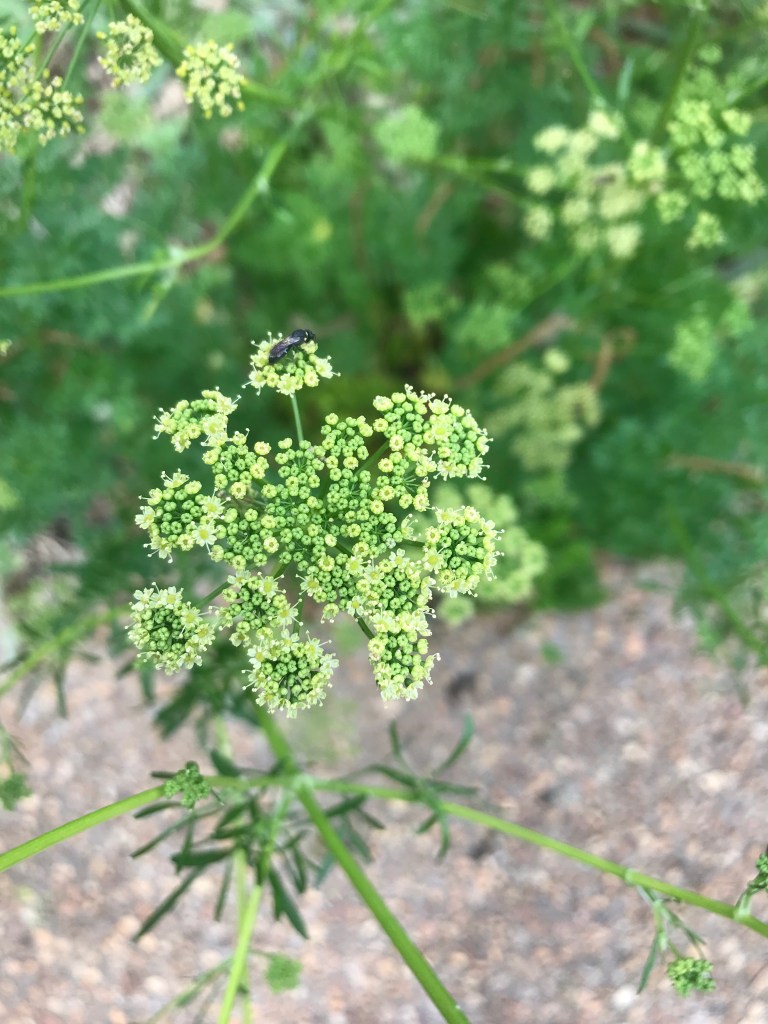
June 11 – I let some parsley flower this spring. It’s the first time I’ve seen a parsley flower before and it was interesting to notice which insects were attracted by it. I’m hoping it goes to seed and brings back a whole flower bed of parsley next year. Below is a cool, black and blue false wasp.
Here are two Margined Leatherwing beetles ensuring future generations.
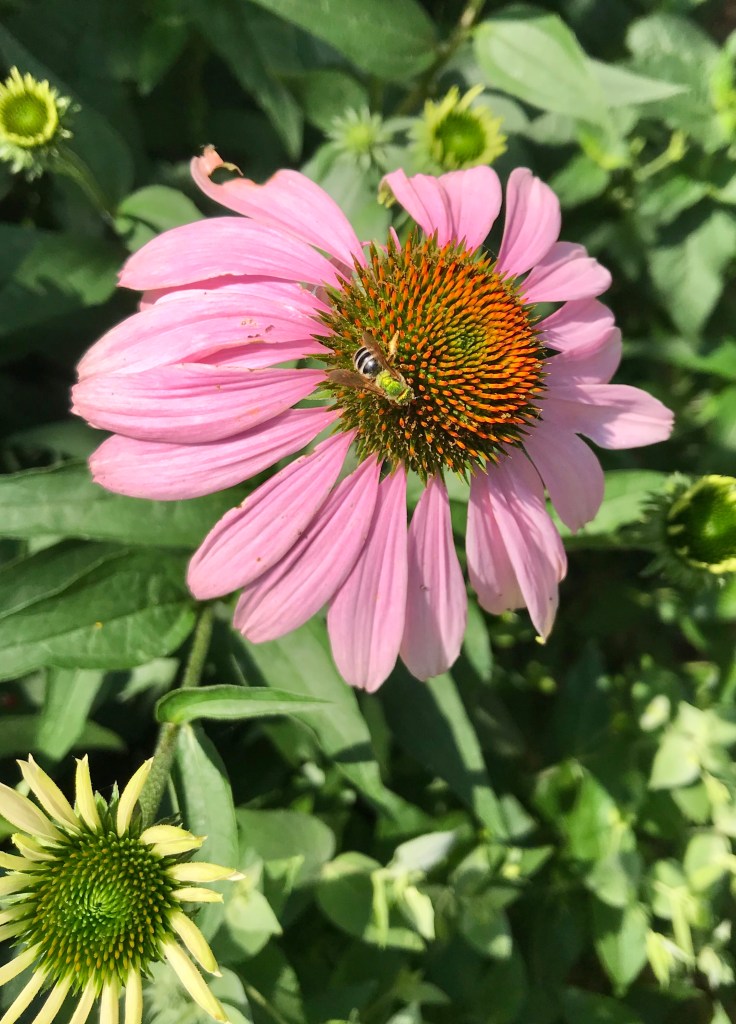
June 15 – In the next two photos, a metallic green sweat bee and a bumblebee forage on the earliest Echinacea blooms of the season. The sweat bees are especially beautiful to watch in the sun.
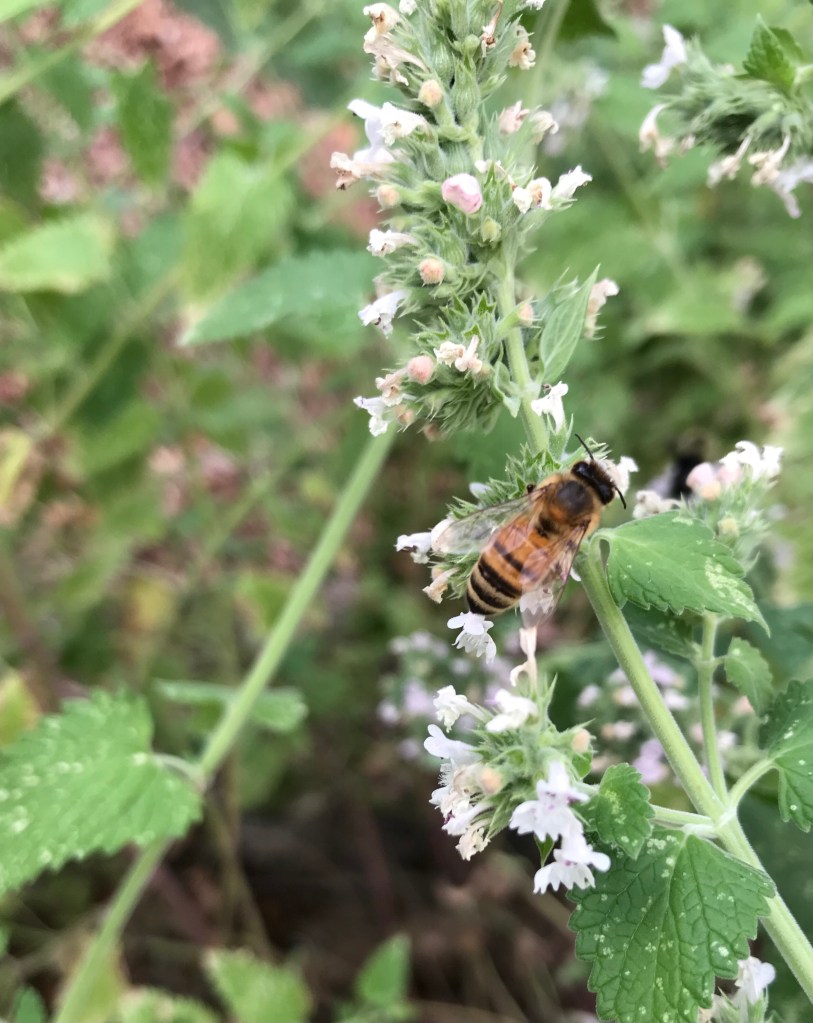
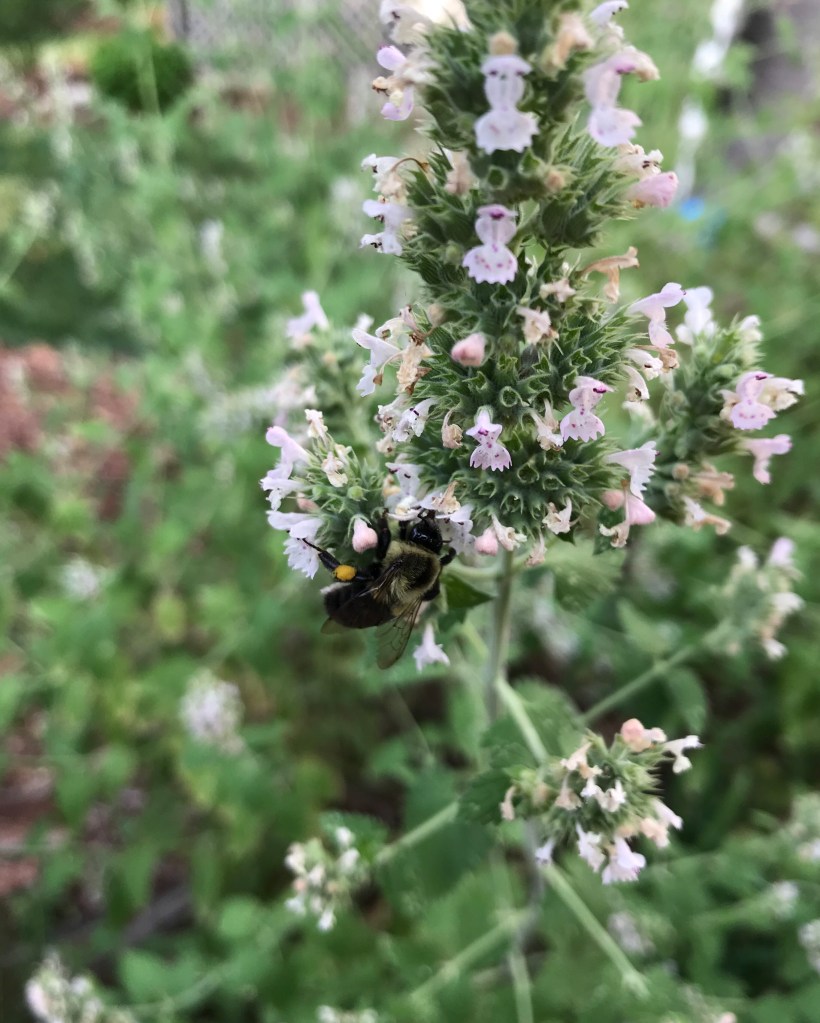
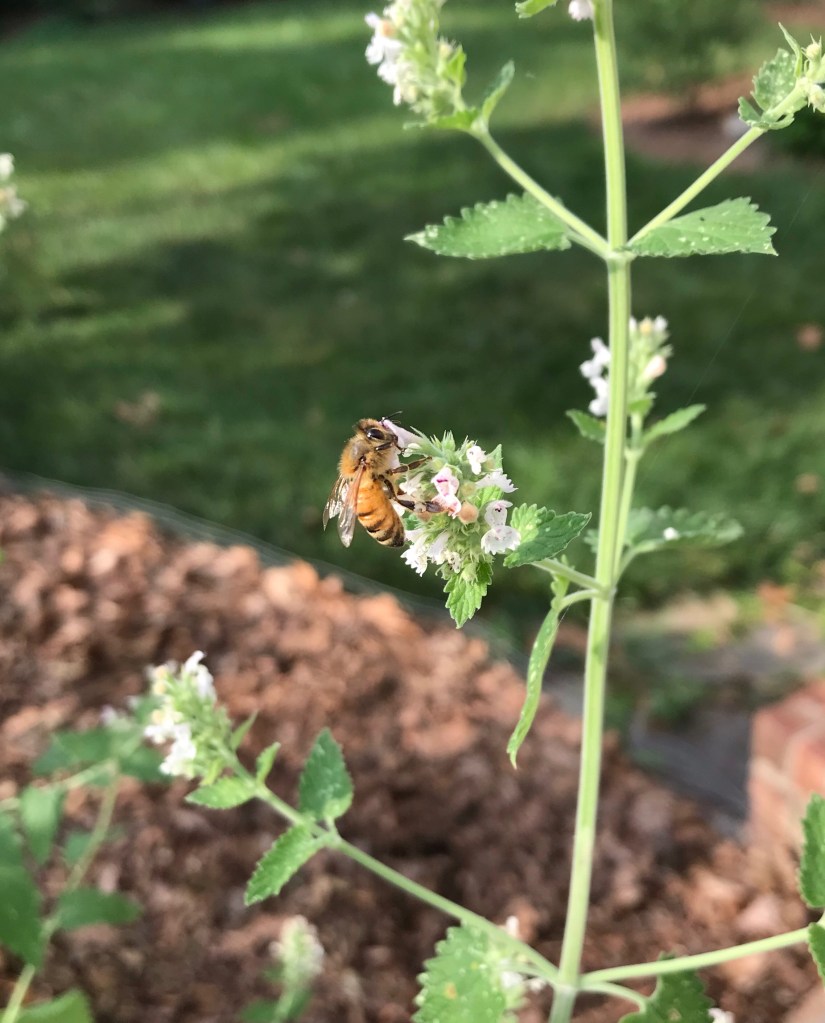
June 20 – Catnip is actually a great pollinator. I planted this last year and it really took off this spring. I’ve been watching all kinds of bees and hover flies swarm around.
June 24 – This next one might gross some people out – feel free to skip
I was recently cutting back suckers on a Crape Myrtle when I found a whole civilization of millipedes (Apheloria virginiensis, I believe) living in a crease in the stump underneath. I took a photo then also a video because the way they were all moving at the same time was completely mesmerizing.
June 27 – This is Euthyrhynchus floridanus, the Florida predatory stink bug, holding its prey. It’s a native stink bug that sometimes travels in packs to hunt other insects.
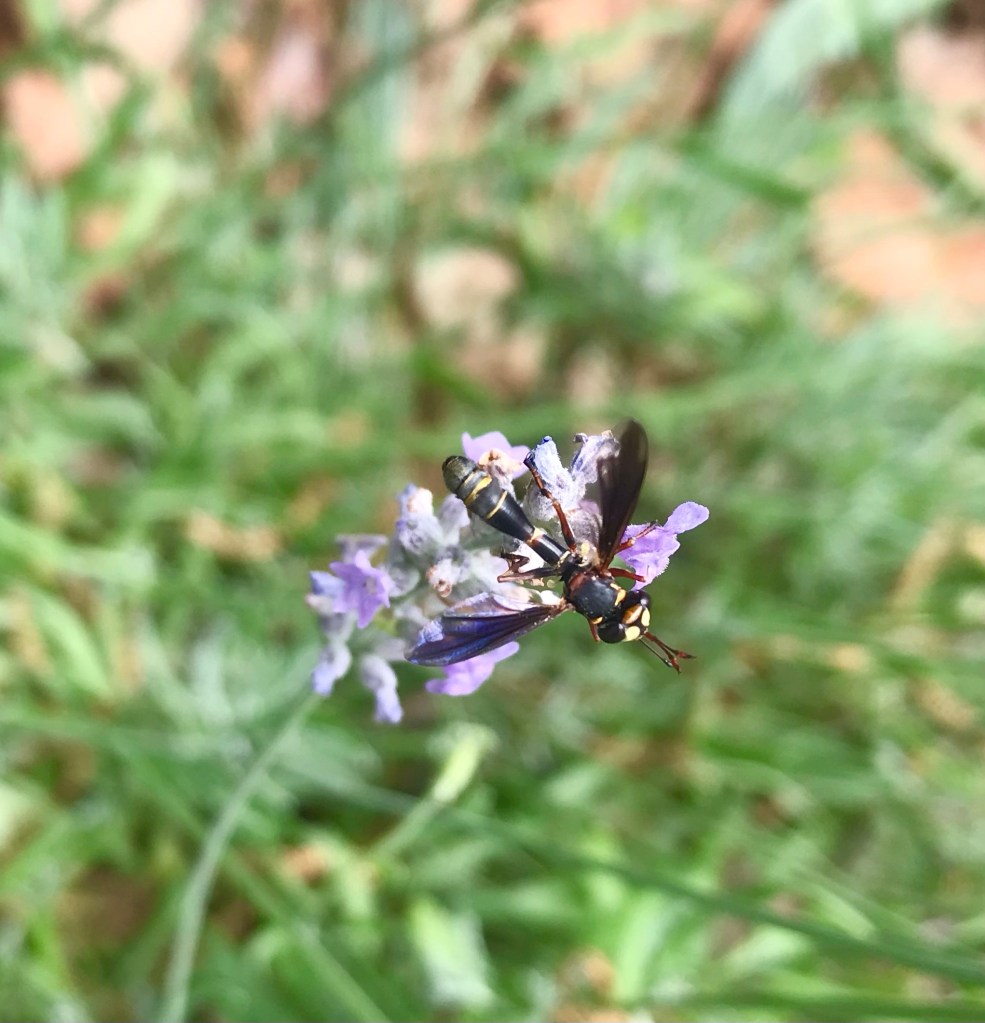
June 27 – A false wasp on English lavender. I think false wasps are some of the coolest looking flying insects in the garden.
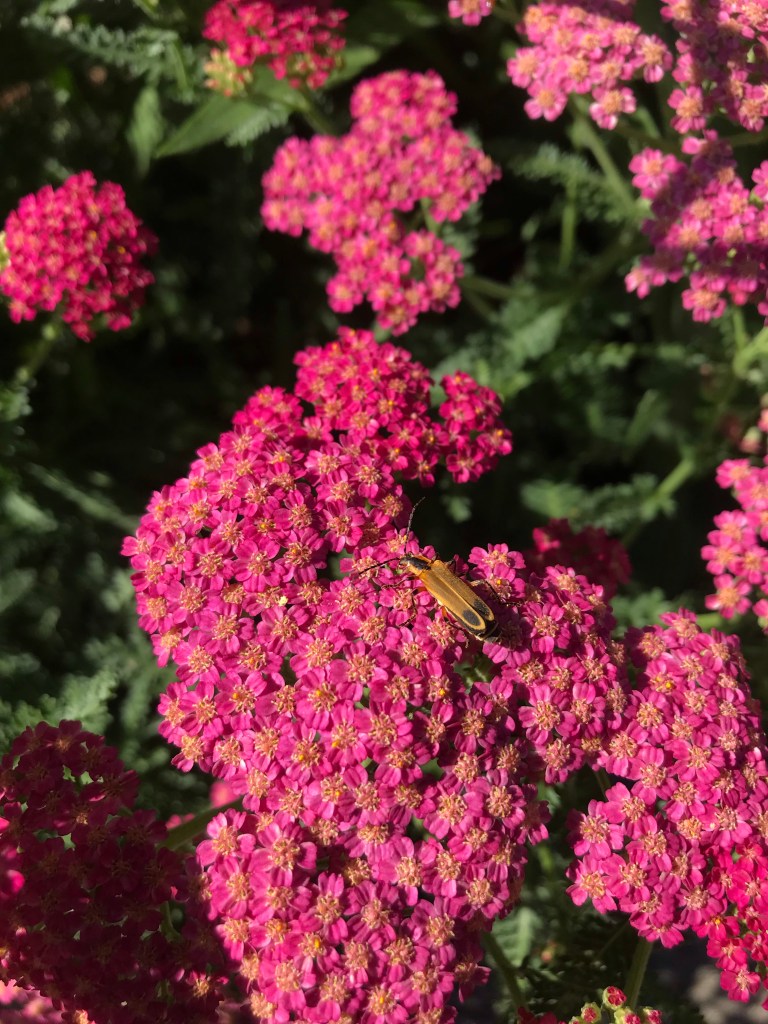
Compared to other varieties, I have not been very impressed with yarrow (Achillea millefolium) as a plant for attracting pollinators. That changed this weekend when I looked more closely at our (much-expanded) clump of yarrow and noticed it swarming with a variety of insects. I planted it in spring 2020 and I imagine that for the past two growing seasons there wasn’t enough of it to attract the insect life I’m seeing today.
When I find some time, I would like to transplant some to the edges of my vegetable beds which are basically empty at the moment. I am not feeling particularly motivated to do veggies this year and I’m also dealing with a pretty overwhelming gastropod situation. Yarrow grows so densely it might deter the snails and slugs (and/or provide a sacrificial meal) while also attracting beneficial insects and apparently accumulating nutrients in the topsoil.
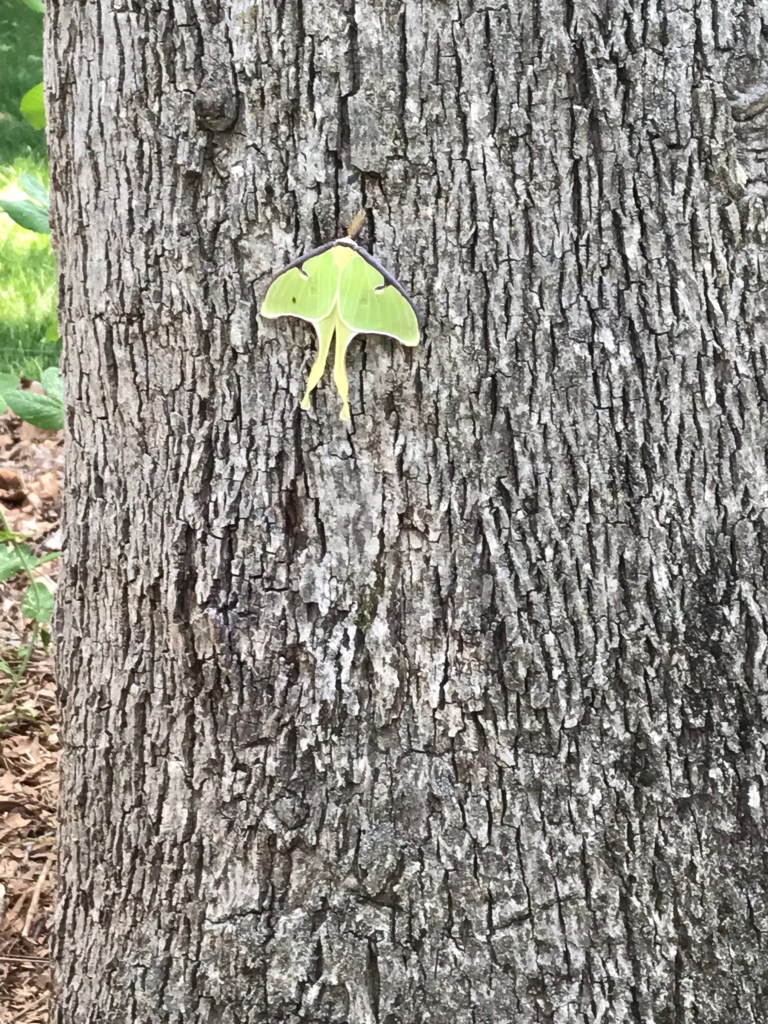
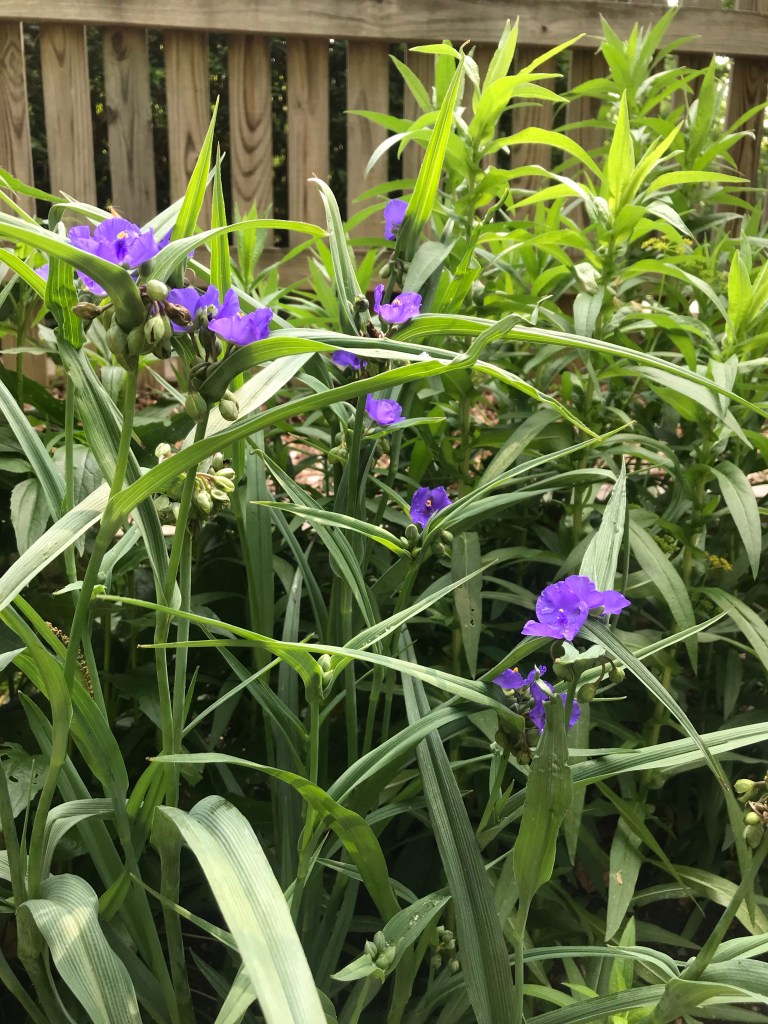
We are just exiting spring in Richmond. There are flowers on asters, peas, Spiderwort and mullein. Buds on the coneflower, beardtongue, yucca, and yarrow. And by the afternoon today and tomorrow, the temperatures are expected to approach triple digits, twenty degrees above average. Texas recently struggled to produce enough energy during a heat wave and in India birds fell from the sky. When I got home yesterday, with the weather and everything else on my mind, I was gifted a visit from a Luna moth.
Whenever I start to think that the garden is my responsibility, weeding, watering, and (unfortunately) overreacting when my toddler accidently tramples plants, I am reminded how fiercely nature is already fighting for itself. You can only take so much credit.
In a sort of baptism, I watered everything last night that I worried might be affected by the temperatures. I told the plants that rain with cooler air was on the way. I also wondered briefly if covering plants, typically something done to protect against a freeze, might soon become a summer-time protection from the heat.
I love the beauty and symbolism of gardens, but I also worry that the climate will change faster than we can adapt. I try to give what I have to give and hold on to gratitude for every bud and bloom.









 Highways and Hallowed Halls