Category Archives: Space

Gallery

C-T-D: The Rose District

This gallery contains 1 photos.

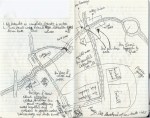
The other night I couldn’t sleep because I kept thinking about this one section of Tyler. The latest iteration of the city within my mind is a revision of a section of Tyler which can be accessed via Google maps … Continue reading

The Place of Graduation and Instant Nostalgia

Well, it happened. My university invited students, families, professors and friends to unite and create a weekend of temporary places throughout campus and the city. These were places of reunion, reflection, celebration and, ultimately, the conferral of a degree for each student’s completed course of study. This invitation created an incredible pull which brought people (with means) from all over the world to join each other for a brief moment and to give legitimacy to the ceremony of graduation. It was excellent.

My family seven united in Richmond in order to celebrate my achievements as well as to enjoy each other’s company on this incredible weekend. As it was also Mother’s Day, the reunion of graduation assumed even more significance to my family and others. In some amazing way, the presence of my family on this day allowed me to love my college experience because it had been shared with those I love. The temporary place of Graduation, while nostalgic, is also intended to become even more powerful a memory than those considered on that day. Now, the place of Graduation in my memory has truly become the culmination of life that many hoped it would be.

Perhaps the most significant place during this process was a small patch of grass beside Ryland Hall. It was here that my thesis adviser met my family including my parents and my 93-year-old grandfather.  To me, this was a place of Healing because my grandfather and parents are the reasons why I was empowered to attend college, but they did not know what I would eventually learn. In four years, I wrote many papers and had many conversations that they would not agree with and developed passions that seem impractical. Often during this time, I viewed college as more of an implicit rebellion than a submission to my grandfather’s provision. Despite this attitude, I worked hard and developed relationships with people like Dr. Brandenberger who watched me grow. When Dr. Brandenberger met my grandfather, he made the comment that I got my money’s worth. He couldn’t have chosen a better person with which to share that news.

As I now (appropriately) reflect on the place of Graduation, I realize that it was a different place for each participant and now exists as many different memories in each person who attended. For some, it was perhaps another place of loneliness and for others I believe it was an inconsequential celebration that they felt they deserved. For me, it was a place of redemption and celebration, not of my achievements, but of the blessing it is to have a family that can create such a place of love anywhere in the world. The milestone served its purpose and I truly believe that I have completed more than I ever imagined I would in four years. Now that I am done, I stand on the past and look forward to the places I will create with other people in the future. I know not where or with whom but I know that I will be committed and active in the process of creating meaningful places.

It is exciting, indeed.

Gallery

Biopower, repentance and traffic court

“[T]he judicial institution is increasingly incorporated into a continuum of apparatuses (medical, administrative, and so on) whose functions are for the most part regulatory” (Foucault, The Will to Knowledge, 1976, 144, Found in “Sovereign Power and Biopower“). Today I went … Continue reading

That Which is Built

When I was young, people taught me history from a book. This history was often a history of nations and political places (e.g. Texas, Germany, the South) and we usually discussed history as a distant idea with little relevance to our lives. I believe this omission is common practice, but in many ways it prevented me from fully appreciating the legacy of history and what Faulkner famously stated is “never dead … not even past.” Additionally, I’ve come to realize that the political history I was taught was difficult to interact with because politics themselves are abstract. I began to realize that the national history seems irrelevant because it seems to only indirectly relates to one’s personal life. I believe that we should rediscover the value in local, applied history that engages the mind on many different levels. Furthermore, I have realized that in studying the physical structures of a society one can develop a deeper understanding of the politics and power of the past.

This is my manifesto for studying that which is built.

Consider the legacy of segregation in America. While there has not been a law mandating segregation for decades, the reality of segregation today is difficult to deny. This legacy lives on in both the tangible structures and the intangible social divisions that locked themselves into the urban landscape years ago.

In my hometown, Jim Crow told black residents to live north of the railroad tracks and white residents of course lived to the south. This one simple policy, coupled with latent racism, has transformed my city into an oblong egg shape as more and more businesses and people move farther south. While they may claim they are moving towards new regions, they are also moving farther away from the historically black and historically poor northern region of the city. Implicit within this movement to the south is the stigmatization of those neighborhoods to the north and their residents. This stigmatization is no longer written in law, but it lingers in the streets named after MLK, the local HBCU Texas College, the Salvation Army and other similar signifiers of race and class. The power of stigma prevents many developers and individuals from imagining a profitable future for the spaces to the north of downtown Tyler. It’s a mental block, but it is directly informed by the physical environment.

This is because the built environment makes statements about the relative significance of a place. On the surface, buildings teach the observer about an area and the people who live there. On a deeper level, buildings teach the scholar about the society that has shaped that place and transformed it’s potential. Greg Dickinson further describes the way buildings “speak” to us in his article “Memories For Sale: Nostalgia and the Construction of Identity in Old Pasadena.” Dickinson writes, “Places are often constructed to make claims about a society. As time passes, these places become rhetorical artifacts that can maintain rhetorical and memorial significance. (Dickinson, 4). This rhetorical significance is powerful and shapes the way we experience places whether or not we are aware. There are many structures that obviously make claims about a society (e.g. Confederate monuments in Richmond) and others that are more subtle such as bike lanes and sidewalks for those who cannot afford to drive. There are also “absences” in many cities where significant places have been destroyed and memories have been lost (I will discuss memory places more at a later time).

As a student, I was not made fully aware of the rhetorical and historical nature of places until an independent study on the rhetoric of highway battles with Dr. Kevin Kuswa. As a spatial thinker, this lesson illuminated my view of the American city and activated my brain to think of history and society in three-dimensions. I believe that it is necessary to teach our students about the built environment because we will begin to realize how significant history is to our individual cities and lives. It helps to answer questions such as, “Why does everyone in my neighborhood look the same?” and “Why aren’t the roads in our neighborhood paved?” The city becomes the classroom and the students become active participants in both learning about the general history and more significantly about themselves and their place in society on a local and national level.