
One of my friends once visited a Christian mega-church where they were hosting a huge college A cappella conference. In describing the conference, she explained to me that the church was, “…one of those churches that had paintings with hands and nails in them and blood gushing out” … or something like that. As a product of the Christian subculture, I laughed at her candor and perspective on the representation of Christ’s body. To me, this sort of painting had become commonplace, but I gradually began to realize that there is nothing “normal” about the bleeding body of Christ.
Can you imagine what it would be like for one of the apostles to see one of these paintings so common in Christian spaces today? Then it would have been a powerful image, but Christians have referenced the body of Christ so many times over the past two thousand years that it seems it may have lost much of its significance. A simple Google images search for “Jesus hands nails blood” reveals an amazing set of images such as the one below. Of course, we know that this isn’t exactly what Jesus’s hands
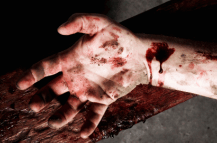
looked like, but it’s close enough that it serves it’s purpose. What is the purpose? I believe that the purpose of all of these images is to further a successful reappropriation of what was once considered a public and humiliating death.
To describe a death such as the Jesus’ death on the cross, Foucault uses the French word “supplice” which refers specifically to public torture and the spectacle of punishing the accused. This torture inflicted on the body of the accused was used by leaders to make a statement of their power and to reinstate order in the realm (Discipline and Punish, editor’s note, 16-18). This statement of power was more likely the original purpose of the cross. The body itself was seen as rebellious and was thus used by earthly kings to maintain control. Foucault writes that all sorts of rituals were used to make these statements of power, but most often these referenced the king directly such as public coronations and parades. In contrast, the public death of the condemned is a statement of the opposite end of the king’s power being used to destroy rather than to ennoble. He writes, “In the darkest region of the political field the condemned man represents the symmetrical, inverted figure of the king” (D & P, 29). The accused seems completely helpless as the power of the king binds the body and destroys the life within.
This death was designed to be dramatic: The public setting, the long walk to Golgotha, the location of a hill for all to see, the pain, the blood. It was a physical punishment very unlike the more common “mental” punishments we see in our incarcerated population today. Christ’s execution on the cross would have been humiliating to his honor and devastating to his followers. The power of the Caesar was proven more powerful than the magic tricks of a man from Nazareth. Order had been restored and the earth was once again Caesar’s realm. It seems that the image of Christ’s hand with a nail in it should be a symbol of triumph over religion or a statement of the former power of the Roman empire to suppress all who undermined the reach of Caesar’s influence.
But somehow this powerful statement was reappropriated by Christians over the past two thousand years … somehow it has become a statement that we seem proud to interpret and display in churches and make in to necklaces. Somehow the effect of the memory has also diminished over time. I believe that is because the death of Jesus was not the conclusion of the story. The Christian story continues to say that Jesus did not remain dead, but was resurrected. This proves to many that his death was not the will of a king, but the will of God.
This perspective completely inverts Foucault’s “king-accused” dichotomy as the king on the cross looks to the accused on the throne. The purpose of the supplice then becomes an invitation of self-sacrifice to all who watch. Rather than reinstate the power, tradition and civilization of man, the cross invites humans to relinquish their ties to the earth for a higher calling. The accused is invited to confess, but not under the weight of torture as in the earthly supplice. Rather, the sight of the king on a cross moves one to reconsider their own lives and their own ambition.
From the earthly, political perspective, leaders have to continually kill and suppress others in order to maintain power. The more public the death, the more widespread the influence (think of Osama Bin Laden and JFK) . Each death lends legitimacy to the source of power be it a president or rebel. From the Jewish perspective, the sacrifice for atonement had to be repeated regularly in order to continually state one’s repentance and submission to God. In both of these readings, Christ’s death is not enough to have any sort of lasting effect. It would still need to be repeated later with another man who had another claim on the throne or another animal to be a ransom for one’s transgressions. The Christian interpretation goes against both of these perspectives to say that the death was a conclusive sacrifice for the sins of humanity and also that the death was not an inconclusive statement of earthly power, but the definitive statement of selfless sacrifice.
I hope that as Christians we will begin to think more deeply about the meaning of the cross because from outside our faith it seems a little strange to wear an image of suffering and torture as a necklace. Perhaps as we seek a deeper understanding of the image of the body of Christ we will have a deeper understanding of the power of this moment in history. Perhaps the sacrifice won’t seem as trivial as any painting on the wall.

 Highways and Hallowed Halls